Resources for higher education management — from the Higher Education Management Group

Associations

Blogs

College Management

Consultants

Content Providers

CRM

Development Consultants

Ed Tech Providers

Education Investment

Education Statistics

Enrollment Management

Full Service Companies

Higher Ed Conferences

Higher Ed Journals

Higher Ed Law

Int’l Student Consulting

Lead Generation

LMS/CMS

Marketing Services

News Sources

Outcome Measurement

Professional Development Firms

Proprietary Higher Ed

Publishers

Research

Search/Recruiters

Social Media Business

Student Portfolios

Student Retention

Technology Consulting

Think-Tanks

Tagged with: •  

Revisiting Moodle — from the elearning queen

It is often difficult for learning management systems to keep up with social networking and collaborative technologies. Their architectures are a bit clunky, and even when they allow embedded html to link into social networking, it’s often difficult to incorporate them in an outcomes-based way. Further, they are not dynamic and it is difficult to integrate mobile activities and devices.

In these cases, Moodle, as an open-source solution, is often overlooked. The basic structure and philosophy of Moodle are simple: object-oriented, with a focus on reusability of components, and a very transparent structure that rests on a foundation of forums, which makes it very friendly to interaction and collaboration. Further, the flexibility of Moodle makes it ideal for programs ranging from certificate programs to graduate programs such as an online MBA program.

Tagged with: • • •  

[Podcast]  Implementing Moodle – Lessons Learned — from Miguel Guhlin, Yolanda Columbus and Amber Icke

Miguel:  “While I encourage you to listen to the whole presentation, here are some of take-aways that I wrote down from their presentation…”

Tagged with: •  

LMS: Strategy or tool? — from Upside Learning by Amit Gautam

Also, one of the questions I have been trying to answer for myself is – Should the LMS be sold as a tool or a strategy? What approach would bring out the best value to the customer in terms of dollar savings, easier management of tasks, learning delivered, performance improvement, etc.

Ideally, the even bigger question than ‘how to sell’ and ‘how customer sees’ is what actually an LMS is? Is it strategy or is it just a tool? I am sure there are arguments either ways and also there is a mix of factors that we may want to consider before we answer this question. E.g. does it make a difference if an LMS has more or less features? Or does it make a difference if it is SaaS or onsite deployment? Or does it make a difference if the LMS has social learning elements or collaboration tools or not? And a few more such questions.

For the sake of simplicity I am making two categories – one who use LMS for selling training or for just putting up eLearning and one who use the LMS for the entire Learning and Development process…

Student-provided sites from The Teaching & Learning Digital Studio at Calvin College

Student-provided sites from The Teaching & Learning Digital Studio at Calvin College

Digital Studio Sites is a blog with a large collection links from the Teaching & Learning Digital Studio Staff at Calvin College (Grand Rapids, MI) that covers a wide range of academic topics and more. The staff scours the Web for the best, most interesting, and useful Web sites for the classroom (and maybe beyond) on the Internet and continually updates the list of links. Professors can quickly find sites related to their field of study by keyword, search, or by subscribing via RSS feed.

Tagged with: • •  
Tagged with: • • • •  

Envisioning the post-LMS era: The Open Learning Network — from Educause Quarterly by Jonathan Mott

Learning management systems (LMSs) have dominated the teaching and learning landscape in higher education for the past decade,1 with a recent Delta Initiative report indicating that more than 90 percent of colleges and universities have a standardized, institutional LMS implementation.2 LMS-related decisions continue to rank among the most pressing IT issues for campus leaders and administrators, as explained in EDUCAUSE Review’s “Top-10 IT Issues, 2009,” which lists several challenges associated with LMS implementations, including:

  • Acquisition strategies
  • Adapting LMSs to local needs
  • Managing rising costs
  • Maintaining system stability and integrity
  • Integrating LMSs with other campus tools and data3

While the LMS has become central to the business of colleges and universities, it has also become a symbol of the higher learning status quo. Many students, teachers, instructional technologists, and administrators consider the LMS too inflexible and are turning to the web for tools that support their everyday communication, productivity, and collaboration needs. Blogs, wikis, social networking sites, microblogging tools, and other web-based applications are supplanting the teaching and learning tools previously found only inside the LMS.

The dilemma thus created is succinctly summarized in the “Top-10” report:

Although the LMS needs to continue serving as an enterprise CMS [course/content management system], it also needs to be a student-centered application that gives students greater control over content and learning. Hence, there is continual pressure for the LMS to utilize and integrate with many of the Web 2.0 tools that students already use freely on the Internet and that they expect to find in this kind of system. Some educators even argue that the next requirement is a Personal Learning Environment (PLE) that interoperates with an LMS.4 (emphasis DSC)

Where the LMS is vertically integrated and institutionally centralized, the PLE is the educational manifestation of the web’s “small pieces loosely joined,” a “world of pure connection, free of the arbitrary constraints of matter, distance, and time.”5 Proponents assert that the PLE’s greater flexibility, portability, adaptability, and openness make it far superior to the LMS as a teaching and learning platform. The PLE is not without its weaknesses, however. Potential security and reliability concerns abound. This conundrum leaves higher education with what appears to be an unsatisfying either-or choice that requires significant tradeoffs whichever path we choose.

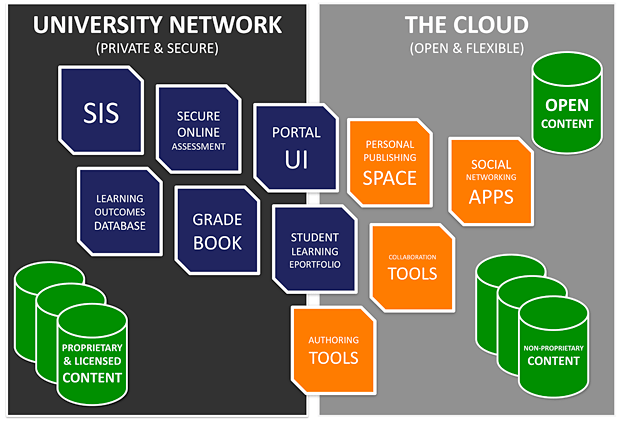
In an increasingly sophisticated technology environment, however, I contend that we can bring together — or mash up — the best of both the LMS and the PLE paradigms to create a learning platform more ideally suited to teaching and learning in higher education — an “open learning network” (OLN) (emphasis DSC). An OLN is intended to be, at the same time:

  • Secure and open
  • Integrated and modular
  • Private and public
  • Reliable and flexible

The framework outlined in this article provides a blueprint for developing what KnowledgeWorks calls a “lightweight, modular infrastructure” with built-in resilience to meet the dynamic needs of today’s “learning agents.”6

The OLN has three key features:

  1. It is malleable.
  2. It leverages technologies that did not exist when the LMS was born in the late 1990s.
  3. It strikes a manageable balance between imperatives of institutional networks and the promise of the cloud (emphasis DSC).

The university network works in tandem with the cloud

Mobility coming to Moodle…

Tagged with: •  

Quizzes in an age of course management software — from profhacker.com

Most days, students in my literature classes will have accessed Moodle, and will have taken a multiple-choice quiz on the day’s reading.

…

The secret sauce to the quizzes is, frankly, the course management system.  Here’s why:

  • The online delivery means that the quizzes take zero minutes of class time (emphasis DSC). I usually teach the MWF (50-minute) schedule, and I can’t be wasting time on quizzes.
  • The online delivery also means that students can look at the questions before they read (emphasis DSC), which, if I’ve thought about the questions enough, can help frame the reading a bit.
  • Because the quizzes are multiple choice, Moodle grades ‘em (emphasis DSC). I’ll repeat that: THE CMS GRADES THE QUIZZES!  This is awesome for lots of reasons: 1) the student knows, right away, how they’re doing. 2) I know before class starts whether the class has understood the assigned reading. And, 3) I don’t have to grade them.  I’m never behind on them.
  • It turns out that the quizzes, easy as they are, reductive as they are, do usefully predict student performance. They’re terrible at differentiating between A/B range students, but they do an awesome job at sorting students who are at risk (emphasis DSC).  Over the course of the semester, there are so many questions that if you miss 1 or 2, it’s no big deal.  But if you’re *always* missing 2 out of 5 questions, then it will eventually dawn on you that you’re doing D-level work.
Tagged with:  

2minuteMoodle: What is it and how to do it? — from Nona Muldoon (back from 8/1/09)

The 2minuteMoodle motto
“Where before there was a spectator, let there now be a participant.” ~ Jerome Bruner

Scaffolding can be characterised as acting on this motto (Bransford et al, 2000), and the aim of the 2minuteMoodle is to provide students additional scaffolding in the learning and teaching process at CQUniversity.

What is scaffolding?
In educational setting, scaffolding is a metaphor used to describe learner support mechanisms, which may be delivered by human and/or embedded in computer-based technological tools. Proponents such as Shaphiro suggest that scaffolding provides learners with a “support structure that aids them in attaining a higher level of achievement” (2008, p. 29).

More…

Tagged with: • •  

Global success, Global failure of the CMS/LMS needs to stop — from Drupal Education for Educators

I know you’re saying “but Bryan, didn’t you mean just the Drupal solution”, no. Drupal is not the answer. Plone, WordPress, Moveable Type, Joomla, PHPNuke, Moodle, NOTEPAD is not the answer. We need to start looking at systems development based on a services and scalability perspective.  No one system is going to solve that problem (emphasis DSC). We need to start looking at what systems do well and then play to those strengths in the creation of a service.

So, what I’ve proposed above is more of a communication between and across systems.  Things like single sign on systems and simple modules within each project could allow users to flow seamlessly between them.  RSS and XMLRPC calls could allow session / user display data to flow seamlessly across each.  The most important thing though is that any system can be any CMS/LMS choice.  Example of that….

  • Core LMS / data system is Moodle
  • CMS is Drupal
  • SMMS is Drupal
  • Syllabus system is WordPress
  • Communications system is Plone
  • Blogging platform is moveable type
  • Wiki collaboration via Wikispace (emphasis on bulleted points: DSC)
Tagged with: •  

Reading 2.0: Bluebonnet Books + Moodle + Video Conferencing — from ClassroomNext.blogspot.com by  Roxanne Glaser

Partnered with Baylor University

Overview:  Baylor students partner with local elementary students using Bluebonnet Books.  Baylor students act as reading mentors for children and final project is a seven minute dramatization of the book.

The Big Picture:

  • Teachers select books (Bluebonnet Books)
  • Baylor students meet their partner classes via video conference
  • Each class and their Baylor partners Moodle
  • Each class creates 7 minute presentation to sell their books

From DSC:
I ran across this 10/4/07 NITLE keynote presentation from Jason Cole (one of the co-authors of Using Moodle, 2nd ed.) and on slide 4/46 he mentioned the following:  (the bulleted text is his, the graphic and callouts are mine)

Tagged with: •  

From Richard Wyles, Eduforge
Please be aware that the current Eduforge website will be decommissioned on the 31st March 2010. We’re planning an exciting new stage for the Eduforge community including a brand new website – currently hosted at http://staging.eduforge.org

The new site offers resources and a showcase area for open source projects. You are most welcome to establish a new project space or transfer your existing project to the new Eduforge. Simply register now on  http://staging.eduforge.org

Our mission has also changed to support the Open Source Learning Laboratory — short e-learning based education courses focused on open source. See http://staging.eduforge.com for the courses we’re starting with. The courses are being delivered in association with Flexible Learning Network and Catalyst IT of Wellington, New Zealand, and are fully recognised by the Open Polytechnic of New Zealand.

eduforge

Tagged with:  

Reflections on Learning Technologies 2010 #LT10uk — from Learning Conversations by Mark Berthelemy

From DSC:
Mark brings up some excellent points here. Well worth the read.

© 2025 | Daniel Christian