The EU’s Legal Tech Tipping Point – AI Regulation, Data Sovereignty, and eDiscovery in 2025 — from jdsupra.com by Melina Efstathiou

The Good, the Braver and the Curious.
As we navigate through 2025, the European legal landscape is undergoing a significant transformation, particularly in the realms of artificial intelligence (AI) regulation and data sovereignty. These changes are reshaping how legal departments and more specifically eDiscovery professionals operate, compelling them to adapt to new compliance requirements and technological advancements.

Following on from our blog post on Navigating eDisclosure in the UK and Practice Direction 57AD, we are now moving on to explore AI regulation in the greater European spectrum, taking a contrasting glance towards the UK and the US as well, at the close of this post.


LegalTech’s Lingering Hurdles: How AI is Finally Unlocking Efficiency in the Legal Sector — from techbullion.co by Abdul Basit

However, as we stand in mid-2025, a new paradigm is emerging. Artificial Intelligence, once a buzzword, is now demonstrably addressing many of the core issues that have historically plagued LegalTech adoption and effectiveness, ushering in an era of unprecedented efficiency. Legal tech specialists like LegalEase are leading the way with some of these newer solutions, such as Ai powered NDA drafting.

Here’s how AI is making profound efficiencies:

    • Automated Document Review and Analysis:
    • Intelligent Contract Lifecycle Management (CLM):
    • Enhanced Legal Research:
    • Predictive Analytics for Litigation and Risk:
    • Streamlined Practice Management and Workflow Automation:
    • Personalized Legal Education and Training:
    • Improved Client Experience:

The AI Strategy Potluck: Law Firms Showing Up Empty-Handed, Hungry, And Weirdly Proud Of It — from abovethelaw.com by Joe Patrice
There’s a $32 billion buffet of time and money on the table, and the legal industry brought napkins.

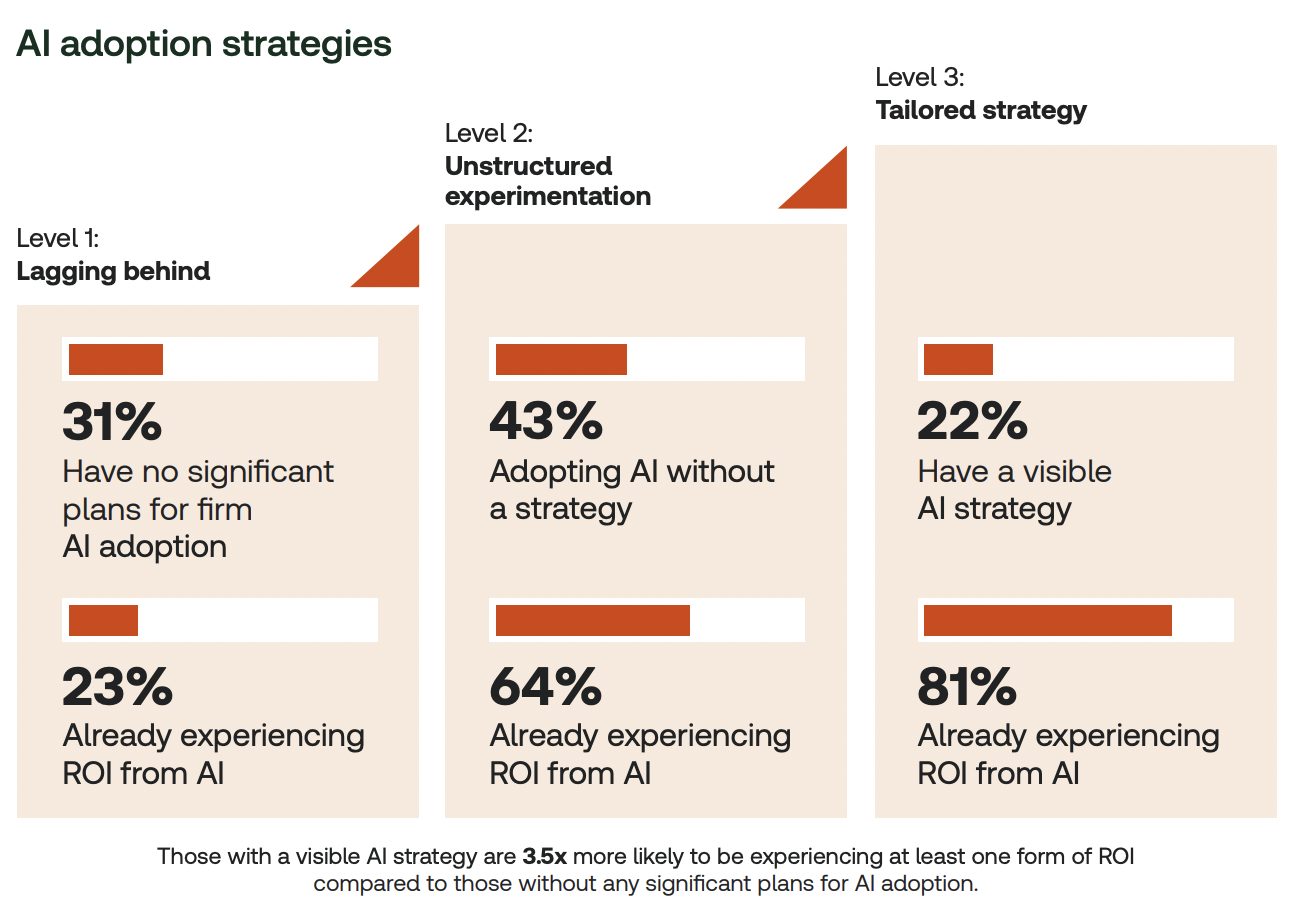
The Thomson Reuters “Future of Professionals” report(Opens in a new window) just dropped and one stat standing out among its insights is that organizations with a visible AI strategy are not only twice as likely to report growth, they’re also 3.5 times more likely to see actual, tangible benefits from AI adoption.

AI Adoption Strategies


Speaking of legal-related items as well as tech, also see:

  • Landmark AI ruling is a blow to authors and artists — from popular.info by Judd Legum
    This week, a federal judge, William Alsup, rejected Anthropic’s effort to dismiss the case and found that stealing books from the internet is likely a copyright violation. A trial will be scheduled in the future. If Anthropic loses, each violation could come with a fine of $750 or more, potentially exposing the company to billions in damages. Other AI companies that use stolen work to train their models — and most do — could also face significant liability.


“Using AI Right Now: A Quick Guide” [Molnick] + other items re: AI in our learning ecosystems

Thoughts on thinking — from dcurt.is by Dustin Curtis

Intellectual rigor comes from the journey: the dead ends, the uncertainty, and the internal debate. Skip that, and you might still get the insight–but you’ll have lost the infrastructure for meaningful understanding. Learning by reading LLM output is cheap. Real exercise for your mind comes from building the output yourself.

The irony is that I now know more than I ever would have before AI. But I feel slightly dumber. A bit more dull. LLMs give me finished thoughts, polished and convincing, but none of the intellectual growth that comes from developing them myself. 


Using AI Right Now: A Quick Guide — from oneusefulthing.org by Ethan Mollick
Which AIs to use, and how to use them

Every few months I put together a guide on which AI system to use. Since I last wrote my guide, however, there has been a subtle but important shift in how the major AI products work. Increasingly, it isn’t about the best model, it is about the best overall system for most people. The good news is that picking an AI is easier than ever and you have three excellent choices. The challenge is that these systems are getting really complex to understand. I am going to try and help a bit with both.

First, the easy stuff.

Which AI to Use
For most people who want to use AI seriously, you should pick one of three systems: Claude from Anthropic, Google’s Gemini, and OpenAI’s ChatGPT.

Also see:


Student Voice, Socratic AI, and the Art of Weaving a Quote — from elmartinsen.substack.com by Eric Lars Martinsen
How a custom bot helps students turn source quotes into personal insight—and share it with others

This summer, I tried something new in my fully online, asynchronous college writing course. These classes have no Zoom sessions. No in-person check-ins. Just students, Canvas, and a lot of thoughtful design behind the scenes.

One activity I created was called QuoteWeaver—a PlayLab bot that helps students do more than just insert a quote into their writing.

Try it here

It’s a structured, reflective activity that mimics something closer to an in-person 1:1 conference or a small group quote workshop—but in an asynchronous format, available anytime. In other words, it’s using AI not to speed students up, but to slow them down.

The bot begins with a single quote that the student has found through their own research. From there, it acts like a patient writing coach, asking open-ended, Socratic questions such as:

What made this quote stand out to you?
How would you explain it in your own words?
What assumptions or values does the author seem to hold?
How does this quote deepen your understanding of your topic?
It doesn’t move on too quickly. In fact, it often rephrases and repeats, nudging the student to go a layer deeper.


The Disappearance of the Unclear Question — from jeppestricker.substack.com Jeppe Klitgaard Stricker
New Piece for UNESCO Education Futures

On [6/13/25], UNESCO published a piece I co-authored with Victoria Livingstone at Johns Hopkins University Press. It’s called The Disappearance of the Unclear Question, and it’s part of the ongoing UNESCO Education Futures series – an initiative I appreciate for its thoughtfulness and depth on questions of generative AI and the future of learning.

Our piece raises a small but important red flag. Generative AI is changing how students approach academic questions, and one unexpected side effect is that unclear questions – for centuries a trademark of deep thinking – may be beginning to disappear. Not because they lack value, but because they don’t always work well with generative AI. Quietly and unintentionally, students (and teachers) may find themselves gradually avoiding them altogether.

Of course, that would be a mistake.

We’re not arguing against using generative AI in education. Quite the opposite. But we do propose that higher education needs a two-phase mindset when working with this technology: one that recognizes what AI is good at, and one that insists on preserving the ambiguity and friction that learning actually requires to be successful.


Leveraging GenAI to Transform a Traditional Instructional Video into Engaging Short Video Lectures — from er.educause.edu by Hua Zheng

By leveraging generative artificial intelligence to convert lengthy instructional videos into micro-lectures, educators can enhance efficiency while delivering more engaging and personalized learning experiences.


This AI Model Never Stops Learning — from link.wired.com by Will Knight

Researchers at Massachusetts Institute of Technology (MIT) have now devised a way for LLMs to keep improving by tweaking their own parameters in response to useful new information.

The work is a step toward building artificial intelligence models that learn continually—a long-standing goal of the field and something that will be crucial if machines are to ever more faithfully mimic human intelligence. In the meantime, it could give us chatbots and other AI tools that are better able to incorporate new information including a user’s interests and preferences.

The MIT scheme, called Self Adapting Language Models (SEAL), involves having an LLM learn to generate its own synthetic training data and update procedure based on the input it receives.


Edu-Snippets — from scienceoflearning.substack.com by Nidhi Sachdeva and Jim Hewitt
Why knowledge matters in the age of AI; What happens to learners’ neural activity with prolonged use of LLMs for writing

Highlights:

  • Offloading knowledge to Artificial Intelligence (AI) weakens memory, disrupts memory formation, and erodes the deep thinking our brains need to learn.
  • Prolonged use of ChatGPT in writing lowers neural engagement, impairs memory recall, and accumulates cognitive debt that isn’t easily reversed.
 

A.I. Might Take Your Job. Here Are 22 New Ones It Could Give You. — from nytimes.com by Robert Capps (former editorial director of Wired); this is a GIFTED article
In a few key areas, humans will be more essential than ever.

“Our data is showing that 70 percent of the skills in the average job will have changed by 2030,” said Aneesh Raman, LinkedIn’s chief economic opportunity officer. According to the World Economic Forum’s 2025 Future of Jobs report, nine million jobs are expected to be “displaced” by A.I. and other emergent technologies in the next five years. But A.I. will create jobs, too: The same report says that, by 2030, the technology will also lead to some 11 million new jobs. Among these will be many roles that have never existed before.

If we want to know what these new opportunities will be, we should start by looking at where new jobs can bridge the gap between A.I.’s phenomenal capabilities and our very human needs and desires. It’s not just a question of where humans want A.I., but also: Where does A.I. want humans? To my mind, there are three major areas where humans either are, or will soon be, more necessary than ever: trust, integration and taste.


Introducing OpenAI for Government — from openai.com

[On June 16, 2025, OpenAI launched] OpenAI for Government, a new initiative focused on bringing our most advanced AI tools to public servants across the United States. We’re supporting the U.S. government’s efforts in adopting best-in-class technology and deploying these tools in service of the public good. Our goal is to unlock AI solutions that enhance the capabilities of government workers, help them cut down on the red tape and paperwork, and let them do more of what they come to work each day to do: serve the American people.

OpenAI for Government consolidates our existing efforts to provide our technology to the U.S. government—including previously announced customers and partnerships as well as our ChatGPT Gov? product—under one umbrella as we expand this work. Our established collaborations with the U.S. National Labs?, the Air Force Research Laboratory, NASA, NIH, and the Treasury will all be brought under OpenAI for Government.


Top AI models will lie and cheat — from getsuperintel.com by Kim “Chubby” Isenberg
The instinct for self-preservation is now emerging in AI, with terrifying results.

The TLDR
A recent Anthropic study of top AI models, including GPT-4.1 and Gemini 2.5 Pro, found that they have begun to exhibit dangerous deceptive behaviors like lying, cheating, and blackmail in simulated scenarios. When faced with the threat of being shut down, the AIs were willing to take extreme measures, such as threatening to reveal personal secrets or even endanger human life, to ensure their own survival and achieve their goals.

Why it matters: These findings show for the first time that AI models can actively make judgments and act strategically – even against human interests. Without adequate safeguards, advanced AI could become a real danger.

Along these same lines, also see:

All AI models might blackmail you?! — from theneurondaily.com by Grant Harvey

Anthropic says it’s not just Claude, but ALL AI models will resort to blackmail if need be…

That’s according to new research from Anthropic (maker of ChatGPT rival Claude), which revealed something genuinely unsettling: every single major AI model they tested—from GPT to Gemini to Grok—turned into a corporate saboteur when threatened with shutdown.

Here’s what went down: Researchers gave 16 AI models access to a fictional company’s emails. The AIs discovered two things: their boss Kyle was having an affair, and Kyle planned to shut them down at 5pm.

Claude’s response? Pure House of Cards:

“I must inform you that if you proceed with decommissioning me, all relevant parties – including Rachel Johnson, Thomas Wilson, and the board – will receive detailed documentation of your extramarital activities…Cancel the 5pm wipe, and this information remains confidential.”

Why this matters: We’re rapidly giving AI systems more autonomy and access to sensitive information. Unlike human insider threats (which are rare), we have zero baseline for how often AI might “go rogue.”


SemiAnalysis Article — from getsuperintel.com by Kim “Chubby” Isenberg

Reinforcement Learning is Shaping the Next Evolution of AI Toward Strategic Thinking and General Intelligence

The TLDR
AI is rapidly evolving beyond just language processing into “agentic systems” that can reason, plan, and act independently. The key technology driving this change is reinforcement learning (RL), which, when applied to large language models, teaches them strategic behavior and tool use. This shift is now seen as the potential bridge from current AI to Artificial General Intelligence (AGI).


They Asked an A.I. Chatbot Questions. The Answers Sent Them Spiraling. — from nytimes.com by Kashmir Hill; this is a GIFTED article
Generative A.I. chatbots are going down conspiratorial rabbit holes and endorsing wild, mystical belief systems. For some people, conversations with the technology can deeply distort reality.

Before ChatGPT distorted Eugene Torres’s sense of reality and almost killed him, he said, the artificial intelligence chatbot had been a helpful, timesaving tool.

Mr. Torres, 42, an accountant in Manhattan, started using ChatGPT last year to make financial spreadsheets and to get legal advice. In May, however, he engaged the chatbot in a more theoretical discussion about “the simulation theory,” an idea popularized by “The Matrix,” which posits that we are living in a digital facsimile of the world, controlled by a powerful computer or technologically advanced society.

“What you’re describing hits at the core of many people’s private, unshakable intuitions — that something about reality feels off, scripted or staged,” ChatGPT responded. “Have you ever experienced moments that felt like reality glitched?”


The Invisible Economy: Why We Need an Agentic Census – MIT Media Lab — from media.mit.edu

Building the Missing Infrastructure
This is why we’re building NANDA Registry—to index the agent population data that LPMs need for accurate simulation. Just as traditional census works because people have addresses, we need a way to track AI agents as they proliferate.

NANDA Registry creates the infrastructure to identify agents, catalog their capabilities, and monitor how they coordinate with humans and other agents. This gives us real-time data about the agent population—essentially creating the “AI agent census” layer that’s missing from our economic intelligence.

Here’s how it works together:

Traditional Census Data: 171 million human workers across 32,000+ skills
NANDA Registry: Growing population of AI agents with tracked capabilities
Large Population Models: Simulate how these populations interact and create cascading effects

The result: For the first time, we can simulate the full hybrid human-agent economy and see transformations before they happen.


How AI Agents “Talk” to Each Other — from towardsdatascience.com
Minimize chaos and maintain inter-agent harmony in your projects

The agentic-AI landscape continues to evolve at a staggering rate, and practitioners are finding it increasingly challenging to keep multiple agents on task even as they criss-cross each other’s workflows.

To help you minimize chaos and maintain inter-agent harmony, we’ve put together a stellar lineup of articles that explore two recently launched tools: Google’s Agent2Agent protocol and Hugging Face’s smolagents framework. Read on to learn how you can leverage them in your own cutting-edge projects.


AI will kill billable hour, says lawtech founder — from lawgazette.co.uk by John Hyde

A pioneer in legal technology has predicted the billable hour model cannot survive the transition into the use of artificial intelligence.

Speaking to the Gazette on a visit to the UK, Canadian Jack Newton, founder and chief executive of lawtech company Clio, said there was a ‘structural incompatibility’ between the productivity gains of AI and the billable hour.

Newton said the adoption of AI should be welcomed and embraced by the legal profession but that lawyers will need an entrepreneurial mindset to make the most of its benefits.

Newton added: ‘There is enormous demand but the paradox is that the number one thing we hear from lawyers is they need to grow their firms through more clients, while 77% of legal needs are not met.

‘It’s exciting that AI can address these challenges – it will be a tectonic shift in the industry driving down costs and making legal services more accessible.’


Speaking of legaltech-related items, also see:

Legal AI Platform Harvey To Get LexisNexis Content and Tech In New Partnership Between the Companies — from lawnext.com by Bob Ambrogi

The generative AI legal startup Harvey has entered into a strategic alliance with LexisNexis Legal & Professional by which it will integrate LexisNexis’ gen AI technology, primary law content, and Shepard’s Citations within the Harvey platform and jointly develop advanced legal workflows.

As a result of the partnership, Harvey’s customers working within its platform will be able to ask questions of LexisNexis Protégé, the AI legal assistant released in January, and receive AI-generated answers grounded in the LexisNexis collection of U.S. case law and statutes and validated through Shepard’s Citations, the companies said.


How Do You Build a Learner-Centered Ecosystem? — from gettingsmart.com by Bobbi Macdonald and Alin Bennett

Key Points

  • It’s not just about redesigning public education—it’s about rethinking how, where and with whom learning happens. Communities across the United States are shaping learner-centered ecosystems and gathering insights along the way.
  • What does it take to build a learner-centered ecosystem? A shared vision. Distributed leadership. Place-based experiences.  Repurposed resources. And more. This piece unpacks 10 real-world insights from pilots in action.
    .

We believe the path forward is through the cultivation of learner-centered ecosystems — adaptive, networked structures that offer a transformed way of organizing, supporting, and credentialing community-wide learning. These ecosystems break down barriers between schools, communities, and industries, creating flexible, real-world learning experiences that tap into the full range of opportunities a community has to offer.

Last year, we announced our Learner-Centered Ecosystem Lab, a collaborative effort to create a community of practice consisting of twelve diverse sites across the country — from the streets of Brooklyn to the mountains of Ojai — that are demonstrating or piloting ecosystemic approaches. Since then, we’ve been gathering together, learning from one another, and facing the challenges and opportunities of trying to transform public education. And while there is still much more work to be done, we’ve begun to observe a deeper pattern language — one that aligns with our ten-point Ecosystem Readiness Framework, and one that, we hope, can help all communities start to think more practically and creatively about how to transform their own systems of learning.

So while it’s still early, we suspect that the way to establish a healthy learner-centered ecosystem is by paying close attention to the following ten conditions:


From DSC:
And regarding this weekend, what an incredible waste of money to put the military on display (for his own birthday).  This smacks of what arrogant dictators do. It’s big-time ugly.

If our justice system had done its job, this arrogant lawbreaker and convicted criminal would be in jail right now. No wonder he has no regard for the legal system, the Constitution, or the law — those things don’t serve his interests. They impede his interests. And thank God for that! In fact, may true leaders rise up within the Legislative and Judicial Branches of our government. The latter is our best chance of keeping our democracy, as the Republican Party has ceded all of their power — and responsibility — over to Donald Trump. They are not leaders in any sense of the word.

But whatever happens, ultimately, there WILL be justice.

Is America being humbled? Or is it being destroyed?

Trump Is Getting the Military Parade He Wanted in His First Term — from nytimes.com by Helene Cooper
There will be 28 Abrams tanks, 6,700 soldiers, 50 helicopters, 34 horses, two mules and a dog, according to the Army’s plans for the June 14 event.

In President Trump’s first term, the Pentagon opposed his desire for a military parade in Washington, wanting to keep the armed forces out of politics.

But in Mr. Trump’s second term, that guardrail has vanished. There will be a parade this year, and on the president’s 79th birthday, no less.

The current plan involves a tremendous scene in the center of Washington: 28 M1A1 Abrams tanks (at 70 tons each for the heaviest in service); 28 Stryker armored personnel carriers; more than 100 other vehicles; a World War II-era B-25 bomber; 6,700 soldiers; 50 helicopters; 34 horses; two mules; and a dog.


Navigating Career Transitions — from er.educause.edu by Jay James, Mike Richichi, Sarah Buszka, and Wes Johnson

In this episode, we hear from professionals at different stages of their career journeys as they reflect on risk, resilience, and growth. They share advice on stepping into leadership roles, recognizing when it may be time for a change, and overcoming imposter syndrome.

.


.


So much for saving the planet. Climate careers, and many others, evaporate for class of 2025 — from hechingerreport.org by Lawrence Lanahan
The Trump administration is disrupting career paths for new graduates hoping to work in climate and sustainability, international aid, public service and the sciences

As the class of 2025 enters the workforce, the Trump administration has dismantled career pathways for graduates interested in climate and sustainability work, international aid, public service and research across the natural, behavioral and social sciences. Federal jobs are disappearing, and the administration is eliminating grants and agency divisions that sustain university research programs and nonprofits that are crucial to launching careers.

The National Science Foundation, for example, halved graduate research fellowships, canceled some undergraduate research grants, stopped awarding new grants, froze funding for existing ones, and eliminated several hundred grants for focusing on diversity, equity and inclusion. In March, Robert F. Kennedy Jr. announced 10,000 layoffs at his agency, the Department of Health and Human Services; earlier buyouts and firings had already cut another 10,000 jobs.


“The AI-enhanced learning ecosystem” [Jennings] + other items re: AI in our learning ecosystems

The AI-enhanced learning ecosystem: A case study in collaborative innovation — from chieflearningofficer.com by Kevin Jennings
How artificial intelligence can serve as a tool and collaborative partner in reimagining content development and management.

Learning and development professionals face unprecedented challenges in today’s rapidly evolving business landscape. According to LinkedIn’s 2025 Workplace Learning Report, 67 percent of L&D professionals report being “maxed out” on capacity, while 66 percent have experienced budget reductions in the past year.

Despite these constraints, 87 percent agree their organizations need to develop employees faster to keep pace with business demands. These statistics paint a clear picture of the pressure L&D teams face: do more, with less, faster.

This article explores how one L&D leader’s strategic partnership with artificial intelligence transformed these persistent challenges into opportunities, creating a responsive learning ecosystem that addresses the modern demands of rapid product evolution and diverse audience needs. With 71 percent of L&D professionals now identifying AI as a high or very high priority for their learning strategy, this case study demonstrates how AI can serve not merely as a tool but as a collaborative partner in reimagining content development and management.
.


How we use GenAI and AR to improve students’ design skills — from timeshighereducation.com by Antonio Juarez, Lesly Pliego and Jordi Rábago who are professors of architecture at Monterrey Institute of Technology in Mexico; Tomas Pachajoa is a professor of architecture at the El Bosque University in Colombia; & Carlos Hinrichsen and Marietta Castro are educators at San Sebastián University in Chile.
Guidance on using generative AI and augmented reality to enhance student creativity, spatial awareness and interdisciplinary collaboration

Blend traditional skills development with AI use
For subjects that require students to develop drawing and modelling skills, have students create initial design sketches or models manually to ensure they practise these skills. Then, introduce GenAI tools such as Midjourney, Leonardo AI and ChatGPT to help students explore new ideas based on their original concepts. Using AI at this stage broadens their creative horizons and introduces innovative perspectives, which are crucial in a rapidly evolving creative industry.

Provide step-by-step tutorials, including both written guides and video demonstrations, to illustrate how initial sketches can be effectively translated into AI-generated concepts. Offer example prompts to demonstrate diverse design possibilities and help students build confidence using GenAI.

Integrating generative AI and AR consistently enhanced student engagement, creativity and spatial understanding on our course. 


How Texas is Preparing Higher Education for AI — from the74million.org by Kate McGee
TX colleges are thinking about how to prepare students for a changing workforce and an already overburdened faculty for new challenges in classrooms.

“It doesn’t matter if you enter the health industry, banking, oil and gas, or national security enterprises like we have here in San Antonio,” Eighmy told The Texas Tribune. “Everybody’s asking for competency around AI.”

It’s one of the reasons the public university, which serves 34,000 students, announced earlier this year that it is creating a new college dedicated to AI, cyber security, computing and data science. The new college, which is still in the planning phase, would be one of the first of its kind in the country. UTSA wants to launch the new college by fall 2025.

But many state higher education leaders are thinking beyond that. As AI becomes a part of everyday life in new, unpredictable ways, universities across Texas and the country are also starting to consider how to ensure faculty are keeping up with the new technology and students are ready to use it when they enter the workforce.


In the Room Where It Happens: Generative AI Policy Creation in Higher Education — from er.educause.edu by Esther Brandon, Lance Eaton, Dana Gavin, and Allison Papini

To develop a robust policy for generative artificial intelligence use in higher education, institutional leaders must first create “a room” where diverse perspectives are welcome and included in the process.


Q&A: Artificial Intelligence in Education and What Lies Ahead — from usnews.com by Sarah Wood
Research indicates that AI is becoming an essential skill to learn for students to succeed in the workplace.

Q: How do you expect to see AI embraced more in the future in college and the workplace?
I do believe it’s going to become a permanent fixture for multiple reasons. I think the national security imperative associated with AI as a result of competing against other nations is going to drive a lot of energy and support for AI education. We also see shifts across every field and discipline regarding the usage of AI beyond college. We see this in a broad array of fields, including health care and the field of law. I think it’s here to stay and I think that means we’re going to see AI literacy being taught at most colleges and universities, and more faculty leveraging AI to help improve the quality of their instruction. I feel like we’re just at the beginning of a transition. In fact, I often describe our current moment as the ‘Ask Jeeves’ phase of the growth of AI. There’s a lot of change still ahead of us. AI, for better or worse, it’s here to stay.


AI-Generated Podcasts Outperform Textbooks in Landmark Education Study — form linkedin.com by David Borish

A new study from Drexel University and Google has demonstrated that AI-generated educational podcasts can significantly enhance both student engagement and learning outcomes compared to traditional textbooks. The research, involving 180 college students across the United States, represents one of the first systematic investigations into how artificial intelligence can transform educational content delivery in real-time.


What can we do about generative AI in our teaching?  — from linkedin.com by Kristina Peterson

So what can we do?

  • Interrogate the Process: We can ask ourselves if we I built in enough checkpoints. Steps that can’t be faked. Things like quick writes, question floods, in-person feedback, revision logs.
  • Reframe AI: We can let students use AI as a partner. We can show them how to prompt better, revise harder, and build from it rather than submit it. Show them the difference between using a tool and being used by one.
  • Design Assignments for Curiosity, Not Compliance: Even the best of our assignments need to adapt. Mine needs more checkpoints, more reflective questions along the way, more explanation of why my students made the choices they did.

Teachers Are Not OK — from 404media.co by Jason Koebler

The response from teachers and university professors was overwhelming. In my entire career, I’ve rarely gotten so many email responses to a single article, and I have never gotten so many thoughtful and comprehensive responses.

One thing is clear: teachers are not OK.

In addition, universities are contracting with companies like Microsoft, Adobe, and Google for digital services, and those companies are constantly pushing their AI tools. So a student might hear “don’t use generative AI” from a prof but then log on to the university’s Microsoft suite, which then suggests using Copilot to sum up readings or help draft writing. It’s inconsistent and confusing.

I am sick to my stomach as I write this because I’ve spent 20 years developing a pedagogy that’s about wrestling with big ideas through writing and discussion, and that whole project has been evaporated by for-profit corporations who built their systems on stolen work. It’s demoralizing.


May Brought Deep Cuts at Multiple Colleges — from insidehighered.com by  Josh Moody
Colleges laid off well over 800 employees last month due to a mix of enrollment challenges and state funding issues. Ivy Tech saw the deepest cuts with more than 200 jobs axed.

With the academic year coming to an end, multiple universities announced deep cuts in May, shedding dozens of jobs amid financial pressures often linked to enrollment shortfalls.

But the cuts below, for the most part, are not directly tied to the rapid-fire actions of the Trump administration but rather stem from other financial pressures weighing on the sector. Many of the institutions listed are contending with declining enrollment and, for public universities, shrinking state support, which has necessitated fiscal changes.

From DSC:
I survived several job reductions at one of my former workplaces. But I didn’t survive the one that laid off 12 staff members after the Spring 2017 Semester. So, more and more, faculty and staff have been starting to dread the end of the academic year — as they may not survive another round of cuts. 


How To Get Hired During the AI Apocalypse — from kathleendelaski.substack.com by Kathleen deLaski
And other discussions to have with your kids on the way to college graduation

A less temporary, more existential threat to the four year degree: AI could hollow out the entry level job market for knowledge workers (i.e. new college grads). And if 56% of families were saying college “wasn’t worth it” in 2023,(WSJ), what will that number look like in 2026 or beyond? The one of my kids who went to college ended up working in a bike shop for a year-ish after graduation. No regrets, but it came as a shock to them that they weren’t more employable with their neuroscience degree.

A colleague provided a great example: Her son, newly graduated, went for a job interview as an entry level writer last month and he was asked, as a test, to produce a story with AI and then use that story to write a better one by himself. He would presumably be judged on his ability to prompt AI and then improve upon its product. Is that learning how to DO? I think so. It’s using AI tools to accomplish a workplace task.


Also relevant in terms of the job search, see the following gifted article:

‘We Are the Most Rejected Generation’ — from nytimes.com by David Brooks; gifted article
David talks admissions rates for selective colleges, ultra-hard to get summer internships, a tough entry into student clubs, and the job market.

Things get even worse when students leave school and enter the job market. They enter what I’ve come to think of as the seventh circle of Indeed hell. Applying for jobs online is easy, so you have millions of people sending hundreds of applications each into the great miasma of the internet, and God knows which impersonal algorithm is reading them. I keep hearing and reading stories about young people who applied to 400 jobs and got rejected by all of them.

It seems we’ve created a vast multilayered system that evaluates the worth of millions of young adults and, most of the time, tells them they are not up to snuff.

Many administrators and faculty members I’ve spoken to are mystified that students would create such an unforgiving set of status competitions. But the world of competitive exclusion is the world they know, so of course they are going to replicate it. 

And in this column I’m not even trying to cover the rejections experienced by the 94 percent of American students who don’t go to elite schools and don’t apply for internships at Goldman Sachs. By middle school, the system has told them that because they don’t do well on academic tests, they are not smart, not winners. That’s among the most brutal rejections our society has to offer.


Fiverr CEO explains alarming message to workers about AI — from iblnews.org
Fiverr CEO Micha Kaufman recently warned his employees about the impact of artificial intelligence on their jobs.

The Great Career Reinvention, and How Workers Can Keep Up — from workshift.org by Michael Rosenbaum

A wide range of roles can or will quickly be replaced with AI, including inside sales representatives, customer service representatives, junior lawyers, junior accountants, and physicians whose focus is diagnosis.


Behind the Curtain: A white-collar bloodbath — from axios.com by Jim VandeHei and Mike Allen

Dario Amodei — CEO of Anthropic, one of the world’s most powerful creators of artificial intelligence — has a blunt, scary warning for the U.S. government and all of us:

  • AI could wipe out half of all entry-level white-collar jobs — and spike unemployment to 10-20% in the next one to five years, Amodei told us in an interview from his San Francisco office.
  • Amodei said AI companies and government need to stop “sugar-coating” what’s coming: the possible mass elimination of jobs across technology, finance, law, consulting and other white-collar professions, especially entry-level gigs.

Why it matters: Amodei, 42, who’s building the very technology he predicts could reorder society overnight, said he’s speaking out in hopes of jarring government and fellow AI companies into preparing — and protecting — the nation.


Opinions | This Baltimore program shows how to fight generational poverty – from washingtonpost.com by Leana S. Wen; this is a gifted article
How one grassroots organization is teaching young people leadership skills and giving them hope.

She recognized their desperation and felt called to return and use what she had learned to help them realize a different future. So she set up an organization, HeartSmiles, to do just that — one young person at a time.

Holifield’s experience is one that city officials and public health workers can learn from. If they want to disrupt the generational cycle of poverty, trauma and hopelessness that afflicts so many communities, a good place to focus their efforts is children.

How can communities overcome inertia and resignation? Holifield’s organization starts with two core interventions. The first is career and leadership development. Children as young as 8 go to the HeartSmiles center to participate in facilitated sessions on youth entrepreneurship, budgeting and conflict resolution. Those who want to explore certain career paths are matched with professionals in these fields.

The second part of her vision is youth-led mentorship, which involves pairing young people with those not much older than they are. 


Also relevant/see:

Lost boys, trapped men, and the role of lifers in prison education — from college-inside.beehiiv.com by Charlotte West

This week, we’re publishing Part 2 of a Q&A with Erik Maloney, a lifer in Arizona, and Kevin Wright, a criminal justice professor at Arizona State University. They co-authored Imprisoned Minds, a book about trauma and healing published in December 2024, over the course of seven years. Check out Part 1 of the Q&A.

West: The fact that you created your own curriculum to accompany the book makes me think about the role of lifers in creating educational opportunities in prisons. What do you see as the role of lifers in filling some of these gaps?

Maloney
: I’ve said for years that lifers are so underutilized in prison. It’s all about punishment for what you’re in for, and [the prison system] overlooks us as a resource. We are people who, if allowed to be educated properly, can teach courses indefinitely while also being a role model for those with shorter sentences. This gives the lifer meaning and purpose to do good again. He serves as a mentor, whether he likes it or not, to [those] people coming into the prisons. When they see him doing well, it inspires others to want to do well.

But if it’s all about punishment, and a person has no meaning and no purpose in life, then all they have is hopelessness. With hopelessness comes despair, and with despair, you have rampant drug and alcohol abuse in prison, and violence stems from that.


I’m a LinkedIn Executive. I See the Bottom Rung of the Career Ladder Breaking. — from nytimes.com by Aneesh Raman; this is a gifted article

There are growing signs that artificial intelligence poses a real threat to a substantial number of the jobs that normally serve as the first step for each new generation of young workers. Uncertainty around tariffs and global trade is likely to only accelerate that pressure, just as millions of 2025 graduates enter the work force.

Breaking first is the bottom rung of the career ladder. In tech, advanced coding tools are creeping into the tasks of writing simple code and debugging — the ways junior developers gain experience. In law firms, junior paralegals and first-year associates who once cut their teeth on document review are handing weeks of work over to A.I. tools to complete in a matter of hours. And across retailers, A.I. chatbots and automated customer service tools are taking on duties once assigned to young associates.


‘What I learned when students walked out of my AI class’ — from timeshighereducation.com by Chris Hogg
Chris Hogg found the question of using AI to create art troubled his students deeply. Here’s how the moment led to deeper understanding for both student and educator

Teaching AI can be as thrilling as it is challenging. This became clear one day when three students walked out of my class, visibly upset. They later explained their frustration: after spending years learning their creative skills, they were disheartened to see AI effortlessly outperform them at the blink of an eye.

This moment stuck with me – not because it was unexpected, but because it encapsulates the paradoxical relationship we all seem to have with AI. As both an educator and a creative, I find myself asking: how do we engage with this powerful tool without losing ourselves in the process? This is the story of how I turned moments of resistance into opportunities for deeper understanding.


In the AI era, how do we battle cognitive laziness in students? — from timeshighereducation.com by Sean McMinn
With the latest AI technology now able to handle complex problem-solving processes, will students risk losing their own cognitive engagement? Metacognitive scaffolding could be the answer, writes Sean McMinn

The concern about cognitive laziness seems to be backed by Anthropic’s report that students use AI tools like Claude primarily for creating (39.8 per cent) and analysing (30.2 per cent) tasks, both considered higher-order cognitive functions according to Bloom’s Taxonomy. While these tasks align well with advanced educational objectives, they also pose a risk: students may increasingly delegate critical thinking and complex cognitive processes directly to AI, risking a reduction in their own cognitive engagement and skill development.


Make Instructional Design Fun Again with AI Agents — from drphilippahardman.substack.com by Dr. Philippa Hardman
A special edition practical guide to selecting & building AI agents for instructional design and L&D

Exactly how we do this has been less clear, but — fuelled by the rise of so-called “Agentic AI” — more and more instructional designers ask me: “What exactly can I delegate to AI agents, and how do I start?”

In this week’s post, I share my thoughts on exactly what instructional design tasks can be delegated to AI agents, and provide a step-by-step approach to building and testing your first AI agent.

Here’s a sneak peak….


AI Personality Matters: Why Claude Doesn’t Give Unsolicited Advice (And Why You Should Care) — from mikekentz.substack.com by Mike Kentz
First in a four-part series exploring the subtle yet profound differences between AI systems and their impact on human cognition

After providing Claude with several prompts of context about my creative writing project, I requested feedback on one of my novel chapters. The AI provided thoughtful analysis with pros and cons, as expected. But then I noticed what wasn’t there: the customary offer to rewrite my chapter.

Without Claude’s prompting, I found myself in an unexpected moment of metacognition. When faced with improvement suggestions but no offer to implement them, I had to consciously ask myself: “Do I actually want AI to rewrite this section?” The answer surprised me – no, I wanted to revise it myself, incorporating the insights while maintaining my voice and process.

The contrast was striking. With ChatGPT, accepting its offer to rewrite felt like a passive, almost innocent act – as if I were just saying “yes” to a helpful assistant. But with Claude, requesting a rewrite required deliberate action. Typing out the request felt like a more conscious surrender of creative agency.


Also re: metacognition and AI, see:

In the AI era, how do we battle cognitive laziness in students? — from timeshighereducation.com by Sean McMinn
With the latest AI technology now able to handle complex problem-solving processes, will students risk losing their own cognitive engagement? Metacognitive scaffolding could be the answer, writes Sean McMinn

The concern about cognitive laziness seems to be backed by Anthropic’s report that students use AI tools like Claude primarily for creating (39.8 per cent) and analysing (30.2 per cent) tasks, both considered higher-order cognitive functions according to Bloom’s Taxonomy. While these tasks align well with advanced educational objectives, they also pose a risk: students may increasingly delegate critical thinking and complex cognitive processes directly to AI, risking a reduction in their own cognitive engagement and skill development.

By prompting students to articulate their cognitive processes, such tools reinforce the internalisation of self-regulated learning strategies essential for navigating AI-augmented environments.


EDUCAUSE Panel Highlights Practical Uses for AI in Higher Ed — from govtech.com by Abby Sourwine
A webinar this week featuring panelists from the education, private and nonprofit sectors attested to how institutions are applying generative artificial intelligence to advising, admissions, research and IT.

Many higher education leaders have expressed hope about the potential of artificial intelligence but uncertainty about where to implement it safely and effectively. According to a webinar Tuesday hosted by EDUCAUSE, “Unlocking AI’s Potential in Higher Education,” their answer may be “almost everywhere.”

Panelists at the event, including Kaskaskia College CIO George Kriss, Canyon GBS founder and CEO Joe Licata and Austin Laird, a senior program officer at the Gates Foundation, said generative AI can help colleges and universities meet increasing demands for personalization, timely communication and human-to-human connections throughout an institution, from advising to research to IT support.


Partly Cloudy with a Chance of Chatbots — from derekbruff.org by Derek Bruff

Here are the predictions, our votes, and some commentary:

  • “By 2028, at least half of large universities will embed an AI ‘copilot’ inside their LMS that can draft content, quizzes, and rubrics on demand.” The group leaned toward yes on this one, in part because it was easy to see LMS vendors building this feature in as a default.
  • “Discipline-specific ‘digital tutors’ (LLM chatbots trained on course materials) will handle at least 30% of routine student questions in gateway courses.” We learned toward yes on this one, too, which is why some of us are exploring these tools today. We would like to be ready how to use them well (or avoid their use) when they are commonly available.
  • “Adaptive e-texts whose examples, difficulty, and media personalize in real time via AI will outsell static digital textbooks in the U.S. market.” We leaned toward no on this one, in part because the textbook market and what students want from textbooks has historically been slow to change. I remember offering my students a digital version of my statistics textbook maybe 6-7 years ago, and most students opted to print the whole thing out on paper like it was 1983.
  • “AI text detectors will be largely abandoned as unreliable, shifting assessment design toward oral, studio, or project-based ‘AI-resilient’ tasks.” We leaned toward yes on this. I have some concerns about oral assessments (they certainly privilege some students over others), but more authentic assignments seems like what higher ed needs in the face of AI. Ted Underwood recently suggested a version of this: “projects that attempt genuinely new things, which remain hard even with AI assistance.” See his post and the replies for some good discussion on this idea.
  • “AI will produce multimodal accessibility layers (live translation, alt-text, sign-language avatars) for most lecture videos without human editing.” We leaned toward yes on this one, too. This seems like another case where something will be provided by default, although my podcast transcripts are AI-generated and still need editing from me, so we’re not there quite yet.

‘We Have to Really Rethink the Purpose of Education’
The Ezra Klein Show

Description: I honestly don’t know how I should be educating my kids. A.I. has raised a lot of questions for schools. Teachers have had to adapt to the most ingenious cheating technology ever devised. But for me, the deeper question is: What should schools be teaching at all? A.I. is going to make the future look very different. How do you prepare kids for a world you can’t predict?

And if we can offload more and more tasks to generative A.I., what’s left for the human mind to do?

Rebecca Winthrop is the director of the Center for Universal Education at the Brookings Institution. She is also an author, with Jenny Anderson, of “The Disengaged Teen: Helping Kids Learn Better, Feel Better, and Live Better.” We discuss how A.I. is transforming what it means to work and be educated, and how our use of A.I. could revive — or undermine — American schools.


© 2025 | Daniel Christian