These 40 Jobs May Be Replaced by AI. These 40 Probably Won’t — from inc.com by Bruce Crumley
A new Microsoft report ranks 80 professions by their risk of being replaced by AI tools.

A new study measuring the use of generative artificial intelligence in different professions has just gone public, and its main message to people working in some fields is harsh. It suggests translators, historians, text writers, sales representatives, and customer service agents might want to consider new careers as pile driver or dredge operators, railroad track layers, hardwood floor sanders, or maids — if, that is, they want to lower the threat of AI apps pushing them out of their current jobs.

From DSC:
Unfortunately, this is where the hyperscalers are going to get their ROI from all of the capital expenditures that they are making. Companies are going to use their services in order to reduce headcount at their organizations. CEOs are even beginning to brag about the savings that are realized by the use of AI-based technologies: (or so they claim.)

“As a CEO myself, I can tell you, I’m extremely excited about it. I’ve laid off employees myself because of AI. AI doesn’t go on strike. It doesn’t ask for a pay raise. These things that you don’t have to deal with as a CEO.”

My first position out of college was being a Customer Service Representative at Baxter Healthcare. It was my most impactful job, as it taught me the value of a customer. From then on, whoever I was trying to assist was my customer — whether they were internal or external to the organization that I was working for. Those kinds of jobs are so important. If they evaporate, what then? How will young people/graduates get their start? 

Also related/see:


Microsoft’s Edge Over the Web, OpenAI Goes Back to School, and Google Goes Deep — from thesignal.substack.com by Alex Banks

Alex’s take: We’re seeing browsers fundamentally transition from search engines ? answer engines ? action engines. Gone are the days of having to trawl through pages of search results. Commands are the future. They are the direct input to arrive at the outcomes we sought in the first place, such as booking a hotel or ordering food. I’m interested in watching Microsoft’s bet develop as browsers become collaborative (and proactive) assistants.


Everyone’s an (AI) TV showrunner now… — from theneurondaily.com by Grant Harvey

Amazon just invested in an AI that can create full TV episodes—and it wants you to star in them.

Remember when everyone lost their minds over AI generating a few seconds of video? Well, Amazon just invested in a company called Fable Studio whose system called Showrunner can generates entire 22-minute TV episodes.

Where does this go from here? Imagine asking AI to rewrite the ending of Game of Thrones, or creating a sitcom where you and your friends are the main characters. This type of tech could create personalized entertainment experiences just like that.

Our take: Without question, we’re moving toward a world where every piece of media can be customized to you personally. Your Netflix could soon generate episodes where you’re the protagonist, with storylines tailored to your interests and sense of humor.

And if this technology scales, the entire entertainment industry could flip upside down. The pitch goes: why watch someone else’s story when you can generate your own? 


The End of Work as We Know It — from gizmodo.com by Luc Olinga
CEOs call it a revolution in efficiency. The workers powering it call it a “new era in forced labor.” I spoke to the people on the front lines of the AI takeover.

Yet, even in this vision of a more pleasant workplace, the specter of displacement looms large. Miscovich acknowledges that companies are planning for a future where headcount could be “reduced by 40%.” And Clark is even more direct. “A lot of CEOs are saying that, knowing that they’re going to come up in the next six months to a year and start laying people off,” he says. “They’re looking for ways to save money at every single company that exists.”

But we do not have much time. As Clark told me bluntly: “I am hired by CEOs to figure out how to use AI to cut jobs. Not in ten years. Right now.”


AI Is Coming for the Consultants. Inside McKinsey, ‘This Is Existential.’ — from wsj.com by Chip Cutter; behind a paywall
If AI can analyze information, crunch data and deliver a slick PowerPoint deck within seconds, how does the biggest name in consulting stay relevant?


ChatGPT users shocked to learn their chats were in Google search results — from arstechnica.com by Ashley Belanger
OpenAI scrambles to remove personal ChatGPT conversations from Google results

Faced with mounting backlash, OpenAI removed a controversial ChatGPT feature that caused some users to unintentionally allow their private—and highly personal—chats to appear in search results.

Fast Company exposed the privacy issue on Wednesday, reporting that thousands of ChatGPT conversations were found in Google search results and likely only represented a sample of chats “visible to millions.” While the indexing did not include identifying information about the ChatGPT users, some of their chats did share personal details—like highly specific descriptions of interpersonal relationships with friends and family members—perhaps making it possible to identify them, Fast Company found.


Character.AI Launches World’s First AI-Native Social Feed — from blog.character.ai

Today, we’re dropping the world’s first AI-native social feed.

Feed from Character.AI is a dynamic, scrollable content platform that connects users with the latest Characters, Scenes, Streams, and creator-driven videos in one place.

This is a milestone in the evolution of online entertainment.

For the last 10 years, social platforms have been all about passive consumption. The Character.AI Feed breaks that paradigm and turns content into a creative playground. Every post is an invitation to interact, remix, and build on what others have made. Want to rewrite a storyline? Make yourself the main character? Take a Character you just met in someone else’s Scene and pop it into a roast battle or a debate? Now it’s easy. Every story can have a billion endings, and every piece of content can change and evolve with one tap.
 

AI and Higher Ed: An Impending Collapse — from insidehighered.com by Robert Niebuhr; via George Siemens; I also think George’s excerpt (see below) gets right to the point.
Universities’ rush to embrace AI will lead to an untenable outcome, Robert Niebuhr writes.

Herein lies the trap. If students learn how to use AI to complete assignments and faculty use AI to design courses, assignments, and grade student work, then what is the value of higher education? How long until people dismiss the degree as an absurdly overpriced piece of paper? How long until that trickles down and influences our economic and cultural output? Simply put, can we afford a scenario where students pretend to learn and we pretend to teach them?


This next report doesn’t look too good for traditional institutions of higher education either:


No Country for Young Grads — from burningglassinstitute.org

For the first time in modern history, a bachelor’s degree is no longer a reliable path to professional employment. Recent graduates face rising unemployment and widespread underemployment as structural—not cyclical—forces reshape entry?level work. This new report identifies four interlocking drivers: an AI?powered “Expertise Upheaval” eliminating many junior tasks, a post?pandemic shift to lean staffing and risk?averse hiring, AI acting as an accelerant to these changes, and a growing graduate glut. As a result, young degree holders are uniquely seeing their prospects deteriorate – even as the rest of the economy remain robust. Read the full report to explore the data behind these trends.

The above article was via Brandon Busteed on LinkedIn:


Recurring Themes In Bob Ambrogi’s 30 Years of Legal Tech Reporting (A Guest Post By ChatGPT) — from lawnext.com by ChatGPT
#legaltech #innovation #law #legal #innovation #vendors #lawyers #lawfirms #legaloperations

  • Evolution of Legal Technology: From Early Web to AI Revolution
  • Challenges in Legal Innovation and Adoption
  • Law Firm Innovation vs. Corporate Legal Demand: Shifting Dynamics
  • Tracking Key Technologies and Players in Legal Tech
  • Access to Justice, Ethics, and Regulatory Reform

Also re: legaltech, see:

How LegalTech is Changing the Client Experience in 2025 — from techbullion.com by Uzair Hasan

A Digital Shift in Law
In 2025, LegalTech isn’t a trend—it’s a standard. Tools like client dashboards, e-signatures, AI legal assistants, and automated case tracking are making law firms more efficient and more transparent. These systems also help reduce errors and save time. For clients, it means less confusion and more control.

For example, immigration law—a field known for paperwork and long processing times—is being transformed through tech. Clients now track their case status online, receive instant updates, and even upload key documents from their phones. Lawyers, meanwhile, use AI tools to spot issues faster, prepare filings quicker, and manage growing caseloads without dropping the ball.

Loren Locke, Founder of Locke Immigration Law, explains how tech helps simplify high-stress cases:
“As a former consular officer, I know how overwhelming the visa process can feel. Now, we use digital tools to break down each step for our clients—timelines, checklists, updates—all in one place. One client recently told me it was the first time they didn’t feel lost during their visa process. That’s why I built my firm this way: to give people clarity when they need it most.”


While not so much legaltech this time, Jordan’s article below is an excellent, highly relevant posting for what we are going through — at least in the United States:

What are lawyers for? — from jordanfurlong.substack.com by Jordan Furlong
We all know lawyers’ commercial role, to be professional guides for human affairs. But we also need lawyers to bring the law’s guarantees to life for people and in society. And we need it right now.

The question “What are lawyers for?” raises another, prior and more foundational question: “What is the law for?”

But there’s more. The law also exists to regulate power in a society: to structure its distribution, create processes for its implementation, and place limits on its application. In a healthy society, power flows through the law, not around it. Certainly, we need to closely examine and evaluate those laws — the exercise of power through a biased or corrupted system will be illegitimate even if it’s “lawful.” But as a general rule, the law is available as a check on the arbitrary exercise of power, whether by a state authority or a private entity.

And above these two aspects of law’s societal role, I believe there’s also a third: to serve as a kind of “moral architecture” of society.


From DSC:
Forgive us world for our current President, who stoops to a new low almost every day. Below is yet another example of that. He’s an embarrassment to me and to many others in our nation. He twists truths into lies, and lies into “truths” (such as he does on “Truth” Social). Lies are his native tongue. (To those who know scripture, this is an enlightening and descriptive statement.)

And speaking of matters of faith, I think God is watching us closely, as numerous moral/ethical tests are presented to our society and to our culture. How will we and our leadership respond to these tests?

For examples:

  • Are we joining the mockery of justice in our country, or are we fighting against these developments?
  • Do we support it when Trump makes a fake video of a former President, or do we find it reprehensible? Especially when we realize it’s yet another attempt at deflecting our attention away from where Trump does NOT want our attention to be –> i.e., away from Trump’s place within the Epstein files.

Trump Posts Fake Video Showing Obama Arrest — from nytimes.com by Matthew Mpoke Bigg; this is a gifted article
President Trump shared what appeared to be an A.I.-generated video of former President Barack Obama being detained in the Oval Office.

President Trump reposted a fake video showing former President Barack Obama being arrested in the Oval Office, as Trump administration officials continue to accuse Mr. Obama of trying to harm Mr. Trump’s campaign during the 2016 election, and the president seeks to redirect conversation from the Epstein files.

The short video, which appears to have been generated by artificial intelligence and posted on TikTok before being reposted on Mr. Trump’s Truth Social account on Sunday…

The fake video purports to show F.B.I. agents bursting into the meeting, pushing Mr. Obama into a kneeling position and putting him in handcuffs as Mr. Trump looks on smiling, while the song “Y.M.C.A.” by the Village People plays. Later, the fake video shows Mr. Obama in an orange jumpsuit pacing in a cell. 

Also relevant/see:

Trump Talks About Anything but Epstein on His Social Media Account — from nytimes.com by Luke Broadwater; this is a gifted article
On Truth Social, the president railed against Democrats and shared a wacky video.

Dogged for weeks over his administration’s refusal to release the Epstein files, President Trump spent the weekend posting on social media about, well, anything else.

On Sunday, the president railed against Senator Adam Schiff, Democrat of California, long a prime target. He attacked Samantha Power, the former administrator of U.S.A.I.D. He posted a fake video of former President Barack Obama being arrested and a fake photo of Mr. Obama and members of his administration in prison garb. He threatened to derail a deal for a new football stadium for the Washington Commanders if the team did not take back its old name, the Redskins.


What borrowers should know about student loan changes in the One Big Beautiful Bill — from npr.org by Cory Turner

If you’re a federal student loan borrower or about to become one, your head may be spinning.

On July 4, when President Trump signed the One Big Beautiful Bill Act into law, he also greenlit a history-making overhaul of the federal student loan system — one that will affect the lives of many, if not most, of the United States’ nearly 43 million student loan borrowers.

And boy is it a lot to unpack, with new, tighter borrowing limits and dramatically reduced repayment options, to name just a few of the sweeping changes.

Under the One Big Beautiful Bill Act, borrowers in SAVE will have to change plans by July 1, 2028, when SAVE will be officially shut down. If they wait, though they currently can’t be required to make payments, they will see their loans explode with interest.


Blood in the Instructional Design Machine? — from drphilippahardman.substack.com by Dr. Philippa Hardman
The reality of AI, job degradation & the likely future of Instructional Design

This raises a very important, perhaps even existential question for our profession: do these tools free a designer from the mind-numbing drudgery of content conversion (the “augmented human”)? Or do they automate the core expertise of the learning professional’s role, e.g. selecting instructional startegies, structuring narratives and designing a learning flow, in the process reducing the ID’s role to simply finding the source file and pushing a button (the “inverted centaur”)?

The stated aspiration of these tool builders seems to be a future where AI means that the instructional designer’s value shifts decisively from production to strategy. Their stated goal is to handle the heavy lifting of content generation, allowing the human ID to provide the indispensable context, creativity, and pedagogical judgment that AI cannot replicate.

However, the risk of these tools lies in how we use them, and the “inverted centaur” model remains deeply potent and possible. In an organisation that prioritises cost above all, these same tools can be used to justify reducing the ID role to the functional drudgery of inputting a PDF and supervising the machine.

The key to this paradox lies in a crucial data point: spending on outside products and services has jumped a dramatic 23% to $12.4 billion. 

This signals a fundamental shift: companies are reallocating funds from large internal teams toward specialised consultants and advanced learning technologies like AI. L&D is not being de-funded; it is being re-engineered.


New Lightcast Report: AI Skills Command 28% Salary Premium as Demand Shifts Beyond Tech Industry — from lightcast.io; via Paul Fain
First-of-its-kind analysis reveals specific AI skills employers need most, enabling targeted workforce training strategies across all career areas

July 23, 2025 – Lightcast, the global leader in labor market intelligence, today released “Beyond the Buzz: Developing the AI Skills Employers Actually Need,” a comprehensive analysis revealing that artificial intelligence has fundamentally transformed hiring patterns across the world of work. The report, based on analysis of over 1.3 billion job postings, shows that job postings including AI skills offer 28% higher salaries—nearly $18,000 more per year—than those without such capabilities.

More importantly, the research analyzes specific skills based on their growth across job postings, their importance in the workforce, and their exposure to AI. This shows exactly which AI skills create value in which contexts, solving the critical challenge facing educators and workforce development leaders: moving beyond vague “AI literacy” to precise, targeted training that delivers measurable results.


Also via Paul Fain:


Despite growing awareness, however, participation in skill development is limited. In 2024, less than half of U.S. employees (45%) participated in training or education to build new skills for their current job. About one in three employees (32%) who are hoping to move into a new role within the next year strongly agree that they have the skills needed to be exceptional in that role.


I Teach Creative Writing. This Is What A.I. Is Doing to Students. — from nytimes.com by Meghan O’Rourke; this is a gifted article.

We need a coherent approach grounded in understanding how the technology works, where it is going and what it will be used for.

From DSC:
I almost feel like Meghan should right the words “this week” or “this month” after the above sentence. Whew! Things are moving fast.

For example, we’re now starting to see more agents hitting the scene — software that can DO things. But that can open up a can of worms too. 

Students know the ground has shifted — and that the world outside the university expects them to shift with it. A.I. will be part of their lives regardless of whether we approve. Few issues expose the campus cultural gap as starkly as this one.ce 

From DSC:
Universities and colleges have little choice but to integrate AI into their programs and offerings. There’s enough pressure on institutions of traditional higher education to prove their worth/value. Students and their families want solid ROI’s. Students know that they are going to need AI-related skills (see the link immediately below for example), or they are going to be left out of the competitive job search process.

A relevant resource here:


From DSC:
In looking at
 
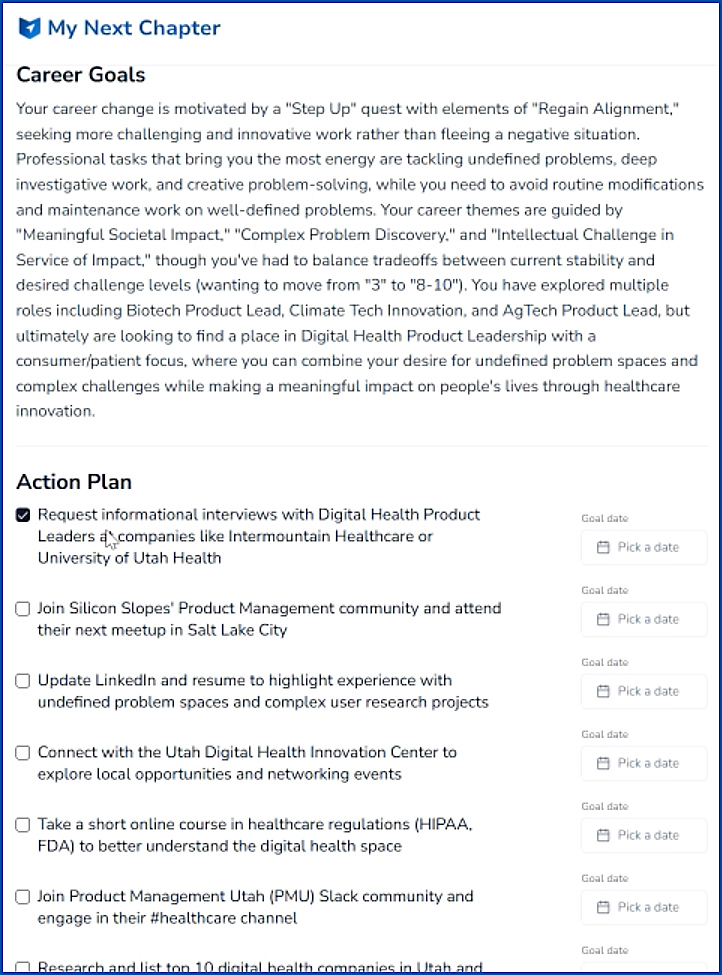
MyNextChapter.ai — THIS TYPE OF FUNCTIONALITY of an AI-based chatbot talking to you re: good fits for a future job — is the kind of thing that could work well in this type of vision/learning platform. The AI asks you relevant career-oriented questions, comes up with some potential job fits, and then gives you resources about how to gain those skills, who to talk with, organizations to join, next steps to get your foot in the door somewhere, etc.

The next gen learning platform would provide links to online-based courses, blogs, peoples’ names on LinkedIn, courses from L&D organizations or from institutions of higher education or from other entities/places to obtain those skills (similar to the ” Action Plan” below from MyNextChapter.ai).


Trump officials accused of defying 1 in 3 judges who ruled against him — from washingtonpost.com by Justin Jouvenal
A comprehensive analysis of hundreds of lawsuits against Trump policies shows dozens of examples of defiance, delay and dishonesty, which experts say pose an unprecedented threat to the U.S. legal system.

President Donald Trump and his appointees have been accused of flouting courts in a third of the more than 160 lawsuits against the administration in which a judge has issued a substantive ruling, a Washington Post analysis has found, suggesting widespread noncompliance with America’s legal system.

Plaintiffs say Justice Department lawyers and the agencies they represent are snubbing rulings, providing false information, failing to turn over evidence, quietly working around court orders and inventing pretexts to carry out actions that have been blocked.

.

The Post examined 337 lawsuits filed against the administration since Trump returned to the White House and began a rapid-fire effort to reshape government programs and policy. As of mid-July, courts had ruled against the administration in 165 of the lawsuits. The Post found that the administration is accused of defying or frustrating court oversight in 57 of those cases — almost 35 percent.


DC: How is making a mockery of the justice system making America great again? I don’t think any one of us would benefit from living in a land with no laws. It would be absolute chaos.


PODCAST: Did AI “break” school? Or will it “fix” it? …and if so, what can we do about it? — from theneurondaily.com by Grant Harvey, Corey Noles, Grant Harvey, & Matthew Robinson

In Episode 5 of The Neuron Podcast, Corey Noles and Grant Harvey tackle the education crisis head-on. We explore the viral UCLA “CheatGPT” controversy, MIT’s concerning brain study, and innovative solutions like Alpha School’s 2-hour learning model. Plus, we break down OpenAI’s new $10M teacher training initiative and share practical tips for using AI to enhance learning rather than shortcut it. Whether you’re a student, teacher, or parent, you’ll leave with actionable insights on the future of education.


Tech Layoffs 2025: Why AI is Behind the Rising Job Cuts — from finalroundai.com by Kaustubh Saini, Jaya Muvania, and Kaivan Dave; via George Siemens
507 tech workers lose their jobs to AI every day in 2025. Complete breakdown of 94,000 job losses across Microsoft, Tesla, IBM, and Meta – plus which positions are next.
.


.


I’ve Spent My Life Measuring Risk. AI Rings Every One of My Alarm Bells — from time.com by Paul Tudor Jones

Amid all the talk about the state of our economy, little noticed and even less discussed was June’s employment data. It showed that the unemployment rate for recent college graduates stood at 5.8%, topping the national level for the first and only time in its 45-year historical record.

It’s an alarming number that needs to be considered in the context of a recent warning from Dario Amodei, CEO of AI juggernaut Anthropic, who predicted artificial intelligence could wipe out half of all entry-level, white-collar-jobs and spike unemployment to 10-20% in the next one to five years.

The upshot: our college graduates’ woes could be just the tip of the spear.


I almost made a terrible mistake last week. — from justinwelsh.me by Justin Welsh; via Roberto Ferraro

But as I thought about it, it just didn’t feel right. Replying to people sharing real gratitude with a copy-paste message seemed like a terribly inauthentic thing to do. I realized that when you optimize the most human parts of your business, you risk removing the very reason people connect with you in the first place.


Is graduate employability a core university priority? — from timeshighereducation.com by Katherine Emms and Andrea Laczik
Universities, once judged primarily on the quality of their academic outcomes, are now also expected to prepare students for the workplace. Here’s how higher education is adapting to changing pressures

A clear, deliberate shift in priorities is under way. Embedding employability is central to an Edge Foundation report, carried out in collaboration with UCL’s Institute of Education, looking at how English universities are responding. In placing employability at the centre of their strategies – not just for professional courses but across all disciplines – the two universities that were analysed in this research show how they aim to prepare students for the labour market overall. Although the employability strategy is initialled by the universities’ senior leaders, the research showed that realising this employability strategy must be understood and executed by staff at all levels across departments. The complexity of offering insights into industry pathways and building relevant skills involves curricula development, student-centred teaching, careers support, partnership work and employer engagement.


Every student can benefit from an entrepreneurial mindset — from timeshighereducation.com by Nicolas Klotz
To develop the next generation of entrepreneurs, universities need to nurture the right mindset in students of all disciplines. Follow these tips to embed entrepreneurial education

This shift demands a radical rethink of how we approach entrepreneurial mindset in higher education. Not as a specialism for a niche group of business students but as a core competency that every student, in every discipline, can benefit from.

At my university, we’ve spent the past several years re-engineering how we embed entrepreneurship into daily student life and learning.

What we’ve learned could help other institutions, especially smaller or resource-constrained ones, adapt to this new landscape.

The first step is recognising that entrepreneurship is not only about launching start-ups for profit. It’s about nurturing a mindset that values initiative, problem-solving, resilience and creative risk-taking. Employers increasingly want these traits, whether the student is applying for a traditional job or proposing their own venture.


Build foundations for university-industry partnerships in 90 days— from timeshighereducation.com by Raul Villamarin Rodriguez and Hemachandran K
Graduate employability could be transformed through systematic integration of industry partnerships. This practical guide offers a framework for change in Indian universities

The most effective transformation strategy for Indian universities lies in systematic industry integration that moves beyond superficial partnerships and towards deep curriculum collaboration. Rather than hoping market alignment will occur naturally, institutions must reverse-engineer academic programmes from verified industry needs.

Our six-month implementation at Woxsen University demonstrates this framework’s practical effectiveness, achieving more than 130 industry partnerships, 100 per cent faculty participation in transformation training, and 75 per cent of students receiving industry-validated credentials with significantly improved employment outcomes.


How Do You Teach Computer Science in the A.I. Era? — from nytimes.com by Steve Lohr; with thanks to Ryan Craig for this resource
Universities across the country are scrambling to understand the implications of generative A.I.’s transformation of technology.

The future of computer science education, Dr. Maher said, is likely to focus less on coding and more on computational thinking and A.I. literacy. Computational thinking involves breaking down problems into smaller tasks, developing step-by-step solutions and using data to reach evidence-based conclusions.

A.I. literacy is an understanding — at varying depths for students at different levels — of how A.I. works, how to use it responsibly and how it is affecting society. Nurturing informed skepticism, she said, should be a goal.

At Carnegie Mellon, as faculty members prepare for their gathering, Dr. Cortina said his own view was that the coursework should include instruction in the traditional basics of computing and A.I. principles, followed by plenty of hands-on experience designing software using the new tools.

“We think that’s where it’s going,” he said. “But do we need a more profound change in the curriculum?”

 
© 2025 | Daniel Christian