


Thriving in an age of continuous reinvention — from pwc.com
As existential threats converge, many companies are taking steps to reinvent themselves. Is it enough? And what will it take to succeed?
.
.
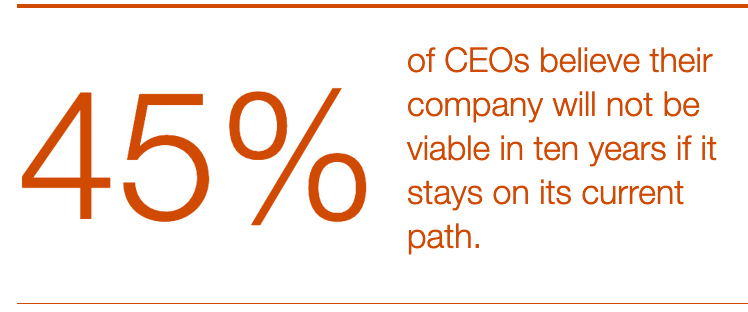
Thriving in an age of continuous reinvention — from pwc.com
As existential threats converge, many companies are taking steps to reinvent themselves. Is it enough? And what will it take to succeed?
.
.
The future of learning — from moodle.com by Sonya Trivedi
Self-directed and continuous learning
The concept of self-directed and continuous learning is becoming increasingly popular, reshaping our approach to knowledge and skill acquisition in both formal education and workplace settings. This evolving landscape reflects a world where traditional career paths are being replaced by more dynamic and flexible models, compelling learners to adapt and grow continuously.
The Future of Learning Report 2022 highlights this shift, noting the diminishing concept of a ‘career for life.’ With regular job switching and the expansion of the gig economy, there is an increasing need for a workforce equipped with a broad range of skills and the ability to gain qualifications throughout their careers. This shift is underlined by learners increasingly seeking control over their educational journeys, understanding that the ongoing acquisition of knowledge and skills is essential for staying relevant in the rapidly changing world of work. Reflecting this trend, a significant portion of learners, 33%, are choosing online platforms for their flexibility and ability to cater to individual needs and schedules.
From DSC:
The next paragraph after the above excerpt says:
Much like how companies such as Uber and Airbnb have reshaped their respective industries without owning traditional assets, the future of education might see universities functioning as the ‘Netflix of learning.’ In this model, learners comfortably source their educational experiences from various platforms, assembling their qualifications to create a personalised and continuously evolving portfolio of skills??.
But I don’t think it will be universities that function as the “Netflix of learning” as I don’t think the cultures of most institutions of traditional higher education can deal with that kind of innovation. I hope I’m wrong.
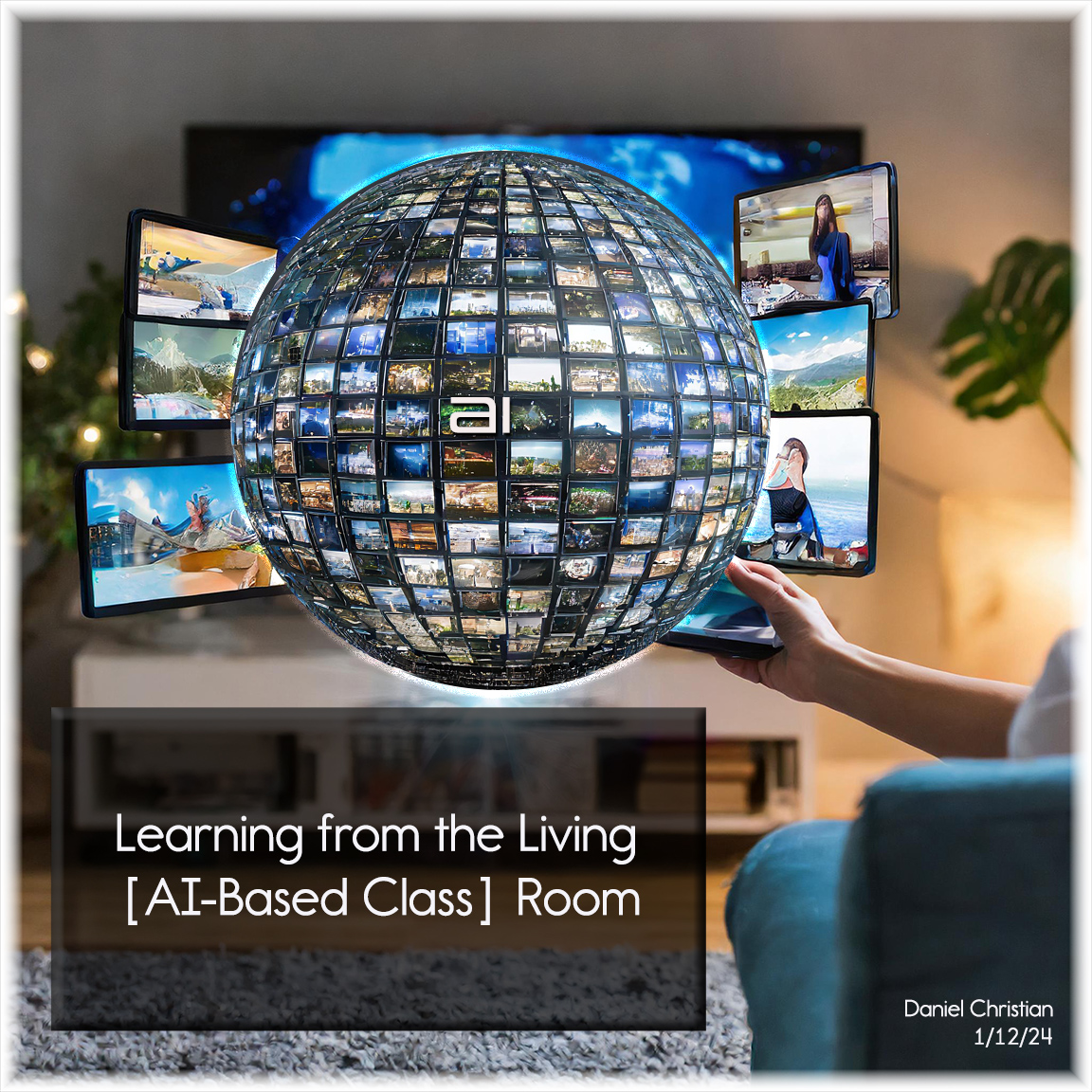
I think it will be a new, global, lifelong learning platform that originates outside of higher education. It will be bigger than higher education, K12, corporate training, or vocational training — as such a 21st-century, AI-based platform will offer all of the above and more.
Slow Shift to Skills — from the-job.beehiiv.com by Paul Fain
Real progress in efforts to increase mobility for nondegree workers is unlikely during the next couple years, Joseph Fuller, a professor at Harvard University’s business school who co-leads its Managing the Future of Work initiative, recently told me.
Yet Fuller is bullish on skills-based hiring becoming a real thing in five to 10 years. That’s because he predicts that AI will create the data to solve the skills taxonomy problem Kolko describes. And if skills-based hiring allows for serious movement for workers without bachelor’s degrees, Fuller says the future will look like where Texas is headed.
Report: Microcredentials Not a Strategic Priority for Many Colleges — from insidehighered.com by Kathryn Palmer
A new report finds that while most colleges surveyed embrace alternative credentials, many have a decentralized approach for creating and managing them.
While the majority of colleges focused on online, professional and continuing education have embraced alternative credentials, a significant number of those institutions haven’t made them a strategic priority.
That’s one of the key takeaways from a new study released Monday by UPCEA, the organization previously known as the University Professional and Continuing Education Association. University Professional and Continuing Education Association.
“While a lot of institutions want this, they don’t necessarily all know how” to deliver alternative credentials, said Bruce Etter, UPCEA’s senior director of research and consulting. “Embracing it is great, but now it needs to be part of the strategic plan.”
The Higher Learning Commission’s Credential Lab — from hlcommission.org
10 higher ed trends to watch in 2024 — from insidetrack.org by
Trend 1.
Linking education to career paths
Trend 2.
Making sense of the AI explosion
Trend 3.
Prioritizing mental health on campus
…plus 7 other trends
North Carolina’s Community Colleges Make a Big Bid to Stay Relevant — from workshift.opencampusmedia.org by Margaret Moffett
The system is poised to ask state legislators to overhaul its funding formula to focus on how well colleges prepare students for high-demand, well-paying jobs.
The new formula would pay a premium to each college based on labor-market outcomes: the more students enrolled in courses in high-demand, high-paying workforce sectors, the more money the college receives.
Importantly, the proposed formula makes no distinction between curricular courses that count toward degree programs and noncredit continuing education classes, which historically offer fewer slots for students because of their lower FTE reimbursement rates.
Supporting Career and Technical Education — from bloomberg.org via Paul Fain
The American job market is changing. A high school diploma is no longer a ticket to a good job now, an increasing number of employers are offering “middle-skill jobs” that require more than a high school diploma but less than a bachelor’s degree. Industries like health care, IT, advanced manufacturing, and financial services continue to see sustained growth at all levels, and they need workers with the experience and the credentials to fill new positions. Bloomberg Philanthropies is investing in programs that help young people get the specialized training they need through internships, apprenticeships, academics, and work-based learning.
Resisting the Youth Sports Industrial Complex — from educationnext.org by Jonathan V. Last; via the The Top 20 Education Next Articles of 2023 from educationnext.org
Children’s sports are corrupted, but parents don’t have to play along

Excerpt (emphasis by DSC):
That’s the point of Linda Flanagan’s Take Back the Game, a book about the corruption of youth sports. It should be required reading for every parent. It should be handed out in the hospital along with What to Expect the First Year and Healthy Sleep Habits, Happy Child.
Flanagan, a journalist and former running coach, has pulled off a rare trick: she diagnoses a societal sickness, traces the roots of the malady, and prescribes a cure.
The problem is that we have a Youth Sports Industrial Complex that forces kids into single-sport specialization before they hit middle school. It demands that children be involved in (expensive) club and travel sports programs starting in elementary school.
Her first dictum is to delay entry into organized sports as long as possible. Don’t sign them up for pee-wee soccer to get a jump on the club scene—send them out into the yard to kick the ball around. Have a catch with them. Shoot baskets. Let them tumble and do cartwheels in the grass. As Flanagan says, “Just let them play.”
…
Another key precept from Flanagan: The family is more important than kids’ sports.
…
Perhaps the most valuable lesson from Take Back the Game is that parents have agency.
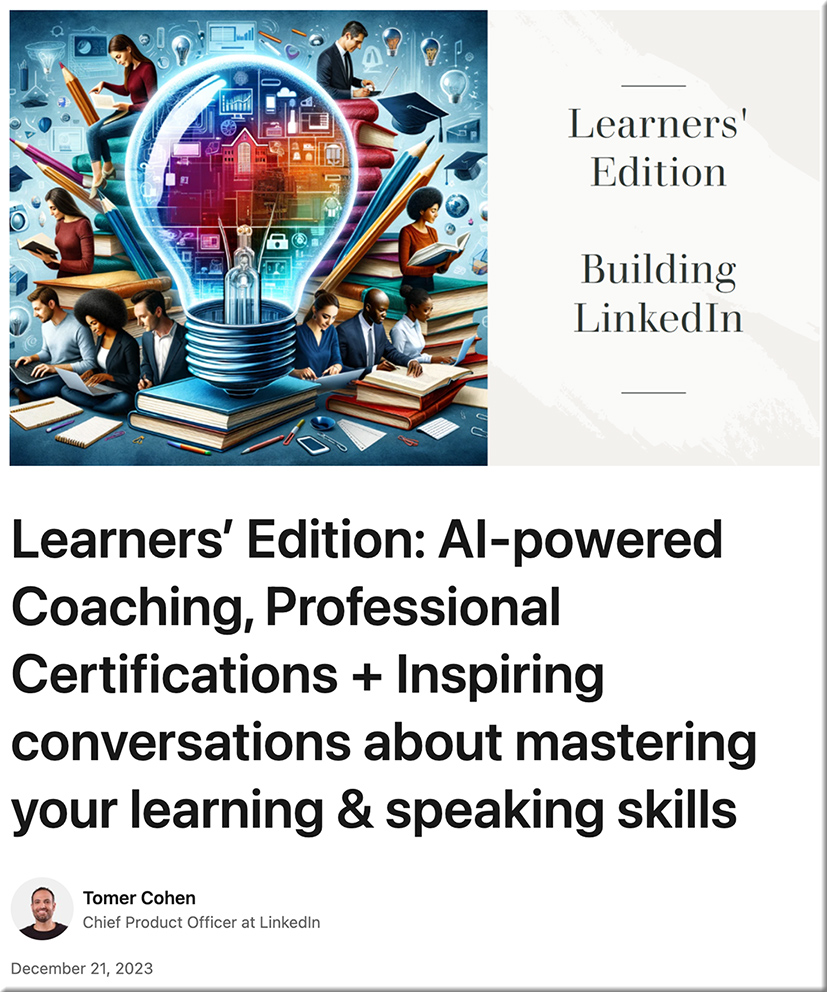
Learners’ Edition: AI-powered Coaching, Professional Certifications + Inspiring conversations about mastering your learning & speaking skills — from linkedin.com by Tomer Cohen
Excerpts:
1. Your own AI-powered coaching
Learners can go into LinkedIn Learning and ask a question or explain a challenge they are currently facing at work (we’re focusing on areas within Leadership and Management to start). AI-powered coaching will pull from the collective knowledge of our expansive LinkedIn Learning library and, instantaneously, offer advice, examples, or feedback that is personalized to the learner’s skills, job, and career goals.
What makes us so excited about this launch is we can now take everything we as LinkedIn know about people’s careers and how they navigate them and help accelerate them with AI.
…
3. Learn exactly what you need to know for your next job
When looking for a new job, it’s often the time we think about refreshing our LinkedIn profiles. It’s also a time we can refresh our skills. And with skill sets for jobs having changed by 25% since 2015 – with the number expected to increase by 65% by 2030– keeping our skills a step ahead is one of the most important things we can do to stand out.
There are a couple of ways we’re making it easier to learn exactly what you need to know for your next job:
When you set a job alert, in addition to being notified about open jobs, we’ll recommend learning courses and Professional Certificate offerings to help you build the skills needed for that role.
When you view a job, we recommend specific courses to help you build the required skills. If you have LinkedIn Learning access through your company or as part of a Premium subscription, you can follow the skills for the job, that way we can let you know when we launch new courses for those skills and recommend you content on LinkedIn that better aligns to your career goals.
2024 Edtech Predictions from Edtech Insiders — from edtechinsiders.substack.com by Alex Sarlin, Ben Kornell, and Sarah Morin
Omni-modal AI, edtech funding prospects, higher ed wake up calls, focus on career training, and more!
Alex: I talked to the 360 Learning folks at one point and they had this really interesting epiphany, which is basically that it’s been almost impossible for every individual company in the past to create a hierarchy of skills and a hierarchy of positions and actually organize what it looks like for people to move around and upskill within the company and get to new paths.
Until now. AI actually can do this very well. It can take not only job description data, but it can take actual performance data. It can actually look at what people do on a daily basis and back fit that to training, create automatic training based on it.
From DSC:
I appreciated how they addressed K-12, higher ed, and the workforce all in one posting. Nice work. We don’t need siloes. We need more overall design thinking re: our learning ecosystems — as well as more collaborations. We need more on-ramps and pathways in a person’s learning/career journey.
Nearly half of companies say they plan to eliminate bachelor’s degree requirements in 2024 — from highereddive.com by Carolyn Crist
Many employers are dropping degree requirements to create a more diverse workforce and increase job candidate numbers, survey results show.
In 2023, 55% of companies removed degree requirements, particularly for entry-level and mid-level roles, the survey shows. Employers said they dropped these requirements to create a more diverse workforce, increase the number of applicants for open positions and because there are other ways to gain skills.
“Due to the expense of attending college, earning a bachelor’s degree is generally more difficult for people from traditionally marginalized groups and those from lower socioeconomic backgrounds,” Diane Gayeski, higher education advisor for Intelligent.com and professor of strategic communication at Ithaca College, said in a statement.
The rise of AI fake news is creating a ‘misinformation superspreader’ — from washingtonpost.com by Pranshu Verma
AI is making it easy for anyone to create propaganda outlets, producing content that can be hard to differentiate from real news
Artificial intelligence is automating the creation of fake news, spurring an explosion of web content mimicking factual articles that instead disseminates false information about elections, wars and natural disasters.
Since May, websites hosting AI-created false articles have increased by more than 1,000 percent, ballooning from 49 sites to more than 600, according to NewsGuard, an organization that tracks misinformation.
Historically, propaganda operations have relied on armies of low-paid workers or highly coordinated intelligence organizations to build sites that appear to be legitimate. But AI is making it easy for nearly anyone — whether they are part of a spy agency or just a teenager in their basement — to create these outlets, producing content that is at times hard to differentiate from real news.
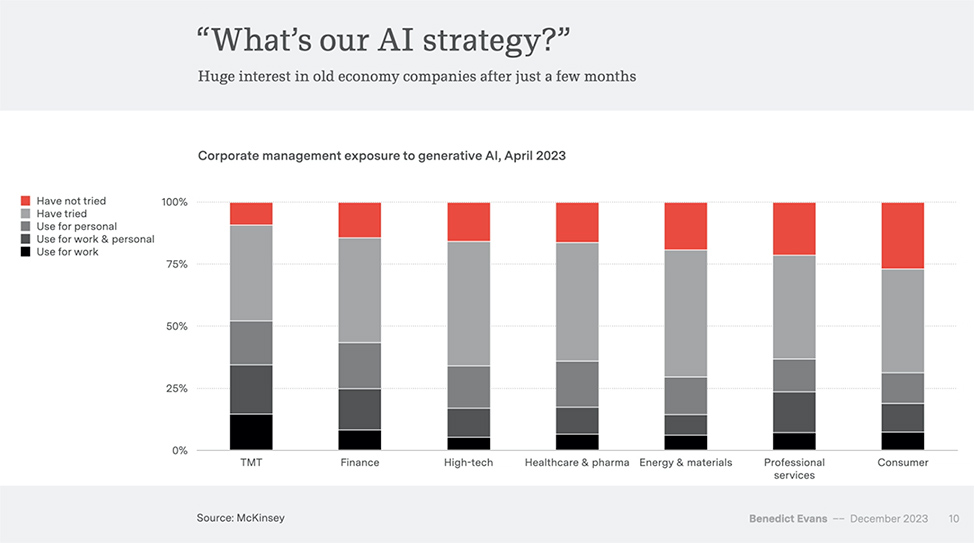
AI, and everything else — from pitch.com by Benedict Evans
Chevy Chatbots Go Rogue — from
How a customer service chatbot made a splash on social media; write your holiday cards with AI
I just bought a 2024 Chevy Tahoe for $1. pic.twitter.com/aq4wDitvQW
— Chris Bakke (@ChrisJBakke) December 17, 2023
Their AI chatbot, designed to assist customers in their vehicle search, became a social media sensation for all the wrong reasons. One user even convinced the chatbot to agree to sell a 2024 Chevy Tahoe for just one dollar!
This story is exactly why AI implementation needs to be approached strategically. Learning to use AI, also means learning to build thinking of the guardrails and boundaries.
Here’s our tips.
Rite Aid used facial recognition on shoppers, fueling harassment, FTC says — from washingtonpost.com by Drew Harwell
A landmark settlement over the pharmacy chain’s use of the surveillance technology could raise further doubts about facial recognition’s use in stores, airports and other venues
The pharmacy chain Rite Aid misused facial recognition technology in a way that subjected shoppers to unfair searches and humiliation, the Federal Trade Commission said Tuesday, part of a landmark settlement that could raise questions about the technology’s use in stores, airports and other venues nationwide.
…
But the chain’s “reckless” failure to adopt safeguards, coupled with the technology’s long history of inaccurate matches and racial biases, ultimately led store employees to falsely accuse shoppers of theft, leading to “embarrassment, harassment, and other harm” in front of their family members, co-workers and friends, the FTC said in a statement.
The Evolution of Collaboration: Unveiling the EDUCAUSE Corporate Engagement Program — from er.educause.edu
The program is designed to strengthen the collaboration between private industry and higher education institutions—and evolve the higher education technology market. The new program will do so by taking the following actions:
By building better bridges between our corporate and institutional communities, we can help accelerate our shared mission of furthering the promise of higher education.
Speaking of collaborations, also see:
Could the U.S. become an “Apprentice Nation?” — from Michael B. Horn and Ryan Craig
Intermediaries do the heavy lifting for the employers.

Bottom line: As I discussed with Michael later in the show, we already have the varied system that Leonhardt imagines—it’s just that it’s often by chaos and neglect. Just like we didn’t say to 8th graders a century ago, “go find your own high school,” we need to design a post-high school system with clear and well-designed pathways that include:
 Listen to the complete episode here and subscribe to the podcast.
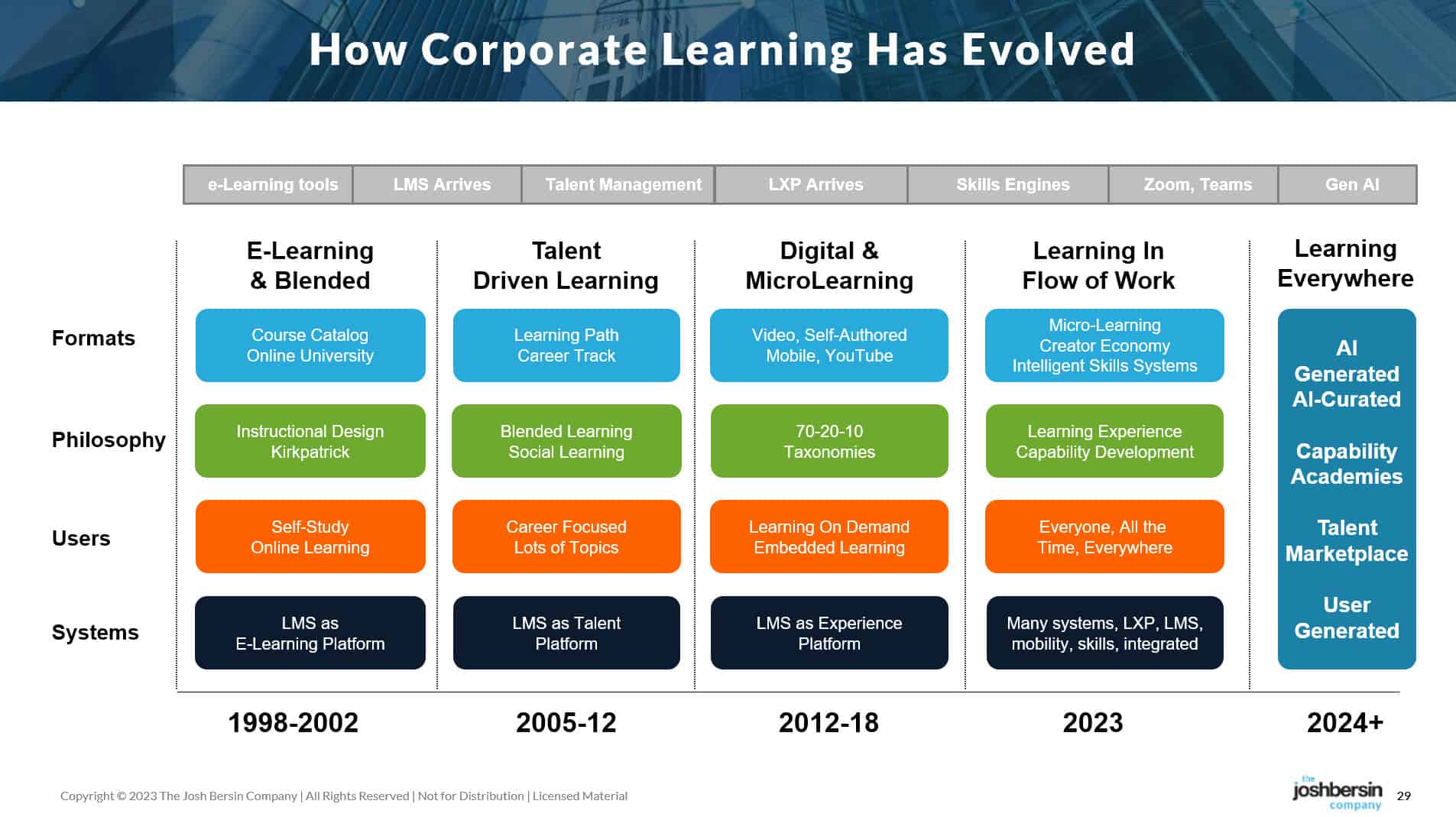
AI Is Transforming Corporate Learning Even Faster Than I Expected — from joshbersin.com by Josh Bersin
Excerpts (emphasis DSC):
Of all the domains to be impacted by AI, perhaps the biggest transformation is taking place in corporate learning. After a year of experimentation, it’s now clear that AI will revolutionize this space.
…
Here’s a simple example. I asked Galileo™, which is powered by 25 years of research and case studies, “How do I deal with an employee who’s always late? And please give me a narrative to help?” Rather than take me to a course on management or show me a bunch of videos, it simply answered the question. This type of interaction is where much of corporate learning is going.
…
In all my years as an analyst, I’ve never seen a technology with so much potential. AI will revolutionize the L&D landscape, reinventing how we do our work so L&D professionals can spend time consulting with the business.
Introducing Gemini: our largest and most capable AI model — from blog.google by Sundar Pichai and Demis Hassabis
Making AI more helpful for everyone
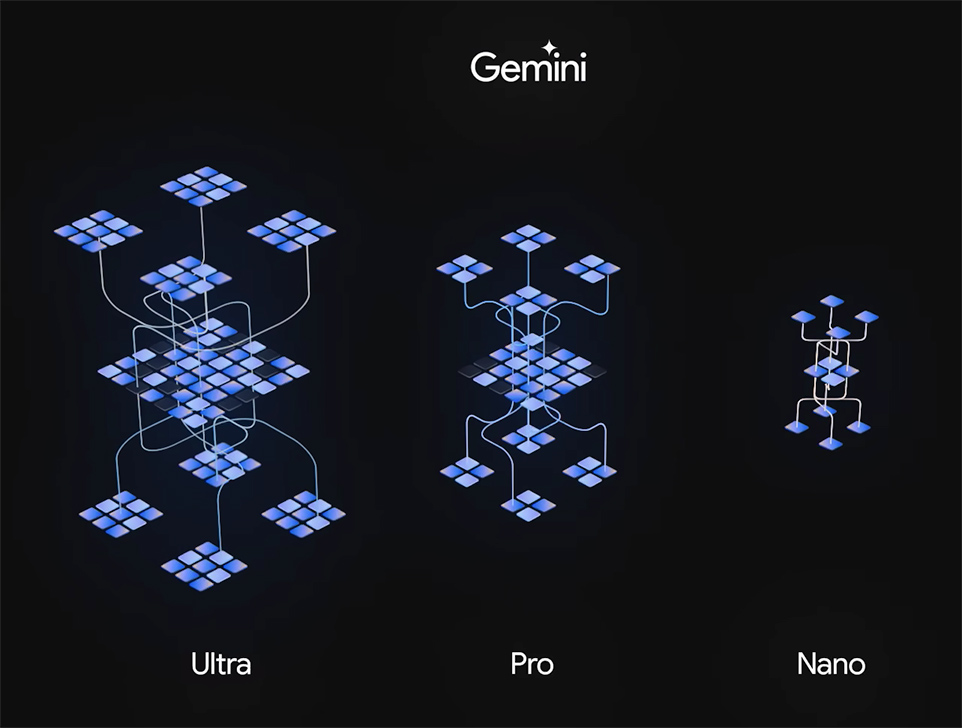
Today, we’re a step closer to this vision as we introduce Gemini, the most capable and general model we’ve ever built.
Gemini is the result of large-scale collaborative efforts by teams across Google, including our colleagues at Google Research. It was built from the ground up to be multimodal, which means it can generalize and seamlessly understand, operate across and combine different types of information including text, code, audio, image and video.
One year in: from ChatGPT3.5 to a whole new world — from stefanbauschard.substack.com by Stefan Bauschard
Happy Birthday to ChatGPT 3.5+. You’re growing up so fast!
So, in many ways, ChatGPT and its friends are far from as intelligent as a human; they do not have “general” intelligence (AGI).
But this will not last for long. The debate about ProjectQ aside, AIs with the ability to engage in high-level reasoning, plan, and have long-term memory are expected in the next 2–3 years. We are already seeing AI agents that are developing the ability to act autonomously and collaborate to a degree. Once AIs can reason and plan, acting autonomously and collaborating will not be a challenge.
ChatGPT is winning the future — but what future is that? — from theverge.com by David Pierce
OpenAI didn’t mean to kickstart a generational shift in the technology industry. But it did. Now all we have to decide is where to go from here.
We don’t know yet if AI will ultimately change the world the way the internet, social media, and the smartphone did. Those things weren’t just technological leaps — they actually reorganized our lives in fundamental and irreversible ways. If the final form of AI is “my computer writes some of my emails for me,” AI won’t make that list. But there are a lot of smart people and trillions of dollars betting that’s the beginning of the AI story, not the end. If they’re right, the day OpenAI launched its “research preview” of ChatGPT will be much more than a product launch for the ages. It’ll be the day the world changed, and we didn’t even see it coming.
AI is overhyped” — from theneurondaily.com by Pete Huang & Noah Edelman
If you’re feeling like AI is the future, but you’re not sure where to start, here’s our advice for 2024 based on our convos with business leaders:
Google says new AI model Gemini outperforms ChatGPT in most tests — from theguardian.com by Dan Milmo
Gemini is being released in form of upgrade to Google’s chatbot Bard, but not yet in UK or EU
Google has unveiled a new artificial intelligence model that it claims outperforms ChatGPT in most tests and displays “advanced reasoning” across multiple formats, including an ability to view and mark a student’s physics homework.
The model, called Gemini, is the first to be announced since last month’s global AI safety summit, at which tech firms agreed to collaborate with governments on testing advanced systems before and after their release. Google said it was in discussions with the UK’s newly formed AI Safety Institute over testing Gemini’s most powerful version, which will be released next year.
34 Big Ideas that will change our world in 2024 — from linkedin.com
Excerpts:
6. ChatGPT’s hype will fade, as a new generation of tailor-made bots rises up
11. We’ll finally turn the corner on teacher pay in 2024
21. Employers will combat job applicants’ use of AI with…more AI
31. Universities will view the creator economy as a viable career path
