Industry Speaks: Top 33 Big Data Predictions for 2016 — from datanami.com by Alex Woodie

Excerpt:

What will happen in big data in 2016? You’d think that would be a cinch to answer, what with all the deep neural net and prescriptive analytic progress being made these days. But in fact the big data predictions from the industry are all over the map. Datanami received dozens of predictions from prominent players in the industry. Here is a culled collection of the most interesting ones.
…
Oracle sees the rise of a new type of user: the Data Civilian. “While complex statistics may still be limited to data scientists, data-driven decision-making shouldn’t be,” Big Red says. “In the coming year, simpler big data discovery tools will let business analysts shop for datasets in enterprise Hadoop clusters, reshape them into new mashup combinations, and even analyze them with exploratory machine learning techniques.”
…
Machine learning, big data automation, and artificial intelligence were big in 2015, and will get bigger next year, says Abdul Razack, SVP & head of platforms, big data and analytics at Infosys. “In 2016, the pace at which enterprises more widely adopt artificial intelligence to replace manual, repetitive tasks will rapidly increase,” Razack says, citing the $1 billion AI investment made recently by Toyota. Big data automation is already growing, but next year “it will be more widely used to accentuate the unique human ability to take complex problems and deliver creative solutions to them.” The self-driving cars from Tesla have built-in machine learning, but next year, “machine learning will quietly find its way into the household, making the objects around us not just connected.”


Will Lynda.com/LinkedIn.com pursue this powerful vision with an organization like IBM? If so, look out!

From DSC:
Back in July of 2012, I put forth a vision that I called Learning from the Living [Class]Room. 


The Living [Class] Room -- by Daniel Christian -- July 2012 -- a second device used in conjunction with a Smart/Connected TV

It’s a vision that involves a multitude of technologies — technologies and trends that we continue to see being developed and ones that could easily converge in the not-too-distant future to offer us some powerful opportunities for lifelong learning! 

Consider that in won’t be very long before a learner will be able to reinvent himself/herself throughout their lifetime, for a very affordable price — while taking ala carte courses from some of the best professors, trainers, leaders, and experts throughout the world, all from the comfort of their living room. (Not to mention tapping into streams of content that will be available on such platforms.)

So when I noticed that Lynda.com now has a Roku channel for the big screen, it got my attention.


lyndadotcom-roku-channel-dec2015


Lets add a few more pieces to the puzzle, given that some other relevant trends are developing quite nicely:

  • tvOS-based apps are now possible — and already there are over 2600 of them and it’s only been a month or so since Apple made this new platform available to the masses
  • Now, let’s add the ability to take courses online via a virtual reality interface — globally, at any time; VR is poised to have some big years in 2016 and 2017!
  • Lynda.com and LinkedIn.com’s fairly recent merger and their developing capabilities to offer micro-credentials, badges, and competency-based education (CBE) — while keeping track of the courses that a learner has taken
  • The need for lifelong learning is now a requirement, as we need to continually reinvent ourselves — especially given the increasing pace of change and as complete industries are impacted (broadsided), almost overnight
  • Big data, algorithms, and artificial intelligence (AI) continue to pick up steam; for example, consider the cognitive computing capabilities being developed in IBM’s Watson — which should be able to deliver personalized digital playlists and likely some level of intelligent tutoring as well
  • Courses could be offered at a fraction of the cost, as MOOC-sized classes could distribute the costs over a greater # of people and back end systems could help grade/assess the students’ work; plus the corporate world continues to use MOOCs to cost-effectively train their employees across the globe (MOOCs would thrive on such a tvOS-based platform, whereby students could watch lectures, demonstrations, and simulations on the big screen and then communicate with each other via their second screens*)
  • As the trends of machine-to-machine communications (M2M) and the Internet of Things (IoT) pick up, relevant courses/modules will likely be instantly presented to people to learn about a particular topic or task.  For example, I purchased a crib and I want to know how to put it together. The chip in the crib communicates to my Smart TV or to my augmented reality glasses/headset, and then a system loads up some multimedia-based training/instructions on how to put it together.
  • Streams of content continue to be developed and offered — via blogs, via channels like Periscope and Meerkat, via social media-based channels, and via other channels — and these streams of multimedia-based content should prove to be highly useful to individual learners as well as for communities of practice

Anyway, these next few years will be packed with change — the pace of which will likely take us by surprise. We need to keep our eyes upward and outward — peering into the horizons rather than looking downwards — doing so should reduce the chance of us getting broadsided!

*It’s also possible that AR and VR will create
a future whereby we only need 1 “screen”


The pace has changed significantly and quickly


Addendum:
After I wrote/published the item above…it was interesting to then see the item below:

IBM opens Watson IoT Global Headquarters, extends power of cognitive computing to a connected world — from finance.yahoo.com
1000 Munich-based experts to drive IoT and industry 4.0 innovation
Launches eight new IoT client experience centers worldwide
Introduces Watson API Services for IoT on the IBM Cloud

Excerpt:

MUNICH, Dec. 15, 2015 /PRNewswire/ — IBM (NYSE: IBM) today announced the opening of its global headquarters for Watson Internet of Things (IoT), launching a series of new offerings, capabilities and ecosystem partners designed to extend the power of cognitive computing to the billions of connected devices, sensors and systems that comprise the IoT.  These new offerings will be available through the IBM Watson IoT Cloud, the company’s global platform for IoT business and developers.


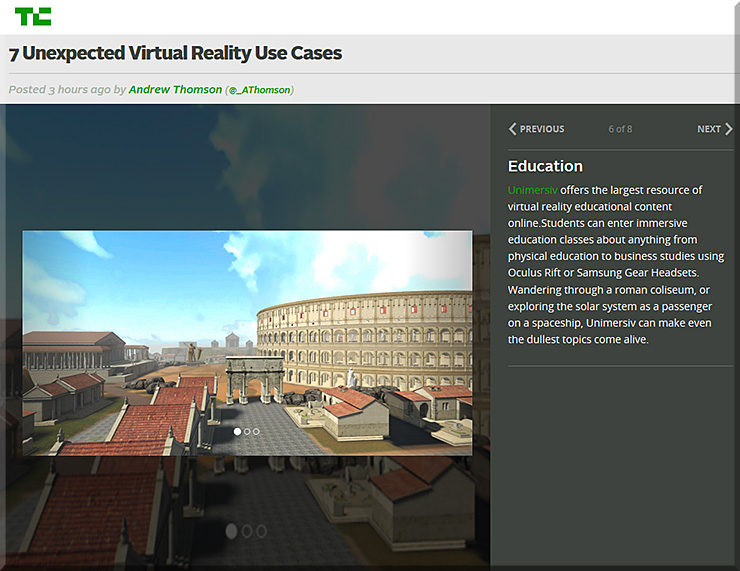
7 unexpected virtual reality use cases — from techcrunch.com by Andrew Thomson

Excerpt:

How VR will be used, and the changes that the technology will make to the day-to-day lives of regular people is still a matter of speculation. Gamers are warming up their trigger fingers for a new level of immersive gaming, and the field of entertainment will be transformed by the changes. But use cases in other industries could be just as transformative.

Indeed, some amazing and inventive new ways to use VR technology are already appearing that could dramatically impact people in their daily lives.


UnexpectedCases-VR-TechcrunchDec2015


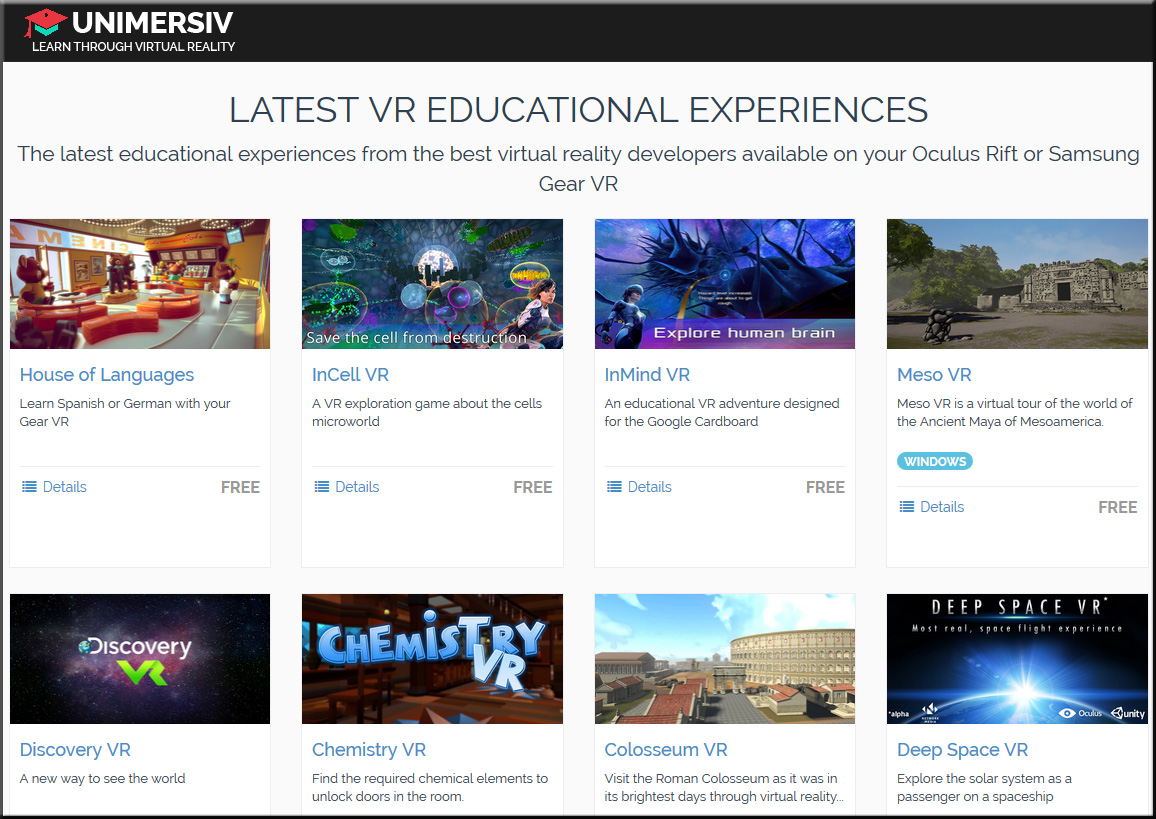
Also see:


Unimersive-Dec2015


Also see:


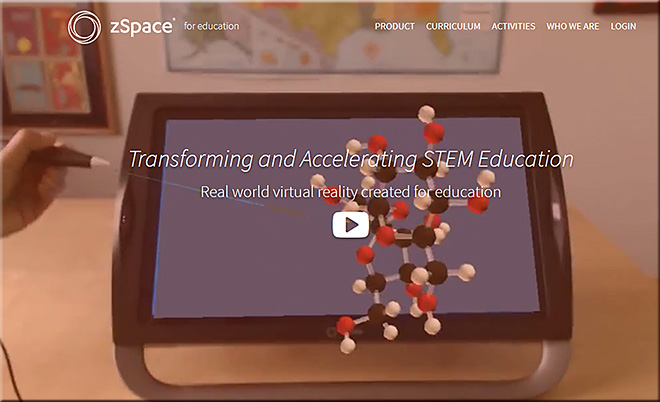
zspace-dec2015


Also see:

Excerpt:

“VR is an individual experience. We’re looking at less obvious VR applications.”

One of these is education. To which end, Mr Hirsch took me into another room to watch a two-minute educational VR video Zypre have made with the Smithsonian National Air and Space Museum, along with some of the Avatar team, using AMD’s technology. It depicts the Wright brothers’ 1903 flight at Kitty Hawk, North Carolina.

The film took six months to make, with computer-generated photorealistic visuals and every detail overseen by historians. I watched it on a prototype of the much-heralded Oculus Rift VR headset, expected out early next year.

It was several times more startling than the VR footage I described in April. It was more than virtual reality; it was pretty much . . . reality.

It’s not enough to say that, standing in a stuffy, darkened room in LA, I truly felt I was on a beach in North Carolina in 1903.

It was way more vivid than that. I even thought I felt the sea breeze in my face, then the backdraught from the propeller of the brothers’ flying machine. I shouted out that I could feel the wind and the techies surrounding me laughed. Apparently, a lot of people say that. It seems the brain is so fooled that it extrapolates and adds effects it thinks should be there. I have to confess, my American history is so sketchy I didn’t even know the flight was on a beach.


Also see:


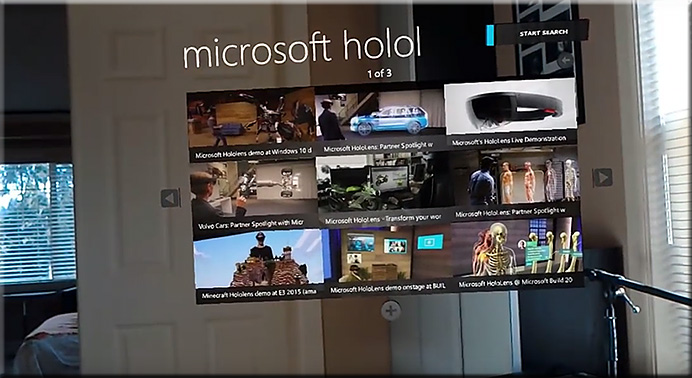
MShololens-dec2015


See more information re:the
Microsoft HoloLens Development Edition.


From DSC:
This posting is meant to surface the need for debates/discussions, new policy decisions, and for taking the time to seriously reflect upon what type of future that we want.  Given the pace of technological change, we need to be constantly asking ourselves what kind of future we want and then to be actively creating that future — instead of just letting things happen because they can happen. (i.e., just because something can be done doesn’t mean it should be done.)

Gerd Leonhard’s work is relevant here.  In the resource immediately below, Gerd asserts:

I believe we urgently need to start debating and crafting a global Digital Ethics Treaty. This would delineate what is and is not acceptable under different circumstances and conditions, and specify who would be in charge of monitoring digressions and aberrations.

I am also including some other relevant items here that bear witness to the increasingly rapid speed at which we’re moving now.


Redefining the relationship of man and machine: here is my narrated chapter from the ‘The Future of Business’ book (video, audio and pdf) — from futuristgerd.com by Gerd Leonhard

.

DigitalEthics-GerdLeonhard-Oct2015


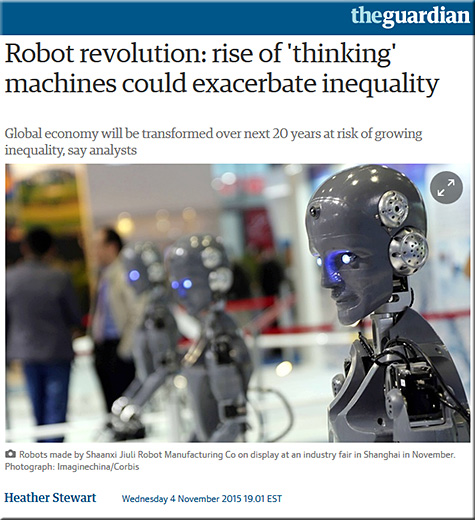
Robot revolution: rise of ‘thinking’ machines could exacerbate inequality — from theguardian.com by Heather Stewart
Global economy will be transformed over next 20 years at risk of growing inequality, say analysts

Excerpt (emphasis DSC):

A “robot revolution” will transform the global economy over the next 20 years, cutting the costs of doing business but exacerbating social inequality, as machines take over everything from caring for the elderly to flipping burgers, according to a new study.

As well as robots performing manual jobs, such as hoovering the living room or assembling machine parts, the development of artificial intelligence means computers are increasingly able to “think”, performing analytical tasks once seen as requiring human judgment.

In a 300-page report, revealed exclusively to the Guardian, analysts from investment bank Bank of America Merrill Lynch draw on the latest research to outline the impact of what they regard as a fourth industrial revolution, after steam, mass production and electronics.

“We are facing a paradigm shift which will change the way we live and work,” the authors say. “The pace of disruptive technological innovation has gone from linear to parabolic in recent years. Penetration of robots and artificial intelligence has hit every industry sector, and has become an integral part of our daily lives.”
 

RobotRevolution-Nov2015


First genetically modified humans could exist within two years — from telegraph.co.uk by Sarah Knapton
Biotech company Editas Medicine is planning to start human trials to genetically edit genes and reverse blindness

Excerpt:

Humans who have had their DNA genetically modified could exist within two years after a private biotech company announced plans to start the first trials into a ground-breaking new technique.

Editas Medicine, which is based in the US, said it plans to become the first lab in the world to ‘genetically edit’ the DNA of patients suffering from a genetic condition – in this case the blinding disorder ‘leber congenital amaurosis’.


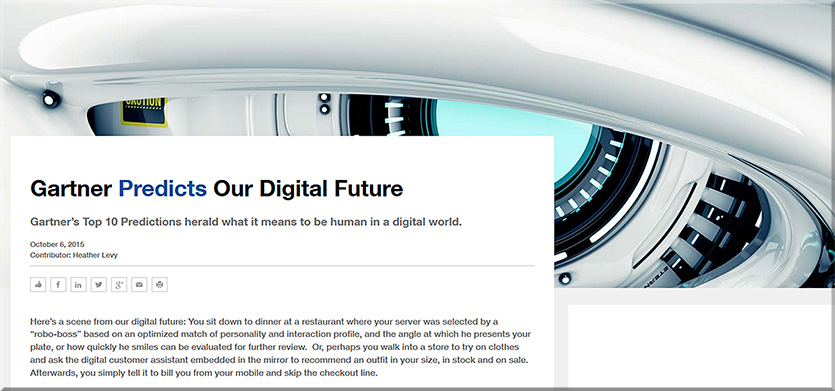
Gartner predicts our digital future — from gartner.com by Heather Levy
Gartner’s Top 10 Predictions herald what it means to be human in a digital world.

Excerpt:

Here’s a scene from our digital future: You sit down to dinner at a restaurant where your server was selected by a “robo-boss” based on an optimized match of personality and interaction profile, and the angle at which he presents your plate, or how quickly he smiles can be evaluated for further review.  Or, perhaps you walk into a store to try on clothes and ask the digital customer assistant embedded in the mirror to recommend an outfit in your size, in stock and on sale. Afterwards, you simply tell it to bill you from your mobile and skip the checkout line.

These scenarios describe two predictions in what will be an algorithmic and smart machine driven world where people and machines must define harmonious relationships. In his session at Gartner Symposium/ITxpo 2016 in Orlando, Daryl Plummer, vice president, distinguished analyst and Gartner Fellow, discussed how Gartner’s Top Predictions begin to separate us from the mere notion of technology adoption and draw us more deeply into issues surrounding what it means to be human in a digital world.


GartnerPredicts-Oct2015


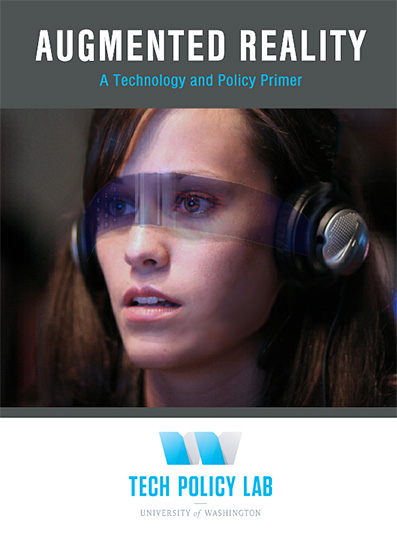
Univ. of Washington faculty study legal, social complexities of augmented reality — from phys.org

Excerpt:

But augmented reality will also bring challenges for law, public policy and privacy, especially pertaining to how information is collected and displayed. Issues regarding surveillance and privacy, free speech, safety, intellectual property and distraction—as well as potential discrimination—are bound to follow.

The Tech Policy Lab brings together faculty and students from the School of Law, Information School and Computer Science & Engineering Department and other campus units to think through issues of technology policy. “Augmented Reality: A Technology and Policy Primer” is the lab’s first official white paper aimed at a policy audience. The paper is based in part on research presented at the 2015 International Joint Conference on Pervasive and Ubiquitous Computing, or UbiComp conference.

Along these same lines, also see:

  • Augmented Reality: Figuring Out Where the Law Fits — from rdmag.com by Greg Watry
    Excerpt:
    With AR comes potential issues the authors divide into two categories. “The first is collection, referring to the capacity of AR to record, or at least register, the people and places around the user. Collection raises obvious issues of privacy but also less obvious issues of free speech and accountability,” the researchers write. The second issue is display, which “raises a variety of complex issues ranging from possible tort liability should the introduction or withdrawal of information lead to injury, to issues surrounding employment discrimination or racial profiling.”Current privacy law in the U.S. allows video and audio recording in areas that “do not attract an objectively reasonable expectation of privacy,” says Newell. Further, many uses of AR would be covered under the First Amendment right to record audio and video, especially in public spaces. However, as AR increasingly becomes more mobile, “it has the potential to record inconspicuously in a variety of private or more intimate settings, and I think these possibilities are already straining current privacy law in the U.S.,” says Newell.


Stuart Russell on Why Moral Philosophy Will Be Big Business in Tech — from kqed.org by

Excerpt (emphasis DSC):

Our first Big Think comes from Stuart Russell. He’s a computer science professor at UC Berkeley and a world-renowned expert in artificial intelligence. His Big Think?

“In the future, moral philosophy will be a key industry sector,” says Russell.

Translation? In the future, the nature of human values and the process by which we make moral decisions will be big business in tech.


Life, enhanced: UW professors study legal, social complexities of an augmented reality future — from washington.edu by Peter Kelley

Excerpt:

But augmented reality will also bring challenges for law, public policy and privacy, especially pertaining to how information is collected and displayed. Issues regarding surveillance and privacy, free speech, safety, intellectual property and distraction — as well as potential discrimination — are bound to follow.


An excerpt from:
UW-AR-TechPolicyPrimer-Nov2015

THREE: CHALLENGES FOR LAW AND POLICY
AR systems  change   human  experience   and,  consequently,   stand  to   challenge   certain assumptions  of  law  and  policy.  The  issues  AR  systems  raise  may  be  divided  into  roughly two  categories.  The  first  is  collection,  referring  to  the  capacity  of  AR  devices  to  record,  or  at  least register,  the people and  places around  the user.  Collection  raises obvious  issues of  privacy  but  also  less  obvious  issues  of  free  speech  and  accountability.  The  second  rough  category  is  display,  referring  to  the  capacity  of  AR  to  overlay  information over  people  and places  in  something  like  real-time.  Display  raises  a  variety  of  complex  issues  ranging  from
possible  tort  liability  should  the  introduction  or  withdrawal  of  information  lead  to  injury,  to issues   surrounding   employment   discrimination   or   racial   profiling.   Policymakers   and stakeholders interested in AR should consider what these issues mean for them.  Issues related to the collection of information include…


HR tech is getting weird, and here’s why — from hrmorning.com by guest poster Julia Scavicchio

Excerpt (emphasis DSC):

Technology has progressed to the point where it’s possible for HR to learn almost everything there is to know about employees — from what they’re doing moment-to-moment at work to what they’re doing on their off hours. Guest poster Julia Scavicchio takes a long hard look at the legal and ethical implications of these new investigative tools.  

Why on Earth does HR need all this data? The answer is simple — HR is not on Earth, it’s in the cloud.

The department transcends traditional roles when data enters the picture.

Many ethical questions posed through technology easily come and go because they seem out of this world.


18 AI researchers reveal the most impressive thing they’ve ever seen — from businessinsider.com by Guia Marie Del Prado,

Excerpt:

Where will these technologies take us next? Well to know that we should determine what’s the best of the best now. Tech Insider talked to 18 AI researchers, roboticists, and computer scientists to see what real-life AI impresses them the most.
…

“The DeepMind system starts completely from scratch, so it is essentially just waking up, seeing the screen of a video game and then it works out how to play the video game to a superhuman level, and it does that for about 30 different video games.  That’s both impressive and scary in the sense that if a human baby was born and by the evening of its first day was already beating human beings at video games, you’d be terrified.”


Algorithmic Economy: Powering the Machine-to-Machine Age Economic Revolution — from formtek.com by Dick Weisinger

Excerpts:

As technology advances, we are becoming increasingly dependent on algorithms for everything in our lives.  Algorithms that can solve our daily problems and tasks will do things like drive vehicles, control drone flight, and order supplies when they run low.  Algorithms are defining the future of business and even our everyday lives.
…
Sondergaard said that “in 2020, consumers won’t be using apps on their devices; in fact, they will have forgotten about apps. They will rely on virtual assistants in the cloud, things they trust. The post-app era is coming.  The algorithmic economy will power the next economic revolution in the machine-to-machine age. Organizations will be valued, not just on their big data, but on the algorithms that turn that data into actions that ultimately impact customers.”


Related items:


Addendums:
 

robots-saying-no


Addendum on 12/14/15:

  • Algorithms rule our lives, so who should rule them? — from qz.com by Dries Buytaert
    As technology advances and more everyday objects are driven almost entirely by software, it’s become clear that we need a better way to catch cheating software and keep people safe.
 

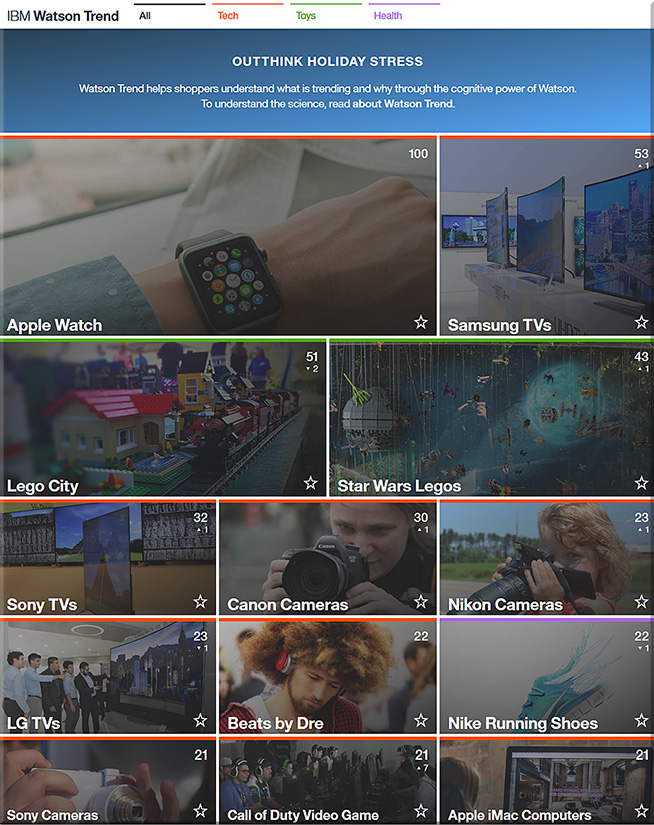
The hot products for holiday 2015: IBM Watson launches new app that can predict trends — from by Kimberly Whitler

Excerpt:

The holiday season—that favorite time of year for retailers and shoppers alike—is just around the corner.  And this year, IBM Watson is launching an app that provides shoppers with the ability to understand the top trends of the season and to predict which products are likely to sell out.

Distilling the sentiment of millions of online conversations across the internet (including social media sites, blogs, forums, ratings, reviews, etc.), the new Watson app (to download the free app, click here) goes beyond providing a static ranking of popular products to provide insight on how consumers feel about the products.


Also see:


IBMWatsonTrend-Nov2015


Addendum om 11/30/15:


Here’s another practical application of IBM Watson technology in healthcare: Boston Children’s Hospital is going to tap the supercomputing platform to improve diagnosis and treatment of rare diseases.

Researchers at the Harvard-affiliated hospital’s Manton Center for Orphan Disease Research will train Watson in nephrology by reading medical literature and scanning data on mutations for a kidney disease known as steroid-resistant nephrotic syndrome. They will then give Watson retrospective genomic data from patients in an effort to teach the computer to assist physicians in interpreting genome sequences as they look for abnormalities.


Wearables will see mass adoption via educated patients and digital health stores — from medcitynews.com by Shahid Shah

Excerpt:

In a fees-for-services (volume-driven) world, selling healthcare products and services to individual institutions is certainly time-consuming but reasonably straightforward. In an outcomes-driven (fees for value) world driven by shared risks and shared rewards, selling healthcare solutions across multiple disciplines, multiple stakeholders, and multiple institutions is much harder and even more time-consuming. That’s because there’s no easy buyer to identify. Population health is all the rage but our current $3 trillion + healthcare industry was never devised nor incentivized to work together as a team for long-term patient or population benefits (it’s reimbursed mainly for episodic care).

Our country’s healthcare industry is more about sick care and episodic transactions rather than longitudinal care. But, since we are moving to population and outcomes driven care where the patient is more responsible for their own care management and payment, it would seem patient education and digital health tools are more important than ever. So, perhaps we need to get together and innovate around how we’re going to present next-generation solutions from across multiple innovators and showcase them to patients and their caregivers.


Watch users claim Apple wearable improves health — from fiercemobilehealthcare.com by Judy Mottl

Excerpt:

Nearly two-thirds of Apple Watch users are exercising more often and for longer periods of time, and 72 percent claim the wearable is improving their health and fitness levels, according to a new report.


IBM forms new health data analytics unit, extends Apple partnership— from zdnet.com by Charlie Osborne
With the help of Apple, acquisitions and new partnerships, Big Blue plans to tap into the vast amount of data offered by health-tracking devices.


After medical school, IBM’s Watson gets ready for Apple health apps — from zdnet.com by David Shamah
The Watson Health Cloud – set to become an important component of Apple’s health platform – is targeting medical care, IBM says.

Excerpt:

“Watson went to medical school, and now it’s set to graduate,” said Dr Aya Soffer, director of big data and cognitive analytics at the Israel facility. “We’ve had it study the medical literature, and now it’s ready to apply its natural language processing skills to real-life applications.”

Just in time, too. Last week, IBM announced the launch of Watson Health Cloud to “provide a secure and open platform for physicians, researchers, insurers, and companies focused on health and wellness solutions”.

The platform will be used by health companies Johnson and Johnson and Medtronic, as well as by Apple. The Mac maker has its own platform and hopes to become a top health company itself. It has established a new business unit, called Watson Health Cloud, to administer the big data apps that will use Watson’s intelligent analysis and understanding of medical data.


Addendum on 11/13/15:

  • NYU Medical Students Learning How to Analyze Big Data — from imedicalapps.com by Brian Wu
    Excerpt:
    Big data is changing the way information is shared in the medical field. Current technologies such as IBM’s Watson are working to merge data from multiple sources to make it easier to access as well as share. Even ten years ago most doctors would not have known anything about big data, and it was definitely not taught in medical school. Today big data is becoming a crucial part of the healthcare field including the diagnosis and treatment of patients. It is important that doctors not only understand the importance of data but know how to properly access and interpret the data. The NYU School of Medicine requires that its first and second-year students complete a health care by the numbers project. Students are given access to a giant database with more than 5 million anonymous records, which includes information on every hospital patient in the state for the preceding two years.
 

Gartner reveals top predictions for IT organizations & users for 2016 and beyond — from gartner.com

Excerpts:

  1. By 2018, 20 percent of business content will be authored by machines.
  2. By 2018, six billion connected things will be requesting support.
  3. By 2020, autonomous software agents outside of human control will participate in five percent of all economic transactions.
  4. By 2018, more than 3 million workers globally will be supervised by a “robo-boss.”
  5. By year-end 2018, 20 percent of smart buildings will have suffered from digital vandalism.
  6. By 2018, 45 percent of the fastest-growing companies will have fewer employees than instances of smart machines.
  7. By year-end 2018, customer digital assistant will recognize individuals by face and voice across channels and partners.
  8. By 2018, two million employees will be required to wear health and fitness tracking devices as a condition of employment.
  9. By 2020, smart agents will facilitate 40 percent of mobile interactions, and the postapp era will begin to dominate.
  10. Through 2020, 95 percent of cloud security failures will be the customer’s fault.


From DSC:
Some of these are pretty bold predictions.  Is this the future we want?  Do you want to be supervised by a “robo-boss?” Perhaps, perhaps not.  Likely, given the pace of technological change, we will need to be flexible and be able to change/adapt in order to remain marketable. Lifelong learning has become a must have ingredient in our lives — for all of us in the workforce. Learning how to learn will pay off, big time.

I’m working on another posting that talks about the ethics, morals, and potential policies that need to be considered now before we get too much further down some of these pathways.


The pace has changed significantly and quickly


The Top 10 Higher Ed IT Issues of 2016 — from centerdigitaled.com by Tanya Roscorla

Excerpt:

2015 2016
1. Evolving staffing models 1. Information security
2. Optimizing technology in teaching and learning 2. Optimizing educational technology
3. Funding IT strategically 3. Student success technologies
4. Improving student outcomes 4. IT workforce
5. Demonstrating IT’s value 5. Institutional data management
6. Increasing capacity for change 6. IT funding models
7. Providing user support 7. Business intelligence and analytics
8. Developing security policies for the institution 8. Enterprise application integrations
9. Developing enterprise IT architecture 9. IT organizational development
10. Balancing information security and openness 10. E-learning and online education


Introducing Coursera for Apple TV: Bringing Online Learning to Your Living Room — from blog.coursera.org


Apple TV


Excerpt (emphasis DSC):

We’re thrilled to announce that Coursera content will now be available on Apple TV.

Since our beginning, one of our primary goals has been to make learning more accessible for everyone. Our mobile platform brought an on-demand learning experience to people’s busy, on-the-go lifestyles, and now, we’re extending availability to your home. Regardless of where in the world you are located, you’ll now be able to learn from top university professors and renowned experts without the expense of travel or tuition.

TV availability isn’t only a first for Coursera—it marks Apple TV’s first ever introduction of online learning to its platform. Everything you can do online at Coursera, you’ll now be able to do from the comfort of your own living room: browse our entire catalogue of courses, peruse new topics, and watch videos from some of the top academic and industry experts.


From DSC:
Coursera takes us one step closed to a very powerful learning platform — one that in the future will provide a great deal of intelligence behind the scenes.  It’s likely that we will be using personalized, adaptable, digital learning playlists while enjoying some serious levels of interactivity…while also making use of web-based learner profiles (the data from which will either be hosted at places like LinkedIn.com or will be fed into employers’ and universities’ competency-based databases).  The application development for tvOS should pick up greatly, especially if the collaboration capabilities are there.

For example, can you imagine marrying the functionalities that Bluescape provides with the reach, flexibility, convenience, and affordances that are unfolding with the new Apple TV?

Truly, some mind-blowing possibilities are developing.  In the not too distant future, lifelong learning won’t ever be the same again (not to mention project-related work).

This is why I’m big on the development and use of
team of specialists — as an organization may have
a harder time competing in the future without one.


BlueScape-2015


The Living [Class] Room -- by Daniel Christian -- July 2012 -- a second device used in conjunction with a Smart/Connected TV


The 50 Most Popular MOOCs of All Time — from onlinecoursereport.com, via Jordan Hall

Excerpt:

MOOCs – or Massive Open Online Courses – are picking up momentum in popularity – at least in terms of initial enrollment.

Unlike regular college/ university courses, MOOCs can attract many thousands of enrollees around the world. They can come in the form of active course sessions with participant interaction, or as archived content for self-paced study. MOOCs can be free, or there can be a charge – either on a subscription basis or a one-time charge. Free MOOCs sometimes have a paid “verified certificate” option. There are now thousands of MOOCs available worldwide from several hundred colleges, universities and other institutions of higher learning. For your convenience, we’ve compiled a list of 50 of the most popular MOOCs, based on enrollment figures for all sessions of a course. The ranking is based on filtering enrollment data for 185 free MOOCs on various elearning platforms.


Ginni Rometty: Forget digital—cognitive business is the future — from fortune.com by Laura Lorenzetti
A new era of cognitive business is here.

Excerpt:

IBM Chairman and CEO Ginni Rometty said that a new technological era is upon us, one that marries digital business with digital intelligence. It’s what’s known as cognitive business.

“Digital is the wires, but digital intelligence, or artificial intelligence as some people call it, is about much more than that,”…

Also see:


Addendum on 10/15/15:


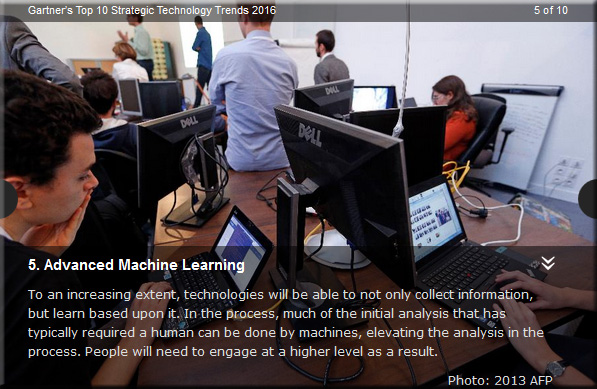
Gartner: Top 10 strategic technology trends for 2016 — from forbes.com by Peter High

Excerpts:

1. The Device Mesh
2. Ambient User Experience
3. 3D-printing Materials
4. Information of Everything
5. Advanced Machine Learning
6. Autonomous Agents and Things
7. Adaptive Security Architecture
8. Advanced Customer Architecture
9. Mesh App and Service Architecture
10. Internet of Things Architecture and Platforms


Also see:

GartnerOct2015


IBM Launches Industry’s First Consulting Practice Dedicated to Cognitive Business — from by finance.yahoo.com
Specialists in analytics and data science lead client journeys spanning cognitive banking, retail, supply chain and healthcare, among others

Excerpt:

ARMONK, N.Y., Oct. 6, 2015 /PRNewswire/ — IBM (NYSE: IBM) [on 10/6/15] launched the industry’s first consulting organization dedicated to helping clients realize the transformative value of cognitive business.
…
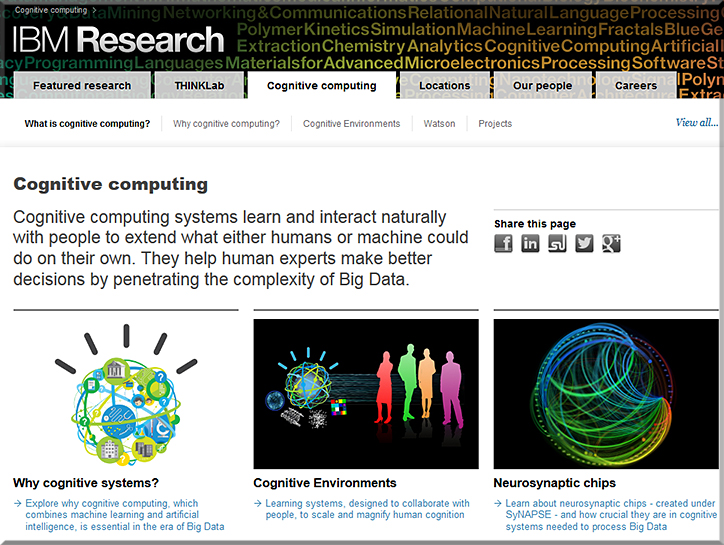
Cognitive represents an entirely new model of computing that includes a range of technology innovations in analytics, natural language processing and machine learning. Industry analyst firm IDC predicts that by 2018, half of all consumers will interact regularly with services based on cognitive computing.


IBMCognitiveComputing-AsofOct2015


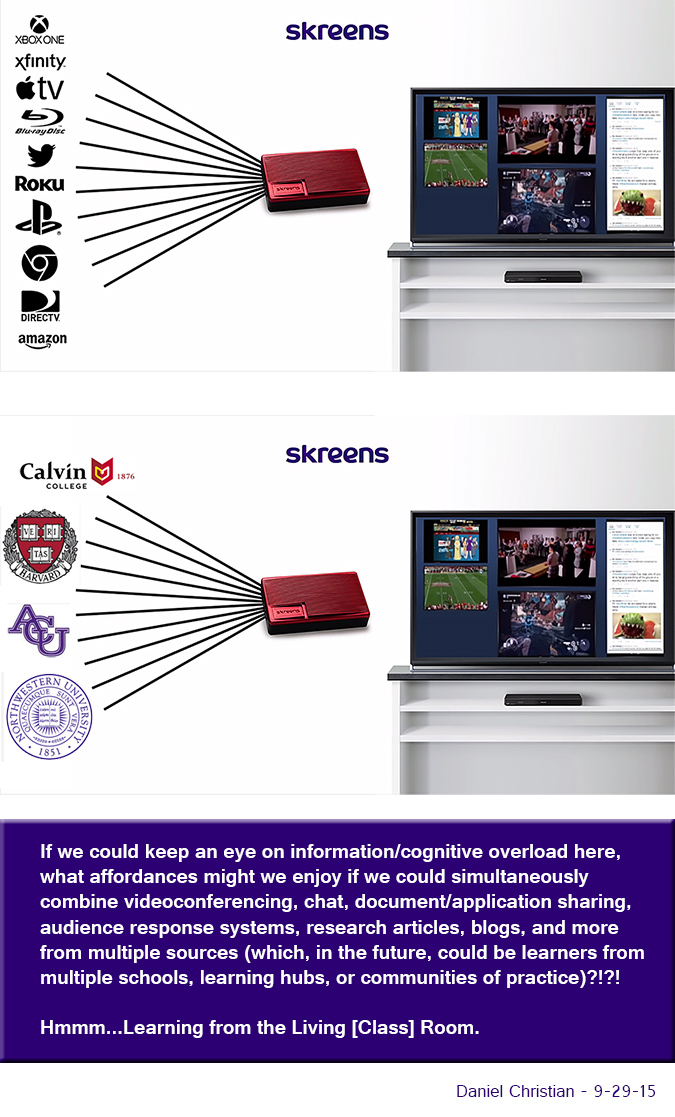
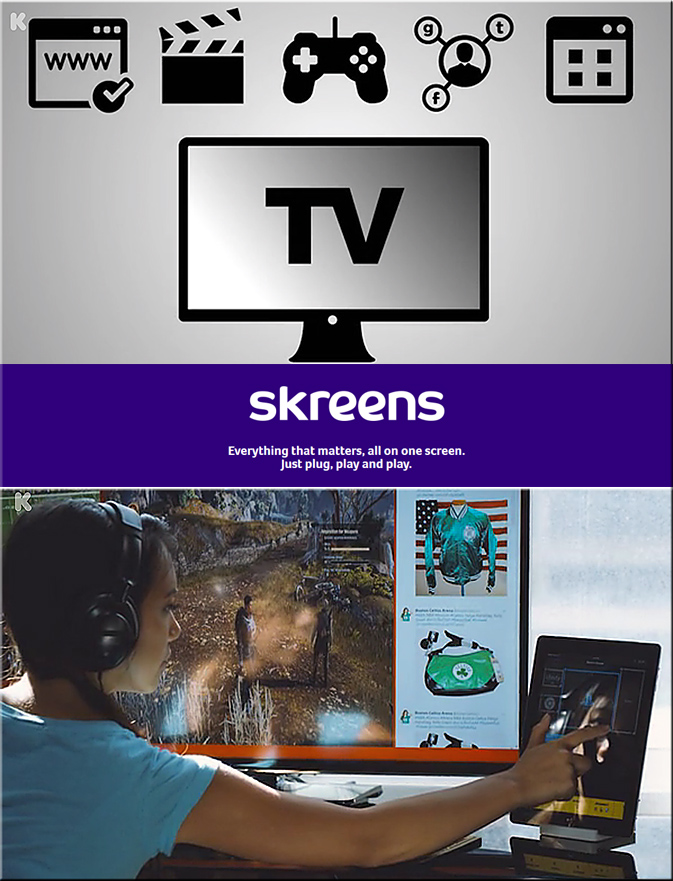
Imagine what learning could look like w/ the same concepts found in Skreens!


From DSC:
Imagine what learning could look like w/ the same concepts found in the
Skreens kickstarter campaign?  Where you can use your mobile device to direct what you are seeing and interacting with on the larger screen?  Hmmm… very interesting indeed! With applications not only in the home (and on the road), but also in the active classroom, the boardroom, and the training room.


See
Skreens.com
&
Learning from the Living [Class] Room


DanielChristian-AVariationOnTheSkreensTheme-9-29-15


Skreens-Sept2015Kickstarter


Skreens2-Sept2015Kickstarter


The Living [Class] Room -- by Daniel Christian -- July 2012 -- a second device used in conjunction with a Smart/Connected TV

From DSC:
Some of the phrases and concepts that come to my mind:

  • tvOS-based apps
  • Virtual field trips while chatting or videoconferencing with fellow learners about that experience
  • Virtual tutoring
  • Global learning for K-12, higher ed, the corporate world
  • Web-based collaborations and communications
  • Ubiquitous learning
  • Transmedia
  • Analytics / data mining / web-based learner profiles
  • Communities of practice
  • Lifelong learning
  • 24×7 access
  • Reinvent
  • Staying relevant
  • More choice. More control.
  • Participation.
  • MOOCs — or what they will continue to morph into
  • Second screens
  • Mobile learning — and the ability to quickly tie into your learning networks
  • Ability to contact teachers, professors, trainers, specialists, librarians, tutors and more
  • Language translation
  • Informal and formal learning, blended learning, active learning, self-directed learning
  • The continued convergence of the telephone, the television, and the computer
  • Cloud-based apps for learning
  • Flipping the classroom
  • Homeschooling
  • Streams of content
  • …and more!


Addendum:

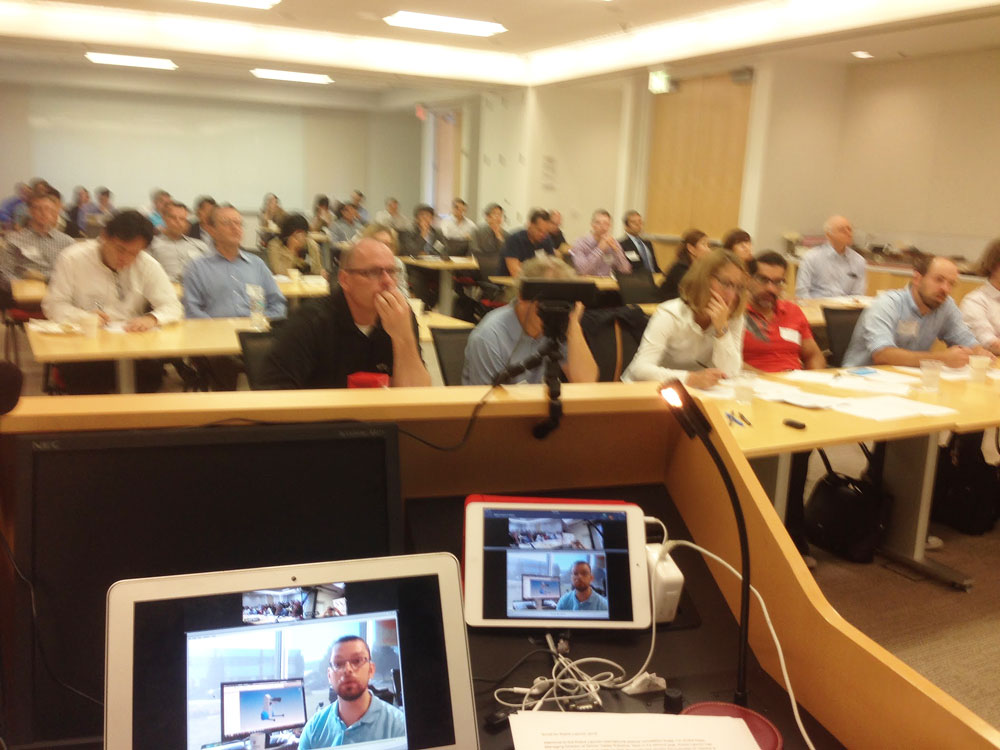
Check out this picture from Meet the winners of #RobotLaunch2015

Packed house at WilmerHale for the Robot Launch 2015 judging – although 2/3rds of the participants were attending and pitching remotely via video and web conferencing.


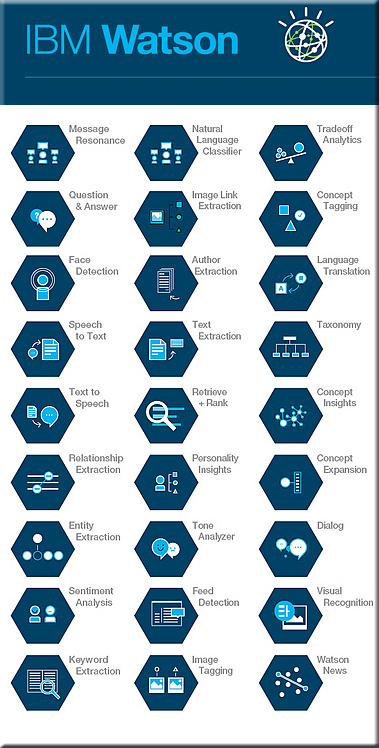
IBM Expands Watson Platform for Next Generation of Builders; Extends Industry’s Largest Portfolio of Cognitive APIs — from ibm.com

– New APIs Broaden Watson’s Language, Vision and Speech Capabilities
– Developer Tools Simplify Combining APIs and Data
– Upcoming Platform Innovations Previewed including Industry Data Sets & Robotics Integration
– New Watson Hub to Open in San Francisco

Excerpt:

SAN FRANCISCO – 24 Sep 2015: IBM (NYSE: IBM) today expanded the industry’s largest and most diverse set of cognitive APIs, technologies and tools for developers who are creating products, services and applications embedded with Watson.

The announcement was made by IBM during its forum on cognitive computing and Artificial Intelligence, where the company announced a new Watson location in San Francisco. IBM also previewed new platform innovations and research projects that will extend its industry-leading cognitive portfolio.


Excerpts from IBM Watson Ecosystem Partners in Market Building Businesses:

Student Career Counseling: Carney Labs is an education technology company that provides a platform embedded with Watson language capabilities to help schools learn about a student’s personality characteristics in order to build them a career roadmap. The Commonwealth of Virginia adopted a policy for all high schools in the state to leverage this app to use with students entering their freshman year.

Knowledge Management: Bloomfire  is a cloud-based knowledge network platform that helps employees within a company easily find the information they need to do their jobs. By scanning posts within the platform and automatically creating tags via the Watson data insights API, employees at companies including Whole Foods, Dun & Bradstreet and Etsy spend less time searching for information and more time doing meaningful work to improve company performance.

Research & Development: Inno360, an enterprise research and innovation management platform provider, is embedding a powerful combination of 7 Watson APIs for language and data insights into its SaaS platform to transform the way its clients, including Fortune 50 companies, conduct research and process big data. Inno360 is able to provide its clients advanced analysis of their R&D data to resolve product issues quickly and bring new products to market more rapidly.

Talent Sourcing and Matching: UnitesUs is a cloud based hiring & recruitment platform utilizing cognitive computing and big data analysis to match prospective employees to hiring organizations based on personality, company cultural fit, and core qualifications. By analyzing the personalities of job candidates leveraging Watson language capabilities and characterizing a company’s work environment, UnitesUs uses proprietary, automated matching algorithms to help companies, including imaging and electronics company Ricoh USA and fitness gym chain 24 Hour Fitness, make better hiring decisions.


ibmwatson-sept2015

 
© 2025 | Daniel Christian