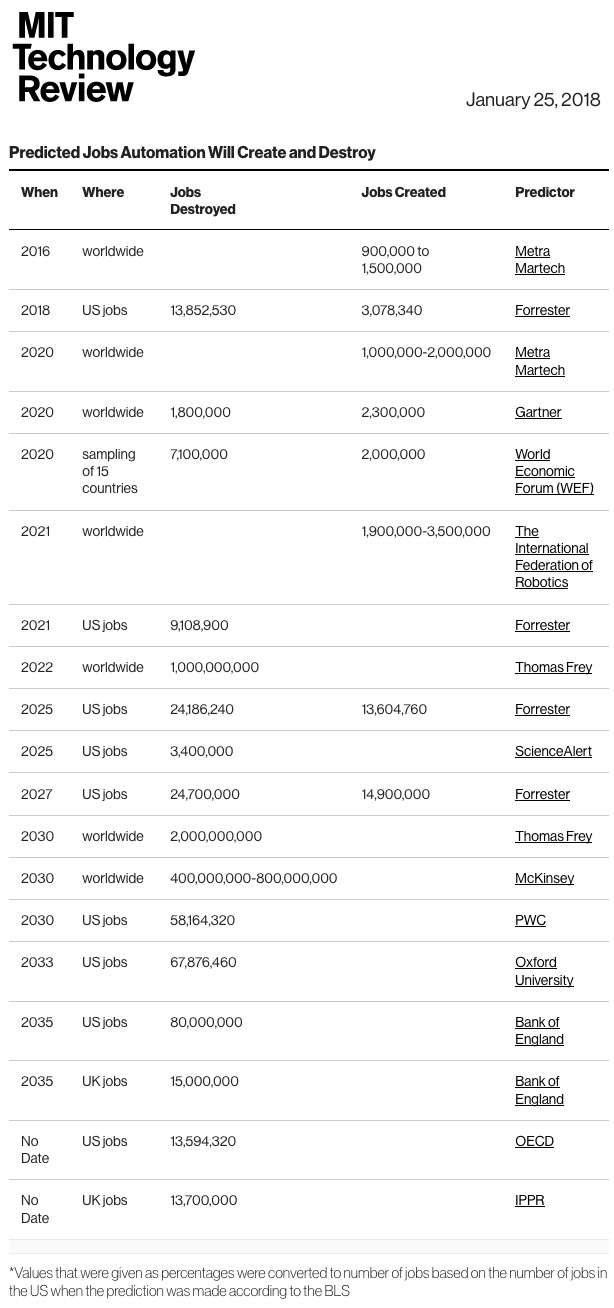
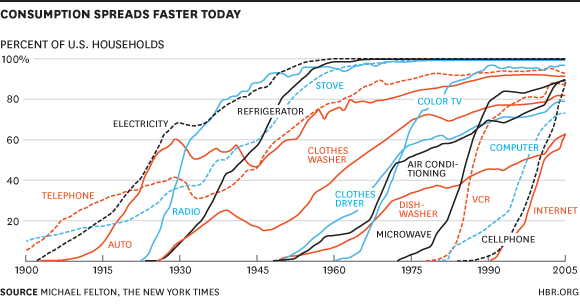
Every study we could find on what automation will do to jobs, in one chart — from technologyreview.com by Erin Winick
There are about as many opinions as there are experts.
Every study we could find on what automation will do to jobs, in one chart — from technologyreview.com by Erin Winick
There are about as many opinions as there are experts.
TV is (finally) an app: The goods, the bads and the uglies for learning — from thejournal.com by Cathie Norris, Elliot Soloway
Excerpts:
Television. TV. There’s an app for that. Finally! TV — that is, live shows such as the news, specials, documentaries (and reality shows, if you must) — is now just like Candy Crunch and Facebook. TV apps (e.g., DirecTV Now) are available on all devices — smartphones, tablets, laptops, Chromebooks. Accessing streams upon streams of videos is, literally, now just a tap away.
…
Plain and simple: readily accessible video can be a really valuable resource for learners and learning.
…
Not everything that needs to be learned is on video. Instruction will need to balance the use of video with the use of printed materials. That balance, of course, needs to take in cost and accessibility.
…
Now for the 800 pound gorilla in the room: Of course, that TV app could be a huge distraction in the classroom. The TV app has just piled yet another classroom management challenge onto a teacher’s back.
…
That said, it is early days for TV as an app. For example, HD (High Definition) TV demands high bandwidth — and we can experience stuttering/skipping at times. But, when 5G comes around in 2020, just two years from now, POOF, that stuttering/skipping will disappear. “5G will be as much as 1,000 times faster than 4G.” Yes, POOF!
From DSC:
Learning via apps is here to stay. “TV” as apps is here to stay. But what’s being described here is but one piece of the learning ecosystem that will be built over the next 5-15 years and will likely be revolutionary in its global impact on how people learn and grow. There will be opportunities for social-based learning, project-based learning, and more — with digital video being a component of the ecosystem, but is and will be insufficient to completely move someone through all of the levels of Bloom’s Taxonomy.
I will continue to track this developing learning ecosystem, but voice-driven personal assistants are already here. Algorithm-based recommendations are already here. Real-time language translation is already here. The convergence of the telephone/computer/television continues to move forward. AI-based bots will only get better in the future. Tapping into streams of up-to-date content will continue to move forward. Blockchain will likely bring us into the age of cloud-based learner profiles. And on and on it goes.
We’ll still need teachers, professors, and trainers. But this vision WILL occur. It IS where things are heading. It’s only a matter of time.
Virtual reality simulates classroom environment for aspiring teachers — from phys.org by Charles Anzalone, University at Buffalo
Excerpt (emphasis DSC):
Two University at Buffalo education researchers have teamed up to create an interactive classroom environment in which state-of-the-art virtual reality simulates difficult student behavior, a training method its designers compare to a “flight simulator for teachers.”
The new program, already earning endorsements from teachers and administrators in an inner-city Buffalo school, ties into State University of New York Chancellor Nancy L. Zimpher’s call for innovative teaching experiences and “immersive” clinical experiences and teacher preparation.
…
The training simulator Lamb compared to a teacher flight simulator uses an emerging computer technology known as virtual reality. Becoming more popular and accessible commercially, virtual reality immerses the subject in what Lamb calls “three-dimensional environments in such a way where that environment is continuous around them.” An important characteristic of the best virtual reality environments is a convincing and powerful representation of the imaginary setting.
Also related/see:
This start-up uses virtual reality to get your kids excited about learning chemistry — from Lora Kolodny and Erin Black
This start-up uses virtual reality to get your kids excited about learning chemistry from CNBC.
From DSC:
It will be interesting to see all the “places” we will be able to go and interact within — all from the comfort of our living rooms! Next generation simulators should be something else for teaching/learning & training-related purposes!!!
The next gen learning platform will likely offer such virtual reality-enabled learning experiences, along with voice recognition/translation services and a slew of other technologies — such as AI, blockchain*, chatbots, data mining/analytics, web-based learner profiles, an online-based marketplace supported by the work of learning-based free agents, and others — running in the background. All of these elements will work to offer us personalized, up-to-date learning experiences — helping each of us stay relevant in the marketplace as well as simply enabling us to enjoy learning about new things.
But the potentially disruptive piece of all of this is that this next generation learning platform could create an Amazon.com of what we now refer to as “higher education.” It could just as easily serve as a platform for offering learning experiences for learners in K-12 as well as the corporate learning & development space.
I’m tracking these developments at:
http://danielschristian.com/thelivingclassroom/
* Also see:
Blockchain, Bitcoin and the Tokenization of Learning — from edsurge.com by Sydney Johnson
Excerpt:
In 2014, Kings College in New York became the first university in the U.S. to accept Bitcoin for tuition payments, a move that seemed more of a PR stunt than the start of some new movement. Much has changed since then, including the value of Bitcoin itself, which skyrocketed to more than $19,000 earlier this month, catapulting cryptocurrencies into the mainstream.
A handful of other universities (and even preschools) now accept Bitcoin for tuition, but that’s hardly the extent of how blockchains and tokens are weaving their way into education: Educators and edtech entrepreneurs are now testing out everything from issuing degrees on the blockchain to paying people in cryptocurrency for their teaching.
eLearning: Predictions for 2018 — from news.elearninginside.com by Cait Etherington
Excerpts:
The educational technology sector grew substantially in 2017 and all signs point to even greater growth in 2018. Over the past year, the sector was buoyed by several key factors, including a growing recognition that as big data restructures work at an unprecedented pace, there is an urgent need to rethink how education is delivered. In fact, there is now growing evidence that colleges and universities, especially if they continue to operate as they have in the past, will simply not be able to produce the workers needed to fill tomorrow’s jobs. Ed tech, with its capacity to make education more affordable, flexible, and relevant, is increasingly being embraced as the answer to the Fourth Industrial Revolution’s growing talent pipeline challenges.
…
12 tech trends that will define 2018 — from businessinsider.com by Chris Weller
Excerpts:
No one can predict how the future will shake out, but we can make some educated guesses.
Global design and strategy firm frog has shared with Business Insider its forecasts for the technologies that will define the upcoming year. Last year, the firm correctly predicted that buildings would harness the power of nature and that businesses would continue using artificially-intelligent bots to run efficiently.
Get ready to step into the future.

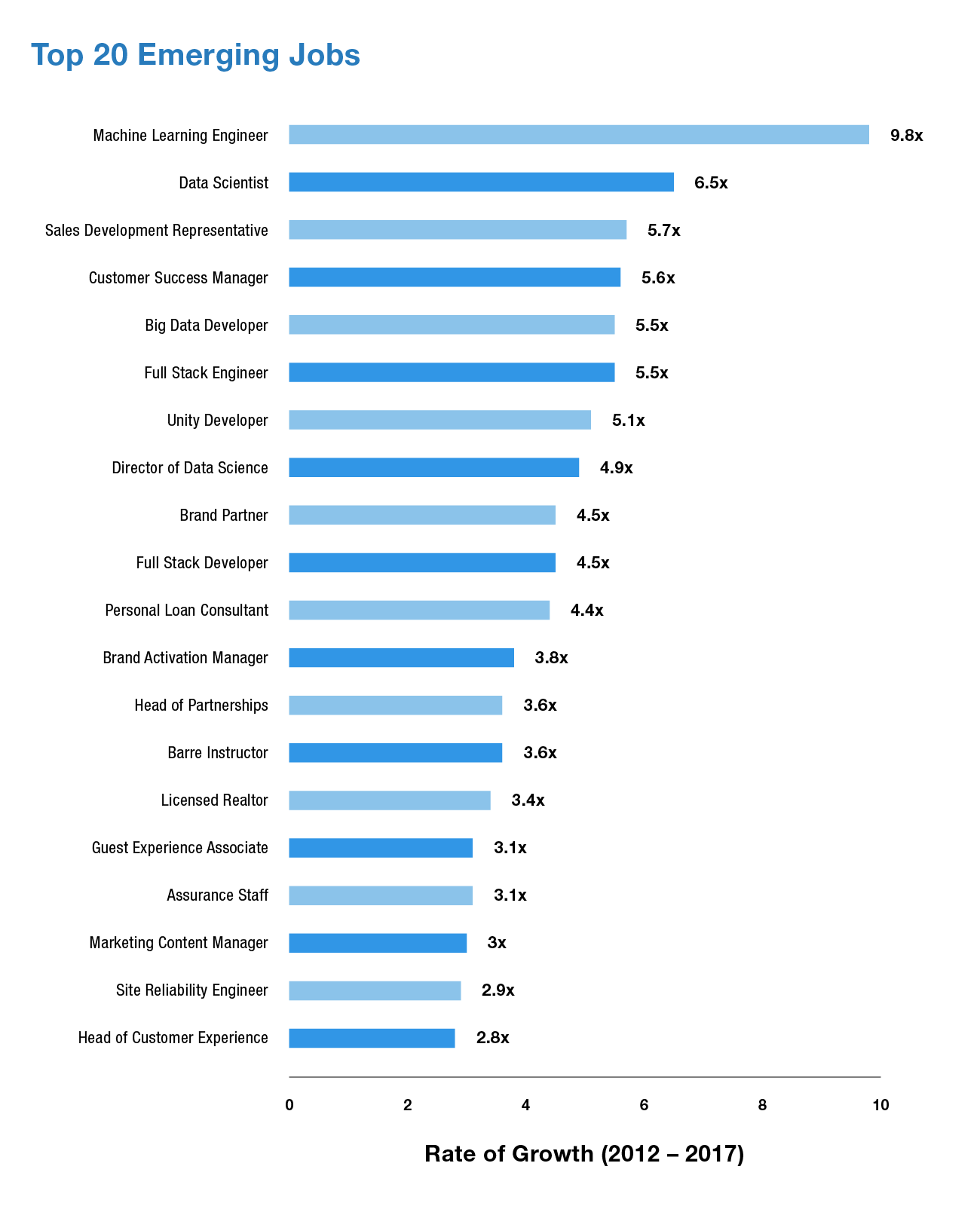
LinkedIn’s 2017 U.S. Emerging Jobs Report — from economicgraph.linkedin.com
Excerpt:
Here’s what we found:
Software engineers are feeding into nearly all of these emerging jobs.
Even further, it’s estimated that 65% of children entering primary school today will ultimately hold jobs that don’t yet exist.
Future-proofing skills is critical: Some of these emerging skills didn’t even exist five years ago, and many professionals are not confident their current skill set will be relevant within the next 1-2 years.
Also see:
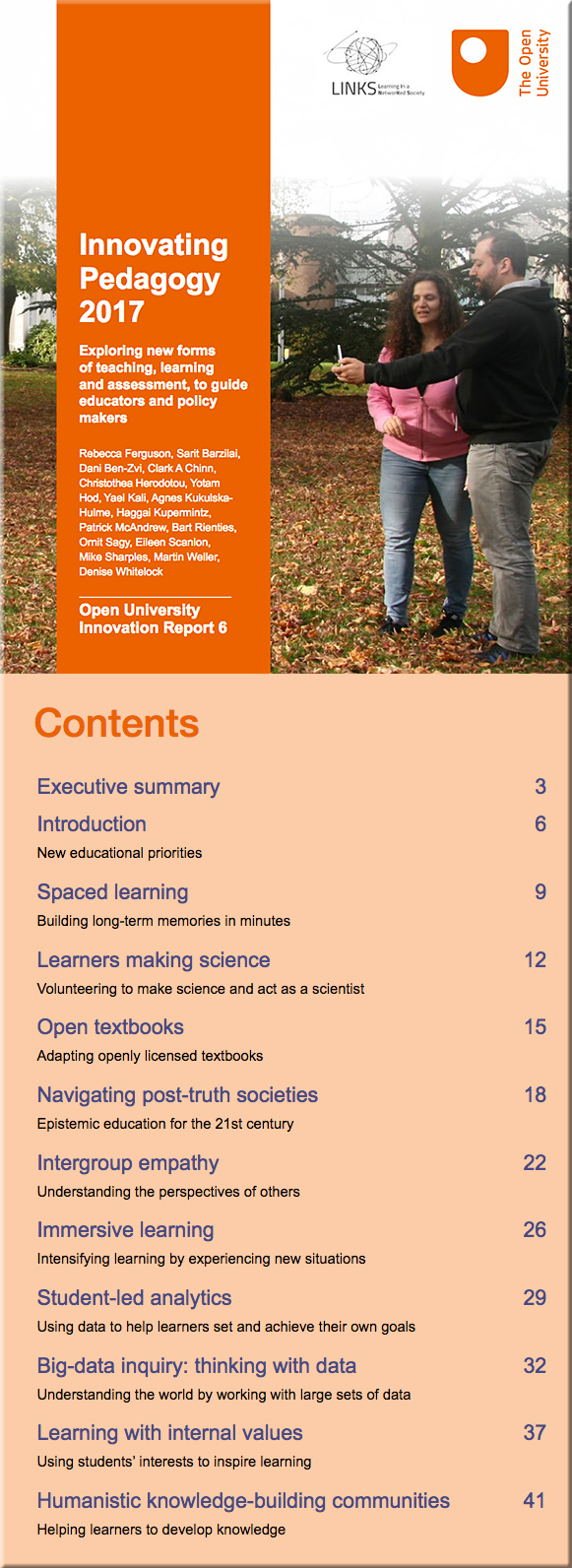
Innovating Pedagogy 2017 — from iet.open.ac.uk
Excerpt:
This series of reports explores new forms of teaching, learning and assessment for an interactive world, to guide teachers and policy makers in productive innovation. This sixth report proposes ten innovations that are already in currency but have not yet had a profound influence on education. To produce it, a group of academics at the Institute of Educational Technology in The Open University collaborated with researchers from the Learning In a NetworKed Society (LINKS) Israeli Center of Research Excellence (I-CORE). We proposed a long list of new educational terms, theories, and practices. We then pared these down to ten that have the potential to provoke major shifts in educational practice, particularly in secondary and tertiary education. Lastly, we drew on published and unpublished writings to compile the ten sketches of new pedagogies that might transform education. These are summarised below in an approximate order of immediacy and timescale to widespread implementation.
Excerpt:
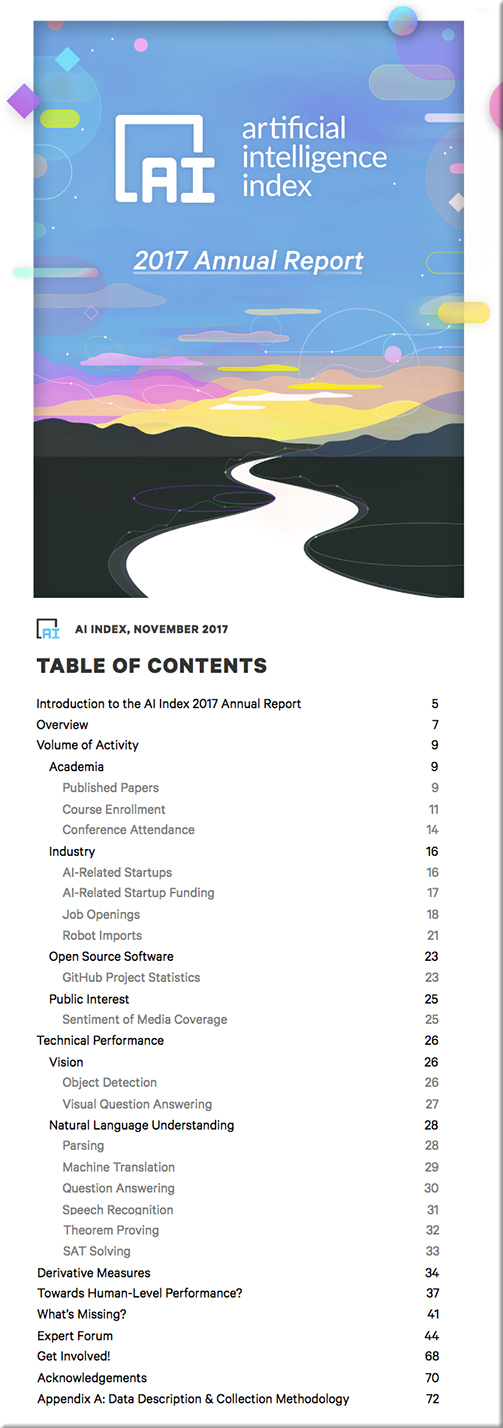
Artificial Intelligence has leapt to the forefront of global discourse, garnering increased attention from practitioners, industry leaders, policymakers, and the general public. The diversity of opinions and debates gathered from news articles this year illustrates just how broadly AI is being investigated, studied, and applied. However, the field of AI is still evolving rapidly and even experts have a hard time understanding and tracking progress across the field.
Without the relevant data for reasoning about the state of AI technology, we are essentially “flying blind” in our conversations and decision-making related to AI.
Created and launched as a project of the One Hundred Year Study on AI at Stanford University (AI100), the AI Index is an open, not-for-profit project to track activity and progress in AI. It aims to facilitate an informed conversation about AI that is grounded in data. This is the inaugural annual report of the AI Index, and in this report we look at activity and progress in Artificial Intelligence through a range of perspectives. We aggregate data that exists freely on the web, contribute original data, and extract new metrics from combinations of data series.
All of the data used to generate this report will be openly available on the AI Index website at aiindex.org. Providing data, however, is just the beginning. To become truly useful, the AI Index needs support from a larger community. Ultimately, this report is a call for participation. You have the ability to provide data, analyze collected data, and make a wish list of what data you think needs to be tracked. Whether you have answers or questions to provide, we hope this report inspires you to reach out to the AI Index and become part of the effort to ground the conversation about AI.
Google, Amazon Find Not Everyone Is Ready for AI — from wired.com by Tom Simonite
Excerpt:
Yet as Amazon and Google seek greater riches by infusing the world with artificial intelligence, they’ve started their own consulting operations, lending out some of their prized AI talent to customers. The reason: Those other businesses lack the expertise to take advantage of techniques such as machine learning.
…
The expertise shortage upsets the usual dynamic of the cloud market, where Amazon, Google, and others mostly compete on price and technical features. “If you’re a random manufacturing company in the midwest you may have money, but it’s hard to attract a $250,000-a-year Stanford PhD to work for you,” says Diego Oppenheimer, whose Google-backed startup provides tools that help companies deploy machine-learning software. Companies in that situation may be more swayed by an offer of help building AI, than pricing and performance, he says.
The Ivory Tower Can’t Keep Ignoring Tech — from nytimes.com by Cathy O’Neil
Excerpt:
We need academia to step up to fill in the gaps in our collective understanding about the new role of technology in shaping our lives. We need robust research on hiring algorithms that seem to filter out people with mental health disorders, sentencing algorithms that fail twice as often for black defendants as for white defendants, statistically flawed public teacher assessments or oppressive scheduling algorithms. And we need research to ensure that the same mistakes aren’t made again and again. It’s absolutely within the abilities of academic research to study such examples and to push against the most obvious statistical, ethical or constitutional failures and dedicate serious intellectual energy to finding solutions. And whereas professional technologists working at private companies are not in a position to critique their own work, academics theoretically enjoy much more freedom of inquiry.
There is essentially no distinct field of academic study that takes seriously the responsibility of understanding and critiquing the role of technology — and specifically, the algorithms that are responsible for so many decisions — in our lives.
There’s one solution for the short term. We urgently need an academic institute focused on algorithmic accountability. First, it should provide a comprehensive ethical training for future engineers and data scientists at the undergraduate and graduate levels, with case studies taken from real-world algorithms that are choosing the winners from the losers. Lecturers from humanities, social sciences and philosophy departments should weigh in.
Somewhat related:
Updating Education for the Evolving Job Market: Learning at the Pace of Life and Work — from huffingtonpost.com by Sophie Wade
Excerpt (emphasis DSC):
A technology-stimulated, connected, and accelerated marketplace is generating different roles and additional skills requirements for us as workers. The traditional model of completing our lifelong education needs before we enter the workforce is now obsolete. On-the-job experience must now be supplemented as business and technological requirements evolve significantly and rapidly. Compelling new multilevel learning options are emerging to cater to the new necessity of updating important knowledge and capabilities at work. Many new offerings are online and modular in order to be accessible and flexible, giving labor force participants greater opportunity to remain relevant and competitive.
Since the beginning of the Industrial Era, evolution typically occurred from generation to generation. New developments were adopted by incoming cohorts, adding to and then replacing well-established workers’ existing practices of which could be phased out gradually. However, the exponential pace that is characteristic of the Fourth Industrial Revolution is requiring modifications to be absorbed and adapted within a generation accompanied by frequent incremental updates and revisions. Innovative learning models and modules that target incoming and existing working populations are being built out to respond to business-related requirements as new fields, disciplines, and roles appear and are established.
I talked to Anant Agarwal, CEO and Founder of edX, and Professor of Electrical Engineering and Computer Science at MIT about the situation for new workforce entrants and the future education of workers. He spoke of what he called “MOOC 2.0” as the next phase of evolution of this high-profile MOOC (Massively Open Online Course) platform and the strategic rationale and content of edX’s new MicroMasters program offerings.
As a member of the International Education Committee, at edX we are extremely aware of the changing nature of work and jobs. It is predicted that 50 percent of current jobs will disappear by 2030.
Anant Agarwal, CEO and Founder of edX, and
Professor of Electrical Engineering and Computer Science at MIT
From DSC:
We are moving towards providing up-to-date, relevant “streams of content” (which will in many cases represent unbundled content/courses). Mark my words, that’s the future that we’re heading for — and the future that we’ll need to successfully adapt to the new, exponential pace of change. Organizations offering such streams will be providing a valuable service in terms identifying, presenting, curating the most relevant, up-to-date content.


From DSC:
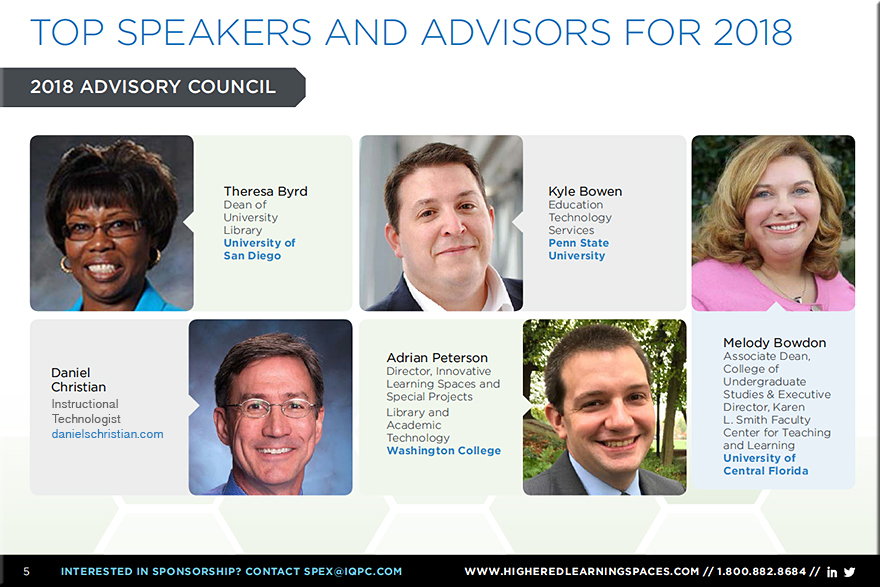
I am honored to be currently serving on the 2018 Advisory Council for the Next Generation Learning Spaces Conference with a great group of people. Missing — at least from my perspective — from the image below is Kristen Tadrous, Senior Program Director with the Corporate Learning Network. Kristen has done a great job these last few years planning and running this conference.
NOTE:
The above graphic reflects a recent change for me. I am still an Adjunct Faculty Member
at Calvin College, but I am no longer a Senior Instructional Designer there.
My brand is centered around being an Instructional Technologist.
This national conference will be held in Los Angeles, CA on February 26-28, 2018. It is designed to help institutions of higher education develop highly-innovative cultures — something that’s needed in many institutions of traditional higher education right now.
I have attended the first 3 conferences and I moderated a panel at the most recent conference out in San Diego back in February/March of this year. I just want to say that this is a great conference and I encourage you to bring a group of people to it from your organization! I say a group of people because a group of 5 of us (from a variety of departments) went one year and the result of attending the NGLS Conference was a brand new Sandbox Classroom — an active-learning based, highly-collaborative learning space where faculty members can experiment with new pedagogies as well as with new technologies. The conference helped us discuss things as a diverse group, think out load, come up with some innovative ideas, and then build the momentum to move forward with some of those key ideas.
If you haven’t already attended this conference, I highly recommend that you check it out. You can obtain the agenda/brochure for the conference by providing some basic contact information here.
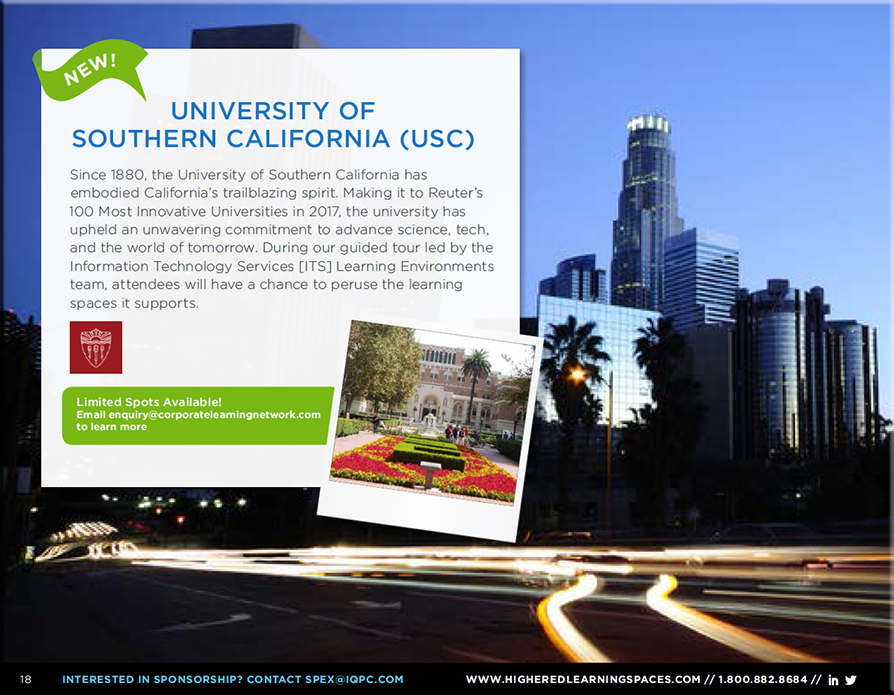
Per Kristen Tadrous, here’s why you want to check out USC:
Building Spaces to Inspire a Culture of Innovation — a core theme at the 4th Next Generation Learning Spaces summit, taking place this February 26-28 in Los Angeles. An invaluable opportunity to meet and hear from like-minded peers in higher education, and continue your path toward lifelong learning. #ngls2018 http://bit.ly/2yNkMLL
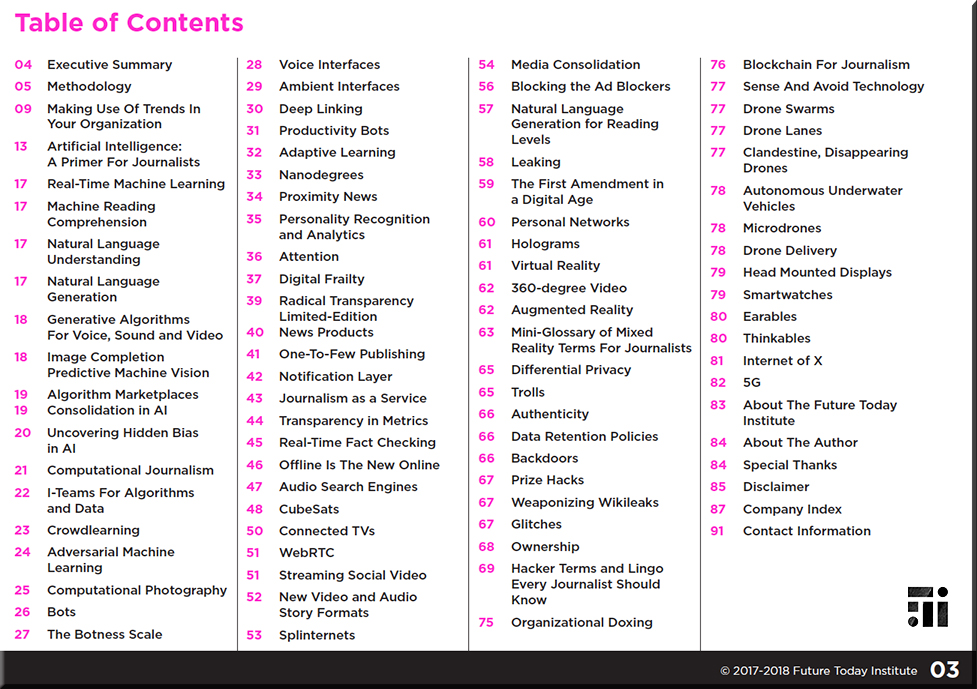
2018 Tech Trends For Journalism Report — from the Future Today Institute
Key Takeaways
Those in the news ecosystem should factor the trends in this report into their strategic thinking for the coming year, and adjust their planning, operations and business models accordingly.
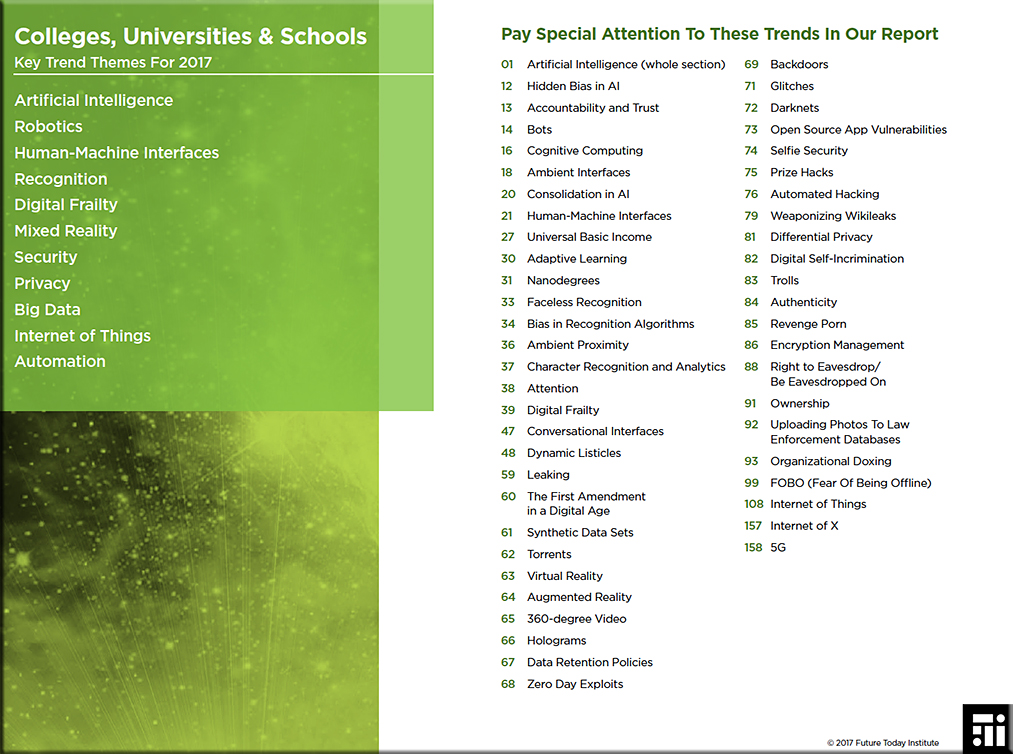
2017 Tech Trends Annual Report — from the Future Today Institute; this is the first I’ve seen this solid report
Excerpts:
This year’s report has 159 trends.
This is mostly due to the fact that 2016 was the year that many areas of science and technology finally started to converge. As a result we’re seeing a sort of slow-motion explosion––we will undoubtedly look back on the last part of this decade as a pivotal moment in our history on this planet.
…
Our 2017 Trend Report reveals strategic opportunities and challenges for your organization in the coming year. The Future Today Institute’s annual Trend Report prepares leaders and organizations for the year ahead, so that you are better positioned to see emerging technology and adjust your strategy accordingly. Use our report to identify near-future business disruption and competitive threats while simultaneously finding new collaborators and partners. Most importantly, use our report as a jumping off point for deeper strategic planning.
Also see:
Emerging eLearning Tools and Platforms Improve Results — from learningsolutionsmag.com
DevLearn Attendees Learn How to ‘Think Like a Futurist’ — from learningsolutionsmag.com
Excerpt:
How does all of this relate to eLearning? Again, Webb anticipated the question. Her response gave hope to some—and terrified others. She presented three possible future scenarios:
In an attempt to end on a strong positive note, Webb said that “the future hasn’t happened yet—we think” and encouraged attendees to take action. “To build the future of learning that you want, listen to weak signals now.”


10 really hard decisions coming our way — from gettingsmart.com by Tom Vander Ark
Excerpt (emphasis DSC):
Things are about to get interesting. You’ve likely heard that Google’s DeepMind recently beat the world’s best Go player. But in far more practical and pervasive ways, artificial intelligence (AI) is creeping into every aspect of life–every screen you view, every search, every purchase, and every customer service contact.
What’s happening? It’s the confluence of several technologies–Moore’s law made storage, computing, and access devices almost free.

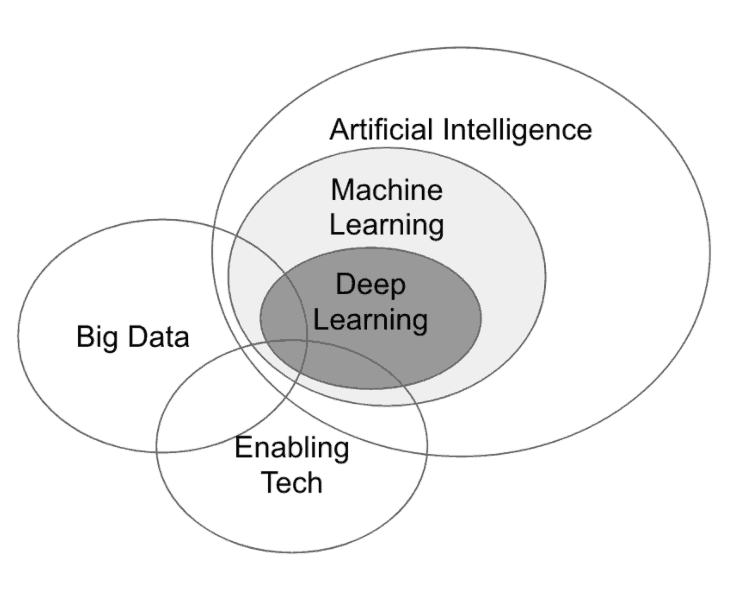
This Venn diagram illustrates how deep learning is a subset of AI and how, when combined with big data, can inform enabling technologies in many sectors. For examples, to AI and big data add:
While there is lots of good news here–diseases will be eradicated and clean energy will be produced–we have a problem: this stuff is moving faster than civic infrastructure can handle. Innovation is outpacing public policy on all fronts. The following are 10 examples of issues coming at us fast that we (in the US in particular) are not ready to deal with.
From DSC:
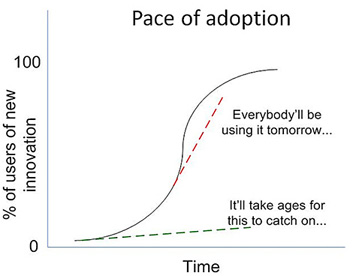
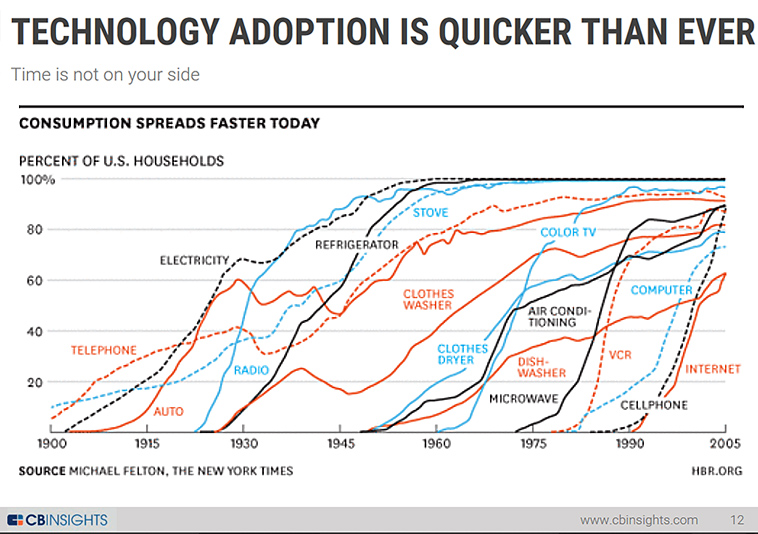
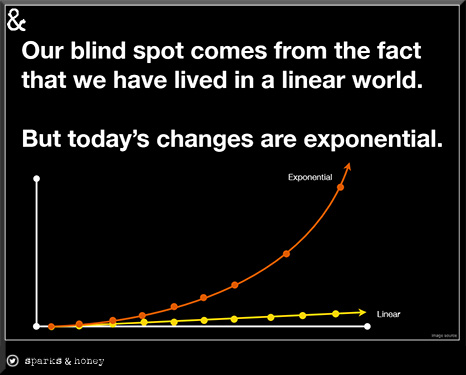
Readers of this blog will know that I’m big on pulse-checking the pace of technological change — because it has enormous ramifications for societies throughout the globe, as well as for individuals, workforces, corporations, jobs, education, training, higher education and more. Readers of this blog will again hear me say that the pace of change has changed. We’re now on an exponential pace/trajectory (vs. a slow, steady, linear path).
“Innovation is outpacing public policy on all fronts.”
How true this is. Our society doesn’t know how to deal with this new pace of change. How shall we tackle this thorny issue?
From DSC:
Some of the largest waves of change that are hitting the beaches of numerous societies throughout the globe are coming from technological changes such as:
But in all of these developments, what is common amongst them is that the pace of change has changed. It’s much faster now. In fact, we are no longer on a linear path of slow, steady, incremental changes. We are now on an exponential trajectory – or pace – of change.


This new pace of change is starting to have profound implications for societies, individuals, institutions of higher education, and workforces throughout the globe. Some of these ramifications include:
Yet the changes aren’t just arising from technological changes. For institutions of higher education, there have been other areas of change that bring with them significant impact, such as:
Navigating these rough waters is not easy. But the key questions now are:

From DSC:
In Part I, I looked at the new, exponential pace of change that colleges, community colleges and universities now need to deal with – observing the enormous changes that are starting to occur throughout numerous societies around the globe. If we were to plot out the rate of change, we would see that we are no longer on a slow, steady, incremental type of linear pathway; but, instead, we would observe that we are now on an exponential trajectory (as the below graphic from sparks & honey very nicely illustrates).

How should colleges and universities deal with this new, exponential pace of change?
1) I suggest that you ensure that someone in your institution is lifting their gaze and peering out into the horizons, to see what’s coming down the pike. That person – or more ideally, persons – should also be looking around them, noticing what’s going on within the current landscapes of higher education. Regardless of how your institution tackles this task, given that we are currently moving at an incredibly fast pace, this trend analysis is very important. The results from this analysis should immediately be integrated into your strategic plan. Don’t wait 3-5 years to integrate these new findings into your plan. The new, exponential pace of change is going to reward those organizations who are nimble and responsive.
2) I recommend that you look at what programs you are offering and consider if you should be developing additional programs such as those that deal with:
3) If you are not already doing so, I recommend that you immediately move to offer a robust lineup of online-based programs. Why do I say this? Because:

4) I recommend that you move towards offering more opportunities for lifelong learning, as learners need to constantly add to their skillsets and knowledge base in order to remain marketable in today’s workforce. This is where adults greatly appreciate – and need – the greater flexibility offered by online-based means of learning. I’m not just talking about graduate programs or continuing studies types of programs here. Rather, I’m hoping that we can move towards providing streams of up-to-date content that learners can subscribe to at any time (and can drop their subscription to at any time). As a relevant side note here, keep your eyes on blockchain-based technologies here.
5) Consider the role of consortia and pooling resources. How might that fit into your strategic plan?
6) Consider why bootcamps continue to come onto the landscape. What are traditional institutions of higher education missing here?
7) And lastly, if one doesn’t already exist, form a small, nimble, innovative group within your organization — what I call a TrimTab Group — to help identify what will and won’t work for your institution.