No surprise: Accrediting agency opts to stunt innovation — from disruptingclass.mhprofessional.com by Clayton Christensen

Excerpts:

Several years ago I offered words of praise when Tiffin College partnered with Altius Education to create Ivy Bridge College, a two-year online institution dedicated to providing an affordable higher education option that boosted the transfer rate of two-year students to four-year institutions.

The Higher Learning Commission (HLC), the accrediting body for the North Central region and thus this partnership because Tiffin College is located in an Ohio city that was once populated with industry, agreed strongly, as in 2010 it approved continuing accreditation for Tiffin University and Ivy Bridge College through 2020. At the time, the HLC lauded the partnership.

In the last few weeks, everything changed.


From DSC:
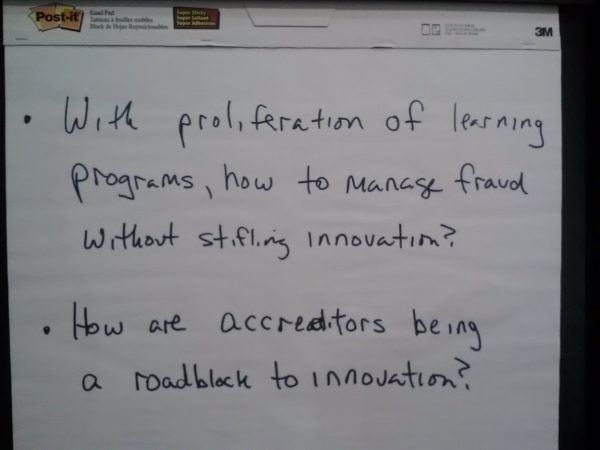
What needs to be done to force accreditation bodies to change who can be on these accreditation teams?  Why is it that the people that institutions of higher education claim to serve can’t be on such boards?  i.e. one must be an “insider” to the higher education industry, but not an “outsider?”

Pursuing the current status quo may have a serious backfiring effect when alternatives present themselves.  In fact, taking steps to insure the status quo only serves to put more energy behind MOOCs and puts yet more heat in higher ed’s kitchen.  I would hope that folks inside higher ed would take the steps to allow for more experimentation and innovation and to take some heat out of the kitchen.


The key, he added, was to try to avoid mistakes like those made by the music industry on its road to iTunes. “This is a Napster moment for education,” he said. “It’s a big opportunity and an existential threat.”
— from A “Napster Moment” in Education


From DSC:
The article below made me wonder…

What would happen if the U.S. Federal Government got tired of waiting for institutions of traditional higher education to respond significantly  enough to their satisfaction?  Would they re-allocate/redirect their funding elsewhere?

(Please leave a comment if you know of cases where they are already doing this.
I have a lot to learn about this, I’m sure.)


No Love for Accreditation — from insidehighered.com by Libby A. Nelson

Excerpt:

But when lawmakers do sit down to rewrite the law governing financial aid programs, accreditation will be under a particularly harsh spotlight.

Members of Congress of both parties seemed to agree more with the critics, saying they were skeptical that traditional accreditation was flexible enough to respond to new developments in higher education.


Northern Arizona wins regional accreditor’s approval for personalized learning program– from nextgenlearning.org by Nancy Millichap

Excerpt (emphasis DSC):

It’s all systems go, at last: Northern Arizona University, one of the ten institutions presently developing breakthrough degree programs with NGLC support, recently got the green light to start enrolling students in their Personalized Learning program. The Higher Learning Commission of the North Central Association of Colleges and Schools (HLC), NAU’s regional accreditor, approved their application to offer a competency-based degree program that moves away from the credit hour standard to use an approach referred to as “direct assessment” instead. In this approach, students receive credit related not to their presence in a real or virtual classroom for a specified period of time but instead to their successful completion of assessments that show they have mastered clearly defined competencies or are able to perform specific, predetermined tasks. HLC has created a pilot group of four institutions now approved to offer a competency-based degree program: NAU, the University of Wisconsin Colleges (a system of two-year campuses), the University of Wisconsin at Milwaukee, and Capella University.

Traditional institutions will close, number of colleges and universities will rise (audio and transcript) — from evoLLLution.com (where LLL stands for lifelong learning) by Richard DeMillo | Director of the Center for 21st Century Universities, Georgia Institute of Technology
Excerpt (emphasis DSC):
.

Well, for me, it always boils down to value. People misunderstand this as assigning value based on salaries or employability, but I mean value in the larger sense. You have to have a reason to ask students to pay more than the marginal costs of delivering education. And with all these revolutions in technology for course delivery, that marginal cost is going to zero very, very quickly [think journalism]. So, every institution that’s going to survive, I think, over the next 50 years, is going to have to make that case. Why is it that tuition at this institution is justified?

The interesting thing about this is it’s going to be accelerated because the old bureaucracies, the old institutional models… are crumbling. At least, their boundaries are crumbling. Let me tell you what I mean by that.

The accrediting agencies, which I think traditionally have had — at least for the last 120 years or so—an institutional focus, are now shifting their focus to students; to competencies, to demonstrations of what students know. And that really starts to cut against institutional entitlement.

I think the conclusion of all this is that, as it becomes harder and harder for… a “Me-Too Institution” to argue for a marginal increase in price, the amount of money that those institutions are going to have available to them to spend on anything but core mission for students is also going to go to zero. So, this is kind of a virtuous cycle; … institutions that are unable to make the value proposition will find themselves more and more strapped for discretionary funds in order to move themselves into a different space. And that’s an ending that’s not very good for most institutions.

From DSC:
How will our/your organization keep from becoming a commodity?  What are we/you all going to bring to the table that’s different, unique, and worth paying for?


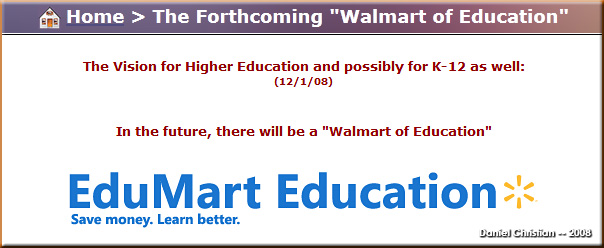
WalmartOfEducation-Christian2008


Also see:

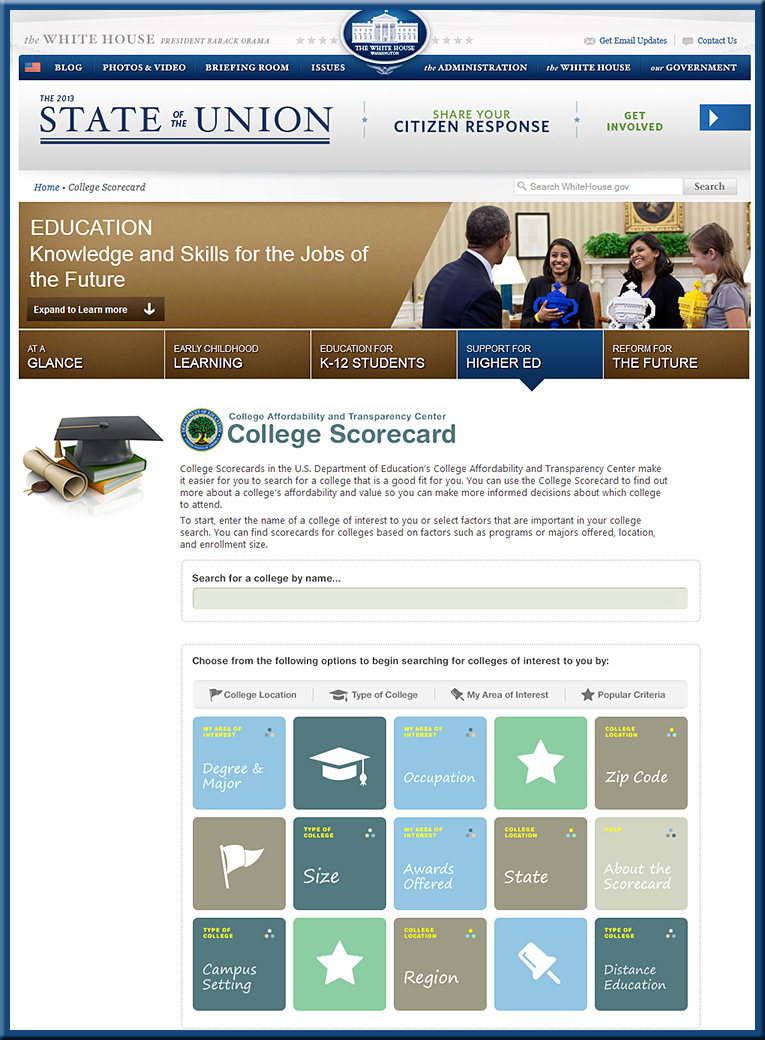
CollegeScorecard-2-13-13


Also see:

On notice, again — from insidehighered.com by Libby A. Nelson

Excerpt (emphasis DSC):

WASHINGTON — President Obama on Tuesday night called for major changes to the criteria accreditors use to evaluate colleges, asking Congress to either require accreditors to take college prices and educational value into account or to create an alternative system based on “performance and results.Either could mark a significant shift in how the federal government judges higher education quality and eligibility for financial aid programs.


From DSC:

  • This speaks directly to higher ed’s ability — or inability — to stay relevant, be responsive, and to reinvent itself.
    .
  • Accreditation teams should include many others who do not work for — nor are in any way connected to — a current institution of higher education.
    .
  • If higher ed can’t respond, the conversation will continue to move away from traditional pathways/institutions and people will find their own ways of getting ahead/surviving.


Curbing the cost of college: Coursera wins approval to offer online courses for credit for under $200 — from techcrunch.com by Rip Empson

Excerpt:

Up until now, the startup has not offered degrees or credits for its online classes, which has meant that Coursera classes have existed mostly as a way to pursue supplementary or continuing education — not as part of degree programs. But that changed today, as Coursera announced [last Thursday morning] that five of its courses have been approved for “credit equivalency” by the American Council on Education (ACE). This means that students who complete these five courses can receive college transfer credit at institutions that accept ACE recommendations.

So, importantly, Coursera’s new credit equivalency doesn’t automatically mean that every university it has partnered with automatically guarantees credit for the approved courses; instead, institutions have the option to accept or decline credit. In other words, it’s up to them.

Also see:

Creative learning on mass, or the MIT MOOC– from daveswhiteboard.com by Dave Ferguson

Excerpt (emphasis DSC):

Just this morning, I came across MIT Media Lab’s announcement for its Learning Creative Learning online course. You can read about it or skim the outline to make your own judgment; I’m enjoying the laid-back description, which tracks with my previous massive open online course experience:

  • “This is a big experiment. Things will break. We don’t have all the answer.”
  • “We hope that participants will jump in as collaborators rather than passive recipients.”
  • “Check out our shiny new platform. Actually, don’t, because we didn’t build a shiny new platform.”

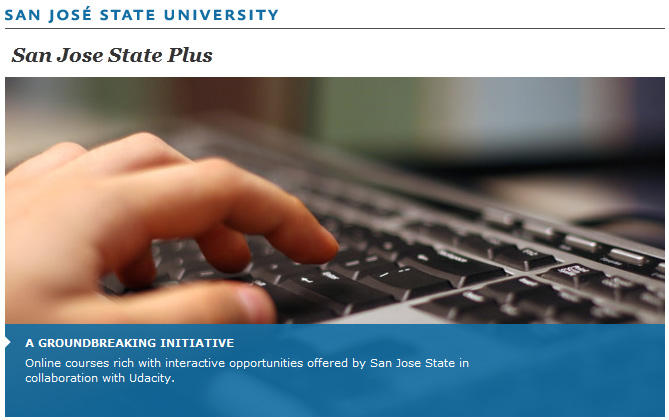
SanJoseStatePlus-UdacityPartnership-Jan2013


Also see:

Excerpt:

Today Udacity is thrilled to announce a partnership with San Jose State University to pilot three courses — Entry-Level Mathematics, College Algebra, and Elementary Statistics — available online at an affordable tuition rate and for college credit. To my knowledge, this is the first time a MOOC has been offered for credit and purely online. Much credit for this partnership goes to Mo Qayoumi and Ellen Junn, president and provost of SJSU, and to the five fearless SJSU professors who have chosen to work with us at Udacity to explore this new medium. The offices of Governor Brown and CSU Chancellor White have also been critically important to this partnership for their leadership and expediency. Last but not least, I want to personally thank our great Udacians who, like everyone on this list, have worked endless hours to drive innovation.
Over the past year, MOOCs have received a lot of attention in the media and education circles mostly because so many students are taking advantage of the course for free. Predictions that MOOCs would fundamentally change higher education often revolved around the fact that the courses have unprecedented reach and affordability.


From DSC:
Given that such “Walmarts of Education” (i.e. solid learning at a greatly reduced prices) continue to develop, what’s our/your plans for responding to this trend? How are we/you going to compete?  What’s our/your vision and strategy?  By the way, you can look all you want to for data — but at the end of the day, it’s likely with this sort of thing that you won’t find all of the data that you require to make a decision. Examples:

  • When I began working for Kraft Foods in 1990 (brought in to roll out email to 66 plants at the time), I believed in the power of email when few others did. Email was viewed as “fluff” and it would never be used for solid business practices; management put the project on hold. But I kept working with email at Kraft — trying to get others to use it. If you looked for data back then, you wouldn’t find it. But by the time I left Kraft in 1997, thousands of people could communicate with thousands of other people throughout the world — within minutes.
    .
  • When Alexander Graham Bell introduced the telephone, what data would support the success of his invention?  I suppose you could have pulled some data on the usage of the telegraph, but even then, vision would have had to trump the data (the ancestor of Western Union rejected his invention, as they questioned why anyone would need/use a telephone when there was already the telegraph in usage).
    .
  • Such technological developments often are not so easy to back up with data; they require some vision, experimentation, and risk taking.


Accreditation actions increased during financial downturn — from The Chronicle by Eric Kelderman

Excerpt:

“Not long ago, accreditation sanctions were rare. Now, in response to growing government criticism of poor disclosure about quality, pricing, and outcomes, as well as inefficient cost management, accreditors are taking more aggressive and quicker actions to bolster their role in demonstrating quality and performance standards in U.S. higher education,” the report says.

The main reasons for the actions are, not surprisingly, financial troubles for colleges struggling with endowment losses, cuts in state appropriations, and the growing institutional costs of student financial aid. But accreditors are also focusing more attention on outcomes, including assessing student learning and graduation rates, the report says.

From DSC:
If the public wants change in higher ed, I might suggest starting with changing who is on the accreditation teams.  Historically speaking, things don’t seem to have changed that much with all insiders on these teams. 

(I wondered when these agencies were going to start sensing some heat in their kitchens.  If I could make at least one prediction for 2013, it’s that the temperatures in those kitchens are going to go up in 2013. I’ll probably make more predictions, but I think that one is low-hanging fruit!)


Taking the next step in online education with credit equivalency — from forbes.com by Daphne Koller & Andrew Ng

Excerpt:

At MOOCs like Coursera, offering web-based courses is the first step in increasing access to education for millions of people around the world.  But for many students, much of the value of taking a course is lost if that course is not helpful in allowing them to obtain a degree.  To help address this limitation, we recently announced a collaboration with American Council on Education (ACE) to begin a credit-equivalence evaluation of some courses offered on Coursera — which means that in the future, students will potentially have the opportunity to receive college transfer credit at institutions choosing to accept the ACE recommendations.  This move is well in line with the current trend to provide students with credit for prior learning (including on-the-job training) and for competency, a trend whose aim is to increase completion rate and reduce time to completion.

Does the U.S. accreditation system discriminate against online learning? — from Tony Bates

Excerpt:

Furthermore, problems remain in both Canada and the USA if students want to start taking online courses from an institution out of state or province then use that for advancement by transferring to a local university. The answer of course is more flexible credit transfer arrangements, more flexible prior learning assessment, and challenge exams, where students can demonstrate their learning without having to work through courses they have already taken elsewhere. Even some of the more prestigious research universities in Canada are realising that they need to be more flexible if they are to attract lifelong learners, for instance. Thus it’s as much up to the institutions as the regulators to ensure there is some flexibility in the system for students taking out of state or out of province online courses.

Yes, there needs to be sensible protections against fraud and fly-by-night online operators, but too often the restrictions, regulations and barriers are steeped in practices that no longer apply in an open, knowledge-based society. Every institution should be examining the structure of its courses, its admission requirements, its arrangements for credit transfer and prior learning assessment, and its strategy for lifelong learning, if it is to be fit for purpose in the 21st century. It is not an issue just of online learning.

From DSC:
Questions I often ponder re: accreditation:

  • Who sits on accrediting boards these days? Is it not people inside the current system?
  • What responsibilities do accreditation bodies have on them to enable/support change (where appropriate)?
  • Are such accreditation bodies feeling the pressure to help colleges and universities reinvent themselves in order to stay relevant? Or are they maintaining the status quo by all means possible?
  • Whose interests are ultimately being served by the current methods of accreditation? (I hope it’s the students!)


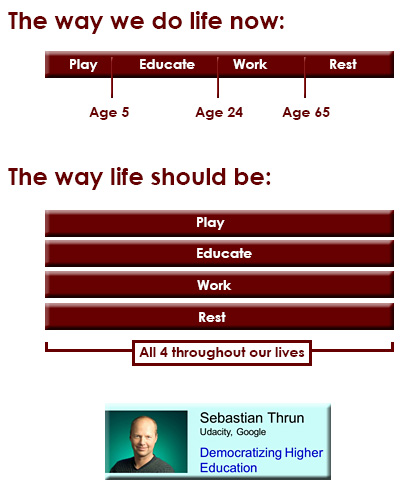
Keynote Address: Democratizing Higher Education by Sebastian Thrun, VP & Fellow Google

From DSC:
Sebastian Thrun gave a great keynote at last week’s Sloan-C Conference in Orlando, Fl.  An especially interesting item:

One of the business models Sebastian is considering is to have Udacity act as a job placement organization.  That is, Udacity can run courses, identify the top performers worldwide, and then match employers up with employees.  Udacity would get ___% of these placements’ first year salaries. Very interesting model.


Higher education used to be on deck, but is now at bat. [Christian]


From DSC:
My way of thinking about what’s happening to higher education these days borrows from the sport of baseball: Higher education used to be on deck; but now, we’re at bat.

I’ve watched as the former power brokers throughout many other industries reluctantly got out of the dugout, nervously began their warm up on deck, and then timidly moved up to bat as well. They were trying to cling to the status quo. Which didn’t work. We’ve all seen the results. There are new power brokers in those industries now. (Which is I why I assert that there is danger in the status quo — our organizations need to always be at the work of reinventing ourselves.)

If I had to pick the top 2 forces driving change throughout the higher education landscape, I would have to say the cost of obtaining a degree and technology-enabled innovation.

Control is an illusion; people will find a way.


Sharples, M., McAndrew, P., Weller, M., Ferguson, R., FitzGerald, E., Hirst, T., Mor, Y., Gaved, M. and Whitelock, D. (2012). Innovating Pedagogy 2012: Open University Innovation Report 1. Milton Keynes: The Open University.

.

Exploring new forms of teaching, learning and assessment, to guide educators and policy makers


Contents

  • Executive summary 3
  • Introduction 6
  • New pedagogy for e-books
    Innovative ways of teaching and learning with next-generation e-books 8
  • Publisher-led short courses
    Publishers producing commercial short courses for leisure and professional development 11
  • Assessment for learning
    Assessment that supports the learning process through diagnostic feedback 13
  • Badges to accredit learning
    Open framework for gaining recognition of skills and achievements 16
  • MOOCs
    Massive open online courses 19
  • Rebirth of academic publishing
    New forms of open scholarly publishing 21
  • Seamless learning
    Connecting learning across settings, technologies and activities 24
  • Learning analytics
    Data-driven analysis of learning activities and environments 27
  • Personal inquiry learning
    Learning through collaborative inquiry and active investigation 30
  • Rhizomatic learning
    Knowledge constructed by self-aware communities adapting to environmental conditions 33

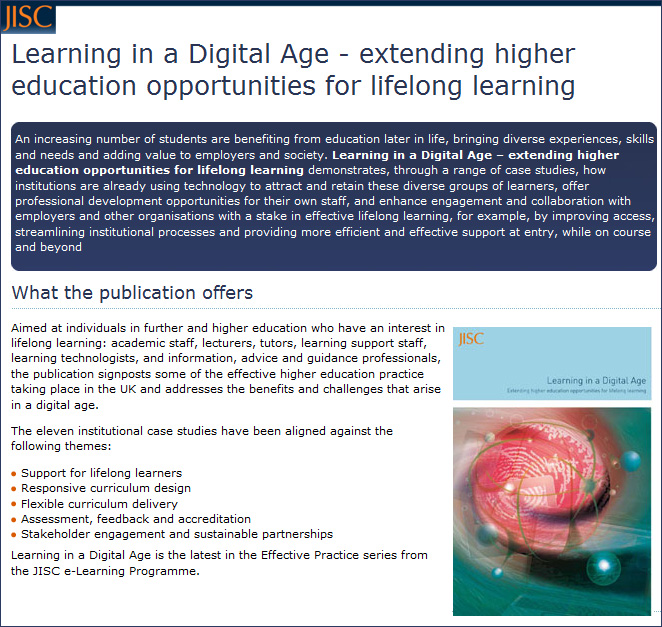
Learning in a Digital Age - JISC - 2012


.

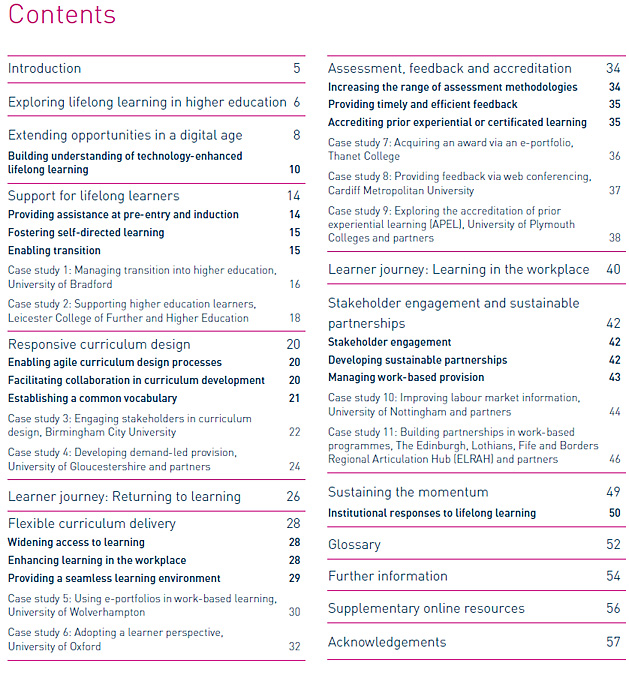
Contents of Learning in a Digital Age -- from JISC in 2012

.


© 2025 | Daniel Christian