From Microsoft and LinkedIn:

Microsoft and LinkedIn: Together changing the way the world works — from blog.linkedin.com

Excerpt:

Today [6/13/16] we are excited to share that LinkedIn has entered into an agreement to be acquired by Microsoft. We are joining forces with Microsoft to realize a common mission to empower people and organizations. LinkedIn’s vision – to create economic opportunity for every member of the global workforce – is not changing and our members still come first.

Our companies are the world’s leading professional cloud and network. This deal will allow us to keep growing, investing in and innovating on LinkedIn to drive value for our members and our customers. Our members will continue to develop their skills, find a job and be great at that job, using our platform. We will continue to help our customers hire top talent, market their brand, and sell to their customers.


From DSC:
It’s interesting to reflect upon what this acquisition could mean and what it could bring to the workplace/career development table.

LinkedIn.com purchased/acquired Lynda.com (announced in April 2015), a growing/thriving (online-based learning) training and development company who can deliver lifelong learning and credentials to people…which continues to help people reinvent themselves.

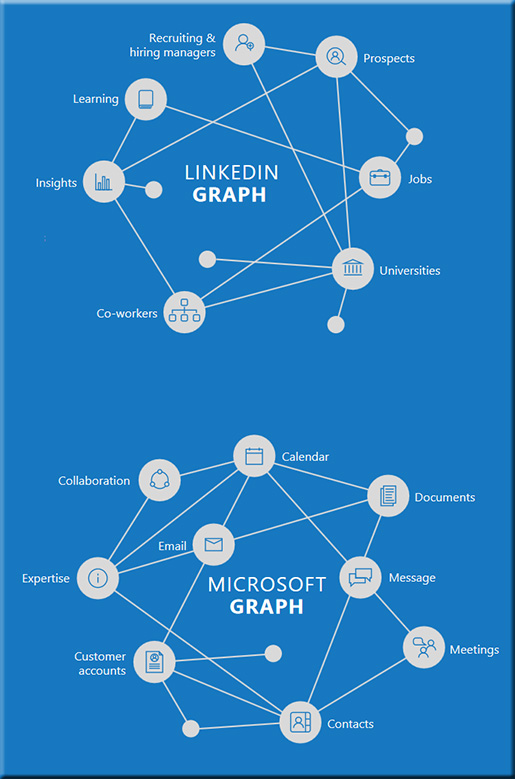
LinkedIn.com is working on an economic graph, a digital mapping of the global economy…building a database/marketplace of job openings and people who can fill those jobs.

What is the Economic Graph?
The Economic Graph is, in short, a digital mapping of the global economy. It will include a profile for every one of the 3 billion members of the global workforce, enabling them to represent their professional identity and subsequently find and realize their most valuable opportunities. It will include a profile for every company in the world, who you know at those companies up to three degrees to help you get your foot in the door, and the product and services those companies offer to enable you to be more productive and successful. It will digitally represent every economic opportunity offered by those companies, full-time, temporary and volunteer, and every skill required to obtain those opportunities. It will include a digital presence for every higher education organization in the world that can help members obtain those skills. And it will overlay the professionally relevant knowledge of every one of those individuals, companies, and universities to the extent that they want to publicly share it. Learn more about the Economic Graph and join the discussion.

Now Microsoft is purchasing/acquiring LinkedIn.com and the data/endeavors/technologies/platforms LinkedIn.com has been working on.

(Add to that the fact that Microsoft has been working on artificial intelligence (AI), personal assistants (i.e., Cortana).  It has been working on other forms of HCI as well, such as HoloLens.)

Therefore, some questions come to my mind:

  • Will the purchase of LinkedIn.com now add a potentially huge new reason to choose their platform/ecosystem as well?  In fact, Microsoft could be expanding their platform/ecosystem — or creating a new platform — to take advantage of using AI, personal assistants, and big data to play the ultimate match maker in the workplace.
  • Will freelancers utilize their services to find work? (The use of freelancing continues to grow; already in the mid-30 percents of the American workforce now.)
  • Will Microsoft be a source of cloud-based learner profiles?
  • Will Microsoft now get into the credentialing business?  Will Microsoft employ blockchain-based technologies? (Higher ed, take note if so.)
  • How will badges/badging play into this platform?
  • Will Microsoft work with companies to offer assessments into whether person A can be successful in position B?
  • What will this mean for lifelong learning?

Hmmmm….time will tell.


Addendums later on 6/13/16

Excerpt from this article:

Nadella explained it in a sentence to Business Insider’s Matt Rosoff Monday morning.

He said that buy buying LinkedIn’s professional network:

“It helps us differentiate our CRM product with social selling. It helps us take Dynamics into new spaces like human capital management with recruiting, and learning, and talent management.”

He later told analysts that connecting LinkedIn data with Dynamics [Microsoft’s suite of business management software] is “where the magic starts to happen.”
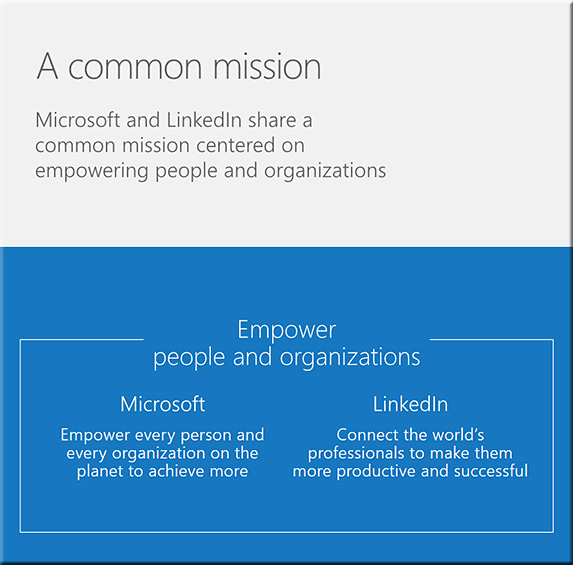


MicrosoftPurchasesLinkedIn-June2016

MicrosoftPurchasesLinkedIn-2-June2016


MicrosoftPurchasesLinkedIn-3-June2016


Excerpt from this article:

Think about it: How people find jobs, build skills, sell, market and get work done and ultimately find success requires a connected professional world. It requires a vibrant network that brings together a professional’s information in LinkedIn’s public network with the information in Office 365 and Dynamics. This combination will make it possible for new experiences such as a LinkedIn newsfeed that serves up articles based on the project you are working on and Office suggesting an expert to connect with via LinkedIn to help with a task you’re trying to complete. As these experiences get more intelligent and delightful, the LinkedIn and Office 365 engagement will grow. And in turn, new opportunities will be created for monetization through individual and organization subscriptions and targeted advertising.



CIO Explainer: What is blockchain? — from blogs.wsj.com by Steve Norton

Excerpt:

Known by many as the technology underpinning the bitcoin digital currency, blockchain has acquired a new identity in the enterprise. At a time when companies face new challenges in data management and security, it’s emerging as a way to let companies make and verify transactions on a network instantaneously without a central authority. Today, more than 40 top financial institutions and a growing number of firms across industries are experimenting with distributed ledger technology as a secure and transparent way to digitally track the ownership of assets, a move that could speed up transactions and cut costs while lowering the risk of fraud. Some companies see an opportunity to use blockchain to track the movement of assets throughout their supply chains or electronically initiate and enforce contracts.

Blockchain remains in the experimental phase inside many large firms and there are few tested use cases, experts and analysts caution. Here’s a look at how this emerging technology works:


Why is the financial industry so interested in Blockchain? — from dcebrief.com

Executive Brief:
With huge money and effort being put into blockchain research by almost the entire financial industry, many have wondered what the reasoning behind it is. To investigate this, Goldman Sachs, the global banking business, has used its research division to put together a report on the effects of blockchain implementation will have on the industry itself. Showing massive cost savings, improved security and a wide range of suitability for other market sectors, the report identifies the many benefits of blockchain technology and emphasizes the robust nature of the foundation of digital currency itself.


Opinion: What Blockchain means for higher education — from edsurge.com by Kerri Lemoie

Excerpt:

Originally created as the underlying database for bitcoin (the peer-to-peer digital asset and payment system), blockchain’s technology is now being seen as valuable and purposeful beyond the financial sector. The advantages blockchain provides to store information on a secure, permanent, historical ledger that can be both public and private will change how edtech applications approach student data.

In higher ed this means that student data could be shared across many institutions—rather than a single one—and also include data from online learning tools, co-curricular activities, employment history and other learning experiences. This would allow the data to be exchanged, understood and validated amongst many parties. Imagine the pictures of students’ learning experiences that this could provide and how these pictures could help develop and improve upon course design, facilitate transferring credits, or prove qualifications for a job to a potential employer.


“The learner could have a record of their learning from MOOCs, professional development activities and universities.”


How blockchain will disrupt the higher education transcript — from campustechnology.com by David Raths
Blockchain technology could offer a more learner-centered alternative to traditional credentialing.

Excerpt:

Last year, the MIT Media Lab began issuing digital certificates to the participants in its Director’s Fellows program. The authentication behind the certificates relies on blockchain technology, best known for its connection to the cryptocurrency bitcoin.

In a blog post, Philipp Schmidt, director of learning innovation at the Media Lab, described how blockchain works: “In essence, it is a just a distributed ledger to record transactions. What makes it special is that it is durable, time-stamped, transparent and decentralized. Those characteristics are equally useful for managing financial transactions as for a system of reputation. In fact, you can think of reputation as a type of currency for social capital, rather than financial capital.”

The technology has tremendous potential for higher education, according to Phil Long, chief innovation officer and associate vice provost for learning sciences at the University of Texas at Austin. In a May 12 Future Trends Forum video chat hosted by consultant and futurist Bryan Alexander, Long pointed to credentialing as an obvious first place to apply blockchain in higher ed.


From DSC:
Could blockchain be the tech to create cloud-based learner profiles?


Addendum on 6/7/16:

  • Blockchain Revolution| Is the future of business a company without workers, managers, or a CEO? — from qz.com
    Excerpt:
    These days, it’s hardly surprising to hear that a hot new startup has received gobs of money from eager investors. But a new company called the DAO (short for “decentralized autonomous organization”) is not your average startup. The DAO, designed to serve as a kind of venture capital fund for the cryptocurrency community, is the first of a new breed of business. It has no CEO and no staff; indeed, it has no human management at all. The company itself is simply software that runs on a blockchain, the technology that powers digital currencies like bitcoin. Through its first three weeks, the DAO raised over $130 million from tens of thousands of global investors, and it’s not done yet. But regardless of how the company fares, its mere existence portends profound changes for business, government, and the roles that people play in our economy. Analysts have questioned whether the DAO is legal or viable. Like any startup, it may fail. It may have attracted investors who don’t understand the risks. Some investors may be speculators in it for a quick buck, in turn, reducing the size of the fund. It may be attracting criminals or terrorists masquerading as entrepreneurs. To be sure, these are important concerns. But the DAO’s debut is a watershed moment in the history of financial services. It demonstrates that autonomous entities can raise huge sums of money without traditional intermediaries. How will venture capitalists and investment banks respond to these blockchain IPOs that crowd-source hundreds of millions of dollars from a global investor base?


Addendums on 6/8/16:

  • Blockchain’s hype exceeds its grasp – for now — from cio.com by Clint Boulton
    Broad adoption of blockchain technology is likely years away as companies struggle to understand how to apply the digital ledger technology to practical scenarios amid regulatory, governance and standards obstacles.

Excerpt:
Blockchain has been touted by venture capitalists, technophiles and pundits as the Next Big Thing in computer science. The reality, however, is that the digital ledger software at the heart of Bitcoin and other cryptocurrencies has a long way to go before it gains mainstream adoption.

That was a key takeaway from a blockchain panel at last month’s MIT Sloan CIO Symposium. Noting that blockchain enables parties to ferry financial transactions, contracts and other digital records over the Internet, MIT professor Christian Catalini asked the panel about potential enterprise applications for the technology.


  • Credentials | MIT Media Lab, Learning Machine Partner on Blockchain-Based Credentials — from campustechnology.com by Joshua BolkanExcerpt:
    The MIT Media Lab’s Learning Initiative has partnered with Learning Machine to release the initial version of an open-source project designed to build an ecosystem for creating, sharing and verifying education credentials based on blockchain technology.Using the Bitcoin blockchain, the certificates can be shared with anyone who requires documentation as simply as sending a link and future versions will add features to improve real-world usability, such as versioning, revocation, cohort issuance, document encryption and cost reducation. “The goal of our collaboration with the MIT Media Lab is to empower individuals with shareable credentials that can be used peer-to-peer and verified as authentic,” said Chris Jagers, co-founder and CEO of Learning Machine, in a prepared statement.


Equipped for EQUIP? Here’s a primer — from edsurge.com by Bart Epstein and Ben Wallerstein (on 11/9/15)

Excerpt:

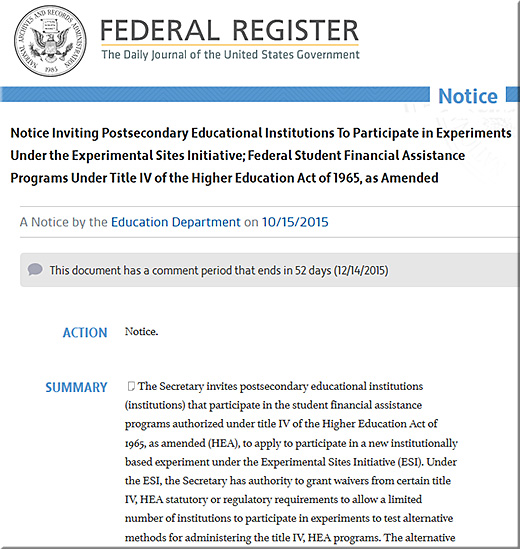
On October 15th, the Department of Education launched a new Experimental Site called Educational Quality through Innovative Partnerships (EQUIP), which creates a pathway to federal aid for unaccredited education providers–including the fast-growing bootcamp sector. Here’s what you need to know.

The US Department of Education’s Experimental Sites Initiative (ESI) is a policymaker’s dream. The authority granted though the ESI allows the Secretary of Education to waive certain rules governing federal financial aid to experiment with new models and test their impact. The goal: improve access for low-income students, and increase the return on our $130 billion annual investment in student aid.

As a policy “lab,” Experimental Sites have allowed the Department of Education to provide Title IV access for self-paced and competency-based programs, decouple aid from the credit hour, and fund students who demonstrate prior learning through assessments.


From DSC:
As higher ed (as an industry) doesn’t seem to be able to decrease the costs of obtaining a degree, alternatives continue to crop up.

If…

  • The prices don’t start coming down from institutions of traditional higher education
  • Alternatives continue to crop up and gather steam
  • The U.S. Federal Government gets behind such alternatives

…then higher ed (again, as an industry) can only blame itself for not responding more significantly than we did.

We need to respond. We need to address this growing wave of unrest regarding higher ed. We need more innovation. We need lower prices. Towards that end, that’s why I’ve been saying that we need more TrimTab Groups to find ways to maintain quality, but reduce the price.


TheTrimtabInHigherEducation-DanielChristian


Ed Dept pilot opens aid to alternative credentialing — from educationdive.com

Excerpt:

  • The U.S. Department of Education on Wednesday [10/14/15] unveiled the Educational Quality Through Innovation Partnerships (EQUIP) program, an experimental pathway to Title IV funding for partnerships between higher ed institutions and nontraditional programs.
  • The program has been brewing for some time under the experimental sites initiative, though it will remain limited to about 10 applications from applicable partnerships.
  • Likely candidates for participation in the pilot include coding bootcamps, MOOC providers, and various short-term certificate and corporate training programs, and according to Inside Higher Ed, inclusion will also give institutions freedom from a federal aid ban on colleges that outsource over half of their content or instruction to an unaccredited third party.


Also see:

Alternatives-Funding-Gov-10-14-15

Excerpt:

Background: The landscape for learning in postsecondary education is undergoing tremendous development. Innovations in technology, pedagogy, and business models are driving rapid change. While much of this development has been led by traditional postsecondary institutions, there are also significant educational changes occurring outside of the traditional educational sector. Non-traditional providers have begun to offer educational opportunities to students in new ways, such as through intensive short-term programs, online or blended approaches, or personalized/adaptive learning. These opportunities have the potential to advance goals such as increased equity and access, more flexible and personalized learning, high-quality student outcomes, and reduced costs.

Although some of these educational opportunities show promise in advancing these priorities, they remain out of reach for many students, particularly those from low-income backgrounds, in part because they generally do not provide students with access to title IV aid. The unavailability of title IV aid could increase the potential for educational inequity, because only those students with significant financial resources are able to enroll in these innovative programs, and it may constrain the growth of promising new approaches to learning.


Higher Education 2.0 and the Next Few Hundred Years; or, How to Create a New Higher Education Ecosystem — from educause.edu by Paul J. LeBlanc

Excerpt:

Three important developments stand to dramatically change the way we think about degree programs and pathways:

  1. The rapid adoption of competency-based education (CBE) programs, often using industry and employer authority for guiding the creation of the competencies and thus programs
  2. An eventual move to suborganizational accreditation, with Title IV funds available for credits, courses, and microcredentials offered by new providers in new delivery models, part of the accelerating trend toward “unbundling” higher education
  3. Increasing recognition that postsecondary education will no longer be contained to the existing and traditional degree levels but will instead be consumed at various levels of granularity—less than full degree programs and continuing throughout lives and careers

If these game changers come to fruition (and they are already taking shape today), we will see an exciting new ecosystem take hold in higher education. Together, these developments are poised to end the monopoly that traditional higher education holds on postsecondary education and to erode the sole authority it has over what counts for quality and relevancy. Smart and agile institutions will respond and even thrive in this changing environment. They will do so alongside new competitors as more providers emerge to compete for students, making the higher education marketplace diverse and robust.

Also, industry is not sitting idly by the phone waiting for higher education to call. General Assembly, a leader among the new sector of programming schools (aka coding boot camps), has launched its own credentialing system…


How Google and Coursera may upend the traditional college degree — from brookings.edu by

Excerpt:

Recently, the online education firm Coursera announced a new arrangement with Google, Instagram and other tech firms to launch what some are calling “microdegrees” – a set of online courses plus a hands-on capstone project designed in conjunction with top universities and leading high-tech firms. Coursera is one of America’s leading MOOC developers (Massive Open Online Courses).

Why does this announcement suggest such a shakeup is likely? Several reasons. Here are just four:

  • MOOCs are moving from novel sideshow to serious competition.
  • The partnership between online education and employers is likely a game-changer.
  • Accreditation as a restriction on competition is eroding.
  • Microdegrees are likely the pathway to customized degree programs.


Also see:

Top companies work with university partners to help create capstone projects with real world applications — from blog.coursera.org

Excerpt:

Experts at top companies like Google and Instagram have joined Coursera to help develop the final projects — called “Capstones” — for Coursera Specializations.

Combining a curated series of courses with a final Capstone Project, Specializations help you master new skills with the best of university teaching and the real-time market perspective of top industry partners. Hundreds of thousands of learners have enrolled in Specializations since their launch in January 2014.


But partnerships like Coursera’s include employers actually certifying groups of courses as meeting industry’s standards for skills and knowledge – essentially an end-run around traditional accreditation as a measure of quality.


Also see:


From DSC:

First of all, that piece about the end-around traditional accreditation should make those of us working within higher ed veeeeerrrrry nervous — and much more responsive — as accreditation has been what’s kept traditional institutions of higher ed in the game. If that goes, well…hmmm…things could get very interesting.

Secondly, those who talk of the demise of MOOCs are waaayyy too premature in their assessment/conclusion. Technologies and vendors such as IBM (Watson), Apple (Siri), Google (Deepmind), and Microsoft (Cortana and Azure Machine Learning) could bake their products into MOOCs. Also, what happens if vendors involved with developing personalized learning platforms and/or those vendors specializing with big data start approaching MOOC providers? (See Will micro-credentialing be an example of the use of big data in education and training?) The resulting offerings could have an enormous impact on how people learn and make a living in the future. Again, if those types of technologies get baked into MOOCs, I’m pretty sure that people won’t be discounting MOOCs any longer.

Also, it’s because of items like those mentioned above that sometimes make me wonder if online education and digitally-related delivery mechanisms are what will save the liberal arts.  People could pick up courses in the liberal arts throughout their lifetimes — obtaining degrees…or not. (As a brief aside, I wonder to what extent faculty members will develop their own brands.)  Anyway, it’s getting to the point that many people can’t afford the campus experience.  But could they afford something online…? It could be…depending upon the pricing and associated business models involved. My guess is that those institutions who practice a team-based approach will survive and thrive if they keep a steady eye on their pricing. 


Making Assessment Work: Lessons from the University of Pittsburgh — from sr.ithaka.org  by Martin Kurzweil

Excerpt:

What should an undergraduate chemistry major know by the time she graduates? How can one tell if she knows it? And how can chemistry instruction be improved to ensure that more students meet those expectations?

Such deceptively simple questions—for chemistry and every other discipline—have become an important focus of higher education leaders, accrediting agencies, and government. Yet many universities have struggled to develop robust processes for assessing student learning. Even when a central administration makes a serious effort to develop such a process, faculty participation is often pro forma.

The University of Pittsburgh is an exception. At Pitt, faculty across 350 programs are deeply engaged in a systematic approach to assessing student learning outcomes, which has led to measurable results and significant changes.

Making Assessment Work: Lessons from the University of Pittsburgh” delves into some of the specific practices Pitt undertook and documents the change in the university’s culture. No system is perfect, but this case study shows Pitt’s decentralized approach, targeted at the level of coherent programs of study, coupled with strong and supportive leadership, led Pitt’s faculty to make assessment an important driver of program improvement.

On a programming note, this is the first in a new series of case studies on educational transformation from Ithaka S+R.  Every few weeks, we will release a new report on innovative approaches that institutions have taken to improve student outcomes and control costs.  Covering issues such as online education, learning analytics, and university governance, the case studies document the ways that change happens in higher education.

Also see the ITHAKA S&R blog.


…the most important factor in the development of Pitt’s culture of assessment was its decentralized, yet accountable, approach. University leaders established a timeline and general framework for assessment, offered feedback, designated degree and certificate programs as the units of assessment, and, most significantly, left the details to faculty responsible for those programs. This combination of broad oversight and localized management has fostered a sense of ownership among faculty, who have made assessment an important driver of program improvement.


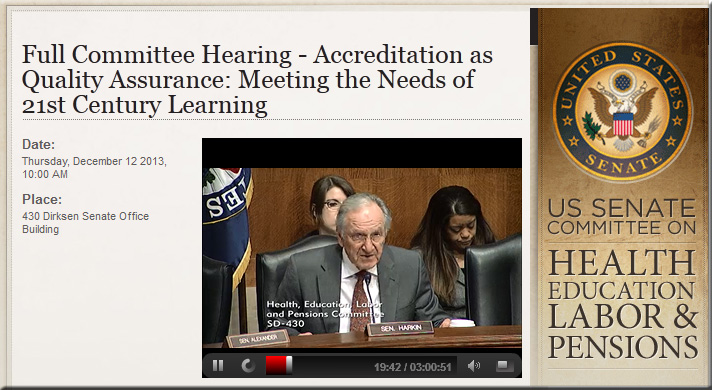
AccreditationFor21stCentury-USSenate-12-12-13


Witnesses/Panel I:


  • Dr. Arthur Levine , President of the Woodrow Wilson National Fellowship Foundation, Princeton, NJ
  • Dr. Ralph Wolff , Former President of the Western Association of Schools and Colleges, Alameda, CA
  • Dr. Daniel J. Phelan , President of Jackson College, Jackson, MI
  • Ms. Laura King , Executive Director of the Council on Education for Public Health, Silver Spring, MD


Also see/originally saw this at:

Accreditation Agita — from insidehighered.com — by Michael Stratford and Paul Fain

Excerpt:

WASHINGTON — During a hearing Thursday, several Democratic senators mulled whether the federal government should get more involved in the accrediting process. They might have been less enthusiastic if they saw what was happening at another meeting two blocks away.

The federal panel that reviews accreditors, the National Advisory Committee on Institutional Quality and Integrity, held that gathering. Faculty members and students from the City College of San Francisco, who for the past year have essentially waged war against the accrediting agency that is threatening to revoke the accreditation of their college, pleaded their case to the panel.


Also see:


For chairs, the seat’s gotten hotter — from chronicle.com by Audrey Williams June
With new demands for fund raising and assessment, academe’s middle managers feel the pressure


Also see:

Excerpt:

Despite their long history in higher education, accreditors now face what some believe are existential challenges, including technological changes that could transform higher education in ways that diminish the groups’ role as standard-bearers of quality, or even eliminate them as gatekeepers for federal dollars.

The higher-education landscape is shifting rapidly. But accreditation, a lengthy and complex process, is not keeping pace, according to critics, and even some supporters, of the current system.


Accreditation on the block as lawmakers look to innovation — from EvoLLLution NewsWire

Excerpt:

Accreditation and federal financial aid policies are in line to be overhauled as lawmakers start to debate the possibility of mainstreaming some of higher education’s most recent innovations.

During a recent hearing of the U.S. Senate’s Committee on Health, Education, Labor and Pensions, numerous federal senators pointed toward competency-based education and hybrid models of online education as examples of strategies that could revolutionize higher education. However, they were concerned by the role of federal financial aid rules and regional accreditation boards in keeping these innovations from reaching the wider higher education marketplace.

It is expected that a number of bills will be introduced in the coming days to overhaul the regulatory systems that govern American postsecondary education.  Senator Mike Lee (R-Utah) plans to unveil a bill to move accreditation responsibilities from the region to the state. This would allow greater market access to non-institutional education providers, which are typically unaccreditated and cannot compete with traditional institutions on an even footing.


U.S. teams up with operator of 0nline courses to plan a global network — from nytimes.com by Tamar Lewin

Excerpt (emphasis DSC):

Coursera, a California-based venture that has enrolled five million students in its free online courses, announced on Thursday a partnership with the United States government to create “learning hubs” around the world where students can go to get Internet access to free courses supplemented by weekly in-person class discussions with local teachers or facilitators.

The learning hubs represent a new stage in the evolution of “massive open online courses,” or MOOCs, and address two issues: the lack of reliable Internet access in some countries, and the growing conviction that students do better if they can discuss course materials, and meet at least occasionally with a teacher or facilitator.

“Our mission is education for everyone, and we’ve seen that when we can bring a community of learners together with a facilitator or teacher who can engage the students, it enhances the learning experience and increases the completion rate,” said Lila Ibrahim, the president of Coursera. “It will vary with the location and the organization we’re working with, but we want to bring in some teacher or facilitator who can be the glue for the class.”


From DSC:
Some thoughts here:

1)  When institutions of higher education cling to the status quo and disregard the disturbing trajectories at play*…when we don’t respond, people — and governments it seems — will find other options/alternatives.

* Such as middle class incomes that continue to decline
while the price of higher education continues to escalate

2)  I wonder if this type of setup might predominate in some countries.
i.e. blended learning types of setups in learning centers around the world where people can come in at any time to learn with a relevant Community of Practice, aided by faculty, teachers, trainers, coaches, etc.   Some of the content is “beamed in” and shared electronically, while some of the learning involves face-to-face discussions/work. Will schools become more community centers where we will pool resources and offer them to people 24×7?

Also see:

  • The New Innovator’s Dilemma — from huffingtonpost.com by Michael Moe and Ben Wallerstein; with thanks to Lisa Duty for the Tweet on this
    Excerpt (emphasis DSC):
    Increasingly, we’re worried that a generation of entrepreneurs is facing a “new innovators dilemma” — where innovation is stymied by regulatory and political environments focused on outdated needs and the wrong set of “customers.” The truth is, Silicon Valley investors and techies will get by just fine without addressing our big, societal problems. But if we encourage our nation’s top entrepreneurs to join search engines and social networks, we will miss the opportunity to apply their genius to solving society’s most pressing problems.

    This isn’t about the classic political divide of right versus left. This is about policies and regulations written in a different era that are not easily translated to modern technology. It’s no secret that the challenge stems, in part, from the motivations of regulators and the politics of protecting the status quo.

    Change is difficult. And no one is arguing that the transportation, hospitality, and higher education industries don’t need to be regulated. New approaches, in particular, warrant close scrutiny. But if we are ever going to experience the sort of revolutionary change that technology might afford to virtually every sector of the American economy, we need to be willing to rethink the traditional ways of regulation to make innovation easier and more responsive to the consumers and students these regulations were originally enacted to protect.


Addendum 11/1/13:


Higher Education: New Models, New Rules — from educause.com by Louis Soares, Judith S. Eaton, and Burck Smith
What are the new rules that will accompany future new models in higher education? Three essays address this question by exploring state higher education policy, accreditation for non-institutional education, and the disaggregation of the current higher education model.


Educause-NewModelsNewRules-Oct72013


Excerpt from Burck’s essay:

Accordingly, the government spurs “supply” by paying for colleges and universities and spurs “demand” by paying for students. Accreditors determine who can receive these funds. All of this worked well for sixty years. Until, suddenly, it doesn’t.


Job market embraces Massive Online Courses — from online.wsj.com by Douglas Belkin and Caroline Porter
Seeking better-trained workers, AT&T, Google and other firms help design and even fund web-based college classes

Excerpt (emphasis DSC):

Big employers such as AT&T Inc. and Google Inc. are helping to design and fund the latest round of low-cost online courses, a development that providers say will open the door for students to earn inexpensive credentials with real value in the job market.

New niche certifications being offered by providers of massive open online courses, or MOOCs, are aimed at satisfying employers’ specific needs. Available at a fraction of the cost of a four-year degree, they represent the latest crack in the monopoly traditional universities have in credentialing higher education.

The Massachusetts Institute of Technology, along with its MOOC partner edX, is starting a course sequence called the XSeries, and plans to ask for input from a consortium of about 50 companies, including United Parcel Service Inc., Procter & Gamble Co. and Wal-Mart Stores Inc. For up to $700, students will be able to take a test and earn a “verified certificate” in subjects like computer science and supply-chain management.

Meanwhile, companies such as Yahoo Inc. have begun reimbursing employees who take certified courses from Coursera, another MOOC provider.


Issue #1: Accreditation


OPINION: How to make college better & more affordable — from edsurge.com by Paul Freedman
One powerful answer: Reform the accreditation process

Excerpt (emphasis DSC):

How can our diverse, 4,300 two- and four-year schools collectively be failing to produce the outcomes we need, at the scale we need them, all at the same time?

How can this be?

…why have these solutions not yet driven the fundamental change the system needs? Innovators that could bring costs down and help our system stay on the leading-edge are being stifled by little-known organizations that possess tremendous unregulated power in higher education: accreditors. As a result, our system is sick–plagued by an institutionalized lack of adaptation.

If they are indeed stewards of the public trust responsible for ensuring the quality of our higher education system, then they are also responsible for its outcomes and therefore share a large portion of the blame for the failures in higher education that we see today. Accreditation is the one constant across all US higher education institutions.

The problem? Ivy Bridge wanted to change the status quo.


Also see:


AccreditationKillingInnovation-Freedman-VB-Aug302013


A relevant side note from DSC:
The following statement in Downgrading Elite Colleges (InsideHigherEd.com) shows the impact of this straitjacketing, status quo situation (emphasis mine):

“We do see pressure on small private colleges as a group and that’s primarily because they don’t have a lot of different things they can do, so they are primarily dependent on tuition revenue,” said a Moody’s analyst, Edie Behr.

Moody’s advises institutions to try to diversify their revenue streams.

That is not an easy task, said Oberlin’s vice president for finance, Ronald Watts.

.
…they don’t have a lot of different things they can do…
…that is not an easy task…
.
From DSC:
Are these statements true? If so, why?
Is accreditation part of the issue/solution?
Who should be on the accrediting bodies? Whose agenda(s) do they represent?


(Related) Issue #2: Only doing what one’s peer groups are doing.


titanic-wakpaper-dot-com


From DSC:
If the entire boat is sinking, does it matter what your peers are doing?!? Isn’t it time for bigger thinking? Bolder thinking? More (and careful/well-thought-through) experimentation?

Paul Freedman states this as well in his article:

I have heard people in the industry compare the current state of higher education to a sinking ship. If that is accurate, then accreditors should be viewed as the ones who are literally nailing down the deck chairs to the Titanic. We need to keep the students we are all dedicated to serving from going down with the ship. We, as the education industry and as US citizens, need to fight for accreditation reform.

I ask these questions and pose the above picture not to promote panic — but rather to strongly encourage change. Institutions of higher education need to adapt in order to stay relevant, survive, and to properly equip future generations for the world they will be entering. 

If not, students will find other ways to be successful — and so will corporations.


Addendum on 9/3/13: 

  • Higher Ed Accrediting Commissions: Transparency for thee, not for me — from mfeldstein.com by Phil Hill
    Excerpt:
    Why do I keep covering accreditation issues on e-Literate, a blog nominally about online learning and educational technology? The reason is that accrediting commissions have enormous influence on higher education institutions, particularly as the industry wrestles with questions of which changes are necessary, which changes are worth trying but might not work, and which changes should be avoided. If there really is a shift in the DOE’s views on accreditation or in the accrediting commissions’ interpretation of standards, then that could have fairly profound cascade effects on competency-based learning programs, private online colleges, MOOCs, and online service providers.That is also why the lack of transparency from the accrediting commissions is so troubling. They are making decisions that have profound effects on many institutions, not just the specific schools under review.

 
© 2025 | Daniel Christian