The résumé is dying, and AI is holding the smoking gun — from arstechnica.com by Benj Edwards
As thousands of applications flood job posts, ‘hiring slop’ is kicking off an AI arms race.

Employers are drowning in AI-generated job applications, with LinkedIn now processing 11,000 submissions per minute—a 45 percent surge from last year, according to new data reported by The New York Times.

Due to AI, the traditional hiring process has become overwhelmed with automated noise. It’s the résumé equivalent of AI slop—call it “hiring slop,” perhaps—that currently haunts social media and the web with sensational pictures and misleading information. The flood of ChatGPT-crafted résumés and bot-submitted applications has created an arms race between job seekers and employers, with both sides deploying increasingly sophisticated AI tools in a bot-versus-bot standoff that is quickly spiraling out of control.

The Times illustrates the scale of the problem with the story of an HR consultant named Katie Tanner, who was so inundated with over 1,200 applications for a single remote role that she had to remove the post entirely and was still sorting through the applications three months later.


Job seekers are leaning into AI — and other happenings in the world of work — from LinkedIn News

Job growth is slowing — and for many professionals, that means longer job hunts and more competition. As a result, more job seekers are turning to AI to streamline their search and stand out.

From optimizing resumes to preparing for interviews, AI tools are becoming a key part of today’s job hunt. Recruiters say it’s getting harder to sift through application materials and identify what is AI-generated and decipher which applicants are actually qualified — but they also say they prefer candidates with AI skills.

The result? Job seekers are growing their familiarity with AI faster than their non-job-seeking counterparts and it’s shifting how they view the workplace. According to LinkedIn’s latest Workforce Confidence survey, over half of active job seekers (52%) believe AI will eventually take on some of the mundane, manual tasks that they’re currently focused on, compared to 46% of others not actively job seeking.


OpenAI warns models with higher bioweapons risk are imminent — from axios.com by Ina Fried

OpenAI cautioned Wednesday that upcoming models will head into a higher level of risk when it comes to the creation of biological weapons — especially by those who don’t really understand what they’re doing.

Why it matters: The company, and society at large, need to be prepared for a future where amateurs can more readily graduate from simple garage weapons to sophisticated agents.

Driving the news: OpenAI executives told Axios the company expects forthcoming models will reach a high level of risk under the company’s preparedness framework.

    • As a result, the company said in a blog post, it is stepping up the testing of such models, as well as including fresh precautions designed to keep them from aiding in the creation of biological weapons.
    • OpenAI didn’t put an exact timeframe on when the first model to hit that threshold will launch, but head of safety systems Johannes Heidecke told Axios “We are expecting some of the successors of our o3 (reasoning model) to hit that level.”

.


Mary Meeker AI Trends Report: Mind-Boggling Numbers Paint AI’s Massive Growth Picture — from ndtvprofit.com
Numbers that prove AI as a tech is unlike any other the world has ever seen.

Here are some incredibly powerful numbers from Mary Meeker’s AI Trends report, which showcase how artificial intelligence as a tech is unlike any other the world has ever seen.

  • AI took only three years to reach 50% user adoption in the US; mobile internet took six years, desktop internet took 12 years, while PCs took 20 years.
  • ChatGPT reached 800 million users in 17 months and 100 million in only two months, vis-à-vis Netflix’s 100 million (10 years), Instagram (2.5 years) and TikTok (nine months).
  • ChatGPT hit 365 billion annual searches in two years (2024) vs. Google’s 11 years (2009)—ChatGPT 5.5x faster than Google.

Above via Mary Meeker’s AI Trend-Analysis — from getsuperintel.com by Kim “Chubby” Isenberg
How AI’s rapid rise, efficiency race, and talent shifts are reshaping the future.

The TLDR
Mary Meeker’s new AI trends report highlights an explosive rise in global AI usage, surging model efficiency, and mounting pressure on infrastructure and talent. The shift is clear: AI is no longer experimental—it’s becoming foundational, and those who optimize for speed, scale, and specialization will lead the next wave of innovation.


Also see Meeker’s actual report at:

Trends – Artificial Intelligence — from bondcap.com by Mary Meeker / Jay Simons / Daegwon Chae / Alexander Krey


The Rundown: Meta aims to release tools that eliminate humans from the advertising process by 2026, according to a report from the WSJ — developing an AI that can create ads for Facebook and Instagram using just a product image and budget.

The details:

  • Companies would submit product images and budgets, letting AI craft the text and visuals, select target audiences, and manage campaign placement.
  • The system will be able to create personalized ads that can adapt in real-time, like a car spot featuring mountains vs. an urban street based on user location.
  • The push would target smaller companies lacking dedicated marketing staff, promising professional-grade advertising without agency fees or skillset.
  • Advertising is a core part of Mark Zuckerberg’s AI strategy and already accounts for 97% of Meta’s annual revenue.

Why it matters: We’re already seeing AI transform advertising through image, video, and text, but Zuck’s vision takes the process entirely out of human hands. With so much marketing flowing through FB and IG, a successful system would be a major disruptor — particularly for small brands that just want results without the hassle.


So much for saving the planet. Climate careers, and many others, evaporate for class of 2025 — from hechingerreport.org by Lawrence Lanahan
The Trump administration is disrupting career paths for new graduates hoping to work in climate and sustainability, international aid, public service and the sciences

As the class of 2025 enters the workforce, the Trump administration has dismantled career pathways for graduates interested in climate and sustainability work, international aid, public service and research across the natural, behavioral and social sciences. Federal jobs are disappearing, and the administration is eliminating grants and agency divisions that sustain university research programs and nonprofits that are crucial to launching careers.

The National Science Foundation, for example, halved graduate research fellowships, canceled some undergraduate research grants, stopped awarding new grants, froze funding for existing ones, and eliminated several hundred grants for focusing on diversity, equity and inclusion. In March, Robert F. Kennedy Jr. announced 10,000 layoffs at his agency, the Department of Health and Human Services; earlier buyouts and firings had already cut another 10,000 jobs.


“The AI-enhanced learning ecosystem” [Jennings] + other items re: AI in our learning ecosystems

The AI-enhanced learning ecosystem: A case study in collaborative innovation — from chieflearningofficer.com by Kevin Jennings
How artificial intelligence can serve as a tool and collaborative partner in reimagining content development and management.

Learning and development professionals face unprecedented challenges in today’s rapidly evolving business landscape. According to LinkedIn’s 2025 Workplace Learning Report, 67 percent of L&D professionals report being “maxed out” on capacity, while 66 percent have experienced budget reductions in the past year.

Despite these constraints, 87 percent agree their organizations need to develop employees faster to keep pace with business demands. These statistics paint a clear picture of the pressure L&D teams face: do more, with less, faster.

This article explores how one L&D leader’s strategic partnership with artificial intelligence transformed these persistent challenges into opportunities, creating a responsive learning ecosystem that addresses the modern demands of rapid product evolution and diverse audience needs. With 71 percent of L&D professionals now identifying AI as a high or very high priority for their learning strategy, this case study demonstrates how AI can serve not merely as a tool but as a collaborative partner in reimagining content development and management.
.


How we use GenAI and AR to improve students’ design skills — from timeshighereducation.com by Antonio Juarez, Lesly Pliego and Jordi Rábago who are professors of architecture at Monterrey Institute of Technology in Mexico; Tomas Pachajoa is a professor of architecture at the El Bosque University in Colombia; & Carlos Hinrichsen and Marietta Castro are educators at San Sebastián University in Chile.
Guidance on using generative AI and augmented reality to enhance student creativity, spatial awareness and interdisciplinary collaboration

Blend traditional skills development with AI use
For subjects that require students to develop drawing and modelling skills, have students create initial design sketches or models manually to ensure they practise these skills. Then, introduce GenAI tools such as Midjourney, Leonardo AI and ChatGPT to help students explore new ideas based on their original concepts. Using AI at this stage broadens their creative horizons and introduces innovative perspectives, which are crucial in a rapidly evolving creative industry.

Provide step-by-step tutorials, including both written guides and video demonstrations, to illustrate how initial sketches can be effectively translated into AI-generated concepts. Offer example prompts to demonstrate diverse design possibilities and help students build confidence using GenAI.

Integrating generative AI and AR consistently enhanced student engagement, creativity and spatial understanding on our course. 


How Texas is Preparing Higher Education for AI — from the74million.org by Kate McGee
TX colleges are thinking about how to prepare students for a changing workforce and an already overburdened faculty for new challenges in classrooms.

“It doesn’t matter if you enter the health industry, banking, oil and gas, or national security enterprises like we have here in San Antonio,” Eighmy told The Texas Tribune. “Everybody’s asking for competency around AI.”

It’s one of the reasons the public university, which serves 34,000 students, announced earlier this year that it is creating a new college dedicated to AI, cyber security, computing and data science. The new college, which is still in the planning phase, would be one of the first of its kind in the country. UTSA wants to launch the new college by fall 2025.

But many state higher education leaders are thinking beyond that. As AI becomes a part of everyday life in new, unpredictable ways, universities across Texas and the country are also starting to consider how to ensure faculty are keeping up with the new technology and students are ready to use it when they enter the workforce.


In the Room Where It Happens: Generative AI Policy Creation in Higher Education — from er.educause.edu by Esther Brandon, Lance Eaton, Dana Gavin, and Allison Papini

To develop a robust policy for generative artificial intelligence use in higher education, institutional leaders must first create “a room” where diverse perspectives are welcome and included in the process.


Q&A: Artificial Intelligence in Education and What Lies Ahead — from usnews.com by Sarah Wood
Research indicates that AI is becoming an essential skill to learn for students to succeed in the workplace.

Q: How do you expect to see AI embraced more in the future in college and the workplace?
I do believe it’s going to become a permanent fixture for multiple reasons. I think the national security imperative associated with AI as a result of competing against other nations is going to drive a lot of energy and support for AI education. We also see shifts across every field and discipline regarding the usage of AI beyond college. We see this in a broad array of fields, including health care and the field of law. I think it’s here to stay and I think that means we’re going to see AI literacy being taught at most colleges and universities, and more faculty leveraging AI to help improve the quality of their instruction. I feel like we’re just at the beginning of a transition. In fact, I often describe our current moment as the ‘Ask Jeeves’ phase of the growth of AI. There’s a lot of change still ahead of us. AI, for better or worse, it’s here to stay.


AI-Generated Podcasts Outperform Textbooks in Landmark Education Study — form linkedin.com by David Borish

A new study from Drexel University and Google has demonstrated that AI-generated educational podcasts can significantly enhance both student engagement and learning outcomes compared to traditional textbooks. The research, involving 180 college students across the United States, represents one of the first systematic investigations into how artificial intelligence can transform educational content delivery in real-time.


What can we do about generative AI in our teaching?  — from linkedin.com by Kristina Peterson

So what can we do?

  • Interrogate the Process: We can ask ourselves if we I built in enough checkpoints. Steps that can’t be faked. Things like quick writes, question floods, in-person feedback, revision logs.
  • Reframe AI: We can let students use AI as a partner. We can show them how to prompt better, revise harder, and build from it rather than submit it. Show them the difference between using a tool and being used by one.
  • Design Assignments for Curiosity, Not Compliance: Even the best of our assignments need to adapt. Mine needs more checkpoints, more reflective questions along the way, more explanation of why my students made the choices they did.

Teachers Are Not OK — from 404media.co by Jason Koebler

The response from teachers and university professors was overwhelming. In my entire career, I’ve rarely gotten so many email responses to a single article, and I have never gotten so many thoughtful and comprehensive responses.

One thing is clear: teachers are not OK.

In addition, universities are contracting with companies like Microsoft, Adobe, and Google for digital services, and those companies are constantly pushing their AI tools. So a student might hear “don’t use generative AI” from a prof but then log on to the university’s Microsoft suite, which then suggests using Copilot to sum up readings or help draft writing. It’s inconsistent and confusing.

I am sick to my stomach as I write this because I’ve spent 20 years developing a pedagogy that’s about wrestling with big ideas through writing and discussion, and that whole project has been evaporated by for-profit corporations who built their systems on stolen work. It’s demoralizing.


Astronaut one day, artist the next: How to help children explore the world of careers — from apnews.com by Cathy Bussewitz

Sometimes career paths follow a straight line, with early life ambitions setting us on a clear path to training or a degree and a specific profession. Just as often, circumstance, luck, exposure and a willingness to adapt to change influence what we do for a living.

Developmental psychologists and career counselors recommend exposing children to a wide variety of career paths at a young age.

“It’s not so that they’ll pick a career, but that they will realize that there’s lots of opportunities and not limit themselves out of careers,” said Jennifer Curry, a Louisiana State University professor who researches career and college readiness.

Preparing for a world of AI
In addition to exposing children to career routes through early conversations and school courses, experts recommend teaching children about artificial intelligence and how it is reshaping the world and work.


The 2025 Global Skills Report— from coursera.org
Discover in-demand skills and credentials trends across 100+ countries and six regions to deliver impactful industry-aligned learning programs.

GenAI adoption fuels global skill demands
In 2023, early adopters flocked to GenAI, with approximately one person per minute enrolling in a GenAI course on Coursera —a rate that rose to eight per minute in 2024.  Since then, GenAI has continued to see exceptional growth, with global enrollment in GenAI courses surging 195% year-over-year—maintaining its position as one of the most rapidly growing skill domains on our platform. To date, Coursera has recorded over 8 million GenAI enrollments, with 12 learners per minute signing up for GenAI content in 2025 across our catalog of nearly 700 GenAI courses.

Driving this surge, 94% of employers say they’re likely to hire candidates with GenAI credentials, while 75% prefer hiring less-experienced candidates with GenAI skills over more experienced ones without these capabilities.8 Demand for roles such as AI and Machine Learning Specialists is projected to grow by up to 40% in the next four years.9 Mastering AI fundamentals—from prompt engineering to large language model (LLM) applications—is essential to remaining competitive in today’s rapidly evolving economy.

Countries leading our new AI Maturity Index— which highlights regions best equipped to harness AI innovation and translate skills into real-world applications—include global frontrunners such as Singapore, Switzerland, and the United States.

Insights in action

Businesses
Integrate role-specific GenAI modules into employee development programs, enabling teams to leverage AI for efficiency and innovation.

Governments
Scale GenAI literacy initiatives—especially in emerging economies—to address talent shortages and foster human-machine capabilities needed to future-proof digital jobs.

Higher education
Embed credit-eligible GenAI learning into curricula, ensuring graduates enter the workforce job-ready.

Learners
Focus on GenAI courses offering real-world projects (e.g., prompt engineering) that help build skills for in-demand roles.


May Brought Deep Cuts at Multiple Colleges — from insidehighered.com by  Josh Moody
Colleges laid off well over 800 employees last month due to a mix of enrollment challenges and state funding issues. Ivy Tech saw the deepest cuts with more than 200 jobs axed.

With the academic year coming to an end, multiple universities announced deep cuts in May, shedding dozens of jobs amid financial pressures often linked to enrollment shortfalls.

But the cuts below, for the most part, are not directly tied to the rapid-fire actions of the Trump administration but rather stem from other financial pressures weighing on the sector. Many of the institutions listed are contending with declining enrollment and, for public universities, shrinking state support, which has necessitated fiscal changes.

From DSC:
I survived several job reductions at one of my former workplaces. But I didn’t survive the one that laid off 12 staff members after the Spring 2017 Semester. So, more and more, faculty and staff have been starting to dread the end of the academic year — as they may not survive another round of cuts. 


Also relevant/see:


Report: 93% of Students Believe Gen AI Training Belongs in Degree Programs — from campustechnology.com by Rhea Kelly

The vast majority of today’s college students — 93% — believe generative AI training should be included in degree programs, according to a recent Coursera report. What’s more, 86% of students consider gen AI the most crucial technical skill for career preparation, prioritizing it above in-demand skills such as data strategy and software development. And 94% agree that microcredentials help build the essential skills they need to achieve career success.

For its Microcredentials Impact Report 2025, Coursera surveyed more than 1,200 learners and 1,000 employers around the globe to better understand the demand for microcredentials and their impact on workforce readiness and hiring trends.


1 in 4 employers say they’ll eliminate degree requirements by year’s end — from hrdive.com by Carolyn Crist
Companies that recently removed degree requirements reported a surge in applications, a more diverse applicant pool and the ability to offer lower salaries.

A quarter of employers surveyed said they will remove bachelor’s degree requirements for some roles by the end of 2025, according to a May 20 report from Resume Templates.

In addition, 7 in 10 hiring managers said their company looks at relevant experience over a bachelor’s degree while making hiring decisions.

In the survey of 1,000 hiring managers, 84% of companies that recently removed degree requirements said it has been a successful move. Companies without degree requirements also reported a surge in applications, a more diverse applicant pool and the ability to offer lower salaries.


Why AI literacy is now a core competency in education — from weforum.org by Tanya Milberg

  • Education systems must go beyond digital literacy and embrace AI literacy as a core educational priority.
  • A new AI Literacy Framework (AILit) aims to empower learners to navigate an AI-integrated world with confidence and purpose.
  • Here’s what you need to know about the AILit Framework – and how to get involved in making it a success.

Also from Allison Salisbury, see:


How To Get Hired During the AI Apocalypse — from kathleendelaski.substack.com by Kathleen deLaski
And other discussions to have with your kids on the way to college graduation

A less temporary, more existential threat to the four year degree: AI could hollow out the entry level job market for knowledge workers (i.e. new college grads). And if 56% of families were saying college “wasn’t worth it” in 2023,(WSJ), what will that number look like in 2026 or beyond? The one of my kids who went to college ended up working in a bike shop for a year-ish after graduation. No regrets, but it came as a shock to them that they weren’t more employable with their neuroscience degree.

A colleague provided a great example: Her son, newly graduated, went for a job interview as an entry level writer last month and he was asked, as a test, to produce a story with AI and then use that story to write a better one by himself. He would presumably be judged on his ability to prompt AI and then improve upon its product. Is that learning how to DO? I think so. It’s using AI tools to accomplish a workplace task.


Also relevant in terms of the job search, see the following gifted article:

‘We Are the Most Rejected Generation’ — from nytimes.com by David Brooks; gifted article
David talks admissions rates for selective colleges, ultra-hard to get summer internships, a tough entry into student clubs, and the job market.

Things get even worse when students leave school and enter the job market. They enter what I’ve come to think of as the seventh circle of Indeed hell. Applying for jobs online is easy, so you have millions of people sending hundreds of applications each into the great miasma of the internet, and God knows which impersonal algorithm is reading them. I keep hearing and reading stories about young people who applied to 400 jobs and got rejected by all of them.

It seems we’ve created a vast multilayered system that evaluates the worth of millions of young adults and, most of the time, tells them they are not up to snuff.

Many administrators and faculty members I’ve spoken to are mystified that students would create such an unforgiving set of status competitions. But the world of competitive exclusion is the world they know, so of course they are going to replicate it. 

And in this column I’m not even trying to cover the rejections experienced by the 94 percent of American students who don’t go to elite schools and don’t apply for internships at Goldman Sachs. By middle school, the system has told them that because they don’t do well on academic tests, they are not smart, not winners. That’s among the most brutal rejections our society has to offer.


Fiverr CEO explains alarming message to workers about AI — from iblnews.org
Fiverr CEO Micha Kaufman recently warned his employees about the impact of artificial intelligence on their jobs.

The Great Career Reinvention, and How Workers Can Keep Up — from workshift.org by Michael Rosenbaum

A wide range of roles can or will quickly be replaced with AI, including inside sales representatives, customer service representatives, junior lawyers, junior accountants, and physicians whose focus is diagnosis.


Behind the Curtain: A white-collar bloodbath — from axios.com by Jim VandeHei and Mike Allen

Dario Amodei — CEO of Anthropic, one of the world’s most powerful creators of artificial intelligence — has a blunt, scary warning for the U.S. government and all of us:

  • AI could wipe out half of all entry-level white-collar jobs — and spike unemployment to 10-20% in the next one to five years, Amodei told us in an interview from his San Francisco office.
  • Amodei said AI companies and government need to stop “sugar-coating” what’s coming: the possible mass elimination of jobs across technology, finance, law, consulting and other white-collar professions, especially entry-level gigs.

Why it matters: Amodei, 42, who’s building the very technology he predicts could reorder society overnight, said he’s speaking out in hopes of jarring government and fellow AI companies into preparing — and protecting — the nation.


Skilling Up for AI Transformation — from learningguild.com by Lauren Milstid and Megan Torrance

Lately, I’ve been in a lot of conversations—some casual, some strategy-deep—about what it takes to skill up teams for AI. One pattern keeps emerging: The organizations getting the most out of generative AI are the ones doing the most to support their people. They’re not just training on a single tool. They’re building the capacity to work with AI as a class of technology.

So let’s talk about that. Not the hype, but the real work of helping humans thrive in an AI-enabled workplace.


If Leadership Training Isn’t Applied, It Hasn’t Happened — from learningguild.com by Tim Samuels

L&D leadership training sessions often “feel” successful. A program is designed, a workshop is delivered, and employees leave feeling informed and engaged. But if that training isn’t applied in the workplace, did it actually happen? If we focus entirely on the “learning” but not the “development,” we’re wasting huge amounts of time and money. So let’s take a look at the current situation first.

The reality is stark; according to Harvard Business Review:

  • Only 12% of employees apply new skills learned in L&D programs
  • Just 25% believe their training measurably improved performance
  • We forget 75% of what we learn within six days unless we use it
 

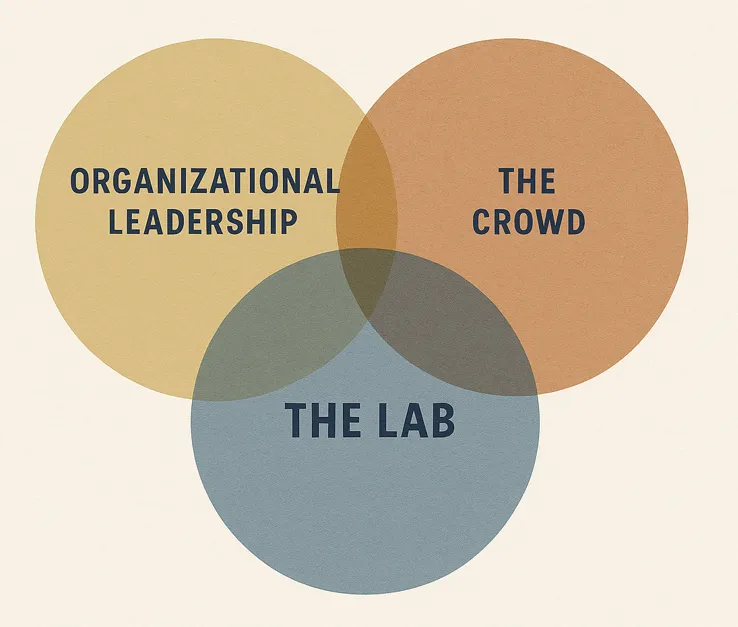
Making AI Work: Leadership, Lab, and Crowd — from oneusefulthing.org by Ethan Mollick
A formula for AI in companies

How do we reconcile the first three points with the final one? The answer is that AI use that boosts individual performance does not naturally translate to improving organizational performance. To get organizational gains requires organizational innovation, rethinking incentives, processes, and even the nature of work. But the muscles for organizational innovation inside companies have atrophied. For decades, companies have outsourced this to consultants or enterprise software vendors who develop generalized approaches that address the issues of many companies at once. That won’t work here, at least for a while. Nobody has special information about how to best use AI at your company, or a playbook for how to integrate it into your organization.
.


Galileo Learn™ – A Revolutionary Approach To Corporate Learning — from joshbersin.com

Today we are excited to launch Galileo Learn™, a revolutionary new platform for corporate learning and professional development.

How do we leverage AI to revolutionize this model, doing away with the dated “publishing” model of training?

The answer is Galileo Learn, a radically new and different approach to corporate training and professional development.

What Exactly is Galileo Learn™?
Galileo Learn is an AI-native learning platform which is tightly integrated into the Galileo agent. It takes content in any form (PDF, word, audio, video, SCORM courses, and more) and automatically (with your guidance) builds courses, assessments, learning programs, polls, exercises, simulations, and a variety of other instructional formats.


Designing an Ecosystem of Resources to Foster AI Literacy With Duri Long — from aialoe.org

Centering Public Understanding in AI Education
In a recent talk titled “Designing an Ecosystem of Resources to Foster AI Literacy,” Duri Long, Assistant Professor at Northwestern University, highlighted the growing need for accessible, engaging learning experiences that empower the public to make informed decisions about artificial intelligence. Long emphasized that as AI technologies increasingly influence everyday life, fostering public understanding is not just beneficial—it’s essential. Her work seeks to develop a framework for AI literacy across varying audiences, from middle school students to adult learners and journalists.

A Design-Driven, Multi-Context Approach
Drawing from design research, cognitive science, and the learning sciences, Long presented a range of educational tools aimed at demystifying AI. Her team has created hands-on museum exhibits, such as Data Bites, where learners build physical datasets to explore how computers learn. These interactive experiences, along with web-based tools and support resources, are part of a broader initiative to bridge AI knowledge gaps using the 4As framework: Ask, Adapt, Author, and Analyze. Central to her approach is the belief that familiar, tangible interactions and interfaces reduce intimidation and promote deeper engagement with complex AI concepts.


I’m a LinkedIn Executive. I See the Bottom Rung of the Career Ladder Breaking. — from nytimes.com by Aneesh Raman; this is a gifted article

There are growing signs that artificial intelligence poses a real threat to a substantial number of the jobs that normally serve as the first step for each new generation of young workers. Uncertainty around tariffs and global trade is likely to only accelerate that pressure, just as millions of 2025 graduates enter the work force.

Breaking first is the bottom rung of the career ladder. In tech, advanced coding tools are creeping into the tasks of writing simple code and debugging — the ways junior developers gain experience. In law firms, junior paralegals and first-year associates who once cut their teeth on document review are handing weeks of work over to A.I. tools to complete in a matter of hours. And across retailers, A.I. chatbots and automated customer service tools are taking on duties once assigned to young associates.


Talk to Me: NVIDIA and Partners Boost People Skills and Business Smarts for AI Agents  — from blogs.nvidia.com by Adel El Hallak
NVIDIA Enterprise AI Factory validated design and latest NVIDIA AI Blueprints help businesses add intelligent AI teammates that can speak, research and learn to their daily operations.

Call it the ultimate proving ground. Collaborating with teammates in the modern workplace requires fast, fluid thinking. Providing insights quickly, while juggling webcams and office messaging channels, is a startlingly good test, and enterprise AI is about to pass it — just in time to provide assistance to busy knowledge workers.

To support enterprises in boosting productivity with AI teammates, NVIDIA today introduced a new NVIDIA Enterprise AI Factory validated design at COMPUTEX. IT teams deploying and scaling AI agents can use the design to build accelerated infrastructure and easily integrate with platforms and tools from NVIDIA software partners.

NVIDIA also unveiled new NVIDIA AI Blueprints to aid developers building smart AI teammates. Using the new blueprints, developers can enhance employee productivity through adaptive avatars that understand natural communication and have direct access to enterprise data.


NVIDIA CEO Envisions AI Infrastructure Industry Worth ‘Trillions of Dollars’ — from blogs.nvidia.com by Brian Caulfield
In his COMPUTEX keynote, Huang unveiled a sweeping vision for an AI-powered future, showcasing new platforms and partnerships.

“AI is now infrastructure, and this infrastructure, just like the internet, just like electricity, needs factories,” Huang said. “These factories are essentially what we build today.”

“They’re not data centers of the past,” Huang added. “These AI data centers, if you will, are improperly described. They are, in fact, AI factories. You apply energy to it, and it produces something incredibly valuable, and these things are called tokens.”

More’s coming, Huang said, describing the growing power of AI to reason and perceive. That leads us to agentic AI — AI able to understand, think and act. Beyond that is physical AI — AI that understands the world. The phase after that, he said, is general robotics.


Everything Revealed at Nvidia’s 2025 Computex Press Conference in 19 Minutes — from mashable.com
Nvidia is creating Omniverse Digital Twins of factories including humanoid robots

Watch all the biggest announcements from Nvidia’s keynote address at Computex 2025 in Taipei, Taiwan.


Dell unveils new AI servers powered by Nvidia chips to boost enterprise adoption — from reuters.com

May 19 (Reuters) – Dell Technologies (DELL.N), opens new tab on Monday unveiled new servers powered by Nvidia’s (NVDA.O), opens new tab Blackwell Ultra chips, aiming to capitalize on the booming demand for artificial intelligence systems.

The servers, available in both air-cooled and liquid-cooled variations, support up to 192 Nvidia Blackwell Ultra chips but can be customized to include as many as 256 chips.


Nvidia announces humanoid robotics, custom AI infrastructure tech at Computex 2025 — from finance.yahoo.com by Daniel Howley

Nvidia (NVDA) rolled into this year’s Computex Taipei tech expo on Monday with several announcements, ranging from the development of humanoid robots to the opening up of its high-powered NVLink technology, which allows companies to build semi-custom AI servers with Nvidia’s infrastructure.

During the event on Monday, Nvidia revealed its Nvidia Isaac GR00T-Dreams, which the company says helps developers create enormous amounts of training data they can use to teach robots how to perform different behaviors and adapt to new environments.


Addendums on 5/22/25:


© 2025 | Daniel Christian