It’s the end of work as we knew it
and I feel…

powerless to fight the technology that we pioneered
nostalgic for a world that moved on without us
after decades of paying our dues
for a payday that never came
…so yeah
not exactly fine.


The Gen X Career Meltdown — from nytimes.com by Steeven Kurutz (DSC: This is a gifted article for you)
Just when they should be at their peak, experienced workers in creative fields find that their skills are all but obsolete.

If you entered media or image-making in the ’90s — magazine publishing, newspaper journalism, photography, graphic design, advertising, music, film, TV — there’s a good chance that you are now doing something else for work. That’s because those industries have shrunk or transformed themselves radically, shutting out those whose skills were once in high demand.

“I am having conversations every day with people whose careers are sort of over,” said Chris Wilcha, a 53-year-old film and TV director in Los Angeles.

Talk with people in their late 40s and 50s who once imagined they would be able to achieve great heights — or at least a solid career while flexing their creative muscles — and you are likely to hear about the photographer whose work dried up, the designer who can’t get hired or the magazine journalist who isn’t doing much of anything.

In the wake of the influencers comes another threat, artificial intelligence, which seems likely to replace many of the remaining Gen X copywriters, photographers and designers. By 2030, ad agencies in the United States will lose 32,000 jobs, or 7.5 percent of the industry’s work force, to the technology, according to the research firm Forrester.


From DSC:
This article reminds me of how tough it is to navigate change in our lives. For me, it was often due to the fact that I was working with technologies. Being a technologist can be difficult, especially as one gets older and faces age discrimination in a variety of industries. You need to pick the right technologies and the directions that will last (for me it was email, videoconferencing, the Internet, online-based education/training, discovering/implementing instructional technologies, and becoming a futurist).

For you younger folks out there — especially students within K-16 — aim to develop a perspective and a skillset that is all about adapting to change. You will likely need to reinvent yourself and/or pick up new skills over your working years. You are most assuredly required to be a lifelong learner now. That’s why I have been pushing for school systems to be more concerned with providing more choice and control to students — so that students actually like school and enjoy learning about new things.




Students Shadow Alumni at Work and at Home — from insidehighered.com by Ashley Mowreader
Learners at Grinnell College can experience a week in the life of a career professional through a homestay job shadow offering.

Job shadows provide students with a low-stakes opportunity to engage in a workplace to gain deeper insight into company culture and daily habits of working individuals.

An externship experience at Grinnell College in Iowa goes one step further and places students in homestays with alumni over spring break, giving them a peek behind the curtain to the work-life balance and habits of alumni in their intended industry.


Students and folks looking for work may want to check out:

Also relevant/see:


The Third Horizon of Learning Shifting beyond the Industrial Model — from gettingsmart.com by Sujata Bhatt & Mason Pashia

Over 24 blog posts, we have sketched a bold vision of what this next horizon of education looks like in action and highlighted the many innovators working to bring it to life. These pioneers are building new models that prioritize human development, relationships, and real-world relevance as most valuable. They are forging partnerships, designing and adopting transformative technologies, developing new assessment methods, and more. These shifts transform the lived experiences of young people and serve the needs of families and communities. In short, they are delivering authentic learning experiences that better address the demands of today’s economy, society, and learners.

We’ve aggregated our findings from this blog series and turned it into an H3 Publication. Inside, you’ll find our key transformation takeaways for school designers and system leaders, as well as a full list of the contributing authors. Thank you to all of the contributors, including LearnerStudio for sponsoring the series and Sujata Bhatt at Incubate Learning for authorship, editing and curation support throughout the entirety of the series and publication.
.


8 Weeks Left to Prepare Students for the AI-Enhanced Workplace — from insidehighered.com by Ray Schroeder
We are down to the final weeks left to fully prepare students for entry into the AI-enhanced workplace. Are your students ready?

The urgent task facing those of us who teach and advise students, whether they be degree program or certificate seeking, is to ensure that they are prepared to enter (or re-enter) the workplace with skills and knowledge that are relevant to 2025 and beyond. One of the first skills to cultivate is an understanding of what kinds of services this emerging technology can provide to enhance the worker’s productivity and value to the institution or corporation.

Given that short period of time, coupled with the need to cover the scheduled information in the syllabus, I recommend that we consider merging AI use into authentic assignments and assessments, supplementary modules, and other resources to prepare for AI.


Learning Design in the Era of Agentic AI — from drphilippahardman.substack.com by Dr Philippa Hardman
Aka, how to design online async learning experiences that learners can’t afford to delegate to AI agents

The point I put forward was that the problem is not AI’s ability to complete online async courses, but that online async courses courses deliver so little value to our learners that they delegate their completion to AI.

The harsh reality is that this is not an AI problem — it is a learning design problem.

However, this realisation presents us with an opportunity which we overall seem keen to embrace. Rather than seeking out ways to block AI agents, we seem largely to agree that we should use this as a moment to reimagine online async learning itself.


8 Schools Innovating With Google AI — Here’s What They’re Doing — from forbes.com by Dan Fitzpatrick

While fears of AI replacing educators swirl in the public consciousness, a cohort of pioneering institutions is demonstrating a far more nuanced reality. These eight universities and schools aren’t just experimenting with AI, they’re fundamentally reshaping their educational ecosystems. From personalized learning in K-12 to advanced research in higher education, these institutions are leveraging Google’s AI to empower students, enhance teaching, and streamline operations.


Essential AI tools for better work — from wondertools.substack.com by Jeremy Caplan
My favorite tactics for making the most of AI — a podcast conversation

AI tools I consistently rely on (areas covered mentioned below)

  • Research and analysis
  • Communication efficiency
  • Multimedia creation

AI tactics that work surprisingly well 

1. Reverse interviews
Instead of just querying AI, have it interview you. Get the AI to interview you, rather than interviewing it. Give it a little context and what you’re focusing on and what you’re interested in, and then you ask it to interview you to elicit your own insights.”

This approach helps extract knowledge from yourself, not just from the AI. Sometimes we need that guide to pull ideas out of ourselves.


How can businesses stay ahead of trends and technologies that are rapidly changing their industries? — from linkedin.com by Tanja Schindler; via her Dancing with Uncertainty newsletter

Companies need to develop a sense of curiosity about both the observable trends in the present and the unobserved factors that could significantly influence their futures. While current trends can drive us in certain directions, we also need to imagine possible futures that could either disrupt our industry or offer tremendous opportunities for growth.

To stay ahead of the game, companies should focus on recognising weak signals in the present – subtle hints of emerging trends – and deciding whether to encourage or discourage these signals to avoid undesirable futures and encourage desirable ones. This process is a constant dance between the push of the present (existing trends) and the pull of the future (visions of the future we want to create).


From DSC:
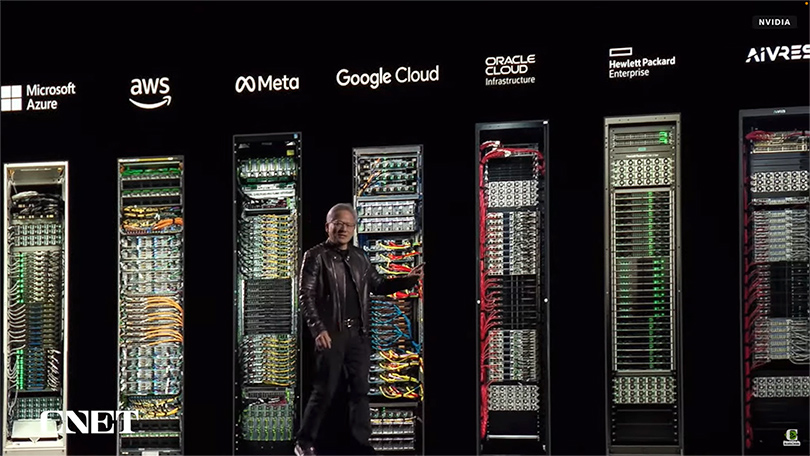
Look out Google, Amazon, and others! Nvidia is putting the pedal to the metal in terms of being innovative and visionary! They are leaving the likes of Apple in the dust.

The top talent out there is likely to go to Nvidia for a while. Engineers, programmers/software architects, network architects, product designers, data specialists, AI researchers, developers of robotics and autonomous vehicles, R&D specialists, computer vision specialists, natural language processing experts, and many more types of positions will be flocking to Nvidia to work for a company that has already changed the world and will likely continue to do so for years to come. 


NVIDIA’s AI Superbowl — from theneurondaily.com by Noah and Grant
PLUS: Prompt tips to make AI writing more natural

That’s despite a flood of new announcements (here’s a 16 min video recap), which included:

  1. A new architecture for massive AI data centers (now called “AI factories”).
  2. A physics engine for robot training built with Disney and DeepMind.
  3. partnership with GM to develop next-gen vehicles, factories and robots.
  4. A new Blackwell chip with “Dynamo” software that makes AI reasoning 40x faster than previous generations.
  5. A new “Rubin” chip slated for 2026 and a “Feynman” chip set for 2028.

For enterprises, NVIDIA unveiled DGX Spark and DGX Station—Jensen’s vision of AI-era computing, bringing NVIDIA’s powerful Blackwell chip directly to your desk.


Nvidia Bets Big on Synthetic Data — from wired.com by Lauren Goode
Nvidia has acquired synthetic data startup Gretel to bolster the AI training data used by the chip maker’s customers and developers.


Nvidia, xAI to Join BlackRock and Microsoft’s $30 Billion AI Infrastructure Fund — from investopedia.com by Aaron McDade
Nvidia and xAI are joining BlackRock and Microsoft in an AI infrastructure group seeking $30 billion in funding. The group was first announced in September as BlackRock and Microsoft sought to fund new data centers to power AI products.


Nvidia CEO Jensen Huang says we’ll soon see 1 million GPU data centers visible from space — from finance.yahoo.com by Daniel Howley
Nvidia CEO Jensen Huang says the company is preparing for 1 million GPU data centers.


Nvidia stock stems losses as GTC leaves Wall Street analysts ‘comfortable with long term AI demand’ — from finance.yahoo.com by Laura Bratton
Nvidia stock reversed direction after a two-day slide that saw shares lose 5% as the AI chipmaker’s annual GTC event failed to excite investors amid a broader market downturn.


Microsoft, Google, and Oracle Deepen Nvidia Partnerships. This Stock Got the Biggest GTC Boost. — from barrons.com by Adam Clark and Elsa Ohlen


The 4 Big Surprises from Nvidia’s ‘Super Bowl of AI’ GTC Keynote — from barrons.com by Tae Kim; behind a paywall

AI Super Bowl. Hi everyone. This week, 20,000 engineers, scientists, industry executives, and yours truly descended upon San Jose, Calif. for Nvidia’s annual GTC developers’ conference, which has been dubbed the “Super Bowl of AI.”


Who does need college anymore? About that book title … — from Education Design Lab

As you may know, Lab founder Kathleen deLaski just published a book with a provocative title: Who Needs College Anymore? Imagining a Future Where Degrees Won’t Matter.

Kathleen is asked about the title in every media interview, before and since the Feb. 25 book release. “It has generated a lot of questions,” she said in our recent book chat. “I tell people to focus on the word, ‘who.’ Who needs college anymore? That’s in keeping with the design thinking frame, where you look at the needs of individuals and what needs are not being met.”

In the same conversation, Kathleen reminded us that only 38% of American adults have a four-year degree. “We never talk about the path to the American dream for the rest of folks,” she said. “We currently are not supporting the other really interesting pathways to financial sustainability — apprenticeships, short-term credentials. And that’s really why I wrote the book, to push the conversation around the 62% of who we call New Majority Learners at the Lab, the people for whom college was not designed.” Watch the full clip

She distills the point into one sentence in this SmartBrief essay:  “The new paradigm is a ‘yes and’ paradigm that embraces college and/or other pathways instead of college or bust.”

What can colleges do moving forward?
In this excellent Q&A with Inside Higher Ed, Kathleen shares her No. 1 suggestion: “College needs to be designed as a stepladder approach, where people can come in and out of it as they need, and at the very least, they can build earnings power along the way to help afford a degree program.”

In her Hechinger Report essay, Kathleen lists four more steps colleges can take to meet the demand for more choices, including “affordability must rule.”

From white-collar apprenticeships and micro-credential programs at local community colleges to online bootcamps, self-instruction using YouTube, and more—students are forging alternative paths to GREAT high-paying jobs. (source)


Education Department Fires 1,300 Workers, Gutting Its Staff — from nytimes.com by Michael C. Bender and Dana Goldstein. From DSC: I’m gifting this article to you.
The layoffs mean that the department will now have a work force of about half the size it did when President Trump took office.

The Education Department announced on Tuesday that it was firing more than 1,300 workers, effectively gutting the agency that manages federal loans for college, tracks student achievement and enforces civil rights laws in schools.

The layoffs mean that the department, which started the year with 4,133 employees, will now have a work force of about half that size after less than two months with President Trump in office. In addition to the 1,315 workers who were fired on Tuesday, 572 employees accepted separation packages offered in recent weeks and 63 probationary workers were terminated last month.


Are Entry-Level Jobs Going Away? The Hidden Workforce Shift — from forbes.com by Dr. Diane Hamilton; via Ryan Craig

The problem is that these new roles demand a level of expertise that wasn’t expected from entry-level candidates in the past. Where someone might have previously learned on the job, they are now required to have relevant certifications, AI proficiency, or experience with digital platforms before they even apply.

Some current and emerging job titles that serve as entry points into industries include:

  • Digital marketing associate – This role often involves content creation, social media management, and working with AI-driven analytics tools.
  • Junior AI analyst – Employees in this role assist data science teams by labeling and refining machine learning datasets.
  • Customer success associate – Replacing traditional customer service roles, these professionals help manage AI-enhanced customer support systems.
  • Technical support specialist – While this role still involves troubleshooting software, it now often includes AI-driven diagnostics and automation oversight.
 

Blind Spot on AI — from the-job.beehiiv.com by Paul Fain
Office tasks are being automated now, but nobody has answers on how education and worker upskilling should change.

Students and workers will need help adjusting to a labor market that appears to be on the verge of a historic disruption as many business processes are automated. Yet job projections and policy ideas are sorely lacking.

The benefits of agentic AI are already clear for a wide range of organizations, including small nonprofits like CareerVillage. But the ability to automate a broad range of business processes means that education programs and skills training for knowledge workers will need to change. And as Chung writes in a must-read essay, we have a blind spot with predicting the impacts of agentic AI on the labor market.

“Without robust projections,” he writes, “policymakers, businesses, and educators won’t be able to come to terms with how rapidly we need to start this upskilling.”


Learning as a Learning Professional: Unlock Hidden Opportunities — from learningguild.com by Will Thalheimer

As learning professionals, we help others grow—but how well are we developing ourselves? And does it really matter? Absolutely! In this article, I’ll explore why mastering the art of learning is crucial for our success and share strategies that go beyond traditional professional development.

Why learning matters for us
We need to be strong learners because our work demands broad expertise. We must understand the learning sciences, instructional design, project management, technology, evaluation, organizational dynamics, and business strategy. We also need to navigate a sea of learning frameworks, approaches, and models.


Also from learningguild.com, see:

Microlearning: The Key to Capturing Modern Learners’ Attention — by Sergiy Movchan

This shift in how we consume and process information is challenging traditional learning methods, which are finding it increasingly difficult to keep learners’ attention.

Microlearning is a bridge to the attention of today’s learners, delivering complex topics in short, manageable pieces. Whether it’s a five-minute video, a quick quiz, or a short lesson, microlearning makes it easier for students to stay engaged. Microlearning often holds learners’ attention better and for longer compared to standard learning methods.

Typical low completion rates clearly show the need for innovative approaches to content delivery and student engagement. Microlearning offers the answer to this need.

Cultivating Creativity as an L&D Professional — by Katie Belle (Curry) Nelson

Instructional designers and learning professionals are creative by nature. We are called upon to be creative with technology like Articulate, Camtasia, or Captivate. More often than we would like, organizations, red tape, and clients require us to be creative with timelines and budgets. Being creative is a core qualification and requirement of our work. So, what do we do when we feel like the creative river has run to a trickle or dried up entirely?


You can now use Deep Research without $200 — from flexos.work


Accelerating scientific breakthroughs with an AI co-scientist — from research.google by Juraj Gottweis and Vivek Natarajan

We introduce AI co-scientist, a multi-agent AI system built with Gemini 2.0 as a virtual scientific collaborator to help scientists generate novel hypotheses and research proposals, and to accelerate the clock speed of scientific and biomedical discoveries.


Now decides next: Generating a new future — from Deloitte.com
Deloitte’s State of Generative AI in the Enterprise Quarter four report

There is a speed limit. GenAI technology continues to advance at incredible speed. However, most organizations are moving at the speed of organizations, not at the speed of technology. No matter how quickly the technology advances—or how hard the companies producing GenAI technology push—organizational change in an enterprise can only happen so fast.

Barriers are evolving. Significant barriers to scaling and value creation are still widespread across key areas. And, over the past year regulatory uncertainty and risk management have risen in organizations’ lists of concerns to address. Also, levels of trust in GenAI are still moderate for the majority of organizations. Even so, with increased customization and accuracy of models—combined with a focus on better governance— adoption of GenAI is becoming more established.

Some uses are outpacing others. Application of GenAI is further along in some business areas than in others in terms of integration, return on investment (ROI) and expectations. The IT function is most mature; cybersecurity, operations, marketing and customer service are also showing strong adoption and results. Organizations reporting higher ROI for their most scaled initiatives are broadly further along in their GenAI journeys.


How can college leaders navigate mergers and closures in 2025? — from highereddive.com by Ricardo Azziz
A consolidation expert urges officials to face the facts, explore their strategic options and be willing to accept external help.

This work leads me to desire three wishes for higher education leaders in 2025, namely that they:

  • Be disposed to accepting the facts.
  • Be willing to explore all strategic options.
  • Be agreeable to accepting external help.

Northland College to close after turnaround falls short — from highereddive.com by Ben Unglesbee
Despite recent restructuring efforts, the Wisconsin nonprofit’s board chair said it couldn’t weather “economic and demographic storms” hitting the sector.


12 Trump moves in 4 weeks: What college leaders need to know— from highereddive.com by Natalie Schwartz
The new administration has implemented several policies that have sparked outcry from university researchers and student advcocates.


© 2025 | Daniel Christian