The following resource was from Roberto Ferraro:

Micromanagement — from psychsafety.com by Jade Garratt

Psychological Safety and Micromanagement
Those who have followed our work at Psych Safety for a while will know that we believe exploring not just what to do – the behaviours and practices that support psychological safety – but also what to avoid can be hugely valuable. Understanding the behaviours that damage psychological safety, what not to do, and even what not to say can help us build better workplaces.

There are many behaviours that damage psychological safety, and one that almost always comes up in our workshops when discussing cultures of fear is micromanagement. So we thought it was time we explored micromanagement in more detail, considering how and why it damages psychological safety and what we can do instead.

Micromanagement is a particular approach to leadership where a manager exhibits overly controlling behaviours or an excessive and inappropriate focus on minor details. They might scrutinise their team’s work closely, insist on checking work, refrain from delegating, and limit the autonomy people need to do their jobs well. It can also manifest as an authoritarian leadership style, where decision-making is centralised (back to themselves) and employees have little say in their work.


From DSC:
I was fortunate to not have a manager who was a micromanager until my very last boss/supervisor of my career. But it was that particular manager who made me call it quits and leave the track. She demeaned me in front of others, and was extremely directive and controlling. She wanted constant check-ins and progress reports. And I could go on and on here. 

But suffice it to say that after having worked for several decades, that kind of manager was not what I was looking for. And you wouldn’t be either. By the way…my previous boss — at the same place — and I achieved a great deal in a very short time. She taught me a lot and was a great administrator, designer, professor, mentor, and friend. But that boss was moved to a different role as upper management/leadership changed. Then the micromanagement began after I reported to a different supervisor.

Anyway, don’t be a micromanager. If you are a recent graduate or are coming up on your graduation from college, learn that lesson now. No one likes to work for a micromanager. No one. It can make your employees’ lives miserable and do damage to their mental health, their enjoyment (or lack thereof) of work, and several other things that this article mentions. Instead, respect your employees. Trust your employees. Let them do their thing. See what they might need, then help meet those needs. Then get out of their way.


.

2025 EDUCAUSE Students and Technology Report: Shaping the Future of Higher Education Through Technology, Flexibility, and Well-Being — from library.educause.edu

The student experience in higher education is continually evolving, influenced by technological advancements, shifting student needs and expectations, evolving workforce demands, and broadening sociocultural forces. In this year’s report, we examine six critical aspects of student experiences in higher education, providing insights into how institutions can adapt to meet student needs and enhance their learning experience and preparation for the workforce:

  • Satisfaction with Technology-Related Services and Supports
  • Modality Preferences
  • Hybrid Learning Experiences
  • Generative AI in the Classroom
  • Workforce Preparation
  • Accessibility and Mental Health

DSC: Shame on higher ed for not preparing students for the workplace (see below). You’re doing your students wrong…again. Not only do you continue to heap a load of debt on their backs, but you’re also continuing to not get them ready for the workplace. So don’t be surprised if eventually you’re replaced by a variety of alternatives that students will flock towards.
.


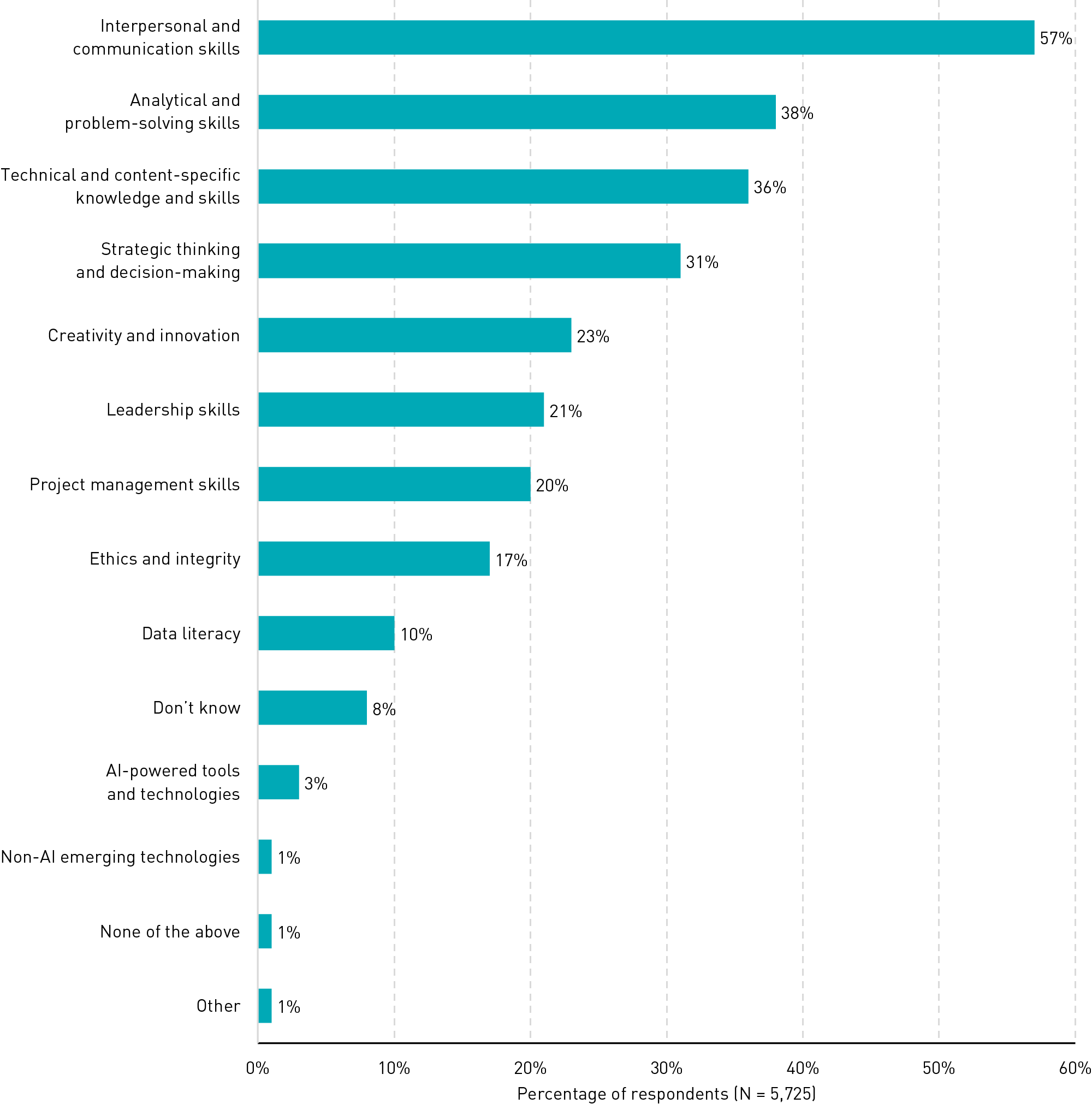
DSC: And students don’t have a clue as to what awaits them in the workplace — they see AI-powered tools and technologies at an incredibly low score of only 3%. Yeh, right. You’ll find out. Here’s but one example from one discipline/field of work –> Thomson Reuters Survey: Over 95% of Legal Professionals Expect Gen AI to Become Central to Workflow Within Five Years

.

Figure 15. Competency Areas Expected to Be Important for Career


From DSC:
After seeing Sam’s posting below, I can’t help but wonder:

  • How might the memory of an AI over time impact the ability to offer much more personalized learning?
  • How will that kind of memory positively impact a person’s learning-related profile?
  • Which learning-related agents get called upon?
  • Which learning-related preferences does a person have while learning about something new?
  • Which methods have worked best in the past for that individual? Which methods didn’t work so well with him or her?


Reflections on “Are You Ready for the AI University? Everything is about to change.” [Latham]

.
Are You Ready for the AI University? Everything is about to change. — from chronicle.com by Scott Latham

Over the course of the next 10 years, AI-powered institutions will rise in the rankings. US News & World Report will factor a college’s AI capabilities into its calculations. Accrediting agencies will assess the degree of AI integration into pedagogy, research, and student life. Corporations will want to partner with universities that have demonstrated AI prowess. In short, we will see the emergence of the AI haves and have-nots.

What’s happening in higher education today has a name: creative destruction. The economist Joseph Schumpeter coined the term in 1942 to describe how innovation can transform industries. That typically happens when an industry has both a dysfunctional cost structure and a declining value proposition. Both are true of higher education.

Out of the gate, professors will work with technologists to get AI up to speed on specific disciplines and pedagogy. For example, AI could be “fed” course material on Greek history or finance and then, guided by human professors as they sort through the material, help AI understand the structure of the discipline, and then develop lectures, videos, supporting documentation, and assessments.

In the near future, if a student misses class, they will be able watch a recording that an AI bot captured. Or the AI bot will find a similar lecture from another professor at another accredited university. If you need tutoring, an AI bot will be ready to help any time, day or night. Similarly, if you are going on a trip and wish to take an exam on the plane, a student will be able to log on and complete the AI-designed and administered exam. Students will no longer be bound by a rigid class schedule. Instead, they will set the schedule that works for them.

Early and mid-career professors who hope to survive will need to adapt and learn how to work with AI. They will need to immerse themselves in research on AI and pedagogy and understand its effect on the classroom. 

From DSC:
I had a very difficult time deciding which excerpts to include. There were so many more excerpts for us to think about with this solid article. While I don’t agree with several things in it, EVERY professor, president, dean, and administrator working within higher education today needs to read this article and seriously consider what Scott Latham is saying.

Change is already here, but according to Scott, we haven’t seen anything yet. I agree with him and, as a futurist, one has to consider the potential scenarios that Scott lays out for AI’s creative destruction of what higher education may look like. Scott asserts that some significant and upcoming impacts will be experienced by faculty members, doctoral students, and graduate/teaching assistants (and Teaching & Learning Centers and IT Departments, I would add). But he doesn’t stop there. He brings in presidents, deans, and other members of the leadership teams out there.

There are a few places where Scott and I differ.

  • The foremost one is the importance of the human element — i.e., the human faculty member and students’ learning preferences. I think many (most?) students and lifelong learners will want to learn from a human being. IBM abandoned their 5-year, $100M ed push last year and one of the key conclusions was that people want to learn from — and with — other people:

To be sure, AI can do sophisticated things such as generating quizzes from a class reading and editing student writing. But the idea that a machine or a chatbot can actually teach as a human can, he said, represents “a profound misunderstanding of what AI is actually capable of.” 

Nitta, who still holds deep respect for the Watson lab, admits, “We missed something important. At the heart of education, at the heart of any learning, is engagement. And that’s kind of the Holy Grail.”

— Satya Nitta, a longtime computer researcher at
IBM’s Watson
Research Center in Yorktown Heights, NY
.

By the way, it isn’t easy for me to write this. As I wanted AI and other related technologies to be able to do just what IBM was hoping that it would be able to do.

  • Also, I would use the term learning preferences where Scott uses the term learning styles.

Scott also mentions:

“In addition, faculty members will need to become technologists as much as scholars. They will need to train AI in how to help them build lectures, assessments, and fine-tune their classroom materials. Further training will be needed when AI first delivers a course.”

It has been my experience from working with faculty members for over 20 years that not all faculty members want to become technologists. They may not have the time, interest, and/or aptitude to become one (and vice versa for technologists who likely won’t become faculty members).

That all said, Scott relays many things that I have reflected upon and relayed for years now via this Learning Ecosystems blog and also via The Learning from the Living [AI-Based Class] Room vision — the use of AI to offer personalized and job-relevant learning, the rising costs of higher education, the development of new learning-related offerings and credentials at far less expensive prices, the need to provide new business models and emerging technologies that are devoted more to lifelong learning, plus several other things.

So this article is definitely worth your time to read, especially if you are working in higher education or are considering a career therein!


Addendum later on 4/10/25:

U-M’s Ross School of Business, Google Public Sector launch virtual teaching assistant pilot program — from news.umich.edu by Jeff Karoub; via Paul Fain

Google Public Sector and the University of Michigan’s Ross School of Business have launched an advanced Virtual Teaching Assistant pilot program aimed at improving personalized learning and enlightening educators on artificial intelligence in the classroom.

The AI technology, aided by Google’s Gemini chatbot, provides students with all-hours access to support and self-directed learning. The Virtual TA represents the next generation of educational chatbots, serving as a sophisticated AI learning assistant that instructors can use to modify their specific lessons and teaching styles.

The Virtual TA facilitates self-paced learning for students, provides on-demand explanations of complex course concepts, guides them through problem-solving, and acts as a practice partner. It’s designed to foster critical thinking by never giving away answers, ensuring students actively work toward solutions.


The 2025 AI Index Report — from Stanford University’s Human-Centered Artificial Intelligence Lab (hai.stanford.edu); item via The Neuron

Top Takeaways

  1. AI performance on demanding benchmarks continues to improve.
  2. AI is increasingly embedded in everyday life.
  3. Business is all in on AI, fueling record investment and usage, as research continues to show strong productivity impacts.
  4. The U.S. still leads in producing top AI models—but China is closing the performance gap.
  5. The responsible AI ecosystem evolves—unevenly.
  6. Global AI optimism is rising—but deep regional divides remain.
  7. …and several more

Also see:

The Neuron’s take on this:

So, what should you do? You really need to start trying out these AI tools. They’re getting cheaper and better, and they can genuinely help save time or make work easier—ignoring them is like ignoring smartphones ten years ago.

Just keep two big things in mind:

  1. Making the next super-smart AI costs a crazy amount of money and uses tons of power (seriously, they’re buying nuclear plants and pushing coal again!).
  2. Companies are still figuring out how to make AI perfectly safe and fair—cause it still makes mistakes.

So, use the tools, find what helps you, but don’t trust them completely.

We’re building this plane mid-flight, and Stanford’s report card is just another confirmation that we desperately need better safety checks before we hit major turbulence.


Addendum on 4/16:


Is collaboration the key to digital accessibility? — from timeshighereducation.com by Sal Jarvis and George Rhodes
Digital accessibility is ethically important, and a legal requirement, but it’s also a lot of work. Here’s how universities can collaborate and pool their expertise to make higher education accessible for all

How easy do you find it to navigate your way around your university’s virtual estate – its websites, virtual learning environment and other digital aspects? If the answer is “not very”, we suspect you may not be alone. And for those of us who might access it differently – without a mouse, for example, or through a screen reader or keyboard emulator – the challenge is multiplied. Digital accessibility is the wide-ranging work to make these challenges a thing of the past for everyone. It is a legal requirement and a moral imperative.

Make Things Accessible is the outcome of a collaboration, initially between the University of Westminster and UCL, but now incorporating many other universities. It is a community of practice, a website and an archive of resources. It aims to make things accessible for all.


Uplimit raises stakes in corporate learning with suite of AI agents that can train thousands of employees simultaneously — from venturebeat.com by Michael Nuñez|

Uplimit unveiled a suite of AI-powered learning agents today designed to help companies rapidly upskill employees while dramatically reducing administrative burdens traditionally associated with corporate training.

The San Francisco-based company announced three sets of purpose-built AI agents that promise to change how enterprises approach learning and development: skill-building agents, program management agents, and teaching assistant agents. The technology aims to address the growing skills gap as AI advances faster than most workforces can adapt.

“There is an unprecedented need for continuous learning—at a scale and speed traditional systems were never built to handle,” said Julia Stiglitz, CEO and co-founder of Uplimit, in an interview with VentureBeat. “The companies best positioned to thrive aren’t choosing between AI and their people—they’re investing in both.”


Introducing Claude for Education — from anthropic.com

Today we’re launching Claude for Education, a specialized version of Claude tailored for higher education institutions. This initiative equips universities to develop and implement AI-enabled approaches across teaching, learning, and administration—ensuring educators and students play a key role in actively shaping AI’s role in society.

As part of announcing Claude for Education, we’re introducing:

  1. Learning mode: A new Claude experience that guides students’ reasoning process rather than providing answers, helping develop critical thinking skills
  2. University-wide Claude availability: Full campus access agreements with Northeastern University, London School of Economics and Political Science (LSE), and Champlain College, making Claude available to all students
  3. Academic partnerships: Joining Internet2 and working with Instructure to embed AI into teaching & learning with Canvas LMS
  4. Student programs: A new Claude Campus Ambassadors program along with an initiative offering API credits for student projects

A comment on this from The Rundown AI:

Why it matters: Education continues to grapple with AI, but Anthropic is flipping the script by making the tech a partner in developing critical thinking rather than an answer engine. While the controversy over its use likely isn’t going away, this generation of students will have access to the most personalized, high-quality learning tools ever.


Should College Graduates Be AI Literate? — from chronicle.com by Beth McMurtrie (behind a paywall)
More institutions are saying yes. Persuading professors is only the first barrier they face.

Last fall one of Jacqueline Fajardo’s students came to her office, eager to tell her about an AI tool that was helping him learn general chemistry. Had she heard of Google NotebookLM? He had been using it for half a semester in her honors course. He confidently showed her how he could type in the learning outcomes she posted for each class and the tool would produce explanations and study guides. It even created a podcast based on an academic paper he had uploaded. He did not feel it was important to take detailed notes in class because the AI tool was able to summarize the key points of her lectures.


Showing Up for the Future: Why Educators Can’t Sit Out the AI Conversation — from marcwatkins.substack.com with a guest post from Lew Ludwig

The Risk of Disengagement
Let’s be honest: most of us aren’t jumping headfirst into AI. At many of our institutions, it’s not a gold rush—it’s a quiet standoff. But the group I worry most about isn’t the early adopters. It’s the faculty who’ve decided to opt out altogether.

That choice often comes from a place of care. Concerns about data privacy, climate impact, exploitative labor, and the ethics of using large language models are real—and important. But choosing not to engage at all, even on ethical grounds, doesn’t remove us from the system. It just removes our voices from the conversation.

And without those voices, we risk letting others—those with very different priorities—make the decisions that shape what AI looks like in our classrooms, on our campuses, and in our broader culture of learning.


Turbocharge Your Professional Development with AI — from learningguild.com by Dr. RK Prasad

You’ve just mastered a few new eLearning authoring tools, and now AI is knocking on the door, offering to do your job faster, smarter, and without needing coffee breaks. Should you be worried? Or excited?

If you’re a Learning and Development (L&D) professional today, AI is more than just a buzzword—it’s transforming the way we design, deliver, and measure corporate training. But here’s the good news: AI isn’t here to replace you. It’s here to make you better at what you do.

The challenge is to harness its potential to build digital-ready talent, not just within your organization but within yourself.

Let’s explore how AI is reshaping L&D strategies and how you can leverage it for professional development.


5 Recent AI Notables — from automatedteach.com by Graham Clay

1. OpenAI’s New Image Generator
What Happened: OpenAI integrated a much more powerful image generator directly into GPT-4o, making it the default image creator in ChatGPT. Unlike previous image models, this one excels at accurately rendering text in images, precise visualization of diagrams/charts, and multi-turn image refinement through conversation.

Why It’s Big: For educators, this represents a significant advancement in creating educational visuals, infographics, diagrams, and other instructional materials with unprecedented accuracy and control. It’s not perfect, but you can now quickly generate custom illustrations that accurately display mathematical equations, chemical formulas, or process workflows — previously a significant hurdle in digital content creation — without requiring graphic design expertise or expensive software. This capability dramatically reduces the time between conceptualizing a visual aid and implementing it in course materials.
.


The 4 AI modes that will supercharge your workflow — from aiwithallie.beehiiv.com by Allie K. Miller
The framework most people and companies won’t discover until 2026


Outsourcing Thought: The Hidden Cost of Letting AI Think for You — from linkedin.com by Robert Atkinson

I’ve watched it unfold in real time. A student submits a flawless coding assignment or a beautifully written essay—clean syntax, sharp logic, polished prose. But when I ask them to explain their thinking, they hesitate. They can’t trace their reasoning or walk me through the process. The output is strong, but the understanding is shallow. As a professor, I’ve seen this pattern grow more common: AI-assisted work that looks impressive on the surface but reveals a troubling absence of cognitive depth underneath.

This article is written with my students in mind—but it’s meant for anyone navigating learning, teaching, or thinking in the age of artificial intelligence. Whether you’re a student, educator, or professional, the question is the same: What happens to the brain when we stop doing our own thinking?

We are standing at a pivotal moment. With just a few prompts, generative AI can produce essays, solve complex coding problems, and summarize ideas in seconds. It feels efficient. It feels like progress. But from a cognitive neuroscience perspective, that convenience comes at a hidden cost: the gradual erosion of the neural processes that support reasoning, creativity, and long-term learning.


Students Shadow Alumni at Work and at Home — from insidehighered.com by Ashley Mowreader
Learners at Grinnell College can experience a week in the life of a career professional through a homestay job shadow offering.

Job shadows provide students with a low-stakes opportunity to engage in a workplace to gain deeper insight into company culture and daily habits of working individuals.

An externship experience at Grinnell College in Iowa goes one step further and places students in homestays with alumni over spring break, giving them a peek behind the curtain to the work-life balance and habits of alumni in their intended industry.


What trauma-informed practice is not — from timeshighereducation.com by Kate Cantrell, India Bryce, and Jessica Gildersleeve from The University of Southern Queensland
Before trauma-informed care can be the norm across all areas of the university, academic and professional staff need to understand what it is. Here, three academics debunk myths and demystify best practice

Recently, we conducted focus groups at our university to better ascertain how academics, administrators and student support staff perceive the purpose and value of trauma-informed practice, and how they perceive their capacity to contribute to organisational change.

We discovered that while most staff were united on the importance of trauma-informed care, several myths persist about what trauma-informed practice is (and is not). Some academic staff, for example, conflated teaching about trauma with trauma-informed teaching, confused trigger warnings with trigger points and, perhaps most alarmingly – given the prevalence of trauma exposure and risk among university students – misjudged trauma-informed practice as “the business of psychologists” rather than educators.


Students and folks looking for work may want to check out:

Also relevant/see:


Online higher education is projected to pass an impressive if little-noticed milestone this year: For the first time, more American college students will be learning entirely online than will be learning 100 percent in person.


Most college students are taking online classes, but they’re paying just as much as in-person students — from hechingerreport.org by Jon Marcus
Rather than lowering the price, some universities use online courses to subsidize everything else

Online higher education is projected to pass an impressive if little-noticed milestone this year: For the first time, more American college students will be learning entirely online than will be learning 100 percent in person.

Bittner’s confusion about the price is widespread. Eighty percent of Americans think online learning after high school should cost less than in-person programs, according to a 2024 survey of 1,705 adults by New America.


8 Weeks Left to Prepare Students for the AI-Enhanced Workplace — from insidehighered.com by Ray Schroeder
We are down to the final weeks left to fully prepare students for entry into the AI-enhanced workplace. Are your students ready?

The urgent task facing those of us who teach and advise students, whether they be degree program or certificate seeking, is to ensure that they are prepared to enter (or re-enter) the workplace with skills and knowledge that are relevant to 2025 and beyond. One of the first skills to cultivate is an understanding of what kinds of services this emerging technology can provide to enhance the worker’s productivity and value to the institution or corporation.

Given that short period of time, coupled with the need to cover the scheduled information in the syllabus, I recommend that we consider merging AI use into authentic assignments and assessments, supplementary modules, and other resources to prepare for AI.


Learning Design in the Era of Agentic AI — from drphilippahardman.substack.com by Dr Philippa Hardman
Aka, how to design online async learning experiences that learners can’t afford to delegate to AI agents

The point I put forward was that the problem is not AI’s ability to complete online async courses, but that online async courses courses deliver so little value to our learners that they delegate their completion to AI.

The harsh reality is that this is not an AI problem — it is a learning design problem.

However, this realisation presents us with an opportunity which we overall seem keen to embrace. Rather than seeking out ways to block AI agents, we seem largely to agree that we should use this as a moment to reimagine online async learning itself.


8 Schools Innovating With Google AI — Here’s What They’re Doing — from forbes.com by Dan Fitzpatrick

While fears of AI replacing educators swirl in the public consciousness, a cohort of pioneering institutions is demonstrating a far more nuanced reality. These eight universities and schools aren’t just experimenting with AI, they’re fundamentally reshaping their educational ecosystems. From personalized learning in K-12 to advanced research in higher education, these institutions are leveraging Google’s AI to empower students, enhance teaching, and streamline operations.


Essential AI tools for better work — from wondertools.substack.com by Jeremy Caplan
My favorite tactics for making the most of AI — a podcast conversation

AI tools I consistently rely on (areas covered mentioned below)

  • Research and analysis
  • Communication efficiency
  • Multimedia creation

AI tactics that work surprisingly well 

1. Reverse interviews
Instead of just querying AI, have it interview you. Get the AI to interview you, rather than interviewing it. Give it a little context and what you’re focusing on and what you’re interested in, and then you ask it to interview you to elicit your own insights.”

This approach helps extract knowledge from yourself, not just from the AI. Sometimes we need that guide to pull ideas out of ourselves.


Who does need college anymore? About that book title … — from Education Design Lab

As you may know, Lab founder Kathleen deLaski just published a book with a provocative title: Who Needs College Anymore? Imagining a Future Where Degrees Won’t Matter.

Kathleen is asked about the title in every media interview, before and since the Feb. 25 book release. “It has generated a lot of questions,” she said in our recent book chat. “I tell people to focus on the word, ‘who.’ Who needs college anymore? That’s in keeping with the design thinking frame, where you look at the needs of individuals and what needs are not being met.”

In the same conversation, Kathleen reminded us that only 38% of American adults have a four-year degree. “We never talk about the path to the American dream for the rest of folks,” she said. “We currently are not supporting the other really interesting pathways to financial sustainability — apprenticeships, short-term credentials. And that’s really why I wrote the book, to push the conversation around the 62% of who we call New Majority Learners at the Lab, the people for whom college was not designed.” Watch the full clip

She distills the point into one sentence in this SmartBrief essay:  “The new paradigm is a ‘yes and’ paradigm that embraces college and/or other pathways instead of college or bust.”

What can colleges do moving forward?
In this excellent Q&A with Inside Higher Ed, Kathleen shares her No. 1 suggestion: “College needs to be designed as a stepladder approach, where people can come in and out of it as they need, and at the very least, they can build earnings power along the way to help afford a degree program.”

In her Hechinger Report essay, Kathleen lists four more steps colleges can take to meet the demand for more choices, including “affordability must rule.”

From white-collar apprenticeships and micro-credential programs at local community colleges to online bootcamps, self-instruction using YouTube, and more—students are forging alternative paths to GREAT high-paying jobs. (source)

 
© 2025 | Daniel Christian