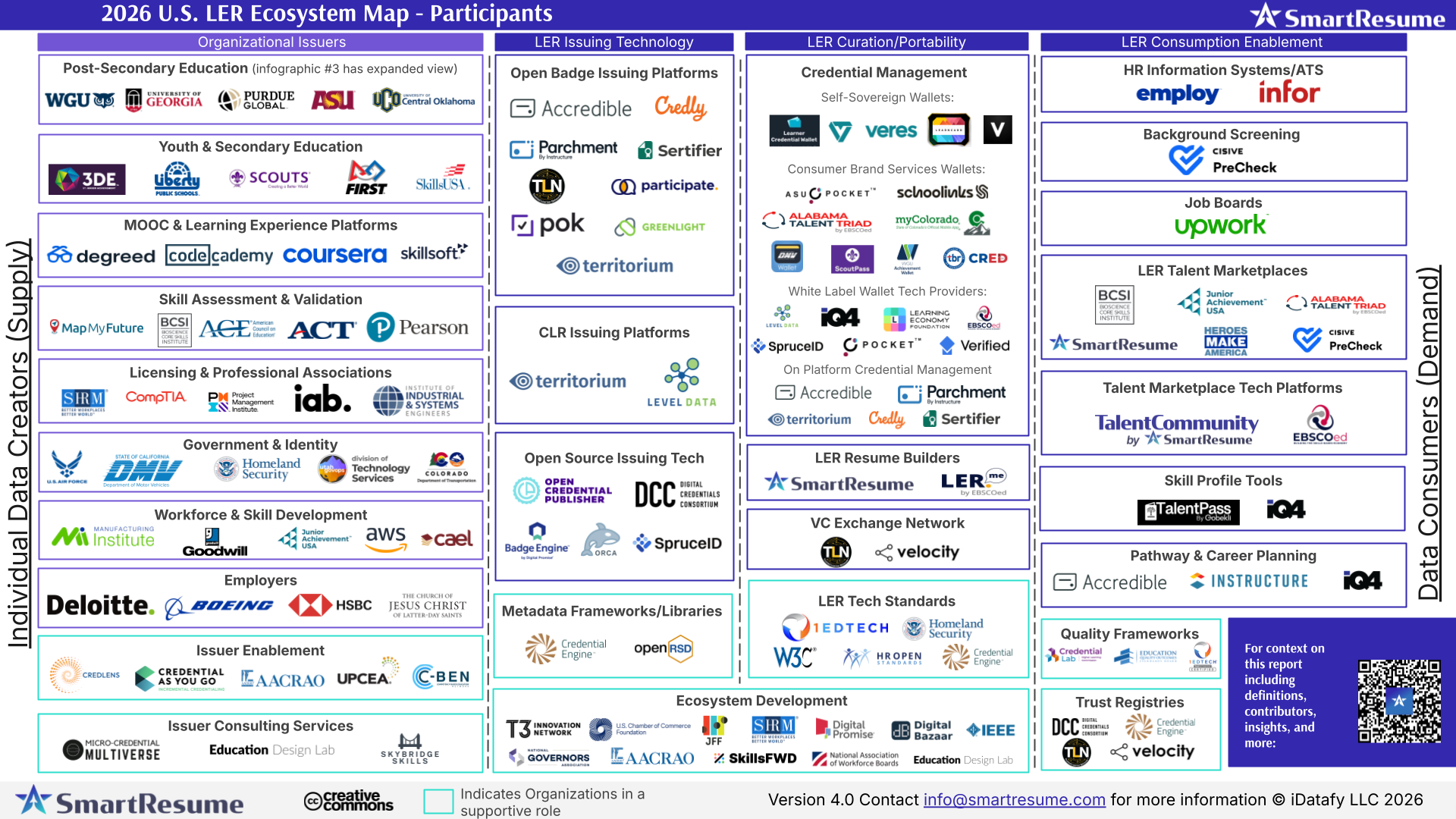
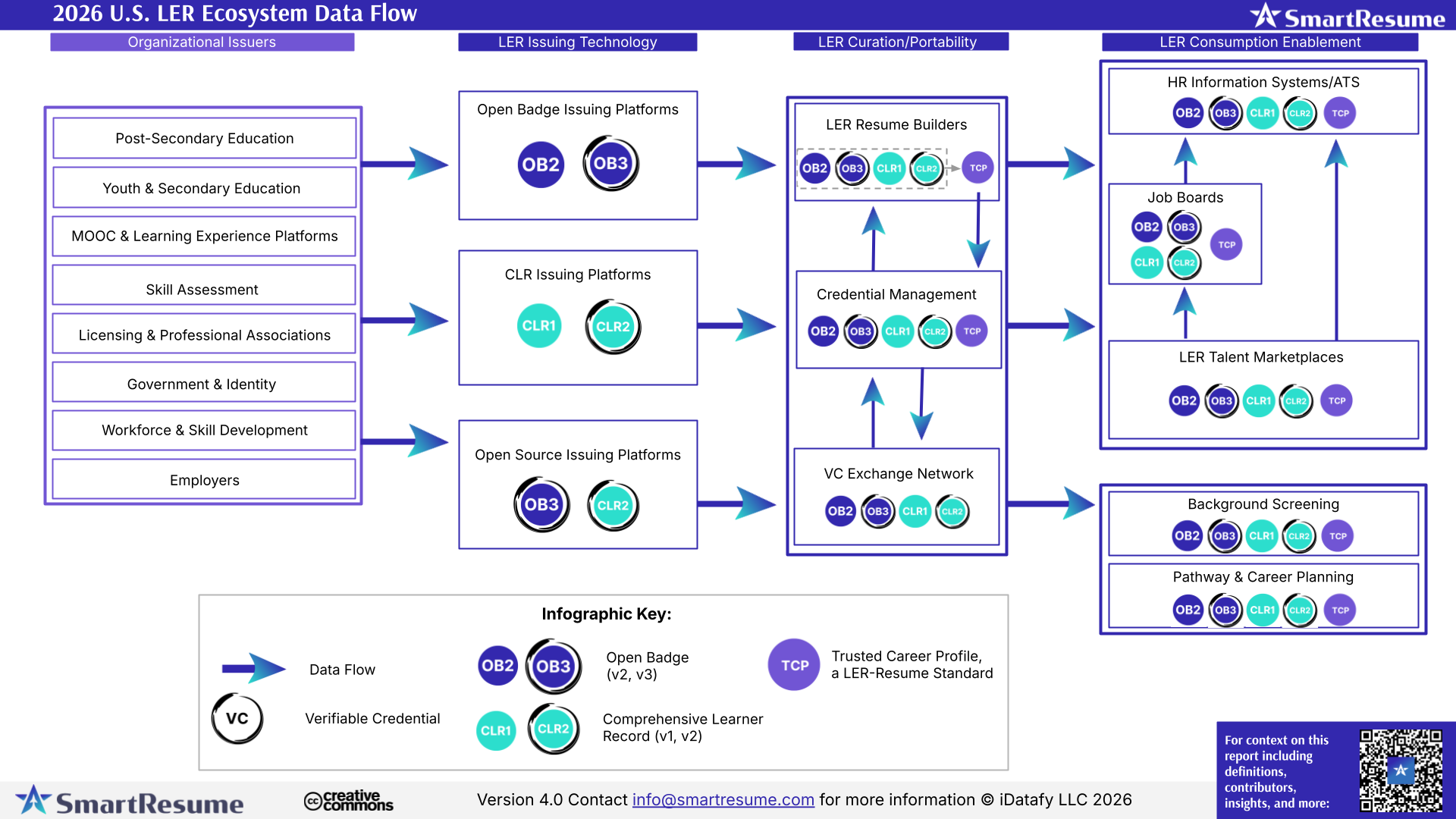
The Learning and Employment Records (LER) Report for 2026: Building the infrastructure between learning and work — from smartresume.com; with thanks to Paul Fain for this resource

Executive Summary (excerpt)

This report documents a clear transition now underway: LERs are moving from small experiments to systems people and organizations expect to rely on. Adoption remains early and uneven, but the forces reshaping the ecosystem are no longer speculative. Federal policy signals, state planning cycles, standards maturation, and employer behavior are aligning in ways that suggest 2026 will mark a shift from exploration to execution.

Across interviews with federal leaders, state CIOs, standards bodies, and ecosystem builders, a consistent theme emerged: the traditional model—where institutions control learning and employment records—no longer fits how people move through education and work. In its place, a new model is being actively designed—one in which individuals hold portable, verifiable records that systems can trust without centralizing control.

Most states are not yet operating this way. But planning timelines, RFP language, and federal signals indicate that many will begin building toward this model in early 2026.

As the ecosystem matures, another insight becomes unavoidable: records alone are not enough. Value emerges only when trusted records can be interpreted through shared skill languages, reused across contexts, and embedded into the systems and marketplaces where decisions are made.

Learning and Employment Records are not a product category. They are a data layer—one that reshapes how learning, work, and opportunity connect over time.

This report is written for anyone seeking to understand how LERs are beginning to move from concept to practice. Whether readers are new to the space or actively exploring implementation, the report focuses on observable signals, emerging patterns, and the practical conditions required to move from experimentation toward durable infrastructure.
 

“The building blocks for a global, interoperable skills ecosystem are already in place. As education and workforce alignment accelerates, the path toward trusted, machine-readable credentials is clear. The next phase depends on credentials that carry value across institutions, industries, states, and borders; credentials that move with learners wherever their education and careers take them. The question now isn’t whether to act, but how quickly we move.”

– Curtiss Barnes, Chief Executive Officer, 1EdTech


The above item was from Paul Fain’s recent posting, which includes the following excerpt:

SmartResume just published a guide for making sense of this rapidly expanding landscape. The LER Ecosystem Report was produced in partnership with AACRAO, Credential Engine, 1EdTech, HR Open Standards, and the U.S. Chamber of Commerce Foundation. It was based on interviews and feedback gathered over three years from 100+ leaders across education, workforce, government, standards bodies, and tech providers.

The tools are available now to create the sort of interoperable ecosystem that can make talent marketplaces a reality, the report argues. Meanwhile, federal policy moves and bipartisan attention to LERs are accelerating action at the state level.

“For state leaders, this creates a practical inflection point,” says the report. “LERs are shifting from an innovation discussion to an infrastructure planning conversation.”


AI and the Work of Centers for Teaching and Learning — from derekbruff.org by Derek Bruff

  • Penelope Adams Moon suggested that instead [of] framing a workshop around “How can we integrate AI into the work of teaching?” we should ask “Given what we know about learning, how might AI be useful?” I love that reframing, and I think it connects to the students’ requests for more AI knowhow. Students have a lot of options for learning: working with their instructor, collaborating with peers, surfing YouTube for explainer videos, university-provided social annotation platforms, and, yes, using AI as a kind of tutor. I think our job (collectively) isn’t just to teach students how to use AI (as they’re requesting) but also to help them figure out when and how AI is helpful for their learning. That’s highly dependent on the student and the learning task! I wrote about this kind of metacognition on my blog.

In the same way, when I approach any kind of educational technology, I’m looking for tools that can be responsive to my pedagogical aims. The pedagogy should drive the technology use, not the other way around.


Planning Your L&D Hiring for Next Year? Start With Skills, Salary Ranges, and Realistic Expectations — from teamedforlearning.com

Salary transparency laws across many states now require organizations to publish compensation ranges. While this can feel like a burden, the truth is: transparency can dramatically speed up hiring. Candidates self-select, mismatches decrease, and teams save time.

But transparency only works when the salary range itself is grounded in reality. And that’s where many organizations struggle.

Posting a salary range is the easy part.
Determining a fair, defensible range is where the work happens.

Also from Teamed for Learning, see:

Hiring Trends For 2026 
The learning industry shifts fast, and this year is no exception. Here’s what’s shaping the hiring landscape right now:

  • AI is now a core skill, not a bonus
  • Project management is showing up in every job description
  • Generalists with business awareness are beating tool-heavy candidates
  • Universities and edtech companies are speeding up content refresh cycles
  • Hiring budgets are tight – but expectations aren’t easing up
 

From Stephanie T.’s posting out on LinkedIn

The lesson isn’t to make school reports more like Spotify Wrapped.

It’s to design reports that are accessible, timely, and readable — without losing the humanity that makes teacher insight meaningful.

If a report is too difficult to access, or arrives too late to matter, who is it really for?


What’s Happening to Jobs for New Grads — from linkedin.com by Jeff Selingo

No matter where you go to college, the job market math for new graduates is grim right now, as I write in a new article out yesterday in New York magazine.

There were 15% fewer entry-level and internship job postings in 2025 than the year before, according to Handshake, a job-search platform popular with college students; meanwhile, applications per posting rose 26%.

How much AI is to blame for the fragile entry-level job market is unclear. Several research studies show AI is hitting young college-educated workers disproportionately, but broader economic forces are part of the story, too.

As Christine Y. Cruzvergara, Handshake’s chief education strategy officer, told me, AI isn’t “taking” jobs so much as employers are “choosing” to replace parts of jobs with automation rather than redesign roles around workers. “They’re replacing people instead of enabling their workforce,” she said.

Today’s graduates are stuck in an in-between moment. Many started college before AI mattered and graduated into a labor market reshaped almost overnight, where entry-level roles are disappearing faster than students can adapt.


The US wants more apprenticeships. The UK figured out how to make them coveted roles — from hechingerreport.org by Kelly Field
‘Degree apprenticeships’ that pair bachelor’s with jobs can be harder to get into than elite colleges

Most students here and in the United States wouldn’t get access to expensive equipment like this until graduate school. Goshawk — a 21-year-old undergraduate student and one of 149 “degree apprentices” employed by AstraZeneca across the U.K. — started using them his second week in.

“It shows the trust we’ve been given,” said Goshawk, who is working nearly full time while studying toward a degree in chemical science at Manchester Metropolitan University that his employer is paying for. By the time he graduates next spring, he will have earned roughly 100,000 pounds (approximately $130,000) in wages, on top of the tuition-free education.

Degree apprenticeships like Goshawk’s have exploded across England since their introduction a decade ago. More than 60,000 apprentices began programs leading to the U.K. equivalent of bachelor’s and master’s degrees in the 2024-25 academic year, in fields as varied as engineering, digital technology, health care, law and business.


AI Is Quietly Rewiring the ADDIE Model (In a Good Way) — from drphilippahardman.substack.com by Dr. Philippa Hardman
The traditional ADDIE workflow isn’t dead, but it is evolving

The real story isn’t what AI can produce — it’s how it changes the decisions we make at every stage of instructional design.

After working with thousands of instructional designers on my bootcamp, I’ve learned something counterintuitive: the best teams aren’t the ones with the fanciest AI tools — they’re the ones who know when to use which mode—and when to use none at all.

Once you recognise that, you start to see instructional design differently — not as a linear process, but as a series of decision loops where AI plays distinct roles.

In this post, I show you the 3 modes of AI that actually matter in instructional design — and map them across every phase of ADDIE so you know exactly when to let AI run, and when to slow down and think.


Also see:

Generative AI for Course Design: Writing Effective Prompts for Multiple Choice Question Development — from onlineteaching.umich.edu by Hedieh Najafi

In higher education, developing strong multiple-choice questions can be a time-intensive part of the course design process. Developing such items requires subject-matter expertise and assessment literacy, and for faculty and designers who are creating and producing online courses, it can be difficult to find the capacity to craft quality multiple-choice questions.

At the University of Michigan Center for Academic Innovation, learning experience designers are using generative artificial intelligence to streamline the multiple-choice question development process and help ameliorate this issue. In this article, I summarize one of our projects that explored effective prompting strategies to develop multiple-choice questions with ChatGPT for our open course portfolio. We examined how structured prompting can improve the quality of AI-generated assessments, producing relevant comprehension and recall items and options that include plausible distractors.

Achieving this goal enables us to develop several ungraded practice opportunities, preparing learners for their graded assessments while also freeing up more time for course instructors and designers.


Major Changes Reshape Law Schools Nationwide in 2026 — from jdjournal.com by Ma Fatima

Law schools across the United States are entering one of the most transformative periods in recent memory. In 2026, legal education is being reshaped by leadership turnover, shifting accreditation standards, changes to student loan policies, and the introduction of a redesigned bar exam. Together, these developments are forcing law schools to rethink how they educate students and prepare future lawyers for a rapidly evolving legal profession.

Also from jdjournal.com, see:

  • Healthcare Industry Legal Careers: High-Growth Roles and Paths — from jdjournal.com by Ma Fatima
    The healthcare industry is rapidly emerging as one of the most promising and resilient sectors for legal professionals, driven by expanding regulations, technological innovation, and an increasingly complex healthcare delivery system. As hospitals, life sciences companies, insurers, and digital health platforms navigate constant regulatory change, demand for experienced legal talent continues to rise.
 

Nvidia, Eli Lilly announce $1 billion investment in AI drug discovery lab — from finance.yahoo.com by Laura Bratton

AI chipmaker Nvidia (NVDA) and pharmaceutical giant Eli Lilly (LLY) on Monday announced that the two companies would jointly invest $1 billion to create a lab in San Francisco focused on using AI to accelerate drug discovery.

The $1 billion investment will be spent over five years on infrastructure, compute, and talent for the lab. Nvidia’s engineers will work alongside Lilly’s experts in biology, science, and medicine to generate large-scale data and build AI models to advance medicine development. The lab’s work will begin early this year, the companies said.


Shoppers will soon be able to make purchases directly through Google’s Gemini app and browser.


Google and Walmart Join Forces to Shape the Future of Retail — from adweek.com by Lauren Johnson
At NRF, Sundar Pichai and John Furner revealed how AI and drones will shape shopping in 2026 and beyond

One of the biggest reveals is that shoppers will be able to purchase Walmart and Sam’s Club products through Google’s AI chatbot Gemini.


The Hard Part of Legal AI Isn’t the Technology — from linkedin.com by Colin S. Levy

Selecting AI tools for legal teams is no longer about novelty or experimentation. It is about aligning technology with judgment, workflows, and risk tolerance. Teams that approach AI with specificity, skepticism, and operational discipline place themselves in a far stronger position to capture real value and avoid unwelcome surprises once the demo environment disappears.


Addendum on 1/8/26:

 
© 2025 | Daniel Christian