
To those who celebrate it, Happy Easter to you!
Glory to God in the Highest!
To those who celebrate it, Happy Easter to you!
Glory to God in the Highest!
Heavenly Father, LORD Jesus, Holy Spirit,
Thank you for you and for this day which you have made.
Thank you for what you have done, what you’re currently doing, and what you will do in the future.
Looking back on this last academic year…
Thank you for the teachers, administrators, staff, school boards, parents, guardians, coaches, and the numerous other people out there who worked hard to positively impact the hearts, minds, and lives of millions of children and young adults.
Thank you for the small and large victories — the growth — that occurred this last academic year.
Thank you for the teachers who persevered in spite of all sorts of obstacles, odds, and issues — who rose above all of that to positively impact our next generation…our future citizens.
Thank you for providing many teachers with the patience, energy, love and compassion for children, especially for those difficult-to-deal with children that can zap one’s energy and emotions; thank you for the cases where the teachers ended up making life-changing behavioral changes with those children — as well as being personally impacted and taught in the process.
Thank you for the single mom who struggled each day this last year to get her little ones out of bed, dressed, fed, clothed, and delivered to school — and then had to go face the work world herself before having to go pick her kids up again, get them to their extracurricular activities (if that was even a possibility), feed them (if enough food was even around), work through life’s issues with them, and then get them back to bed again…before collapsing into bed, without having much time or energy left for herself.
Thank you for the dad who sat down after long days of work, even when he was tired and wanted some time for himself, and yet ended up helping his son and his daughter with their homework…or having the tough discussions to help keep his kids’ feet on solid ground.
Thank you for the teachers who fought like crazy for those on-the-edge students — those students who were about to drop out of school and head down some slippery paths — yet, due to those caring teachers, were encouraged enough to attempt school for another day, week, month, or year.
Thank you for helping teachers continue to teach, even when they faced numerous agendas coming at them from all over the place.
Thank you for the administrators and the office staff who not only kept things running, but advanced how students learned and helped provide them with the infrastructures/environments to further their learning — who dealt with incredible amounts of stress and had to make many in-the-moment, important decisions.
Thank you for good friends for our students — those friends who cared enough to tell each other the truth, spoken in love; for those who helped make school a less painful, isolating place (for those students who experienced school that way).
Thank you for the wonders of this world — may our students experience more of them. Sustain their curiosities. May they have many moments when learning is enjoyable, fun, playful, creative, and even inspirational.
May you bless the teachers with continued vision and a strong sense of mission; bless them with a caring spirit, with love, compassion, energy, and with fresh/new ideas.
LORD, please strengthen and sustain those students and teachers suffering from health issues, financial difficulties, or from issues at home such as divorce or addictions. For those who bully other students, LORD please soften their hearts and grant them new eyes to see — so that they can perceive and understand the harmful, lasting impacts their hurtful words and actions have on others…then help them turn away from those destructive pathways. Strengthen and encourage those students who feel inadequate — help them know that they, too, can learn and grow.
May you bless the staff and administrators with wisdom; with your wise counsel continue to guide their work– knowing which projects to move forward with, and which ones to stop and drop.
Grant us the insight and the courage to change where we need to change. Show us what’s in our blind spots.
Guide us as we determine our priorities throughout our nations; may education be high on the lists.
Thank you LORD for our amazing bodies and minds — incredible, amazing work! May we give you the glory you deserve.
And again, thank you for you LORD!
Thank you for your forgiveness and for your grace.
In Jesus’ powerful name I offer up this prayer of thanksgiving,
Amen.
Augmented Reality can be a reality in your art classroom — from theartofed.com
Excerpt:
Last fall, I attended a technology conference where I went to a session on augmented reality technology (AR) and how it can be used in the classroom. I was blown away by the possibilities of this tech concept and its ability to modify our students’ current reality into a compelling, virtual experience of interactive information.
AR in your Art Classroom
There are dozens of AR apps, programs and resources out there that can help encourage curiosity and inspire critical thinking and intense creativity in your students. Here are a few augmented reality options that you can start infusing into your art curriculum.
Jaunt VR wants to (virtually) change the way we travel — from cntraveler.com
Gaming is just the beginning. The real future of virtual reality lies in hacking the global travel experience.
52 of the best apps for your classroom in 2015 — from list.ly by Terry Heick
Adobe’s Slate is a [new] visual storytelling app for the iPad — from techcrunch.com; also an article at CampusTechnology.com on this app
The top 50 apps for creative minds — from theguardian.com
Our pick of the best tablet and smartphone tools to enable you to make video, music, art and more
[Microsoft’s] Sway is now collaborative—create and edit together with others!
Excerpt:
When we announced Sway, we knew that people would want to work on standout class projects, eye-catching business reports, engaging vacation recaps, or more, together—it’s the way things are done now, right? But Sway up until now has been a tool for individual authors to create polished content in a new and interactive way to share with their audiences. However, we know you’ve asked for shared editing in Sway in our feedback channels (such as UserVoice), and that Office has delivered real-time editing and collaboration features for years, allowing people to work together to share their collective ideas. On top of that, we can’t tell you how many times that we on the Sway team have said to each other, “I wish I could work on this Sway with you!” So now we’re rolling out co-authoring in Sway!
Microsoft debuts Office Lens, a document-scanning app for iOS and Android — from techcrunch.com by Sarah Perez
Excerpt:
Microsoft [on 4/2/15] launched Office Lens, a mobile document scanner app that works with OneNote, for iOS and Android smartphones. The app, which allows users to snap photos of paper documents, receipts, business cards, menus, whiteboards, sticky notes and more, was first launched a year ago as an application designed only for Windows Phone devices.
5 free (or low cost) tools for Flipped Learning— from Campus Technology’s April/May 2015 edition
AppStudio for ArcGIS — with thanks to Dr. Jason Van Horn (Associate Professor Geology, Geography & Env Studies at Calvin College) for this resource
Your mobile mapping apps, built in a snap
Excerpt:
AppStudio for ArcGIS is a groundbreaking tool in the GIS app revolution. It lets you convert your maps into beautiful, consumer-friendly mobile apps ready for Android, iOS, Windows, Mac OS X, and Linux, and publish them using your own brand to all popular app stores – no developer skills required.
Moodle Mobile 2 is coming: updated look and feel of the application, transition to Ionic Framework — from moodlenews.com
Excerpt:
A few weeks ago Juan Leyva introduced a demo site for Moodlers to check out the 2nd version of Moodle Mobile the ever improving official mobile application for the learning management system. The major changes include a shift to Ionic framework which will greatly enhance the developers’ ability to focus on new features development.
Some of the best storytelling apps for elementary students — from educatorstechnology.com
Excerpt:
The apps below are particularly useful for elementary students but they can also be used with other age groups. Elementary teachers often complain about the paucity of apps that are kids appropriate compared with apps for other age groups. So we thought it would be useful to create a section in this blog devoted entirely to apps specifically curated for elementary teachers. After we have covered math and writing apps, today’s post features some very good iPad storytelling apps to use with young kids. You can use these apps to help kids develop a wide range of basic literacy skills that include: writing, reading and speaking.
5 great writing apps for elementary students — from educatorstechnology.com
Excerpt:
The selection we curated for you today contains some useful iPad apps to use with elementary students to help them with their writing. Some the things your kids will get to learn from these apps include: learning how to write letters, learning phonics and spelling, composing syllables by combining vowels and consonants, and several other basic literacy skills. Some of these apps also include tracking features which allow teachers and parents to keep updated about the progress of their kids.
Addendum on 4/8/15:
Addendum on 4/9/15:
Addendums on 4/13:15:
Liberal arts education is unique in its ability to develop independence of thought, to nurture wisdom, and to build both a deep empathy for others and broad context for decision making in uncertain situations.
— Gunnar Counselman
8 steps to 7 billion liberal arts degrees — from ecampusnews.com by Gunnar Counselman, the founder/CEO of Fidelis Education, a Learning Relationship Management (LRM) System.
Excerpt (emphasis DSC):
So being on the offensive about the liberal arts means reframing the conversation from a defense for the 40M people who participate in it today. Being on offensive means abandoning all tendency toward Ludditism and instead getting creative about using technology to scale effective learning in the liberal arts and pure sciences to the other 99.6 percent of people on the planet. And being on the offensive means we must stop worrying about jobs. There will be many more jobs educating 99.6 percent of the world’s population than there are educating the .4 percent (the percentage of the world population currently receiving a liberal arts degree), no matter how efficient we become with technology.
…
Let’s observe the ingredients of liberal education as they are today at places like Middlebury, Smith, Sarah Lawrence, and Union, honors programs at state universities, then imagine what it would look like scaled to 7 billion people.
…
This analysis makes it clear that liberal education is a relationship-generation machine built around personalized content. So our technology has to be a relationship-management machine, purpose-built to make sure that every single person in a learning community has peers, mentors, and advisors to collaborate to build strong learning pathways of content.
From DSC:
Though Gunnar likely has his LMS-influenced lenses on while sharing his thoughts here (as I often have my tech-tinted lenses/perspectives on as well), he still makes some valid points. Those who support the liberal arts need “to stop hunkering down in a defensive posture. It’s time to go on the offensive…” he asserts. I would second his thought that we need to creatively employ technology to help the liberal arts thrive in the 21st century.
In fact, I’m beginning to wonder more and more if online/digitally-based learning will turn out to be the very thing that saves the liberal arts as we make our way through the 21st century. Getting a liberal arts degree at $5K a year is one thing. Getting it at a price tag of $25K-$50+K per year is another thing. When prices rise like that, expectations change. The expectations of a solid ROI come to mind much more as the prices increase (and I would even use the word requirements for many of us now, not just expectations).
If we want the liberal arts to continue to exist outside the top 5% of the income earners out there, we must find ways to bring the prices down again. The best way I know to do that is to go online — at least in part. Setting up a new server or asking one’s vendor(s) to allocate more storage, bandwidth, applications, user accounts, etc. is far cheaper than maintaining physical campuses or developing new buildings on campuses across the land. And you can still have excellent relationships, interactions, and communications via online/digitally-based means.
Also see:
[From DSC: In the posting below, when I say higher ed, I’m thinking here of traditional 4-year colleges and universities, whether for-profit or non-profit.]
Years ago…President Obama said to higher ed: “You’re getting too expensive. Please take steps to address this, will you?” And student debt continued to mount that year. Many families struggled with how to make getting degrees work within their budgets.
But the year passed, higher ed did little to nothing to address the issue of accessibility and pricing, so President Obama had to once again address higher ed: “Heh…did you all hear me, I said that you’re getting too expensive. Please take steps to address this, will you?”
Higher ed responded, “Yeh, yeh, yeh…we know…we’ve heard you say this before. Thanks…and have a nice day.” And what was unsaid — yet what was lived out — was “Let us run our own show. Please don’t bother us again.”
So another year passed, higher ed again did little to nothing to address the issue of accessibility and the rising cost of attending college. Therefore, even more families and students went into debt (an invisible reality that folks on campus often don’t really “see” being played out in real peoples’ lives). The amount of student debt continued to increase on a national level. At this point, more students and families started to question whether they wanted to go into that kind of debt — would they be ok with the decision to delay the start of their families? Would they be ok with not being able to purchase a home for a while after graduating? Or not being able to save for their retirements for a long while? (Re: this last item, financial advisers often stress how important time is — advising folks to put away money early on in their lives so that time and compound interest can be on their side, working positively on their investments.) So families and individuals begin to ask, “Is college really worth it?” (And I believe it is in most situations today, but that’s not the point of this posting.)
Yet again, higher ed doesn’t respond much…at least not for the most part. While a handful of experiments begin here and there, most of the traditional institutions of higher education pursue the status quo…all the while believing, “The gold ol’ days will return. The period we’re going through is an aberration. Let the status quo continue — it’s working very well for us.” But it wasn’t — and isn’t — an aberration. Student debt continued to mount. More families and students found higher education now out of reach for them.
Meanwhile, higher ed institutions said things like, “Our tuition increases were the smallest within our peer group” or “Our tuition increases were the smallest in years” or “We didn’t increase tuition nearly as much as the other institutions in our state.”
So fast forward and once again, President Obama had to address higher ed: “Heh!!! You’re too expensive! Are you guys hearing me or what?! If you don’t take steps to address this, the Federal Government’s going to get involved. Got it?!”
Then higher ed essentially responded in the same manner, “Yeh, yeh, yeh…we know…we’ve heard you say this before. Thanks…and, again, have a nice day.”
And so it went for the last several years.
Therefore, does anyone blame the President for taking matters to the next level? If traditional 4-year colleges and universities aren’t going to do much to address the accessibility/cost situation, then he and the Federal Government have to get seriously involved.
For others, a federal government that spends more than $140 billion a year on higher education is justified in attempting to get the right bang for its buck.
— from Ry Rivard’s article, New Higher Ed Federalism, at insidehighered.com on 1/12/15
So on January 8th, 2015, President Obama introduced his proposal for free community college for responsible students across the nation who are willing to work hard (see here , here, here, here, or here).
If this moves forward, it could have an enormous impact on those traditional 4-year colleges and universities who blew him off all of those years.
January 8, 2015

.
Also see:
Tim Brown: How to Be a Creative Listener — from 99u.com by Stephanie Kaptein
Excerpt:
By actively listening, you can find valuable information to inspire new ideas. The podcasts are rich in examples where innovative ideas have come to light because they listened to more than what was being said. As writer G. K. Chesteron noted, “There’s a lot of difference between listening and hearing.”
Also see:
Also see this free course:
Harvard MOOCs up ante on production quality — from educationnews.org by Grace Smith
Excerpt (emphasis DSC):
It’s called HarvardX, a program begun two years ago, that films professors who are creating lessons that act as an adjunct to their coursework. The catch is, the production value is equally proportioned to the subject matter. The underproduced in-class lecture being filmed by a camera at the back of the lecture hall is being updated, in a big way.
Two video studios, 30 employees, producers, editors, videographers, composers, animators, typographers, and even a performance coach, make HarvardX a far cry from a talking head sort of online class.
The Harvard idea is to produce excellent videos, on subject matters that might be difficult to pull off in a lecture hall or class. Then, to bring these videos into the class for enrichment purposes. An example is Ulrich’s online class, “Tangible Things”.
Also see:
Sea change of technology: Education — from the Harvard Gazette, Christina Pazzanese, May 26, 2014
Excerpt (emphasis DSC):
After centuries of relative torpor, technology breakthroughs have begun to reshape teaching and learning in ways that have prompted paradigm shifts around pedagogy, assessment, and scholarly research, and have upended assumptions of how and where learning takes place, the student-teacher dynamic, the functions of libraries and museums, and the changing role of scholars as creators and curators of knowledge.
“There are massive changes happening right now,” said Robert A. Lue, the Richard L. Menschel Faculty Director of the Derek Bok Center for Teaching and Learning and faculty director of HarvardX (harvardx.harvard.edu). “What has brought it into particularly tight focus now is that the revolution in online education has raised a whole host of very important questions about: What do students do with faculty face-to-face; what is the value of the brick-and-mortar experience; and how does technology in general really support teaching and learning in exciting, new ways? It’s been a major catalyst, if you will, for a reconsideration of how we teach in the classroom.”
…
Classrooms of the future are likely to resemble the laboratory or studio model, as more disciplines abandon the passive lecture and seminar formats for dynamic, practice-based learning, Harvard academicians say.
“There’s a move away from using the amphitheater as a learning space … toward a room that looks more like a studio where students sit in groups around tables, and the focus is on them, not on the instructor, and the instructor becomes more the ‘guide outside’ rather than the ‘sage onstage,’ facilitating the learning process rather than simply teaching and hoping people will learn,” said Eric Mazur, Balkanski Professor of Physics and Applied Physics at the Harvard School of Engineering and Applied Sciences.
It’s a shift that’s changing teaching in the humanities as well. “It’s a project-based model where students learn by actually being engaged in a collaborative, team-based experience of actually creating original scholarship, developing a small piece of a larger mosaic — getting their hands dirty, working with digital media tools, making arguments in video, doing ethnographic work,” said Jeffrey Schnapp, founder and faculty director of metaLAB (at) Harvard, an arts and humanities research and teaching unit of the Berkman Center for Internet & Society.
From DSC:
HarvardX is a great example of using teams to create and deliver learning experiences.
Also, the “Sea change…” article reminded me of the concept of learning hubs — whereby some of the content is face-to-face around a physical table, and whereby some of the content is electronic (either being created by the students or being consumed/reviewed by the students). I also appreciated the work that Jeff Schnapp is doing to increase students’ new media literacy skills.
From DSC:
Is higher education on the same trajectory as Blockbuster, Kodak, & others who didn’t adapt? Some items that prompted me to ask this question (again):
Private Distress — from insidehighered.com by Ry Rivard
Excerpt:
Some private colleges that managed to weather the recession are finding new troubles.
So they are announcing layoffs, cutting programs and more. Almost all of these small to mid-sized privates are tuition-dependent and lack large endowments. National declines in the number of traditional college-age population mean students just aren’t showing up to privates, which are facing competition from public colleges that are more stable now than a few years ago and the reality that privates cannot afford to indefinitely lure students by cutting prices with generous financial aid packages. And this could become a huge problem.
Higher education: On a crash course for reinvention — huffingtonpost.com by Bob Kerrey
Obama to Higher Ed: Find Ways to Lower Costs, Maintain Quality — from aspireblog.org by Sara Jacobi
Excerpt:
“The Secretary is particularly interested in experiments that will improve student persistence and academic success, result in shorter time to degree, and reduce student loan indebtedness,” reads the notice issued by the Department of Education.
Like trying to count the stars…if I were to try and thank the LORD for everything, some things I would be able to see and thank Him for…but many of His gifts I wouldn’t see.
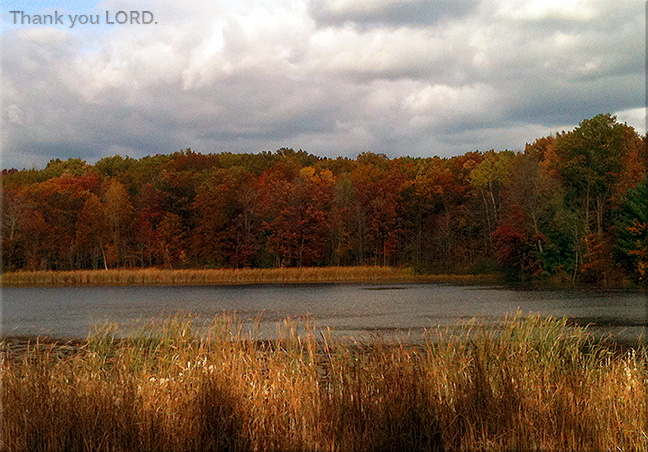

From DSC:
I took these pictures at our CIT Retreat yesterday; there are some beautiful colors/scenes appearing throughout Michigan.
From DSC:
I find Chapters 38-42 from the Book of Job to be very humbling. When I read those chapters, I often begin to try to answer the questions (and not get very far!) or I imagine others trying to explain how this or that thing occurs (and many, with an incredible amount of confidence in their perspectives).
But the explanations seem trite in regards to the LORD’s overall lines of questioning therein. One of the messages I walk away with is that we live on this earth for such a short time — and there is much we don’t know from the past, the present, or from the future. Below are some verses from Chapter 38.
The Lord Speaks
38 Then the Lord spoke to Job out of the storm. He said:
2 “Who is this that obscures my plans
with words without knowledge?
3 Brace yourself like a man;
I will question you,
and you shall answer me.
4 “Where were you when I laid the earth’s foundation?
Tell me, if you understand.
5 Who marked off its dimensions? Surely you know!
Who stretched a measuring line across it?
6 On what were its footings set,
or who laid its cornerstone—
7 while the morning stars sang together
and all the angels shouted for joy?
…
21 Surely you know, for you were already born!
You have lived so many years!

Traditional education beats online in key areas, opinion poll finds — from chronicle.com by Scott Carlson
Excerpt (emphasis DSC):
In early October, Gallup asked two groups, each composed of more than 1,000 adults, whether they thought “online education is better” in a series of categories. In terms of “providing a wide range of options for curriculum” and “good value for the money,” online education got slightly better scores than traditional classroom-based education.
But online education scored much worse in four areas: in delivering “instruction tailored to each individual,” in providing “high-quality instruction from well-qualified instructors,” in offering “rigorous testing and grading that can be trusted,” and—finally, worst of all—in dispensing “a degree that will be viewed positively by employers.”
From DSC:
As you are likely able to tell, it’s hard for me not to get sucked into squabbling about which method is more effective — i.e. online vs. face to face. But ultimately, I think where we need to get to is a blended or hybrid learning type of approach — i.e. taking the best of the face-to-face world and combining it with the best of the online world. I think that will be the Holy Grail of learning.
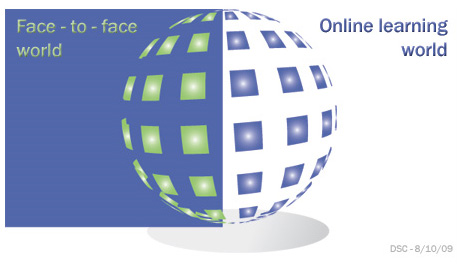
But in regards to these criticisms of online learning, let’s take a closer look at those items from the opinion poll.
I’ll use my experience at Northwestern University to address these items.
In delivering “instruction tailored to each individual”
In K-12, that comment might hold some water. However, in many collegiate settings where there are 50-100+ students in a face-to-face classroom, I don’t think that’s the case. In fact, at Northwestern, I doubt that most of my professors even knew who I was, let alone ever tried to custom tailor any instruction for me in those face-to-face settings. Granted, I need to own my part of this — that is, I should have taken more advantage of their office hours. But I’m not sure that my professors even graded/assessed my work. Often my work was graded by graduate students/TA’s who likely had 0 (zero) training or background in education. For that matter, the professors I took courses from most likely did not have any background in teaching and learning, nor coursework in pedagogy/education. They were likely more concerned with how to present the material to 100+ people — not with tailoring it to each individual.
“In providing “high-quality instruction from well-qualified instructors”
See above. Also, my guess is that many face-to-face professors were hired at Northwestern for their research skills and what they brought to the table in that regard. They were screened, I’m quite sure, for how prospective professors’ reputations would contribute to Northwestern’s brand and bottom line. Doing research is not the same thing as teaching students. Knowing something and being able to teach someone are also two different things. Teaching is both an art and a science (and learning is messy).
“In offering “rigorous testing and grading that can be trusted” — this carries the most weight of the above concerns. However, there are an increasing amount of options here — from proctored tests to software tools (and in the future, most likely solutions will take the form of biometric security/scanning used in conjunction with webcams). For those who decide to cheat, I give a heads-up:
“Consider for a moment — if you do cheat — how you are going to get by those interviews where the interviewer is going to want to see first-hand evidence of what you can actually do. No…do yourself a favor and just do the work; you’ll be glad that you did.”
“In dispensing ‘a degree that will be viewed positively by employers.'” It’s quickly becoming the case that employers won’t have a choice (already, 32% of UG’s have taken an online course). Also, my guess is that the people who think this have never taken an online class themselves. If they had, they would know that online learning takes a lot of work. It takes very motivated, committed students — the type of “self-starters” most companies that I know of want to hire.
Final comment: