Student-provided sites from The Teaching & Learning Digital Studio at Calvin College

Student-provided sites from The Teaching & Learning Digital Studio at Calvin College

Digital Studio Sites is a blog with a large collection links from the Teaching & Learning Digital Studio Staff at Calvin College (Grand Rapids, MI) that covers a wide range of academic topics and more. The staff scours the Web for the best, most interesting, and useful Web sites for the classroom (and maybe beyond) on the Internet and continually updates the list of links. Professors can quickly find sites related to their field of study by keyword, search, or by subscribing via RSS feed.

Tagged with: • •  

Smart Phones

Cisco Sees Mobile Data Doubling Annually — from WSJ

Wireless-data traffic is expected to double every year through 2014, driven by a sharp increase in the volume of handheld devices as well as mobile video content, according to a Cisco report. Data use will surge as cellphone makers produce more Web-enabled handsets. Cisco says there could be more than five billion such devices connected to mobile networks in four years.

Tagged with:  

From DSC:
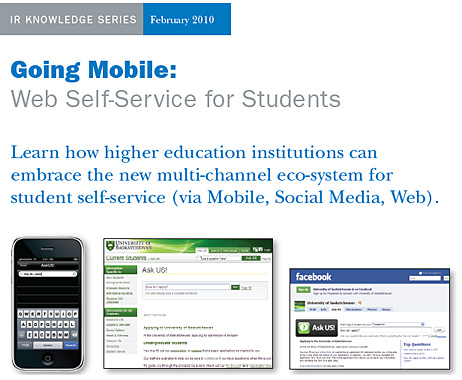
I signed up and downloaded a whitepaper from intelliresponse.com entitled, “Going Mobile: Web Self-Service for Students — Learn how higher education institutions can embrace the new multi-channel eco-system for student self-service (via Mobile, Social Media, Web)”.

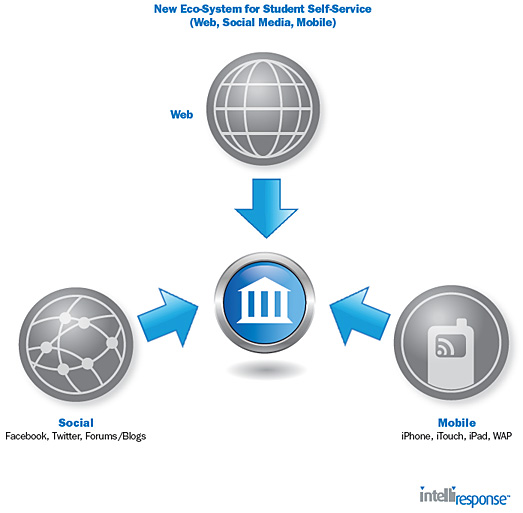
I thought it was interesting how the term eco-system weaved its way through this company’s marketing literature. But it also relayed some more data on the increasing amount of mobile devices out there (now and expected in the near future).  If we were to substitute the word “learning” in place of the words “self-service”, this topic becomes very relevant to this blog.

Here are a couple graphics from the paper:

Going Mobile: Web Self-Service for Students Learn how higher education institutions can embrace the new multi-channel eco-system for student self-service (via Mobile, Social Media, Web)

Mobile self-service

The Future of Higher Education: Beyond the Campus — from iangardnergb.blogspot.com

“Lots and lots at the time being on the future of HE, especially in the UK due to the funding cuts, imminent election, etc. One of the latest reports is a joint one from JISC, SERF, EDUCAUSE and CAUDIT, showing many issues are not just affecting the UK. “

Abstract:
Higher education’s purpose is to equip students for success in life—in the workplace, in communities, and in their personal lives. While this purpose may have remained constant for centuries, the world around colleges and universities is undergoing significant change. Higher education is under pressure to meet greater expectations, whether for student numbers, educational preparation, workforce needs, or economic development. Meanwhile, the resources available are likely to decline. New models, an intense focus on the student experience, and a drive for innovation and entrepreneurism will ensure that higher education continues to meet society’s needs. Information technology supports virtually every aspect of higher education, including finances, learning, research, security, and sustainability, and IT professionals need to understand the range of problems their institutions face so they apply IT where it brings greatest value. Creating this future will require collaboration across organizational and national boundaries, bringing together the collective intelligence of people from backgrounds including education, corporations, and government.

From DSC:
Many quotes jumped off of the pages of the report, but here’s one of them:

Higher education represents a complex, adaptive system that is influenced by larger societal trends and information technology. If higher education is adaptive, what will its future be?

“Ultimate Mashup” a Glimpse into the Future — from blog.programmableweb.com by Adam DuVander

“A new iPhone app is trying to take the fiction out of Science Fiction. Movies have long portrayed people in the future speaking commands to computers. Siri, based on $200M of research and development, is trying to make it so.”

From DSC:
Which question is dead? This one:

Where is the return on investment in all of this technology?

Through the last several decades, as we’ve invested in PCs, Macs, cabling/telecommunications infrastructure, wireless access points, LANs, servers, routers, etc…the question kept being asked, “Where’s the return on investment with all of this technology?”

To me, that question is being put to rest once and for all (at least in terms of those sets of technologies.) Why? Because that infrastructure is the foundation of an ever-growing, sprawling, network of connections that people are using more and more to communicate, socialize, learn, and grow. Sure, there are downsides to the Internet, but there are many upsides as well:

  • You want a lesson plan? It’s out there.
  • You want to hear a lecture on topic A, B, or C? It’s out there and able to start playing on your PC, Mac, iPhone, etc. in seconds
  • You need to find directions to place XYZ? As you know, a huge timesaver can be found in services like Mapquest or with GPS-enabled services.
  • You want to take a break and watch a show? It’s on your PC or Mac in a short period of time.
  • You want to quickly orchestrate an event to catch up with a group of your friends? No problem.
  • …
  • …

I could go on and on, but you get my point: We are at the embryonic stages of an explosion in innovation that is now possible due to the Internet and the blazingly-fast exchanges of information. Surely, there has been an excellent ROI here!

Technologies to Watch in Higher Education: 7 Years’ Worth of Predictions — from Saul Carliner

The New Media Consortium and Educause recently published their annual Horizon Report, which “describes six areas of emerging technology that will have significant impact in higher education within three adoption horizons over the next one to five years” (Johnson, Levine, Smith & Stone, 2010). In response, I compiled the lists of technologies to watch from all seven reports…

…

Food for thought: Which technologies did they call correctly? Which ones not?

References
Johnson, L., Levine, A., Smith, R., & Stone, S. (2010). The 2010 Horizon Report. Austin, Texas: The New Media Consortium.

AT&T to invest $2B in mobile network — from CNN.com by Marguerite Reardon

Tagged with: •  

From DSC:
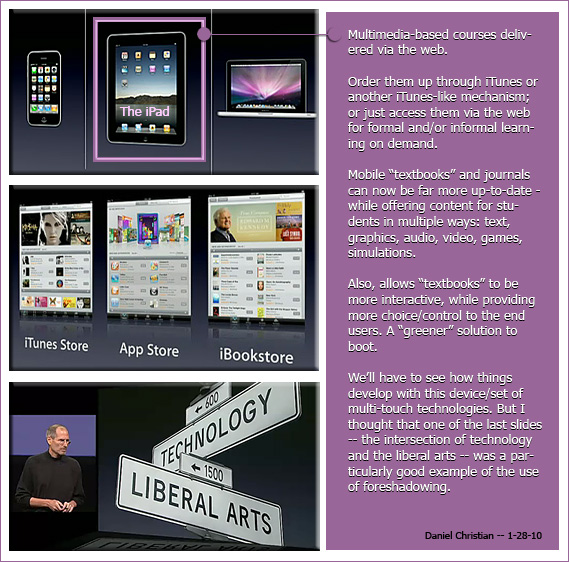
To me, this device has the potential to really move multimedia-based communications forward.  For one thing, “magazines” will never be the same again.

Service Lets Professors Log On to Networks on Other Campuses — from The Chronicle by Mary Helen Miller

Tagged with: •  
© 2025 | Daniel Christian