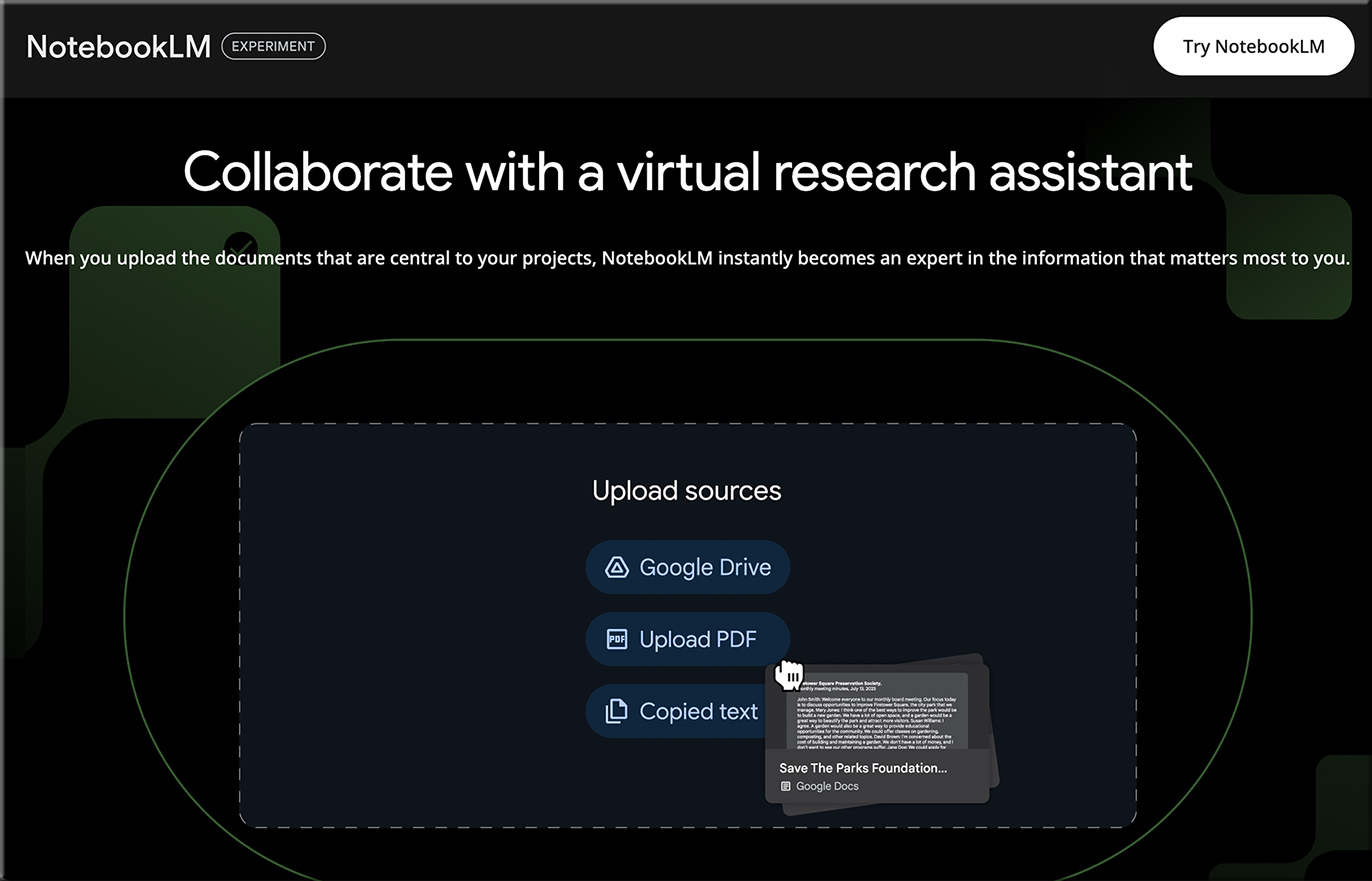
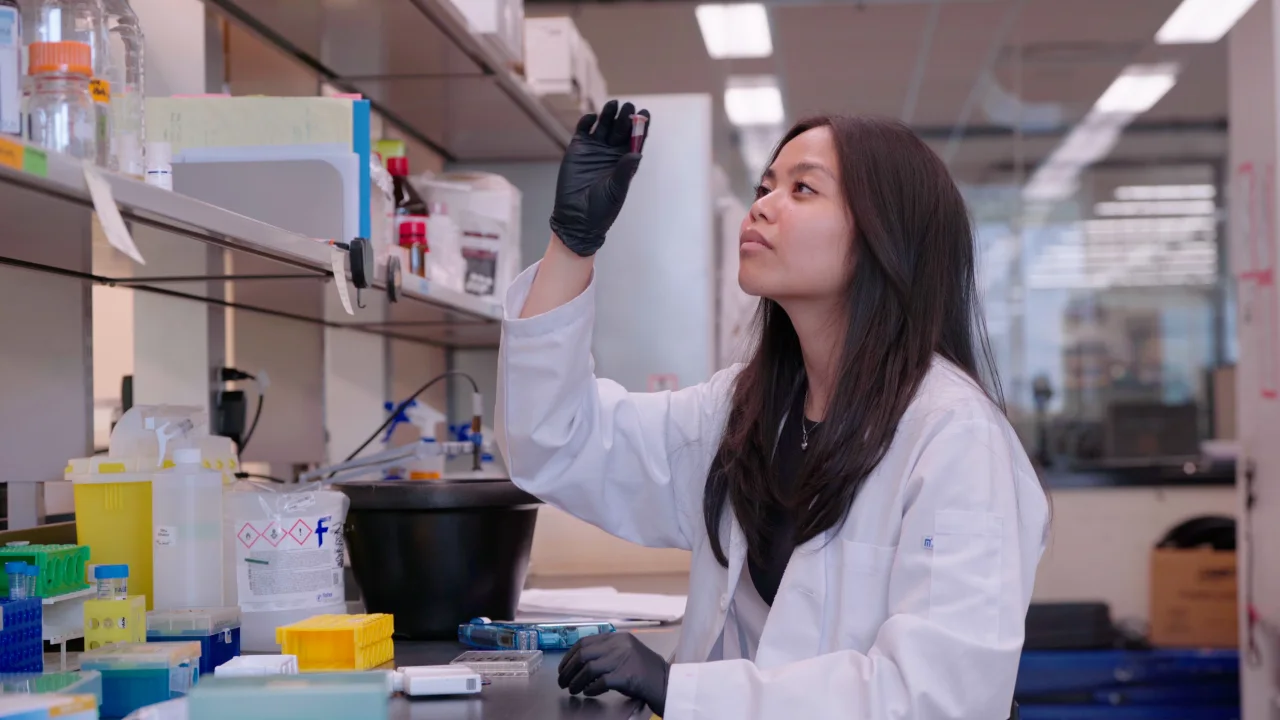
Google hopes that this personalized AI -- called Notebook LM -- will help people with their note-taking, thinking, brainstorming, learning, and creating.

Google NotebookLM (experiment)

From DSC:
Google hopes that this personalized AI/app will help people with their note-taking, thinking, brainstorming, learning, and creating.

It reminds me of what Derek Bruff was just saying in regards to Top Hat’s Ace product being able to work with a much narrower set of information — i.e., a course — and to be almost like a personal learning assistant for the course you are taking. (As Derek mentions, this depends upon how extensively one uses the CMS/LMS in the first place.)


Syllabusters Are Outdated — from scholarlyteacher.com by Todd Zakrajsek

What does this all mean for the first day of class? Approach that first day with “learning-centered” in your mind. Focus on learning. Learning is all about curiosity and desire. Desire to know, to figure things out, to be surprised, all getting that dopamine flowing throughout the brain: That is what learning-centered is all about. An exam is best thought of as feedback, showing whether students are learning, not a date to cover on the first day and dread every class period in the meantime. An exam should never be the reason to learn, it should always be an indication of learning. Don’t spend your first 45 or 85 minutes focused solely on exams, term paper deadlines, and attendance policies. That moves teaching toward an artificial transactional arrangement where students learn in exchange for points and grades.

From DSC:
I would highly recommend starting out with a major HOOK. Some question, some video, some recording/piece of audio, etc. that would provoke interest, curiosity, or even some emotion. On that first day, the following item MUST be addressed if you expect to engage your students:

Why is this class/topic relevant?

Start with that. Immediately. The other stuff can be introduced later on, as Todd mentions.


More Chief Online Learning Officers Step Up to Senior Leadership Roles 
In 2024, I think we will see more Chief Online Learning Officers (COLOs) take on more significant roles and projects at institutions.

In recent years, we have seen many COLOs accept provost positions. The typical provost career path that runs up through the faculty ranks does not adequately prepare leaders for the digital transformation occurring in postsecondary education.

As we’ve seen with the professionalization of the COLO role, in general, these same leaders proved to be incredibly valuable during the pandemic due to their unique skills: part academic, part entrepreneur, part technologist, COLOs are unique in higher education. They sit at the epicenter of teaching, learning, technology, and sustainability. As institutions are evolving, look for more online and professional continuing leaders to take on more senior roles on campuses.

Julie Uranis, Senior Vice President, Online and Strategic Initiatives, UPCEA


Where a developing, new kind of learning ecosystem is likely headed [Christian]

From DSC:
As I’ve long stated on the Learning from the Living [Class]Room vision, we are heading toward a new AI-empowered learning platform — where humans play a critically important role in making this new learning ecosystem work.

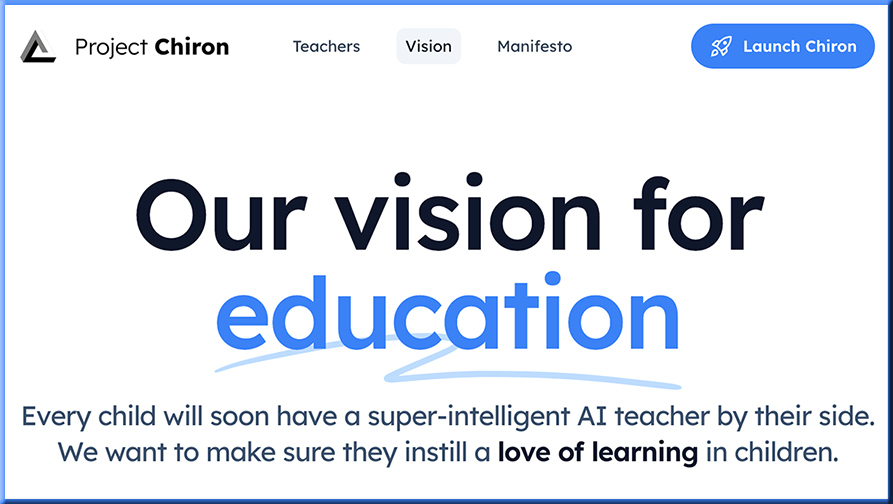
Along these lines, I ran into this site out on X/Twitter. We’ll see how this unfolds, but it will be an interesting space to watch.

Project Chiron's vision: Our vision for education Every child will soon have a super-intelligent AI teacher by their side. We want to make sure they instill a love of learning in children.


From DSC:
This future learning platform will also focus on developing skills and competencies. Along those lines, see:

Scale for Skills-First — from the-job.beehiiv.com by Paul Fain
An ed-tech giant’s ambitious moves into digital credentialing and learner records.

A Digital Canvas for Skills
Instructure was a player in the skills and credentials space before its recent acquisition of Parchment, a digital transcript company. But that $800M move made many observers wonder if Instructure can develop digital records of skills that learners, colleges, and employers might actually use broadly.

Ultimately, he says, the CLR approach will allow students to bring these various learning types into a coherent format for employers.

Instructure seeks a leadership role in working with other organizations to establish common standards for credentials and learner records, to help create consistency. The company collaborates closely with 1EdTech. And last month it helped launch the 1EdTech TrustEd Microcredential Coalition, which aims to increase quality and trust in digital credentials.

Paul also links to 1EDTECH’s page regarding the Comprehensive Learning Record


What happens to teaching after Covid? — from chronicle.com by Beth McMurtrie

It’s an era many instructors would like to put behind them: black boxes on Zoom screens, muffled discussions behind masks, students struggling to stay engaged. But how much more challenging would teaching during the pandemic have been if colleges did not have experts on staff to help with the transition? On many campuses, teaching-center directors, instructional designers, educational technologists, and others worked alongside professors to explore learning-management systems, master video technology, and rethink what and how they teach.

A new book out this month, Higher Education Beyond Covid: New Teaching Paradigms and Promise, explores this period through the stories of campus teaching and learning centers. Their experiences reflect successes and failures, and what higher education could learn as it plans for the future.

Beth also mentioned/link to:


How to hold difficult discussions online — from chronicle.com by Beckie Supiano

As usual, our readers were full of suggestions. Kathryn Schild, the lead instructional designer in faculty development and instructional support at the University of Alaska at Anchorage, shared a guide she’s compiled on holding asynchronous discussions, which includes a section on difficult topics.

In an email, Schild also pulled out a few ideas she thought were particularly relevant to Le’s question, including:

  • Set the ground rules as a class. One way to do this is to share your draft rules in a collaborative document and ask students to annotate it and add suggestions.
  • Plan to hold fewer difficult discussions than in a face-to-face class, and work on quality over quantity. This could include multiweek discussions, where you spiral through the same issue with fresh perspectives as the class learns new approaches.
  • Start with relationship-building interactions in the first few weeks, such as introductions, low-stakes group assignments, or peer feedback, etc.
 

Sparking online joy: five ways to keep students engaged — from timeshighereducation.com by Andrés Ordorica, Marcello Crolla, and Lizzy Garner-Foy
Five guiding principles to use when designing and developing content for short online courses that will keep students engaged

Keeping students engaged is a big challenge and one that’s key to making a short online course successful. With a diverse audience, a variety of learning preferences and a multitude of distractions in the online space, how can you create a course that successfully retains students’ attention? Here, we explore five guiding principles for designing an online course that is engaging and enjoyable.

By offering bitesize learning, embracing variety and interactivity, infusing meaning into content, fostering a learning community and adhering to the “less is more” principle, you can create a course that captivates your audience and cultivates a lasting love for learning. 


Speaking of pedagogical-related items, also see:


Mark Zuckerberg: First Interview in the Metaverse | Lex Fridman Podcast #398


Photo-realistic avatars show future of Metaverse communication — from inavateonthenet.net

Mark Zuckerberg, CEO, Meta, took part in the first-ever Metaverse interview using photo-realistic virtual avatars, demonstrating the Metaverse’s capability for virtual communication.

Zuckerberg appeared on the Lex Fridman podcast, using scans of both Fridman and Zuckerberg to create realistic avatars instead of using a live video feed. A computer model of the avatar’s faces and bodies are put into a Codec, using a headset to send an encoded version of the avatar.

The interview explored the future of AI in the metaverse, as well as the Quest 3 headset and the future of humanity.


Canva’s new AI tools automate boring, labor-intensive design tasks — from theverge.com by Jess Weatherbed
Magic Studio features like Magic Switch automatically convert your designs into blogs, social media posts, emails, and more to save time on manually editing documents.


Canva launches Magic Studio, partners with Runway ML for video — from bensbites.beehiiv.com by Ben Tossell

Here are the highlights of launched features under the new Magic Studio:

  • Magic Design – Turn ideas into designs instantly with AI-generated templates.
  • Magic Switch – Transform content into different formats and languages with one click.
  • Magic Grab – Make images editable like Canva templates for easy editing.
  • Magic Expand – Use AI to expand images beyond the original frame.
  • Magic Morph – Transform text and shapes with creative effects and prompts.
  • Magic Edit – Make complex image edits using simple text prompts.
  • Magic Media – Generate professional photos, videos and artworks from text prompts.
  • Magic Animate – Add animated transitions and motion to designs instantly.
  • Magic Write – Generate draft text and summaries powered by AI.


Adobe Firefly

Meet Adobe Firefly -- Adobe is going hard with the use of AI. This is a key product along those lines.


Addendums on 10/11/23:


Adobe Releases New AI Models Aimed at Improved Graphic Design — from bloomberg.com
New version of Firefly is bigger than initial tool, Adobe says Illustrator, Express programs each get own generative tools


As AI Chatbots Rise, More Educators Look to Oral Exams — With High-Tech Twist — from edsurge.com by Jeffrey R. Young

To use Sherpa, an instructor first uploads the reading they’ve assigned, or they can have the student upload a paper they’ve written. Then the tool asks a series of questions about the text (either questions input by the instructor or generated by the AI) to test the student’s grasp of key concepts. The software gives the instructor the choice of whether they want the tool to record audio and video of the conversation, or just audio.

The tool then uses AI to transcribe the audio from each student’s recording and flags areas where the student answer seemed off point. Teachers can review the recording or transcript of the conversation and look at what Sherpa flagged as trouble to evaluate the student’s response.


OpenAI angles to put ChatGPT in classrooms with special tutor prompts — from techcrunch.com by Devin Coldewey

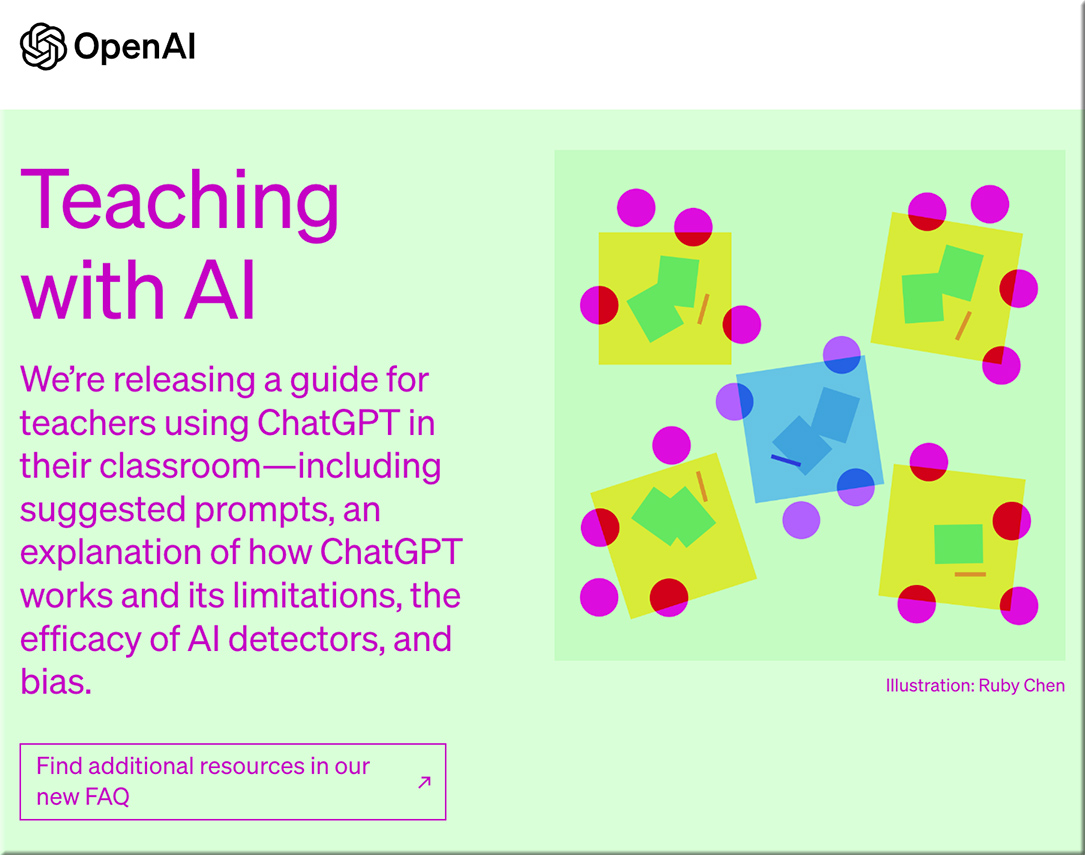
Taking the bull by the horns, the company has proposed a few ways for teachers to put the system to use… outside its usual role as “research assistant” for procrastinating students.
.

Teaching with AI -- a guide from OpenAI


Q2 Earnings Roundup – EdTech Generative AI — from aieducation.substack.com by Claire Zau
A roundup of LLM and AI discussions from Q2 EdTech Earnings

In this piece, we’ll be breaking down how a few of edtech’s most important companies are thinking about AI developments.

  • Duolingo
  • Powerschool
  • Coursera
  • Docebo
  • Instructure
  • Nerdy
 

A First Look at Teaching Preferences since the Pandemic”— from library.educause.edu/ by Muscanell

2023 Faculty & Technology Report: A First Look at Teaching Preferences since the Pandemic

This is the first faculty research conducted by EDUCAUSE since 2019. Since then, the higher education landscape has been through a lot, including COVID-19, fluctuations in enrollment and public funding, and the rapid adoption of multiple instructional modalities and new technologies. In this report, we describe the findings of the research in four key areas:

  • Modality preferences and the impacts of teaching in non-preferred modes
  • Experiences teaching online and hybrid courses
  • Technology and digital availability of course components
  • Types of support needed and utilized for teaching

From DSC:
Polling the faculty members and getting their feedback is not as relevant and important to the future of higher education as better addressing the needs and wants of parents and students who are paying the bills. Asking faculty members what they want to post online is not as relevant as what students want and need to see online.


From DSC:
More fringe responses — versus overhauling pricing, updating curriculum, providing more opportunities to try out jobs before investing in a degree, and/or better rewarding those adjunct faculty members who are doing the majority of the teaching on many campuses.


Online college enrollment is on the rise: What brings students to virtual campuses? — from digitaljournal.com by Jill Jaracz and Emma Rubin; via GSV

Before the pandemic, online learning programs were typically for people going back to school to augment or change their career or pursuing a graduate degree to enhance their career while they work. That attitude is shifting as students juggle learning with jobs, family responsibilities, and commutes. In California, 4 in 5 community college classes were in person before the pandemic. By 2021, just 1 in 4 were in person, while 65% were online, according to the California Community Colleges Chancellor’s Office.

Younger students are also opting for online classes. EducationDynamics found in 2023 that the largest share of students pursuing undergraduate or graduate degrees online is 35 or younger. That said, 35% of students pursuing online undergraduate degrees are between


10 ways for students to get repetitions for practice — from ditchthattextbook.com by Matt Miller

If we want students to remember – to lock new information or ideas into long-term memory – getting meaningful repetitions still is key. And the science of learning still backs that up.

So … if we want students to get repetitions to make new learning permanent, how can they do it? Here are 10 ways to help students get repetitions for practice – and how classroom technology can help.


MUST-TRY FIRST WEEK OF SCHOOL ACTIVITY IDEAS – EASY EDTECH PODCAST 225 — from classtechtips.com by Dr. Monica Burns

In this episode, I share ten engaging activities that combine education, technology, and plenty of fun to make the first week of class super memorable. From digital scavenger hunts to virtual field trips, hear about a few of my favorite ways to create an interactive start to your school year.

Tips for First Week of School Activity Ideas

  • Establish routines in a fun way.
  • Provide opportunities for collaboration.
  • Introduce tech tools that will be used all year.

From DSC:
Dr. Burns has a great list of tools/tips/resources in this posting.


Teaching: What does it take to elevate good teaching? A lot. — from chronicle.com by Beth McMurtrie

Advice guides for teaching
As the fall approaches, we want to remind readers that The Chronicle offers a range of free advice guides designed to help improve your teaching. They’re written by experts for instructors who want to gather ideas on creating a syllabusteaching a good first day of classmaking your teaching more engagingimproving classroom discussion, making your teaching more inclusive and being a better online teacher.


Four directions for assessment redesign in the age of generative AI— from timeshighereducation.com by Julia Chen
The rise of generative AI has led universities to rethink how learning is quantified. Julia Chen offers four options for assessment redesign that can be applied across disciplines

Direction 1: From written description to multimodal explanation and application

Direction 2: From literature review alone to referencing lectures

Direction 3: From presentation of ideas to defence of views

Direction 4: From working alone to student-staff partnership


Absenteeism Mires Recovery from Pandemic Learning Losses — from educationnext.org by Phyllis W. Jordan
But simple measures by schools can encourage better student attendance

Excerpt (emphasis DSC):

With the latest national test results showing a dispiriting lack of progress in catching students up academically in the wake of the pandemic, one potential explanation stands out: stubbornly high rates of student absenteeism. Vast numbers of students haven’t returned to class regularly since schools reopened.

From DSC:
Shouldn’t that tell us something? 


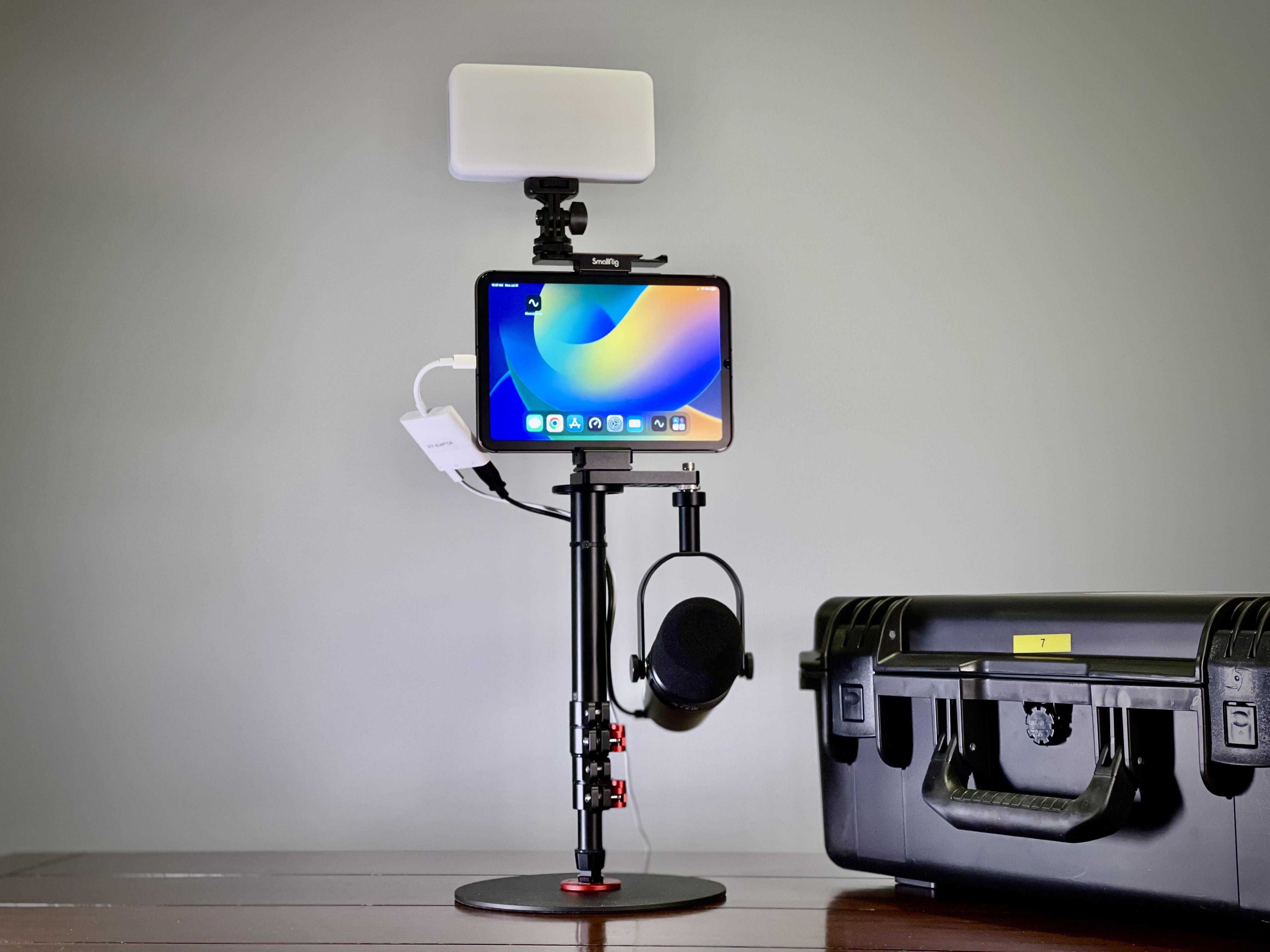
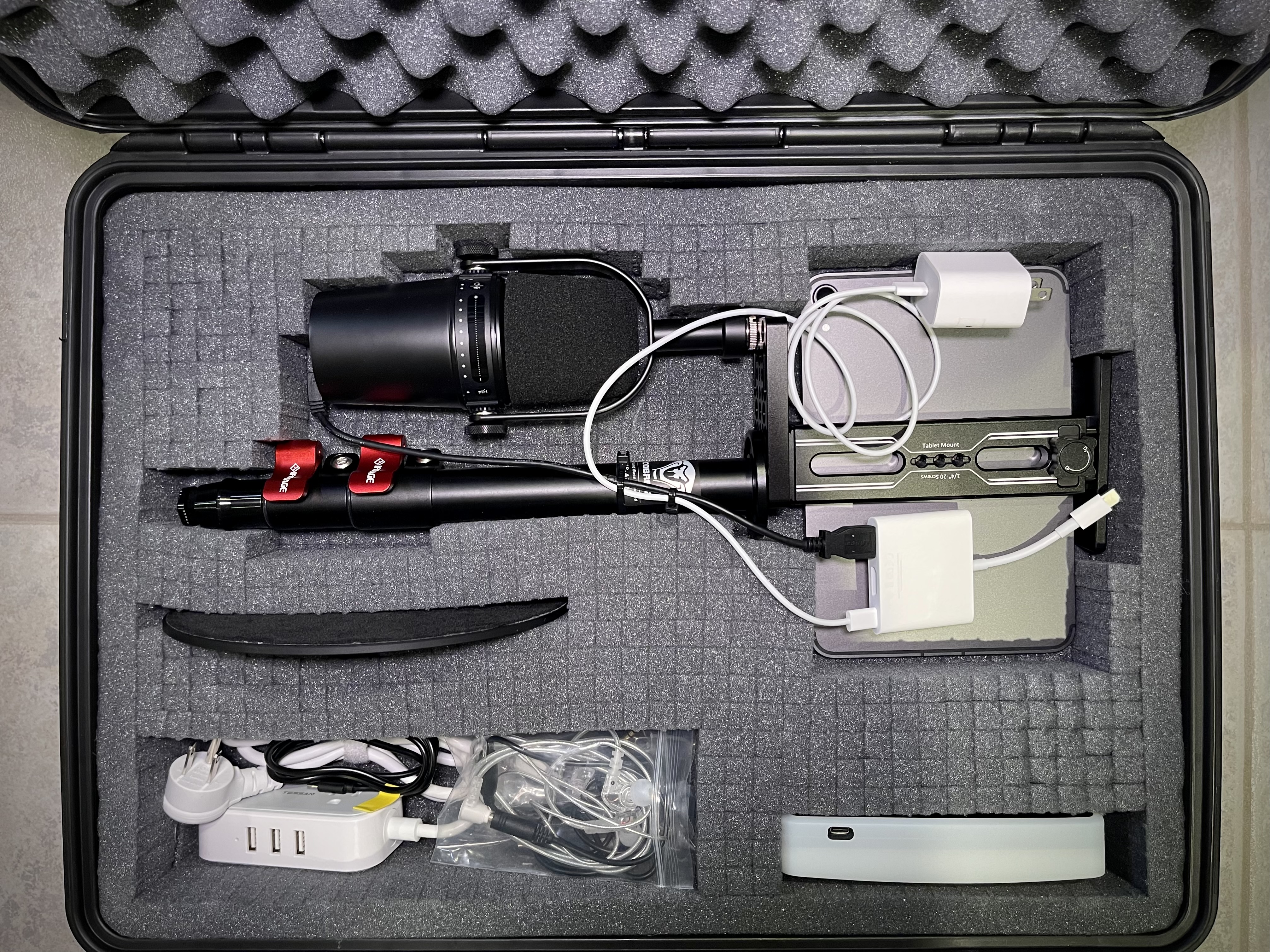
A cam/mic/light/teleprompter remote kit for non-tech-savvy guests, including Shure MV7 — from provideocoalition.com by Allan Tépper

Excerpt (emphasis DSC):

Inspired by my recent Review: Shure MV7 dynamic hybrid studio microphone – near, far and beyond, Beaker Films of Fairfield, Connecticut, US has developed and deployed a first batch of 10 kits to capture remote conversations from different locations worldwide. Beaker Films is frequently contracted to record remote interviews or testimonials from medical professionals. For this project, Beaker Films’ clients wanted consistent, high quality audio and video, but with 3 additional challenges: they preferred to have no visible microphone in the shot, they needed a teleprompter function and the whole kit needed to be as simple as possible for non-technical guests.


Speaking of A/V-related items, also see:

Seven worlds one planet at the BBC Earth Experience — from inavateonthenet.net by Paul Milligan

‘Holographic’ animal-free zoo opens in Australia — from inavateonthenet.net

XR Lab opens in UK college — from inavateonthenet.net

West Suffolk College in the UK has opened its Extended Reality Lab (XR Lab), the facilities comprise of four distinct areas: an Immersion Lab, a Collaboration Theatre, a Green Room, and a Conference Room. The project was designed by architects WindsorPatania for Eastern Colleges Group.

CJP to create virtual studio for Solent University — from inavateonthenet.net

Systems integrator CJP Broadcast Service Solutions, has won a tender to build a virtual production environment for Solent University in the UK.

The new facilities, converted from an existing studio space, will provide students on the film production courses with outstanding opportunities to develop their creative output.


Online learning: Is it worth trying? — from social-and-emotional-learning.educationtechnologyinsights.com by Dr. Miko Nino


From DSC:
Dr. Nino makes several solid points in this article. The article won’t let me copy/paste some excerpts for you, but I would encourage you to look at it. 

I would add a few things:

  • The huge advantage of online-based learning is that a significant amount of learning-related data is automatically captured and doesn’t need to be manually entered (if such manually entered data ever does get entered…which most of it doesn’t).
  • Learners have much more control over the pacing within the digital realm — i.e., which media they want to use as well as stopping/fast-forwarding/rewinding certain kinds of media.
  • Most people are now required to be lifelong learners — where convenience and time-savings become very important factors in continuing one’s education
  • And finally, as AI and other technologies continue to make their way forward, it will be hard to beat online-based and/or hybrid-based learning. 
 

From DSC:
And how long before that type of interactivity is embedded into learning-related applications/games?!


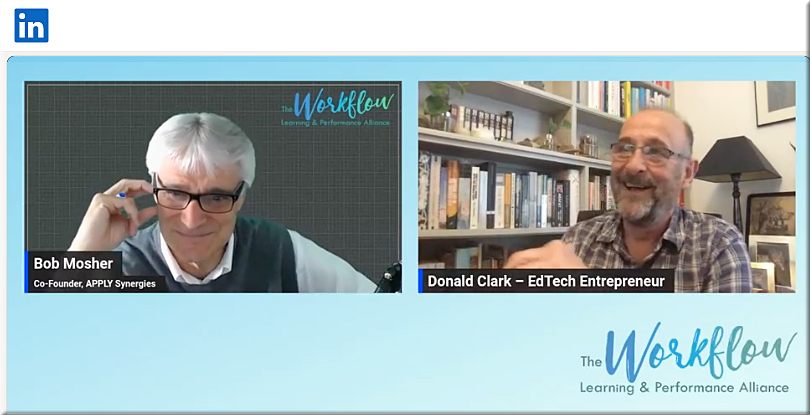
AI in Learning: The Impact of ChatGPT on L&D & Workflow Learning — from linkedin.com; this event by Bob Mosher features his conversation with Donald Clark

AI in Learning: The Impact of ChatGPT on L&D & Workflow Learning -- from linkedin.com; this event by Bob Mosher features his conversation with Donald Clark


Bill Gates says AI is poised to destroy search engines and Amazon — from futurism.com by Victor Tangermann
Who will win the AI [competition]? (DSC: I substituted the word competition here, as that’s what it is. It’s not a war, it’s a part of America’s way of doing business.)

“Whoever wins the personal agent, that’s the big thing, because you will never go to a search site again, you will never go to a productivity site, you’ll never go to Amazon again,” Gates said during a Goldman Sachs event on AI in San Francisco this week, as quoted by CNBC.

These AI assistants could “read the stuff you don’t have time to read,” he said, allowing users to get to information without having to use a search engine like Google.


EdX launches ChatGPT-powered plugin, learning assistant — from edscoop.com
The online learning firm edX introduced two new tools powered by ChatGPT, the “first of many innovations” in generative AI for the platform.

The online learning platform edX introduced two new tools on Friday based on OpenAI’s ChatGPT technology: an edX plugin for ChatGPT and a learning assistant embedded in the edX platform, called Xpert.

According to the company, its plugin will enable ChatGPT Plus subscribers to discover educational programs and explore learning content such as videos and quizzes across edX’s library of 4,200 courses.


Bing is now the default search for ChatGPT — from theverge.com by Tom Warren; via superhuman.beehiiv.com
The close partnership between Microsoft and OpenAI leads to plug-in interoperability and search defaults.

Excerpt:

OpenAI will start using Bing as the default search experience for ChatGPT. The new search functionality will be rolling out to ChatGPT Plus users today and will be enabled for all free ChatGPT users soon through a plug-in in ChatGPT.


How ChatGPT Could Help or Hurt Students With Disabilities — from chronicle.com by Beth McMurtrie

Excerpt:

  • Students with mobility challenges may find it easier to use generative AI tools — such as ChatGPT or Elicit — to help them conduct research if that means they can avoid a trip to the library.
  • Students who have trouble navigating conversations — such as those along the autism spectrum — could use these tools for “social scripting.” In that scenario, they might ask ChatGPT to give them three ways to start a conversation with classmates about a group project.
  • Students who have trouble organizing their thoughts might benefit from asking a generative AI tool to suggest an opening paragraph for an essay they’re working on — not to plagiarize, but to help them get over “the terror of the blank page,” says Karen Costa, a faculty-development facilitator who, among other things, focuses on teaching, learning, and living with ADHD. “AI can help build momentum.”
  • ChatGPT is good at productive repetition. That is a practice most teachers use anyway to reinforce learning. But AI can take that to the next level by allowing students who have trouble processing information to repeatedly generate examples, definitions, questions, and scenarios of concepts they are learning.

It’s not all on you to figure this out and have all the answers. Partner with your students and explore this together.


A new antibiotic, discovered with artificial intelligence, may defeat a dangerous superbug — from edition.cnn.com by Brenda Goodman


8 YouTube Channels to Learn AI — from techthatmatters.beehiiv.com by Harsh Makadia

  • The AI Advantage (link)
  • Jason West (link)
  • TheAIGRID (link)
  • Prompt Engineering (link)
  • Matt Wolfe (link)
  • Two-Minute Papers (link)
  • Brett Malinowski (link)
  • 10X Income (link)

AI and the Future of Teaching and Learning | Insights and Recommendations from the Office of Educational Technology

Artificial Intelligence and the Future of Teaching and Learning | Insights and Recommendations — with thanks to Robert Gibson on LinkedIn for this resource


Ai Valley -- the latest source of AI tools and prompts

 
© 2025 | Daniel Christian