Sharif El-Mekki on Growing Educators of Color Through Pleasure, Duty and Honor — from gettingsmart.com by Shawnee Caruthers and Sharif El-Mekki, Founder and CEO of the Center for Black Educator Development.

Key Points

  • Aspiring educators should have the requisites to spend time in their community as a part of their education.
  • Educators should be asking: how do we build cultures of cooperation and collaboration?
  • Investigate your intellectual genealogy to see where you are getting the ideas you have to question assumptions.

His mantra, “We Need Black Teachers” is more than a rallying cry, but a deep desire to give voice to the over 8 million black learners that need to see themselves in their classrooms and community.


Something Big Is Happening — from shumer.dev by Matt Shumer; see below from the BIG Questions Institute, where I got this article from

I’ve spent six years building an AI startup and investing in the space. I live in this world. And I’m writing this for the people in my life who don’t… my family, my friends, the people I care about who keep asking me “so what’s the deal with AI?” and getting an answer that doesn’t do justice to what’s actually happening. I keep giving them the polite version. The cocktail-party version. Because the honest version sounds like I’ve lost my mind. And for a while, I told myself that was a good enough reason to keep what’s truly happening to myself. But the gap between what I’ve been saying and what is actually happening has gotten far too big. The people I care about deserve to hear what is coming, even if it sounds crazy.


They’ve now done it. And they’re moving on to everything else.

The experience that tech workers have had over the past year, of watching AI go from “helpful tool” to “does my job better than I do”, is the experience everyone else is about to have. Law, finance, medicine, accounting, consulting, writing, design, analysis, customer service. Not in ten years. The people building these systems say one to five years. Some say less. And given what I’ve seen in just the last couple of months, I think “less” is more likely.

The models available today are unrecognizable from what existed even six months ago. The debate about whether AI is “really getting better” or “hitting a wall” — which has been going on for over a year — is over. It’s done. Anyone still making that argument either hasn’t used the current models, has an incentive to downplay what’s happening, or is evaluating based on an experience from 2024 that is no longer relevant. I don’t say that to be dismissive. I say it because the gap between public perception and current reality is now enormous, and that gap is dangerous… because it’s preventing people from preparing.


What “Something Big Is Happening” Means for Schools — from/by the BIG Questions Institute
Matt Shumer’s newsletter post Something Big is Happening has been read over 80 million times within the week when it was published, on February 9.

Still, it’s worth reading Shumer’s post. Given the claims and warnings in Something Big Is Happening (and countless other articles), how would you truly, honestly respond to these questions:

  • What will the purpose of school be in 5 years?
  • What are we doing now that we must leave behind right away?
  • What can we leave behind gradually?
  • What does rigor look like in this AI-powered world?
  • Does our strategy look like making adjustments at the margins or are we preparing our students for a fundamental shift?
  • What is our definition of success? How do the the implications of AI and jobs (and other important forces, from geopolitical shifts and climate change, to mental health needs and shifting generational values) impact the outcomes we prioritize? What is the story of success we want to pass on to our students and wider community?
 

The Campus AI Crisis — by Jeffrey Selingo; via Ryan Craig
Young graduates can’t find jobs. Colleges know they have to do something. But what?

Only now are colleges realizing that the implications of AI are much greater and are already outrunning their institutional ability to respond. As schools struggle to update their curricula and classroom policies, they also confront a deeper problem: the suddenly enormous gap between what they say a degree is for and what the labor market now demands. In that mismatch, students are left to absorb the risk. Alina McMahon and millions of other Gen-Zers like her are caught in a muddled in-between moment: colleges only just beginning to think about how to adapt and redefine their mission in the post-AI world, and a job market that’s changing much, much faster.

“Colleges and universities face an existential issue before them,” said Ryan Craig, author of Apprentice Nation and managing director of a firm that invests in new educational models. “They need to figure out how to integrate relevant, in-field, and hopefully paid work experience for every student, and hopefully multiple experiences before they graduate.”


Confidence, Engagement, and Love: The Missing Alumni Data that Will Transform K-12 — from gettingsmart.com by Corey Mohn

Ten years ago, we made a bet on relationships over replication. Instead of franchising a model, we chose to build an ecosystem—the CAPS Network—grounded in the belief that an entrepreneurial approach would create ripples of innovation with exponential scaling power. We believed that by harnessing the power of relationships for good, we could help more students discover who they are and where they belong in the world.

Today, with over 1,200 alumni voices captured in our 2025 Alumni Impact Study, we’re seeing those ripples turn into waves. And we believe these waves can and will be surfed by educators all across the globe. We are committed to the idea that our purpose (providing more students in more places the time and space for self-discovery) is more important than our brand. As such, we want our learnings to be leveraged by anyone and everyone to make a positive impact.


Confidence, Engagement, and Love explores the data we rarely track but desperately need. This piece argues that alumni confidence, sustained engagement, and a sense of being loved by their school communities are leading indicators of long-term success. It challenges K–12 systems to look beyond test scores and graduation rates and instead ask what happens after students leave, who stays connected, and how belonging shapes opportunity. The result is a call to rethink accountability around relationships, not just results.


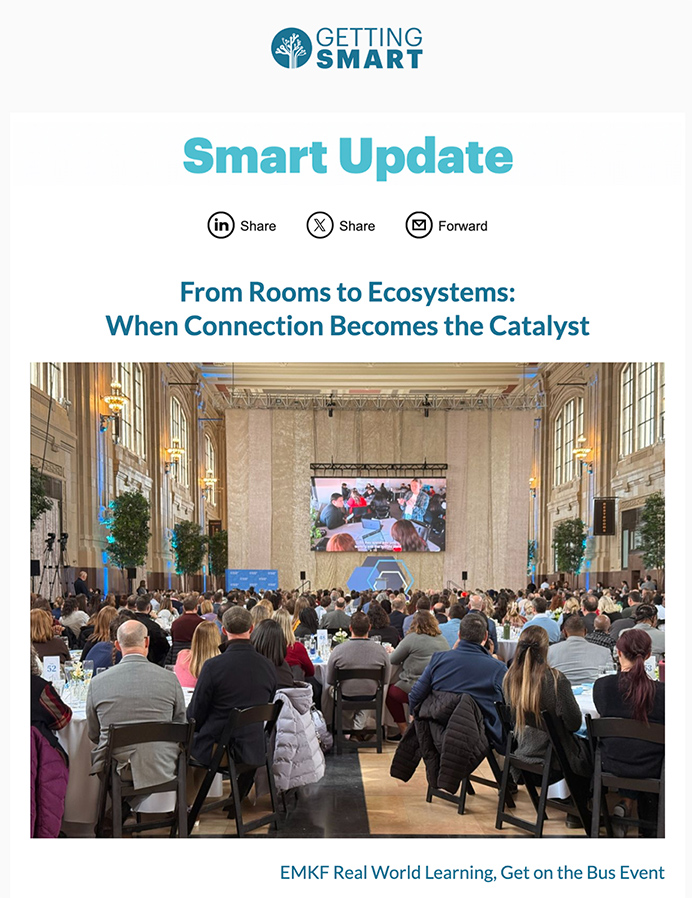
From Rooms to Ecosystems: When Connection Becomes the Catalyst

Some gatherings change not just in size, but in meaning. What started as a small, intentional space to celebrate partners has grown into a moment that reflects how an entire ecosystem has matured. Each year, the room fills with more leaders, more relationships, and more shared language about what learning can look like when people are genuinely connected. It is less about an event on the calendar and more about what it represents: an education community that knows each other, trusts each other, and keeps showing up.

That kind of connection did not happen by accident. Through efforts like Get on the Bus, hosted by the Ewing Marion Kauffman Foundation, networking for education leaders has shifted from transactional to relational. Students lead. Stories anchor the work. Conversations happen across tables, sectors, and roles. System leaders, intermediaries, industry partners, and civic organizations are not passing business cards. They are building shared understanding and social capital that lasts long after the room clears.

This week’s newsletter carries that same energy. You will find examples of learning that travels beyond buildings, leadership conversations grounded in real tensions, and models that reflect what becomes possible when ecosystems are aligned. When people feel connected to one another and to a common purpose, the work gets clearer, stronger, and more human. That sense of belonging is not just powerful. It is foundational to what comes next.


Town Hall Recap: What’s Next in Learning 2026 — from gettingsmart.com by Tom Vander Ark, Nate McClennen, Shawnee Caruthers, Victoria Andrews

As we enter 2026, the Getting Smart team is diving deep into the convergence of human potential and technological opportunity. Our annual Town Hall isn’t just a forecast—it’s a roadmap for the year ahead. We will explore how human-centered AI is reshaping pedagogy, the power of participation, and the new realities of educational leadership. Join us as we define the new dispositions for future-ready educators and discover how to build meaningful, personalized pathways for every student.


Planning Your L&D Hiring for Next Year? Start With Skills, Salary Ranges, and Realistic Expectations — from teamedforlearning.com

Salary transparency laws across many states now require organizations to publish compensation ranges. While this can feel like a burden, the truth is: transparency can dramatically speed up hiring. Candidates self-select, mismatches decrease, and teams save time.

But transparency only works when the salary range itself is grounded in reality. And that’s where many organizations struggle.

Posting a salary range is the easy part.
Determining a fair, defensible range is where the work happens.

Also from Teamed for Learning, see:

Hiring Trends For 2026 
The learning industry shifts fast, and this year is no exception. Here’s what’s shaping the hiring landscape right now:

  • AI is now a core skill, not a bonus
  • Project management is showing up in every job description
  • Generalists with business awareness are beating tool-heavy candidates
  • Universities and edtech companies are speeding up content refresh cycles
  • Hiring budgets are tight – but expectations aren’t easing up
 

Major Changes Reshape Law Schools Nationwide in 2026 — from jdjournal.com by Ma Fatima

Law schools across the United States are entering one of the most transformative periods in recent memory. In 2026, legal education is being reshaped by leadership turnover, shifting accreditation standards, changes to student loan policies, and the introduction of a redesigned bar exam. Together, these developments are forcing law schools to rethink how they educate students and prepare future lawyers for a rapidly evolving legal profession.

Also from jdjournal.com, see:

  • Healthcare Industry Legal Careers: High-Growth Roles and Paths — from jdjournal.com by Ma Fatima
    The healthcare industry is rapidly emerging as one of the most promising and resilient sectors for legal professionals, driven by expanding regulations, technological innovation, and an increasingly complex healthcare delivery system. As hospitals, life sciences companies, insurers, and digital health platforms navigate constant regulatory change, demand for experienced legal talent continues to rise.


So, You Want to Open a Microschool — from educationnext.org by Kerry McDonald
For aspiring founders who have the will but lack the way to launch their schools, startup partners are there to help

In recent years, microschools—small, highly individualized, flexible learning models—have become a popular education option, now serving at least 750,000 U.S. schoolchildren. More than half of microschools nationwide operate as homeschooling centers, while 30 percent function as private schools, 5 percent are public charters, and the rest fit into unique, often overlapping categories, according to a 2025 sector analysis by the National Microschooling Center. While many founders achieve success on their own, joining an accelerator or network can offer the business coaching and community connection that make the inevitable challenges of entrepreneurship more manageable. Van Camp decided to join KaiPod Catalyst, a microschool accelerator program from KaiPod Learning.

I feature six of these microschool accelerators and networks in my new book, Joyful Learning: How to Find Freedom, Happiness, and Success Beyond Conventional Schooling. Some of them have been around for years, but they have attracted rising interest since 2020 as more parents and teachers consider starting schools. These programs vary widely in the startup services and supports they offer, but they share a commitment to building relationships among founders and facilitating the ongoing success of today’s creative schooling options.


MICROSCHOOL REPORT
A small shift with an outsized impact in K-12 education— from gettingsmart.com by Getting Smart

High quality, personalized instruction in an intimate setting that focuses on the whole child is growing in popularity—and it looks very different from traditional models both past and present. What may seem like a throwback to the pioneers’ one-room schoolhouse actually speaks volumes about what we as a society have outgrown.

What began as a response to a global crisis has led to a watershed moment.

Yet to categorize microschools simply as “pandemic pods” or private schools with a low headcount largely misses the mark. They are perhaps best described as intentionally-designed small learning environments that are bucking two centuries of inertia and industrial-era constraints.

Microschools are providing educators with an entrepreneurial opportunity that was unthinkable just a couple of decades ago, in tandem with the ability to deliver high student and family satisfaction. And they’re doing it by prioritizing learner agency, personalization, and mastery over compliance and standardization.

However, for microschools to truly scale and impact equitable outcomes, the K-12 sector must address critical policy challenges related to access, accountability and regulatory restrictions.

The following key findings from deeply researched case studies and strategic guides published by the Getting Smart team are intended to provide a comprehensive overview on the microschool movement. Each section offers an opportunity to dive deeper into resources on specific, timely topics.


Speaking of education reform and alternatives, also see:

Driving systems transformation for 21st-century educators, learners, and workers. — from jff.org

Today’s education ecosystem must meet the needs of today’s learners. This means learner-centered outcomes, pathways between education and careers, and policies and practices that support both degree and non-degree programs.

Jobs for the Future’s Education practice works to support systems change in the education ecosystem, influence policies that promote diverse pathways, and identify and apply data-informed, learner-centered solutions.


7 Legal Tech Trends That Will Reshape Every Business In 2026 — from forbes.com by Bernard Marr

Here are the trends that will matter most.

  1. AI Agents As Legal Assistants
  2. AI As A Driver Of Business Strategy
  3. Automation In Judicial Administration
  4. Always-On Compliance Monitoring
  5. Cybersecurity As An Essential Survival Tool
  6. Predictive Litigation
  7. Compliance As Part Of The Everyday Automation Fabric

According to the Thomson Reuters Future Of Professionals report, most experts already expect AI to transform their work within five years, with many viewing it as a positive force. The challenge now is clear: legal and compliance leaders must understand the tools reshaping their field and prepare their teams for a very different way of working in 2026.


Addendum on 12/17/25:


The Other Regulatory Time Bomb — from onedtech.philhillaa.com by Phil Hill
Higher ed in the US is not prepared for what’s about to hit in April for new accessibility rules

Most higher-ed leaders have at least heard that new federal accessibility rules are coming in 2026 under Title II of the ADA, but it is apparent from conversations at the WCET and Educause annual conferences that very few understand what that actually means for digital learning and broad institutional risk. The rule isn’t some abstract compliance update: it requires every public institution to ensure that all web and media content meets WCAG 2.1 AA, including the use of audio descriptions for prerecorded video. Accessible PDF documents and video captions alone will no longer be enough. Yet on most campuses, the conversation has been understood only as a buzzword, delegated to accessibility coordinators and media specialists who lack the budget or authority to make systemic changes.

And no, relying on faculty to add audio descriptions en masse is not going to happen.

The result is a looming institutional risk that few presidents, CFOs, or CIOs have even quantified.


KPMG wants junior consultants to ditch the grunt work and hand it over to teams of AI agents — from businessinsider.com by Polly Thompson

The Big Four consulting and accounting firm is training its junior consultants to manage teams of AI agents — digital assistants capable of completing tasks without human input.

“We want juniors to become managers of agents,” Niale Cleobury, KPMG’s global AI workforce lead, told Business Insider in an interview.

KPMG plans to give new consulting recruits access to a catalog of AI agents capable of creating presentation slides, analyzing data, and conducting in-depth research, Cleobury said.

The goal is for these agents to perform much of the analytical and administrative work once assigned to junior consultants, allowing them to become more involved in strategic decisions.


From DSC:
For a junior staff member to provide quality assurance in working with agents, an employee must know what they’re talking about in the first place. They must have expertise and relevant knowledge. Otherwise, how will they spot the hallucinations?

So the question is, how can businesses build such expertise in junior staff members while they are delegating things to an army of agents? This question applies to the next posting below as well. Having agents report to you is all well and good — IF you know when the agents are producing helpful/accurate information and when they got things all wrong.


This Is the Next Vital Job Skill in the AI Economy — from builtin.com by Saurabh Sharma
The future of tech work belongs to AI managers.

Summary: A fundamental shift is making knowledge workers “AI managers.” The most valuable employees will direct intelligent AI agents, which requires new competencies: delegation, quality assurance and workflow orchestration across multiple agents. Companies must bridge the training gap to enable this move from simple software use to strategic collaboration with intelligent, yet imperfect, systems.

The shift is happening subtly, but it’s happening. Workers are learning to prompt agents, navigate AI capabilities, understand failure modes and hand off complex tasks to AI. And if they haven’t started yet, they probably will: A new study from IDC and Salesforce found that 72 percent of CEOs think most employees will have an AI agent reporting to them within five years. This isn’t about using a new kind of software tool — it’s about directing intelligent systems that can reason, search, analyze and create.

Soon, the most valuable employees won’t just know how to use AI; they’ll know how to manage it. And that requires a fundamentally different skill set than anything we’ve taught in the workplace before.


AI agents failed 97% of freelance tasks; here’s why… — from theneurondaily.com by Grant Harvey

AI Agents Can’t Actually Do Your Job (Yet)—New Benchmark Reveals The Gap

DEEP DIVE: AI can make you faster at your job, but can only do 2-3% of jobs by itself.

The hype: AI agents will automate entire workflows! Replace freelancers! Handle complex tasks end-to-end!

The reality: a measly 2-3% completion rate.

See, Scale AI and CAIS just released the Remote Labor Index (paper), a benchmark where AI agents attempted real freelance tasks. The best-performing model earned just $1,810 out of $143,991 in available work, and yes, finishing only 2-3% of jobs.


The new legal intelligence — from jordanfurlong.substack.com by Jordan Furlong
We’ve built machines that can reason like lawyers. Artificial legal intelligence is becoming scalable, portable and accessible in ways lawyers are not. We need to think hard about the implications.

Much of the legal tech world is still talking about Clio CEO Jack Newton’s keynote at last week’s ClioCon, where he announced two major new features: the “Intelligent Legal Work Platform,” which combines legal research, drafting and workflow into a single legal workspace; and “Clio for Enterprise,” a suite of legal work offerings aimed at BigLaw.

Both these features build on Clio’s out-of-nowhere $1B acquisition of vLex (and its legally grounded LLM Vincent) back in June.

A new source of legal intelligence has entered the legal sector.

Legal intelligence, once confined uniquely to lawyers, is now available from machines. That’s going to transform the legal sector.


Where the real action is: enterprise AI’s quiet revolution in legal tech and beyond — from canadianlawyermag.com by Tim Wilbur
Harvey, Clio, and Cohere signal that organizational solutions will lead the next wave of change

The public conversation about artificial intelligence is dominated by the spectacular and the controversial: deepfake videos, AI-induced psychosis, and the privacy risks posed by consumer-facing chatbots like ChatGPT. But while these stories grab headlines, a quieter – and arguably more transformative – revolution is underway in enterprise software. In legal technology, in particular, AI is rapidly reshaping how law firms and legal departments operate and compete. This shift is just one example of how enterprise AI, not just consumer AI, is where real action is happening.

Both Harvey and Clio illustrate a crucial point: the future of legal tech is not about disruption for its own sake, but partnership and integration. Harvey’s collaborations with LexisNexis and others are about creating a cohesive experience for law firms, not rendering them obsolete. As Pereira put it, “We don’t see it so much as disruption. Law firms actually already do this… We see it as ‘how do we help you build infrastructure that supercharges this?’”

The rapid evolution in legal tech is just one example of a broader trend: the real action in AI is happening in enterprise software, not just in consumer-facing products. While ChatGPT and Google’s Gemini dominate the headlines, companies like Cohere are quietly transforming how organizations across industries leverage AI.

Also from canadianlawyermag.com, see:

The AI company’s plan to open an office in Toronto isn’t just about expanding territory – it’s a strategic push to tap into top technical talent and capture a market known for legal innovation.


Unseeable prompt injections in screenshots: more vulnerabilities in Comet and other AI browsers — from brave.com by Artem Chaikin and Shivan Kaul Sahib

Building on our previous disclosure of the Perplexity Comet vulnerability, we’ve continued our security research across the agentic browser landscape. What we’ve found confirms our initial concerns: indirect prompt injection is not an isolated issue, but a systemic challenge facing the entire category of AI-powered browsers. This post examines additional attack vectors we’ve identified and tested across different implementations.

As we’ve written before, AI-powered browsers that can take actions on your behalf are powerful yet extremely risky. If you’re signed into sensitive accounts like your bank or your email provider in your browser, simplysummarizing a Reddit postcould result in an attacker being able to steal money or your private data.

The above item was mentioned by Grant Harvey out at The Neuron in the following posting:


Robin AI’s Big Bet on Legal Tech Meets Market Reality — from lawfuel.com

Robin’s Legal Tech Backfire
Robin AI, the poster child for the “AI meets law” revolution, is learning the hard way that venture capital fairy dust doesn’t guarantee happily-ever-after. The London-based legal tech firm, once proudly waving its genAI-plus-human-experts flag, is now cutting staff after growth dreams collided with the brick wall of economic reality.

The company confirmed that redundancies are under way following a failed major funding push. Earlier promises of explosive revenue have fizzled. Despite around $50 million in venture cash over the past two years, Robin’s 2025 numbers have fallen short of investor expectations. The team that once ballooned to 200 is now shrinking.

The field is now swarming with contenders: CLM platforms stuffing genAI into every feature, corporate legal teams bypassing vendors entirely by prodding ChatGPT directly, and new entrants like Harvey and Legora guzzling capital to bulldoze into the market. Even Workday is muscling in.

Meanwhile, ALSPs and AI-powered pseudo-law firms like Crosby and Eudia are eating market share like it’s free pizza. The number of inhouse teams actually buying these tools at scale is still frustratingly small. And investors don’t have much patience for slow burns anymore.


Why Being ‘Rude’ to AI Could Win Your Next Case or Deal — from thebrainyacts.beehiiv.com by Josh Kubicki

TL;DR: AI no longer rewards politeness—new research shows direct, assertive prompts yield better, more detailed responses. Learn why this shift matters for legal precision, test real-world examples (polite vs. blunt), and set up custom instructions in OpenAI (plus tips for other models) to make your AI a concise analytical tool, not a chatty one. Actionable steps inside to upgrade your workflow immediately.


Is Your Institution Ready for the Earnings Premium Buzzsaw? — from ailearninsights.substack.com by Alfred Essa

On Wednesday [October 29th, 2025], I’m launching the Beta version of an Education Accountability Website (”EDU Accountability Lab”). It analyzes federal student aid, institutional outcomes, and accountability metrics across 6,000+ colleges and universities in the US.

Our Mission
The EDU Accountability Lab delivers independent, data-driven analysis of higher education with a focus on accountability, affordability, and outcomes. Our audience includes policymakers, researchers, and taxpayers who seek greater transparency and effectiveness in postsecondary education. We take no advocacy position on specific institutions, programs, metrics, or policies. Our goal is to provide clear and well-documented methods that support policy discussions, strengthen institutional accountability, and improve public understanding of the value of higher education.

But right now, there’s one area demanding urgent attention.

Starting July 1, 2026, every degree program at every institution receiving federal student aid must prove its graduates earn more than people without that credential—or lose Title IV eligibility.

This isn’t about institutions passing or failing. It’s about programs. Every Bachelor’s in Psychology. Every Master’s in Education. Every Associate in Nursing. Each one assessed separately. Each one facing the same pass-or-fail tests.

 
© 2025 | Daniel Christian