Robotics CEO: 12-year-old whiz as smart as Ph.Ds — from Yahoo.com by Andrew Lampard; with thanks to Mr. Joseph Byerwalter and Jay Collier for the resources here

Excerpt (emphasis DSC):

After hearing about Rohan’s very successful internship, we traveled to Silicon Valley to find out how Rohan learned so much about robots by such a young age. Watch the video to meet Rohan and some of his robots.


Rohan-12-year-old-robotics-specialist-Nov2013


Per Jay Collier (@JayCollier) out in Maine, they are doing something similar with “The Hour of Code:”

The Hour of Code is coming to Maine — from ProjectLogin.com

Excerpt:

Sixteen Maine schools have already pledged to participate, and Project>Login will host an Hour-of-Code Dojo at the Augusta Civic Center December 14.

More than 5,000 Maine students will be joining a national campaign to demystify computer science during the Hour of Code week in December, according to the organizers at Code.org.


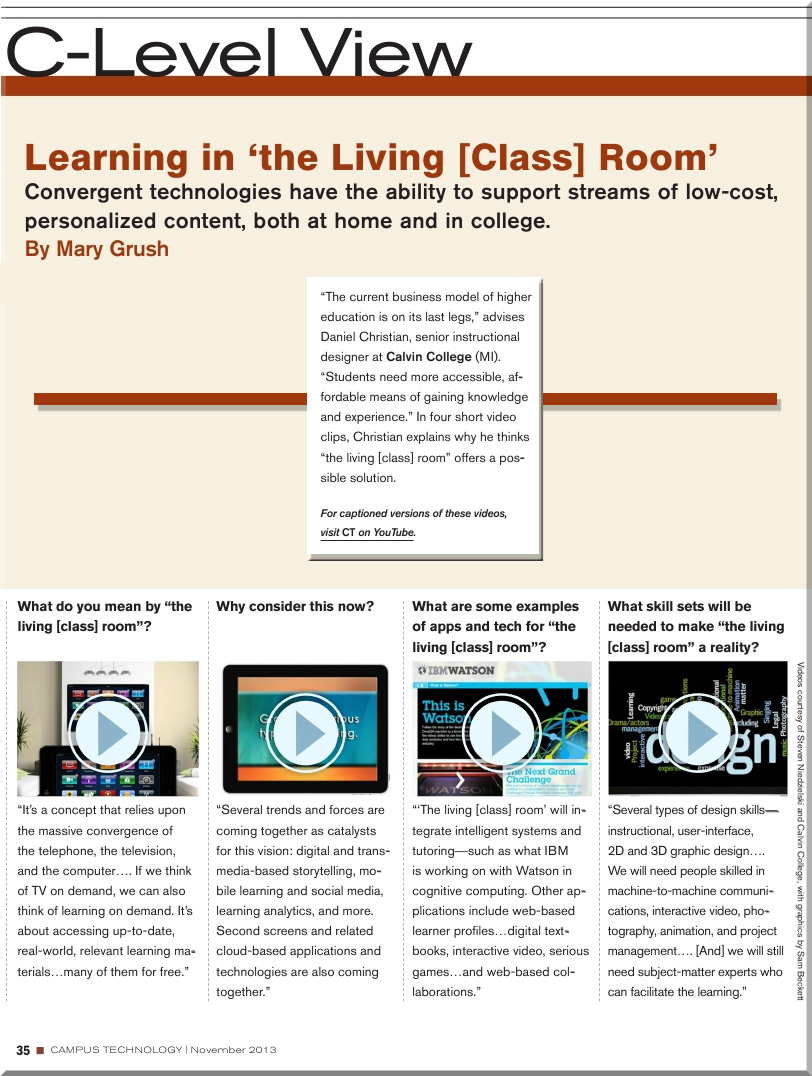
“Learning in the Living [Class] Room” — as explained by Daniel Christian [Campus Technology]

Learning from the Living [Class] Room  — from Campus Technology by Daniel Christian and Mary Grush; with a huge thanks also going out to Mr. Steven Niedzielski (@Marketing4pt0) and to Mr. Sam Beckett (@SamJohnBeck) for their assistance and some of the graphics used in making these videos.

From DSC:
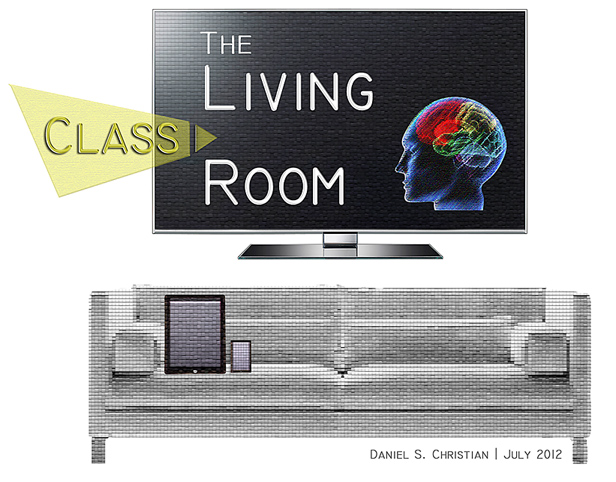
These 4 short videos explain what I’m trying to relay with a vision I’m entitling, Learning from the Living [Class] Room.  I’ve been pulse checking a variety of areas for years now, and the pieces of this vision continue to come into fruition.  This is what I see Massive Open Online Courses (MOOCs) morphing into (though there may be other directions/offshoots that they go in as well).

After watching these videos, I think you will see why I think we must move to a team–based approach.

(It looks like the production folks for Campus Technology had to scale things way back in terms of video quality to insure an overall better performance for the digitally-based magazine.) 


To watch these videos in a higher resolution, please use these links:


  1. What do you mean by “the living [class] room”?
  2. Why consider this now?
  3. What are some examples of apps and tech for “the living [class] room”?
  4. What skill sets will be needed to make “the living [class] room” a reality?


Alternatively, these videos can be found at:


DanielSChristianLearningFromTheLivingClassRoom-CampusTechnologyNovember2013

.


HTML5Research-VisionMobileNov2013


Example slides/information:


HTML5Routes2Market-VisionMobileNov2013


HTML5KeyPlayers-VisionMobileNov2013


Smart Machines: IBM’S Watson and the era of cognitive computing — from cup.columbia.edu by John E. Kelly III, Director of IBM Research, and Steve Hamm, writer at IBM and former business and technology journalist

Excerpt (emphasis DSC):

Computers today are brilliant idiots. They have tremendous capacities for storing information and performing numerical calculations-far superior to those of any human. Yet when it comes to another class of skills, the capacities for understanding, learning, adapting, and interacting, computers are woefully inferior to humans; there are many situations where computers can’t do a lot to help us.

…

But the goal is not to replicate human brains or replace human thinking with machine thinking. Rather, in the era of cognitive systems, humans and machines will collaborate to produce better results, each bringing its own skills to the partnership. The machines will be more rational and analytic-and, of course, possess encyclopedic memories and tremendous computational abilities. People will provide judgment, intuition, empathy, a moral compass, and human creativity.


From DSC:
Consider what Watson “read in” to come up with some recommendations:
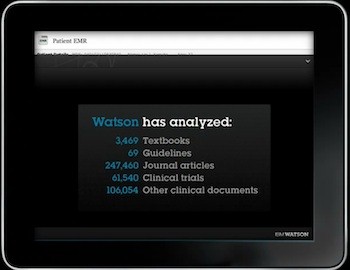
 

Watson


Addendum on 10/14/13 (emphasis DSC):

Watson is being used to assist with the treatment of cancer patients. According to an article from medicalnewstoday.com, Watson is “revolutionizing cancer care and research and speeding up progress for patients.”

In that same article, it mentions that, so far, Watson has ingested:

  • Over 600,000 pieces of medical evidence
  • 2,000,000 pages of text from 42 academic journals and clinical trials based on oncology research
  • A huge number of patients’ records spanning decades of cancer treatment history, including medical records and patient outcomes. Watson can sift through 1.5 million pieces of such records and provide doctors with evidence-based treatment options within seconds.

One of IBM’s General Managers who works with Watson said:

“breakthrough capabilities bring forward the first in a series of Watson-based technologies, which exemplifies the value of applying big data and analytics and cognitive computing to tackle the industry’s most pressing challenges.”


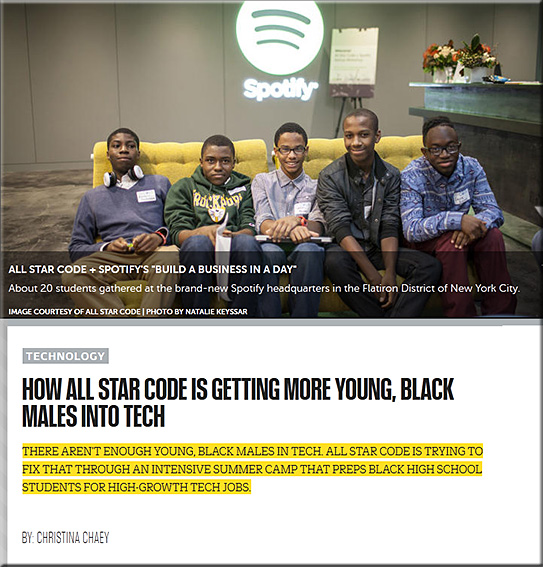
AllStarCode-Oct-1-2013
“As I get older, I want to know: What can I make better in the world? What type of new technology can I create?”

— Shakeem Brown, 15, a sophomore at New York City’s Pace High School
who participated in All Star Code’s workshop.


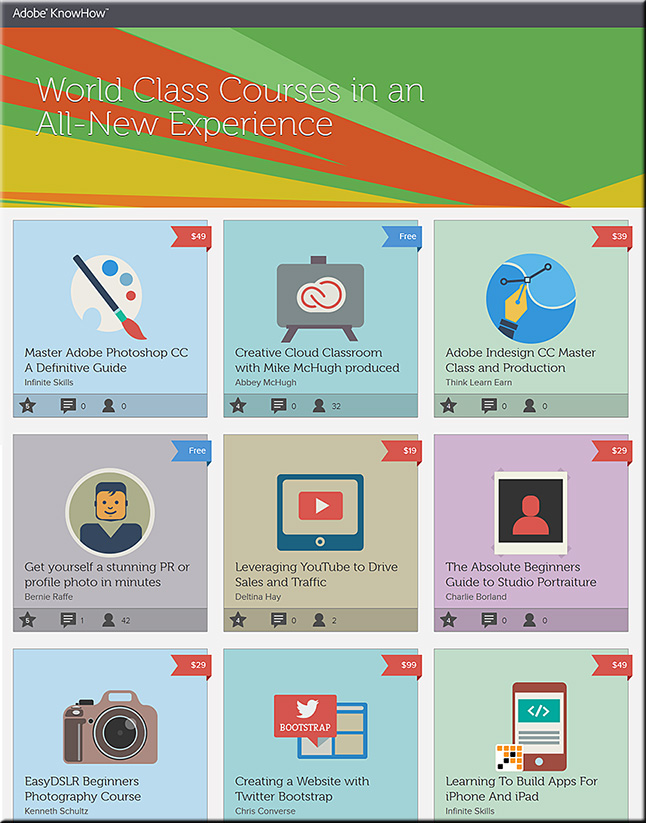
Adobe launches a new learning service – KnowHow — from blogs.adobe.com; with thanks to Dr. Tony Karrer (@elearningPosts) for posting this on Twitter

Excerpt:

If you have been learning through video playlists and always thought:

  • Wouldn’t it be great it I could scribble notes on top of the video? <– From DSC: Idea for future “textbooks”?
  • Why not add text in the context of the video I am learning from? <– For future “textbooks”…?
  • Why can’t I go back and forth between videos easily?                     <– For future “textbooks”…?

You are not alone.


Also see:


AdobeKnowHow-August302013


IBM cranks up big data analytics training programs as government continues cloud moves [infographic] — from cmswire.com by David Roe

Excerpt (emphasis DSC):

IBM is clearly concerned about the big data skills shortage. It has announced the addition of another 9 universities to its big data training program. The economic importance of the program was also underlined this week by the announcement that it has just secured a US$ 1 billion federal contract for cloud computing.

Big Data, Analytics Skills Shortages

The problem for IT giants that are currently muscling into the big data market is that the development of the technology has been so rapid the number of big data/analytics projects currently underway far outweighs the number of people that have appropriate skills.

In fact between now and the end of 2015, IBM estimates that there will be 4.4 million jobs worldwide in big data support. At the moment it is not clear where all the people required to fill these positions are going to come from.


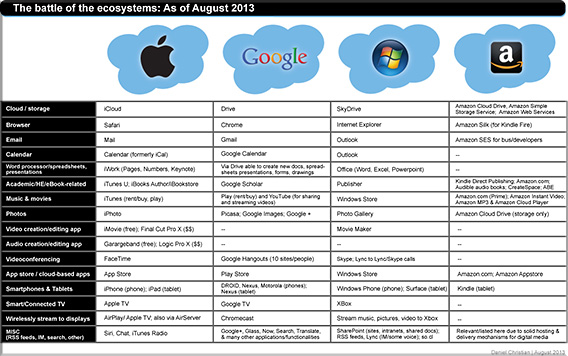
The battle of the ecosystems: Apple, Google, Microsoft, & Amazon.com — by Daniel Christian with thanks to Krista Spahr, Michael Mandeville, Bill Vriesema, and Adam Tozer from Calvin College for their feedback/inputs on this.


BattleOfTheEcosystems-DanielChristian-August2013

PDF version here [1.35MB]


Also see:


Ecosystem value metrics


Ecosystem value metrics - developer perspective


Addendums on 8/13/13:


Here’s why the TV apps economy will be a $14 billion business [Wolf]

Here’s why the TV apps economy will be a $14 billion business — from forbes.com by Michael Wolf


.

Excerpt:

According to new research published this week, the TV apps economy is forecasted to reach $14 billion by 2017.

…

Take for example today’s news that Apple will begin selling video advertisements served by iAd through iTunes Radio loaded on Apple TVs. This is only the first move for Apple in this space, and others like Samsung and Google  are already investing heavily in connected TV app advertising.


From DSC:
Why post this? Because:

  • It lays out future directions/careers related to Programming, Computer Science, Data Mining, Analytics, Marketing, Telecommunications, User Experience Design, Digital and Transmedia Storytelling, and more
    .
  • It leads to “Learning from the Living [Class] Room”

.


The Living [Class] Room -- by Daniel Christian -- July 2012 -- a second device used in conjunction with a Smart/Connected TV


From DSC:
And if this does take off,
$14 billion won’t begin to capture the profits from this new industry.

It will be far larger than that.


Relevant addendum on 6/27/13:

  • The future of cinema is on demand — from bitrebels.com by Ben Warner (From DSC: Having just paid $32 for 4 people — 3 of whom were kids — to see Monsters U, I believe it!)
    .

future-of-cinema-on-demand

Via: [The Verge] Image Credits: [Venture Beat] [Home Theater]


Dear Kids:

First of all, why learn how to program? Why learn programs such as Scratch?

  • It is critical that you have at least some exposure to programming — as having some basic understanding of what programming is like will be very helpful for you. Coding is becoming like air and water for your futures.  That is, it’s like the modern day version of reading, writing, and doing basic math.

You will also be able to:

  • Build games that you can use to play with your friends! 🙂
  • Create/code your own website and code others’ websites to help them out.
  • Design immersive, story-driven experiences.
  • Write software for churches, other individuals, non-profits.
  • Get jobs anywhere in the world – and be highly-marketable/employable.
  • Make a solid contribution to the world via the development of software and new applications.
  • Have some basic understanding of programming so that when you have jobs later on, you will at least know what programmers do.

To get started, see:

Thanks,
Dad

P.S.  Take your time and have some fun with it; and don’t get discouraged if things don’t come easily or automatically for you. Thinking like a programmer requires a different way of thinking; so it may take some time to develop or appreciate.


TV apps: A dive into fragmentation — from appmarket.tv by

Excerpt:

Suppose you wanted to build an app for TV, where would you start? Admittedly, there is an enormous number of variables to consider for an app developer on where they might start the journey, even before that journey starts. These include areas like skill sets, funding, previous development, and relationships. This article is the first in a series that aims to shed some light on the current state of TV app development, as well as the exciting ecosystem that is forming around the connected TV. If you’ve identified an opportunity where developing a TV app makes sense, read on!

…

At this point, suppose you want to cover the market and develop for all devices and middleware platforms. That’s at least 72 middleware/OS, 122 devices, and 3 screen resolutions, which equates to managing over 26,352 experiences. A little overwhelming, right? Luckily, the picture isn’t quite this grim and in practice, no developer has gone to these lengths (we hope!). The next article in this series will go into how some of this fragmentation is being dealt with and some best practices that we’ve discovered along the way.

.

itv-image


.


The Living [Class] Room -- by Daniel Christian -- July 2012 -- a second device used in conjunction with a Smart/Connected TV

MOwayduino are mini robots designed to get kids & kidults playing around with robotics — from techcrunch.com by Natasha Lomas

Excerpt:

Fast forward a few decades and enter mOwayduino: programmable Arduino-based robot toys designed to be used in conjunction with mobile apps (e.g for radio controlling the device via the phone’s accelerometer) plus hardware add-ons — creating a rich environment for learning by playing around with hardware and software building blocks.

Or that’s the idea. At the moment, mOwayduino is at the concept/prototyping stage.  The Spanish company behind the project is apparently aiming to crowdfund the idea via Indiegogo. For now, you can register your interest via their website. Update: mOwayduino’s makers say the Indiegogo campaign to fund production will launch in less than two weeks. “If we succeed, in three months, it will be on market. For people supporting the Indiegogo project, mOwayduino will be available at a special prize,” the company tells TechCrunch. “If we exceed the money we need for the production, we will develop a graphical programming App for tablets.”

Tagged with: • • •  

Ten things you should know about WebRTC — from cioinsight.com by Dennis McCafferty

Excerpt:

Don’t you think it would be great if you could engage with customers, employees, and partners accessing voice, video and data-sharing apps on a Web browser without any plug-ins? Thanks to developments with WebRTC technology, this is becoming a reality. To lend greater insight into this topic, Constellation Research Inc. has come out with a recent report, Ten Things CIOs Should Know about WebRTC. In it, author E. Brent Kelly reveals that WebRTC has the potential to take concepts pioneered by programs such as Skype to the next level. Ordinary Web developers will be able to, for example, use basic JavaScript application programming interfaces (APIs) to craft fully functioning voice, video and data-collaboration apps, or embed these capabilities with other apps with just a few lines of code. As a result, CIOs can lead their organizations to greater levels of employee productivity and customer engagement. “WebRTC may prove to be as disruptive to communications and collaboration as the World Wide Web was for information,” says Kelly, a vice president and principal analyst at Constellation.

Making news: How software is disrupting media — from fastcolabs.com by Gabe Stein
Get out from under your rock and take notice; the news industry is in big trouble! The Internet is killing journalism. Craigslist is stealing all the classified ads. Digital ad revenues stink. Yet journalists are still working, getting paid, and breaking important stories. Here’s what you need to know to survive and thrive as a techno-savvy journalist!

Want to catch up on other news about
the convergence of technology and journalism?

This is an ongoing story we’re tracking;
read on for context…

© 2025 | Daniel Christian