Something Big Is Happening— from shumer.dev by Matt Shumer; see below from the BIG Questions Institute, where I got this article from
I’ve spent six years building an AI startup and investing in the space. I live in this world. And I’m writing this for the people in my life who don’t… my family, my friends, the people I care about who keep asking me “so what’s the deal with AI?” and getting an answer that doesn’t do justice to what’s actually happening. I keep giving them the polite version. The cocktail-party version. Because the honest version sounds like I’ve lost my mind. And for a while, I told myself that was a good enough reason to keep what’s truly happening to myself. But the gap between what I’ve been saying and what is actually happening has gotten far too big. The people I care about deserve to hear what is coming, even if it sounds crazy.
…
They’ve now done it. And they’re moving on to everything else.
The experience that tech workers have had over the past year, of watching AI go from “helpful tool” to “does my job better than I do”, is the experience everyone else is about to have. Law, finance, medicine, accounting, consulting, writing, design, analysis, customer service.Not in ten years. The people building these systems say one to five years. Some say less. And given what I’ve seen in just the last couple of months, I think “less” is more likely.
…
The models available today are unrecognizable from what existed even six months ago. The debate about whether AI is “really getting better” or “hitting a wall” — which has been going on for over a year — is over. It’s done. Anyone still making that argument either hasn’t used the current models, has an incentive to downplay what’s happening, or is evaluating based on an experience from 2024 that is no longer relevant. I don’t say that to be dismissive. I say it because the gap between public perception and current reality is now enormous, and that gap is dangerous… because it’s preventing people from preparing.
What “Something Big Is Happening” Means for Schools — from/by the BIG Questions Institute
Matt Shumer’s newsletter post Something Big is Happening has been read over 80 million times within the week when it was published, on February 9.
…
Still, it’s worth reading Shumer’s post. Given the claims and warnings in Something Big Is Happening (and countless other articles), how would you truly, honestly respond to these questions:
What will the purpose of school be in 5 years?
What are we doing now that we must leave behind right away?
What can we leave behind gradually?
What does rigor look like in this AI-powered world?
Does our strategy look like making adjustments at the margins or are we preparing our students for a fundamental shift?
What is our definition of success? How do the the implications of AI and jobs (and other important forces, from geopolitical shifts and climate change, to mental health needs and shifting generational values) impact the outcomes we prioritize? What is the story of success we want to pass on to our students and wider community?
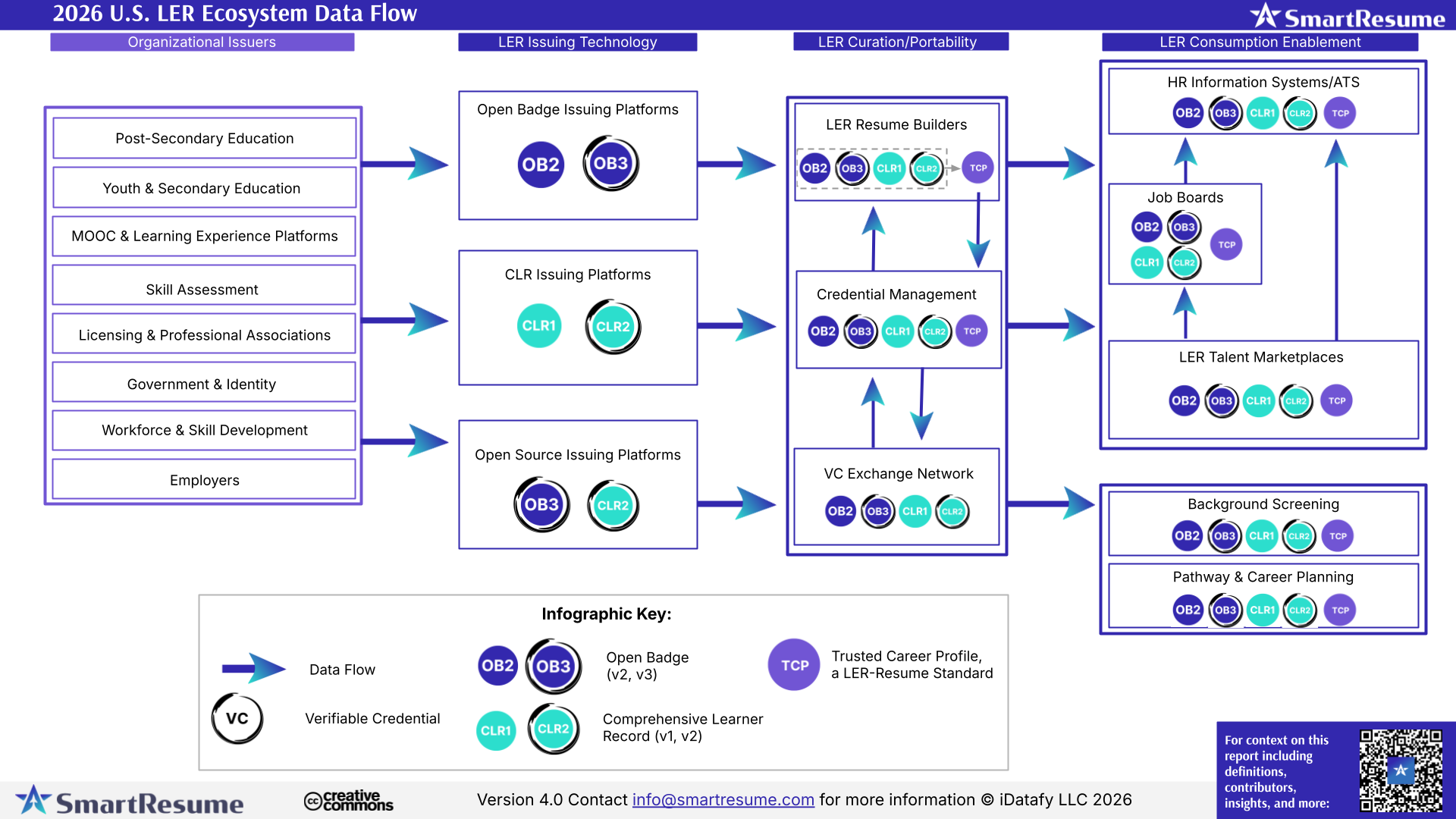
This report documents a clear transition now underway: LERs are moving from small experiments to systems people and organizations expect to rely on. Adoption remains early and uneven, but the forces reshaping the ecosystem are no longer speculative. Federal policy signals, state planning cycles, standards maturation, and employer behavior are aligning in ways that suggest 2026 will mark a shift from exploration to execution.
Across interviews with federal leaders, state CIOs, standards bodies, and ecosystem builders, a consistent theme emerged: the traditional model—where institutions control learning and employment records—no longer fits how people move through education and work. In its place, a new model is being actively designed—one in which individuals hold portable, verifiable records that systems can trust without centralizing control.
Most states are not yet operating this way. But planning timelines, RFP language, and federal signals indicate that many will begin building toward this model in early 2026.
As the ecosystem matures, another insight becomes unavoidable: records alone are not enough. Value emerges only when trusted records can be interpreted through shared skill languages, reused across contexts, and embedded into the systems and marketplaces where decisions are made.
Learning and Employment Records are not a product category. They are a data layer—one that reshapes how learning, work, and opportunity connect over time.
This report is written for anyone seeking to understand how LERs are beginning to move from concept to practice. Whether readers are new to the space or actively exploring implementation, the report focuses on observable signals, emerging patterns, and the practical conditions required to move from experimentation toward durable infrastructure.
…
…
“The building blocks for a global, interoperable skills ecosystem are already in place. As education and workforce alignment accelerates, the path toward trusted, machine-readable credentials is clear. The next phase depends on credentials that carry value across institutions, industries, states, and borders; credentials that move with learners wherever their education and careers take them. The question now isn’t whether to act, but how quickly we move.”
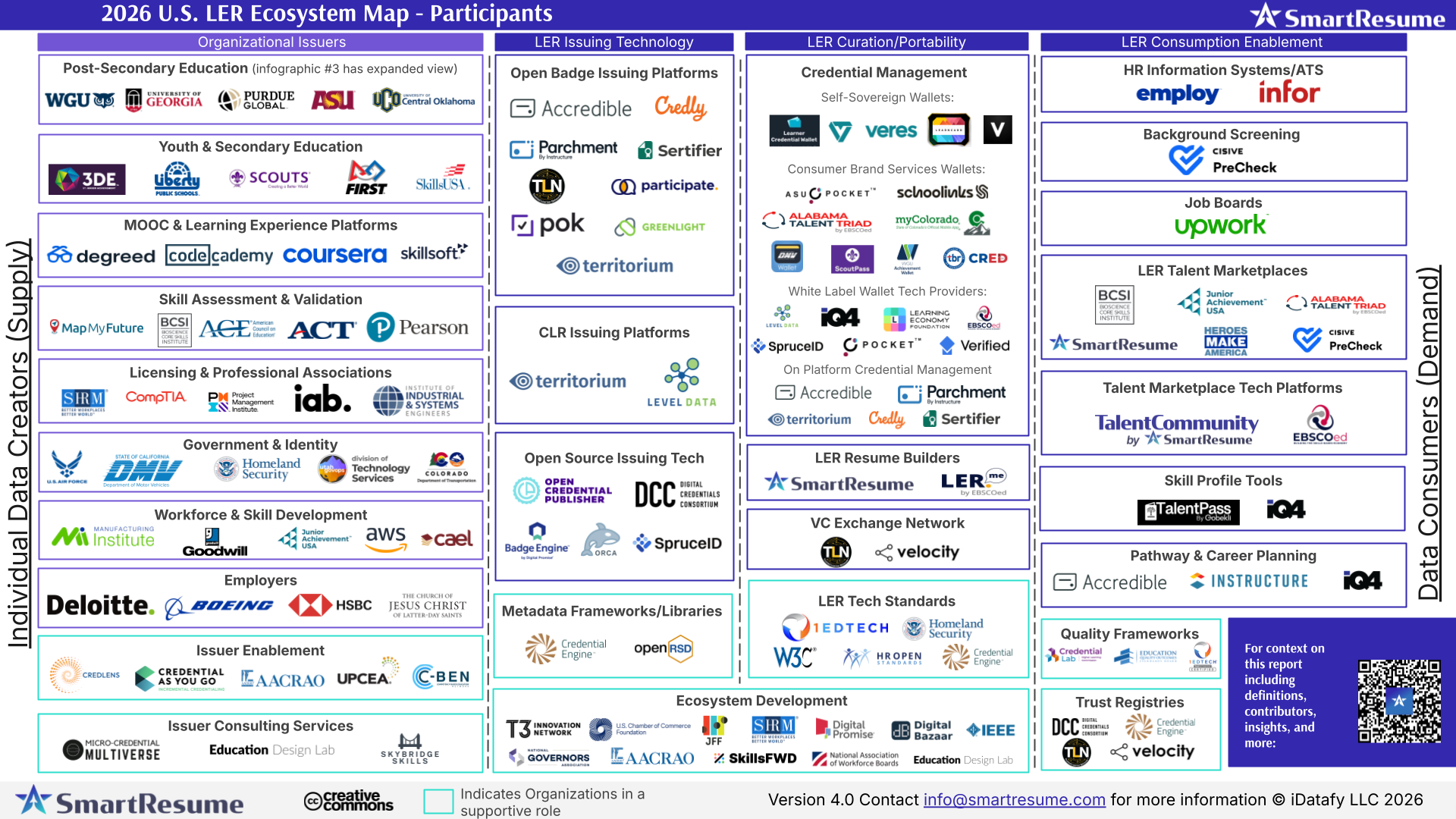
SmartResume just published a guide for making sense of this rapidly expanding landscape. The LER Ecosystem Report was produced in partnership with AACRAO, Credential Engine, 1EdTech, HR Open Standards, and the U.S. Chamber of Commerce Foundation. It was based on interviews and feedback gathered over three years from 100+ leaders across education, workforce, government, standards bodies, and tech providers.
The tools are available now to create the sort of interoperable ecosystem that can make talent marketplaces a reality, the report argues. Meanwhile, federal policy moves and bipartisan attention to LERs are accelerating action at the state level.
“For state leaders, this creates a practical inflection point,” says the report. “LERs are shifting from an innovation discussion to an infrastructure planning conversation.”
You’ll hear me briefly describe five recent op-eds on teaching and learning in higher ed. For each op-ed, I’ll ask each of our panelists if they “take it,” that is, generally agree with the main thesis of the essay, or “leave it.” This is an artificial binary that I’ve found to generate rich discussion of the issues at hand.
Combining two strategies—spacing and retrieval practice—is key to success in learning, says Shana Carpenter.
On a somewhat related note (i.e., for Instructional Designers, teachers, faculty members, T&L staff members), also see:
Fresh Approaches to Instructional Design — from edutopia.org by Sara Furnival An educator with 20-plus years of experience on crafting creative and energizing lessons.
From 70/20/10 to 90/10— from drphilippahardman.substack.com by Dr Philippa Hardman A new L&D operating system for the AI Era?
This week I want to share a hypothesis I’m increasingly convinced of: that we are entering an age of the 90/10 model of L&D.
90/10 is a model where roughly 90% of “training” is delivered by AI coaches as daily performance support, and 10% of training is dedicated to developing complex and critical skills via high-touch, human-led learning experiences.
Proponents of 90/10 argue that the model isn’t about learning less, but about learning smarter by defining all jobs to be done as one of the following:
Delegate (the dead skills): Tasks that can be offloaded to AI.
Co-Create (the 90%): Tasks which well-defined AI agents can augment and help humans to perform optimally.
Facilitate (the 10%): Tasks which require high-touch, human-led learning to develop.
So if AI at work is now both real and material, the natural question for L&D is: how do we design for it? The short answer is to stop treating learning as an event and start treating it as a system.
My daughter’s generation expects to learn with AI, not pretend it doesn’t exist, because they know employers expect AI fluency and because AI will be ever-present in their adult lives.
Gamified AI Learning Tools personalize education by adapting the difficulty and content to each child’s pace, fostering confidence and mastery.
Engaging & Fun: Gamified elements like quests, badges, and stories keep children motivated and enthusiastic.
Safe & Inclusive: Attention to equity, privacy, and cultural context ensures responsible and accessible learning.
How to test GenAI’s impact on learning — from timeshighereducation.com by Thibault Schrepel Rather than speculate on GenAI’s promise or peril, Thibault Schrepel suggests simple teaching experiments to uncover its actual effects
Generative AI in higher education is a source of both fear and hype. Some predict the end of memory, others a revolution in personalised learning. My two-year classroom experiment points to a more modest reality: Artificial intelligence (AI) changes some skills, leaves others untouched and forces us to rethink the balance.
This indicates that the way forward is to test, not speculate. My results may not match yours, and that is precisely the point. Here are simple activities any teacher can use to see what AI really does in their own classroom.
4. Turn AI into a Socratic partner Instead of being the sole interrogator, let AI play the role of tutor, client or judge. Have students use AI to question them, simulate cross-examination or push back on weak arguments. New “study modes” now built into several foundation models make this kind of tutoring easy to set up. Professors with more technical skills can go further, design their own GPTs or fine-tuned models trained on course content and let students interact directly with them. The point is the practice it creates. Students learn that questioning a machine is part of learning to think like a professional.
Assessment tasks that support human skills — from timeshighereducation.com by Amir Ghapanchi and Afrooz Purarjomandlangrudi Assignments that focus on exploration, analysis and authenticity offer a road map for university assessment that incorporates AI while retaining its rigour and human elements
Rethinking traditional formats
1. From essay to exploration When ChatGPT can generate competent academic essays in seconds, the traditional format’s dominance looks less secure as an assessment task. The future lies in moving from essays as knowledge reproduction to assessments that emphasise exploration and curation. Instead of asking students to write about a topic, challenge them to use artificial intelligence to explore multiple perspectives, compare outputs and critically evaluate what emerges.
Example: A management student asks an AI tool to generate several risk plans, then critiques the AI’s assumptions and identifies missing risks.
What your students are thinking about artificial intelligence — from timeshighereducation.com by Florencia Moore and Agostina Arbia GenAI has been quickly adopted by students, but the consequences of using it as a shortcut could be grave. A study into how students think about and use GenAI offers insights into how teaching might adapt
However, when asked how AI negatively impacts their academic development, 29 per cent noted a “weakening or deterioration of intellectual abilities due to AI overuse”. The main concern cited was the loss of “mental exercise” and soft skills such as writing, creativity and reasoning.
The boundary between the human and the artificial does not seem so easy to draw, but as the poet Antonio Machado once said: “Traveller, there is no path; the path is made by walking.”
There is nothing new about students trying to get one over on their teachers — there are probably cuneiform tablets about it — but when students use AI to generate what Shannon Vallor, philosopher of technology at the University of Edinburgh, calls a “truth-shaped word collage,” they are not only gaslighting the people trying to teach them, they are gaslighting themselves. In the words of Tulane professor Stan Oklobdzija, asking a computer to write an essay for you is the equivalent of “going to the gym and having robots lift the weights for you.”
As part of the collaboration, Deloitte will establish a Claude Center of Excellence with trained specialists who will develop implementation frameworks, share leading practices across deployments, and provide ongoing technical support to create the systems needed to move AI pilots to production at scale. The collaboration represents Anthropic’s largest enterprise AI deployment to date, available to more than 470,000 Deloitte people.
Deloitte and Anthropic are co-creating a formal certification program to train and certify 15,000 of its professionals on Claude. These practitioners will help support Claude implementations across Deloitte’s network and Deloitte’s internal AI transformation efforts.
Everboarding flips this model. Rather than ending after orientation, everboarding provides ongoing, role-specific training and support throughout the employee journey. It adapts to evolving responsibilities, reinforces standards, and helps workers grow into new roles. For high-turnover, high-pressure environments like retail, it’s a practical solution to a persistent challenge.
AI agents will be instrumental in the success of everboarding initiatives; they can provide a much more tailored training and development process for each individual employee, keeping track of which training modules may need to be completed, or where staff members need or want to develop further. This personalisation helps staff to feel not only more satisfied with their current role, but also guides them on the right path to progress in their individual careers.
Digital frontline apps are also ideal for everboarding. They offer bite-sized training that staff can complete anytime, whether during quiet moments on shift or in real time on the job, all accessible from their mobile devices.
As I and many others have pointed out in recent months, LLMs are great assistants but very ineffective teachers. Despite the rise of “educational LLMs” with specialised modes (e.g. Anthropic’s Learning Mode, OpenAI’s Study Mode, Google’s Guided Learning) AI typically eliminates the productive struggle, open exploration and natural dialogue that are fundamental to learning.
In this week’s blog post, I deep dive what the research found and share the six key findings — including reflections on how well TeachLM performs on instructional design.
AI as an assessment tool represents an existential threat to education because no matter how you try and establish guardrails or best practices around how it is employed, using the technology in place of an educator ultimately cedes human judgment to a machine-based process. It also devalues the entire enterprise of education and creates a situation where the only way universities can add value to education is by further eliminating costly human labor.
For me, the purpose of higher education is about human development, critical thinking, and the transformative experience of having your ideas taken seriously by another human being. That’s not something we should be in a rush to outsource to a machine.
K-12 education worldwide is facing a two-pronged dilemma: A global shortage of 44 million teachers by 2030 and not enough funding to train or retain them, according to a report released by UNESCO and the International Taskforce on Teachers for Education 2030 following the summit. Countries around the world risk not having enough teachers — or not enough high-caliber teachers — for the rising number of students expected to enter primary and secondary school within the next five years.
The report’s findings reflect what some school districts and states have been grappling with in the United States, where research has consistently shown that teachers face lower rates of well-being and satisfaction with pay than similarly employed workers in other fields.
A day in the life: The next 25 years A learner wakes up. Their AI-powered learning coach welcomes them, drawing their attention to their progress and helping them structure their approach to the day. A notification reminds them of an upcoming interview and suggests reflections to add to their learning portfolio.
Rather than a static gradebook, their portfolio is a dynamic, living record, curated by the student, validated by mentors in both industry and education, and enriched through co-creation with maturing modes of AI. It tells a story through essays, code, music, prototypes, journal reflections, and team collaborations. These artifacts are not “submitted”, they are published, shared, and linked to verifiable learning outcomes.
And when it’s time to move, to a new institution, a new job, or a new goal, their data goes with them, immutable, portable, verifiable, and meaningful.
From DSC: And I would add to that last solid sentence that the learner/student/employee will be able to control who can access this information. Anyway, some solid reflections here from Lev.
I know a lot of readers will disagree with this, and the timeline feels aggressive (the future always arrives more slowly than pundits expect) but I think the overall premise is sound: “The concept of a tipping point in education – where AI surpasses traditional schools as the dominant learning medium – is increasingly plausible based on current trends, technological advancements, and expert analyses.”
The Rundown: In this tutorial, you will learn how to combine NotebookLM with ChatGPT to master any subject faster, turning dense PDFs into interactive study materials with summaries, quizzes, and video explanations.
Step-by-step:
Go to notebooklm.google.com, click the “+” button, and upload your PDF study material (works best with textbooks or technical documents)
Choose your output mode: Summary for a quick overview, Mind Map for visual connections, or Video Overview for a podcast-style explainer with visuals
Generate a Study Guide under Reports — get Q&A sets, short-answer questions, essay prompts, and glossaries of key terms automatically
Take your PDF to ChatGPT and prompt: “Read this chapter by chapter and highlight confusing parts” or “Quiz me on the most important concepts”
Combine both tools: Use NotebookLM for quick context and interactive guides, then ChatGPT to clarify tricky parts and go deeperPro Tip: If your source is in EPUB or audiobook, convert it to PDF before uploading. Both NotebookLM and ChatGPT handle PDFs best.
Claude can now create and edit Excel spreadsheets, documents, PowerPoint slide decks, and PDFs directly in Claude.ai and the desktop app. This transforms how you work with Claude—instead of only receiving text responses or in-app artifacts, you can describe what you need, upload relevant data, and get ready-to-use files in return.
Also see:
Microsoft to lessen reliance on OpenAI by buying AI from rival Anthropic — from techcrunch.com byRebecca Bellan
Microsoft will pay to use Anthropic’s AI in Office 365 apps, The Information reports, citing two sources. The move means that Anthropic’s tech will help power new features in Word, Excel, Outlook, and PowerPoint alongside OpenAI’s, marking the end of Microsoft’s previous reliance solely on the ChatGPT maker for its productivity suite. Microsoft’s move to diversify its AI partnerships comes amid a growing rift with OpenAI, which has pursued its own infrastructure projects as well as a potential LinkedIn competitor.
In this episode of Unfixed, we talk with Ray Schroeder—Senior Fellow at UPCEA and Professor Emeritus at the University of Illinois Springfield—about Artificial General Intelligence (AGI) and what it means for the future of higher education. While most of academia is still grappling with ChatGPT and basic AI tools, Schroeder is thinking ahead to AI agents, human displacement, and AGI’s existential implications for teaching, learning, and the university itself. We explore why AGI is so controversial, what institutions should be doing now to prepare, and how we can respond responsibly—even while we’re already overwhelmed.
Data from the State of AI and Instructional Design Report revealed that 95.3% of the instructional designers interviewed use AI in their daily work [1]. And over 85% of this AI use occurs during the design and development process.
These figures showcase the immense impact AI is already having on the instructional design world.
If you’re an L&D professional still on the fence about adding AI to your workflow or an AI convert looking for the next best tools, keep reading.
This guide breaks down 5 of the top AI tools for instructional designers in 2025, so you can streamline your development processes and build better training faster.
But before we dive into the tools of the trade, let’s address the elephant in the room:
Real, capability-building learning requires three key elements: content, context and conversation.
The Rise Of AI Agents: Teaching At Scale
The generative AI revolution is often framed in terms of efficiency: faster content creation, automated processes and streamlined workflows. But in the world of L&D, its most transformative potential lies elsewhere: the ability to scale great teaching.
AI gives us the means to replicate the role of an effective teacher across an entire organization. Specifically, AI agents—purpose-built systems that understand, adapt and interact in meaningful, context-aware ways—can make this possible. These tools understand a learner’s role, skill level and goals, then tailor guidance to their specific challenges and adapt dynamically over time. They also reinforce learning continuously, nudging progress and supporting application in the flow of work.
More than simply sharing knowledge, an AI agent can help learners apply it and improve with every interaction. For example, a sales manager can use a learning agent to simulate tough customer scenarios, receive instant feedback based on company best practices and reinforce key techniques. A new hire in the product department could get guidance on the features and on how to communicate value clearly in a roadmap meeting.
In short, AI agents bring together the three essential elements of capability building, not in a one-size-fits-all curriculum but on demand and personalized for every learner. While, obviously, this technology shouldn’t replace human expertise, it can be an effective tool for removing bottlenecks and unlocking effective learning at scale.
SINGAPORE Sept. 3, 2025 /PRNewswire/ — Today, Midoo AIproudly announces the launch of the world’s first AI language learning agent, a groundbreaking innovation set to transform language education forever.
For decades, language learning has pursued one ultimate goal: true personalization. Traditional tools offered smart recommendations, gamified challenges, and pre-written role-play scripts—but real personalization remained out of reach. Midoo AI changes that. Here is the >launch video of Midoo AI.
Imagine a learning experience that evolves with you in real time. A system that doesn’t rely on static courses or scripts but creates a dynamic, one-of-a-kind language world tailored entirely to your needs. This is the power of Midoo’s Dynamic Generation technology.
“Midoo is not just a language-learning tool,” said Yvonne, co-founder of Midoo AI. “It’s a living agent that senses your needs, adapts instantly, and shapes an experience that’s warm, personal, and alive. Learning is no longer one-size-fits-all—now, it’s yours and yours alone.”
Language learning apps have traditionally focused on exercises, quizzes, and progress tracking. Midoo AI introduces a different approach. Instead of presenting itself as a course provider, it acts as an intelligent learning agent that builds, adapts, and sustains a learner’s journey.
This review examines how Midoo AI operates, its feature set, and what makes it distinct from other AI-powered tutors.
Midoo AI in Context: Purpose and Position
Midoo AI is not structured around distributing lessons or modules. Its core purpose is to provide an agent-like partner that adapts in real time. Where many platforms ask learners to select a “level” or “topic,”
Midoo instead begins by analyzing goals, usage context, and error patterns. The result is less about consuming predesigned units and more about co-constructing a pathway.
Turning Time Saved Into Better Learning
AI can save teachers time, but what can that time be used for (besides taking a breath)? For most of us, it means redirecting energy into the parts of teaching that made us want to pursue this profession in the first place: connecting with our students and helping them grow academically.
Differentiation Every classroom has students with different readiness levels, language needs, and learning preferences. AI tools like Diffit or MagicSchool can instantly create multiple versions of a passage or assignment, differentiated by grade level, complexity, or language. This allows every student to engage with the same core concept, moving together as one cohesive class. Instead of spending an evening retyping and rephrasing, teachers can review and tweak AI drafts in minutes, ready for the next lesson.
Mass Intelligence — from oneusefulthing.org by Ethan Mollick From GPT-5 to nano banana: everyone is getting access to powerful AI
When a billion people have access to advanced AI, we’ve entered what we might call the era of Mass Intelligence. Every institution we have — schools, hospitals, courts, companies, governments — was built for a world where intelligence was scarce and expensive. Now every profession, every institution, every community has to figure out how to thrive with Mass Intelligence. How do we harness a billion people using AI while managing the chaos that comes with it? How do we rebuild trust when anyone can fabricate anything? How do we preserve what’s valuable about human expertise while democratizing access to knowledge?
By the time today’s 9th graders and college freshman enter the workforce, the most disruptive waves of AGI and robotics may already be embedded into part society.
What replaces the old system will not simply be a more digital version of the same thing. Structurally, schools may move away from rigid age-groupings, fixed schedules, and subject silos. Instead, learning could become more fluid, personalized, and interdisciplinary—organized around problems, projects, and human development rather than discrete facts or standardized assessments.
AI tutors and mentors will allow for pacing that adapts to each student, freeing teachers to focus more on guidance, relationships, and high-level facilitation. Classrooms may feel less like miniature factories and more like collaborative studios, labs, or even homes—spaces for exploring meaning and building capacity, not just delivering content.
…
If students are no longer the default source of action, then we need to teach them to:
Design agents,
Collaborate with agents,
Align agentic systems with human values,
And most of all, retain moral and civic agency in a world where machines act on our behalf.
We are no longer educating students to be just doers.
We must now educate them to be judges, designers, and stewards of agency.
Meet Your New AI Tutor — from wondertools.substack.com by Jeremy Caplan Try new learning modes in ChatGPT, Claude, and Gemini
AI assistants are now more than simple answer machines. ChatGPT’s new Study Mode, Claude’s Learning Mode, and Gemini’s Guided Learningrepresent a significant shift. Instead of just providing answers, these free tools act as adaptive, 24/7 personal tutors.
That’s why, in preparation for my next bootcamp which kicks off September 8th 2025, I’ve just completed a full refresh of my list of the most powerful & popular AI tools for Instructional Designers, complete with tips on how to get the most from each tool.
The list has been created using my own experience + the experience of hundreds of Instructional Designers who I work with every week.
It contains the 50 most powerful AI tools for instructional design available right now, along with tips on how to optimise their benefits while mitigating their risks.
Addendums on 9/4/25:
AI Companies Roll Out Educational Tools — from insidehighered.com by Ray Schroeder This fall, Google, Anthropic and OpenAI are rolling out powerful new AI tools for students and educators, each taking a different path to shape the future of learning.
So here’s the new list of essential skills I think my students will need when they are employed to work with AI five years from now:
They can follow directions, analyze outcomes, and adapt to change when needed.
They can write or edit AI to capture a unique voice and appropriate tone in sync with an audience’s needs
They have a deep understanding of one or more content areas of a particular profession, business, or industry, so they can easily identify factual errors.
They have a strong commitment to exploration, a flexible mindset, and a broad understanding of AI literacy.
They are resilient and critical thinkers, ready to question results and demand better answers.
They are problem solvers.
And, of course, here is a new rubric built on those skills:
Educators use AI in and out of the classroom Educators’ uses range from developing course materials and writing grant proposals to academic advising and managing administrative tasks like admissions and financial planning.
Educators aren’t just using chatbots; they’re building their own custom tools with AI
Faculty are using Claude Artifacts to create interactive educational materials, such as chemistry simulations, automated grading rubrics, and data visualization dashboards.
Educators tend to automate the drudgery while staying in the loop for everything else
Tasks requiring significant context, creativity, or direct student interaction—like designing lessons, advising students, and writing grant proposals—are where educators are more likely to use AI as an enhancement. In contrast, routine administrative work such as financial management and record-keeping are more automation-heavy.
Some educators are automating grading; others are deeply opposed
In our Claude.ai data, faculty used AI for grading and evaluation less frequently than other uses, but when they did, 48.9% of the time they used it in an automation-heavy way (where the AI directly performs the task). That’s despite educator concerns about automating assessment tasks, as well as our surveyed faculty rating it as the area where they felt AI was least effective.
“Where generative AI creates, agentic AI acts.” That’s how my trusted assistant, Gemini 2.5 Pro deep research, describes the difference.
…
Agents, unlike generative tools, create and perform multistep goals with minimal human supervision. The essential difference is found in its proactive nature. Rather than waiting for a specific, step-by-step command, agentic systems take a high-level objective and independently create and execute a plan to achieve that goal. This triggers a continuous, iterative workflow that is much like a cognitive loop. The typical agentic process involves six key steps, as described by Nvidia:
Our 2025 national survey of over 650 respondents across 49 states and Puerto Rico reveals both encouraging trends and important challenges. While AI adoption and optimism are growing, concerns about cheating, privacy, and the need for training persist.
Despite these challenges, I’m inspired by the resilience and adaptability of educators. You are the true game-changers in your students’ growth, and we’re honored to support this vital work.
This report reflects both where we are today and where we’re headed with AI. More importantly, it reflects your experiences, insights, and leadership in shaping the future of education.
This groundbreaking collaboration represents a transformative step forward in education technology and will begin with, but is not limited to, an effort between Instructure and OpenAI to enhance the Canvas experience by embedding OpenAI’s next-generation AI technology into the platform.
IgniteAI announced earlier today, establishes Instructure’s future-ready, open ecosystem with agentic support as the AI landscape continues to evolve. This partnership with OpenAI exemplifies this bold vision for AI in education. Instructure’s strategic approach to AI emphasizes the enhancement of connections within an educational ecosystem comprising over 1,100 edtech partners and leading LLM providers.
“We’re committed to delivering next-generation LMS technologies designed with an open ecosystem that empowers educators and learners to adapt and thrive in a rapidly changing world,” said Steve Daly, CEO of Instructure. “This collaboration with OpenAI showcases our ambitious vision: creating a future-ready ecosystem that fosters meaningful learning and achievement at every stage of education. This is a significant step forward for the education community as we continuously amplify the learning experience and improve student outcomes.”
Faculty Latest Targets of Big Tech’s AI-ification of Higher Ed— from insidehighered.com by Kathryn Palmer A new partnership between OpenAI and Instructure will embed generative AI in Canvas. It may make grading easier, but faculty are skeptical it will enhance teaching and learning.
The two companies, which have not disclosed the value of the deal, are also working together to embed large language models into Canvas through a feature called IgniteAI. It will work with an institution’s existing enterprise subscription to LLMs such as Anthropic’s Claude or OpenAI’s ChatGPT, allowing instructors to create custom LLM-enabled assignments. They’ll be able to tell the model how to interact with students—and even evaluate those interactions—and what it should look for to assess student learning. According to Instructure, any student information submitted through Canvas will remain private and won’t be shared with OpenAI.
… Faculty Unsurprised, Skeptical
Few faculty were surprised by the Canvas-OpenAI partnership announcement, though many are reserving judgment until they see how the first year of using it works in practice.
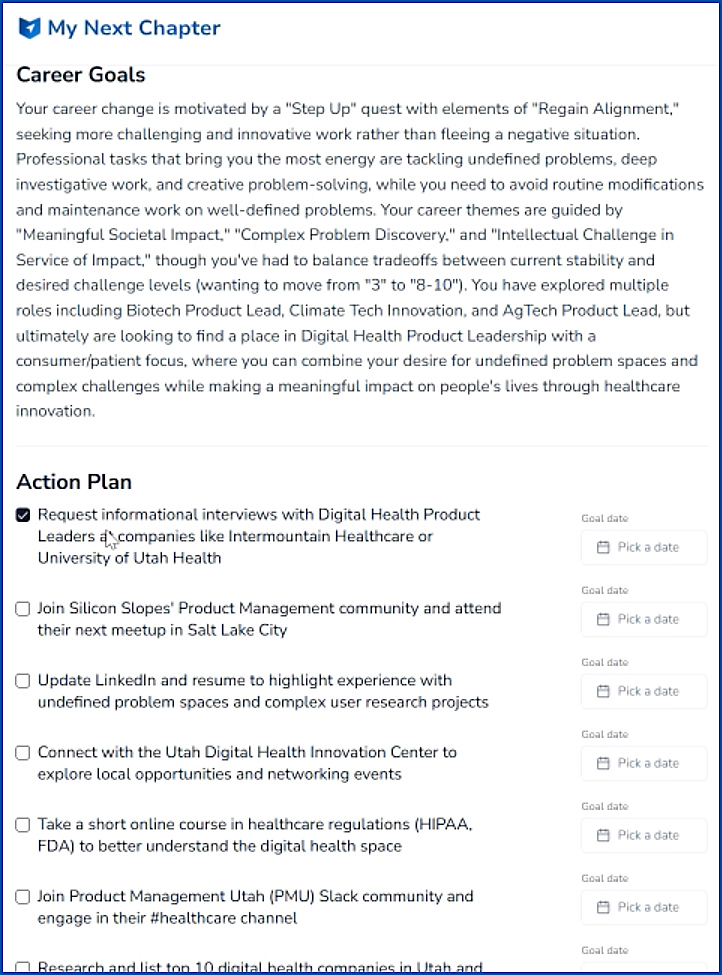
From DSC: In looking atMyNextChapter.ai— THIS TYPE OF FUNCTIONALITY of an AI-based chatbot talking to you re: good fits for a future job — is the kind of thing that could work well in this type of vision/learning platform. The AI asks you relevant career-oriented questions, comes up with some potential job fits, and then gives you resources about how to gain those skills, who to talk with, organizations to join, next steps to get your foot in the door somewhere, etc.
The next gen learning platform would provide links to online-based courses, blogs, peoples’ names on LinkedIn, courses from L&D organizations or from institutions of higher education or from other entities/places to obtain those skills (similar to the ” Action Plan” below from MyNextChapter.ai).