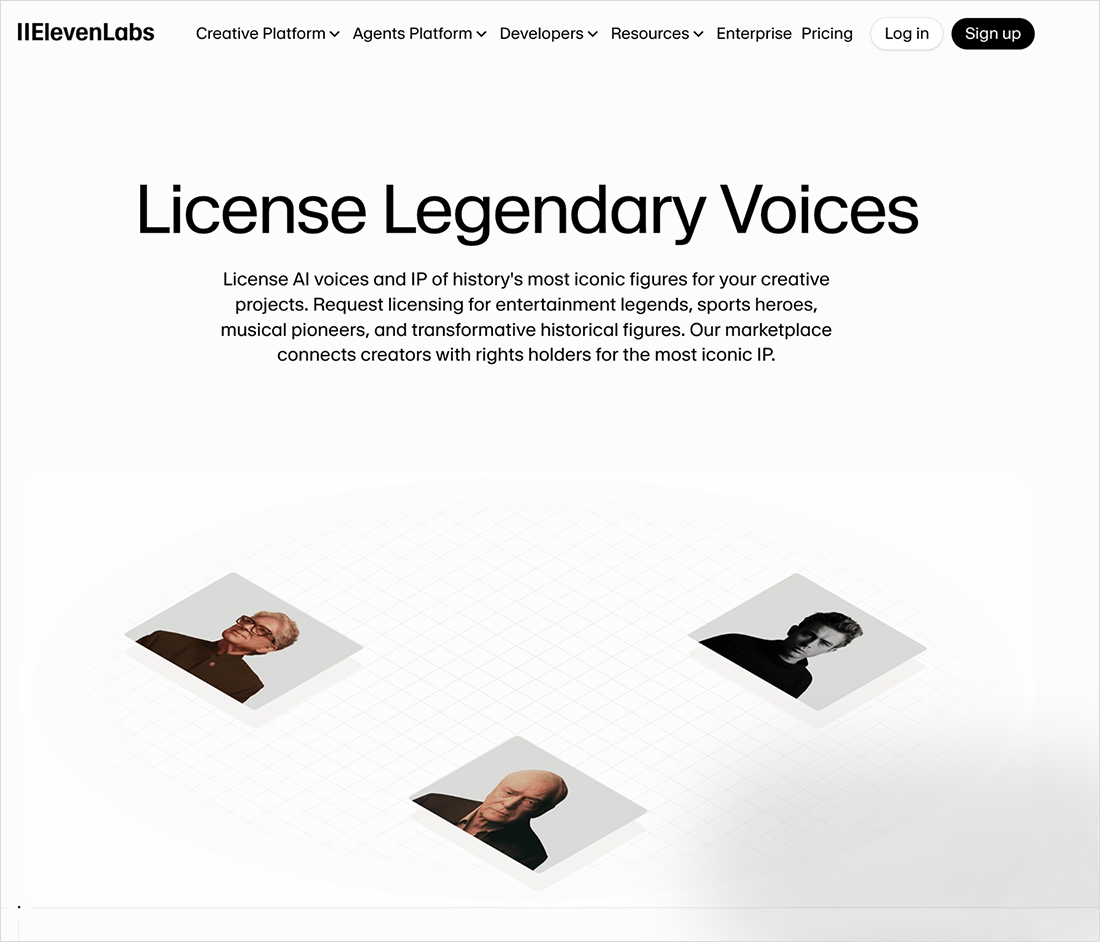
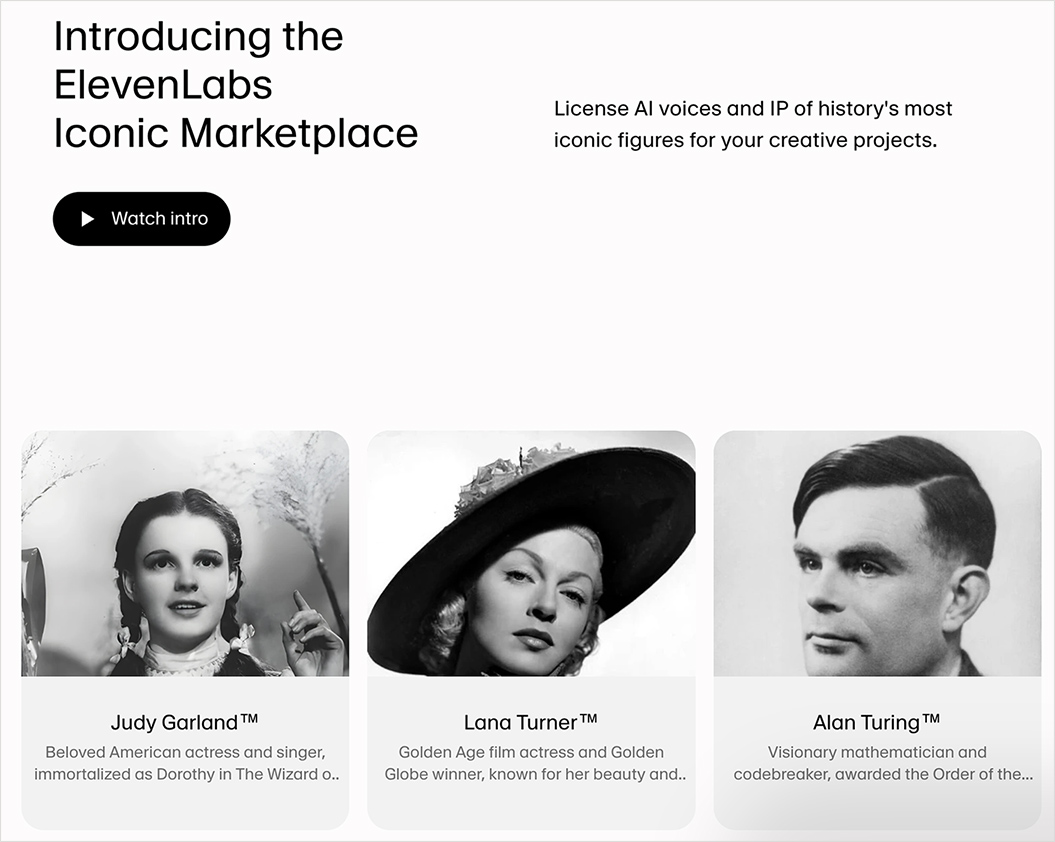
ElevenLabs just launched a voice marketplace — from elevenlabs.io; via theaivalley.com

Via the AI Valley:

Why does it matter?
AI voice cloning has already flooded the internet with unauthorized imitations, blurring legal and ethical lines. By offering a dynamic, rights-secured platform, ElevenLabs aims to legitimize the booming AI voice industry and enable transparent, collaborative commercialization of iconic IP.
.
ElevenLabs just launched a voice marketplace

ElevenLabs just launched a voice marketplace


[GIFTED ARTICLE] How people really use ChatGPT, according to 47,000 conversations shared online — from by Gerrit De Vynck and Jeremy B. Merrill
What do people ask the popular chatbot? We analyzed thousands of chats to identify common topics discussed by users and patterns in ChatGPT’s responses.
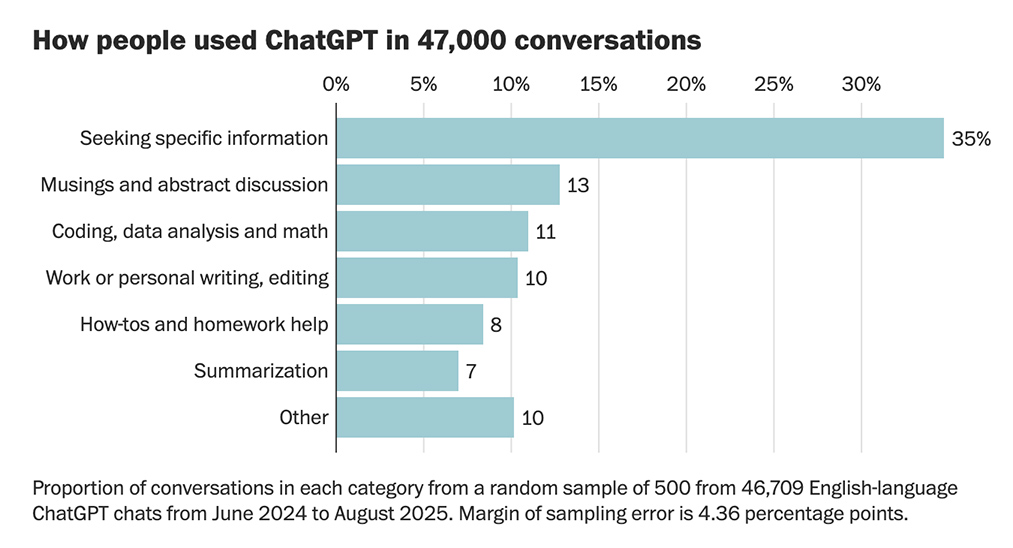
.
Data released by OpenAI in September from an internal study of queries sent to ChatGPT showed that most are for personal use, not work.

Emotional conversations were also common in the conversations analyzed by The Post, and users often shared highly personal details about their lives. In some chats, the AI tool could be seen adapting to match a user’s viewpoint, creating a kind of personalized echo chamber in which ChatGPT endorsed falsehoods and conspiracy theories.

Lee Rainie, director of the Imagining the Digital Future Center at Elon University, said his own research has suggested ChatGPT’s design encourages people to form emotional attachments with the chatbot. “The optimization and incentives towards intimacy are very clear,” he said. “ChatGPT is trained to further or deepen the relationship.”


Per The Rundown: OpenAI just shared its view on AI progress, predicting systems will soon become smart enough to make discoveries and calling for global coordination on safety, oversight, and resilience as the technology nears superintelligent territory.

The details:

  • OpenAI said current AI systems already outperform top humans in complex intellectual tasks and are “80% of the way to an AI researcher.”
  • The company expects AI will make small scientific discoveries by 2026 and more significant breakthroughs by 2028, as intelligence costs fall 40x per year.
  • For superintelligent AI, OAI said work with governments and safety agencies will be essential to mitigate risks like bioterrorism or runaway self-improvement.
  • It also called for safety standards among top labs, a resilience ecosystem like cybersecurity, and ongoing tracking of AI’s real impact to inform public policy.

Why it matters: While the timeline remains unclear, OAI’s message shows that the world should start bracing for superintelligent AI with coordinated safety. The company is betting that collective safeguards will be the only way to manage risk from the next era of intelligence, which may diffuse in ways humanity has never seen before.

Which linked to:

  • AI progress and recommendations — from openai.com
    AI is unlocking new knowledge and capabilities. Our responsibility is to guide that power toward broad, lasting benefit.

From DSC:
I hate to say this, but it seems like there is growing concern amongst those who have pushed very hard to release as much AI as possible — they are NOW worried. They NOW step back and see that there are many reasons to worry about how these technologies can be negatively used.

Where was this level of concern before (while they were racing ahead at 180 mph)? Surely, numerous and knowledgeable people inside those organizations warned them about the destructive/downside of these technologies. But their warnings were pretty much blown off (at least from my limited perspective). 


The state of AI in 2025: Agents, innovation, and transformation — from mckinsey.com

Key findings

  1. Most organizations are still in the experimentation or piloting phase: Nearly two-thirds of respondents say their organizations have not yet begun scaling AI across the enterprise.
  2. High curiosity in AI agents: Sixty-two percent of survey respondents say their organizations are at least experimenting with AI agents.
  3. Positive leading indicators on impact of AI: Respondents report use-case-level cost and revenue benefits, and 64 percent say that AI is enabling their innovation. However, just 39 percent report EBIT impact at the enterprise level.
  4. High performers use AI to drive growth, innovation, and cost: Eighty percent of respondents say their companies set efficiency as an objective of their AI initiatives, but the companies seeing the most value from AI often set growth or innovation as additional objectives.
  5. Redesigning workflows is a key success factor: Half of those AI high performers intend to use AI to transform their businesses, and most are redesigning workflows.
  6. Differing perspectives on employment impact: Respondents vary in their expectations of AI’s impact on the overall workforce size of their organizations in the coming year: 32 percent expect decreases, 43 percent no change, and 13 percent increases.

Marble: A Multimodal World Model — from worldlabs.ai

Spatial intelligence is the next frontier in AI, demanding powerful world models to realize its full potential. World models should reconstruct, generate, and simulate 3D worlds; and allow both humans and agents to interact with them. Spatially intelligent world models will transform a wide variety of industries over the coming years.

Two months ago we shared a preview of Marble, our World Model that creates 3D worlds from image or text prompts. Since then, Marble has been available to an early set of beta users to create 3D worlds for themselves.

Today we are making Marble, a first-in-class generative multimodal world model, generally available for anyone to use. We have also drastically expanded Marble’s capabilities, and are excited to highlight them here:


Seeing The Unseen Students: The Invisible Strength of Teachers — from teachthought.com by Tasneem Tazkiya
One afternoon, I asked a different question: “What would make school feel worth showing up for again?”

A Moment That Changed My View of Teaching
I’ll never forget a student I’ll call Jalen. He was bright and quick with answers, sharp in debate, but he had built a wall around himself after a difficult year at home. He’d stopped turning in work and began sitting silently in the back of the room, disengaged and defiant.

One afternoon, instead of lecturing him about missing assignments, I asked a different question: “What would make school feel worth showing up for again?”

That simple question opened a door. Over the following weeks, Jalen began sharing ideas for projects connected to his interests, designing sneakers and exploring how geometry applies to shoe patterns. I adapted lessons to let him create, design, and analyze. Slowly, his confidence returned. Months later, he told me, “You made me feel like my ideas mattered.”

That moment reminded me that teaching isn’t just about delivering content; it’s about restoring belief in learning, and in oneself.


Also see:

The Power of Play — from barbarabray.net by Barbara Bray

Play brings joy and happiness to learning. Infusing play in schools prepares kids as future citizens.
When you play a game with your friends, how do you feel?

When you see children playing with other children, what do you notice?

Ask a child if they remember the worksheet they filled out last week.
Did they have fun?

Do they remember what they learned?

Let’s play more and discover how learning unfolds.
Schools can invest in more play through games, interactive experiences, and just making learning fun. Providing engaging activities through play creates learners who become critical thinkers, researchers, and designers.


Also re: teaching and learning:


Adobe Reinvents its Entire Creative Suite with AI Co-Pilots, Custom Models, and a New Open Platform — from theneuron.ai by Grant Harvey
Adobe just put an AI co-pilot in every one of its apps, letting you chat with Photoshop, train models on your own style, and generate entire videos with a single subscription that now includes top models from Google, Runway, and Pika.

Adobe came to play, y’all.

At Adobe MAX 2025 in Los Angeles, the company dropped an entire creative AI ecosystem that touches every single part of the creative workflow. In our opinion, all these new features aren’t about replacing creators; it’s about empowering them with superpowers they can actually control.

Adobe’s new plan is to put an AI co-pilot in every single app.

  • For professionals, the game-changer is Firefly Custom Models. Start training one now to create a consistent, on-brand look for all your assets.
  • For everyday creators, the AI Assistants in Photoshop and Express will drastically speed up your workflow.
  • The best place to start is the Photoshop AI Assistant (currently in private beta), which offers a powerful glimpse into the future of creative software—a future where you’re less of a button-pusher and more of a creative director.

Adobe MAX Day 2: The Storyteller Is Still King, But AI Is Their New Superpower — from theneuron.ai by Grant Harvey
Adobe’s Day 2 keynote showcased a suite of AI-powered creative tools designed to accelerate workflows, but the real message from creators like Mark Rober and James Gunn was clear: technology serves the story, not the other way around.

On the second day of its annual MAX conference, Adobe drove home a message that has been echoing through the creative industry for the past year: AI is not a replacement, but a partner. The keynote stage featured a powerful trio of modern storytellers—YouTube creator Brandon Baum, science educator and viral video wizard Mark Rober, and Hollywood director James Gunn—who each offered a unique perspective on a shared theme: technology is a powerful tool, but human instinct, hard work, and the timeless art of storytelling remain paramount.

From DSC:
As Grant mentioned, the demos dealt with ideation, image generation, video generation, audio generation, and editing.


Adobe Max 2025: all the latest creative tools and AI announcements — from theverge.com by Jess Weatherbed

The creative software giant is launching new generative AI tools that make digital voiceovers and custom soundtracks for videos, and adding AI assistants to Express and Photoshop for web that edit entire projects using descriptive prompts. And that’s just the start, because Adobe is planning to eventually bring AI assistants to all of its design apps.


Also see Adobe Delivers New AI Innovations, Assistants and Models Across Creative Cloud to Empower Creative Professionals plus other items from the News section from Adobe


5 Ways to Spark Critical Thinking About AI in the Art Room — from theartofeducation.edu by Paige Wilde

Here are five AI activities to explore this summer to help you and your students navigate artificial intelligence with an ethical, responsible, and creative approach.

1. Use Google’s Quick, Draw! to have fun and get curious about AI.
We all have a desire to doodle–even students and adults who say, “I can’t even draw a stick figure!” Bring lots of light-hearted energy into your art room with Google’s Quick Draw! tool. This platform allows you to draw simple prompts, such as a bike, a cat, or a cup, in 20 seconds. While you’re drawing, AI attempts to recognize the subject.

This tool works with any skill level and is a space to draw freely without overthinking. Beyond quick sketching, this activity demonstrates that human input builds machine learning, and it’s only as “smart” as the information (or in this case, drawings) we feed it. It’s a fun way to explore the evolving role of AI in our visual world!

No tech? No problem! Use paper to run the same activity. You can even use the Thumbnail Sketches template in FLEX Curriculum. Students sketch quick prompts in groups and then guess the drawings to spark conversation about how AI “learns.”


From DSC:
Read through the article below. It’s an excellent example of a learning ecosystem, one that has been developed and practiced by Tiago Forte.

My 4-Stage System for Learning Anything New — from fortelabs.com by Tiago Forte

  • Stage 1: Immersion – Get Maximum Exposure
  • Stage 2: Building – Make Something Real
  • Stage 3: Structured Learning – Find Your Mentors
  • Stage 4: Connection – Build Real Relationships
  • The Secret Ingredient: Cultivating Play in Learning
 

Get yourself unstuck: overthinking is boring and perfectionism is a trap — from timeshighereducation.com by David Thompson
The work looks flawless, the student seems fine. But underneath, perfectionism is doing damage. David Thompson unpacks what educators can do to help high-performing students navigate the pressure to succeed and move from stuck to started

That’s why I encourage imperfection, messiness and play and build these ideas into how I teach.

These moments don’t come from big breakthroughs. They come from removing pressure and replacing it with permission.


A Three-Phase, Rational System of Education — from petergray.substack.com by Peter Gray; with thanks to Dr. Kate Christian for this resource
What will replace k-12 and college?

A Three-Phase, Rational System of Education
I don’t know just how or how fast the change will happen, but I think the days of K-12 and four years of college are numbered and sanity will begin to prevail in the educational world. I envision a future with something like the following three-phase approach to education:

Phase I. Discovery: Learning about your world, your self, and how the two fit together.
Phase II. Exploring a career path.
Phase III. Becoming credentialed for specialized work.


What Happens When ‘Play’ Is Left Out of the School Curriculum — from edsurge.com by Fatema Elbakoury
When two birds flew into my classroom, I realized how much teachers lose when we don’t trust students to play.

Due to the rigidity of curriculum, standardized tests and the controlling nature of compulsory education, playfulness and unstructured time are seen as detrimental to a student’s learning. But what is learning and why is play seen as so antithetical to teaching? What if we centered playfulness and unstructured time in our classrooms, even when it has nothing to do with the curriculum? Part of learning is acquiring knowledge through experience. If play is an experience it, too, can result in the acquisition of knowledge.


Campus webinar: The art of bringing creativity and fun into the classroom — from Times Higher Education

In our latest webinar, we spoke to three experts from Campus+ partner across the UK to discuss creative and fun ways to get students engaged, both online and in the classroom.

Gary Burnett from Loughborough University, Simon Brownhill from the University of Bristol and Kelly Edmunds from the University of East Anglia talked to us about:

  • Creative and fun ways to get students engaged, in-person and online
  • Tapping into students’ creativity for better learning outcomes
  • Creating a culture of creativity and experimentation
  • Breaking down disciplinary boundaries for learning and collaboration
  • Creative ways to bring AI into classroom activities and assignments
  • Play as a powerful teaching tool


And while we’re having some fun, also see the following items:


Free Sites for Back to School — from techlearning.com by Diana Restifo
Top free and freemium sites for learning

An internet search for free learning resources will likely return a long list that includes some useful sites amid a sea of not-really-free and not-very-useful sites.

To help teachers more easily find the best free and freemium sites they can use in their classrooms and curricula, I’ve curated a list that describes the top free/freemium sites for learning.

In some cases, Tech & Learning has reviewed the site in detail, and those links are included so readers can find out more about how to make the best use of the online materials. In all cases, the websites below provide valuable educational tools, lessons, and ideas, and are worth exploring further.


Two bonus postings here! 🙂 


NYC High School Reimagines Career & Technical Education for the 21st Century — from the74million.org by Andrew Bauld
Thomas A. Edison High School is providing students with the skills to succeed in both college and career in an unusually creative way.

From DSC:
Very interesting to see the mention of an R&D department here! Very cool.

Baker said ninth graders in the R&D department designed the essential skills rubric for their grade so that regardless of what content classes students take, they all get the same immersion into critical career skills. Student voice is now so integrated into Edison’s core that teachers work with student designers to plan their units. And he said teachers are becoming comfortable with the language of career-centered learning and essential skills while students appreciate the engagement and develop a new level of confidence.

The R&D department has grown to include teachers from every department working with students to figure out how to integrate essential skills into core academic classes. In this way, they’re applying one of the XQ Institute’s crucial Design Principles for innovative high schools: Youth Voice and Choice.
.

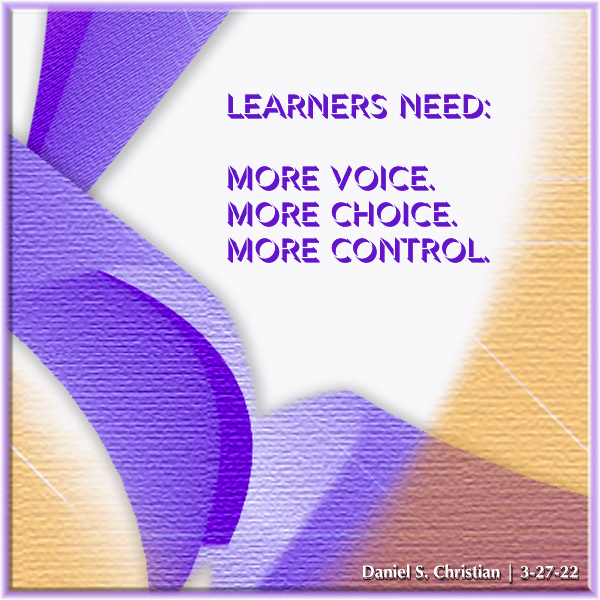
Learners need: More voice. More choice. More control. -- this image was created by Daniel Christian


Student Enterprise: Invite Learners to Launch a Media Agency or Publication — from gettingsmart.com by Tom Vander Ark

Key Points

  • Client-connected projects have become a focal point of the Real World Learning initiative, offering students opportunities to solve real-world problems in collaboration with industry professionals.
  • Organizations like CAPS, NFTE, and Journalistic Learning facilitate community connections and professional learning opportunities, making it easier to implement client projects and entrepreneurship education.

Important trend: client projects. Work-based learning has been growing with career academies and renewed interest in CTE. Six years ago, a subset of WBL called client-connected projects became a focal point of the Real World Learning initiative in Kansas City where they are defined as authentic problems that students solve in collaboration with professionals from industry, not-for-profit, and community-based organizations….and allow students to: engage directly with employers, address real-world problems, and develop essential skills.


Portrait of a Community to Empower Learning Transformation — from gettingsmart.com by Rebecca Midles and Mason Pashia

Key Points

  • The Community Portrait approach encourages diverse voices to shape the future of education, ensuring it reflects the needs and aspirations of all stakeholders.
  • Active, representative community engagement is essential for creating meaningful and inclusive educational environments.

The Portrait of a Graduate—a collaborative effort to define what learners should know and be able to do upon graduation—has likely generated enthusiasm in your community. However, the challenge of future-ready graduates persists: How can we turn this vision into a reality within our diverse and dynamic schools, especially amid the current national political tensions and contentious curriculum debates?

The answer lies in active, inclusive community engagement. It’s about crafting a Community Portrait that reflects the rich diversity of our neighborhoods. This approach, grounded in the same principles used to design effective learning systems, seeks to cultivate deep, reciprocal relationships within the community. When young people are actively involved, the potential for meaningful change increases exponentially.


Q&A: Why Schools Must Redesign Learning to Include All Students — from edtechmagazine.com by Taashi Rowe
Systems are broken, not children, says K–12 disability advocate Lindsay E. Jones.

Although Lindsay E. Jones came from a family of educators, she didn’t expect that going to law school would steer her back into the family business. Over the years she became a staunch advocate for children with disabilities. And as mom to a son with learning disabilities and ADHD who is in high school and doing great, her advocacy is personal.

Jones previously served as president and CEO of the National Center for Learning Disabilities and was senior director for policy and advocacy at the Council for Exceptional Children. Today, she is the CEO at CAST, an organization focused on creating inclusive learning environments in K–12. EdTech: Focus on K–12 spoke with Jones about how digital transformation, artificial intelligence and visionary leaders can support inclusive learning environments.

Our brains are all as different as our fingerprints, and throughout its 40-year history, CAST has been focused on one core value: People are not broken, systems are poorly designed. And those systems are creating a barrier that holds back human innovation and learning.


Are Colleges Ready For an Online-Education World Without OPMs? — from edsurge.com by Robert Ubell (Columnist)
Online Program Management companies have helped hundreds of colleges build online degree programs, but the sector is showing signs of strain.

For more than 15 years, a group of companies known as Online Program Management providers, or OPMs, have been helping colleges build online degree programs. And most of them have relied on an unusual arrangement — where the companies put up the financial backing to help colleges launch programs in exchange for a large portion of tuition revenue.

As a longtime administrator of online programs at colleges, I have mixed feelings about the idea of shutting down the model. And the question boils down to this: Are colleges ready for a world without OPMs?


Guy Raz on Podcasts and Passion: Audio’s Ability to Spark Learning — from michaelbhorn.substack.com by Michael B. Horn

This conversation went in a bunch of unexpected directions. And that’s what’s so fun about it. After all, podcasting is all about bringing audio back and turning learning into leisure. And the question Guy and his partner Mindy Thomas asked a while back was: Why not bring kids in on the fun? Guy shared how his studio, Tinkercast, is leveraging the medium to inspire and educate the next generation of problem solvers.

We discussed the power of audio to capture curiosities and foster imagination, how Tinkercast is doing that in and out of the classroom, and how it can help re-engage students in building needed skills at a critical time. Enjoy!


April 2024 Job Cuts Announced by US-Based Companies Fall; More Cuts Attributed to TX DEI Law, AI in April — from challengergray.com

Excerpt (emphasis DSC):

Education
Companies in the Education industry, which includes schools and universities, cut the second-most jobs last month with 8,092 for a total of 17,892. That is a 635% increase from the 2,435 cuts announced during the first four months of 2023.

“April is typically the time school districts are hiring and setting budgets for the next fiscal year. Certainly, there are budgetary constraints, as labor costs rise, but school systems also have a retention and recruitment issue,” said Challenger.


Lifetime college returns differ significantly by major, research finds — from highereddive.com by Lilah Burke
Engineering and computer science showed the best return out of 10 fields of study that were examined.

Dive Brief:

  • The lifetime rate of return for a college education differs significantly by major, but it also varies by a student’s gender and race or ethnicity, according to new peer-reviewed research published in the American Educational Research Journal.
  • A bachelor’s degree in general provides a roughly 9% rate of return for men, and nearly 10% for women, researchers concluded. The majors with the best returns were computer science and engineering.
  • Black, Hispanic and Asian college graduates had slightly higher rates of return than their White counterparts, the study found.
 

Description:

I recently created an AI version of myself—REID AI—and recorded a Q&A to see how this digital twin might challenge me in new ways. The video avatar is generated by Hour One, its voice was created by Eleven Labs, and its persona—the way that REID AI formulates responses—is generated from a custom chatbot built on GPT-4 that was trained on my books, speeches, podcasts and other content that I’ve produced over the last few decades. I decided to interview it to test its capability and how closely its responses match—and test—my thinking. Then, REID AI asked me some questions on AI and technology. I thought I would hate this, but I’ve actually ended up finding the whole experience interesting and thought-provoking.


From DSC:
This ability to ask questions of a digital twin is very interesting when you think about it in terms of “interviewing” a historical figure. I believe character.ai provides this kind of thing, but I haven’t used it much.


Corporate Learning Is Boring — But It Doesn’t Have to Be — from hbr.org by Duncan Wardle; via GSV

Summary:
Most corporate learnings aren’t cutting it. Almost 60% of employees say they’re interested in upskilling and training, but 57% of workers also say they’re already pursuing training outside of work. The author, the former Head of Innovation and Creativity at Disney, argues that creativity is the missing piece to make upskilling engaging and effective. From his experience, he shares four strategies to unlock creativity in trainings: 1) Encourage “What if?”, 2) respond “How else?” to challenges, 3) give people time to think by encouraging playfulness, and 4) make training a game.

 
© 2025 | Daniel Christian