From DSC:
If you can clear up just short of an hour of your time, this piece from PBS entitled, “School Sleuth: The Case of the Wired Classroom” is very well done and worth your time.  It’s creative and objective; it offers us some solid research, some stories, and some examples of the positives and negatives of technology in the classroom. It weaves different modes of learning into the discussion — including blended learning, online learning, personalized learning and more. Though it aired back in October of 2015, I just found out about it.

Check it out if you can!

 

SchoolSleuth-WiredClassroom-Oct2015


Also see:

  • Schools push personalized learning to new heights — from edweek.org
    Excerpt:
    For most schools, reaching the next level of digitally driven, personalized learning is far from reality. Still, some schools are extending their digital reach in significant and sometimes groundbreaking ways, as the stories in this special report illustrate. They are making moves to integrate a variety of technologies to track how students learn and to use the resulting data to expand the use of hands-on, project-based learning. The goal is to build never-ending feedback loops that ultimately inform the development of curriculum and assessment. Plus, big data and analytics are gradually making their marks in K-12 education. This special report outlines the progress schools are making to use digital tools to personalize learning, but also raises the question: Are they reaching far enough?
    .
  • A Pedagogical Model for the use of iPads for Learning — from higheru.org
 

pedagogicalmodeliPads-dec2015


An Admissions Surprise From the Ivy League — from nytimes.com by Frank Bruni ; with thanks to Mr. Jeff Kuhn for this resource

Excerpt (emphasis DSC):

About three weeks ago, a group of more than 80 colleges — including all eight in the Ivy League and many other highly selective private and public ones — announced that they were developing a free website and set of online tools that would, among other things, inform ninth and 10th graders without savvy college advisers about the kind of secondary-school preparation that best positions them for admission.

What’s more, these colleges plan to use the website for an application process, in place by next fall, that would be separate from, and competitive with, the “Common App,” a single form students can submit to any of more than 600 schools. If colleges in the new group — which calls itself the Coalition for Access, Affordability and Success — have been taking the Common App, they would continue to, but would clearly be encouraging students to explore this alternate route.

…

“For every student from the entire bottom half of the nation’s income distribution at Dartmouth, Penn, Princeton, Yale and more than a few other colleges, there appear to be roughly two students from just the top 5 percent (which means they come from families making at least $200,000).”


Flip Your Back-to-School Night — from Catlin Tucker

Excerpt:

Back-to-School Night is the one evening each year when I have the opportunity to connect face-to-face with my students’ parents. Unfortunately, not all parents can attend Back-to-School Night. Some of my parents work at night or they are at home with their other children. So, three years ago I began flipping my Back-to-School Night presentation in the hopes of reaching more of my parents.

This is how I flip my Back-to-School Night.


Screen Shot 2015-09-14 at 9.07.23 PM


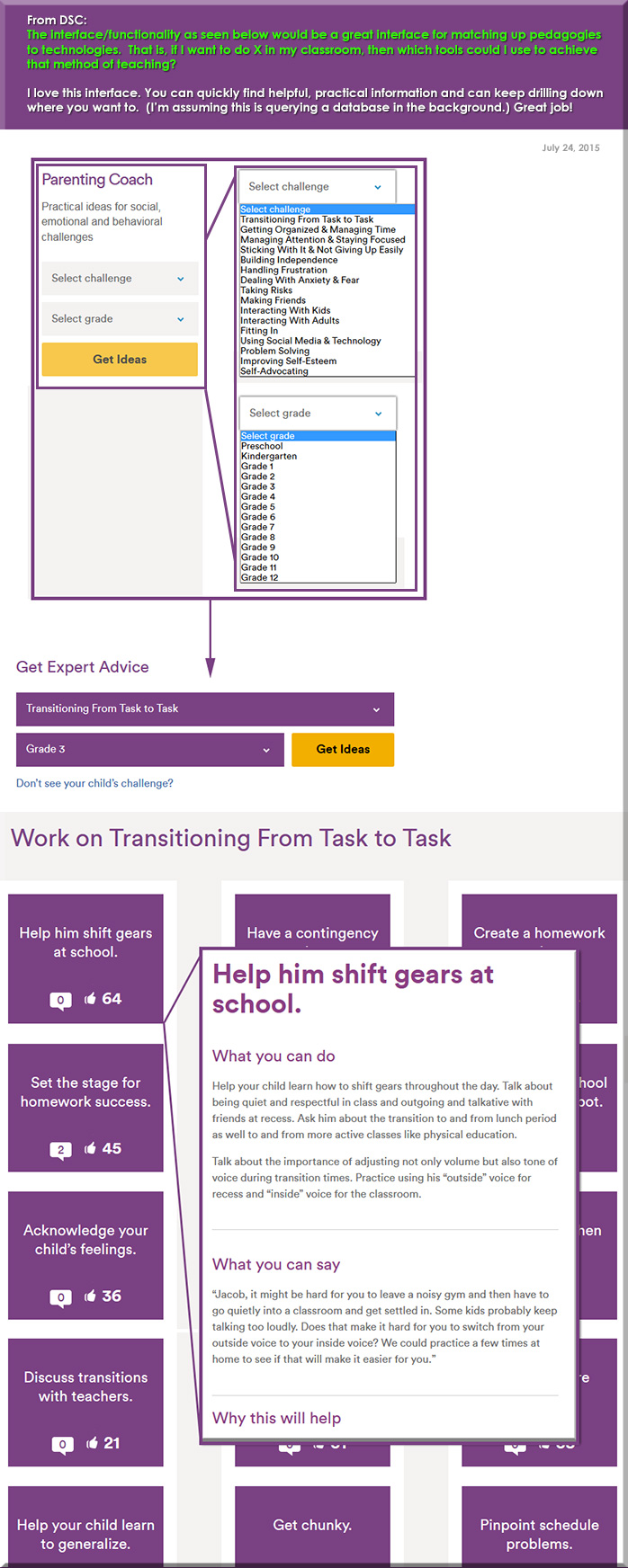
From DSC:
The folks who worked on the Understood.org site have done a great job! Besides the wonderful resources therein, I really appreciated the user experience one is able to get by using their site. Check out the interface and functionality you can experience there (and which I’ve highlighted below).


We need a similar interface for matching up pedagogies with technologies.


DSC-NeedThisInterface4SelectingTechs4Pedagogies--July2015-flat


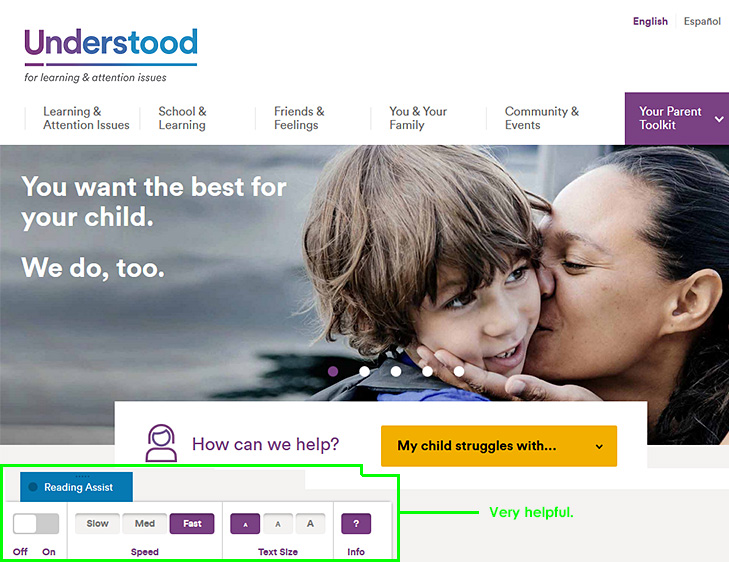
Also, there are some excellent accessibility features:


Understood-July2015


From DSC:
When you read the article below, you’ll see why I’m proposing the aforementioned interface/service/database — a service that would be similar to Wikipedia in terms of allowing many people to contribute to it.


Why ed tech is not transforming how teachers teach  — from edweek.org by Benjamin Herold
Student-centered, technology-driven instruction remains elusive for most

Excerpt:

Public schools now provide at least one computer for every five students. They spend more than $3 billion per year on digital content. And nearly three-fourths of high school students now say they regularly use a smartphone or tablet in the classroom.

But a mountain of evidence indicates that teachers have been painfully slow to transform the ways they teach, despite that massive influx of new technology into their classrooms. The student-centered, hands-on, personalized instruction envisioned by ed-tech proponents remains the exception to the rule.


7 things parents and teachers should know about teens — from edutopia.org by Maurice Elias; with a shout out to Brian Bailey for his Tweet on this

Excerpt:

What Teens Think About
Generally speaking, Rachael believed we give adolescents far too little credit. The passages in their lives are moments when they ask themselves important questions, such as these:

  • How does my life have meaning and purpose?
  • What gifts do I have that the world wants and needs?
  • To what or whom do I feel most deeply connected?
  • How can I rise above my fears and doubts?
  • What or who awakens or touches the spirit within me?

…

What Can Parents and Educators Do?
While parents and educators may have a hard time addressing issues of soul and spirit with their teens, it can help to be aware of some ways into the hearts and minds of young people that can make a difference. Here is what Rachael Kessler suggests in her landmark book, The Soul of Education.

  1. Positive Belonging
  2. Silence and Solitude
  3. Reflections on Life
  4. Joy and Play
  5. Creativity
  6. Linking to the Large
  7. Shape the Passages


From DSC:
Along these lines, please see:


whatiflearning.co.uk -- Examples of connecting Christian faith and teaching across various ages and subjects.


…and also:


VisionsOfVocation-2014


Exclusive survey: Parents weigh in on the digital classroom — from marketplace.org

Excerpt:

For the last year, Marketplace’s LearningCurve team has been looking at the impact of technology on education. We’ve talked to students, teachers and ed-tech companies about the digital revolution taking hold in classrooms across the country.
…
Now we turn our attention to parents, many of whom have spent the last year exploring the ins-and-outs of educational technology themselves, alongside their children. We wanted to get parents’ views of the shift, as their children do more school work on laptops and tablets, and become accustomed to emailing teachers and checking grades online.

In a national, online survey of parents of kids in grades 3 through 12 conducted by Lieberman Research Worldwide, “Parents’ Attitudes Toward Educational Technology,” we found parents feel good about the growing use of technology in education, and most think it is improving the quality of education for their children.

 
tech-schoolwork-may2015


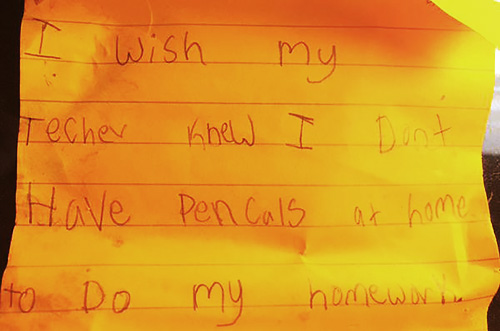
5 reasons we shouldn’t be so surprised by what kids wish teachers knew — from takepart.com by Liz Dwyer
The stories being shared with #IWishMyTeacherKnew, the viral hashtag started by teacher Kyle Schwartz, are turning the spotlight on the harsh reality of many American kids.


Students-want-teachers-to-know-INLINE1


Excerpt:

Their thoughts are handwritten on sticky notes, index cards, and plain old pieces of notebook paper—and they’re providing a window into the lives of America’s children. On Friday, the story of #IWishMyTeacherKnew, the effort by Denver elementary school teacher Kyle Schwartz to get students in her classroom to share something about themselves, went viral across the Web.


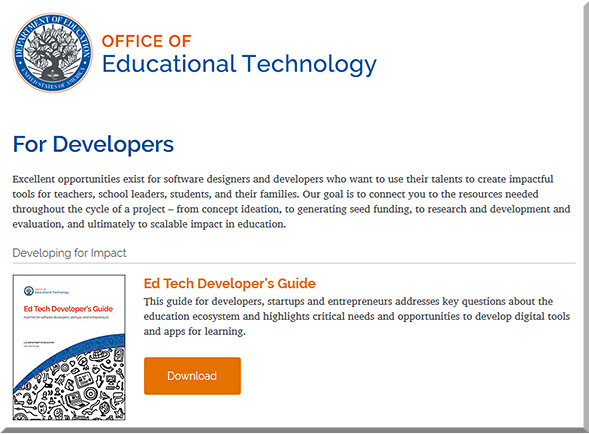
DeptOfEdTech2-GuideApril2015

Excerpt from the tech.ed.gov/developers/ page:

For Developers
Excellent opportunities exist for software designers and developers who want to use their talents to create impactful tools for teachers, school leaders, students, and their families. Our goal is to connect you to the resources needed throughout the cycle of a project – from concept ideation, to generating seed funding, to research and development and evaluation, and ultimately to scalable impact in education.


I originally saw this at “Ed tech must do more to ‘advance equity,’ U.S. Secretary of Education says” — from hechingerreport.org by Nichole Dobo

Excerpt:

SCOTTSDALE, Arizona—The U.S. Department of Education unveiled a new education technology developer’s guide [on 4/7/15] during the annual ASU+GSV Summit conference here.

In remarks at the conference, U.S. Secretary of Education Arne Duncan urged developers to consider the needs of disadvantaged students, so that they are not left behind as more schools adopt new tools that advance teaching and learning.

“If the technology revolution only happens for families that already have money and education, then it’s not really a revolution,” Duncan said.

Duncan announced the developer’s guide during a speech at the ASU+GSV Summit, , a gathering of about 2,500 people interested in innovation in education. The free guide, available for download at tech.ed.gov/developers, is the result of two years of research by Department of Education officials, who interviewed educators, entrepreneurs, parents and students. Its goal is to help technology developers better understand the key needs of the nation’s school system. It identifies 10 “persistent problems in education,” among them increasing family engagement, improving professional development for teachers, creating tests that accurately measure what students have learned, and closing achievement gaps.


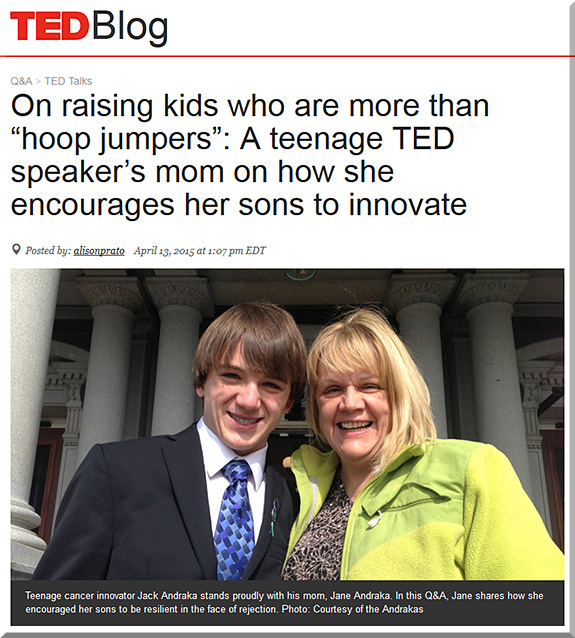
Don’t raise a hoop jumper — from by Terri Eichholz

Excerpt:

Yesterday, a dad forwarded this fabulous post from the TED blog.  It includes the video of Jane Andraka’s TEDx talk.  If that name sounds a bit familiar, but you can’t quite place it, Mrs. Andraka is the mother of two successful young men.  One of them is Jack Andraka, a teenager who developed an early-detection test for pancreatic cancer.  The other son, Luke, won an international science fair and the MIT Think Award.

Mrs. Andraka speaks about how she helped her sons find their passions, and the responsibility that all parents have to do so.  In the Q&A included in the blog post, she says the following,

I saw all these kids who had made themselves into little hoop-jumpers. All of a sudden, for seniors in high school in October, it’s, “Oh, jeez, I need to join some clubs and get my grades up, and then I’ll go to Harvard.” And then whining, “Well, I got all ‘A’s, and I joined Model U.N.” But that’s just not what it’s about. You have to make your own self remarkable. Make them say, “Wow, this couldn’t be any other child.” Don’t be like everybody else.


Also see:


no-hoop-jumpers-april2015


A vision for radically personalized learning | Katherine Prince | TEDxColumbus

Description:

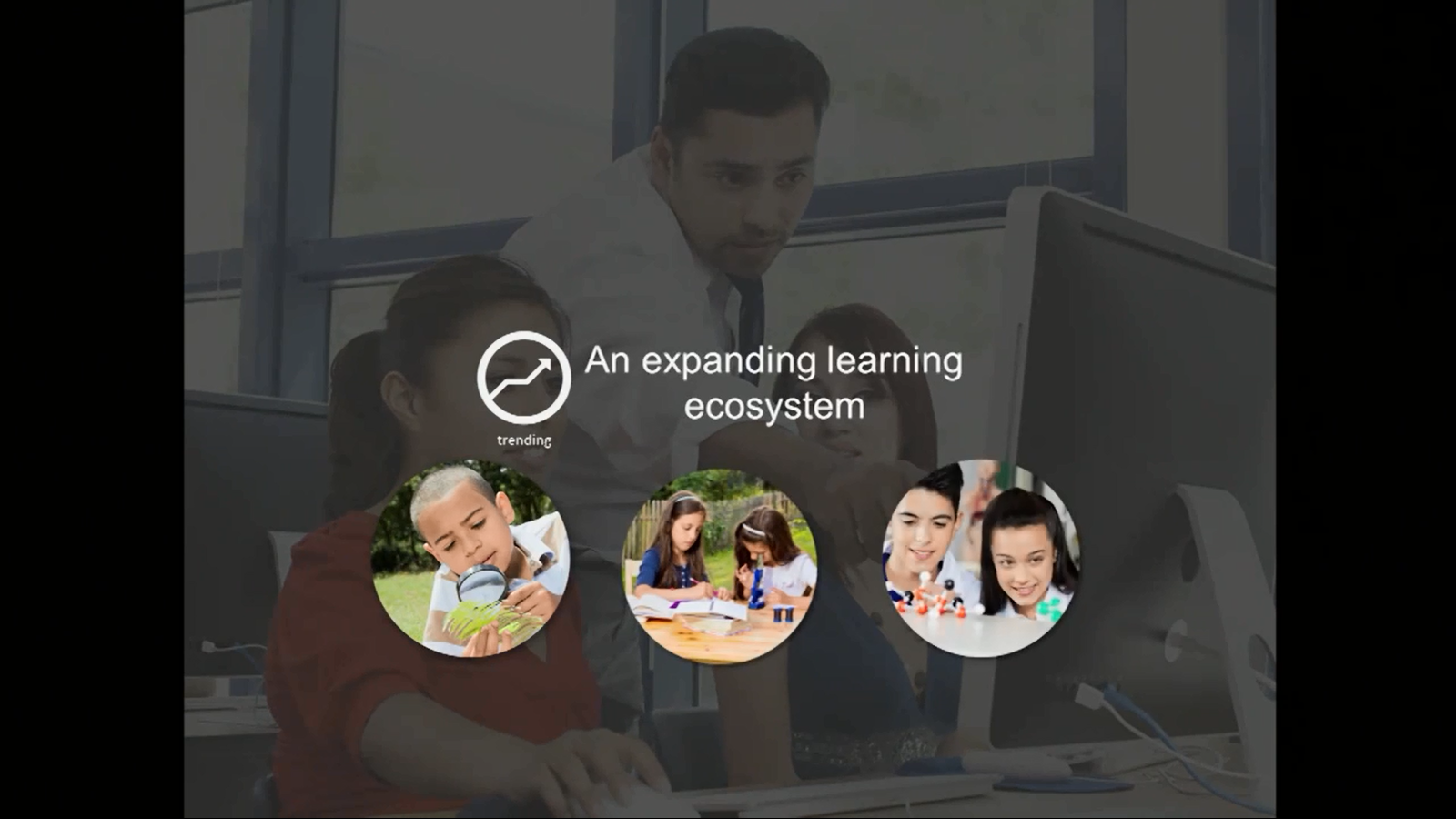
Could we transform today’s outmoded education system to a vibrant learning ecosystem that puts learners at the center and enables many right combinations of learning resources, experiences, and supports to help each child succeed? Creating personalized learning for all young people will require a paradigm shift in education and a deep commitment to providing each student with the right experiences at the right time.

As Senior Director of Strategic Foresight at KnowledgeWorks, Katherine Prince leads the organization’s work on the future of learning. Since 2007, she has helped a wide range of education stakeholders translate KnowledgeWorks’ future forecasts into forward-looking visions and develop strategies for bringing those visions to life. She also writes about what trends shaping the future of learning could mean for the learning ecosystem.


Learning Ecosystems mentioned again2


The New Digital Learning Playbook, Advancing College and Career Ready Skill Development in K-12 Schools | from tomorrow.org | June 2014
The second in a two part series to document the key national findings from Speak Up 2013.


Key Findings from this year’s report include:


  • Infographic: The New Digital Learning Playbook: The Digital Content Story
  • More than 40 percent of high school principals are now offering online classes for students in math, science, history and English/language arts. Only 17 percent of high schools are not offering online classes, according to school principals.
  • Principals are offering online learning for multiple reasons, including providing academic remediation (66 percent), keeping students engaged in staying in school (63 percent) and providing options for students that need credit recovery (61 percent).
  • Teachers who teach online classes, in particular, see a strong correlation between the use of technology and students’ college and career ready skill development. More than half of these teachers say technology use helps students understand how to apply academic concepts to real world problems (58 percent), take ownership of their learning (57 percent) and develop problem solving and critical thinking skills (57 percent).
  • The professional development requests of teachers are fairly common among new and veteran teachers. Even new teachers, who are presumed to be more digitally native and comfortable with technology, have a wish list of professional development support. The rookie teachers have a greater interest than other teachers in learning more about incorporating games and using social media with both students and parents.
  • Parental support of mobile device as part of learning does not appear to have an economic, community type or grade level bias. Around 60 percent of all parents said they would like their children to be in a class where using one’s own mobile device was allowed. Two-thirds said they would purchase a mobile device for their child to use within class, if that was allowed by the school.
  • Two-thirds of community members and a similar number of parents of school-aged children expressed support for paying $.50 more per month on their phone bill if those funds were used to increase school access to the Internet for student learning.
  • One-third of elementary school teachers (32 percent) report using games in their classrooms. The top two reasons given for using games within instruction were increasing student engagement in learning (79 percent) and providing a way for teachers to address different learning styles in the classroom (72 percent).
 

#PLearning #MakeitHappen — from edelements.com by Justin DeLeon

Excerpts:

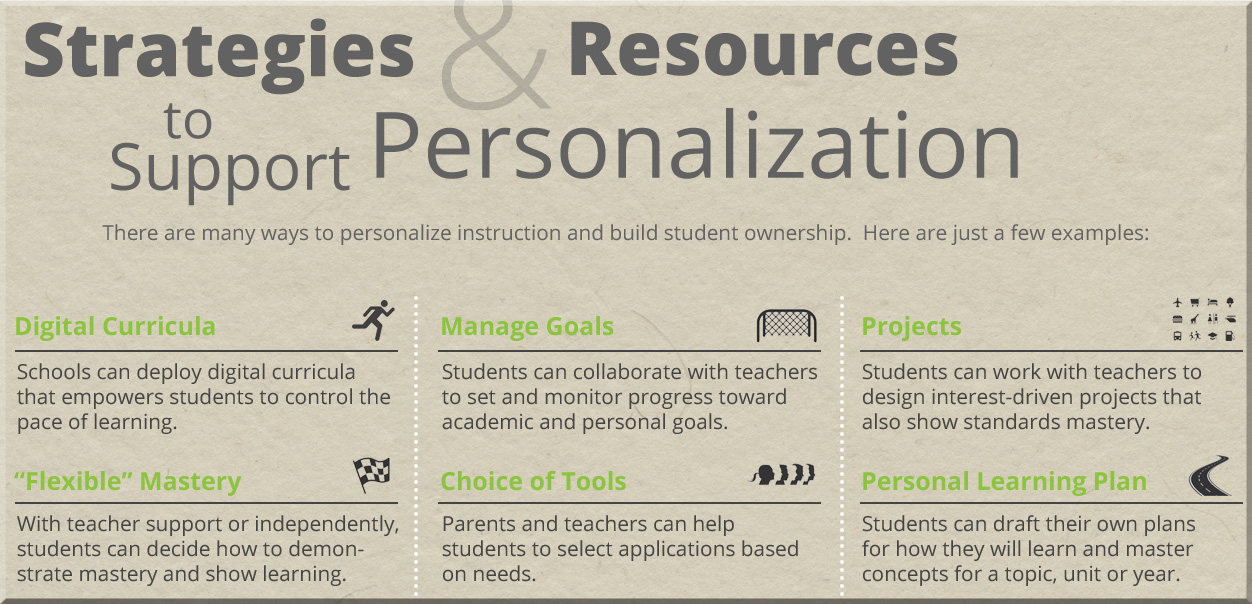
We hope to answer your questions through our #plearning infographic series.  In part one #plearning#makeithappen (below) we’ll arm you with a definition for personalized learning, examples of what it might look like in the classroom and concrete strategies and resources to support the personalized classroom. In part two #plearningframework (coming soon!), we will offer a tangible framework to make personalized learning happen in your classroom.  Parts three #makeplearninghappen and four #plearning#itsateameffort will offer insight into implementation and stakeholder support, respectively.


Strategies-PersonalizedLearning-EdElementsFeb2014

 
© 2025 | Daniel Christian