One step closer to reality: introducing 360-degree live streaming and spatial audio on YouTube — from youtube.googleblog.com

Excerpt:

We first launched support for 360-degree videos back in March 2015. From musicians to athletes to brands, creators have done some incredible things with this technology. Now, they’ll be able to do even more to bring fans directly into their world, with 360-degree live streaming. And after years of live streaming Coachella for fans around the world who can’t attend the festival, this year we’re bringing you the festival like never before by live streaming select artist performances in 360 degrees this weekend. Starting today, we’re also launching spatial audio for on-demand YouTube videos. Just as watching a concert in 360 degrees can give you an unmatched immersive experience, spatial audio allows you to listen along as you do in real life, where depth, distance and intensity all play a role. Try out this playlist on your Android device.


Could HoloLens’ augmented reality change how we study the human body? — from edtechmagazine.com by D. Frank Smith
Case Western Reserve University is helping to revolutionize medical-science studies with a new technology from Microsoft.

Excerpt:

CWRU was among the first in higher education to begin working with HoloLens, back in 2014. They’ve since discovered new ways the tech could help transform education. One of their current focuses is changing how students experience medical-science courses.

“This is a curriculum that hasn’t drastically changed in more than 100 years, because there simply hasn’t been another way,” says Mark Griswold, the faculty director for HoloLens at CWRU. “The mixed-reality of the HoloLens has the potential to revolutionize this education by bringing 3D content into the real world.”


Virtual reality invites a new era of learning to higher education  — from edtechmagazine.com by D. Frank Smith
A team of technology experts at the University of Maryland see an endless horizon of opportunities in education through virtual reality applications.

Excerpt:

“Imagine a physics class where you’re able to show how friction works. Imagine being able to experience gravity on Mars — by moving around virtually,” he says. “VR can make science, technology and art come alive.”

VR will soon become an open canvas for educators to create learning experiences. Eventually, fitting VR into the curriculum will be limited only by an instructor’s imagination and budget, says Christopher Sessums, the program director of research and evaluation at Johns Hopkins School of Education.


NYU Holodeck to be model for year 2041 cyberlearning — from kurzweilai.net
The role of VR and AI in future integrated living, learning, and research environments

Excerpt:

In an open-access paper in the Journal of Artificial Intelligence Education, Winslow Burleson, PhD, MSE, associate professor, New York University Rory Meyers College of Nursing, suggests that “advanced cyberlearning environments that involve VR and AI innovations are needed to solve society’s “wicked challenges*” — entrenched and seemingly intractable societal problems.

Burleson and and co-author Armanda Lewis imagine such technology in a year 2041 Holodeck, which Burleson’s NYU-X Lab is currently developing in prototype form, in collaboration with colleagues at NYU Courant, Tandon, Steinhardt, and Tisch.

“The “Holodeck” will support a broad range of transdisciplinary collaborations, integrated education, research, and innovation by providing a networked software/hardware infrastructure that can synthesize visual, audio, physical, social, and societal components,” said Burleson.

It’s intended as a model for the future of cyberlearning experience, integrating visual, audio, and physical (haptics, objects, real-time fabrication) components, with shared computation, integrated distributed data, immersive visualization, and social interaction to make possible large-scale synthesis of learning, research, and innovation.


Virtual tour honored Shakespeare’s legacy — from thejournal.com by Richard Chang

Excerpt:

…British television presenter Diane-Louise Jordan will guide students on a tour through Shakespeare’s hometown of Stratford-upon-Avon, including his childhood home and school; and the bard’s view of London, including the famous Globe Theatre where his plays were performed. (Shakespeare actually died April 23, which this year falls on a Saturday.)


Also see:

VirtualShakespeareTour-April2016

You can register to see the recording on that page as well.


The current selection of Mixed Reality and Virtual Reality related hardware
As of April 2016; from https://www.wired.com/2016/04/magic-leap-vr/


MR-and-VR-selections--as-of-april-2016


Film Students To Compete in Virtual Reality Production Contest — from campustechnology.com by Michael Hart
One of the first ever competitions involving virtual reality production will challenge college film students to create their own 360-degree films.

Excerpt:

360fly, which produces single-lens cameras to capture 360-degree video, will sponsor the 360 VR (virtual reality) Film Contest for film students at New York University and the Rhode Island School of Design along with Drury Design. The students will use 360fly HD cameras, which they were briefed on during an April 9 presentation on the NYU campus.


HBO and Discovery are partnering with a startup to develop holograms — from theverge.com by Ananya Bhattacharya
Going beyond the TV screen

Excerpt:

HBO and Discovery Communications announced today that they are partnering with 3D-graphics startup OTOY — both companies taking equity stakes. The partnership marks an effort by the two networks to evolve entertainment experiences beyond two dimensional television. Virtual reality, augmented reality, and even holograms were all highlighted as areas OTOY would help its traditional media partners explore.


TV knows it must push toward virtual and augmented reality


Also see the various items re: Augmented & Virtual Reality from:
Rutgers Office of Instructional & Research Technology

Excerpts:


Mark Zuckerberg says augmented reality glasses are ‘what we’re trying to get to’ — from theverge.com


Facebook plans to build augmented reality glasses — from mashable.com


Apple patents new augmented reality technology — from mobilesyrup.com by Rose Behar

Excerpt:

Apple was granted a patent today for a type of live interactive augmented reality (AR) video to be used in future iOS devices, indicating the company may soon enter the AR/VR game. The patent does not appear to be directly related to an AR/VR headset, but is certainly a step in that direction.

The patent describes Apple’s planned augmented reality technology as layered, live AR video that users can interact with via touchscreen. In the live video, objects can be identified and an information layer can be generated for them.

“In some implementations,” the patent text notes, “the information layer can include annotations made by a user through the touch sensitive surface.”


AltspaceVR wants to make VR chat sessions part of everyday life — from by Adi Robertson


Virtual & Augmented Reality: Blooloop’s Guide to VR and AR — from blooloop.com
Visitor attractions are racing to embrace Virtual and Augmented Reality technologies.  But what are the potential opportunities and possible pitfalls of VR and AR?
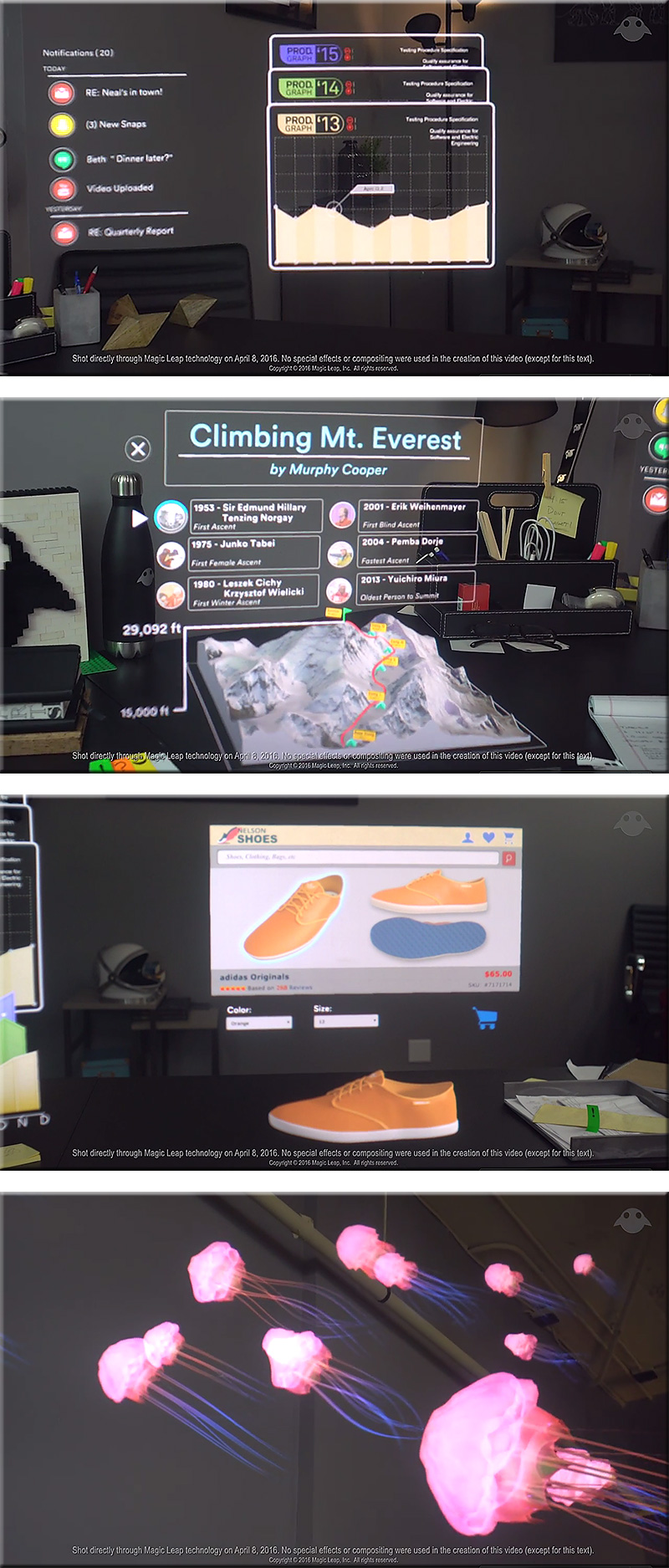


A New Morning — by Magic Leap; posted on 4/19/16
Welcome to a new way to start your day. Shot directly through Magic Leap technology on April 8, 2016 without use of special effects or compositing.


MagicLeap-ANewMorning-April2016


Also see:


8ninths Develops “Holographic Workstation”™ for Citi Traders using Microsoft HoloLens — from 8ninths.com

Excerpt:

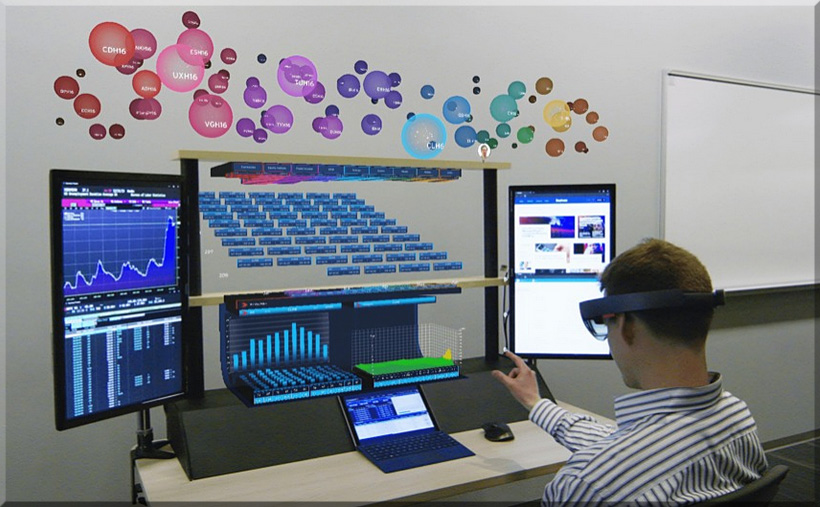
San Francisco – March 30, 2016 – 8ninths was named today by Microsoft Corporation as one of seven companies chosen for the Microsoft HoloLens Agency Readiness Program, and will showcase their “Holographic Workstation”™ prototype, designed and engineered for Citi, this week at Microsoft Build 2016. The Holographic Workstation™ increases efficiency by using the Microsoft HoloLens platform to create 3D holograms of real-time financial data. A three-tiered system of dynamically updated and interactive information enables traders to view, process, and interact with large amounts of abstract data in a combined 3D and 2D environment. The physical workstation integrates tablet screen space, 3D holographic docking space, keyboard, mouse, gaze, gesture, voice input, and existing Citi devices and workflows.


Hololens-VR-Workstation-March2016


8ninths-march2016-main


8ninths-march2016


HoloLens could get into finance with this VR workstation — from mashable.com by Lance Ulanoff

Excerpt:

8Ninths Cofounder and CEO Adam Sheppard told me they looked at the pain points of existing workstations and then drew inspiration from how, for example, they’d seen Microsoft and NASA solve 3D problems by embedding information in 2D and real environments.

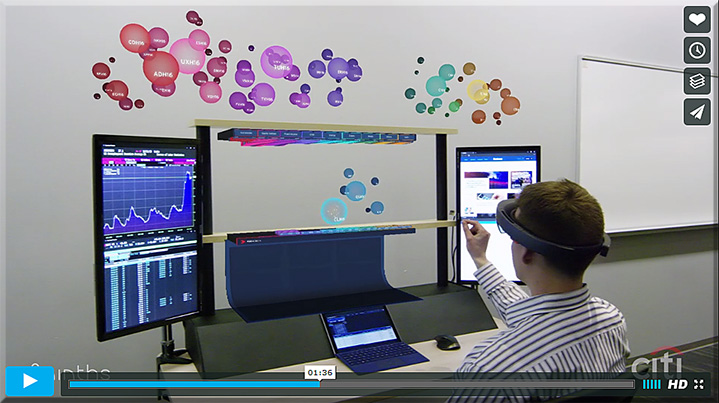
The result is 8ninths’ Holographic Workstation, which was announced Wednesday at Microsoft’s Build 2016 developers conference. It’s a true blend of the real world (a physical day trader desk with a pair of real screens and a Surface Pro 4 in the middle) and a host of live, financial visualizations spread above the physical desk, including a cloud-like work area floating above the top shelf.


Also see the Vimeo video on this:


8ninths-march2016-vimeo


Microsoft HoloLens used as the basis for a cool holographic stock trading workstation — from windowscentral.com by John Callaham


\


Microsoft starts shipping HoloLens and announces a big Windows 10 update — from money.cnn.com by Heather Kelly
Microsoft’s take on virtual reality is one step closer to becoming a real product.

Excerpt:

The developer version of the HoloLens augmented reality headset starts shipping today, Microsoft (MSFT, Tech30) announced at its developers’ conference in San Francisco.

The company also unveiled a Windows 10 update that includes new powers for virtual assistant Cortana, expanded security features, and new support for styluses.


11 incredible headsets that are making the virtual a reality — from digitaltrends.com by Simon Hill
The latest VR headsets offer more than a mere doorway into wire-frame worlds. We are finally about to lay our hands on the decent VR headset we’ve all be waiting for. Here are the top contenders, from Oculus to PlayStation VR, vying for the title.

Along these lines, also see:


“My name is Sidra”: how virtual reality could combat compassion fatigue — from newstatesman.com by
We look away from the suffering in humanitarian crises because it’s so vast. Virtual reality invites us to look at individuals’ experiences again.

Excerpt:

The aim of these films is to make us care about these crises on a deep, personal level. We know instinctively that it’s easier to emote with a single person than a faceless crowd of thousands, and this tactic takes that idea to its extreme: VR places you next to the person you could help with your donations, and allows you to directly engage by “walking” around the film yourself. The near-banality of Sidra’s film is its strength: the balance of dark and light in her life is easier to understand than a montage of outright misery, because it more closely mirrors our own.


CancerSurgery-VR-March2016


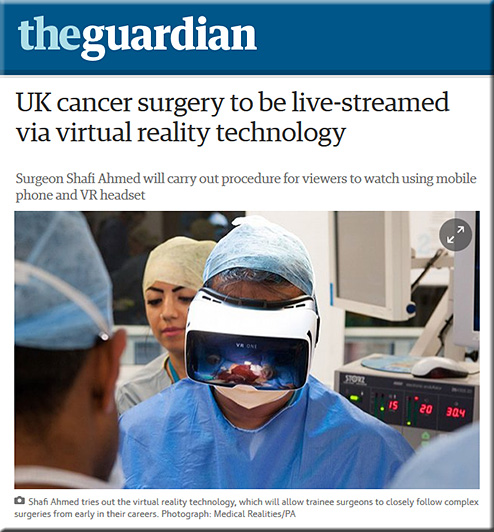
UK cancer surgery to be live-streamed via virtual reality technology
— from theguardian.com by Ben Quinn

Excerpt:

An operation on a British cancer patient is to be live-streamed around the world using virtual reality technology designed to make viewers feel as if they are in the operating theatre.

It will be performed by Shafi Ahmed, a London surgeon who has been at the forefront of pioneering virtual reality technology in surgery, and who described next month’s operation as a gamechanger for healthcare innovation and education.


Addendums:


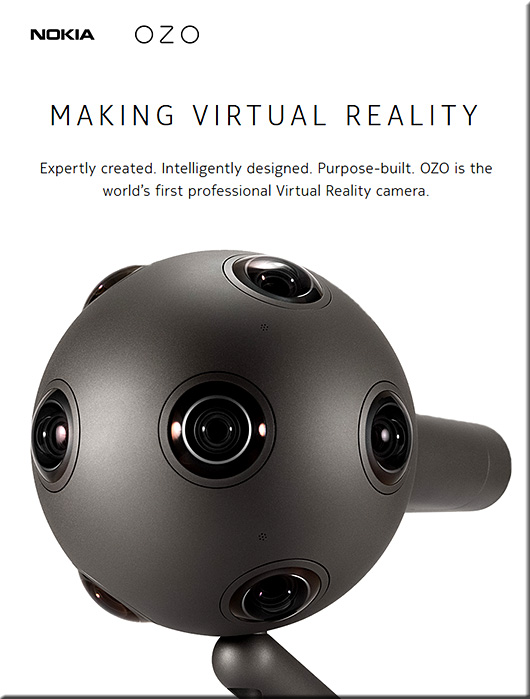
Nokia-OZO-March2016


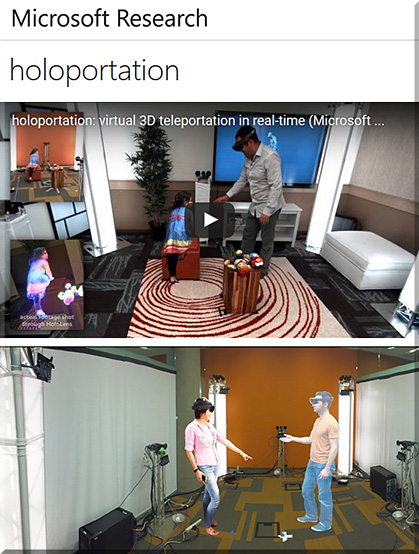
MicrosoftHoloportationGoesLive-March2016

Description:

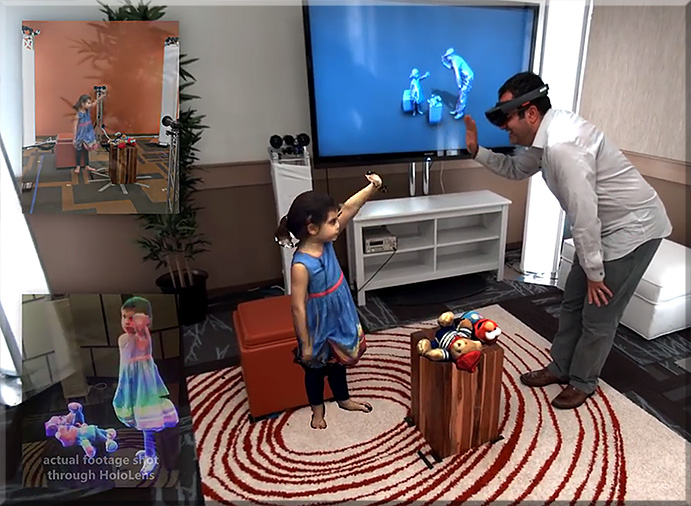
Holoportation is a new type of 3D capture technology that allows high-quality 3D models of people to be reconstructed, compressed and transmitted anywhere in the world in real time. When combined with mixed reality displays such as HoloLens, this technology allows users to see, hear, and interact with remote participants in 3D as if they are actually present in the same physical space. Communicating and interacting with remote users becomes as natural as face-to-face communication.

Team webpage:
http://research.microsoft.com/en-us/groups/i3d/

Video:
http://youtu.be/7d59O6cfaM0


holoportation is a new type of 3D capture technology that allows high quality 3D models of people to be reconstructed, compressed, and transmitted anywhere in the world in real-time. When combined with mixed reality displays such as HoloLens, this technology allows users to see and interact with remote participants in 3D as if they are actually present in their physical space. Communicating and interacting with remote users becomes as natural as face to face communication.


MicrosoftHoloportationGoesLive-March2016-2


Some other items on this:


Addendum:


MicrosoftHololensDevelopmentKit-March2016


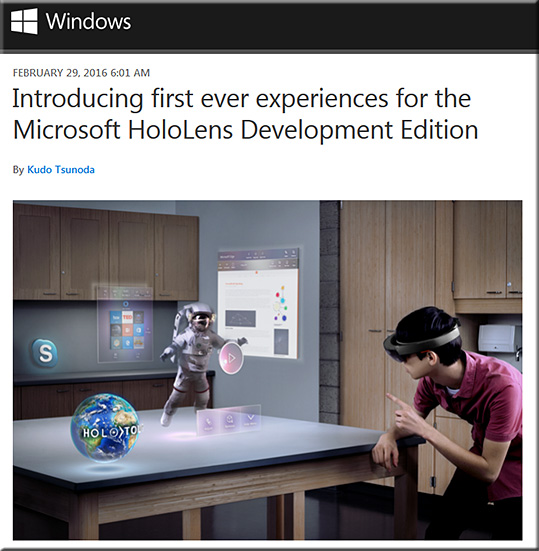
Introducing first ever experiences for the Microsoft HoloLens Development Edition — from blogs.windows.com by Kudo Tsunoda

Excerpt:

I am super excited about today’s announcement that the Microsoft HoloLens Development Edition is available for pre-order. We set out on a mission to deliver the world’s first untethered holographic computer and it is amazing to finally be at this point in time where developers will be receiving the very first versions so they can start building their own holographic experiences.
…
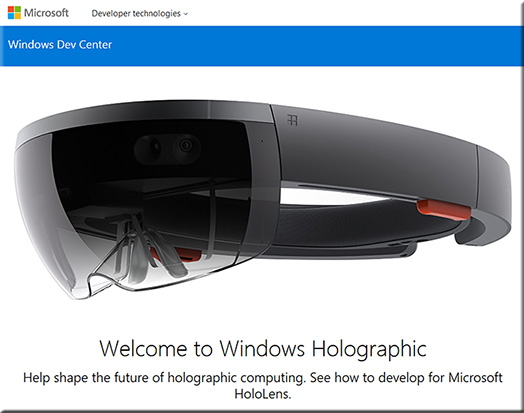
With HoloLens, we are committed to providing the development community with the best experience possible. In order to help get developers started creating experiences for HoloLens, we’ve provided a number of great resources. First of all, there is a complete set of documentation provided to developers both by the people who have created the platform and by the people who have been building holographic experiences. We want to share all of our holographic knowledge with developers so they can start bringing their holographic dreams to reality as easily as possible. We have also provided a host of tutorial videos to help people along. All of the documentation and videos can be found at dev.windows.com/holographic.


MicrosoftHololensDevelopmentKit2-March2016


Winner revealed for Microsoft’s HoloLens App Competition — from vrfocus.com by Peter Graham

Excerpt:

Out of the thousands of ideas entered, Airquarium, Grab the Idol and Galaxy Explorer were the three that made it through. Out of those the eventual winner was Galaxy Explorer with a total of 58 per cent of the votes. The app aims to give users the ability to wander the Milky Way and learn about our galaxy. Navigating through the stars and landing on the myriad of planets that are out there.


Also see:

Virtual Reality in 2016: What to expect from Google, Facebook, HTC and others in 2016 — from tech.firstpost.com by Naina Khedekar

Excerpt:

Many companies have made their intentions for virtual reality clear. Let’s see what they are up to in 2016.


Also see:


Somewhat related, but in the AR space:

Except:
Augmented reality(AR) has continued to gain momentum in the educational landscape over the past couple of years. These educators featured below have dove in head first using AR in their classrooms and schools. They continue to share excellent resources to help educators see how augmented reality can engage students and deepen understanding.


Intel launches x-ray-like glasses that allow wearers to ‘see inside’ objects — from theguardian.com by
Smart augmented reality helmet allows wearers to overlay maps, schematics and thermal images to effectively see through walls, pipes and other solid objects

Excerpt:

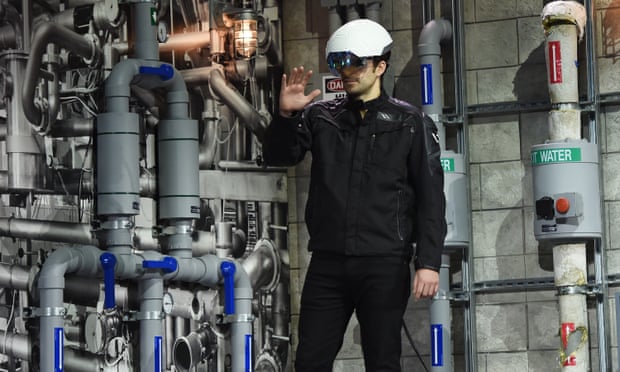
Unlike devices such as HoloLens or Google Glass, which have been marketed as consumer devices, the Daqri Smart Helmet is designed with industrial use in mind. It will allow the wearer to effectively peer into the workings of objects using real-time overlay of information, such as wiring diagrams, schematics and problem areas that need fixing.


Choose Your Reality: Virtual, Augmented or Mixed — from recode.net by Eric Johnson; with thanks to Woontack Woo for his posting on this

Excerpts:

[For VR] The key buzzword here is presence, shorthand for technology and content that can trick the brain into believing it is somewhere it’s not.

The key term for AR is utility…AR takes your view of the real world and adds digital information and/or data on top of it.

The key term for mixed reality, or MR, is flexibility…It tries to combine the best aspects of both VR and AR…In theory, mixed reality lets the user see the real world (like AR) while also seeing believable, virtual objects (like VR). And then it anchors those virtual objects to a point in real space, making it possible to treat them as “real,” at least from the perspective of the person who can see the MR experience.

So, to borrow an example from Microsoft’s presentation at the gaming trade show E3, you might be looking at an ordinary table, but see an interactive virtual world from the video game Minecraft sitting on top of it. As you walk around, the virtual landscape holds its position, and when you lean in close, it gets closer in the way a real object would.


See this example.


© 2025 | Daniel Christian