Law firms are entering the metaverse, here’s why — from web3law.center by Meagan Cline

Excerpt:

Lawyers and law firms are increasingly exploring web3 and the metaverse. The technology is here and likely will only become a greater part of our society. Therefore, lawyers must at least consider how their operations may need to evolve to meet the growing demand for web3 literate legal services.


In this episode, David Aird talks;

  • Diversity and Inclusion
  • Social Mobility in Legal IT
  • Security Matters and Cyber-threats
  • Technology as the Answer
  • Artificial Intelligence and the Future
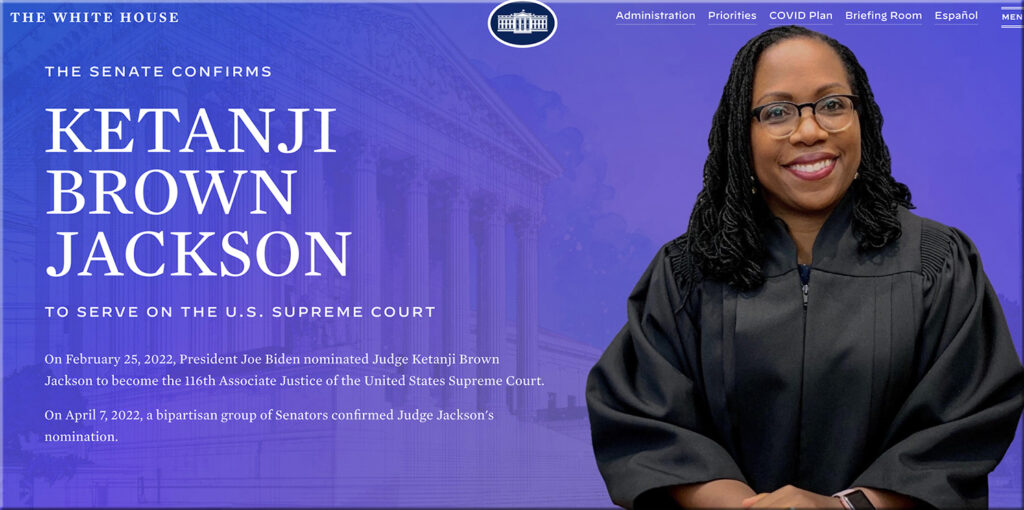
HUGE NEWS!

KETANJI BROWN JACKSON
TO SERVE ON THE U.S. SUPREME COURT

This Week’s Latest Additions to the LawNext Legal Technology Directory — from legaltechmonitor.com by Bob Ambrogi
This Week’s Latest Additions to the LawNext Legal Technology Directory -- by Bob Ambrogi

Photo Geotagging for Lawyers — from legaltechmonitor.com by Jim Calloway

How to automate your law office — from lawtechnologytoday.org

New Microsoft Study Reveals Work Changes: We Aren’t Going Back — from legaltechmonitor.com by Stephen Embry

https://www.lawtechnologytoday.org/2022/03/top-5-benefits-of-a-virtual-law-practice/

Reimagining Law: Embracing the Power of ‘No’ (Part 1) — from legaltechmonitor.com by 2civility

Reimagining Law: Embracing the Power of ‘No’ (Part 2) — from legaltechmonitor.com by 2civility

JUSTICE IN A CHANGING WORLD 2021 | ANNUAL REPORT — from iaals.du.edu

Another State Adopts Duty of Technology Competence for Lawyers, Bringing Total to 40 — from legaltechmonitor.com by Bob Ambrogi

IAALS Launches Allied Legal Professionals in an Effort to Increase Access to Quality Legal Services and Help Reduce Barriers to Representation — from iaals.du.edu by Kelsey Montague

Excerpt:

IAALS, the Institute for the Advancement of the American Legal System at the University of Denver, announced today that it is launching Allied Legal Professionals. With generous support from the Sturm Family Foundation, this project seeks to help standardize a new tier of legal professionals nationally—to increase the options for accessible and affordable legal help for the public.

Up and down the income scale, the legal needs of people in this country are going unmet. The inability to afford a lawyer, among other factors, has led to ballooning rates of self-representation in our justice system, with over 70 percent of civil and family cases including a party without a lawyer. People in these situations are not only facing life-altering challenges such as child custody hearings or landlord/tenant issues alone—they also face disproportionately bad outcomes in their cases.

Addendums on 4/8/22:


45 Next Generation Learning Tools That Kids Will Love — from ireviews.com with thanks to Alex Ward for this resource

Excerpts:

There’s a wide range of tools designed to support curriculum and help teachers and students achieve their goals. These are our top picks for school students of every age, due to their impressive functionality and simple integration into the classroom.


From DSC:
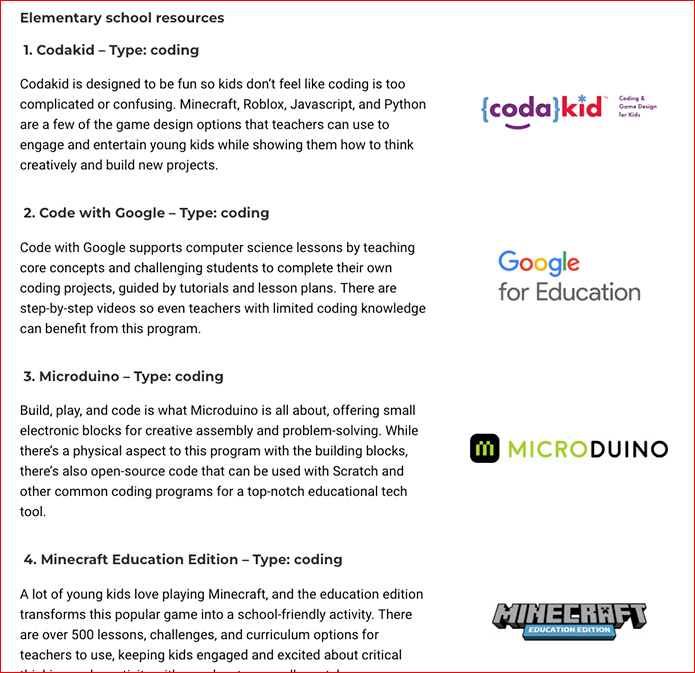
Below is a sample screenshot from the Elementary school resources section. They also have resources for middle schoolers and high schoolers.


45 Next Generation Learning Tools That Kids Will Love


The 20 best dyslexia resources for homeschoolers — from raisinglifelonglearners.com Colleen Kessler

Excerpt:

Homeschooling a child with dyslexia can be a challenge, especially when you are struggling to find resources. I believe homeschooling is the best possible educational choice for your dyslexic child. You just need to right education and support. These are 20 of the best dyslexia resources out there for homeschoolers.

Also relevant/see:


Tapping the Potential of Learning Through Play in STEAM Programs — from techlearning.com by Ray Bendici
Encouraging purposeful play through tools such as LEGO Education to engage students and improve STEAM learning outcomes

Excerpt:

We know children thrive through play, but did you know that learning through play is a powerful research-backed strategy to boost student engagement in the classroom?

“When students are playing, they’re unlocking their natural curiosity and finding their joy in learning,” said Dr. Jenny Nash, Head of Education Impact, US, for LEGO Education, during a recent virtual Tech & Learning roundtable discussion. “And when students learn in a purposeful, hands-on way it builds their confidence, and lessons can really become more motivating and meaningful. Purposeful play is rooted in pedagogical approaches, such as project-based learning, and it’s really known to increase student learning outcomes.”


From DSC:
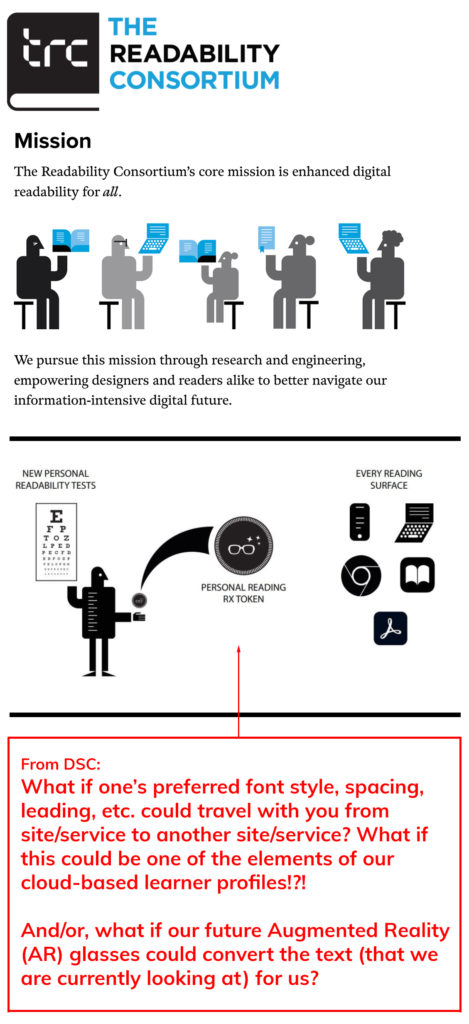
After checking out the following two links, I created the graphic below:

  1. Readability initiative > Better reading for all. — from Adobe.com
    We’re working with educators, nonprofits, and technologists to help people of all ages and abilities read better by personalizing the reading experience on digital devices.
  2. The Readability Consortium > About page


What if one's preferred font style, spacing, leading, etc. could travel with you from site to site? Or perhaps future AR glasses will be able to convert the text that we are looking at for us


Also related/see:


How I use Minecraft to help kids with autism — from ted.com by Stuart Duncan; with thanks to Dr. Kate Christian for this resource

Description:

The internet can be an ugly place, but you won’t find bullies or trolls on Stuart Duncan’s Minecraft server, AutCraft. Designed for children with autism and their families, AutCraft creates a safe online environment for play and self-expression for kids who sometimes behave a bit differently than their peers (and who might be singled out elsewhere). Learn more about one of the best places on the internet with this heartwarming talk.


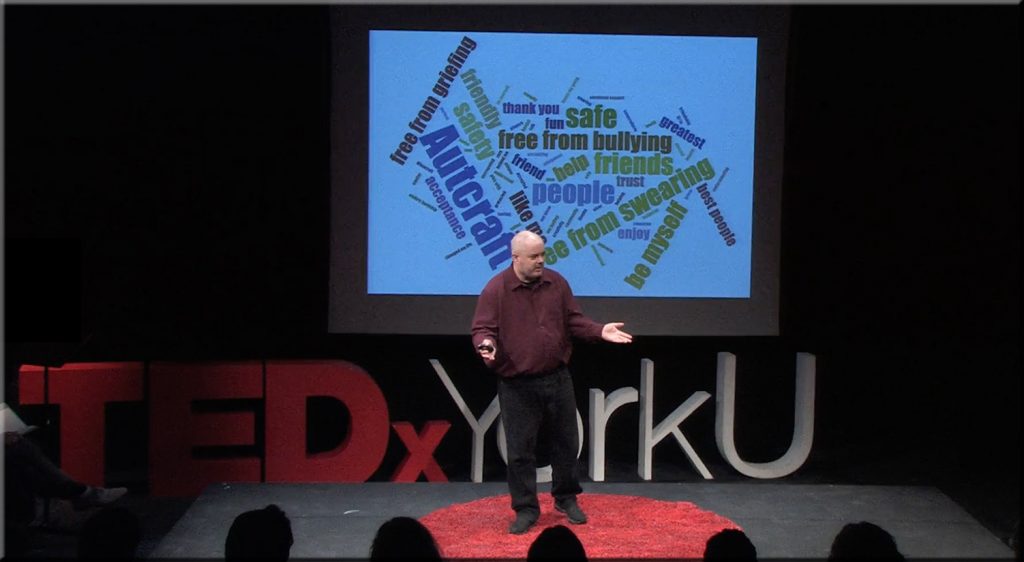
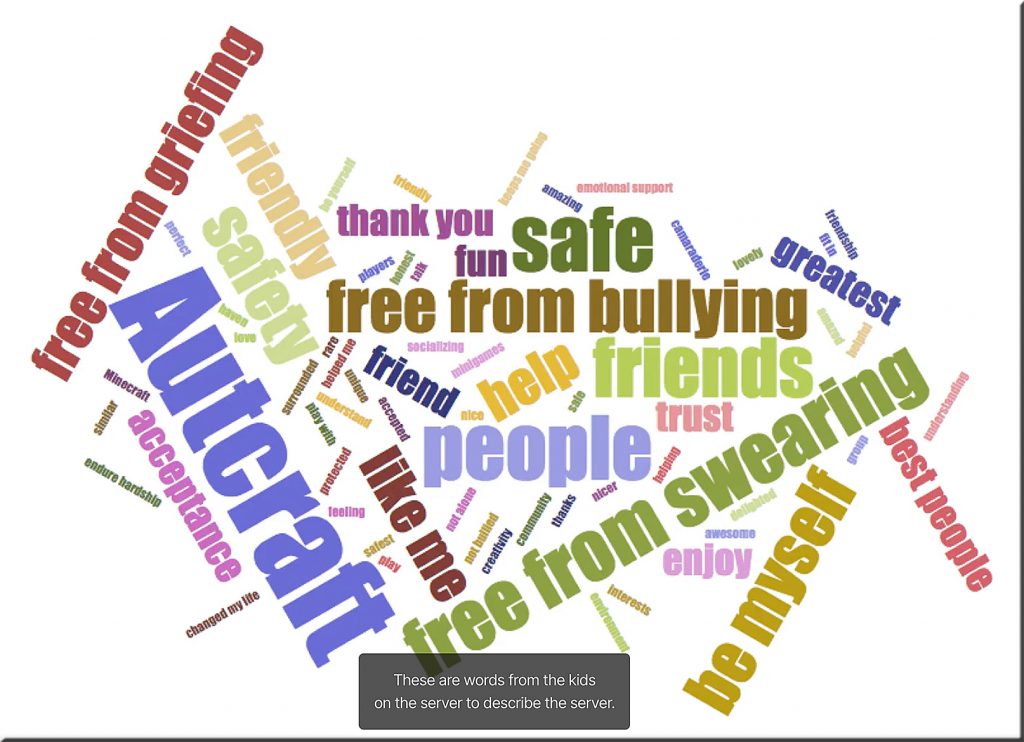
Below are two excerpted snapshots from Stuart’s presentation:

Stuart Duncan speaking at TEDX York U

These are the words autistic students used to describe their experience with Stuart's Minecraft server


22 Augmented Reality Trends to Keep an Eye on for 2022 — from linkedin.com by Tom Emrich

Excerpts:

#1 Metaverse remains at peak hype as the next iteration of the Internet feels so close but is actually much further away

#2 The smartphone continues to become an even more powerful augmented reality machine with advancements in chips, displays and connectivity

#3 Early consumer smartglasses reinforce the need for smartphones rather than attempt to replace them

The metaverse is defined differently by different people but for me, the metaverse is an aha moment. It is a realization by industry that the next wave of computing is comprised of a stack of emerging technologies (including blockchain, AI, IoT, AR and VR) that will all work together to create a fundamental shift in our relationship with technology. 


Also see:


From DSC:
These ideas are specially meant for you entrepreneurs and vendors out there! Including such vendors and products such as Zoom, Cisco Webex, Microsoft Teams, Adobe Connect, and others!

This idea could also be profitable and fun for CMS/LMS vendors and products such as Instructure/Canvas, Blackboard Learn, D2L, Google Classroom and others!


How might we take engagement within an online-based learning environment to an entirely different level? Well, check out these ideas!

What if learning could feature more personality? Be more fun? Have shades of game shows even!? Yet at the same time, if you are a learner who ventures into the ideas that I’m about to suggest, you had better be ready to back up and explain your perspective/position!

Here’s what I’m getting at. You know when you are messaging you can insert some fun motion graphics into your message?


Well, what about if we could select from a bank of very short video clips during a live/synchronous discussion — or during an asynchronous-based discussion board posting — that contained a famous movie clip/message? Then, if you choose to do that, you are then required to explain your perspective/position.  


Video What the video could mean
“Beam me up Scotty! There’s no intelligent life down here.” This is ridiculous. No one’s making any sense here. 
“You meddling kids.”
 From various bad guys on Scooby-Doo.
 You’re messing with me. I don’t agree with your perspective, and here’s why.
“That does not compute.”
Spock from Star Trek. 
I don’t agree with your answer. That doesn’t make any sense and here’s why.
“You can’t handle the truth.”
Jack Nicholson in “A Few Good Men.”
Are you sure you want to know the truth about this topic? Can you handle such a truth? This is about to get real in here.
“Do. Or do not. There is no try.”
Yoda. Star Wars
 Take action on something; do something.
“I’ll be back.”
Arnold Schwarzenegger in various films.
I’m stepping away from my desk…but I’ll be back soon.
or
You may have one this round, but I’ll be back for another round.

Learners within a learning community could use entertainment and have some fun while also having to backup their position/perspective! Talk about engagement! Shooooot.

And/or…learners could be like DJ’s at radio stations — and, on the fly, select from a bank of songs, audio-based noises and sounds!

The danger here is that humor can sometimes backfire and/or offend someone. So we would need to watch the content that’s available to choose from within the repositories of media. We would want to do some serious beta testing here to make sure things stay on the fun, entertaining, and educational sides of things.

Such an approach could introduce opportunities for creativity and for honing one’s ability to think on one’s feet. Also, learners could work on their communication skills as well as their ability to debate or persuade, or to practice some critical thinking.

While more gameshow-like on the surface, if you use such media, you have to explain why you used that media.


Addendum on 1/17/22:

  • Fortnite Is Back On Apple iOS, for Some Users — from threstreet.com by Tony Owusu
    Beta testers for Fortnite on streaming cloud gaming service GeForce Now will have access to the third-person shooter through Apple’s Safari web browser.
 

Frequently Asked Questions About Metaverse — from 101blockchains.com by Georgia Weston

You can also discover many other interesting use cases of the metaverse, such as creating virtual learning spaces or virtual tourism. 


Also see:

Top 5 Blockchain And Crypto Projects In The Metaverse — from 101blockchains.com by Georgia Weston


From DSC:
As the article below clearly relays, MOOCs did NOT fail! In the last decade, they have reached 220 million learners worldwide!

I don’t know the total number of graduates from the Ivy League — throughout all of the relevant institutions’ histories — but I would bet you that MOOCs have reached far more learners. And MOOCs did so in less than a decade. 

And you’re going to tell me MOOCs have been a failure?!!!! Are you being serious!?!?!  You can talk about completion rates all that you want to (and that misses the point, as some people sign up for MOOCs without ever intending to finish the entire course). As with other things, people get out of something what they put into that thing.


A Decade of MOOCs: A Review of Stats and Trends for Large-Scale Online Courses in 2021 — from edsurge.com by Dhawal Shah

Excerpts:

Now, a decade later, MOOCs have reached 220 million learners, excluding China where we don’t have as reliable data, . In 2021, providers launched over 3,100 courses and 500 microcredentials.

Originally, MOOC providers relied on universities to create courses. But that dependence is declining as more and more of the courses are created by companies every year. These corporate partners in course creation include tech giants Google, Microsoft, Amazon and Facebook.

…the majority of the new courses launched on Coursera in 2021 are not from universities anymore.

These mass online courses were born without a business model. Yet within a decade, MOOCs went from no revenue to bringing in well over a half a billion dollars annually.


TechReport 2021: Cloud Computing — from lawtechnologytoday.org by Dennis Kennedy; with thanks to Cat Moon for this resource

Excerpt:

The 2021 ABA Legal Technology Survey Report will be important historically because it gives us the first look at how lawyers responded to the COVID-19 pandemic. Spoiler alert: we did not see anything like the movement to the cloud we expected in 2020. In fact, the 2021 results might be interpreted as another example of lawyers being late arrivals to technologies widely in use in other professions and businesses.

Nonetheless, we still expect the practice of law to be much more cloud-intensive in the near future than it is now, with courts and clients driving many of the changes. Do you think Zoom meetings, online court hearings, and other forms of online collaboration tools will really go away after what we’ve seen in the pandemic?

In the legal profession, it’s still a much different story. Legal is a lagging industry in cloud use. That said, it is still surprising that even in 2021 the reported use of cloud computing in law practice stayed flat or even declined—despite the pandemic and all the news coverage about Zoom meetings and working from home. This result is difficult to comprehend, let alone explain.


From DSC:
From my perspective, both of the items below are highly-related to each other:

Let’s Teach Computer Science Majors to Be Good Citizens. The Whole World Depends on It. — from edsurge.com by Anne-Marie Núñez, Matthew J. Mayhew, Musbah Shaheen and Laura S. Dahl

Excerpt:

Change may need to start earlier in the workforce development pipeline. Undergraduate education offers a key opportunity for recruiting students from historically underrepresented racial and ethnic, gender, and disability groups into computing. Yet even broadened participation in college computer science courses may not shift the tech workforce and block bias from seeping into tech tools if students aren’t taught that diversity and ethics are essential to their field of study and future careers.

Computer Science Majors Lack Citizenship Preparation
Unfortunately, those lessons seem to be missing from many computer science programs.

…and an excerpt from Why AI can’t really filter out “hate news” — with thanks to Sam DeBrule for this resource (emphasis DSC):

The incomprehensibility and unexplainability of huge algorithms
Michael Egnor: What terrifies me about artificial intelligence — and I don’t think one can overstate this danger — is that artificial intelligence has two properties that make it particularly deadly in human civilization. One is concealment. Even though every single purpose in artificial intelligence is human, it’s concealed. We don’t really understand it. We don’t understand Google’s algorithms.

There may even be a situation where Google doesn’t understand Google’s algorithms. But all of it comes from the people who run Google. So the concealment is very dangerous. We don’t know what these programs are doing to our culture. And it may be that no one knows, but they are doing things.

Note:Roman Yampolskiy has written about the incomprehensibility and unexplainability of AI: “Human beings are finite in our abilities. For example, our short term memory is about 7 units on average. In contrast, an AI can remember billions of items and AI capacity to do so is growing exponentially. While never infinite in a true mathematical sense, machine capabilities can be considered such in comparison with ours. This is true for memory, compute speed, and communication abilities.” So we have built-in bias and incomprehensibility at the same time.

From DSC:
That part about concealment reminds me that our society depends upon the state of the hearts of the tech leaders. We don’t like to admit that, but it’s true. The legal realm is too far behind to stop the Wild West of technological change. The legal realm is trying to catch up, but they’re coming onto the race track with no cars…just as pedestrians walking or running as fast as they can….all the while, the technological cars are whizzing by. 

The pace has changed significantly and quickly


The net effect of all of this is that we are more dependent upon the ethics, morals, and care for their fellow humankind (or not) of the C-Suites out there (especially Facebook/Meta Platforms, Google, Microsoft, Amazon, Google, and Apple) than we care to admit. Are they producing products and services that aim to help our societies move forward, or are they just trying to make some more bucks? Who — or what — is being served?

The software engineers and software architects are involved here big time as well. “Just because we can doesn’t mean we should.” But that perspective is sometimes in short supply.

 
© 2025 | Daniel Christian