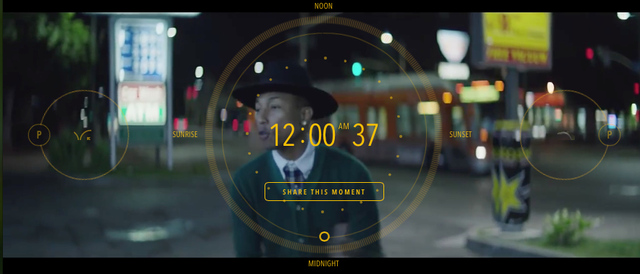
Pharrell Williams debuts 24-hour, interactive music video for ‘Happy’ — from theverge.com by Amar Toor; with thanks to Mr. Colton Credelle for this item


pharrell

Excerpt:

On Thursday, at the stroke of midnight, pop impresario Pharrell Williams debuted the video for his new single, “Happy.” It’s 24 hours long.

The video, available for streaming on 24hoursofhappy.com, features various dancers lip-synching to Williams’ single throughout the course of a day in Los Angeles. The four-minute, upbeat song is played on loop, with each cycle introducing a new dancer (or dancers) at a different location. Viewers can fast-forward or move backward using a clock interface that hovers over the display, and share specific moments on Twitter or Facebook. The dancers, meanwhile, include both anonymous extras and celebrities like Magic Johnson, Steve Carrell, and of course, Williams himself.


Also see:

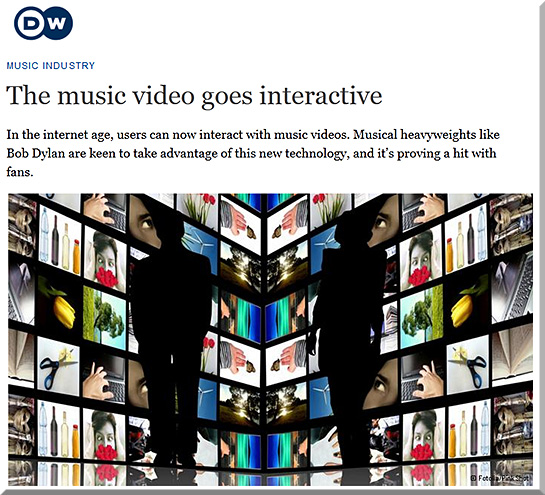
MusicVideoGoesInteractive-Dec2013


From DSC:
How might this relate to educationally-related videos?

And for those of you in marketing and retail out there, could be some sharp/beneficial applications for you all here.


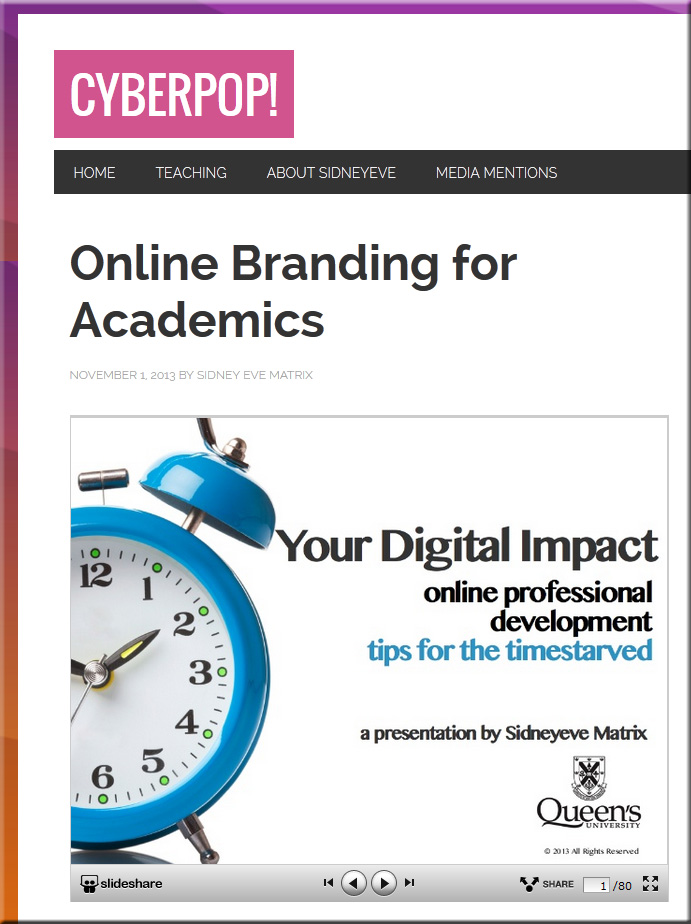
OnlineBrandingForAcademics-SidneyEveMatrix-11-1-13


Online Branding for Academics 
— from cyberpopblog.com by Sidneyeve Matrix; Keynote for EdMedia 2013 in Victoria BC


From DSC:
Sidneyeve’s presentation made me wonder…in the future of higher education (if it’s even called higher education), will adjunct faculty and faculty members be their own brand?  It’s already heading in that direction for many adjunct faculty members.


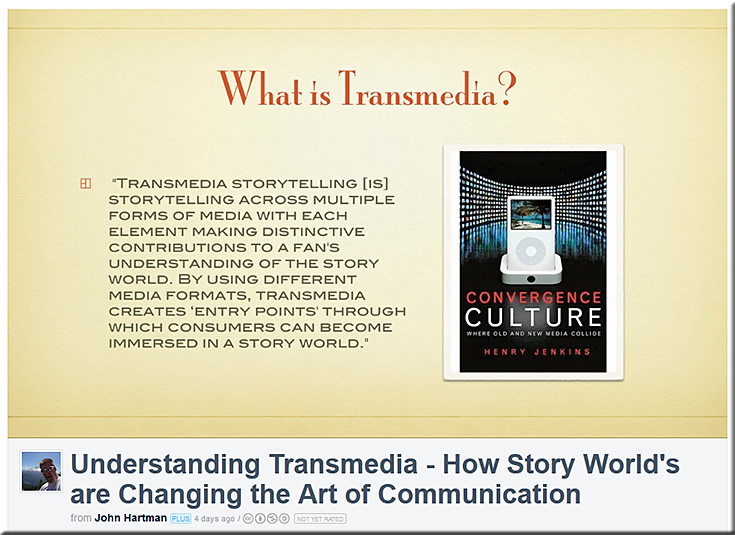
The science behind transmedia storytelling & why you need to be across it now — infographic from marketingmag.com.au

Excerpt/description of infographic:

Transmedia storytelling is a marketing buzzword that will be around for a while – and for good reason. Brand storytellers are being forced to create new transmedia experiences by integrating dynamic content, often co-created through audience participation.

Getty Images has released a new infographic explaining the effective transmedia storytelling can offer the consumer if done correctly.

The infographic details how a transmedia story can lead to stronger emotional connections to brands and the ability for businesses to engage with new or jaded audiences to send brand loyalty soaring via this new media experience.

For this reason, Getty’s infographic explains why becoming effective storytellers in the transmedia marketplace is something that should be top of mind for marketers, advertisers and business decision makers.

.

From DSC:
After reviewing the infographic, I wondered…how might some of this relate to education? Engaging students? Fostering creativity in a variety of areas/disciplines?


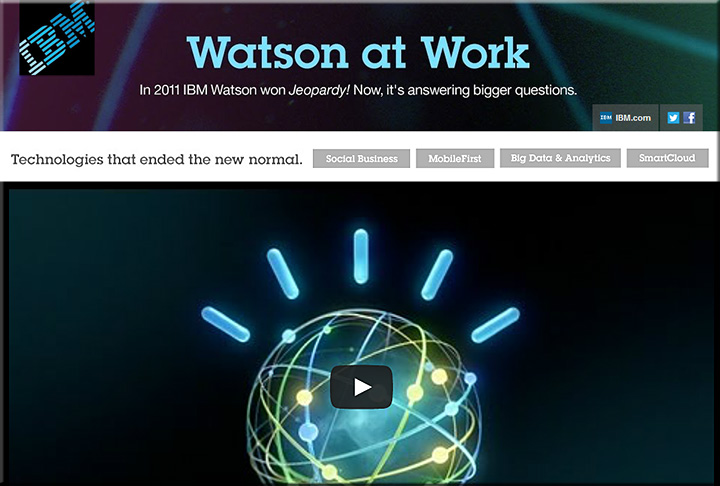
IBM-WatsonAtWork-Sept2013


From DSC:
IBM Watson continues to expand into different disciplines/areas, which currently include:

  • Healthcare
  • Finance
  • Customer Service

But Watson is also entering the marketing and education/research realms.

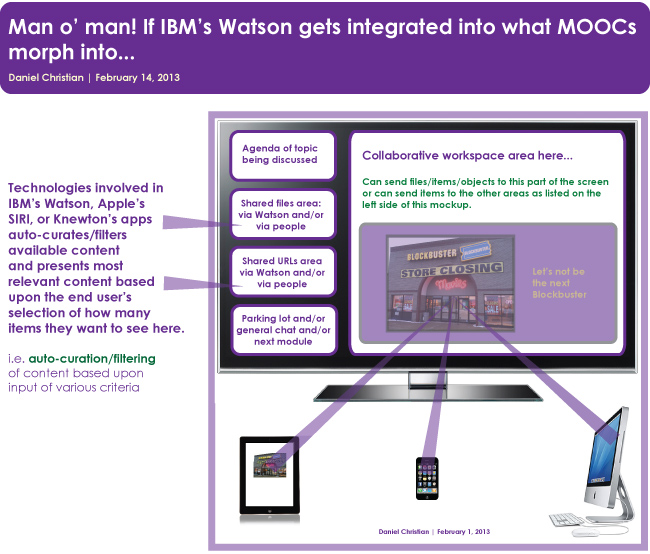
I see a Watson-type-of-tool as being a key ingredient for future MOOCs and the best chance for MOOCs to morph into something very powerful indeed — offloading the majority of the workload to computers/software/intelligent tutoring/learning agents, while at the same time allowing students to connect with each other and/or to Subject Matter Experts (SME’s) as appropriate.

The price of education could hopefully come way down — depending upon the costs involved with licensing Watson or a similar set of technologies — as IBM could spread out their costs to multiple institutions/organizations.  This vision represents another important step towards the “Walmart of Education” that continues to develop before our eyes.

Taking this even one step further, I see this system being available to us on our mobile devices as well as in our living rooms — as the telephone, the television, and the computer continue to converge.  Blended learning on steroids.

What would make this really powerful would be to provide:

  • The ability to create narratives/stories around content
  • To feed streams of content into Watson for students to tap into
  • Methods of mining data and using that to tweak algorithms, etc. to improve the tools/learning opportunities

Such an architecture could be applied towards lifelong learning opportunities — addressing what we now know as K-12, higher education, and corporate training/development.

.


The Living [Class] Room -- by Daniel Christian -- July 2012 -- a second device used in conjunction with a Smart/Connected TV


From DSC:
The two items mentioned below — which I recently ran across — took me back to a nagging thought: 

In the United States, we need for our businesses to pursue a higher calling and purpose. We need businesses to ask how they might best be serving society/others; and I, as an individual, need to be asking the same thing.  

It’s tough to do. It’s easy to loose our footing here.  But if culture eats strategy for breakfast — and if strategies are so key in navigating/surviving in a quickly-changing world — then why don’t we work more on our cultures?  Our hearts?  Our reasons for existing and working?

My guess is that employees would also find their work more meaningful if they saw how their companies were making significant contributions and differences in the world.  For example, when I worked at Kraft (Foods) in the 90’s, we did some things like sending food to areas in crisis; but it wasn’t highlighted that much and it certainly wasn’t our reason for being.  Can you imagine how we would have felt if it was one of our top goals to provide food to every single person in the world?  I wonder how much more energy, commitment, creativity, innovation, etc. would have been generated with that sort of aim in mind? How would such a perspective/drive have affected the company’s culture?  (Instead, Philip Morris purchased Kraft and had a negative affect on the company’s culture.)


The new marketing strategy: Company culture — from kristakotrla.com on March 17, 2013

Excerpt:

Dear Corporate Leadership
Please get back to being a business of people… serving people. Sounds a tad cheesy but seriously. Stop trying to be a big “corporatey,” over-processed, over-mechanized, over-bureaucratic, over-org-charted machine. Smoke and mirrors and perfection is out. Authentic, human, collaboration and innovation from real-time engagement is in.

If you treat your business like a machine then don’t be surprised when your employees act like passionless robots. Ever find yourself scratching your head wondering why on earth your machine-like, killer strategy isn’t thriving? Check your culture (and check your heart).


This one tweet reveals what’s wrong with American business — from LinkedIn.com by Henry Blodget

Excerpt (emphasis DSC):

The real problem is that American corporations, which are richer and more profitable than they have ever been in history (see chart below), have become so obsessed with “maximizing short-term profits” that they are no longer investing in their future, their people, and the country.

This short-term greed can be seen in many aspects of corporate behavior, from scrimping on investment to obsessing about quarterly earnings to fretting about daily fluctuations in stock prices. But it is most visible in the general cultural attitude toward average employees.

Employees are human beings. They devote their lives to creating value for customers, shareholders, and colleagues. And, in return, at least in theory, they share in the rewards of the value created by their team.

In theory.

In practice, American business culture has become so obsessed with maximizing short-term profits that employees aren’t regarded as people who are members of a team.

Rather, they are regarded as “costs.”


Corporate profits and profit margins are at the highest level in history…


From DSC:
I love multimedia because it enables me to craft a message using audio, video, text, graphics, and even animations.  The Internet extends the power of this communication by allowing that message to go forth 24 x 7 x 365 in multi-directional ways — even allowing others to join in the conversations and participate.

The following item made me reflect upon on how important this is becoming to business:

Excerpt:

How (and why) is Marketing Changing?
The first thing to understand about marketing today is that it’s all about shared experience. Consumer behavior is radically changing with respect to content consumption. No longer are people consuming most of their content on the TV, a newspaper, or even their computer. Rather, they are using a combination of channels:


From DSC:

  • Won’t this trend also impact students’ expectations/hopes/engagement?
  • What do we need to do to help youth build these skillsets?


Also related/see:

  • The rise, implications & benefits of the second screen — from newsworks.org.uk by Mark Challinor
    Telegraph Media Group’s director of mobile Mark Challinor says in this new era of second screens, news companies must create content that helps consumers to multi-task on multiple platforms with multiple devices.

Excerpt:
Watching television – or even reading a newspaper – with a smartphone and/or tablet device is becoming one of the most popular leisure activities of this “mobile age”. In turn, publishers such as ourselves are trying to find ways to capitalise on this somewhat new consumer behaviour of real-time interaction, which, more often than not, includes social media. This type of interaction, referred to as “the second screen” or “the companion device”, has become not just a latest hot topic of discussion all over social media blogs; it is a huge development for the mobile app industry and a target-rich environment for our advertisers.

  • Emerging markets’ second-screen boost with 1BN smart devices by 2014 — from rapidtvnews.com by Joseph O’Halloran
    Excerpt:
    New research by IDC has revealed that it won’t just be Western Europe and North America forming happy hunting grounds for second-screen services and applications. The analyst says it is clear that demand for smart connected devices is quickly shifting from developed to emerging markets and that by the end of 2014, global shipments of smart connected devices such as PCs, tablets, and smartphones will exceed surpass 1.7 billion units, with roughly one billion units delivered to emerging markets. The emerging markets are expected to grow at a compound annual growth rate (CAGR) of 17% over the 2012-2017 forecast period, compared to the 7% CAGR expected in developed markets.
 

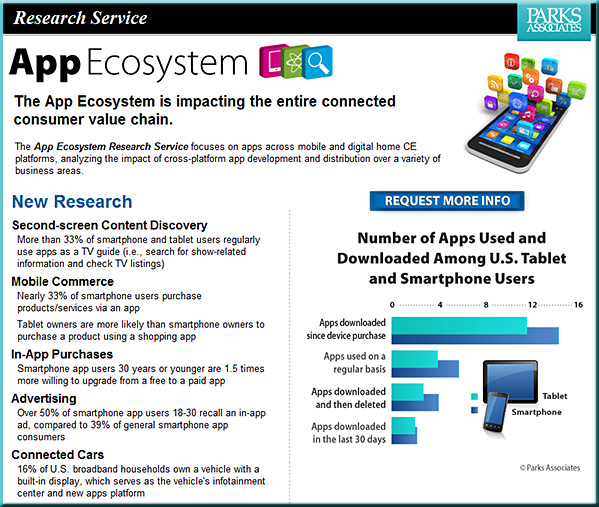
Here’s why the TV apps economy will be a $14 billion business [Wolf]

Here’s why the TV apps economy will be a $14 billion business — from forbes.com by Michael Wolf


.

Excerpt:

According to new research published this week, the TV apps economy is forecasted to reach $14 billion by 2017.

Take for example today’s news that Apple will begin selling video advertisements served by iAd through iTunes Radio loaded on Apple TVs. This is only the first move for Apple in this space, and others like Samsung and Google  are already investing heavily in connected TV app advertising.


From DSC:
Why post this? Because:

  • It lays out future directions/careers related to Programming, Computer Science, Data Mining, Analytics, Marketing, Telecommunications, User Experience Design, Digital and Transmedia Storytelling, and more
    .
  • It leads to “Learning from the Living [Class] Room”

.


The Living [Class] Room -- by Daniel Christian -- July 2012 -- a second device used in conjunction with a Smart/Connected TV


From DSC:
And if this does take off,
$14 billion won’t begin to capture the profits from this new industry.

It will be far larger than that.


Relevant addendum on 6/27/13:

  • The future of cinema is on demand — from bitrebels.com by Ben Warner (From DSC: Having just paid $32 for 4 people — 3 of whom were kids — to see Monsters U, I believe it!)
    .

future-of-cinema-on-demand

Via: [The Verge] Image Credits: [Venture Beat] [Home Theater]


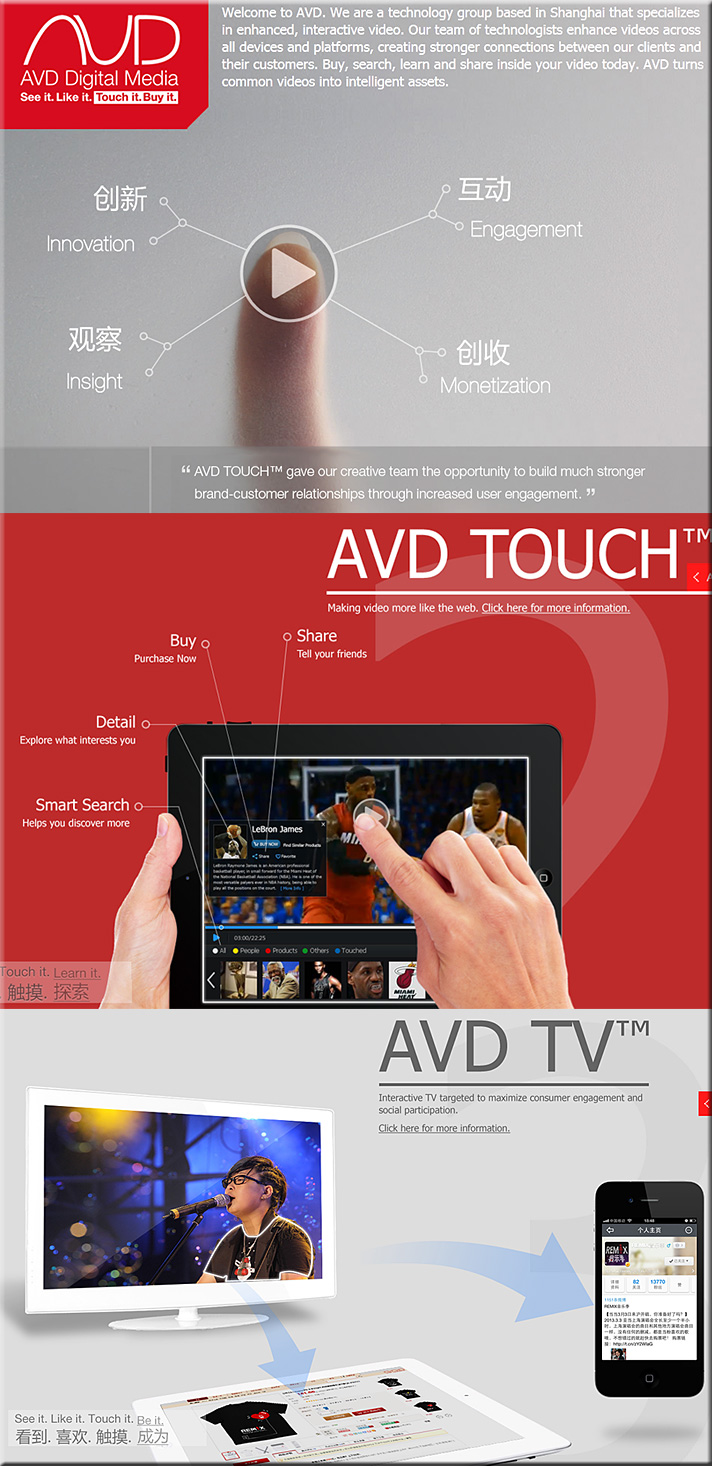
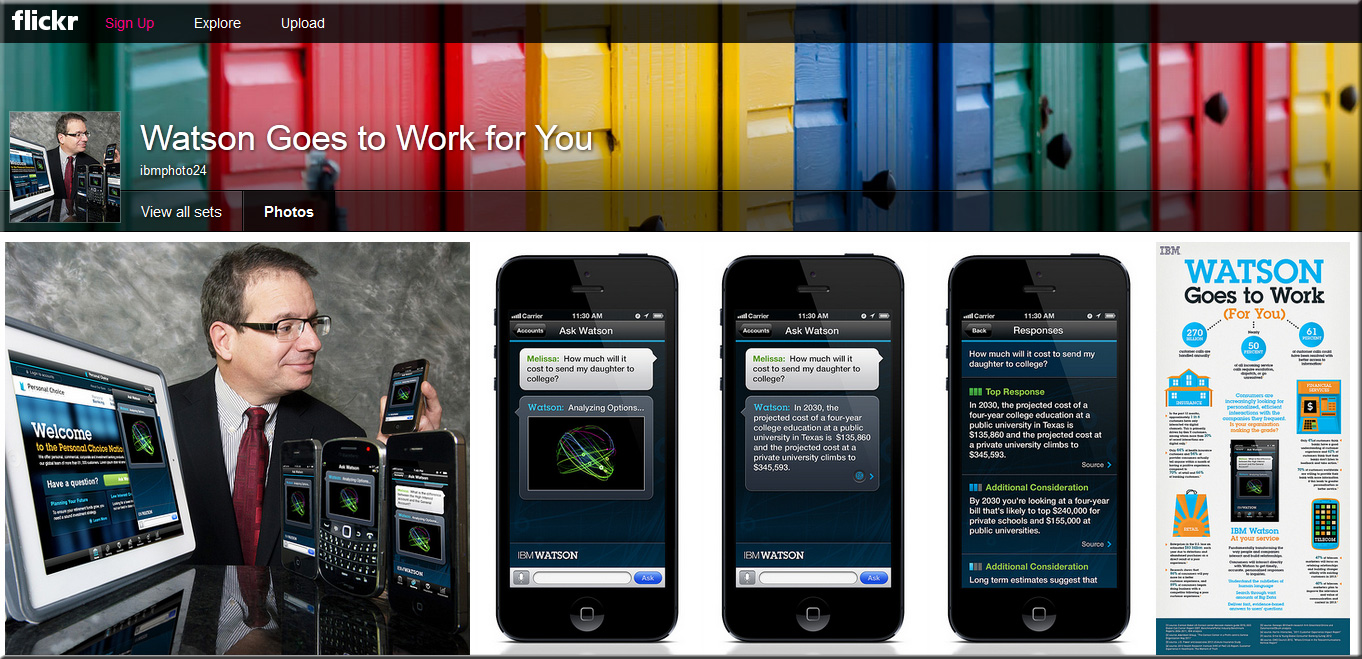
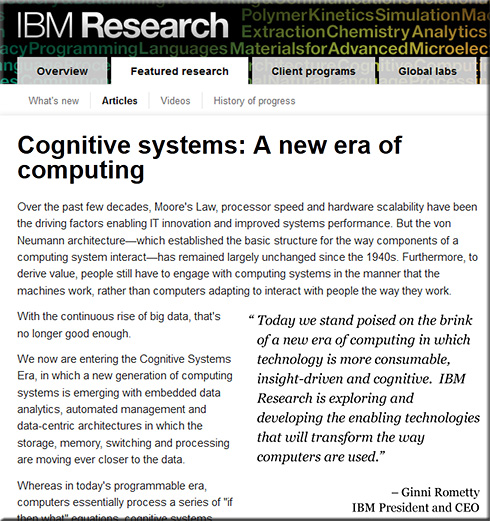
IBM Watson at your service: New Watson breakthrough transforms how brands engage today’s connected consumers — from IBM.com
Delivered from the cloud and into the hands of mobile consumers, Watson provides faster, personalized service for smarter commerce; top brands tap Watson’s ability to crunch big data and provide fast, personalized advice for empowered consumers

.

WatsonGoesToWorkForYouMay2013

.

Also see:


.

CognitiveSystems-IBMResearch-May2013


.


.

Watson-MOOCs-NewTypesCollaboration-DChristian-2-14-13

.


IBM’s Watson tries to learn…everything — from spectrum.ieee.org by Steven Cherry
What happens when Watson learns a million databases? RPI students and faculty hope to find out.


Cara face recognition transforms standard webcams into intelligent sensors — from singularityhub.com by Jason Dorrier

Excerpt:

Founder and CEO, Jason Sosa, told Singularity Hub, “Website stats are powerful—gender, age breakdowns, age categories, how many impressions you have based on traffic. Cara gives you the same thing, only it’s for a real world space.”

Cara detects multiple faces up to 25 feet away and notes whether they are a male or female child (0-13), young adult (14-35), adult (35-65), or senior (65+). It also records how much and what kind of attention they’re giving the camera. This includes total duration (time in front of the camera), glances (looking away and back), attention time (facing the camera), and opportunity to see (traffic near the camera).


Also see:

Also, here is an excerpt from an email from IMRSV:

We’re excited to announce a breakthrough in perceptive computing. Cara is a face detection software that uses a basic webcam to measure gender, age, attention time and glances for up to 25 people simultaneously, up to 25 ft away. It’s available to download now at http://imrsv.com. With complete privacy by design, it doesn’t record video, images or any personal information. Cara is a way to measure retail, advertising and other real world environments that have typically required expensive research studies using a handwritten pen, paper and clipboard.

This new technology enables smarter spaces and devices – whether toys that smile back at you, or advertising messages that adapt to the audience automatically – with real-time, continuous data collection. There are many possible applications including audience measurement, retail insights, adaptive advertising, gaming/entertainment and internet of things capabilities. We’re very excited to share with you a brand new way to measure the world. Cara is also available as a REST API allowing third party developers to leverage real world data for custom applications.


From DSC:
As I mentioned to Jason, I could easily see this type of technology being integrated into what I’ve been thinking about re: the Learning from the Living [Class] Room concept — i.e. a “Smart/Connected TV” and/or a second screen app recognizes who is viewing the materials, brings up a customized listing of educational materials as well as that person’s digital learning playlists (and where that person last left off), their social learning networks, and their communities of practice, etc.

I also wonder whether this type of technology could be used in interactive storytelling…?


The emergence of Chief Digital Officers — from sloanreview.mit.edu by Robert Berkman
As social and other digital technologies shift responsibilities in the C-suite, businesses are creating a new position, the chief digital officer or CDO, to focus their digital strategy. This is the fifth and final piece in our series on how social business is changing power dynamics in the C-suite.

.

Also see:

  • The coming era of ‘on-demand’ marketing — from mckinsey.com by Peter Dahlström and David Edelman
    Emerging technologies are poised to personalize the consumer experience radically—in real time and almost everywhere. It’s not too early to prepare.

The tech industry’s massive marketing problem — from readwrite.com by Matt Asay

.

The Tech Industry's Massive Marketing Problem


Excerpt:

The US has a skilled developer shortage, and it’s one of its own making. While Silicon Valley wrings its hands over H1B visa caps on skilled foreign workers, the bigger issue remains the U.S.’ inability to educate its own citizens. Actually, it may be worse than this: while we may educate a surplus of STEM (Science, Technology, Engineering and Mathematics) students for traditional STEM roles, we seem to fail to entice enough of them to get into technology.

Which is bizarre, if we stop to think about this for even a nanosecond.


Comments/reflections on this from DSC:

I think that the shock waves are still being felt from the decades’ worth of how the corporate world handled IT-related personnel and projects — that and the Dot Com crash.

A member from our CS department mentioned a while back that many of the high school career counselors were encouraging students not to go into a technology-related field such as programming.  I think they were basing such a perspective on how quickly the tech-related projects and personnel were dropped when the economy started heading south.

Another tough thing about the tech-side of the house…
With the pace of technological change, choosing which technologies to invest one’s time in is very difficult. One can easily choose an incorrect path or a product line or a programming language that didn’t turn out to be the one in demand.


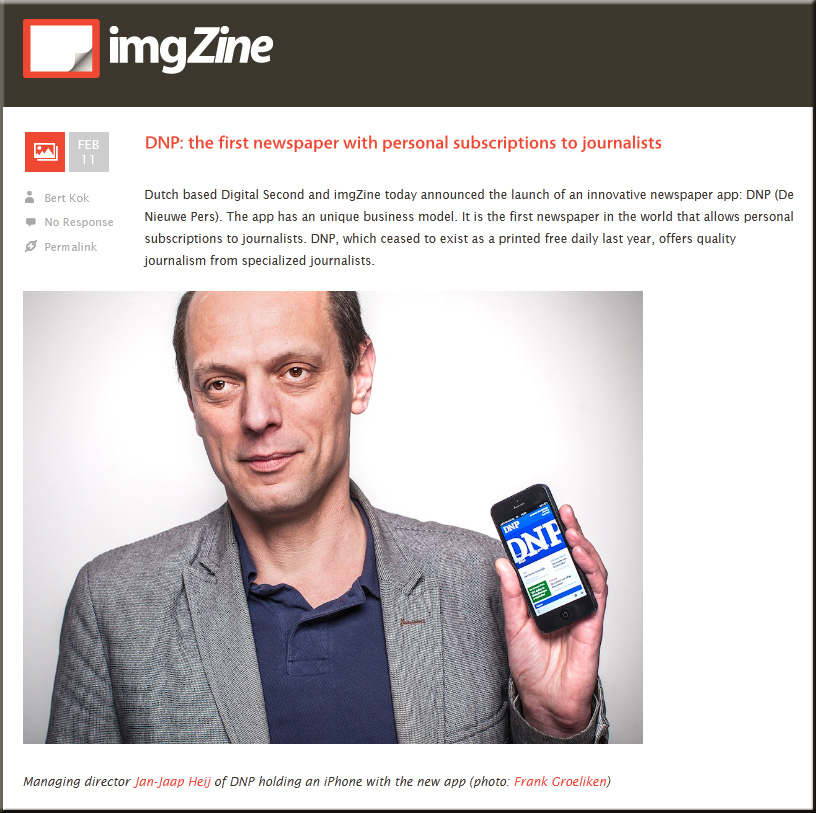
imgZine-Feb2013

.

From DSC:
Hmmmm…I wonder how this might apply to education? Will we move more towards personal brands vs. institutional brands?

© 2025 | Daniel Christian