The North Face uses IBM’s Watson to make online shopping smarter — from thestreet.com by Rebecca Borison

Excerpt:

Aiming to solve one of e-commerce’s challenges of not offering personalized service, VF Corp’s “The North Face” on Monday launched a new online shopping tool using IBM’s Watson artificial intelligence system.

The tool, which is powered by Fluid and called XPS, guides a consumer through the online store to better find what he or she is looking for.

E-commerce today doesn’t generally give the personal attention a consumer might get when he walks into a store and is greeted by a human being. This new tool seeks to address that challenge.


NorthFace-Watson-Dec2015


Watch this robot solve a Rubik’s Cube in a world record 2.39 seconds — from singularityhub.com by Jason Dorrier

.


Novo Nordisk, IBM Watson Health to create ‘virtual doctor’ — from wsj.com by Denise Roland
Software could dispense treatment advice for diabetes patients

Excerpt:

Novo Nordisk A/S is teaming up with IBM Watson Health, a division of International Business Machines Corp., to create a “virtual doctor” for diabetes patients that could dispense treatment advice such as insulin dosage.

The Danish diabetes specialist hopes to use IBM’s supercomputer platform, Watson, to analyze health data from diabetes patients to help them manage their disease.


CES 2016: driverless cars and virtual reality to dominate at world’s biggest technology show — from mirror.co.uk
The world’s biggest technology showcase kicks off in Las Vegas on 6 January 2016. Here’s what we know about what will be happening at the Consumer Electronics Show


Build an automatic cookie decorating machine with LEGO Mindstorms — from lifehacker.com by Patrick Allan

Excerpt:

Decorating cookies by hand can be a pleasant activity, but with a LEGO Mindstorms set, you can crank out a bunch of perfectly iced cookies in no time at all.


World’s First Holographic Navigation System — from machinetomachinemagazine.com

Excerpt:

PARIS – The United States is the first commercial market to receive two innovative telematics devices that apply aerospace technology to land navigation. WayRay Navion is an augmented reality navigation system that projects holographic GPS imagery and driver notifications onto the windshield of a car, a first-of-its-kind for the automobile aftermarket. WayRay Element is a smart tracker that can be plugged into the diagnostics port of any automobile for monitoring driver performance, safety and fuel efficiency. The solutions arrive courtesy of WayRay, a Swiss startup dedicated to the advancement of connected car telematics, and Orange Business Services, a B2B global telecom operator and IT solutions integrator.


The hot products for holiday 2015: IBM Watson launches new app that can predict trends — from by Kimberly Whitler

Excerpt:

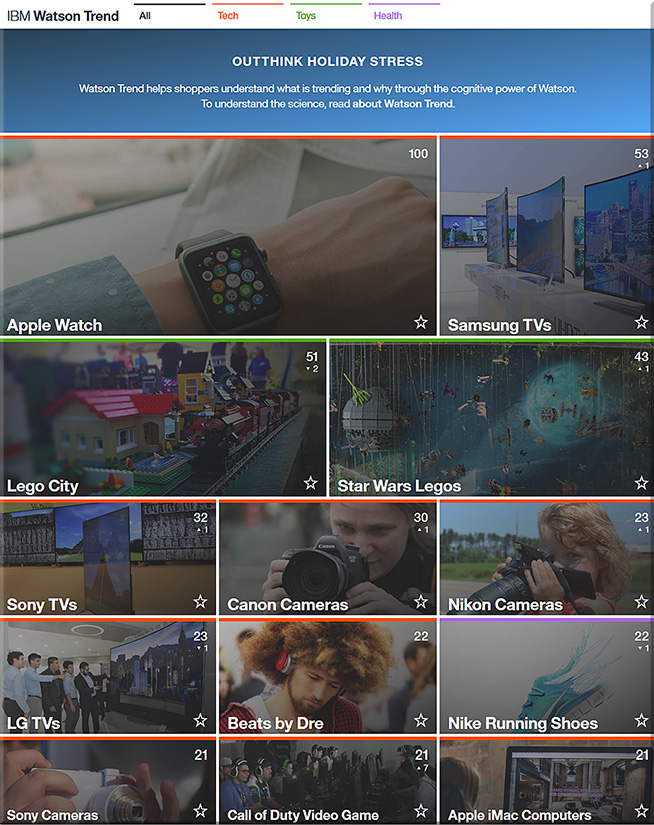
The holiday season—that favorite time of year for retailers and shoppers alike—is just around the corner.  And this year, IBM Watson is launching an app that provides shoppers with the ability to understand the top trends of the season and to predict which products are likely to sell out.

Distilling the sentiment of millions of online conversations across the internet (including social media sites, blogs, forums, ratings, reviews, etc.), the new Watson app (to download the free app, click here) goes beyond providing a static ranking of popular products to provide insight on how consumers feel about the products.


Also see:


IBMWatsonTrend-Nov2015


Addendum om 11/30/15:


From DSC:
Many times we don’t want to hear news that could be troubling in terms of our futures. But we need to deal with these trends now or face the destabilization that Harold Jarche mentions in his posting below. 

The topics found in the following items should be discussed in courses involving economics, business, political science, psychology, futurism, engineering, religion*, robotics, marketing, the law/legal affairs and others throughout the world.  These trends are massive and have enormous ramifications for our societies in the not-too-distant future.

* When I mention religion classes here, I’m thinking of questions such as :

  • What does God have in mind for the place of work in our lives?
    Is it good for us? If so, why or why not?
  • How might these trends impact one’s vocation/calling?
  • …and I’m sure that professors who teach faith/
    religion-related courses can think of other questions to pursue


turmoil and transition — from jarche.com by Harold Jarche

Excerpts (emphasis DSC):

One of the greatest issues that will face Canada, and many developed countries in the next decade will be wealth distribution. While it does not currently appear to be a major problem, the disparity between rich and poor will increase. The main reason will be the emergence of a post-job economy. The ‘job’ was the way we redistributed wealth, making capitalists pay for the means of production and in return creating a middle class that could pay for mass produced goods. That period is almost over. From self-driving vehicles to algorithms replacing knowledge workers, employment is not keeping up with production. Value in the network era is accruing to the owners of the platforms, with companies such as Instagram reaching $1 billion valuations with only 13 employees.

The emerging economy of platform capitalism includes companies like Amazon, Facebook, Google, and Apple. These giants combined do not employ as many people as General Motors did.  But the money accrued by them is enormous and remains in a few hands. The rest of the labour market has to find ways to cobble together a living income. Hence we see many people willing to drive for a company like Uber in order to increase cash-flow. But drivers for Uber have no career track. The platform owners get richer, but the drivers are limited by finite time. They can only drive so many hours per day, and without benefits. At the same time, those self-driving cars are poised to replace all Uber drivers in the near future. Standardized work, like driving a vehicle, has little future in a world of nano-bio-cogno-techno progress.


Value in the network era is accruing to the owners of the platforms, with companies such as Instagram reaching $1 billion valuations with only 13 employees.


For the past century, the job was the way we redistributed wealth and protected workers from the negative aspects of early capitalism. As the knowledge economy disappears, we need to re-think our concepts of work, income, employment, and most importantly education. If we do not find ways to help citizens lead productive lives, our society will face increasing destabilization. 


Also see:

Will artificial intelligence and robots take your marketing job? — from by markedu.com by
Technology will overtake jobs to an extent and at a rate we have not seen before. Artificial intelligence is threatening jobs even in service and knowledge intensive sectors. This begs the question: are robots threatening to take your marketing job?

Excerpt:

What exactly is a human job?
The benefits of artificial intelligence are obvious. Massive productivity gains while a new layer of personalized services from your computer – whether that is a burger robot or Dr. Watson. But artificial intelligence has a bias. Many jobs will be lost.

A few years ago a study from the University of Oxford got quite a bit of attention. The study said that 47 percent of the US labor market could be replaced by intelligent computers within the next 20 years.

The losers are a wide range of job categories within the administration, service, sales, transportation and manufacturing.

Before long we should – or must – redefine what exactly a human job is and the usefulness of it. How we as humans can best complement the extraordinary capabilities of artificial intelligence.


This development is expected to grow fast. There are different predictions about the timing, but by 2030 there will be very few tasks that only a human can solve.


Augmented Reality – hype, or the future? — from mybroadband.co.za by EE Publishers
The concept of Augmented Reality has existed for many years now – and commentators have remained rigidly sceptical about whether it will truly materialise in our everyday lives.

Excerpts:

Essentially, AR describes the way in which a device (such as a smartphone camera, wearables like Google Glasses, or a videogame motion sensor) uses an application to “see” the real world around us, and overlay augmented features onto that view.

These augmented features are aimed at adding value to the user’s experience of their physical environment.

We predict there will be three primary areas in which we will initially engage with AR:

The way we consume information: Imagine going to a library or museum and being able to have a “conversation” with key people throughout history, or instantly transform the world around to you resemble a bygone era.

The fields of product development, marketing and customer engagement: Overlaying new digital services into retail environments opens up a host of new possibilities for organisations to tailor products to their consumers.

Back office/operational functions within the organisation: Companies are already finding ways to use AR in their supply chain, logistics and warehousing environments. Find out, for example, if a particular unit is missing from a shelf.


From DSC:
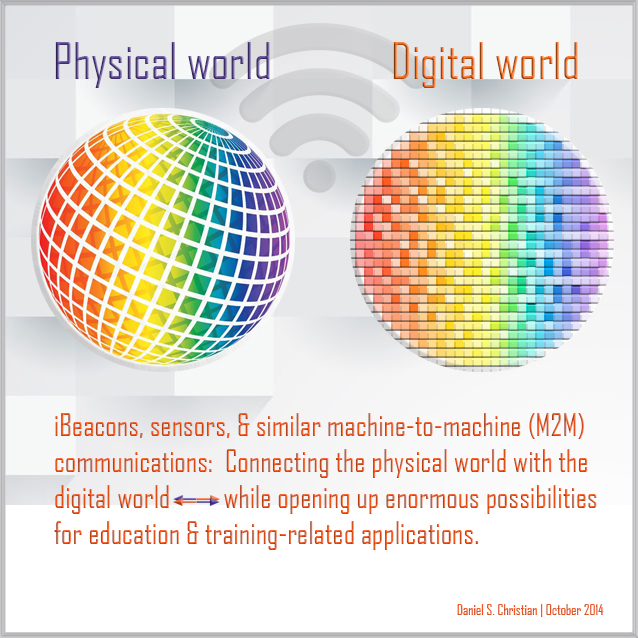
I wonder how Machine-to-Machine communications, beacons, GPS, and more will come into play here…? The end result, I think is a connection between the physical world and the digital world:


DanielChristian-Combining-Digital-Physical-Worlds-Oct2014


World’s first open online MBA to be launched by MOOC platform Coursera — from by Seb Murray
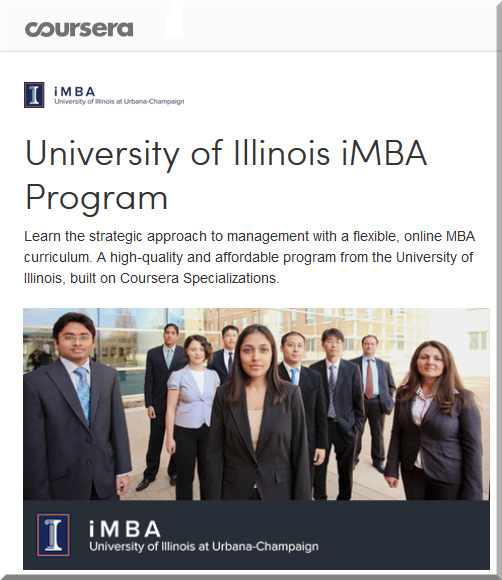
The world’s first open digital MBA degree will be launched in a tie-up between Mooc maker Coursera and US b-school the University of Illinois.

Excerpt:

The world’s first open online MBA will launch in 2015 after a landmark decision from a top business school which is expected to pave the way for further digitization of the business degree and disrupt an already shaken education market.

The University of Illinois at Urbana Champaign College of Business has received the seal of approval from its senate to launch the “iMBA”, in collaboration with Coursera, the $300 million-plus Silicon Valley start-up that produces MOOCs and has amassed nearly 13 million users.


Also see:

The University of Illinois at Urbana-Champaign plans to start a low-cost online M.B.A. program in partnership with Coursera, the Silicon Valley-based MOOC provider, hoping to meet its land-grant mission of improving access and also to create a new stream of revenue at a time of shrinking state support for higher education.

Students enrolling in the new online master’s program, dubbed the iMBA, could complete the entire degree for about $20,000 — far less than the approximately $50,000 for the on-campus version or the $100,000 for the university’s executive M.B.A.

iMBA-May2015
 

Does Studying Fine Art = Unemployment? Introducing LinkedIn’s Field of Study Explorer — from LinkedIn.com by Kathy Hwang

Excerpt:

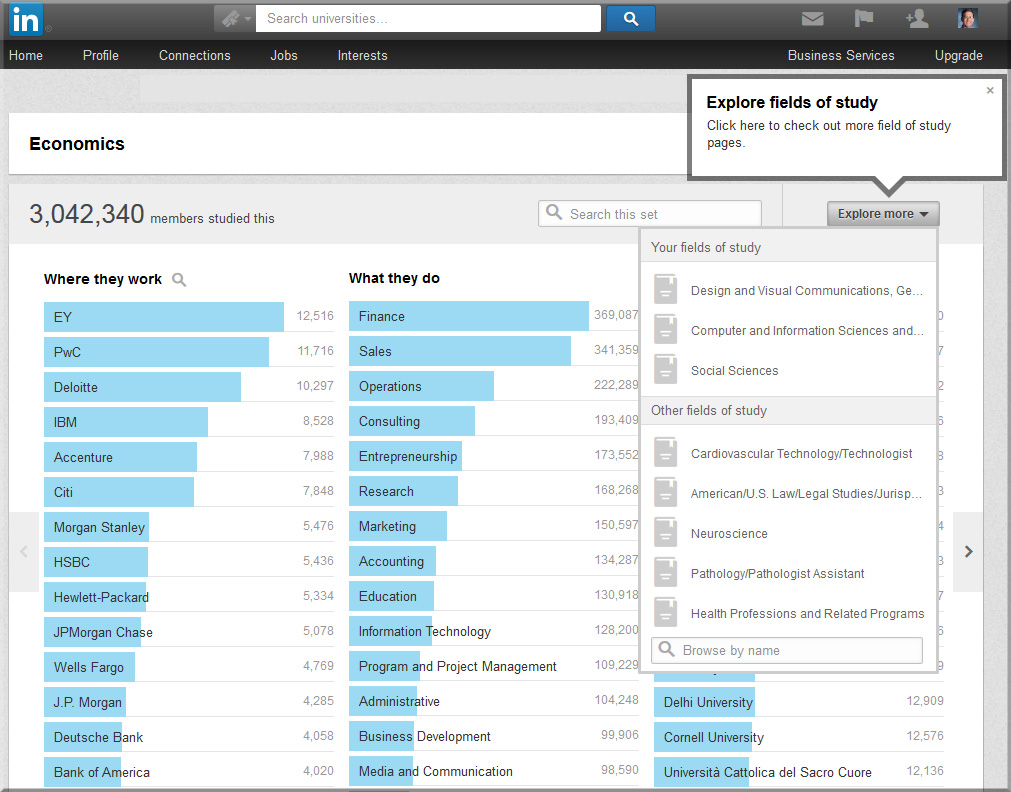
[On July 28, 2014], we are pleased to announce a new product – Field of Study Explorer – designed to help students like Candice explore the wide range of careers LinkedIn members have pursued based on what they studied in school.

So let’s explore the validity of this assumption: studying fine art = unemployment by looking at the careers of members who studied Fine & Studio Arts at Universities around the world. Are they all starving artists who live in their parents’ basements?


LinkedInDotCom-July2014-FieldofStudyExplorer


Also see:

The New Rankings? — from insidehighered.com by Charlie Tyson

Excerpt:

Who majored in Slovak language and literature? At least 14 IBM employees, according to LinkedIn.

Late last month LinkedIn unveiled a “field of study explorer.” Enter a field of study – even one as obscure in the U.S. as Slovak – and you’ll see which companies Slovak majors on LinkedIn work for, which fields they work in and where they went to college. You can also search by college, by industry and by location. You can winnow down, if you desire, to find the employee who majored in Slovak at the Open University and worked in Britain after graduation.


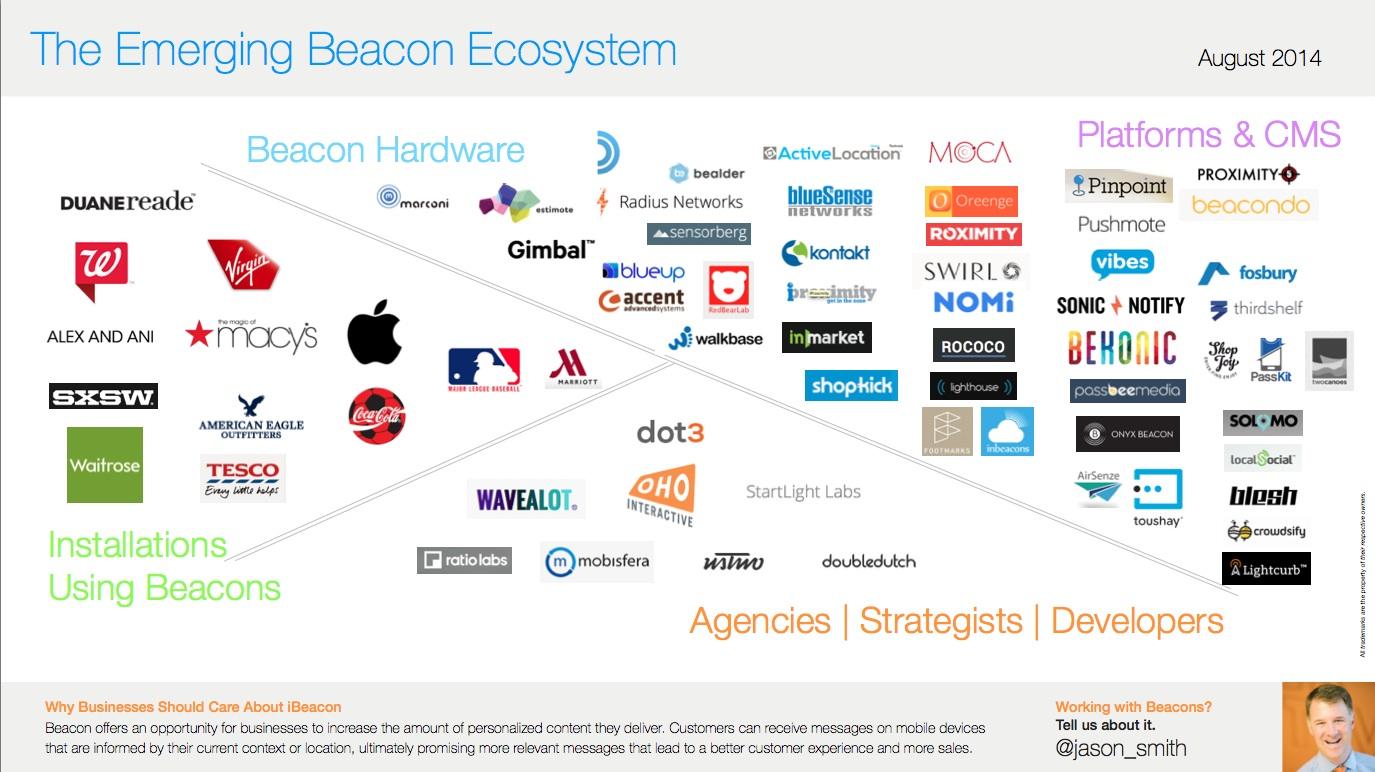
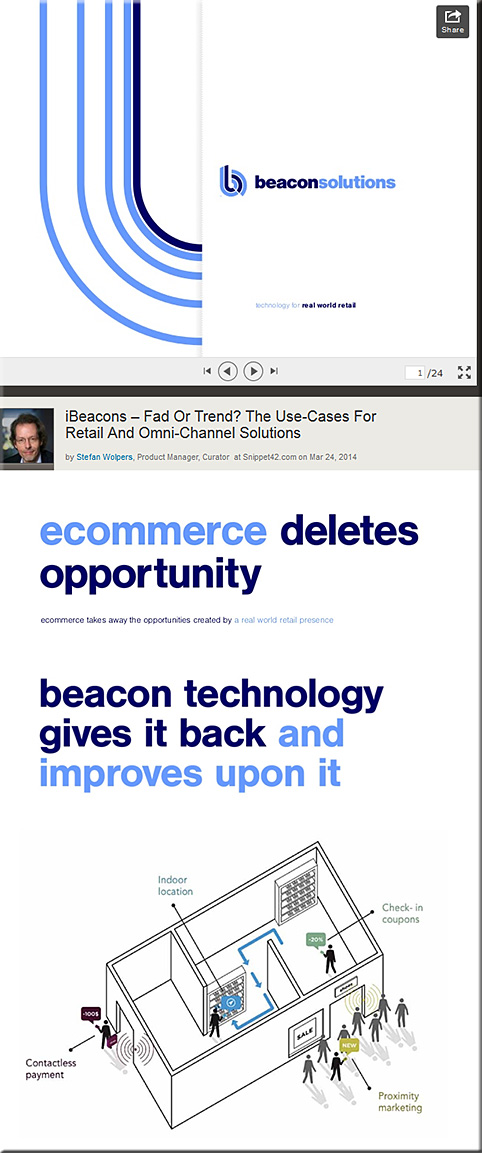
The Future of iBeacon: Trends for the Year Ahead — from beekn.net guest post by Stefan Wolpers

Excerpt:

Beacons will become a hardware commodity within the next 6 to 12 months:


Best of Beacons – Weekly Wrap Up for May 9 — from storify.com/jason_smith by Jason Smith, OHO Interactive
Great to see some new launches and some very interesting patent news from Apple. The Cisco Report on In Store experiences came out earlier but the data is very good.


Also see:


beaconsstefan-wolpers-2014


A TV app from Disney lets travelers browse its vacation offerings — from nytimes.com by Jane Levere

Excerpts (emphasis DSC):

A SMART TV app being introduced by Walt Disney Parks and Resorts on Thursday will let potential travelers use their remote controls to research vacations at theme parks and hotels and on cruise ships and packaged tours.

Brad Baker, director of digital marketing for Walt Disney Parks and Resorts, said the advent of smart, or Internet-connected, TVs had created “a really interesting space for us, since there is now a new way for us to be able to tell our story.”


Some mentioned functionality:

  • Aggregates videos, photographs, interactive theme park maps and other information from the websites of Walt Disney Parks and Resorts businesses and from their social media channels.
  • Has a trivia quiz
  • Some videos
  • Lets viewers request additional information by submitting their email address


From DSC:
The items below speak to the wonderful, powerful world of storytelling.  I see storytelling becoming more interactive/participatory — offering more choice and more control to the viewers.  There are applications in education, training, marketing, advertising, and more.  Finally, I’ve also included some interesting tools/sites for folks to create their own digitally-based stories. 


How storytelling can do wonders in blogging — by Kumail Hemani

Excerpt (emphasis DSC):

Why then was my history class one of the best classes I had? We never had to learn by heart any of the history notes in spite of all the dates, events, places and names. What we heard in that class got imprinted in our mind word by word as soon as they reached my ears.

Reason?

It was in the art of my teacher’s style of speaking and style of lectures. She never took our lessons as lectures, instead she choose to tell them through stories.

My teacher knew the art of true speaking. She spoke in such a style that we students felt everything happening around us. The lectures used to start forming an image in students mind, creating a flow, making everything seem like it is happening in the present. In such style of lectures, it only took us moments before everything made an impact on us and we understood everything word by word.


5 apps for making movies on mobile devices — from edutopia.org by Monica Burns

Excerpt:

Every year at Hollywood award shows, we see fantastic movies celebrated for their rich storytelling and dynamic performances. Your students can become moviemakers, too, thanks to some powerful apps for mobile devices. With these tools, your children can take videos and edit their work to make professional quality movies using iOS devices (iPads and iPhones) and Android tablets.

One good thing about this easy-to-use technology is that students can still use important English language arts skills like writing a narrative, planning a sequential story, and including key details when getting ready to make a movie. These apps can enhance the work that you are doing with children in the classroom and give them room to be creative storytellers.


Visual storytelling: Why data visualization is a content marketing fairytale — from searchenginejournal.com by Shane Jones

Excerpt (emphasis DSC):

Humans are scientifically designed to love stories.
More of our brain is engaged when we listen to stories. They cause our neurons to act as if we were actually doing the actions we hear in the story. Stories also have that human element we were talking about earlier, which makes them more entertaining and engaging.

If you do it right, you can use your data to tell the human story – and how it can be improved through the use of your product or service. In fact, the best content visuals do just that. They introduce viewers to a concept or situation (the problem you address), walk them through the main information about that concept or situation (how you’ll address it), and then provide a conclusion in the form of CTA (converting).

In summary, people are interested in learning about themselves, but they’re sick of learning through plain copy, and they’re programmed to desire visual content that tells a tale. Visualizing data is an effective strategy for giving them exactly what they want – information that is more visible and less difficult to digest.


Crowdsourced storytelling: How can you make the most of user-generated content? — from latd.com by Kim Gaskins

Excerpt:

Connect with people on an emotional level.
This may sound obvious, but there are countless ways to frame a particular project or issue to people you’re hoping to entice—so make sure to think like a good marketer. For example, Israel Mirsky is the founder of Uncoverage, a crowd-funding platform for investigative journalism, who has decided to focus his message on the issues that are most emotionally accessible to his audience. There’s a compelling business case backing Mirsky’s efforts; namely, there’s no longer any business model to support important but resource-intensive journalism that may bring in fewer advertising dollars than simple, click-worthy headlines. It’s a powerful argument, but it’s not the one Mirsky is taking to potential contributors: “I suspect that talking about the problem with investigative journalism isn’t the right value proposition to bring to the table here. The right one is the one that individuals care about: the people and the issues that matter to them.”
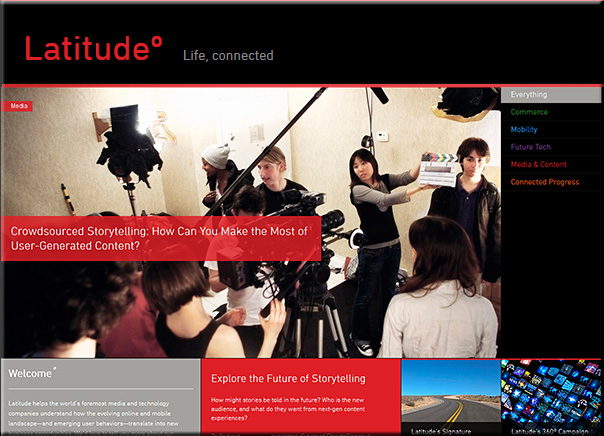
 

latitude-March2014


6 great examples of digital storytelling — from 8ms.com by Simon Heyes

Excerpt:

In the socially connected world, the attention span of an audience becomes shorter as more and more mundane content is thrust in front of their eyes. Digital storytelling allows a brand to evoke emotion, and become more connected with consumers.

If content is at the heart of digital marketing, then we believe audiences are at the heart of digital storytelling. By creating a story that is authentic to your brand and to your audience, and then building content around that story, you will connect your brand to the lives of your consumers.

Here are six handpicked examples where we believe great writing is combined with great imagery to create authentic content, and a brilliant digital story.


5 steps for successful transmedia storytelling — from 8ms.com by Simon Heyes
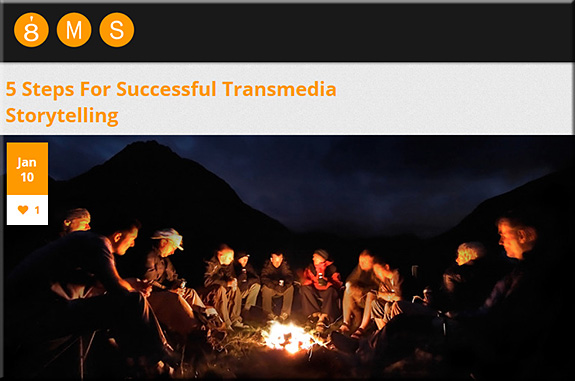
 

5tipstransmediastorytelling


From DSC:
I see storytelling becoming more interactive/participatory — offering more choice and more control to the viewers.  As such, here are some interesting tools/sites:


Interlude
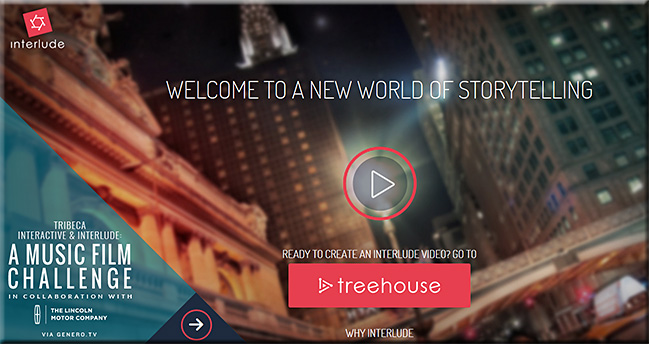
interlude-March2014


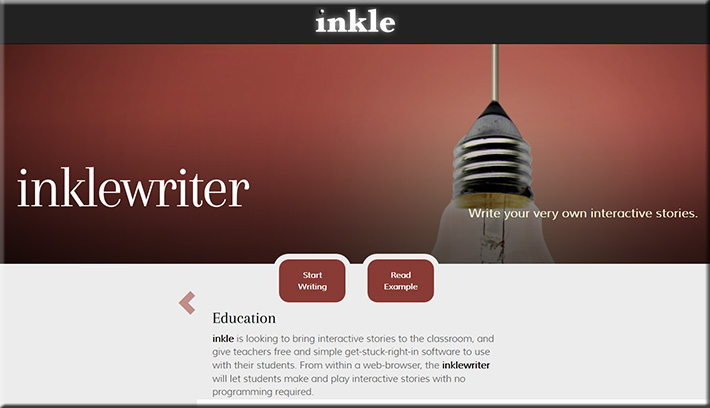
inklewriter

inkle-March2014


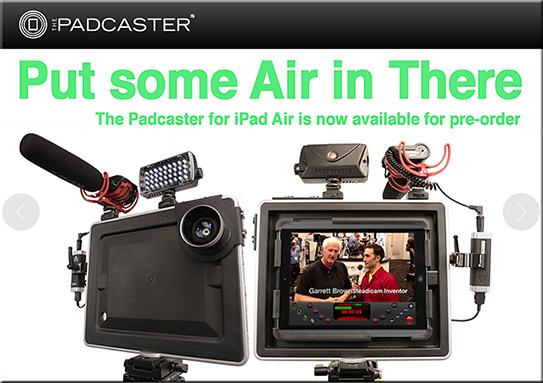
Padcaster

Padcaster-March2014


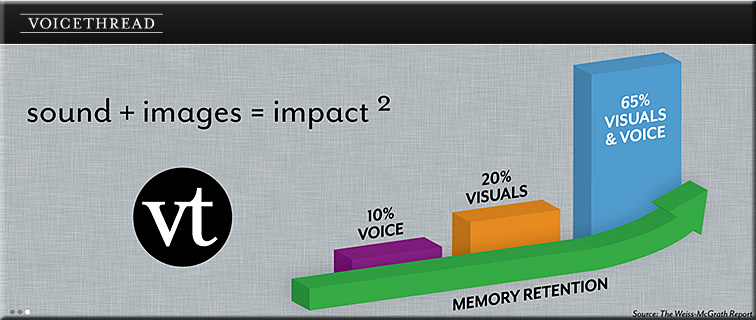
Voicethread

Voicethread-March2014


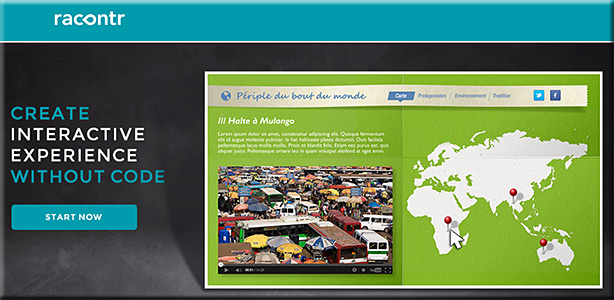
Racontr.com

racontr-March2014


TouchCast

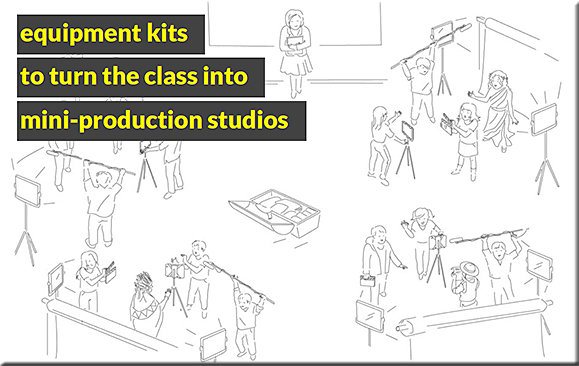
TouchCast-in-Education3


Metta

metta-March2014


Hapyak

hapyak-March2014


Also see:


5 reasons why you should be using storytelling in training — from dashe.com by Ben Nesvig

Excerpt:

Storytelling has been a popular tool for learning since the dawn of civilization, but thanks to technology bringing new mediums for storytelling, it has been on the rise in training in the workplace. Despite the fact that storytelling is a powerful vehicle for teaching, some still prefer to do a “data dump” because it’s easier than constructing a narrative, though not more effective. Below I provide 5 reasons why storytelling should be used more frequently in the workplace.


Digital storytelling: an efficient and engaging learning activity — from elearningindustry.com


 Storehouse
“The easiest way to create, share, and discover beautiful stories.”


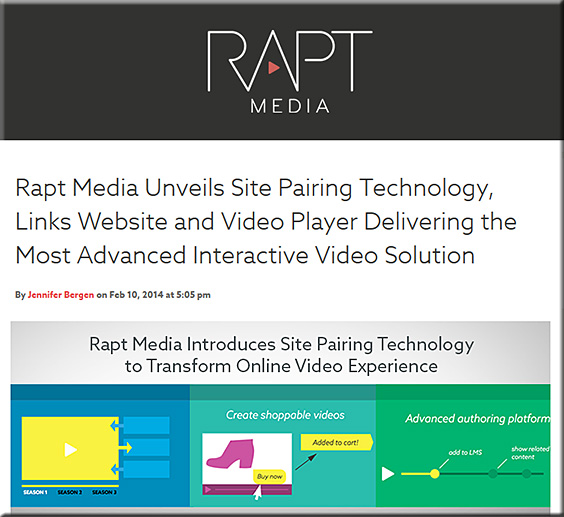
RaptMedia-NewSitePairingTech-Feb2014


Excerpt (emphasis DSC):

Today, we’re thrilled to announce that our patent-pending Site Pairing technology is officially out of beta and into the hands of creatives, marketers, brands, and agencies. Our new Site Pairing technology, which creates a link between your video and your website, allows your creative or content team to quickly and easily build a scalable Interactive Video (IV) framework that enables communication between your videos and your website.

“Online Videos have traditionally been dead ends to brands and marketers,” said Erika Trautman, CEO and co-founder of Rapt Media. “Viewers can’t navigate from them, and often leave a site altogether if the content isn’t exactly what they’re looking for.”

Taking a step back, we see that the website and its embedded media are having a true conversation. “There is nothing that you’ve come to expect on a website, that we can’t duplicate in a video,” said Trautman. “And now the two are talking.”


From DSC:
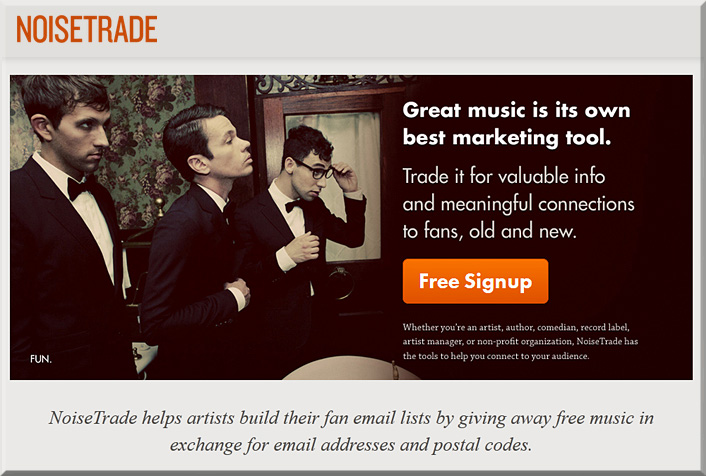
Consider Noisetrade.com (a resource graciously relayed to me by Mr. Michael Haan at Calvin College)


NoiseTrade-12-16-13


Using this site/service, people can download music for free and donate to the artists if they want to (and I think they should).  The WIN for the artist is more visibility and the ability to create/expand a fan base.

This site/service is another example of people representing themselves…of selling what they have to offer…of people representing their own brands.

Add to this the continuing trend towards more freelancing, and I can’t help but wonder…

  • How should these sorts of things impact what we teach?
  • How can we model this for our students? (i.e. reinventing oneself, selling oneself, communicating with others, staying relevant, and more)


Also see:

Excerpt:

As work becomes more flexible and communication more mobile, the office is turning into an increasingly complex and even abstract concept. As we look to the future, we have to ask: Will the workplace be on-site at our employer’s property, or on-demand at a collaborative space? Or will work simply be a mindset independent of place or time of day?

The answer is all three, and more.


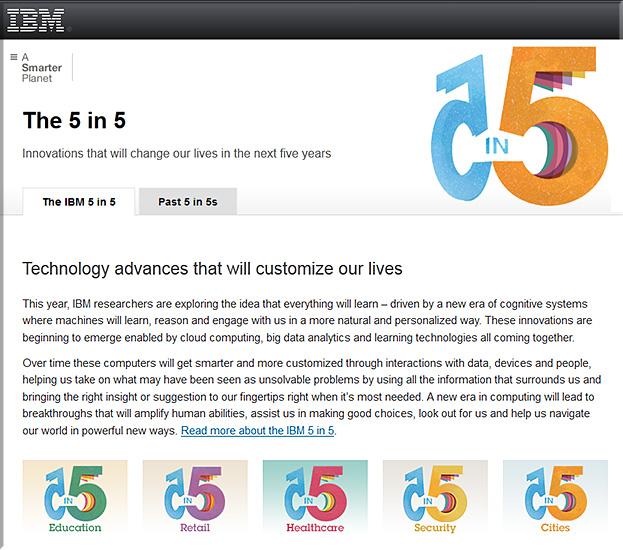
IBM5-in-5-12-17-2013


See also:


IBM5-in-5-Education-12-17-2013


IBM5-in-5-Learning-12-17-2013


 Also see:


Addendum on 12/18/13:

IBM reveals its top five innovation predictions for the next five years — from venturebeat.com by Dean Takahashi

Excerpt:

Globally, two out of three adults haven’t gotten the equivalent of a high school education. But IBM believes the classrooms of the future will give educators the tools to learn about every student, providing them with a tailored curriculum from kindergarten to high school.

“Your teacher spends time getting to know you every year,” Meyerson said. “What if they already knew everything about how you learn?”

In the next five years, IBM believes teachers will use “longitudinal data” such as test scores, attendance, and student behavior on electronic learning platforms — and not just the results of aptitude tests. Sophisticated analytics delivered over the cloud will help teachers make decisions about which students are at risk, their roadblocks, and the way to help them. IBM is working on a research project with the Gwinnett County Public Schools in Georgia, the 14th largest school district in the U.S. with 170,000 students. The goal is to increase the district’s graduation rate. And after a $10 billion investment in analytics, IBM believes it can harness big data to help students out.

“You’ll be able to pick up problems like dyslexia instantly,” Meyerson said. “If a child has extraordinary abilities, they can be recognized. With 30 kids in a class, a teacher cannot do it themselves. This doesn’t replace them. It allows them to be far more effective. Right now, the experience in a big box store doesn’t resemble this, but it will get there.”

 
© 2025 | Daniel Christian