Free Music Discovery Tools — from wondertools.substack.com by Jeremy Caplan and Chris Dalla Riva
Travel through time and around the world with sound

I love apps like Metronaut and Tomplay, which let me carry a collection of classical (sheet) music on my phone. They also provide piano or orchestral accompaniment for any violin piece I want to play.

Today’s post shares 10 other recommended tools for music lovers from my fellow writer and friend, Chris Dalla Riva, who writes Can’t Get Much Higher, a popular Substack focused on the intersection of music and data. I invited Chris to share with you his favorite resources for discovering, learning, and creating music.

Sections include:

  • Learn about Music
  • Discover New Music
  • Learn an Instrument
  • Tools for Artists


Gen AI Is Going Mainstream: Here’s What’s Coming Next — from joshbersin.com by Josh Bersin

I just completed nearly 60,000 miles of travel across Europe, Asia, and the Middle East meeting with hundred of companies to discuss their AI strategies. While every company’s maturity is different, one thing is clear: AI as a business tool has arrived: it’s real and the use-cases are growing.

A new survey by Wharton shows that 46% of business leaders use Gen AI daily and 80% use it weekly. And among these users, 72% are measuring ROI and 74% report a positive return. HR, by the way, is the #3 department in use cases, only slightly behind IT and Finance.

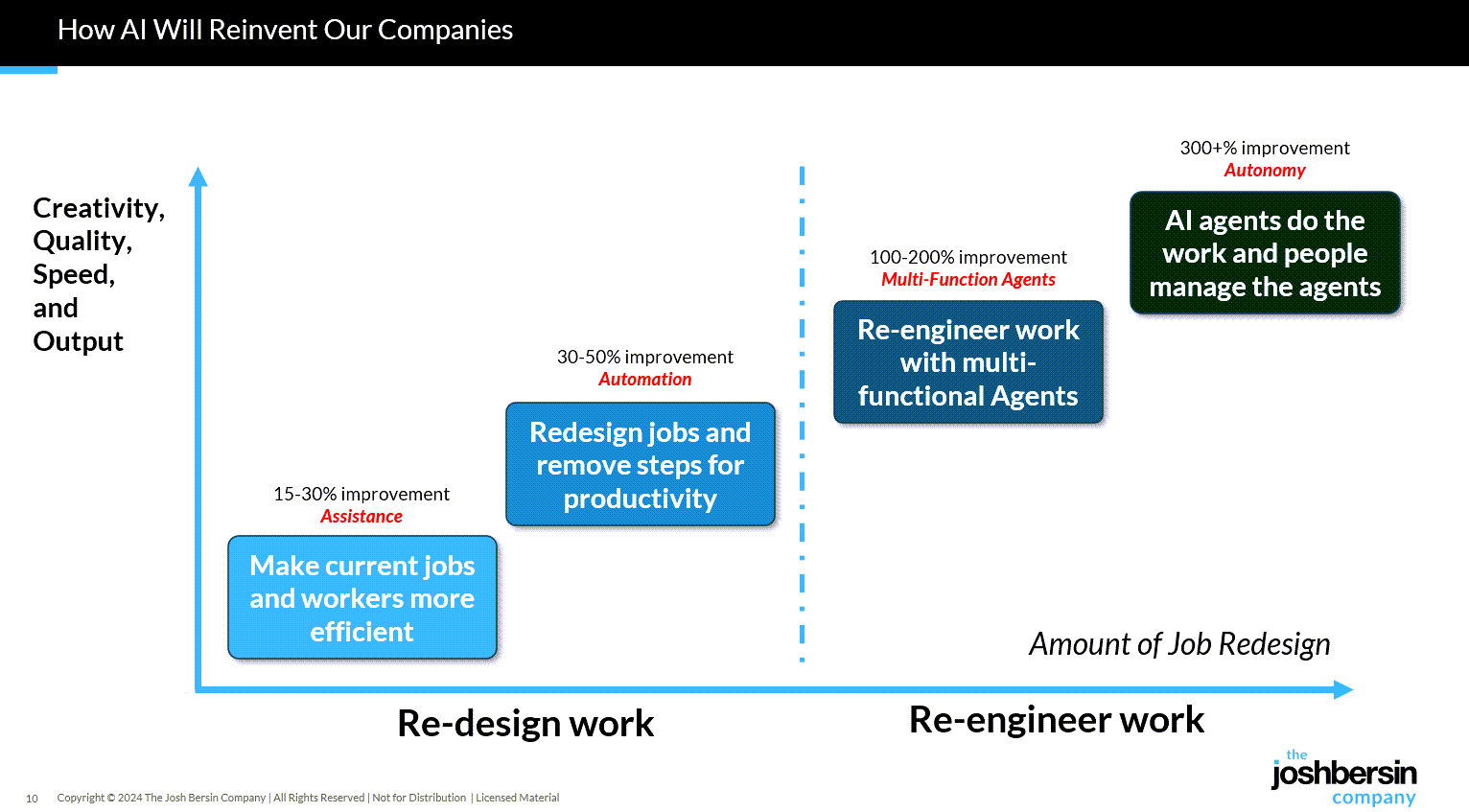
What are companies getting out of all this? Productivity. The #1 use case, by far, is what we call “stage 1” usage – individual productivity. 

.

From DSC:
Josh writes: “Many of our large clients are now implementing AI-native learning systems and seeing 30-40% reduction in staff with vast improvements in workforce enablement.

While I get the appeal (and ROI) from management’s and shareholders’ perspective, this represents a growing concern for employment and people’s ability to earn a living. 

And while I highly respect Josh and his work through the years, I disagree that we’re over the problems with AI and how people are using it: 

Two years ago the NYT was trying to frighten us with stories of AI acting as a romance partner. Well those stories are over, and thanks to a $Trillion (literally) of capital investment in infrastructure, engineering, and power plants, this stuff is reasonably safe.

Those stories are just beginning…they’re not close to being over. 


“… imagine a world where there’s no separation between learning and assessment…” — from aiedusimplified.substack.com by Lance Eaton, Ph.D. and Tawnya Means
An interview with Tawnya Means

So let’s imagine a world where there’s no separation between learning and assessment: it’s ongoing. There’s always assessment, always learning, and they’re tied together. Then we can ask: what is the role of the human in that world? What is it that AI can’t do?

Imagine something like that in higher ed. There could be tutoring or skill-based work happening outside of class, and then relationship-based work happening inside of class, whether online, in person, or some hybrid mix.

The aspects of learning that don’t require relational context could be handled by AI, while the human parts remain intact. For example, I teach strategy and strategic management. I teach people how to talk with one another about the operation and function of a business. I can help students learn to be open to new ideas, recognize when someone pushes back out of fear of losing power, or draw from my own experience in leading a business and making future-oriented decisions.

But the technical parts such as the frameworks like SWOT analysis, the mechanics of comparing alternative viewpoints in a boardroom—those could be managed through simulations or reports that receive immediate feedback from AI. The relational aspects, the human mentoring, would still happen with me as their instructor.

Part 2 of their interview is here:


Seeing The Unseen Students: The Invisible Strength of Teachers — from teachthought.com by Tasneem Tazkiya
One afternoon, I asked a different question: “What would make school feel worth showing up for again?”

A Moment That Changed My View of Teaching
I’ll never forget a student I’ll call Jalen. He was bright and quick with answers, sharp in debate, but he had built a wall around himself after a difficult year at home. He’d stopped turning in work and began sitting silently in the back of the room, disengaged and defiant.

One afternoon, instead of lecturing him about missing assignments, I asked a different question: “What would make school feel worth showing up for again?”

That simple question opened a door. Over the following weeks, Jalen began sharing ideas for projects connected to his interests, designing sneakers and exploring how geometry applies to shoe patterns. I adapted lessons to let him create, design, and analyze. Slowly, his confidence returned. Months later, he told me, “You made me feel like my ideas mattered.”

That moment reminded me that teaching isn’t just about delivering content; it’s about restoring belief in learning, and in oneself.


Also see:

The Power of Play — from barbarabray.net by Barbara Bray

Play brings joy and happiness to learning. Infusing play in schools prepares kids as future citizens.
When you play a game with your friends, how do you feel?

When you see children playing with other children, what do you notice?

Ask a child if they remember the worksheet they filled out last week.
Did they have fun?

Do they remember what they learned?

Let’s play more and discover how learning unfolds.
Schools can invest in more play through games, interactive experiences, and just making learning fun. Providing engaging activities through play creates learners who become critical thinkers, researchers, and designers.


Also re: teaching and learning:


How Coworking Spaces Are Becoming The Learning Ecosystems Of The Future — from hrfuture.net

What if your workspace helped you level up your career? Coworking spaces are becoming learning hubs where skills grow, ideas connect, and real-world education fits seamlessly into the workday.

Continuous learning has become a cornerstone of professional longevity, and flexible workspaces already encourage it through workshops, talks, and mentoring. Their true potential, however, may lie in becoming centers of industry-focused education that help professionals stay adaptable in a rapidly changing world of work.
.


.

What if forward-thinking workspaces and coworking centers became hubs of lifelong learning, integrating job-relevant training with accessible, real-world education?

For coworking operators, this raises important questions: Which types of learning thrive best in these environments, and how much do the design and layout of a space influence how people learn?

By exploring these questions and combining innovative programs with cutting-edge technology aligned to the future workforce, could coworking spaces ultimately become the classrooms of tomorrow?


Breaking News: Law Firm’s AI Pilot Lets New Lawyers Step Away from Billable Hours — from jdjournal.com

In a groundbreaking move that may redefine how law firms integrate technology training into daily practice, Ropes & Gray LLP has introduced a new pilot program allowing its first-year associates to dedicate a significant portion of their work hours to artificial intelligence (AI) learning—without the pressure of billing those hours to clients.

The initiative, called “TrAIlblazers,” marks one of the first formal attempts by a major law firm to give attorneys credit toward their billable-hour requirements for time spent exploring and developing AI skills. The firm hopes the move will both prepare young lawyers for a rapidly evolving profession and signal a new era of flexibility in how law firms evaluate performance.


A New AI Career Ladder — from ssir.org (Stanford Social Innovation Review) by Bruno V. Manno; via Matt Tower
The changing nature of jobs means workers need new education and training infrastructure to match.

AI has cannibalized the routine, low-risk work tasks that used to teach newcomers how to operate in complex organizations. Without those task rungs, the climb up the opportunity ladder into better employment options becomes steeper—and for many, impossible. This is not a temporary glitch. AI is reorganizing work, reshaping what knowledge and skills matter, and redefining how people are expected to acquire them.

The consequences ripple from individual career starts to the broader American promise of economic and social mobility, which includes both financial wealth and social wealth that comes from the networks and relationships we build. Yet the same technology that complicates the first job can help us reinvent how experience is earned, validated, and scaled. If we use AI to widen—not narrow—access to education, training, and proof of knowledge and skill, we can build a stronger career ladder to the middle class and beyond. A key part of doing this is a redesign of education, training, and hiring infrastructure.

What’s needed is a redesigned model that treats work as a primary venue for learning, validates capability with evidence, and helps people keep climbing after their first job. Here are ten design principles for a reinvented education and training infrastructure for the AI era.

  1. Create hybrid institutions that erase boundaries. …
  2. Make work-based learning the default, not the exception. …
  3. Create skill adjacencies to speed transitions. …
  4. Place performance-based hiring at the core. 
  5. Ongoing supports and post-placement mobility. 
  6. Portable, machine-readable credentials with proof attached. 
  7. …plus several more…
 

The Other Regulatory Time Bomb — from onedtech.philhillaa.com by Phil Hill
Higher ed in the US is not prepared for what’s about to hit in April for new accessibility rules

Most higher-ed leaders have at least heard that new federal accessibility rules are coming in 2026 under Title II of the ADA, but it is apparent from conversations at the WCET and Educause annual conferences that very few understand what that actually means for digital learning and broad institutional risk. The rule isn’t some abstract compliance update: it requires every public institution to ensure that all web and media content meets WCAG 2.1 AA, including the use of audio descriptions for prerecorded video. Accessible PDF documents and video captions alone will no longer be enough. Yet on most campuses, the conversation has been understood only as a buzzword, delegated to accessibility coordinators and media specialists who lack the budget or authority to make systemic changes.

And no, relying on faculty to add audio descriptions en masse is not going to happen.

The result is a looming institutional risk that few presidents, CFOs, or CIOs have even quantified.


…the above posting links to:

Higher Ed Is Sleepwalking Toward Obsolescence— And AI Won’t Be the Cause, Just the Accelerant — from substack.com by Steven Mintz
AI Has Exposed Higher Ed’s Hollow Core — The University Must Reinvent Itself or Fade

It begins with a basic reversal of mindset: Stop treating AI as a threat to be policed. Start treating it as the accelerant that finally forces us to build the education we should have created decades ago.

A serious institutional response would demand — at minimum — six structural commitments:

  • Make high-intensity human learning the norm.  …
  • Put active learning at the center, not the margins.  …
  • Replace content transmission with a focus on process.  …
  • Mainstream high-impact practices — stop hoarding them for honors students.  …
  • Redesign assessment to make learning undeniable.  …

And above all: Instructional design can no longer be a private hobby.


Teaching with AI: From Prohibition to Partnership for Critical Thinking — from facultyfocus.com by Michael Kiener, PhD, CRC

How to Integrate AI Developmentally into Your Courses

  • Lower-Level Courses: Focus on building foundational skills, which includes guided instruction on how to use AI responsibly. This moves the strategy beyond mere prohibition.
  • Mid-Level Courses: Use AI as a scaffold where faculty provide specific guidelines on when and how to use the tool, preparing students for greater independence.
  • Upper-Level/Graduate Courses: Empower students to evaluate AI’s role in their learning. This enables them to become self-regulated learners who make informed decisions about their tools.
  • Balanced Approach: Make decisions about AI use based on the content being learned and students’ developmental needs.

Now that you have a framework for how to conceptualize including AI into your courses here are a few ideas on scaffolding AI to allow students to practice using technology and develop cognitive skills.


80 per cent of young people in the UK are using AI for their schoolwork — from aipioneers.org by Graham Attwell

What was encouraging, though, is that students aren’t just passively accepting this new reality. They are actively asking for help. Almost half want their teachers to help them figure out what AI-generated content is trustworthy, and over half want clearer guidelines on when it’s appropriate to use AI in their work. This isn’t a story about students trying to cheat the system; it’s a story about a generation grappling with a powerful new technology and looking to their educators for guidance. It echoes a sentiment I heard at the recent AI Pioneers’ Conference – the issue of AI in education is fundamentally pedagogical and ethical, not just technological.


Custom AI Development: Evolving from Static AI Systems to Dynamic Learning Agents in 2025 — community.nasscom.in

This blog explores how custom AI development accelerates the evolution from static AI to dynamic learning agents and why this transformation is critical for driving innovation, efficiency, and competitive advantage.

Dynamic Learning Agents: The Next Generation
Dynamic learning agents, sometimes referred to as adaptive or agentic AI, represent a leap forward. They combine continuous learningautonomous action, and context-aware adaptability.

Custom AI development plays a crucial role here: it ensures that these agents are designed specifically for an enterprise’s unique needs rather than relying on generic, one-size-fits-all AI platforms. Tailored dynamic agents can:

  • Continuously learn from incoming data streams
  • Make autonomous, goal-directed decisions aligned with business objectives
  • Adapt behavior in real time based on context and feedback
  • Collaborate with other AI agents and human teams to solve complex challenges

The result is an AI ecosystem that evolves with the business, providing sustained competitive advantage.

Also from community.nasscom.in, see:

Building AI Agents with Multimodal Models: From Perception to Action

Perception: The Foundation of Intelligent Agents
Perception is the first step in building AI agents. It involves capturing and interpreting data from multiple modalities, including text, images, audio, and structured inputs. A multimodal AI agent relies on this comprehensive understanding to make informed decisions.

For example, in healthcare, an AI agent may process electronic health records (text), MRI scans (vision), and patient audio consultations (speech) to build a complete understanding of a patient’s condition. Similarly, in retail, AI agents can analyze purchase histories (structured data), product images (vision), and customer reviews (text) to inform recommendations and marketing strategies.

Effective perception ensures that AI agents have contextual awareness, which is essential for accurate reasoning and appropriate action.


From 70-20-10 to 90-10: a new operating system for L&D in the age of AI? — from linkedin.com by Dr. Philippa Hardman

Also from Philippa, see:


Your New ChatGPT Guide — from wondertools.substack.com by Jeremy Caplan and The PyCoach
25 AI Tips & Tricks from a guest expert

  • ChatGPT can make you more productive or dumber. An MIT study found that while AI can significantly boost productivity, it may also weaken your critical thinking. Use it as an assistant, not a substitute for your brain.
  • If you’re a student, use study mode in ChatGPT, Gemini, or Claude. When this feature is enabled, the chatbots will guide you through problems rather than just giving full answers, so you’ll be doing the critical thinking.
  • ChatGPT and other chatbots can confidently make stuff up (aka AI hallucinations). If you suspect something isn’t right, double-check its answers.
  • NotebookLM hallucinates less than most AI tools, but it requires you to upload sources (PDFs, audio, video) and won’t answer questions beyond those materials. That said, it’s great for students and anyone with materials to upload.
  • Probably the most underrated AI feature is deep research. It automates web searching for you and returns a fully cited report with minimal hallucinations in five to 30 minutes. It’s available in ChatGPT, Perplexity, and Gemini, so give it a try.


“OpenAI’s Atlas: the End of Online Learning—or Just the Beginning?” [Hardman] + other items re: AI in our LE’s

OpenAI’s Atlas: the End of Online Learning—or Just the Beginning? — from drphilippahardman.substack.com by Dr. Philippa Hardman

My take is this: in all of the anxiety lies a crucial and long-overdue opportunity to deliver better learning experiences. Precisely because Atlas perceives the same context in the same moment as you, it can transform learning into a process aligned with core neuro-scientific principles—including active retrieval, guided attention, adaptive feedback and context-dependent memory formation.

Perhaps in Atlas we have a browser that for the first time isn’t just a portal to information, but one which can become a co-participant in active cognitive engagement—enabling iterative practice, reflective thinking, and real-time scaffolding as you move through challenges and ideas online.

With this in mind, I put together 10 use cases for Atlas for you to try for yourself.

6. Retrieval Practice
What:
Pulling information from memory drives retention better than re-reading.
Why: Practice testing delivers medium-to-large effects (Adesope et al., 2017).
Try: Open a document with your previous notes. Ask Atlas for a mixed activity set: “Quiz me on the Krebs cycle—give me a near-miss, high-stretch MCQ, then a fill-in-the-blank, then ask me to explain it to a teen.”
Atlas uses its browser memory to generate targeted questions from your actual study materials, supporting spaced, varied retrieval.


From DSC:
A quick comment. I appreciate these ideas and approaches from Katarzyna and Rita. I do think that someone is going to want to be sure that the AI models/platforms/tools are given up-to-date information and updated instructions — i.e., any new procedures, steps to take, etc. Perhaps I’m missing the boat here, but an internal AI platform is going to need to have access to up-to-date information and instructions.


Is An Internship In College More Important Than The Degree Itself? — from forbes.com by Brandon Busteed

While confidence in higher education has eroded and more Americans are questioning the importance of a degree, the demand for internships among college students is skyrocketing and the odds of getting an internship at a major company are now lower than getting into the Ivy League. This begs the question: are we at a point where an internship is as valuable – or perhaps more so – than a degree itself?

While concerns about degree ROI were on the rise, the value of internships and other work-integrated learning opportunities was becoming increasingly apparent. New research and analysis have shown us how valuable it is for a student to have an internship during college: it doubles the odds they have a good job waiting for them upon graduation and doubles their odds of being engaged in their work over their lifetime. Although there are some variations in those outcomes by choice of college or academic major, those variations pale in comparison to the impact of having an internship. In short, a collegiate internship experience is a more important indicator of these outcomes than alma mater or major.


Chegg CEO steps down amid major AI-driven restructure — from linkedin.com by Megan McDonough

Edtech firm Chegg confirmed Monday it is reducing its workforce by 45%, or 388 employees globally, and its chief executive officer is stepping down. Current CEO Nathan Schultz will be replaced effective immediately by executive chairman (and former CEO) Dan Rosensweig. The rise of AI-powered tools has dealt a massive blow to the online homework helper and led to “substantial” declines in revenue and traffic. Company shares have slipped over 10% this year. Chegg recently explored a possible sale, but ultimately decided to keep the company intact.


Is Your Institution Ready for the Earnings Premium Buzzsaw? — from ailearninsights.substack.com by Alfred Essa

On Wednesday [October 29th, 2025], I’m launching the Beta version of an Education Accountability Website (”EDU Accountability Lab”). It analyzes federal student aid, institutional outcomes, and accountability metrics across 6,000+ colleges and universities in the US.

Our Mission
The EDU Accountability Lab delivers independent, data-driven analysis of higher education with a focus on accountability, affordability, and outcomes. Our audience includes policymakers, researchers, and taxpayers who seek greater transparency and effectiveness in postsecondary education. We take no advocacy position on specific institutions, programs, metrics, or policies. Our goal is to provide clear and well-documented methods that support policy discussions, strengthen institutional accountability, and improve public understanding of the value of higher education.

But right now, there’s one area demanding urgent attention.

Starting July 1, 2026, every degree program at every institution receiving federal student aid must prove its graduates earn more than people without that credential—or lose Title IV eligibility.

This isn’t about institutions passing or failing. It’s about programs. Every Bachelor’s in Psychology. Every Master’s in Education. Every Associate in Nursing. Each one assessed separately. Each one facing the same pass-or-fail tests.


Resilient by Design: The Future of America’s Community Colleges — from aacc.nche.edu

This report highlights several truths:

  • Leadership capacity must expand. Presidents and leaders are now expected to be fundraisers, policy navigators, cultural change agents, and data-informed strategists. Leadership can no longer be about a single individual—it must be a team sport. AACC is charged with helping you and your teams build these capacities through leadership academies, peer learning communities, and practical toolkits.
  • The strength of our network is our greatest asset. No college faces its challenges alone, because within our membership there are leaders who have already innovated, stumbled, and succeeded. Resilient by Design urges AACC to serve as the connector and amplifier of this collective wisdom, developing playbooks and scaling proven practices in areas from guided pathways to artificial intelligence to workforce partnerships.
  • Innovation in models and tools is urgent. Budgets must be strategic, business models must be reimagined, and ROI must be proven—not only to funders and policymakers, but to the students and communities we serve. Community colleges must claim their role as engines of economic vitality and social mobility, advancing both immediate workforce needs and long-term wealth-building for students.
  • Policy engagement must be deepened. Federal advocacy remains essential, but the daily realities of our institutions are shaped by state and regional policy. AACC will increasingly support members with state-level resources, legislative templates, and partnerships that equip you to advocate effectively in your unique contexts.
  • Employer engagement must become transformational. Students deserve not just degrees, but careers. The report challenges us to create career-connected colleges where employers co-design curricula, offer meaningful work-based learning, and help ensure graduates are not just prepared for today’s jobs but resilient for tomorrow’s.
 

Ground-level Impacts of the Changing Landscape of Higher Education — from onedtech.philhillaa.com by Glenda Morgan; emphasis DSC
Evidence from the Virginia Community College System

In that spirit, in this post I examine a report from Virginia’s Joint Legislative Audit and Review Commission (JLARC) on Virginia’s Community Colleges and the changing higher-education landscape. The report offers a rich view of how several major issues are evolving at the institutional level over time, an instructive case study in big changes and their implications.

Its empirical depth also prompts broader questions we should ask across higher education.

  • What does the shift toward career education and short-term training mean for institutional costs and funding?
  • How do we deliver effective student supports as enrollment moves online?
  • As demand shifts away from on-campus learning, do physical campuses need to get smaller?
  • Are we seeing a generalizable movement from academic programs to CTE to short-term options? If so, what does that imply for how community colleges are staffed and funded?
  • As online learning becomes a larger, permanent share of enrollment, do student services need a true bimodal redesign, built to serve both online and on-campus students effectively? Evidence suggests this urgent question is not being addressed, especially in cash-strapped community colleges.
  • As online learning grows, what happens to physical campuses? Improving space utilization likely means downsizing, which carries other implications. Campuses are community anchors, even for online students—so finding the right balance deserves serious debate.
 
© 2025 | Daniel Christian