Who does need college anymore? About that book title … — from Education Design Lab

As you may know, Lab founder Kathleen deLaski just published a book with a provocative title: Who Needs College Anymore? Imagining a Future Where Degrees Won’t Matter.

Kathleen is asked about the title in every media interview, before and since the Feb. 25 book release. “It has generated a lot of questions,” she said in our recent book chat. “I tell people to focus on the word, ‘who.’ Who needs college anymore? That’s in keeping with the design thinking frame, where you look at the needs of individuals and what needs are not being met.”

In the same conversation, Kathleen reminded us that only 38% of American adults have a four-year degree. “We never talk about the path to the American dream for the rest of folks,” she said. “We currently are not supporting the other really interesting pathways to financial sustainability — apprenticeships, short-term credentials. And that’s really why I wrote the book, to push the conversation around the 62% of who we call New Majority Learners at the Lab, the people for whom college was not designed.” Watch the full clip

She distills the point into one sentence in this SmartBrief essay:  “The new paradigm is a ‘yes and’ paradigm that embraces college and/or other pathways instead of college or bust.”

What can colleges do moving forward?
In this excellent Q&A with Inside Higher Ed, Kathleen shares her No. 1 suggestion: “College needs to be designed as a stepladder approach, where people can come in and out of it as they need, and at the very least, they can build earnings power along the way to help afford a degree program.”

In her Hechinger Report essay, Kathleen lists four more steps colleges can take to meet the demand for more choices, including “affordability must rule.”

From white-collar apprenticeships and micro-credential programs at local community colleges to online bootcamps, self-instruction using YouTube, and more—students are forging alternative paths to GREAT high-paying jobs. (source)


2025 College Hopes & Worries Survey Report — from princetonreview.com
We surveyed 9,317 college applicants and parents about their dream schools and their biggest college admission and financial aid challenges.
.


Education Department Fires 1,300 Workers, Gutting Its Staff — from nytimes.com by Michael C. Bender and Dana Goldstein. From DSC: I’m gifting this article to you.
The layoffs mean that the department will now have a work force of about half the size it did when President Trump took office.

The Education Department announced on Tuesday that it was firing more than 1,300 workers, effectively gutting the agency that manages federal loans for college, tracks student achievement and enforces civil rights laws in schools.

The layoffs mean that the department, which started the year with 4,133 employees, will now have a work force of about half that size after less than two months with President Trump in office. In addition to the 1,315 workers who were fired on Tuesday, 572 employees accepted separation packages offered in recent weeks and 63 probationary workers were terminated last month.


All of the articles listed below are from edutopia.org


4 Ways to Boost Students’ Self-Efficacy — by Tyler Rablin
These strategies help students see what they have learned so they believe they can be successful in school in the future.

Self-efficacy, on the other hand, focuses on outcomes to drive beliefs. In essence, self-efficacy involves intentionally providing students with evidence of early success to help them build the belief that they can be successful in the future.

Self-efficacy has been a powerful focus for me because it helps me to be more intentional as a teacher. It requires me to be mindful of how I structure assessments, feedback, etc., to provide students with evidence of their successes early on to help them see potential future successes.

Maintaining Students’ Focus in the Spring — by Miriam Plotinsky
Teachers can use these small ‘upgrades’ or tweaks to their regular practices to help keep students focused and involved.

As a recent MindShift article notes, “The second semester brings a lot of potential challenges to teachers’ regularly scheduled programming because of standardized testing, graduation events, and student burnout.” These challenges may be complex, but they are not insurmountable. With subtle shifts in practice, classrooms can remain safe and productive spaces—even in the spring.

She recommends a “coping jar” to help students identify moments of angst and manage their feelings. Fagell explains that when students find an effective coping mechanism, they write their idea on one side of a Popsicle stick and explain how it works on the other side. As students add ideas to the jar, they have an increased awareness of coping strategies and the importance of helping one another.

10 Picture Books That Showcase Collaboration — by Kristin Rydholm
These entertaining stories feature collaboration and social-emotional skills to highlight the benefit of working together to accomplish a goal.

Are you an early childhood teacher in search of relationship-building resources to help unify your classroom? Have I got a book list for you! In the verbiage of 1970s infomercials: “This collection has everything!” The main characters are early childhood students, the setting is the school, and each plot requires the class to work collaboratively. The characters are united in curiosity, determination, and mission to work on accomplishing projects together that they couldn’t possibly do alone.

What a 30-Day Break From AI Taught Me About My Teaching — by James Bedford
Using AI became second nature for this educator. A month without the tools gave him an opportunity to pause, reflect, and recalibrate.

My goal is to try to preserve the messy, creative core of what it means to be an educator: curiosity, critical thinking, and the grit and energy to solve problems without always resorting to shortcuts—technological or otherwise. My hope is that my students will do the same.

Unplug and reconnect: Challenge yourself and your students to embark on an AI detox. Step away from AI tools where possible, and rediscover the power of human creativity and independent thought. Start a journal to document the journey, exploring questions like “How does it feel to rely solely on my own intellect?” or “What challenges arise when AI isn’t there to assist? This activity can foster resilience, raise self-awareness, and cultivate a deeper appreciation for the human capacity to think, create, problem-solve, and innovate.


Blind Spot on AI — from the-job.beehiiv.com by Paul Fain
Office tasks are being automated now, but nobody has answers on how education and worker upskilling should change.

Students and workers will need help adjusting to a labor market that appears to be on the verge of a historic disruption as many business processes are automated. Yet job projections and policy ideas are sorely lacking.

The benefits of agentic AI are already clear for a wide range of organizations, including small nonprofits like CareerVillage. But the ability to automate a broad range of business processes means that education programs and skills training for knowledge workers will need to change. And as Chung writes in a must-read essay, we have a blind spot with predicting the impacts of agentic AI on the labor market.

“Without robust projections,” he writes, “policymakers, businesses, and educators won’t be able to come to terms with how rapidly we need to start this upskilling.”


2025 Survey of College and University Presidents
Learn about presidents’ takes on topics such as financial confidence, the 2024 election’s impact on higher ed & more.

Inside Higher Ed’s 2025 Survey of College and University Presidents was conducted by Hanover Research. The survey asked presidents from 298 public and private, largely nonprofit two- and four-year institutions timely questions on the following issues:

  • General financial and economic confidence, plus mergers and acquisitions
  • Politics, policy and the 2024 election’s impact on higher education
  • Public perceptions of higher ed and the value of a degree
  • Campus speech
  • Race on campus
  • Artificial intelligence
  • Environmental sustainability goals
  • Campus health and wellness, including student mental health
  • Management, governance and the hardest part about being a president
 

6 Characteristics of an Education that Students Want — from gettingsmart.com by IDEA (School of Industrial Design, Engineering and Arts) Students in Tacoma Washington

As current high school students, we want:

  1. Education for the Real World
  2. Personalized and Flexible Education
  3. Cultivating Agency
  4. Creativity and Divergent Thinking
  5. Joyful Learning and Community Building
  6. Empathy and Emotional Growth

Also from gettingsmart.com

Diving into the Evidence: Virtual and Hybrid Models as High-Quality School Choice Options

Key Points

  • The Learning Accelerator is building an evidence base of what high-quality virtual and hybrid learning looks like and how it can be a catalyst for expanding access to powerful learning opportunities.
  • An analysis of 64 high-quality models revealed that virtual and hybrid learning occurs in various contexts, from state-based, fully-virtual programs to individual, hybrid schools and meets the needs of different student populations, including those underserved or disengaged by traditional education systems as well as looking for increased flexibility and course access.
 

Nvidia helps launch AI platform for teaching American Sign Language — from venturebeat.com by Dean Takahashi; via Claire Zau

Nvidia has unveiled a new AI platform for teaching people how to use American Sign Language to help bridge communication gaps.

The Signs platform is creating a validated dataset for sign language learners and developers of ASL-based AI applications.

Nvidia, the American Society for Deaf Children and creative agency Hello Monday are helping close this gap with Signs, an interactive web platform built to support ASL learning and the development of accessible AI applications.


Using Gen AI to Design, Implement, and Assess PBL — from gettingsmart.com by David Ross

Key Points

  • Generative AI can significantly reduce the time and effort required in designing PBL by providing tools for research, brainstorming, and organization.
  • AI tools can assist educators in managing project implementation and assessment, providing formative feedback and organizing resources efficiently.

I usually conclude blogs with some pithy words, but this time I’ll turn the microphone over to Rachel Harcrow, a high school English/Language Arts teacher at Young Women’s College Prep Charter School of Rochester, NY: “After years of struggling to call myself a PBL practitioner, I finally feel comfortable saying I am, thanks to the power of Gen AI,” Harcrow told me. “Initial ideas now turn into fully fledged high-quality project plans in minutes that I can refine, giving me the space and energy to focus on what truly matters: My students.”


AI Resources for District Leaders — from techlearning.com by Steve Baule
Educational leaders aiming to effectively integrate generative AI into their schools should consider several key resources

To truly harness the transformative power of generative AI in education, district leaders must navigate a landscape rich with resources and opportunities. By delving into state and national guidelines, exploring successful case studies, utilizing innovative planning tools, and engaging in professional development, educational leaders can craft robust implementation plans. These plans can then assist in integrating AI seamlessly into their schools and elevate the learning experience to new heights.


Anthropic brings ‘extended thinking’ to Claude, which can solves complex physics problems with 96.5% accuracy — from rdworldonline.com by Brian Buntz

Anthropic, a favorite frontier AI lab among many coders and genAI power users has unveiled Claude 3.7 Sonnet, its first “hybrid reasoning” AI model. It is capable of both near-instant answers and in-depth, step-by-step reasoning within a single system.

Users can toggle an extended thinking mode where the model self-reflects before answering, considerably improving performance on complex tasks like math, physics and coding. In early testing by the author, the model largely succeeded in creating lines of Python (related to unsupervised learning) that were close to 1,000 lines long that ran without error on the first or second try, including the unsupervised machine learning task shown below:


New Tools. Old Complaints. Why AI Won’t Kill Education or Fix it  — from coolcatteacher.com by Vicki Davis; via Stephen Downes

AI won’t kill education. But will it kill learning? The challenge isn’t AI itself—it’s whether students can still think for themselves when the answers are always one click away.

Wait. Before you go, let me ask you one thing.
AI has opportunities to help learning. But it also won’t fix it. The real question isn’t whether students can use AI—but whether they’re still learning without it.

Whether the learning is happening between the ears.

And so much of what we teach in schools isn’t the answers on a test. It answers questions like “What is my purpose in life?” “How do I make friends?” and “How can I help my team be stronger.” Questions that aren’t asked on a test but are essential to living a good life. These questions aren’t answered between the ears but within the heart.

That, my friends, is what teaching has always been about.

The heart.

And the heart of the matter is we have new challenges, but these are old complaints. Complaints since the beginning of time and teaching. And in those days, you didn’t need kids just to be able to talk about how to build a fire, they had to make one themselves. Their lives depend on it.

And these days, we need to build another kind of fire. A fire that sparks the joy of learning. The joy of the opportunities that await us sparked by some of the most powerful tools ever invented. Kids need to not be able to just talk about making a difference, they need to know how to build a better world tomorrow. Our lives depend on it.


How Debating Skills Can Help Us In The Fight Against AI — from adigaskell.org by Adi Gaskell

Debating skills have a range of benefits in the workplace, from helping to improve our communication to bolstering our critical thinking skills. Research from the University of Mississippi suggests it might also help us in the battle with AI in the workplace.

We can often assume that debate teaches us nothing more than how to argue our point, but in order to do this, we have to understand both our own take on a subject and that of our opponent. This allows us to see both sides of any issue we happen to be debating.

“Even though AI has offered a shortcut through the writing process, it actually still is important to be able to write and speak and think on your own,” the researchers explain. “That’s what the focus of this research is: how debate engenders those aspects of being able to write and speak and study and research on your own.”


.
Building an AI-Ready Workforce: A look at College Student ChatGPT Adoption in the US — from cdn.openai.com

One finding from our student survey that stood out to us: Many college and university students are teaching themselves and their friends about AI without waiting for their institutions to provide formal AI education or clear policies about the technology’s use. The education ecosystem is in an important moment of exploration and learning, but the rapid adoption by students across the country who haven’t received formalized instruction in how and when to use the technology creates disparities in AI access and knowledge.

The enclosed snapshot of how young people are using ChatGPT provides insight into the state of AI use among America’s college-aged students. We also include actionable proposals to help address adoption gaps. We hope these insights and proposals can inform research and policy conversation across the nation’s education ecosystem about how to achieve outcomes that support our students, our workforce, and the economy. By improving literacy, expanding access, and implementing clear policies, policymakers and educators can better integrate AI into our educational infrastructure and ensure that our workforce is ready to both sustain and benefit from our future with AI.

Leah Belsky | Vice President, Education | OpenAI


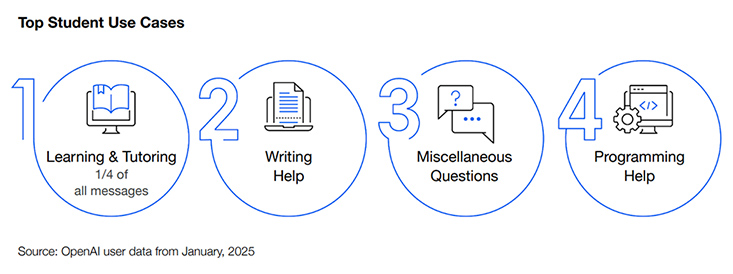
Top student use cases of ChatGPT -- learning and tutoring, writing help, miscellaneouc questions, and programming help


Assistive tech in your classroom: A practical guide — from understood.org by Andrew M.I. Lee, JD
Assistive technology (AT) are tools that let people with differences work around challenges. They make tasks and activities accessible at school, work, and home. Learn how AT apps and software can help with reading, writing, math, and more.

People who learn and think differently can use technology to help work around their challenges. This is called assistive technology (AT). AT helps people with disabilities learn, communicate, or function better. It can be as high-tech as a computer, or as low-tech as a pencil grip. It’s a type of accommodation that involves tools.

Assistive technology has two parts: devices (the actual tools people use) and services (the support to choose and use the tools).

Students who struggle with learning can use AT to help with subjects like reading, writing, and math. AT can also help kids and adults with the tasks of daily life. And many adults use these tools on the job, too.
.


The Learning & Development Global Sentiment Survey 2025 — from donaldhtaylor.co.uk by Don Taylor

The L&D Global Sentiment Survey, now in its 12th year, once again asked two key questions of L&D professionals worldwide:

  • What will be hot in workplace learning in 2025?
  • What are your L&D challenges in 2025?

For the obligatory question on what they considered ‘hot’ topics, respondents voted for one to three of 15 suggested options, plus a free text ‘Other’ option. Over 3,000 voters participated from nearly 100 countries. 85% shared their challenges for 2025.

The results show more interest in AI, a renewed focus on showing the value of L&D, and some signs of greater maturity around our understanding of AI in L&D.


What Educators Need to Know About Dyslexia—and Why It’s Not Something to ‘Fix’ — from edweek.org by Elizabeth Heubeck

“The good news is, though, with early intervention and with the appropriate types of modifications and intervention, people with dyslexia thrive in today’s world.”

From DSC:
I have a retired friend who is dyslexic and, to this very day, feels the pain of being told — and treated like — he was stupid in the majority of his K-12 years. He later went on to get trained on how to operate missiles, solve a variety of highly technical IT-related problems, set up networks, run security departments, and more. He is a highly intelligent individual. But he is dsylexic. And he recalls the pain of those early education days.

I’m glad that we’ve made some significant progress in understanding dsylexia. And I hope that today’s dyslexic students don’t have experiences like his.


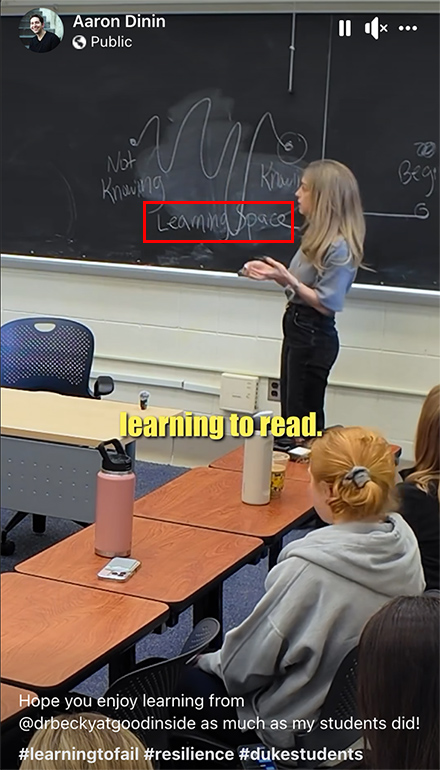
“Learning is frustration.”

The learning space is that space between “not knowing” and “knowing.” It can be very frustrating. But don’t be discouraged when you are frustrated. It means that you are learning. Eventually, you’ll get to “knowing.”
.


Department of Education Helps Students With Disabilities. Don’t Let It Disappear | Opinion — from newsweek.com by Katy NeasCEO, The Arc of the United States

When education is limited, so is opportunity. Without education, students with disabilities face higher rates of poverty, unemployment, poor health, and social isolation. Education is the foundation for independence, inclusion, and a future with choices. Strip it away, and we are not just limiting potential—we are forcing millions of people into a lifetime of barriers and hardship.

This issue is personal for me. As a former deputy assistant secretary in the Department of Education’s Office of Special Education and a lifelong advocate for disability rights, I have seen firsthand what happens when children with disabilities face barriers—and how the Department of Education steps in to make things right.


An excerpt from Derek Bruff’s newsletter entitled, “Digital reading, belonging stories, escape rooms, and more

Course Contributors
At the Top Hat Engage conference last week, I met Whitney Silvis-Sawyer, who teaches education courses at Louisiana Tech University. She regularly invites her students to provide feedback on her courses, and when she makes a change to a course in response to student feedback, she acknowledges that student by name (and with permission) in a “course contributors” section of her syllabus. Some of her course syllabi now have dozens of students listed who have helped shape her courses. I love this as a way to help students see that you take their feedback seriously and as a way to acknowledge sources of inspiration for one’s teaching.

In-Class Escape Rooms
Over on Bluesky, I was delighted to see that Lisa Fazio, who teaches psychology at Vanderbilt University, shared images of the escape room activity she designed as a review for her social cognition course. Her students worked in teams of four to complete a series of puzzles and open a number of combination locks, all of which required them to apply social cognition concepts they had been studying. Lisa writes, “Watching them race through the puzzles today brought me joy!” See Lisa’s thread for all the details.


Designing the Classroom of the Future: 5 Easy Pieces — from ed-spaces.com by Leslie Stebbins
When designing new classrooms the most important factors to consider are designs that encourage movement, provide space for collaborative and independent work, seamlessly embed technology, promote creativity, and provide flexibility.

  1. Design for Movement: Sitting is the new smoking!
  2. Build for Collaboration and Independent Work
  3. Embed Technology Seamlessly: Clean up your Cables!
  4. Promote Creativity: Mix it Up!
  5. Flexibility with Limits

Addendums:


AI in K12: Today’s Breakthroughs and Tomorrow’s Possibilities (webinar)
How AI is Transforming Classrooms Today and What’s Next


Audio-Based Learning 4.0 — from drphilippahardman.substack.com by Dr. Philippa Hardman
A new & powerful way to leverage AI for learning?

At the end of all of this my reflection is that the research paints a pretty exciting picture – audio-based learning isn’t just effective, it’s got some unique superpowers when it comes to boosting comprehension, ramping up engagement, and delivering feedback that really connects with learners.

While audio has been massively under-used as a mode of learning, especially compared to video and text, we’re at an interesting turning point where AI tools are making it easier than ever to tap into audio’s potential as a pedagogical tool.

What’s super interesting is how the solid research backing audio’s effectiveness is and how well this is converging with these new AI capabilities.

From DSC:
I’ve noticed that I don’t learn as well via audio-only based events. It can help if visuals are also provided, but I have to watch the cognitive loads. My processing can start to get overloaded — to the point that I have to close my eyes and just listen sometimes. But there are people I know who love to listen to audiobooks and prefer to learn that way. They can devour content and process/remember it all. Audio is a nice change of pace at times, but I prefer visuals and reading often times. It needs to be absolutely quiet if I’m tackling some new information/learning. 


In Conversation With… Ashton Cousineau — from drphilippahardman.substack.com by Dr. Philippa Hardman
A new video series exploring how L&D professionals are working with AI on the ground

In Conversation With… Ashton Cousineau by Dr Philippa Hardman

A new video series exploring how L&D professionals are working with AI on the ground

Read on Substack


The Learning Research Digest vol. 28 — from learningsciencedigest.substack.com by Dr. Philippa Hardman

Hot Off the Research Press This Month:

  • AI-Infused Learning Design – A structured approach to AI-enhanced assignments using a three-step model for AI integration.
  • Mathematical Dance and Creativity in STEAM – Using AI-powered motion capture to translate dance movements into mathematical models.
  • AI-Generated Instructional Videos – How adaptive AI-powered video learning enhances problem-solving and knowledge retention.
  • Immersive Language Learning with XR & AI – A new framework for integrating AI-driven conversational agents with Extended Reality (XR) for task-based language learning.
  • Decision-Making in Learning Design – A scoping review on how instructional designers navigate complex instructional choices and make data-driven decisions.
  • Interactive E-Books and Engagement – Examining the impact of interactive digital books on student motivation, comprehension, and cognitive engagement.
  • Elevating Practitioner Voices in Instructional Design – A new initiative to amplify instructional designers’ contributions to research and innovation.

Deep Reasoning, Agentic AI & the Continued Rise of Specialised AI Research & Tools for Education — from learningfuturesdigest.substack.com by Dr. Philippa Hardman

Here’s a quick teaser of key developments in the world of AI & learning this month:

  • DeepSeek R-1, OpenAI’s Deep Seek & Perplexity’s ‘Deep Research’ are the latest additions to a growing number of “reasoning models” with interesting implications for evidence-based learning design & development.
  • The U.S. Education Dept release an AI Toolkit and a fresh policy roadmap enabling the adoption of AI use in schools.
  • Anthropic Release “Agentic Claude”, another AI agent that clicks, scrolls, and can even successfully complete e-learning courses…
  • Oxford University Announce the AIEOU Hub, a research-backed research lab to support research and implementation on AI in education.
  • “AI Agents Everywhere”: A Forbes peek at how agentic AI will handle the “boring bits” of classroom life.
  • [Bias klaxon!] Epiphany AI: My own research leads to the creation of a specialised, “pedagogy first” AI co-pilot for instructional design marking the continued growth of specialised AI tools designed for specific industries and workflows.

AI is the Perfect Teaching Assistant for Any Educator — from unite.ai by Navi Azaria, CPO at Kaltura

Through my work with leading educational institutions at Kaltura, I’ve seen firsthand how AI agents are rapidly becoming indispensable. These agents alleviate the mounting burdens on educators and provide new generations of tech-savvy students with accessible, personalized learning, giving teachers the support they need to give their students the personalized attention and engagement they deserve.


Learning HQ — from ai-disruptor-hq.notion.site

This HQ includes all of my AI guides, organized by tool/platform. This list is updated each time a new one is released, and outdated guides are removed/replaced over time.


How AI Is Reshaping Teachers’ Jobs — from edweek.org

Artificial intelligence is poised to fundamentally change the job of teaching. AI-powered tools can shave hours off the amount of time teachers spend grading, lesson-planning, and creating materials. AI can also enrich the lessons they deliver in the classroom and help them meet the varied needs of all students. And it can even help bolster teachers’ own professional growth and development.

Despite all the promise of AI, though, experts still urge caution as the technology continues to evolve. Ethical questions and practical concerns are bubbling to the surface, and not all teachers feel prepared to effectively and safely use AI.

In this special report, see how early-adopter teachers are using AI tools to transform their daily work, tackle some of the roadblocks to expanded use of the technology, and understand what’s on the horizon for the teaching profession in the age of artificial intelligence.


2025 EDUCAUSE AI Landscape Study: Into the Digital AI Divide — from library.educause.edu

The higher education community continues to grapple with questions related to using artificial intelligence (AI) in learning and work. In support of these efforts, we present the 2025 EDUCAUSE AI Landscape Study, summarizing our community’s sentiments and experiences related to strategy and leadership, policies and guidelines, use cases, the higher education workforce, and the institutional digital divide.

 
© 2025 | Daniel Christian