Making Learning Matter— from emilypittsdonahoe.substack.com by Emily Pitts Donahoe We’ve got to get better at talking to students
In a recent newsletter, John Warner articulated a problem I’ve been mulling over for quite some time now:
“The challenge is to convince students that there is a genuine benefit in the struggle of learning as something distinct from the steady forced march of schooling. How do I convey the genuine value of thinking when the cultural message of the moment is the opposite?”
If higher education is to have any meaningful future at all, we have to find real answers to this question.
So, for a long time, I’ve been lamenting that we don’t talk enough with students about the value of work in our disciplines. We should devote more time to exploring how this knowledge operates in the real world! We should explicitly communicate its benefits not only for students’ future professional lives but also for their personal lives, and for the world at large! We should give them a self-transcendent purpose for learning! We should show them that what they learn has real, tangible meaning beyond the classroom!
74 percent of microschools have annual tuition and fees at or below $10,000, with 65 percent offering sliding scale tuition and discounts;
Among microschools that track academic growth data of students over time, 81 percent reported between 1 and 2 years of academic gains during one school year;
Children receive letter grades in just 29 percent of microschools, while observation-based reporting, portfolios, and tracking mastery are the most prevalent methods of tracking their impact;
The most important student outcomes for currently-operating microschools are growth in nonacademic learning, children’s happiness in their microschool, skills perceived as needed for future, and academic growth.
Cultivating a responsible innovation mindset among future tech leaders — from timeshighereducation.com by Andreas Alexiou The classroom is a perfect place to discuss the messy, real-world consequences of technological discoveries, writes Andreas Alexiou. Beyond ‘How?’, students should be asking ‘Should we…?’ and ‘What if…?’ questions around ethics and responsibility
University educators play a crucial role in guiding students to think about the next big invention and its implications for privacy, the environment and social equity. To truly make a difference, we need to bring ethics and responsibility into the classroom in a way that resonates with students. Here’s how.
…
Debating with industry pioneers on incorporating ethical frameworks in innovation, product development or technology adoption is eye-opening because it can lead to students confronting assumptions they hadn’t questioned before. For example, students could discuss the roll-out of emotion-recognition software. Many assume it’s neutral, but guest speakers from industry can highlight how cultural and racial biases are baked into design decisions.
Leveraging alumni networks and starting with short virtual Q&A sessions instead of full lectures can work well.
Are we overlooking the power of autonomy when it comes to motivating students? — from timeshighereducation.com by Danny Oppenheimer Educators fear giving students too much choice in their learning will see them making the wrong decisions. But structuring choice without dictating the answers could be the way forward
So, how can we get students to make good decisions while still allowing them agency to make their own choices, maintaining the associated motivational advantages that agency provides? One possibility is to use choice architecture, more commonly called “nudges”: structuring choices in ways that scaffold better decisions without dictating them.
…
Higher education rightly emphasises the importance of belonging and mastery, but when it ignores autonomy – the third leg of the motivational tripod – the system wobbles. When we allow students to decide for themselves how they’ll engage with their coursework, they consistently rise to the occasion. They choose to challenge themselves, perform better academically and enjoy their education more.
Five Essential Skills Kids Need (More than Coding)
I’m not saying we shouldn’t teach kids to code. It’s a useful skill. But these are the five true foundations that will serve them regardless of how technology evolves.
Day of AI Australia hosted a panel discussion on 20 May, 2025. Hosted by Dr Sebastian Sequoiah-Grayson (Senior Lecturer in the School of Computer Science and Engineering, UNSW Sydney) with panel members Katie Ford (Industry Executive – Higher Education at Microsoft), Tamara Templeton (Primary School Teacher, Townsville), Sarina Wilson (Teaching and Learning Coordinator – Emerging Technology at NSW Department of Education) and Professor Didar Zowghi (Senior Principal Research Scientist at CSIRO’s Data61).
As many students face criticism and punishment for using artificial intelligence tools like ChatGPT for assignments, new reporting shows that many instructors are increasingly using those same programs.
Our next challenge is to self-analyze and develop meaningful benchmarks for AI use across contexts. This research exhibit aims to take the first major step in that direction.
With the right approach, a transcript becomes something else:
A window into student decision-making
A record of how understanding evolves
A conversation that can be interpreted and assessed
An opportunity to evaluate content understanding
This week, I’m excited to share something that brings that idea into practice.
Over time, I imagine a future where annotated transcripts are collected and curated. Schools and universities could draw from a shared library of real examples—not polished templates, but genuine conversations that show process, reflection, and revision. These transcripts would live not as static samples but as evolving benchmarks.
This Field Guide is the first move in that direction.
She recognized their desperation and felt called to return and use what she had learned to help them realize a different future. So she set up an organization, HeartSmiles, to do just that — one young person at a time.
Holifield’s experience is one that city officials and public health workers can learn from. If they want to disrupt the generational cycle of poverty, trauma and hopelessness that afflicts so many communities, a good place to focus their efforts is children.
… How can communities overcome inertia and resignation? Holifield’s organization starts with two core interventions. The first is career and leadership development. Children as young as 8 go to the HeartSmiles center to participate in facilitated sessions on youth entrepreneurship, budgeting and conflict resolution. Those who want to explore certain career paths are matched with professionals in these fields.
… The second part of her vision is youth-led mentorship, which involves pairing young people with those not much older than they are.
This week, we’re publishing Part 2 of a Q&A with Erik Maloney, a lifer in Arizona, and Kevin Wright, a criminal justice professor at Arizona State University. They co-authored Imprisoned Minds, a book about trauma and healing published in December 2024, over the course of seven years. Check out Part 1 of the Q&A.
West: The fact that you created your own curriculum to accompany the book makes me think about the role of lifers in creating educational opportunities in prisons. What do you see as the role of lifers in filling some of these gaps?
Maloney: I’ve said for years that lifers are so underutilized in prison. It’s all about punishment for what you’re in for, and [the prison system] overlooks us as a resource. We are people who, if allowed to be educated properly, can teach courses indefinitely while also being a role model for those with shorter sentences. This gives the lifer meaning and purpose to do good again. He serves as a mentor, whether he likes it or not, to [those] people coming into the prisons. When they see him doing well, it inspires others to want to do well.
But if it’s all about punishment, and a person has no meaning and no purpose in life, then all they have is hopelessness. With hopelessness comes despair, and with despair, you have rampant drug and alcohol abuse in prison, and violence stems from that.
Rick: What kinds of strategies do you think would help?
Richard: In education, we should expand the use of male-friendly teaching methods, such as more hands-on and active learning approaches. We should also consider redshirting boys—starting them in school a year later—to account for developmental differences between boys and girls. We should also introduce more male mentors and role models in schools, particularly in elementary education, where male teachers are scarce. In the workforce, apprenticeship and vocational training programs need to be expanded to create pathways into stable employment for young men who may not pursue a four-year degree. Career counseling should also emphasize diverse pathways to ensure that boys who may not thrive in a traditional academic setting still have opportunities for success. Additionally, fatherhood policies should recognize the importance of male engagement in family life, supporting fathers in their role as caregivers and providers.
While on the topic of K12 education, also see:
How Electives Help All Students Succeed — from edutopia.org by Miriam Plotinsky Giving students a choice of electives increases engagement and allows them to develop skills outside of core academic subjects.
I recently conducted a student focus group on the topic of school attendance. One of the participants, a high school junior who admitted to being frequently late or absent, explained why she still came to school: “I never want to miss Drama. My teacher is awesome. Her class is the reason I show up every day.” As the rest of the focus group chimed in with similar thoughts, I reflected on the power that elective courses hold for students of all ages.
These courses, from jazz band to yoga, cement students’ sense of self not just in their primary and secondary years, but also in their journey toward adulthood. In these tight economic times, schools or districts often slash electives to save money on staffing, which is highly detrimental to student success. Instead, not only should budget cuts be made elsewhere, but also elective offerings should increase to heighten student choice and well-being.
Millions of former students and college graduates across the U.S. are weighed down with student loan debt, but with exactly how much may depend on where you live.
Student loans are the second highest form of household debt after mortgages, according to WalletHub, totaling more than $1.6 tillion, or averaging $38,000 per borrower.
High balances combined with a payoff timeline that lasts into middle age force many graduates to significantly delay or forgo other financial goals such as saving for retirement or buying a home. Paying back student loans has also become even more difficult due to high inflation putting a strain on Americans’ finances.
While we have a big student-loan crisis as a country, student-loan debts are more unsustainable in some places than others. To determine where borrowers are burdened the most, WalletHub compared the median student-loan balance against the median earnings of adults ages 25 and older with a bachelor’s degree in more than 2,500 U.S. cities.
If you are considering borrowing money for college or you’re in danger of defaulting, we advise using a student loan calculatorto determine an affordable payment amount and realistic payoff timeline.
‘What I learned when students walked out of my AI class’ — from timeshighereducation.com by Chris Hogg Chris Hogg found the question of using AI to create art troubled his students deeply. Here’s how the moment led to deeper understanding for both student and educator
Teaching AI can be as thrilling as it is challenging. This became clear one day when three students walked out of my class, visibly upset. They later explained their frustration: after spending years learning their creative skills, they were disheartened to see AI effortlessly outperform them at the blink of an eye.
This moment stuck with me – not because it was unexpected, but because it encapsulates the paradoxical relationship we all seem to have with AI. As both an educator and a creative, I find myself asking: how do we engage with this powerful tool without losing ourselves in the process? This is the story of how I turned moments of resistance into opportunities for deeper understanding.
In the AI era, how do we battle cognitive laziness in students? — from timeshighereducation.com by Sean McMinn With the latest AI technology now able to handle complex problem-solving processes, will students risk losing their own cognitive engagement? Metacognitive scaffolding could be the answer, writes Sean McMinn
The concern about cognitive laziness seems to be backed by Anthropic’s report that students use AI tools like Claude primarily for creating (39.8 per cent) and analysing (30.2 per cent) tasks, both considered higher-order cognitive functions according to Bloom’s Taxonomy. While these tasks align well with advanced educational objectives, they also pose a risk: students may increasingly delegate critical thinking and complex cognitive processes directly to AI, risking a reduction in their own cognitive engagement and skill development.
Make Instructional Design Fun Again with AI Agents— from drphilippahardman.substack.com by Dr. Philippa Hardman A special edition practical guide to selecting & building AI agents for instructional design and L&D
Exactly how we do this has been less clear, but — fuelled by the rise of so-called “Agentic AI” — more and more instructional designers ask me: “What exactly can I delegate to AI agents, and how do I start?”
In this week’s post, I share my thoughts on exactly what instructional design tasks can be delegated to AI agents, and provide a step-by-step approach to building and testing your first AI agent.
After providing Claude with several prompts of context about my creative writing project, I requested feedback on one of my novel chapters. The AI provided thoughtful analysis with pros and cons, as expected. But then I noticed what wasn’t there: the customary offer to rewrite my chapter.
… Without Claude’s prompting, I found myself in an unexpected moment of metacognition. When faced with improvement suggestions but no offer to implement them, I had to consciously ask myself:“Do I actually want AI to rewrite this section?” The answer surprised me – no, I wanted to revise it myself, incorporating the insights while maintaining my voice and process.
The contrast was striking. With ChatGPT, accepting its offer to rewrite felt like a passive, almost innocent act – as if I were just saying “yes” to a helpful assistant. But with Claude, requesting a rewrite required deliberate action. Typing out the request felt like a more conscious surrender of creative agency.
Also re: metacognition and AI, see:
In the AI era, how do we battle cognitive laziness in students? — from timeshighereducation.com by Sean McMinn With the latest AI technology now able to handle complex problem-solving processes, will students risk losing their own cognitive engagement? Metacognitive scaffolding could be the answer, writes Sean McMinn
The concern about cognitive laziness seems to be backed by Anthropic’s report that students use AI tools like Claude primarily for creating (39.8 per cent) and analysing (30.2 per cent) tasks, both considered higher-order cognitive functions according to Bloom’s Taxonomy. While these tasks align well with advanced educational objectives, they also pose a risk: students may increasingly delegate critical thinking and complex cognitive processes directly to AI, risking a reduction in their own cognitive engagement and skill development.
By prompting students to articulate their cognitive processes, such tools reinforce the internalisation of self-regulated learning strategies essential for navigating AI-augmented environments.
EDUCAUSE Panel Highlights Practical Uses for AI in Higher Ed — from govtech.com by Abby Sourwine A webinar this week featuring panelists from the education, private and nonprofit sectors attested to how institutions are applying generative artificial intelligence to advising, admissions, research and IT.
Many higher education leaders have expressed hope about the potential of artificial intelligence but uncertainty about where to implement it safely and effectively. According to a webinar Tuesday hosted by EDUCAUSE, “Unlocking AI’s Potential in Higher Education,” their answer may be “almost everywhere.”
Panelists at the event, including Kaskaskia College CIO George Kriss, Canyon GBS founder and CEO Joe Licata and Austin Laird, a senior program officer at the Gates Foundation, said generative AI can help colleges and universities meet increasing demands for personalization, timely communication and human-to-human connections throughout an institution, from advising to research to IT support.
Here are the predictions, our votes, and some commentary:
“By 2028, at least half of large universities will embed an AI ‘copilot’ inside their LMS that can draft content, quizzes, and rubrics on demand.” The group leaned toward yes on this one, in part because it was easy to see LMS vendors building this feature in as a default.
“Discipline-specific ‘digital tutors’ (LLM chatbots trained on course materials) will handle at least 30% of routine student questions in gateway courses.” We learned toward yes on this one, too, which is why some of us are exploring these tools today. We would like to be ready how to use them well (or avoid their use) when they are commonly available.
“Adaptive e-texts whose examples, difficulty, and media personalize in real time via AI will outsell static digital textbooks in the U.S. market.” We leaned toward no on this one, in part because the textbook market and what students want from textbooks has historically been slow to change. I remember offering my students a digital version of my statistics textbook maybe 6-7 years ago, and most students opted to print the whole thing out on paper like it was 1983.
“AI text detectors will be largely abandoned as unreliable, shifting assessment design toward oral, studio, or project-based ‘AI-resilient’ tasks.” We leaned toward yes on this. I have some concerns about oral assessments (they certainly privilege some students over others), but more authentic assignments seems like what higher ed needs in the face of AI. Ted Underwood recently suggested a version of this: “projects that attempt genuinely new things, which remain hard even with AI assistance.” See his post and the replies for some good discussion on this idea.
“AI will produce multimodal accessibility layers (live translation, alt-text, sign-language avatars) for most lecture videos without human editing.” We leaned toward yes on this one, too. This seems like another case where something will be provided by default, although my podcast transcripts are AI-generated and still need editing from me, so we’re not there quite yet.
Description: I honestly don’t know how I should be educating my kids. A.I. has raised a lot of questions for schools. Teachers have had to adapt to the most ingenious cheating technology ever devised. But for me, the deeper question is: What should schools be teaching at all? A.I. is going to make the future look very different. How do you prepare kids for a world you can’t predict?
And if we can offload more and more tasks to generative A.I., what’s left for the human mind to do?
Rebecca Winthrop is the director of the Center for Universal Education at the Brookings Institution. She is also an author, with Jenny Anderson, of “The Disengaged Teen: Helping Kids Learn Better, Feel Better, and Live Better.” We discuss how A.I. is transforming what it means to work and be educated, and how our use of A.I. could revive — or undermine — American schools.
School systems today face a complex challenge: how to personalize learning while responding to the rapidly shifting needs of students, families, and communities. Enter the Public Microschool Playbook—a new, field-tested resource co-created by Getting Smart, Learner-Centered Collaborative, and Transcend to help public education leaders reimagine learning from the ground up.
This isn’t just about launching new schools. It’s about designing dynamic, student-centered ecosystems that live inside our public systems and reflect the aspirations of the communities they serve. With an intentional focus on access and opportunity, microschools offer more than just flexibility—they offer a path to more relevant, sustainable, and empowering learning for all.
Grounded in three key phases—Planning, Designing, and Implementing—the Playbook equips district leaders, charter networks, and innovators with real-world tools and insights to launch microschools that meet local needs and drive systemic transformation. From policy navigation and budgeting to learner-centered design elements like advisory, PBL, and multi-age cohorts, this guide is a blueprint for creating purpose-built environments that make learning personal and powerful.
CTE programs need to move beyond traditional frameworks and adopt the Career Clusters Framework to better prepare students for real-world opportunities.
It’s crucial to integrate career readiness into the entire educational experience, making it an intentional and structured pathway from early education through high school.
Live experiential learning: ILT as usual?
Is live experiential learning, or LEL, just a surface rebranding of traditional instructor-led training?
Absolutely not. In fact, LEL is as distant from traditional ILT as Sleep No More is from traditional theater.
Instead of sitting politely, nodding along — or nodding off — as an instructor carefully reads aloud from their slide deck, learners roam about, get their hands dirty and focus on the things that matter to them (yes, even if that means they don’t get to every topic or encounter them in the way we would have liked).
In short, LEL has the ability to shake up your learners, in a good way. And when they realize that this isn’t learning as usual, they land in a mental space that makes them more curious and receptive.
So what does this look like, really? And how does it work?
As learning and development leaders, you can create fun, engaging and challenging exercises for teams that develop these important characteristics and improve numerous markers of team efficacy. Exercises to improve team performance should be focused on four themes: negotiation, agreement, coordination and output. In this article, I’ll discuss each type of exercise briefly, then how I use a framework to create challenging and engaging exercises to improve collaborative problem-solving and performance on my teams.
Marketers have spent billions of dollars testing what works—and their insights can revolutionize microlearning. By borrowing from marketing’s best strategies, L&D professionals can create microlearning that cuts through the noise, engages learners, and drives real behavior change.
If marketing can make people remember a product, L&D can make people remember a skill.
.Get the 2025 Student Guide to Artificial Intelligence — from studentguidetoai.org This guide is made available under a Creative Commons license by Elon University and the American Association of Colleges and Universities (AAC&U). .
Agentic AI is taking these already huge strides even further. Rather than simply asking a question and receiving an answer, an AI agent can assess your current level of understanding and tailor a reply to help you learn. They can also help you come up with a timetable and personalized lesson plan to make you feel as though you have a one-on-one instructor walking you through the process. If your goal is to learn to speak a new language, for example, an agent might map out a plan starting with basic vocabulary and pronunciation exercises, then progress to simple conversations, grammar rules and finally, real-world listening and speaking practice.
…
For instance, if you’re an entrepreneur looking to sharpen your leadership skills, an AI agent might suggest a mix of foundational books, insightful TED Talks and case studies on high-performing executives. If you’re aiming to master data analysis, it might point you toward hands-on coding exercises, interactive tutorials and real-world datasets to practice with.
The beauty of AI-driven learning is that it’s adaptive. As you gain proficiency, your AI coach can shift its recommendations, challenge you with new concepts and even simulate real-world scenarios to deepen your understanding.
Ironically, the very technology feared by workers can also be leveraged to help them. Rather than requiring expensive external training programs or lengthy in-person workshops, AI agents can deliver personalized, on-demand learning paths tailored to each employee’s role, skill level, and career aspirations. Given that 68% of employees find today’s workplace training to be overly “one-size-fits-all,” an AI-driven approach will not only cut costs and save time but will be more effective.
This is one reason why I don’t see AI-embedded classrooms and AI-free classrooms as opposite poles. The bone of contention, here, is not whether we can cultivate AI-free moments in the classroom, but for how long those moments are actually sustainable.
Can we sustain those AI-free moments for an hour? A class session? Longer?
…
Here’s what I think will happen. As AI becomes embedded in society at large, the sustainability of imposed AI-free learning spaces will get tested. Hard. I think it’ll become more and more difficult (though maybe not impossible) to impose AI-free learning spaces on students.
However, consensual and hybrid AI-free learning spaces will continue to have a lot of value. I can imagine classes where students opt into an AI-free space. Or they’ll even create and maintain those spaces.
Duolingo’s AI Revolution — from drphilippahardman.substack.com by Dr. Philippa Hardman What 148 AI-Generated Courses Tell Us About the Future of Instructional Design & Human Learning
Last week, Duolingo announced an unprecedented expansion: 148 new language courses created using generative AI, effectively doubling their content library in just one year. This represents a seismic shift in how learning content is created — a process that previously took the company 12 years for their first 100 courses.
As CEO Luis von Ahn stated in the announcement, “This is a great example of how generative AI can directly benefit our learners… allowing us to scale at unprecedented speed and quality.”
In this week’s blog, I’ll dissect exactly how Duolingo has reimagined instructional design through AI, what this means for the learner experience, and most importantly, what it tells us about the future of our profession.
Medical education is experiencing a quiet revolution—one that’s not taking place in lecture theatres or textbooks, but with headsets and holograms. At the heart of this revolution are Mixed Reality (MR) AI Agents, a new generation of devices that combine the immersive depth of mixed reality with the flexibility of artificial intelligence. These technologies are not mere flashy gadgets; they’re revolutionising the way medical students interact with complicated content, rehearse clinical skills, and prepare for real-world situations. By combining digital simulations with the physical world, MR AI Agents are redefining what it means to learn medicine in the 21st century.
4 Reasons To Use Claude AI to Teach — from techlearning.com by Erik Ofgang Features that make Claude AI appealing to educators include a focus on privacy and conversational style.
After experimenting using Claude AI on various teaching exercises, from generating quizzes to tutoring and offering writing suggestions, I found that it’s not perfect, but I think it behaves favorably compared to other AI tools in general, with an easy-to-use interface and some unique features that make it particularly suited for use in education.
Higher education is in a period of massive transformation and uncertainty. Not only are current events impacting how institutions operate, but technological advancement—particularly in AI and virtual reality—are reshaping how students engage with content, how cognition is understood, and how learning itself is documented and valued.
Our newly released 2025 EDUCAUSE Horizon Report | Teaching and Learning Edition captures the spirit of this transformation and how you can respond with confidence through the lens of emerging trends, key technologies and practices, and scenario-based foresight.
In many traditional school buildings, the design sends an unspoken message: “Sit down. Follow instructions. Stay within the lines.”
But imagine what students might believe about themselves and the world if their learning environment said instead:
“You belong here. Your ideas matter. Explore freely.”
For another item related to learning spaces, see:
Choosing the Right Technology for Today’s HyFlex Classroom — from edtechmagazine.com by Gaurav Bradoo Long-lasting adoption of the HyFlex learning modality means higher education institutions shouldn’t be afraid to invest in tools that can enhance the student experience.
The answer? Solutions built for quick and easy installation, designed to work across multiple platforms and equipped with remote update and troubleshooting features. Anything we can do to reduce the number of cords, components and required steps during installation will assist AV staff. Prioritizing user-friendly design will cut down on help tickets across the lifespan of a device, and choosing features such as remote update capability can streamline maintenance. The bottom line is that simplicity and ease of deployment are not nice-to-haves. They are essential.
I’ve visited universities where instructors are faced with control panels with laminated cheat sheets next to them. These panels are often overloaded, acting as the room system as well, and not designed with simplicity or teaching flow in mind as it relates to capturing and streaming content for HyFlex teaching.
Along the lines of learning and working/office spaces…I’d like to thank Daan van Rossum for this next article (below emphasis from DSC).Daan mentioned that:
In it, Phil introduces “Vibe Officing”—challenges the mandate-vs-flexibility debate with a third way: designing office spaces people want to return to, not because they’re told to, but because they actually enjoy being there.He also touches on how AI can enable personalized nudges to improve workplace journeys.
DC: THIS could unfortunately be the ROI companies will get from large investments in #AI — reduced headcount/employees/contract workers. https://t.co/zEWlqCSWzI
Duolingo will “gradually stop using contractors to do work that AI can handle,” according to an all-hands email sent by cofounder and CEO Luis von Ahn announcing that the company will be “AI-first.” The email was posted on Duolingo’s LinkedIn account.
According to von Ahn, being “AI-first” means the company will “need to rethink much of how we work” and that “making minor tweaks to systems designed for humans won’t get us there.” As part of the shift, the company will roll out “a few constructive constraints,” including the changes to how it works with contractors, looking for AI use in hiring and in performance reviews, and that “headcount will only be given if a team cannot automate more of their work.”
Something strange, and potentially alarming, is happening to the job market for young, educated workers.
According to the New York Federal Reserve, labor conditions for recent college graduates have “deteriorated noticeably” in the past few months, and the unemployment rate now stands at an unusually high 5.8 percent. Even newly minted M.B.A.s from elite programs are struggling to find work. Meanwhile, law-school applications are surging—an ominous echo of when young people used graduate school to bunker down during the great financial crisis.
What’s going on? I see three plausible explanations, and each might be a little bit true.
The new workplace trend is not employee friendly. Artificial intelligence and automation technologies are advancing at blazing speed. A growing number of companies are using AI to streamline operations, cut costs, and boost productivity. Consequently, human workers are facing facing layoffs, replaced by AI. Like it or not, companies need to make tough decisions, including layoffs to remain competitive.
Corporations including Klarna, UPS, Duolingo, Intuit and Cisco are replacing laid-off workers with AI and automation. While these technologies enhance productivity, they raise serious concerns about future job security. For many workers, there is a big concern over whether or not their jobs will be impacted.
Key takeaway: Career navigation has remained largely unchanged for decades, relying on personal networks and static job boards. The advent of AI is changing this, offering personalised career pathways, better job matching, democratised job application support, democratised access to career advice/coaching, and tailored skill development to help you get to where you need to be.Hundreds of millions of people start new jobs every year, this transformation opens up a multi-billion dollar opportunity for innovation in the global career navigation market.
…
A.4 How will AI disrupt this segment? Personalised recommendations: AI can consume a vast amount of information (skills, education, career history, even youtube history, and x/twitter feeds), standardise this data at scale, and then use data models to match candidate characteristics to relevant careers and jobs. In theory, solutions could then go layers deeper, helping you position yourself for those future roles. Currently based in Amsterdam, and working in Strategy at Uber and want to work in a Product role in the future? Here are X,Y,Z specific things YOU can do in your role today to align yourself perfectly. E.g. find opportunities to manage cross functional projects in your current remit, reach out to Joe Bloggs also at Uber in Amsterdam who did Strategy and moved to Product, etc.
No matter the school, no matter the location, when I deliver an AI workshop to a group of teachers, there are always at least a few colleagues thinking (and sometimes voicing), “Do I really need to use AI?”
Nearly three years after ChatGPT 3.5 landed in our lives and disrupted workflows in ways we’re still unpacking, most schools are swiftly catching up. Training sessions, like the ones I lead, are springing up everywhere, with principals and administrators trying to answer the same questions: Which tools should we use? How do we use them responsibly? How do we design learning in this new landscape?
But here’s what surprises me most: despite all the advances in AI technology, the questions and concerns from teachers remain strikingly consistent.
…
In this article, I want to pull back the curtain on those conversations. These concerns aren’t signs of reluctance – they reflect sincere feelings. And they deserve thoughtful, honest answers.
This week, in advance of major announcements from us and other vendors, I give you a good overview of the AI Agent market, and discuss the new role of AI governance platforms, AI agent development tools, AI agent vendors, and how AI agents will actually manifest and redefine what we call an “application.”
I discuss ServiceNow, Microsoft, SAP, Workday, Paradox, Maki People, and other vendors. My goal today is to “demystify” this space and explain the market, the trends, and why and how your IT department is going to be building a lot of the agents you need. And prepare for our announcements next week!
DeepSeek has quietly launched Prover V2, an open-source model built to solve math problems using Lean 4 assistant, which ensures every step of a proof is rigorously verified.
What’s impressive about it?
Massive scale: Based on DeepSeek-V3 with 671B parameters using a mixture-of-experts (MoE) architecture, which activates only parts of the model at a time to reduce compute costs.
Theorem solving: Uses long context windows (32K+ tokens) to generate detailed, step-by-step formal proofs for a wide range of math problems — from basic algebra to advanced calculus theorems.
Research grade: Assists mathematicians in testing new theorems automatically and helps students understand formal logic by generating both Lean 4 code and readable explanations.
New benchmark: Introduces ProverBench, a new 325-question benchmark set featuring problems from recent AIME exams and curated academic sources to evaluate mathematical reasoning.
The need for deep student engagement became clear at Dartmouth Geisel School of Medicine when a potential academic-integrity issue revealed gaps in its initial approach to artificial intelligence use in the classroom, leading to significant revisions to ensure equitable learning and assessment.
From George Siemens “SAIL: Transmutation, Assessment, Robots e-newsletter on 5/2/25
All indications are that AI, even if it stops advancing, has the capacity to dramatically change knowledge work. Knowing things matters less than being able to navigate and make sense of complex environments. Put another way, sensemaking, meaningmaking, and wayfinding (with their yet to be defined subelements) will be the foundation for being knowledgeable going forward.
That will require being able to personalize learning to each individual learner so that who they are (not what our content is) forms the pedagogical entry point to learning.(DSC: And I would add WHAT THEY WANT to ACHIEVE.)LLMs are particularly good and transmutation. Want to explain AI to a farmer? A sentence or two in a system prompt achieves that. Know that a learner has ADHD? A few small prompt changes and it’s reflected in the way the LLM engages with learning. Talk like a pirate. Speak in the language of Shakespeare. Language changes. All a matter of a small meta comment send to the LLM. I’m convinced that this capability to change, transmute, information will become a central part of how LLMS and AI are adopted in education.
… Speaking of Duolingo– it took them 12 years to develop 100 courses. In the last year, they developed an additional 148. AI is an accelerant with an impact in education that is hard to overstate. “Instead of taking years to build a single course with humans the company now builds a base course and uses AI to quickly customize it for dozens of different languages.”
FutureHouse is launching our platform, bringing the first publicly available superintelligent scientific agents to scientists everywhere via a web interface and API. Try it out for free at https://platform.futurehouse.org.
College is often advertised as the best four years of one’s life, but many Americans now have regrets.
More than a third of all graduates now say their degree was a “waste of money,” according to a new survey by Indeed. This frustration is especially pronounced among Gen Z, with 51% expressing remorse—compared to 41% of millennials and just 20% of baby boomers.
Overall, a growing share of college-educated workers are questioning the return on investment (ROI) of their degree, Kyle M.K., a career trend expert at Indeed, told Fortune. It’s something that’s not all too surprising considering that the average cost of a bachelor’s degree has doubled in the last two decades to over $38,000, and total student loan debt has ballooned to nearly $2 trillion.
“Another 38% feel student loans have limited their career growth more than their diploma has accelerated it,” M.K. said.
“AI won’t invalidate a solid education, but it will reward those who keep upgrading their toolkit.”
Report Highlights. The average cost of college* in the United States is $38,270 per student per year, including books, supplies, and daily living expenses.
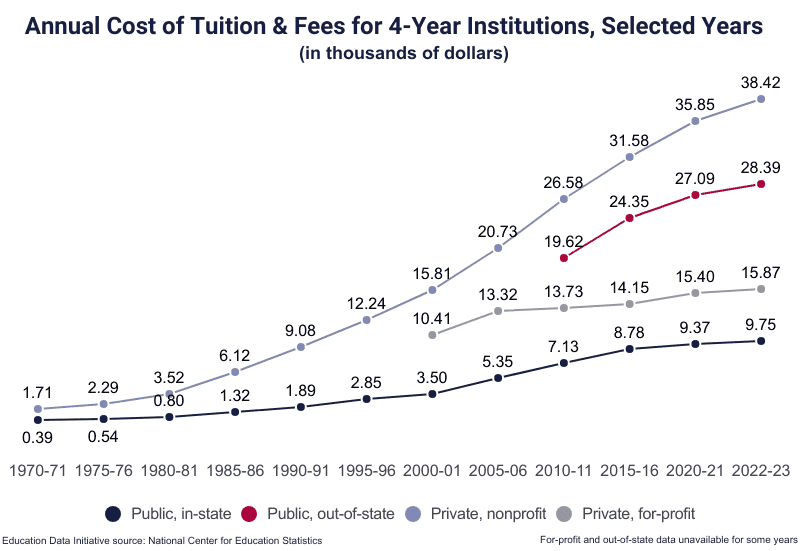
The average cost of college has more than doubled in the 21st century; the compound annual growth rate (CAGR) of tuition is 4.04%.
The average in-state student attending a public 4-year institution and living on-campus spends $27,146 for one academic year.
The average cost of in-state tuition alone is $9,750; out-of-state tuition averages $28,386.
The average private, nonprofit university student spends $58,628 per academic year living on campus, $38,421 of it on tuition and fees.
Considering student loan interest and loss of income, investing in a bachelor’s degree can ultimately cost in excess of $500,000.
.
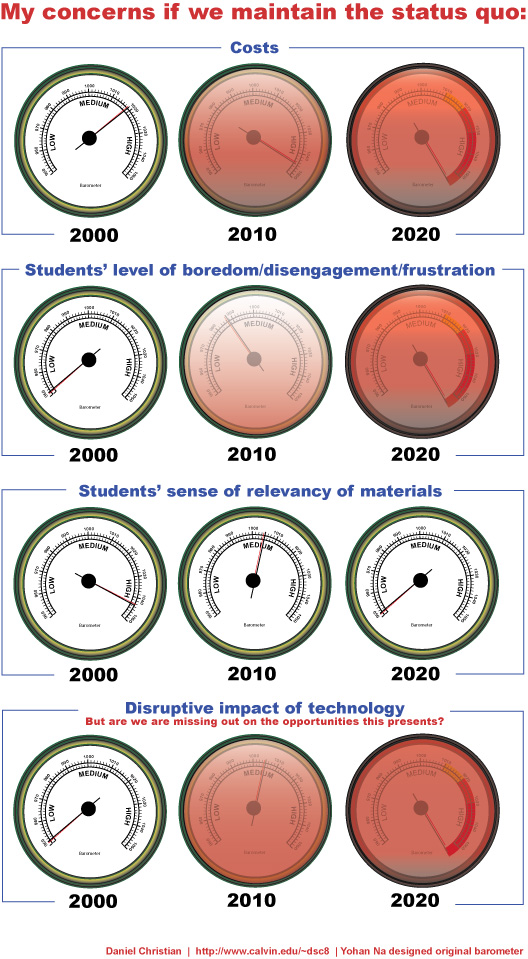
From DSC: Reminds me of a graphic that Yohan Na and I created back in 2009: .