We need a coherent approach grounded in understanding how the technology works, where it is going and what it will be used for.
From DSC: I almost feel like Meghan should right the words “this week” or “this month” after the above sentence. Whew! Things are moving fast.
For example, we’re now starting to see more agents hitting the scene — software that can DO things. But that can open up a can of worms too.
Students know the ground has shifted — and that the world outside the university expects them to shift with it. A.I. will be part of their lives regardless of whether we approve. Few issues expose the campus cultural gap as starkly as this one.ce
From DSC: Universities and colleges have little choice but to integrate AI into their programs and offerings. There’s enough pressure on institutions of traditional higher education to prove their worth/value. Students and their families want solid ROI’s. Students know that they are going to need AI-related skills (see the link immediately below for example), or they are going to be left out of the competitive job search process.
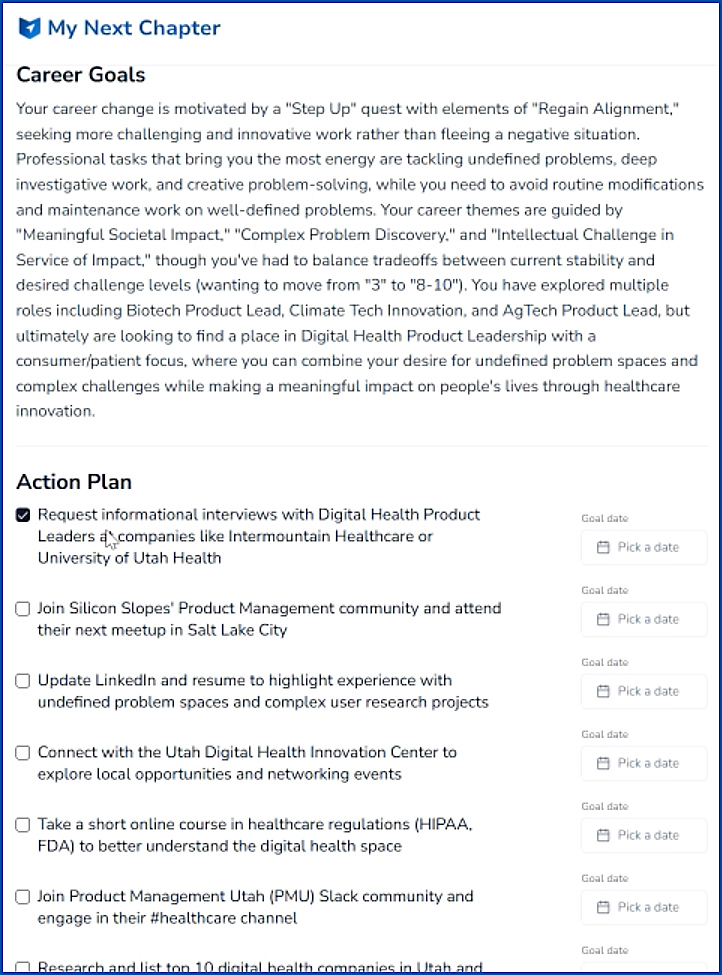
From DSC: In looking atMyNextChapter.ai— THIS TYPE OF FUNCTIONALITY of an AI-based chatbot talking to you re: good fits for a future job — is the kind of thing that could work well in this type of vision/learning platform. The AI asks you relevant career-oriented questions, comes up with some potential job fits, and then gives you resources about how to gain those skills, who to talk with, organizations to join, next steps to get your foot in the door somewhere, etc.
The next gen learning platform would provide links to online-based courses, blogs, peoples’ names on LinkedIn, courses from L&D organizations or from institutions of higher education or from other entities/places to obtain those skills (similar to the ” Action Plan” below from MyNextChapter.ai).
In Episode 5 of The Neuron Podcast, Corey Noles and Grant Harvey tackle the education crisis head-on. We explore the viral UCLA “CheatGPT” controversy, MIT’s concerning brain study, and innovative solutions like Alpha School’s 2-hour learning model. Plus, we break down OpenAI’s new $10M teacher training initiative and share practical tips for using AI to enhance learning rather than shortcut it. Whether you’re a student, teacher, or parent, you’ll leave with actionable insights on the future of education.
I also pondered what functions blogging has provided for me over the years.
Continuity – as an individual you persist across multiple organisations, roles and jobs. Although I stayed in one institution, I had many roles and the blog wasn’t associated with one specific project. Now I have left it continues.
Holistic – you can blog about one topic, but over time I think some personality will creep in. You are not just one thing, you have a personal life, tastes, interests etc which will all feed into what you do. A blog allows this more rounded representation.
Experimentation – there is relatively low cost and risk for much of it (this may not be the case for many people online, we need to acknowledge), so you can try things, and if they don’t work, so what? Also you can try formats that conventional outlets might not be appropriate for.
Development – the blog has been both an intentional and unintentional vehicle for working up ideas, documenting the process and getting feedback, which have led to more substantial outputs, such as books, project proposals and papers. Most importantly though it has been the means through which I have continually developed writing.
Connecting – particularly in those halcyon early days, it was a good way of finding others, working on ideas together, sharing something of yourself. A lot of my career related personal friendships have resulted from blogging.
Publicity – I became at one point (the OU crisis of 2018) something of a public voice of the OU, and have often used the blog for projects such as GO-GN
That’s not a bad return for a lil’ ol’ blog. I couldn’t say the same for academic journals.
AI is rewiring how we learn, and it’s a game-changer for L&D— from chieflearningofficer.com by Josh Bersin As AI becomes central to learner engagement, L&D leaders are being urged to fundamentally rethink corporate training, says global industry analyst Josh Bersin.
What are people really doing with ChatGPT? They’re learning. They’re asking questions, getting immediate answers, digging deeper, analyzing information and ultimately making themselves more productive. So, one could argue that simply by shifting to a “learn by inquiry” model, we may triple our value to the business.
From my experience, there are two main learning models in this industry. The first is “what you need to know”—linear or prescriptive things that every employee needs to understand about the company, its products and their role. This kind of content is well handled by existing L&D models.
The second, and far more important, is “what you’d like to know”—questions, curiosities and explorations about how the company works, what customers truly need and how we can each go further in our careers. Thanks to AI, this kind of learning is now explosive and transformative.
Imagine a sales rep who loses a deal. Naturally, they may ask, “What could I have done to be more successful?” A well-designed AI-powered learning system would take that question, give the employee an initial answer and chat with the individual to dig into the problem.
The system would then surface relevant sales training material and recommend videos, tips or case studies for help. And the employee, assuming they like the experience, would likely keep exploring until they feel they’ve learned what they need.
This “curiosity-based” learning is now possible, and its benefits extend far beyond traditional training.
Supreme Court green-lights Education Department layoffs— from k12dive.com by Naaz Modan The decision is a significant victory for the Trump administration as it seeks to close the department to the greatest extent possible.
The U.S. Supreme Court on Monday allowed the Trump administration to proceed with laying off nearly half the U.S. Department of Education’s staff — a significant victory for the administration’s mission to dissolve the department to the greatest extent possible.
The decision in New York v. McMahon green-lights the department’s reduction in force initiated in March as the original question of the layoffs’ legality works its way through the lower courts. The layoffs closed department offices and spurred concerns from public school advocates that the education system would descend into chaos with little federal oversight.
For 29 years, the private, non-profit center — don’t call it a school — has been a refuge for kids who chafe at the stress, loneliness or bullying of school. They spend a few months or a few years here, catching their breath as they prepare for life after graduation.
With an enrollment of 65, it offers rigorous, one-on-one tutoring; small, personalized classes in history, math, writing and the arts, and extracurriculars like weekly hiking club excursions. This year, young people designed and taught three courses on Dungeons & Dragons.
“You’re accountable to yourself. Is this the life you want?”
Kenneth Danford
While most mainstream educators would say letting young people “do nothing” for a year is out of the question, he sees it differently: In the unschooling world, he said, “there’s no such thing as ‘doing nothing.’ ”
For today’s chief learning officer, the days of just rolling out compliance training are long gone. In 2025, learning and development leaders are architects of innovation, crafting ecosystems that are agile, automated and AI-infused. This quarter’s Tech Check invites us to pause, assess and get strategic about where tech is taking us. Because the goal isn’t more tools—it’s smarter, more human learning systems that scale with the business.
Sections include:
The state of AI in L&D: Hype vs. reality
AI in design: From static content to dynamic experiences
AI in development: Redefining production workflows
NEW YORK – The AFT, alongside the United Federation of Teachers and lead partner Microsoft Corp., founding partner OpenAI, and Anthropic, announced the launch of the National Academy for AI Instruction today. The groundbreaking $23 million education initiative will provide access to free AI training and curriculum for all 1.8 million members of the AFT, starting with K-12 educators. It will be based at a state-of-the-art bricks-and-mortar Manhattan facility designed to transform how artificial intelligence is taught and integrated into classrooms across the United States.
The academy will help address the gap in structured, accessible AI training and provide a national model for AI-integrated curriculum and teaching that puts educators in the driver’s seat.
In an era when the college-going rate of high school graduates has dropped from an all-time high of 70 percent in 2016 to roughly 62 percent now, AI seems to be heightening the anxieties about the value of college.
According to the survey, two-thirds of parents say AI is impacting their view of the value of college. Thirty-seven percent of parents indicate they are now scrutinizing college’s “career-placement outcomes”; 36 percent say they are looking at a college’s “AI-skills curriculum,” while 35 percent respond that a “human-skills emphasis” is important to them.
This echoes what I increasingly hear from college leadership: Parents and students demand to see a difference between what they are getting from a college and what they could be “learning from AI.”
Culture matters here. Organizations that foster psychological safety—where experimentation is welcomed and mistakes are treated as learning—are making the most progress. When leaders model curiosity, share what they’re trying, and invite open dialogue, teams follow suit. Small tests become shared wins. Shared wins build momentum.
Career development must be part of this equation. As roles evolve, people will need pathways forward. Some will shift into new specialties. Others may leave familiar roles for entirely new ones. Making space for that evolution—through upskilling, mobility, and mentorship—shows your people that you’re not just investing in AI, you’re investing in them.
And above all, people need transparency. Teams don’t expect perfection. But they do need clarity. They need to understand what’s changing, why it matters, and how they’ll be supported through it. That kind of trust-building communication is the foundation for any successful change.
These shifts may play out differently across sectors—but the core leadership questions will likely be similar.
AI marks a turning point—not just for technology, but for how we prepare our people to lead through disruption and shape the future of learning.
At least 85% of students with disabilities can learn and achieve on grade level.
14% of all U.S. students have a disability.
No belief is more damaging in education than the misperception that children with disabilities cannot really succeed and shouldn’t be challenged to reach the same high standards as all children.
Arne Duncan, former U.S. Secretary of Education
From DSC: One of our kids — actually, who is no longer a kid anymore — was born with Mosaic Down Syndrome. Looking back on her K-12 years, first through fifth grade went very well — which my wife and I were very grateful for. (We didn’t know what each year would bring and whether she would be able to move on to the next grade.)
But sixth and seventh grades were very rough. At the end of seventh grade, we decided to homeschool our daughter. The system she was in — like so many school systems across the nation — was meant to address the 80% of students who are neither gifted nor have special needs. The quickly-moving trains leave at such and such a time and then stop at such and such a time. One better keep up. This traditional system is a one-size-fits-all approach, and it’s something we do for administrative purposes — it’s not for the benefit of the kids within K-12 schools.
After a few years of both homeschooling and Christian education, it turned out that our daughter was able to learn almost all of the subjects in high school. But she needed to learn ON HER TIMELINE…AT HER OWN PACE of learning.
We’re proud of her. She has had a couple of jobs already and is doing quite well overall. Her motivation has been very low at times, which made homeschooling very tough. But, overall, I would agree with Karla Phillips-Krivicka’s key point that at least 85% of students with disabilities can learn and achieve at grade level. That’s been true for our daughter who has some special needs.
How Do You Teach Computer Science in the A.I. Era? — from nytimes.com by Steve Lohr; with thanks to Ryan Craig for this resource Universities across the country are scrambling to understand the implications of generative A.I.’s transformation of technology.
The future of computer science education, Dr. Maher said, is likely to focus less on coding and more on computational thinking and A.I. literacy. Computational thinking involves breaking down problems into smaller tasks, developing step-by-step solutions and using data to reach evidence-based conclusions.
A.I. literacy is an understanding — at varying depths for students at different levels — of how A.I. works, how to use it responsibly and how it is affecting society. Nurturing informed skepticism, she said, should be a goal.
At Carnegie Mellon, as faculty members prepare for their gathering, Dr. Cortina said his own view was that the coursework should include instruction in the traditional basics of computing and A.I. principles, followed by plenty of hands-on experience designing software using the new tools.
“We think that’s where it’s going,” he said. “But do we need a more profound change in the curriculum?”
Adulting and Career Exploration — from the-job.beehiiv.com by Paul Fain Junior Achievement helps high school grads learn life skills and gain work experience while figuring out what comes next.
Bridging the Gap Between School and Careers Junior Achievement has stepped into the blur space between high school and what comes next. The nonprofit’s 5th Year program gives young adults a structured year to live on a college campus and explore careers, gain work experience, and build life skills.
An initial cohort of 24 students graduated this May from a trial run of the program based in Toledo, Ohio. Each participant held two internships—one in the fall and one in the spring. They also visited 60 employers across the metro area. Represented industries included law, engineering, construction, accounting, healthcare, higher education, and nonprofit organizations.
The program is focused on helping students find a clear path forward, by guiding them to match their interests and abilities with in-demand careers and local job opportunities.
“We’re giving them the space to just pause,” he says. “To discover, to explore, to grow personally, to grow socially.”
The microschooling sector’s robust diversity of educational approaches is often described by the families who choose it as among its most appealing attributes. The wide range of approaches offered, and the many ways different approaches are combined within different microschooling models, offer families options usually not currently available in the communities they live.
And while many of these approaches, like project-based learning, are popular across all of American education, within the smaller, more personalized and responsive context of a microschool, educators are able to take advantage of their flexibility to delve more deeply into the possibilities of each than they were in the more rigid structures of most traditional schools.
According to 2025 research published by the National Microschooling Center, microschool leaders reported that project-based learning is the most popular educational approach used (72 percent). Respondents were asked to indicate all that apply, so microschools typically indicated incorporating multiple approaches.