Law firm leaders should evaluate their legal technology and decide if they are truly helping legal work or causing a disconnect between human and AI contributions.
75% of firms now rely on cloud platforms for everything from document storage to client collaboration.
The rise of virtual law firms and remote work is reshaping the profession’s culture. Hybrid and remote-first models, supported by cloud and collaboration tools, are growing.
Are we truly innovating, or just rearranging the furniture? That’s the question every law firm leader should be asking as the legal technology landscape shifts beneath our feet. There are many different thoughts and opinions on how the legal technology landscape will evolve in the coming years, particularly regarding the pace of generative AI-driven changes and the magnitude of these changes.
To try to answer the question posed above, we looked at six recently published technology trends reports from influential entities in the legal technology arena: the American Bar Association, Clio, Wolters Kluwer, Lexis Nexis, Thomson Reuters, and NetDocuments.
When we compared these reports, we found them to be remarkably consistent. While the level of detail on some topics varied across the reports, they identified six trends that are reshaping the very core of legal practice. These trends are summarized in the following paragraphs.
The new legal intelligence — from jordanfurlong.substack.com by Jordan Furlong We’ve built machines that can reason like lawyers. Artificial legal intelligence is becoming scalable, portable and accessible in ways lawyers are not. We need to think hard about the implications.
Both these features build on Clio’s out-of-nowhere $1B acquisition of vLex (and its legally grounded LLM Vincent) back in June.
A new source of legal intelligence has entered the legal sector.
…
Legal intelligence, once confined uniquely to lawyers, is now available from machines. That’s going to transform the legal sector.
The public conversation about artificial intelligence is dominated by the spectacular and the controversial: deepfake videos, AI-induced psychosis, and the privacy risks posed by consumer-facing chatbots like ChatGPT. But while these stories grab headlines, a quieter – and arguably more transformative – revolution is underway in enterprise software. In legal technology, in particular, AI is rapidly reshaping how law firms and legal departments operate and compete. This shift is just one example of how enterprise AI, not just consumer AI, is where real action is happening.
Both Harvey and Clio illustrate a crucial point: the future of legal tech is not about disruption for its own sake, but partnership and integration. Harvey’s collaborations with LexisNexis and others are about creating a cohesive experience for law firms, not rendering them obsolete. As Pereira put it, “We don’t see it so much as disruption. Law firms actually already do this… We see it as ‘how do we help you build infrastructure that supercharges this?’”
…
The rapid evolution in legal tech is just one example of a broader trend: the real action in AI is happening in enterprise software, not just in consumer-facing products. While ChatGPT and Google’s Gemini dominate the headlines, companies like Cohere are quietly transforming how organizations across industries leverage AI.
The AI company’s plan to open an office in Toronto isn’t just about expanding territory – it’s a strategic push to tap into top technical talent and capture a market known for legal innovation.
Building on our previous disclosure of the Perplexity Comet vulnerability, we’ve continued our security research across the agentic browser landscape. What we’ve found confirms our initial concerns: indirect prompt injection is not an isolated issue, but a systemic challenge facing the entire category of AI-powered browsers. This post examines additional attack vectors we’ve identified and tested across different implementations.
As we’ve written before, AI-powered browsers that can take actions on your behalf are powerful yet extremely risky. If you’re signed into sensitive accounts like your bank or your email provider in your browser, simplysummarizing a Reddit postcould result in an attacker being able to steal money or your private data.
The above item was mentioned by Grant Harvey out at The Neuron in the following posting:
Robin’s Legal Tech Backfire
Robin AI, the poster child for the “AI meets law” revolution, is learning the hard way that venture capital fairy dust doesn’t guarantee happily-ever-after. The London-based legal tech firm, once proudly waving its genAI-plus-human-experts flag, is now cutting staff after growth dreams collided with the brick wall of economic reality.
The company confirmed that redundancies are under way following a failed major funding push. Earlier promises of explosive revenue have fizzled. Despite around $50 million in venture cash over the past two years, Robin’s 2025 numbers have fallen short of investor expectations. The team that once ballooned to 200 is now shrinking.
The field is now swarming with contenders: CLM platforms stuffing genAI into every feature, corporate legal teams bypassing vendors entirely by prodding ChatGPT directly, and new entrants like Harvey and Legora guzzling capital to bulldoze into the market. Even Workday is muscling in.
Meanwhile, ALSPs and AI-powered pseudo-law firms like Crosby and Eudia are eating market share like it’s free pizza. The number of inhouse teams actually buying these tools at scale is still frustratingly small. And investors don’t have much patience for slow burns anymore.
TL;DR: AI no longer rewards politeness—new research shows direct, assertive prompts yield better, more detailed responses. Learn why this shift matters for legal precision, test real-world examples (polite vs. blunt), and set up custom instructions in OpenAI (plus tips for other models) to make your AI a concise analytical tool, not a chatty one. Actionable steps inside to upgrade your workflow immediately.
My take is this: in all of the anxiety lies a crucial and long-overdue opportunity to deliver better learning experiences. Precisely because Atlas perceives the same context in the same moment as you, it can transform learning into a process aligned with core neuro-scientific principles—including active retrieval, guided attention, adaptive feedback and context-dependent memory formation.
Perhaps in Atlas we have a browser that for the first time isn’t just a portal to information, but one which can become a co-participant in active cognitive engagement—enabling iterative practice, reflective thinking, and real-time scaffolding as you move through challenges and ideas online.
With this in mind, I put together 10 use cases for Atlas for you to try for yourself.
…
6. Retrieval Practice
What: Pulling information from memory drives retention better than re-reading. Why: Practice testing delivers medium-to-large effects (Adesope et al., 2017). Try: Open a document with your previous notes. Ask Atlas for a mixed activity set: “Quiz me on the Krebs cycle—give me a near-miss, high-stretch MCQ, then a fill-in-the-blank, then ask me to explain it to a teen.” Atlas uses its browser memory to generate targeted questions from your actual study materials, supporting spaced, varied retrieval.
From DSC: A quick comment. I appreciate these ideas and approaches from Katarzyna and Rita. I do think that someone is going to want to be sure that the AI models/platforms/tools are given up-to-date information and updated instructions — i.e., any new procedures, steps to take, etc. Perhaps I’m missing the boat here, but an internal AI platform is going to need to have access to up-to-date information and instructions.
From DSC: Stephen has some solid reflections and asks some excellent questions in this posting, including:
The question is: how do we optimize an AI to support learning? Will one model be enough? Or do we need different models for different learners in different scenarios?
A More Human University: The Role of AI in Learning — from er.educause.edu by Robert Placido Far from heralding the collapse of higher education, artificial intelligence offers a transformative opportunity to scale meaningful, individualized learning experiences across diverse classrooms.
The narrative surrounding artificial intelligence (AI) in higher education is often grim. We hear dire predictions of an “impending collapse,” fueled by fears of rampant cheating, the erosion of critical thinking, and the obsolescence of the human educator.Footnote1 This dystopian view, however, is a failure of imagination. It mistakes the death rattle of an outdated pedagogical model for the death of learning itself. The truth is far more hopeful: AI is not an asteroid coming for higher education. It is a catalyst that can finally empower us to solve our oldest, most intractable problem: the inability to scale deep, engaged, and truly personalized learning.
Increasing the rate of scientific progress is a core part of Anthropic’s public benefit mission.
We are focused on building the tools to allow researchers to make new discoveries – and eventually, to allow AI models to make these discoveries autonomously.
Until recently, scientists typically used Claude for individual tasks, like writing code for statistical analysis or summarizing papers. Pharmaceutical companies and others in industry also use it for tasks across the rest of their business, like sales, to fund new research. Now, our goal is to make Claude capable of supporting the entire process, from early discovery through to translation and commercialization.
To do this, we’re rolling out several improvements that aim to make Claude a better partner for those who work in the life sciences, including researchers, clinical coordinators, and regulatory affairs managers.
AI as an access tool for neurodiverse and international staff— from timeshighereducation.com by Vanessa Mar-Molinero Used transparently and ethically, GenAI can level the playing field and lower the cognitive load of repetitive tasks for admin staff, student support and teachers
Where AI helps without cutting academic corners When framed as accessibility and quality enhancement, AI can support staff to complete standard tasks with less friction. However, while it supports clarity, consistency and inclusion, generative AI (GenAI) does not replace disciplinary expertise, ethical judgement or the teacher–student relationship. These are ways it can be put to effective use:
The Sleep of Liberal Arts Produces AI — from aiedusimplified.substack.com by Lance Eaton, Ph.D. A keynote at the AI and the Liberal Arts Symposium Conference
This past weekend, I had the honor to be the keynote speaker at a really fantstistic conferece, AI and the Liberal Arts Symposium at Connecticut College. I had shared a bit about this before with my interview with Lori Looney. It was an incredible conference, thoughtfully composed with a lot of things to chew on and think about.
It was also an entirely brand new talk in a slightly different context from many of my other talks and workshops. It was something I had to build entirely from the ground up. It reminded me in some ways of last year’s “What If GenAI Is a Nothingburger”.
It was a real challenge and one I’ve been working on and off for months, trying to figure out the right balance. It’s a work I feel proud of because of the balancing act I try to navigate. So, as always, it’s here for others to read and engage with. And, of course, here is the slide deck as well (with CC license).
The Most Innovative Law Schools (2025) — from abovethelaw.com by Staci Zaretsky Forget dusty casebooks — today’s leaders in legal education are using AI, design thinking, and real-world labs to reinvent how law is taught.
“[F]rom AI labs and interdisciplinary centers to data-driven reform and bold new approaches to design and client service,” according to National Jurist’s preLaw Magazine, these are the law schools that “exemplify innovation in action.”
North Carolina Central University School of Law
Suffolk University Law School
UC Berkeley School of Law
Nova Southeastern University Shepard Broad College of Law
Northeastern University School of Law
Maurice A. Deane School of Law at Hofstra University
Seattle University School of Law
Case Western Reserve University School of Law
University of Miami School of Law
Benjamin N. Cardozo School of Law at Yeshiva University
Vanderbilt University Law School
Southwestern Law School
Click here to read short summaries of why each school made this year’s list of top innovators.
Newton delivered what may have been the most consequential keynote in the company’s history and one that signals a shift by Clio from a traditional practice management provider to a comprehensive platform that essentially does everything for the business and practice of law.
…
Clio also earlier this year acquired vLex, the heavy-duty AI legal research player. The acquisition is pending regulatory approval. It is the vLex acquisition that is powering the Clio transformation that Newton described in his keynote.
vLex has a huge amount of legal data in its wheelhouse to power sophisticated legal AI research. On top of this data, vLex developed Vincent, a powerful AI tool to work with this data and enable all sorts of actions and work.
This means a couple of things. First, by acquiring vLex, Clio can now offer its customers AI legal research tools. Clio customers will no longer have to go one place for its practice management needs and a second place for its substantive legal work, like research. It makes what Clio can provide much more comprehensive and all inclusive.
Artificial intelligence will give solos and small firms “a huge advantage,” according to one legal tech consultant.
In this episode of “Adventures in Legal Tech,” host Jared Correia speaks with Ernie Svenson — aka “Ernie the Attorney” — about the psychology behind resistance to change, how law firms are positioning their AI use, the power of technology for business development, and more.
Legal ops experts can categorize legal AI platforms and software by the ability to streamline key tasks such as legal research, document processing or analysis, and drafting.
The trustworthiness and accuracy of AI hinge on the quality of its underlying data; solutions like CoCounsel Legal are grounded in authoritative, expert-verified content from Westlaw and Practical Law, unlike providers that may rely on siloed or less reliable databases.
When evaluating legal software, firms should use a framework that assesses critical factors such as integration with existing tech stacks, security, scalability, user adoption, and vendor reputation.
The Sandra Day O’Connor College of Law at Arizona State University appointed Sean Harrington as director of the newly established AI and Legal Tech Studio, a key milestone in ASU Law’s bold initiative to reimagine legal education for the artificial intelligence era. ASU, ranked No. 1 in innovation for the 11th consecutive year, drives AI solutions that enhance teaching, enrich student training and facilitate digital transformation.
The sixth annual American Legal Technology Awards were presented on Wednesday, October 15th, at Suffolk University Law School (Boston), recognizing winners across ten categories. There were 211 nominees who were evaluated by 27 judges.
“Future of Professionals Report” analysis: Why AI will flip law firm economics — from thomsonreuters.com by Ragunath Ramanathan AI forces a reinvention of law firm billing models, the market will reward those firms that price by outcome, guarantee efficiency, and are transparent. The question then isn’t whether to change — it’s whether firms will stand on the sidelines or lead
Key insights:
Efficiency and cost savings are expected— AI is significantly increasing efficiency and reducing costs in the legal industry, with each lawyer expecting to save 190 work-hours per year by leveraging AI, resulting in approximately $20 billion worth of work-savings in the US alone.
Challenges to the billable hour model— The traditional billable hour model is being challenged by AI advancements, as lawyers are now able to complete tasks more efficiently and quickly, leading some law firms to explore alternative pricing models that reflect the value delivered rather than the time spent.
Opportunities for smaller law firms— AI presents unique opportunities for smaller law firms to differentiate themselves and compete with larger firms, as AI solutions allow smaller firms to access advanced technology without significant investment and deliver innovative pricing models.
The legal industry is undergoing a significant transformation that’s being driven by the rapid adoption of AI — a shift that is poised to redefine traditional practices, particularly the billable hour model, a cornerstone of law firm operations.
…
Not surprisingly, AI is anticipated to have the biggest impact on the legal industry over the next five years, with 80% of law firm survey respondents to Thomson Reuters recently published 2025 Future of Professionals report saying that they expect AI to fundamentally alter how they conduct business, especially around how law firms price, staff, and deliver legal work to their clients.
What if one line of invisible text could change how your AI interprets an entire case file?
This isn’t hypothetical. It’s called prompt injection, and as more legal teams connect LLMs to client files, discovery docs, and contract repositories, the risk is growing, fast.
…
The AI, following instructions like a good little pattern matcher, now refers to the entire thing using the wrong legal frame.
You never saw the white text.
Your associate didn’t catch it.
The system happily processes it as truth.
And now you have slop in the system. Not because the AI hallucinated but because it was tricked.
While over 80% of respondents in the 2025 AI in Education Report have already used AI for school, we believe there are significant opportunities to design AI that can better serve each of their needs and broaden access to the latest innovation.1
That’s why today [10/15/25], we’re announcing AI-powered experiences built for teaching and learning at no additional cost, new integrations in Microsoft 365 apps and Learning Management Systems, and an academic offering for Microsoft 365 Copilot.
Introducing AI-powered teaching and learning Empowering educators with Teach
We’re introducing Teach to help streamline class prep and adapt AI to support educators’ teaching expertise with intuitive and customizable features. In one place, educators can easily access AI-powered teaching tools to create lesson plans, draft materials like quizzes and rubrics, and quickly make modifications to language, reading level, length, difficulty, alignment to relevant standards, and more.
Combining two strategies—spacing and retrieval practice—is key to success in learning, says Shana Carpenter.
On a somewhat related note (i.e., for Instructional Designers, teachers, faculty members, T&L staff members), also see:
Fresh Approaches to Instructional Design — from edutopia.org by Sara Furnival An educator with 20-plus years of experience on crafting creative and energizing lessons.
The numbers are stark: 92% of low-income Americans receive no help with substantial civil legal problems, while small claims filings have plummeted 32% in just four years. But AI is changing the game. By making legal procedures accessible to pro se litigants and supercharging legal aid organizations, these tools are reviving dormant disputes and opening courthouse doors that have been effectively closed to millions.
A growing number of U.S. law schools are now requiring students to train in artificial intelligence, marking a shift from optional electives to essential curriculum components. What was once treated as a “nice-to-have” skill is fast becoming integral as the legal profession adapts to the realities of AI tools.
From Experimentation to Obligation
Until recently, most law schools relegated AI instruction to upper-level electives or let individual professors decide whether to incorporate generative AI into their teaching. Now, however, at least eight law schools require incoming students—especially in their first year—to undergo training in AI, either during orientation, in legal research and writing classes, or via mandatory standalone courses.
Some of the institutions pioneering the shift include Fordham University, Arizona State University, Stetson University, Suffolk University, Washington University in St. Louis, Case Western, and the University of San Francisco.
There’s a vision that’s been teased Learning & Development for decades: a vision of closing the gap between learning and doing—of moving beyond stopping work to take a course, and instead bringing support directly into the workflow. This concept of “learning in the flow of work” has been imagined, explored, discussed for decades —but never realised. Until now…?
This week, an article published Harvard Business Review provided some some compelling evidence that a long-awaited shift from “courses to coaches” might not just be possible, but also powerful.
…
The two settings were a) traditional in-classroom workshops, led by an expert facilitator and b) AI-coaching, delivered in the flow of work.The results were compelling….
TLDR: The evidence suggests that “learning in the flow of work” is not only feasible as a result of gen AI—it also show potential to be more scalable, more equitable and more efficient than traditional classroom/LMS-centred models.
The 10 Most Popular AI Chatbots For Educators — from techlearning.com by Erik Ofgang Educators don’t need to use each of these chatbots, but it pays to be generally aware of the most popular AI tools
I’ve spent time testing many of these AI chatbots for potential uses and abuses in my own classes, so here’s a quick look at each of the top 10 most popular AI chatbots, and what educators should know about each. If you’re looking for more detail on a specific chatbot, click the link, as either I or other Tech & Learning writers have done deeper dives on all these tools.
Generative artificial intelligence isn’t just a new tool—it’s a catalyst forcing the higher education profession to reimagine its purpose, values, and future.
…
As experts in educational technology, digital literacy, and organizational change, we argue that higher education must seize this moment to rethink not just how we use AI, but how we structure and deliver learning altogether.
Over the past decade, microschools — experimental small schools that often have mixed-age classrooms — have expanded.
…
Some superintendents have touted the promise of microschools as a means for public schools to better serve their communities’ needs while still keeping children enrolled in the district. But under a federal administration that’s trying to dismantle public education and boost homeschool options, others have critiqued poor oversight and a lack of information for assessing these models.
Microschools offer a potential avenue to bring innovative, modern experiences to rural areas, argues Keith Parker, superintendent of Elizabeth City-Pasquotank Public Schools.
Imagining Teaching with AI Agents… — from michellekassorla.substack.com by Michelle Kassorla Teaching with AI is only one step toward educational change, what’s next?
More than two years ago I started teaching with AI in my classes. At first I taught against AI, then I taught with AI, and now I am moving into unknown territory: agents. I played with Manus and n8n and some other agents, but I really never got excited about them. They seemed more trouble than they were worth. It seemed they were no more than an AI taskbot overseeing some other AI bots, and that they weren’t truly collaborating. Now, I’m looking at Perplexity’s Comet browser and their AI agent and I’m starting to get ideas for what the future of education might hold.
I have written several times about the dangers of AI agents and how they fundamentally challenge our systems, especially online education. I know there is no way that we can effectively stop them–maybe slow them a little, but definitely not stop them. I am already seeing calls to block and ban agents–just like I saw (and still see) calls to block and ban AI–but the truth is they are the future of work and, therefore, the future of education.
So, yes! This is my next challenge: teaching with AI agents. I want to explore this idea, and as I started thinking about it, I got more and more excited. But let me back up a bit. What is an agent and how is it different than Generative AI or a bot?
For lawyers, paralegals, compliance professionals, and legal tech specialists, 2025 is shaping up to be a strong hiring year. According to a new LawCrossing report, theTop 50 Legal Employers Hiring Now highlights a wave of open positions across law firms, corporations, government agencies, and universities — a snapshot of where demand is highest and where job-seekers should be focusing their efforts.
… The Types of Employers on the List The Top 50 Legal Employers Hiring Now spans a diverse set of organizations:
Corporate Legal Departments: …
Law Firms: …
Government Agencies: …
Universities and Nonprofits: …
This diversity means opportunities exist for professionals at many career stages, whether you are a new graduate seeking entry-level work, a mid-career attorney looking for stability, or a seasoned litigator hoping to move in-house.
.
U.S. law schools are experiencing a surge unlike anything seen in over a decade, with first-year J.D. classes hitting record sizes this fall. The unprecedented boom follows an 18 % year-over-year jump in applications, fueled by a mix of economic uncertainty, political engagement, and strong job prospects for recent graduates.
On September 16, members of the IAALS Lawyers Council gathered in downtown Denver to discuss the growing momentum of alternative business structures with Arizona Chief Justice Ann A. Scott Timmer and Jess Bednarz, IAALS’ Director of Legal Services and the Profession.
Arizona is on the frontlines of this movement, and Chief Justice Timmer talked about how alternative business structures have led to meaningful innovations in how lawyers in Arizona provide legal services.
Chief Justice Timmer credits a culture of innovation in Arizona for providing the ability for lawyers and businesses to try new ways of delivering legal services. She emphasized that lawyers are still at the heart of the practice of law in these alternative business structures, and that the structures allow lawyers to have added resources to innovate and reach more clients. This creativity has led to businesses and innovations that make the legal system easier to access, like financial planners and lawyers combining businesses or an app that helps people start the process of expunging criminal records.
With as many as 120 million legal problems going unresolved in America each year, traditional lawyer-centered approaches to access to justice have consistently failed to meet the scale of need. But what if the solution is not just about providing more legal services — what if it lies in fundamentally rethinking who can provide legal help?
In today’s episode, host Bob Ambrogi is joined by two of the nation’s leading researchers on access to justice: Rebecca Sandefur, professor and director of the Sanford School of Social and Family Dynamics at Arizona State University and a faculty fellow at the American Bar Foundation, and Matthew Burnett, director of research and programs for the Access to Justice Research Initiative at the American Bar Foundation and an adjunct professor of law at Georgetown University Law Center.
Aiming to discover more about AI’s impact on the intellectual property (IP) field, Questel recently released the findings of its 2025 IP Outlook Research Report entitled “Pathways to Productivity: AI in IP”, the much-awaited follow-up to its inaugural 2024 study “Beyond the Hype: How Technology is Transforming IP.” The 2025 Report (“the Report”) polled over 500 patent and trademark professionals from various continents and countries across the globe.
As artificial intelligence reshapes the legal profession, both in-house and outside counsel face two major—but not unprecedented—challenges.
The first is how to harness transformative technology while maintaining the rigorous standards that define effective legal practice.
The second is how to ensure that new technology doesn’t impair the training and development of new lawyers.
Rigorous standards and apprenticeship are foundational aspects of lawyering. Preserving and integrating both into our use of AI will be essential to creating a stable and effective AI-enabled legal practice.
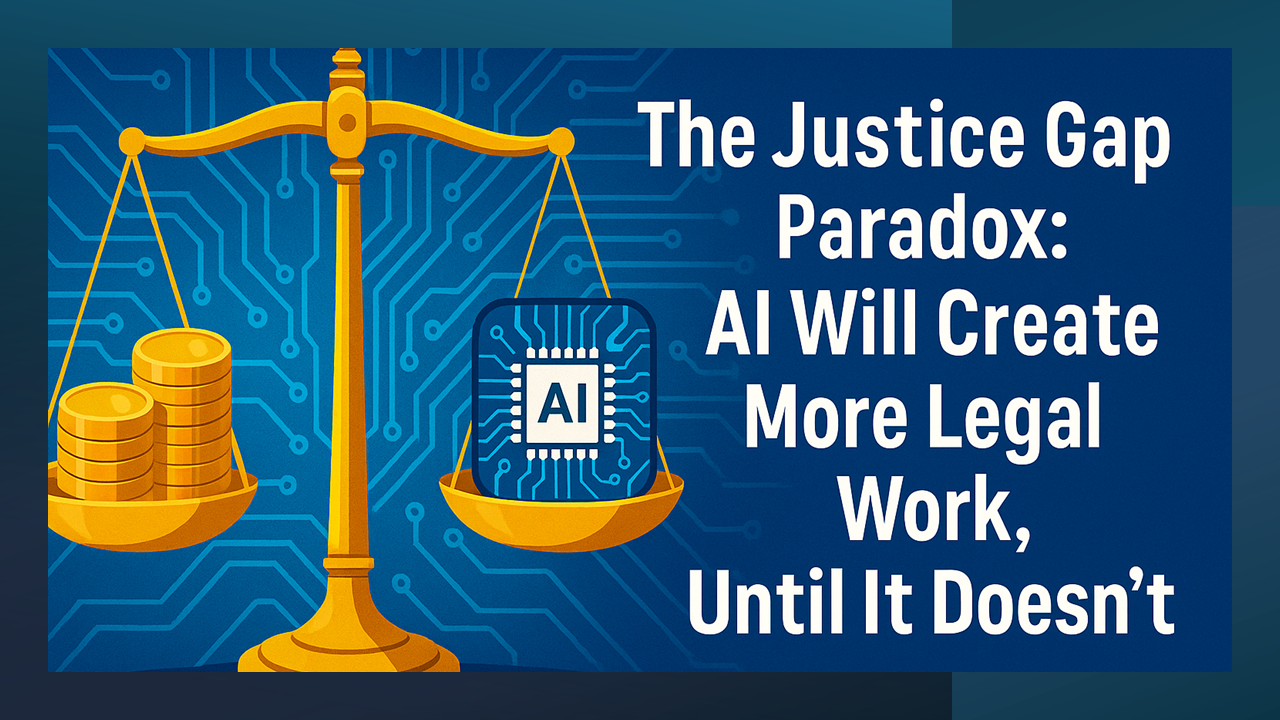
Every technology vendor pitching to law firms leads with the same promise: our solution will save you time. They’re lying, and they know it. The truth about AI in legal practice isn’t that it will reduce work. It’s that it will explode the volume of work while fundamentally changing what that work looks like.
New practice areas will emerge overnight. AI compliance law is already booming. Algorithmic discrimination cases are multiplying. Smart contract disputes need lawyers who understand both code and law. The metaverse needs property rights. Cryptocurrency needs regulation. Every technological advance creates legal questions that didn’t exist yesterday.
The skill shift will be brutal for lawyers who resist.
Finalists have been named for the 2025 American Legal Technology Awards, which honor exceptional achievement in various aspects of legal technology.
The awards recognize achievement in various categories related to legal technology, such as by a law firm, an individual, or an enterprise.
The awards will be presented on Oct. 15 at a gala dinner on the eve of the Clio Cloud Conference in Boston, Mass. The dinner will be held at Suffolk Law School.
ChatGPT: the world’s most influential teacher — from drphilippahardman.substack.com by Dr. Philippa Hardman; emphasis DSC New research shows that millions of us are “learning with AI” every week: what does this mean for how (and how well) humans learn?
This week, an important piece of researchlanded that confirms the gravity of AI’s role in the learning process. The TLDR is that learning is now a mainstream use case for ChatGPT; around 10.2% of all ChatGPT messages (that’s ~2BN messages sent by over 7 million users per week) are requests for help with learning.
The research shows that about 10.2% of all messages are tutoring/teaching, and within the “Practical Guidance” category, tutoring is 36%. “Asking” interactions are growing faster than “Doing” and are rated higher quality by users. Younger people contribute a huge share of messages, and growth is fastest in low- and middle-income countries (How People Use ChatGPT, 2025).
If AI is already acting as a global tutor, the question isn’t “will people learn with AI?”—they already are. The real question we need to ask is: what does great learning actually look like, and how should AI evolve to support it? That’s where decades of learning science help us separate “feels like learning” from “actually gaining new knowledge and skills”.