Beyond Infographics: How to Use Nano Banana to *Actually* Support Learning — from drphilippahardman.substack.com by Dr Philippa Hardman
Six evidence-based use cases to try in Google’s latest image-generating AI tool

While it’s true that Nano Banana generates better infographics than other AI models, the conversation has so far massively under-sold what’s actually different and valuable about this tool for those of us who design learning experiences.

What this means for our workflow:

Instead of the traditional “commission ? wait ? tweak ? approve ? repeat” cycle, Nano Banana enables an iterative, rapid-cycle design process where you can:

  • Sketch an idea and see it refined in minutes.
  • Test multiple visual metaphors for the same concept without re-briefing a designer.
  • Build 10-image storyboards with perfect consistency by specifying the constraints once, not manually editing each frame.
  • Implement evidence-based strategies (contrasting cases, worked examples, observational learning) that are usually too labour-intensive to produce at scale.

This shift—from “image generation as decoration” to “image generation as instructional scaffolding”—is what makes Nano Banana uniquely useful for the 10 evidence-based strategies below.


Beyond ChatGPT: Why In-House Counsel Need Purpose Built AI (Cecilia Ziniti, CEO – GC AI) — from tlpodcast.com

This episode features a conversation with Cecilia Ziniti, Co-Founder and CEO of GC.AI. Cecilia traces her career from the early days of the internet to founding an AI-driven legal platform for in-house counsel.

Cecilia shares her journey, starting as a paralegal at Yahoo in the early 2000s, working on nascent legal issues related to the internet. She discusses her time at Morrison & Foerster and her role at Amazon, where she was an early member of the Alexa team, gaining deep insight into AI’s potential before the rise of modern large language models (LLMs).

The core discussion centers on the creation of GC AI, a legal AI tool specifically designed for in-house counsel. Cecilia explains why general LLMs like ChatGPT are insufficient for professional legal work—lacking proper citation, context, and security/privilege protections. She highlights the app’s features, including enhanced document analysis (RAG implementation), a Word Add-in, and workflow-based playbooks to deliver accurate, client-forward legal analysis. The episode also touches on the current state of legal tech, the growing trend of bringing legal work in-house, and the potential for AI to shift the dynamics of the billable hour.


Law Firm 2.0: A Trillion-Dollar Market Begins To Move — from abovethelaw.com by Ken Crutchfield
The test cases for Law Firm 2.0 are arriving faster than many expected.

A move to separate legal advice from other legal services that don’t require advice is a big shift that would ripple through established firms and also test regulatory boundaries.

The LegalTech Fund (TLTF) sees a $1 trillion opportunity to reinvent legal services through the convergence of technology, regulatory changes, and innovation. TLTF calls this movement Law Firm 2.0, and the fund believes a reinvention will pave the way for entirely new, tech-enabled models of legal service delivery.


From Paper to Platform: How LegalTech Is Revolutionizing the Practice of Law — from markets.financialcontent.com by AB Newswire

For decades, practicing law has been a business about paper — contracts, case files, court documents, and floor-to-ceiling piles of precedent. But as technology transforms all aspects of modern-day business, law firms and in-house legal teams are transforming along with it. The development of LegalTech has revolutionized what was previously a paper-driven, manpower-intensive profession into a data-driven digital web of collaboration and automation.

Conclusion: Building the Future of Law
The practice of law has always been about accuracy, precedent, and human beings. Technology doesn’t alter that — it magnifies it. The shift to the platform from paper is about liberating lawyers from back-office tasks so they can concentrate on strategy, advocacy, and creativity.

By coupling intelligent automation with moral obligation, today’s firms are positioning the legal profession for a more intelligent, responsive industry. LegalTech isn’t about automation, it’s about empowering attorneys to practice at the speed of today’s business.


What Legal Can Learn from Other Industries’ AI Transformations — from jdsupra.com

Artificial intelligence has already redefined how industries like finance, healthcare, and supply chain operate — transforming once-manual processes into predictive, data-driven engines of efficiency.

Yet the legal industry, while increasingly open to innovation, still lags behind its peers in adopting automation at scale. As corporate legal departments face mounting pressure to do more with less, they have an opportunity to learn from how other sectors successfully integrated AI into their operations.

The message is clear: AI transformation doesn’t just change workflows — it changes what’s possible.


7 Legal Tech Trends To Watch In 2026 — from lexology.com


Small Language Models Are Changing Legal Tech: What That Means for Lawyers and Law Firms — from community.nasscom.in

The legal profession is at a turning point. Artificial intelligence tools are moving from novelty to everyday utility, and small language models, or SLMs, are a major reason why. For law firms and in-house legal teams that are balancing client confidentiality, tight budgets, and the need to move faster, SLMs offer a practical, high impact way to bring legal AI into routine practice. This article explains what SLMs are, why they matter to lawyers, where they fit in legal workflows, and how to adopt them responsibly.


Legal AI startup draws new $50 million Blackstone investment, opens law firm — from reuters.com by Sara Merken

NEW YORK, Nov 20 (Reuters) – Asset manager Blackstone (BX.N), opens new tab has invested $50 million in Norm Ai, a legal and compliance technology startup that also said on Thursday that it is launching an independent law firm that will offer “AI-native legal services.”

Lawyers at the new New York-based firm, Norm Law LLP, will use Norm Ai’s artificial intelligence technology to do legal work for Blackstone and other financial services clients, said Norm Ai founder and CEO John Nay.


Law School Toolbox Podcast Episode 531: What Law Students Should Know About New Legal Tech (w/Gabe Teninbaum) — from jdsupra.com

Today, Alison and Gabe Teninbaum — law professor and creator of SpacedRepetition.com — discuss how technology is rapidly transforming the legal profession, emphasizing the importance for law students and lawyers to develop technological competence and adapt to new tools and roles in the legal profession.  


New York is the San Francisco of legal tech — from businessinsider.com by Melia Russell

  • Legal tech ?? NYC.
  • To win the market, startups say they need to be where the law firms and corporate legal chiefs are.
  • Legora and Harvey are expanding their footprints in New York, as Clio hunts for office space.

Legal Tech Startups Expand in New York to Access Law Firms — from indexbox.io

Several legal technology startups are expanding their physical presence in New York City, according to a report from Legal tech NYC. The companies state that to win market share, they need to be located where major law firms and corporate legal departments are based.


Linklaters unveils 20-strong ‘AI lawyer’ team — from legalcheek.com by Legal Cheek

Magic Circle giant Linklaters has launched a team of 20 ‘AI Lawyers’ (yes, that is their actual job title) as it ramps up its commitment to artificial intelligence across its global offices.

The new cohort is a mix of external tech specialists and Linklaters lawyers who have decided to boost their legal expertise with advanced AI know-how. They will be placed into practice groups around the world to help build prompts, workflows and other tech driven processes that the firm hopes will sharpen client delivery.


I went to a closed-door retreat for top lawyers. The message was clear: Don’t fear AI — use it. — from businessinsider.com by Melia Russell

  • AI is making its mark on law firms and corporate legal teams.
  • Clients expect measurable savings, and firms are spending real money to deliver them.
  • At TLTF Summit, Big Law leaders and legal-tech builders explored the future of the industry.

From Cost Center to Command Center: The Future of Litigation is Being Built In-House — from law.stanford.edu by Adam Rouse,  Tamra Moore, Renee Meisel, Kassi Burns, & Olga Mack

Litigation isn’t going away, but who leads, drafts, and drives it is rapidly changing. Empirical research shows corporate legal departments have steadily expanded litigation management functions over the past decade. (Annual Litigation Trends Survey, Norton Rose Fulbright (2025)).

For decades, litigation lived squarely in the law firm domain. (Wald, Eli, Getting in and Out of the House: Career Trajectories of In-House Lawyers, Fordham Law Review, Vol. 88, No. 1765, 2020 (June 22, 2020)). Corporate legal departments played a responsive role: approving strategies, reviewing documents, and paying hourly rates. But through dozens of recent conversations with in-house legal leaders, legal operations professionals, and litigation specialists, a new reality is emerging. One in which in-house counsel increasingly owns the first draft, systematizes their litigation approach, and reshapes how outside counsel fits into the picture.

AI, analytics, exemplar libraries, playbooks, and modular document builders are not simply tools. They are catalysts for a structural shift. Litigation is becoming modular, data-informed, and orchestrated by in-house teams who increasingly want more than cost control. They want consistency, clarity, and leverage. This piece outlines five major trends from our qualitative research, predictions on their impact to the practice of law, and research questions that are worth considering to further understand these trends. A model is then introduced for understanding how litigation workflows and outside counsel relationships will evolve in the coming years.


Three Years from GPT-3 to Gemini 3 — from oneusefulthing.org by Ethan Mollick
From chatbots to agents

Three years ago, we were impressed that a machine could write a poem about otters. Less than 1,000 days later, I am debating statistical methodology with an agent that built its own research environment. The era of the chatbot is turning into the era of the digital coworker. To be very clear, Gemini 3 isn’t perfect, and it still needs a manager who can guide and check it. But it suggests that “human in the loop” is evolving from “human who fixes AI mistakes” to “human who directs AI work.” And that may be the biggest change since the release of ChatGPT.


Results May Vary — from aiedusimplified.substack.com by Lance Eaton, PhD
On Custom Instructions with GenAI Tools….

I’m sharing today about custom instructions and my use of them across several AI tools (paid versions of ChatGPT, Gemini, and Claude). I want to highlight what I’m doing, how it’s going, and solicit from readers to share in the comments some of their custom instructions that they find helpful.

I’ve been in a few conversations lately that remind me that not everyone knows about them, even some of the seasoned folks around GenAI and how you might set them up to better support your work. And, of course, they are, like all things GenAI, highly imperfect!

I’ll include and discuss each one below, but if you want to keep abreast of my custom instructions, I’ll be placing them here as I adjust and update them so folks can see the changes over time.


Clio Completes Historic $1 Billion vLex Acquisition, Announces $500 Million Series G at $5 Billion Valuation, Plus Exclusive Interview with CEO and CFO — from lawnext.com

Legal technology company Clio has completed its $1 billion acquisition of vLex, marking the conclusion of the largest deal in legal tech history, and has simultaneously closed a $500 million Series G funding round, along with a $350 million debt facility, valuing the combined company at $5 billion, and clearing the way to move forward on creating an unprecedented unified platform that spans both the business and practice of law.

With the deal now closed, Clio becomes a company with $400 million in annual recurring revenue and a customer base of 400,000 legal professionals, it says.

“This is a defining moment for Clio and for the legal industry,” said Jack Newton, Clio’s founder and CEO. “We founded Clio to transform the legal experience for all, and this milestone brings that mission to a new horizon.”

The transaction brings vLex’s 350-plus employees – including experts in law, data and technology – into Clio’s organization, creating what Newton calls “the world’s most powerful legal intelligence platform, a platform that will define how legal work is done for generations to come.”

By combining practice management, research, drafting, and firm operations into connected AI-powered workflows, the platform aims to enable legal professionals to move from insight to action with greater speed and precision.


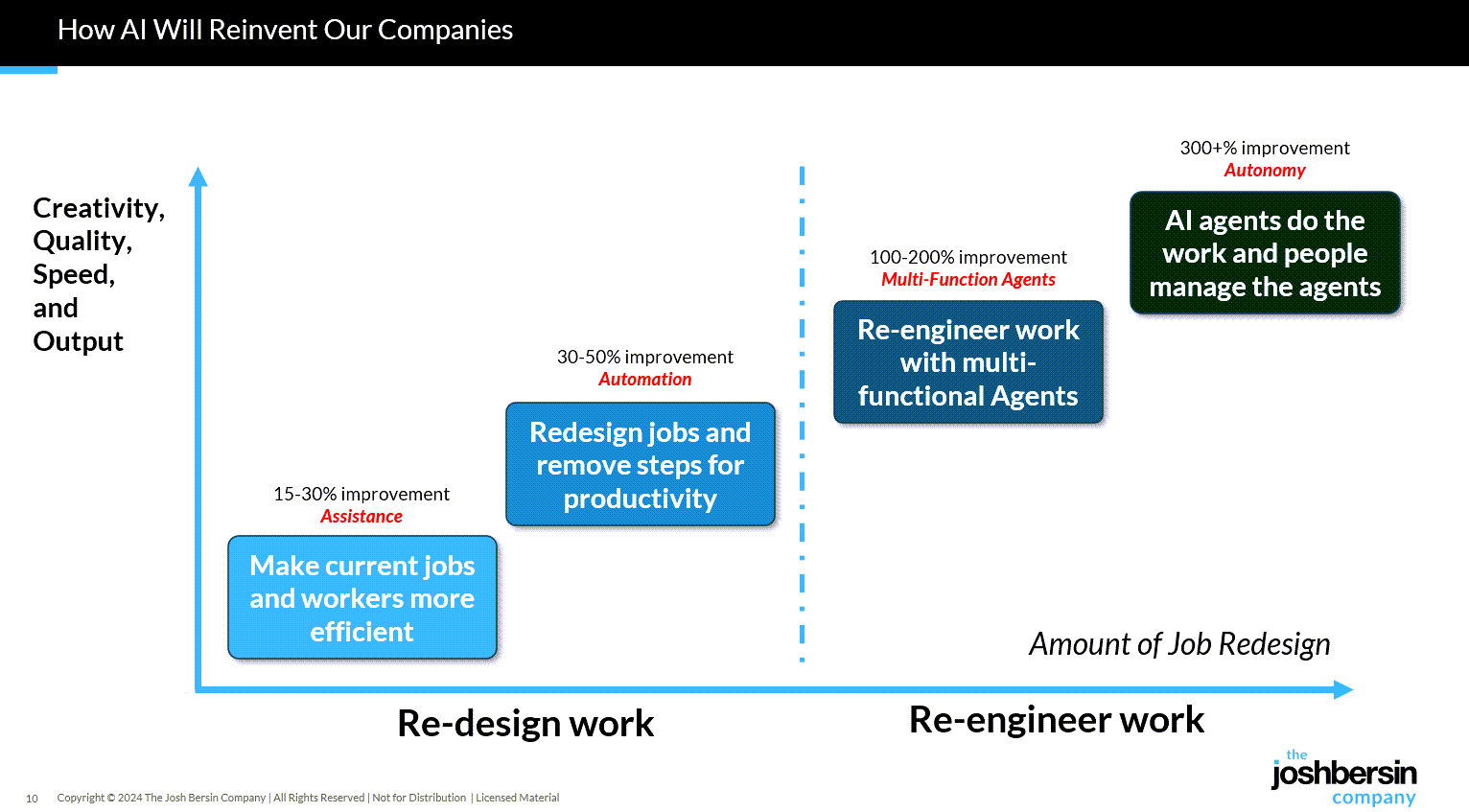
Gen AI Is Going Mainstream: Here’s What’s Coming Next — from joshbersin.com by Josh Bersin

I just completed nearly 60,000 miles of travel across Europe, Asia, and the Middle East meeting with hundred of companies to discuss their AI strategies. While every company’s maturity is different, one thing is clear: AI as a business tool has arrived: it’s real and the use-cases are growing.

A new survey by Wharton shows that 46% of business leaders use Gen AI daily and 80% use it weekly. And among these users, 72% are measuring ROI and 74% report a positive return. HR, by the way, is the #3 department in use cases, only slightly behind IT and Finance.

What are companies getting out of all this? Productivity. The #1 use case, by far, is what we call “stage 1” usage – individual productivity. 

.


From DSC:
Josh writes: “Many of our large clients are now implementing AI-native learning systems and seeing 30-40% reduction in staff with vast improvements in workforce enablement.

While I get the appeal (and ROI) from management’s and shareholders’ perspective, this represents a growing concern for employment and people’s ability to earn a living. 

And while I highly respect Josh and his work through the years, I disagree that we’re over the problems with AI and how people are using it: 

Two years ago the NYT was trying to frighten us with stories of AI acting as a romance partner. Well those stories are over, and thanks to a $Trillion (literally) of capital investment in infrastructure, engineering, and power plants, this stuff is reasonably safe.

Those stories are just beginning…they’re not close to being over. 


“… imagine a world where there’s no separation between learning and assessment…” — from aiedusimplified.substack.com by Lance Eaton, Ph.D. and Tawnya Means
An interview with Tawnya Means

So let’s imagine a world where there’s no separation between learning and assessment: it’s ongoing. There’s always assessment, always learning, and they’re tied together. Then we can ask: what is the role of the human in that world? What is it that AI can’t do?

Imagine something like that in higher ed. There could be tutoring or skill-based work happening outside of class, and then relationship-based work happening inside of class, whether online, in person, or some hybrid mix.

The aspects of learning that don’t require relational context could be handled by AI, while the human parts remain intact. For example, I teach strategy and strategic management. I teach people how to talk with one another about the operation and function of a business. I can help students learn to be open to new ideas, recognize when someone pushes back out of fear of losing power, or draw from my own experience in leading a business and making future-oriented decisions.

But the technical parts such as the frameworks like SWOT analysis, the mechanics of comparing alternative viewpoints in a boardroom—those could be managed through simulations or reports that receive immediate feedback from AI. The relational aspects, the human mentoring, would still happen with me as their instructor.

Part 2 of their interview is here:


Breaking News: Law Firm’s AI Pilot Lets New Lawyers Step Away from Billable Hours — from jdjournal.com

In a groundbreaking move that may redefine how law firms integrate technology training into daily practice, Ropes & Gray LLP has introduced a new pilot program allowing its first-year associates to dedicate a significant portion of their work hours to artificial intelligence (AI) learning—without the pressure of billing those hours to clients.

The initiative, called “TrAIlblazers,” marks one of the first formal attempts by a major law firm to give attorneys credit toward their billable-hour requirements for time spent exploring and developing AI skills. The firm hopes the move will both prepare young lawyers for a rapidly evolving profession and signal a new era of flexibility in how law firms evaluate performance.


The Other Regulatory Time Bomb — from onedtech.philhillaa.com by Phil Hill
Higher ed in the US is not prepared for what’s about to hit in April for new accessibility rules

Most higher-ed leaders have at least heard that new federal accessibility rules are coming in 2026 under Title II of the ADA, but it is apparent from conversations at the WCET and Educause annual conferences that very few understand what that actually means for digital learning and broad institutional risk. The rule isn’t some abstract compliance update: it requires every public institution to ensure that all web and media content meets WCAG 2.1 AA, including the use of audio descriptions for prerecorded video. Accessible PDF documents and video captions alone will no longer be enough. Yet on most campuses, the conversation has been understood only as a buzzword, delegated to accessibility coordinators and media specialists who lack the budget or authority to make systemic changes.

And no, relying on faculty to add audio descriptions en masse is not going to happen.

The result is a looming institutional risk that few presidents, CFOs, or CIOs have even quantified.


Six Transformative Technology Trends Impacting the Legal Profession — from americanbar.org

Summary

  • Law firm leaders should evaluate their legal technology and decide if they are truly helping legal work or causing a disconnect between human and AI contributions.
  • 75% of firms now rely on cloud platforms for everything from document storage to client collaboration.
  • The rise of virtual law firms and remote work is reshaping the profession’s culture. Hybrid and remote-first models, supported by cloud and collaboration tools, are growing.

Are we truly innovating, or just rearranging the furniture? That’s the question every law firm leader should be asking as the legal technology landscape shifts beneath our feet. There are many different thoughts and opinions on how the legal technology landscape will evolve in the coming years, particularly regarding the pace of generative AI-driven changes and the magnitude of these changes.

To try to answer the question posed above, we looked at six recently published technology trends reports from influential entities in the legal technology arena: the American Bar Association, Clio, Wolters Kluwer, Lexis Nexis, Thomson Reuters, and NetDocuments.

When we compared these reports, we found them to be remarkably consistent. While the level of detail on some topics varied across the reports, they identified six trends that are reshaping the very core of legal practice. These trends are summarized in the following paragraphs.

  1. Generative AI and AI-Assisted Drafting …
  2. Cloud-Based Practice Management…
  3. Cybersecurity and Data Privacy…
  4. Flat Fee and Alternative Billing Models…
  5. Legal Analytics and Data-Driven Decision Making…
  6. Virtual Law Firms and Remote Work…
 

The new legal intelligence — from jordanfurlong.substack.com by Jordan Furlong
We’ve built machines that can reason like lawyers. Artificial legal intelligence is becoming scalable, portable and accessible in ways lawyers are not. We need to think hard about the implications.

Much of the legal tech world is still talking about Clio CEO Jack Newton’s keynote at last week’s ClioCon, where he announced two major new features: the “Intelligent Legal Work Platform,” which combines legal research, drafting and workflow into a single legal workspace; and “Clio for Enterprise,” a suite of legal work offerings aimed at BigLaw.

Both these features build on Clio’s out-of-nowhere $1B acquisition of vLex (and its legally grounded LLM Vincent) back in June.

A new source of legal intelligence has entered the legal sector.

Legal intelligence, once confined uniquely to lawyers, is now available from machines. That’s going to transform the legal sector.


Where the real action is: enterprise AI’s quiet revolution in legal tech and beyond — from canadianlawyermag.com by Tim Wilbur
Harvey, Clio, and Cohere signal that organizational solutions will lead the next wave of change

The public conversation about artificial intelligence is dominated by the spectacular and the controversial: deepfake videos, AI-induced psychosis, and the privacy risks posed by consumer-facing chatbots like ChatGPT. But while these stories grab headlines, a quieter – and arguably more transformative – revolution is underway in enterprise software. In legal technology, in particular, AI is rapidly reshaping how law firms and legal departments operate and compete. This shift is just one example of how enterprise AI, not just consumer AI, is where real action is happening.

Both Harvey and Clio illustrate a crucial point: the future of legal tech is not about disruption for its own sake, but partnership and integration. Harvey’s collaborations with LexisNexis and others are about creating a cohesive experience for law firms, not rendering them obsolete. As Pereira put it, “We don’t see it so much as disruption. Law firms actually already do this… We see it as ‘how do we help you build infrastructure that supercharges this?’”

The rapid evolution in legal tech is just one example of a broader trend: the real action in AI is happening in enterprise software, not just in consumer-facing products. While ChatGPT and Google’s Gemini dominate the headlines, companies like Cohere are quietly transforming how organizations across industries leverage AI.

Also from canadianlawyermag.com, see:

The AI company’s plan to open an office in Toronto isn’t just about expanding territory – it’s a strategic push to tap into top technical talent and capture a market known for legal innovation.


Unseeable prompt injections in screenshots: more vulnerabilities in Comet and other AI browsers — from brave.com by Artem Chaikin and Shivan Kaul Sahib

Building on our previous disclosure of the Perplexity Comet vulnerability, we’ve continued our security research across the agentic browser landscape. What we’ve found confirms our initial concerns: indirect prompt injection is not an isolated issue, but a systemic challenge facing the entire category of AI-powered browsers. This post examines additional attack vectors we’ve identified and tested across different implementations.

As we’ve written before, AI-powered browsers that can take actions on your behalf are powerful yet extremely risky. If you’re signed into sensitive accounts like your bank or your email provider in your browser, simplysummarizing a Reddit postcould result in an attacker being able to steal money or your private data.

The above item was mentioned by Grant Harvey out at The Neuron in the following posting:


Robin AI’s Big Bet on Legal Tech Meets Market Reality — from lawfuel.com

Robin’s Legal Tech Backfire
Robin AI, the poster child for the “AI meets law” revolution, is learning the hard way that venture capital fairy dust doesn’t guarantee happily-ever-after. The London-based legal tech firm, once proudly waving its genAI-plus-human-experts flag, is now cutting staff after growth dreams collided with the brick wall of economic reality.

The company confirmed that redundancies are under way following a failed major funding push. Earlier promises of explosive revenue have fizzled. Despite around $50 million in venture cash over the past two years, Robin’s 2025 numbers have fallen short of investor expectations. The team that once ballooned to 200 is now shrinking.

The field is now swarming with contenders: CLM platforms stuffing genAI into every feature, corporate legal teams bypassing vendors entirely by prodding ChatGPT directly, and new entrants like Harvey and Legora guzzling capital to bulldoze into the market. Even Workday is muscling in.

Meanwhile, ALSPs and AI-powered pseudo-law firms like Crosby and Eudia are eating market share like it’s free pizza. The number of inhouse teams actually buying these tools at scale is still frustratingly small. And investors don’t have much patience for slow burns anymore.


Why Being ‘Rude’ to AI Could Win Your Next Case or Deal — from thebrainyacts.beehiiv.com by Josh Kubicki

TL;DR: AI no longer rewards politeness—new research shows direct, assertive prompts yield better, more detailed responses. Learn why this shift matters for legal precision, test real-world examples (polite vs. blunt), and set up custom instructions in OpenAI (plus tips for other models) to make your AI a concise analytical tool, not a chatty one. Actionable steps inside to upgrade your workflow immediately.


“OpenAI’s Atlas: the End of Online Learning—or Just the Beginning?” [Hardman] + other items re: AI in our LE’s

OpenAI’s Atlas: the End of Online Learning—or Just the Beginning? — from drphilippahardman.substack.com by Dr. Philippa Hardman

My take is this: in all of the anxiety lies a crucial and long-overdue opportunity to deliver better learning experiences. Precisely because Atlas perceives the same context in the same moment as you, it can transform learning into a process aligned with core neuro-scientific principles—including active retrieval, guided attention, adaptive feedback and context-dependent memory formation.

Perhaps in Atlas we have a browser that for the first time isn’t just a portal to information, but one which can become a co-participant in active cognitive engagement—enabling iterative practice, reflective thinking, and real-time scaffolding as you move through challenges and ideas online.

With this in mind, I put together 10 use cases for Atlas for you to try for yourself.

6. Retrieval Practice
What:
Pulling information from memory drives retention better than re-reading.
Why: Practice testing delivers medium-to-large effects (Adesope et al., 2017).
Try: Open a document with your previous notes. Ask Atlas for a mixed activity set: “Quiz me on the Krebs cycle—give me a near-miss, high-stretch MCQ, then a fill-in-the-blank, then ask me to explain it to a teen.”
Atlas uses its browser memory to generate targeted questions from your actual study materials, supporting spaced, varied retrieval.


From DSC:
A quick comment. I appreciate these ideas and approaches from Katarzyna and Rita. I do think that someone is going to want to be sure that the AI models/platforms/tools are given up-to-date information and updated instructions — i.e., any new procedures, steps to take, etc. Perhaps I’m missing the boat here, but an internal AI platform is going to need to have access to up-to-date information and instructions.


There is no God Tier video model — from downes.ca by Stephen Downes

From DSC:
Stephen has some solid reflections and asks some excellent questions in this posting, including:

The question is: how do we optimize an AI to support learning? Will one model be enough? Or do we need different models for different learners in different scenarios?


A More Human University: The Role of AI in Learning — from er.educause.edu by Robert Placido
Far from heralding the collapse of higher education, artificial intelligence offers a transformative opportunity to scale meaningful, individualized learning experiences across diverse classrooms.

The narrative surrounding artificial intelligence (AI) in higher education is often grim. We hear dire predictions of an “impending collapse,” fueled by fears of rampant cheating, the erosion of critical thinking, and the obsolescence of the human educator.Footnote1 This dystopian view, however, is a failure of imagination. It mistakes the death rattle of an outdated pedagogical model for the death of learning itself. The truth is far more hopeful: AI is not an asteroid coming for higher education. It is a catalyst that can finally empower us to solve our oldest, most intractable problem: the inability to scale deep, engaged, and truly personalized learning.


Claude for Life Sciences — from anthropic.com

Increasing the rate of scientific progress is a core part of Anthropic’s public benefit mission.

We are focused on building the tools to allow researchers to make new discoveries – and eventually, to allow AI models to make these discoveries autonomously.

Until recently, scientists typically used Claude for individual tasks, like writing code for statistical analysis or summarizing papers. Pharmaceutical companies and others in industry also use it for tasks across the rest of their business, like sales, to fund new research. Now, our goal is to make Claude capable of supporting the entire process, from early discovery through to translation and commercialization.

To do this, we’re rolling out several improvements that aim to make Claude a better partner for those who work in the life sciences, including researchers, clinical coordinators, and regulatory affairs managers.


AI as an access tool for neurodiverse and international staff — from timeshighereducation.com by Vanessa Mar-Molinero
Used transparently and ethically, GenAI can level the playing field and lower the cognitive load of repetitive tasks for admin staff, student support and teachers

Where AI helps without cutting academic corners
When framed as accessibility and quality enhancement, AI can support staff to complete standard tasks with less friction. However, while it supports clarity, consistency and inclusion, generative AI (GenAI) does not replace disciplinary expertise, ethical judgement or the teacher–student relationship. These are ways it can be put to effective use:

  • Drafting and tone calibration:
  • Language scaffolding:
  • Structure and templates: ..
  • Summarise and prioritise:
  • Accessibility by default:
  • Idea generation for pedagogy:
  • Translation and cultural mediation:

Beyond learning design: supporting pedagogical innovation in response to AI — from timeshighereducation.com by Charlotte von Essen
To avoid an unwinnable game of catch-up with technology, universities must rethink pedagogical improvement that goes beyond scaling online learning


The Sleep of Liberal Arts Produces AI — from aiedusimplified.substack.com by Lance Eaton, Ph.D.
A keynote at the AI and the Liberal Arts Symposium Conference

This past weekend, I had the honor to be the keynote speaker at a really fantstistic conferece, AI and the Liberal Arts Symposium at Connecticut College. I had shared a bit about this before with my interview with Lori Looney. It was an incredible conference, thoughtfully composed with a lot of things to chew on and think about.

It was also an entirely brand new talk in a slightly different context from many of my other talks and workshops. It was something I had to build entirely from the ground up. It reminded me in some ways of last year’s “What If GenAI Is a Nothingburger”.

It was a real challenge and one I’ve been working on and off for months, trying to figure out the right balance. It’s a work I feel proud of because of the balancing act I try to navigate. So, as always, it’s here for others to read and engage with. And, of course, here is the slide deck as well (with CC license).


The Most Innovative Law Schools (2025) — from abovethelaw.com by Staci Zaretsky
Forget dusty casebooks — today’s leaders in legal education are using AI, design thinking, and real-world labs to reinvent how law is taught.

“[F]rom AI labs and interdisciplinary centers to data-driven reform and bold new approaches to design and client service,” according to National Jurist’s preLaw Magazine, these are the law schools that “exemplify innovation in action.”

  1. North Carolina Central University School of Law
  2. Suffolk University Law School
  3. UC Berkeley School of Law
  4. Nova Southeastern University Shepard Broad College of Law
  5. Northeastern University School of Law
  6. Maurice A. Deane School of Law at Hofstra University
  7. Seattle University School of Law
  8. Case Western Reserve University School of Law
  9. University of Miami School of Law
  10. Benjamin N. Cardozo School of Law at Yeshiva University
  11. Vanderbilt University Law School
  12. Southwestern Law School

Click here to read short summaries of why each school made this year’s list of top innovators.


Clio’s Metamorphosis: From Practice Management To A Comprehensive AI And Law Practice Provider — from abovethelaw.com by Stephen Embry
Clio is no longer a practice management company. It’s much more of a comprehensive provider of all needs of its customers big and small.

Newton delivered what may have been the most consequential keynote in the company’s history and one that signals a shift by Clio from a traditional practice management provider to a comprehensive platform that essentially does everything for the business and practice of law.

Clio also earlier this year acquired vLex, the heavy-duty AI legal research player. The acquisition is pending regulatory approval. It is the vLex acquisition that is powering the Clio transformation that Newton described in his keynote.

vLex has a huge amount of legal data in its wheelhouse to power sophisticated legal AI research. On top of this data, vLex developed Vincent, a powerful AI tool to work with this data and enable all sorts of actions and work.

This means a couple of things. First, by acquiring vLex, Clio can now offer its customers AI legal research tools. Clio customers will no longer have to go one place for its practice management needs and a second place for its substantive legal work, like research. It makes what Clio can provide much more comprehensive and all inclusive.


‘Adventures In Legal Tech’: How AI Is Changing Law Firms — from abovethelaw.com
Ernie the Attorney shares his legal tech takes.

Artificial intelligence will give solos and small firms “a huge advantage,” according to one legal tech consultant.

In this episode of “Adventures in Legal Tech,” host Jared Correia speaks with Ernie Svenson — aka “Ernie the Attorney” — about the psychology behind resistance to change, how law firms are positioning their AI use, the power of technology for business development, and more.


Legal software: how to look for and compare AI in legal technology — from legal.thomsonreuters.com by Chris O’Leary

Highlights

  • Legal ops experts can categorize legal AI platforms and software by the ability to streamline key tasks such as legal research, document processing or analysis, and drafting.
  • The trustworthiness and accuracy of AI hinge on the quality of its underlying data; solutions like CoCounsel Legal are grounded in authoritative, expert-verified content from Westlaw and Practical Law, unlike providers that may rely on siloed or less reliable databases.
  • When evaluating legal software, firms should use a framework that assesses critical factors such as integration with existing tech stacks, security, scalability, user adoption, and vendor reputation.

ASU Law appoints a director of AI and Legal Tech Studio, advancing its initiative to reimagine legal education — from law.asu.edu

The Sandra Day O’Connor College of Law at Arizona State University appointed Sean Harrington as director of the newly established AI and Legal Tech Studio, a key milestone in ASU Law’s bold initiative to reimagine legal education for the artificial intelligence era. ASU, ranked No. 1 in innovation for the 11th consecutive year, drives AI solutions that enhance teaching, enrich student training and facilitate digital transformation.


The American Legal Technology Awards Name 2025 Winners — from natlawreview.com by Tom Martin

The sixth annual American Legal Technology Awards were presented on Wednesday, October 15th, at Suffolk University Law School (Boston), recognizing winners across ten categories. There were 211 nominees who were evaluated by 27 judges.

The honorees on the night included:


“Future of Professionals Report” analysis: Why AI will flip law firm economics — from thomsonreuters.com by Ragunath Ramanathan
AI forces a reinvention of law firm billing models, the market will reward those firms that price by outcome, guarantee efficiency, and are transparent. The question then isn’t whether to change — it’s whether firms will stand on the sidelines or lead

Key insights:

  • Efficiency and cost savings are expected  AI is significantly increasing efficiency and reducing costs in the legal industry, with each lawyer expecting to save 190 work-hours per year by leveraging AI, resulting in approximately $20 billion worth of work-savings in the US alone.
  • Challenges to the billable hour model — The traditional billable hour model is being challenged by AI advancements, as lawyers are now able to complete tasks more efficiently and quickly, leading some law firms to explore alternative pricing models that reflect the value delivered rather than the time spent.
  • Opportunities for smaller law firms — AI presents unique opportunities for smaller law firms to differentiate themselves and compete with larger firms, as AI solutions allow smaller firms to access advanced technology without significant investment and deliver innovative pricing models.

The legal industry is undergoing a significant transformation that’s being driven by the rapid adoption of AI — a shift that is poised to redefine traditional practices, particularly the billable hour model, a cornerstone of law firm operations.

Not surprisingly, AI is anticipated to have the biggest impact on the legal industry over the next five years, with 80% of law firm survey respondents to Thomson Reuters recently published 2025 Future of Professionals report saying that they expect AI to fundamentally alter how they conduct business, especially around how law firms price, staff, and deliver legal work to their clients.


© 2025 | Daniel Christian