Blood in the Instructional Design Machine?— from drphilippahardman.substack.com by Dr. Philippa Hardman The reality of AI, job degradation & the likely future of Instructional Design
This raises a very important, perhaps even existential question for our profession: do these tools free a designer from the mind-numbing drudgery of content conversion (the “augmented human”)? Or do they automate the core expertise of the learning professional’s role, e.g. selecting instructional startegies, structuring narratives and designing a learning flow, in the process reducing the ID’s role to simply finding the source file and pushing a button (the “inverted centaur”)?
The stated aspiration of these tool builders seems to be a future where AI means that the instructional designer’s value shifts decisively from production to strategy. Their stated goal is to handle the heavy lifting of content generation, allowing the human ID to provide the indispensable context, creativity, and pedagogical judgment that AI cannot replicate.
However, the risk of these tools lies in how we use them, and the “inverted centaur” model remains deeply potent and possible. In an organisation that prioritises cost above all, these same tools can be used to justify reducing the ID role to the functional drudgery of inputting a PDF and supervising the machine.
The key to this paradox lies in a crucial data point: spending on outside products and services has jumped a dramatic 23% to $12.4 billion.
This signals a fundamental shift: companies are reallocating funds from large internal teams toward specialised consultants and advanced learning technologies like AI. L&D is not being de-funded; it is being re-engineered.
The US AI Action Plan, Explained— from theneurondaily.com by Grant Harvey Sam’s 3 AI nightmares, Google hits 2B users, and Trump bans “woke” AI…
Meanwhile, at the Fed’s banking conference on Wednesday, Altman revealed his three nightmare AI scenarios. The first two were predictable: bad actors getting superintelligence first, and the classic “I’m afraid I can’t do that, Dave” situation.
But the third? AI accidentally steering us off course while we just…go along with it.
His example hit home: young people who can’t make decisions without ChatGPT (according to Sam, this is literally a thing). See, even when AI gives great advice, collectively handing over all decision-making feels “bad and dangerous” (even to Sam, who MADE this thing).
So yeah, Sam’s not really worried about the AI rebelling. He’s worried about AI becoming so good that we stop thinking for ourselves—and that might be scarier.
Also from The Neuron re: the environmental impacts of producing/offering AI:
We need a coherent approach grounded in understanding how the technology works, where it is going and what it will be used for.
From DSC: I almost feel like Meghan should right the words “this week” or “this month” after the above sentence. Whew! Things are moving fast.
For example, we’re now starting to see more agents hitting the scene — software that can DO things. But that can open up a can of worms too.
Students know the ground has shifted — and that the world outside the university expects them to shift with it. A.I. will be part of their lives regardless of whether we approve. Few issues expose the campus cultural gap as starkly as this one.ce
From DSC: Universities and colleges have little choice but to integrate AI into their programs and offerings. There’s enough pressure on institutions of traditional higher education to prove their worth/value. Students and their families want solid ROI’s. Students know that they are going to need AI-related skills (see the link immediately below for example), or they are going to be left out of the competitive job search process.
Today, we’re introducing powerful enhancements to our Firefly Video Model, including improved motion fidelity and advanced video controls that will accelerate your workflows and provide the precision and style you need to elevate your storytelling. We are also adding new generative AI partner models within Generate Video on Firefly, giving you the power to choose which model works best for your creative needs across image, video and sound.
Plus, our new workflow tools put you in control of your video’s composition and style. You can now layer in custom-generated sound effects right inside the Firefly web app — and start experimenting with AI-powered avatar-led videos.
… Generate Sound Effects (beta)
Sound is a powerful storytelling tool that adds emotion and depth to your videos. Generate Sound Effects (beta) makes it easy to create custom sounds, like a lion’s roar or ambient nature sounds, that enhance your visuals. And like our other Firefly generative AI models, Generate Sound Effects (beta) is commercially safe, so you can create with confidence.
Just type a simple text prompt to generate the sound effect you need. Want even more control? Use your voice to guide the timing and intensity of the sound. Firefly listens to the energy and rhythm of your voice to place sound effects precisely where they belong — matching the action in your video with cinematic timing.
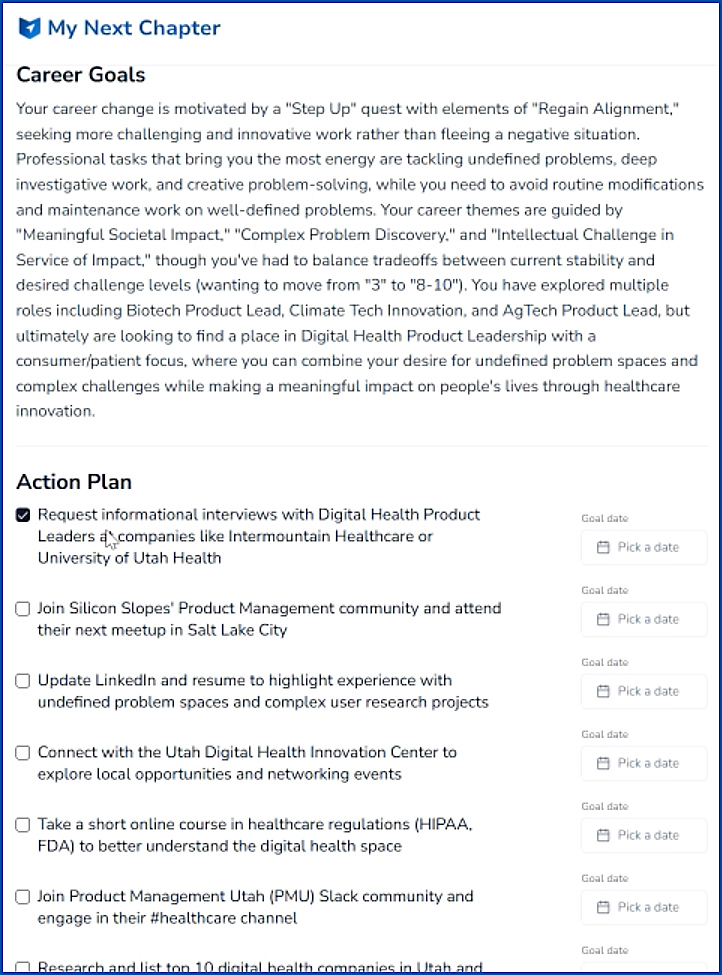
From DSC: In looking atMyNextChapter.ai— THIS TYPE OF FUNCTIONALITY of an AI-based chatbot talking to you re: good fits for a future job — is the kind of thing that could work well in this type of vision/learning platform. The AI asks you relevant career-oriented questions, comes up with some potential job fits, and then gives you resources about how to gain those skills, who to talk with, organizations to join, next steps to get your foot in the door somewhere, etc.
The next gen learning platform would provide links to online-based courses, blogs, peoples’ names on LinkedIn, courses from L&D organizations or from institutions of higher education or from other entities/places to obtain those skills (similar to the ” Action Plan” below from MyNextChapter.ai).
ChatGPT can now do work for you using its own computer, handling complex tasks from start to finish.
You can now ask ChatGPT to handle requests like “look at my calendar and brief me on upcoming client meetings based on recent news,” “plan and buy ingredients to make Japanese breakfast for four,” and “analyze three competitors and create a slide deck.” ChatGPT will intelligently navigate websites, filter results, prompt you to log in securely when needed, run code, conduct analysis, and even deliver editable slideshows and spreadsheets that summarize its findings.
In Episode 5 of The Neuron Podcast, Corey Noles and Grant Harvey tackle the education crisis head-on. We explore the viral UCLA “CheatGPT” controversy, MIT’s concerning brain study, and innovative solutions like Alpha School’s 2-hour learning model. Plus, we break down OpenAI’s new $10M teacher training initiative and share practical tips for using AI to enhance learning rather than shortcut it. Whether you’re a student, teacher, or parent, you’ll leave with actionable insights on the future of education.
AI is rewiring how we learn, and it’s a game-changer for L&D— from chieflearningofficer.com by Josh Bersin As AI becomes central to learner engagement, L&D leaders are being urged to fundamentally rethink corporate training, says global industry analyst Josh Bersin.
What are people really doing with ChatGPT? They’re learning. They’re asking questions, getting immediate answers, digging deeper, analyzing information and ultimately making themselves more productive. So, one could argue that simply by shifting to a “learn by inquiry” model, we may triple our value to the business.
From my experience, there are two main learning models in this industry. The first is “what you need to know”—linear or prescriptive things that every employee needs to understand about the company, its products and their role. This kind of content is well handled by existing L&D models.
The second, and far more important, is “what you’d like to know”—questions, curiosities and explorations about how the company works, what customers truly need and how we can each go further in our careers. Thanks to AI, this kind of learning is now explosive and transformative.
Imagine a sales rep who loses a deal. Naturally, they may ask, “What could I have done to be more successful?” A well-designed AI-powered learning system would take that question, give the employee an initial answer and chat with the individual to dig into the problem.
The system would then surface relevant sales training material and recommend videos, tips or case studies for help. And the employee, assuming they like the experience, would likely keep exploring until they feel they’ve learned what they need.
This “curiosity-based” learning is now possible, and its benefits extend far beyond traditional training.
Tech Layoffs 2025: Why AI is Behind the Rising Job Cuts — from finalroundai.com by Kaustubh Saini, Jaya Muvania, and Kaivan Dave; via George Siemens 507 tech workers lose their jobs to AI every day in 2025. Complete breakdown of 94,000 job losses across Microsoft, Tesla, IBM, and Meta – plus which positions are next. .
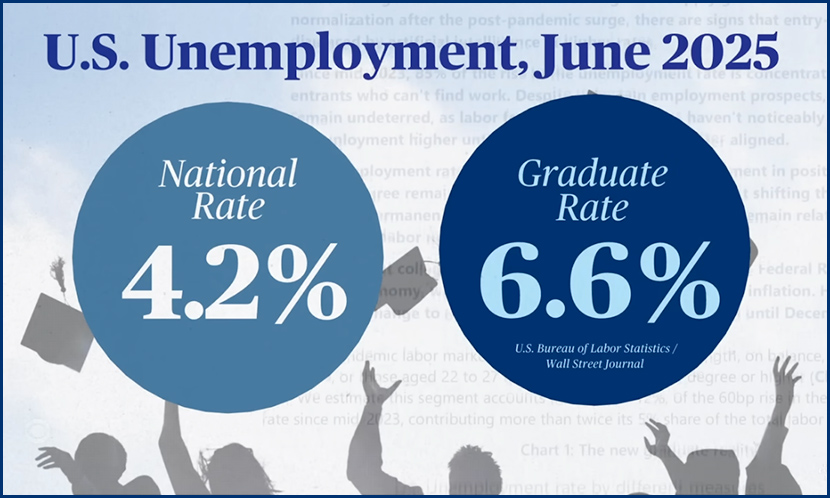
Amid all the talk about the state of our economy, little noticed and even less discussed was June’s employment data. It showed that the unemployment rate for recent college graduates stood at 5.8%, topping the national level for the first and only time in its 45-year historical record.
It’s an alarming number that needs to be considered in the context of a recent warning from Dario Amodei, CEO of AI juggernaut Anthropic, who predicted artificial intelligence could wipe out half of all entry-level, white-collar-jobs and spike unemployment to 10-20% in the next one to five years.
The upshot: our college graduates’ woes could be just the tip of the spear.
But as I thought about it, it just didn’t feel right. Replying to people sharing real gratitude with a copy-paste message seemed like a terribly inauthentic thing to do. I realized that when you optimize the most human parts of your business, you risk removing the very reason people connect with you in the first place.
For today’s chief learning officer, the days of just rolling out compliance training are long gone. In 2025, learning and development leaders are architects of innovation, crafting ecosystems that are agile, automated and AI-infused. This quarter’s Tech Check invites us to pause, assess and get strategic about where tech is taking us. Because the goal isn’t more tools—it’s smarter, more human learning systems that scale with the business.
Sections include:
The state of AI in L&D: Hype vs. reality
AI in design: From static content to dynamic experiences
AI in development: Redefining production workflows
NEW YORK – The AFT, alongside the United Federation of Teachers and lead partner Microsoft Corp., founding partner OpenAI, and Anthropic, announced the launch of the National Academy for AI Instruction today. The groundbreaking $23 million education initiative will provide access to free AI training and curriculum for all 1.8 million members of the AFT, starting with K-12 educators. It will be based at a state-of-the-art bricks-and-mortar Manhattan facility designed to transform how artificial intelligence is taught and integrated into classrooms across the United States.
The academy will help address the gap in structured, accessible AI training and provide a national model for AI-integrated curriculum and teaching that puts educators in the driver’s seat.
In an era when the college-going rate of high school graduates has dropped from an all-time high of 70 percent in 2016 to roughly 62 percent now, AI seems to be heightening the anxieties about the value of college.
According to the survey, two-thirds of parents say AI is impacting their view of the value of college. Thirty-seven percent of parents indicate they are now scrutinizing college’s “career-placement outcomes”; 36 percent say they are looking at a college’s “AI-skills curriculum,” while 35 percent respond that a “human-skills emphasis” is important to them.
This echoes what I increasingly hear from college leadership: Parents and students demand to see a difference between what they are getting from a college and what they could be “learning from AI.”
Culture matters here. Organizations that foster psychological safety—where experimentation is welcomed and mistakes are treated as learning—are making the most progress. When leaders model curiosity, share what they’re trying, and invite open dialogue, teams follow suit. Small tests become shared wins. Shared wins build momentum.
Career development must be part of this equation. As roles evolve, people will need pathways forward. Some will shift into new specialties. Others may leave familiar roles for entirely new ones. Making space for that evolution—through upskilling, mobility, and mentorship—shows your people that you’re not just investing in AI, you’re investing in them.
And above all, people need transparency. Teams don’t expect perfection. But they do need clarity. They need to understand what’s changing, why it matters, and how they’ll be supported through it. That kind of trust-building communication is the foundation for any successful change.
These shifts may play out differently across sectors—but the core leadership questions will likely be similar.
AI marks a turning point—not just for technology, but for how we prepare our people to lead through disruption and shape the future of learning.
In a landmark deal that will undoubtedly reshape the legal tech landscape, law practice management company Clio has signed a definitive agreement to acquire the AI and legal research company vLex for $1 billion in cash and stock.
The companies say that the acquisition will “establish a new category of intelligent legal technology at the intersection of the business and practice of law, empowering legal professionals to seamlessly manage, research, and execute legal work within a unified system.”
Yoodli is an AI tool designed to help users improve their public speaking skills. It analyzes your speech in real-time or after a recording and gives you feedback on things like:
Filler words (“um,” “like,” “you know”)
Pacing (Are you sprinting or sedating your audience?)
Word choice and sentence complexity
Eye contact and body language (with video)
And yes, even your “uhhh” to actual word ratio
Yoodli gives you a transcript and a confidence score, plus suggestions that range from helpful to brutally honest. It’s basically Simon Cowell with AI ethics and a smiley face interface.
[What’s] going on with AI and education? — from theneuron.ai by Grant Harvey With students and teachers alike using AI, schools are facing an “assessment crisis” where the line between tool and cheating has blurred, forcing a shift away from a broken knowledge economy toward a new focus on building human judgment through strategic struggle.
What to do about it: The future belongs to the “judgment economy,” where knowledge is commoditized but taste, agency, and learning velocity become the new human moats. Use the “Struggle-First” principle: wrestle with problems for 20-30 minutes before turning to AI, then use AI as a sparring partner (not a ghostwriter) to deepen understanding. The goal isn’t to avoid AI, but to strategically choose when to embrace “desirable difficulties” that build genuine expertise versus when to leverage AI for efficiency.
… The Alpha-School Program in brief:
Students complete core academics in just 2 hours using AI tutors, freeing up 4+ hours for life skills, passion projects, and real-world experiences.
The school claims students learn at least 2x faster than their peers in traditional school.
The top 20% of students show 6.5x growth. Classes score in the top 1-2% nationally across the board.
Claims are based on NWEA’s Measures of Academic Progress (MAP) assessments… with data only available to the school. Hmm…
Austen Allred shared a story about the school, which put it on our radar.
.
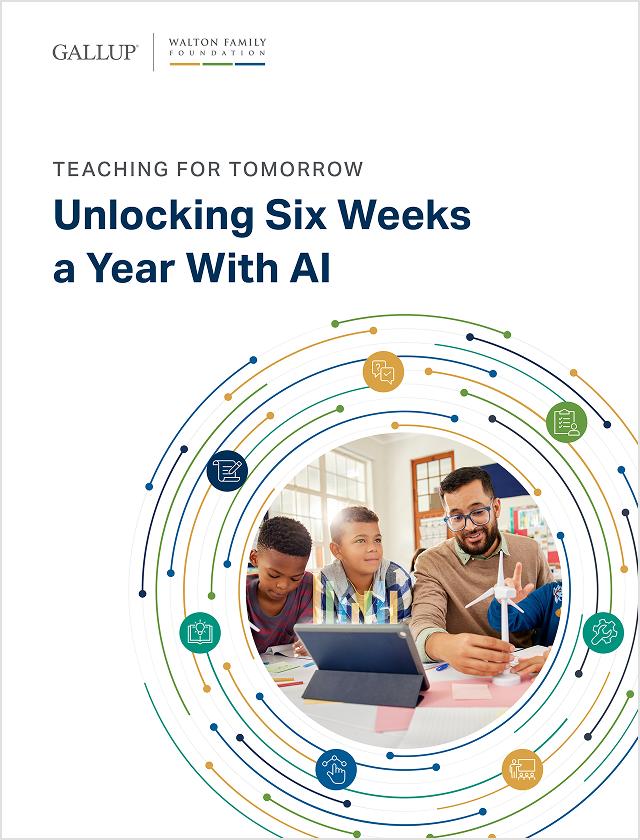
In the latest installment of Gallup and the Walton Family Foundation’s research on education, K-12 teachers reveal how AI tools are transforming their workloads, instructional quality and classroom optimism. The report finds that 60% of teachers used an AI tool during the 2024–25 school year. Weekly AI users report reclaiming nearly six hours per week — equivalent to six weeks per year — which they reinvest in more personalized instruction, deeper student feedback and better parent communication.
Despite this emerging “AI dividend,” adoption is uneven: 40% of teachers aren’t using AI at all, and only 19% report their school has a formal AI policy. Teachers with access to policies and support save significantly more time.
Educators also say AI improves their work. Most report higher-quality lesson plans, assessments and student feedback. And teachers who regularly use AI are more optimistic about its benefits for student engagement and accessibility — mirroring themes from the Voices of Gen Z: How American Youth View and Use Artificial Intelligence report, which found students hesitant but curious about AI’s classroom role. As AI tools grow more embedded in education, both teachers and students will need the training and support to use them effectively.
What Is Amira Learning?
Amira Learning’s system is built upon research led by Jack Mostow, a professor at Carnegie Mellon who helped pioneer AI literacy education. Amira uses Claude AI to power its AI features, but these features are different than many other AI tools on the market. Instead of focusing on chat and generative response, Amira’s key feature is its advanced speech recognition and natural language processing capabilities, which allow the app to “hear” when a student is struggling and tailor suggestions to that student’s particular mistakes.
Though it’s not meant to replace a teacher, Amira provides real-time feedback and also helps teachers pinpoint where a student is struggling. For these reasons, Amira Learning is a favorite of education scientists and advocates for science of reading-based literacy instruction. The tool currently is used by more than 4 million students worldwide and across the U.S.
Who is leading the pack? Who is setting themselves apart here in the mid-year?
Are they an LMS? LMS/LXP? Talent Development System? Mentoring? Learning Platform?
Something else?
Are they solely customer training/education, mentoring, or coaching? Are they focused only on employees? Are they an amalgamation of all or some?
Well, they cut across the board – hence, they slide under the “Learning Systems” umbrella, which is under the bigger umbrella term – “Learning Technology.”
…
Categories: L&D-specific, Combo (L&D and Training, think internal/external audiences), and Customer Training/Education (this means customer education, which some vendors use to mean the same as customer training).