From DSC: I have attended theNext Generation Learning Spaces Conferencefor the past two years. Both conferences were very solid and they made a significant impact on our campus, as they provided the knowledge, research, data, ideas, contacts, and the catalyst for us to move forward with building a Sandbox Classroom on campus. This new, collaborative space allows us to experiment with different pedagogies as well as technologies. As such, we’ve been able to experiment much more with active learning-based methods of teaching and learning. We’re still in Phase I of this new space, and we’re learning new things all of the time.
For the upcoming conference in February, I will be moderating a New Directions in Learning panel on the use of augmented reality (AR), virtual reality (VR), and mixed reality (MR). Time permitting, I hope that we can also address other promising, emerging technologies that are heading our way such as chatbots, personal assistants, artificial intelligence, the Internet of Things, tvOS, blockchain and more.
The goal of this quickly-moving, engaging session will be to provide a smorgasbord of ideas to generate creative, innovative, and big thinking. We need to think about how these topics, trends, and technologies relate to what our next generation learning environments might look like in the near future — and put these things on our radars if they aren’t already there.
Key takeaways for the panel discussion:
Reflections regarding the affordances that new developments in Human Computer Interaction (HCI) — such as AR, VR, and MR — might offer for our learning and our learning spaces (or is our concept of what constitutes a learning space about to significantly expand?)
An update on the state of the approaching ed tech landscape
Creative, new thinking: What might our next generation learning environments look like in 5-10 years?
I’m looking forward to catching up with friends, meeting new people, and to the solid learning that I know will happen at this conference. I encourage you to check outthe conferenceandregister soon to take advantage of the early bird discounts.
The recent announcement of Salesforce Einstein — dubbed “artificial intelligence for everyone” — sheds new light on the new and pervasive usage of artificial intelligence in every aspect of businesses.
Powered by advanced machine learning, deep learning, predictive analytics, natural language processing and smart data discovery, Einstein’s models will be automatically customized for every single customer, and it will learn, self-tune, and get smarter with every interaction and additional piece of data. Most importantly, Einstein’s intelligence will be embedded within the context of business, automatically discovering relevant insights, predicting future behavior, proactively recommending best next actions and even automating tasks.
…
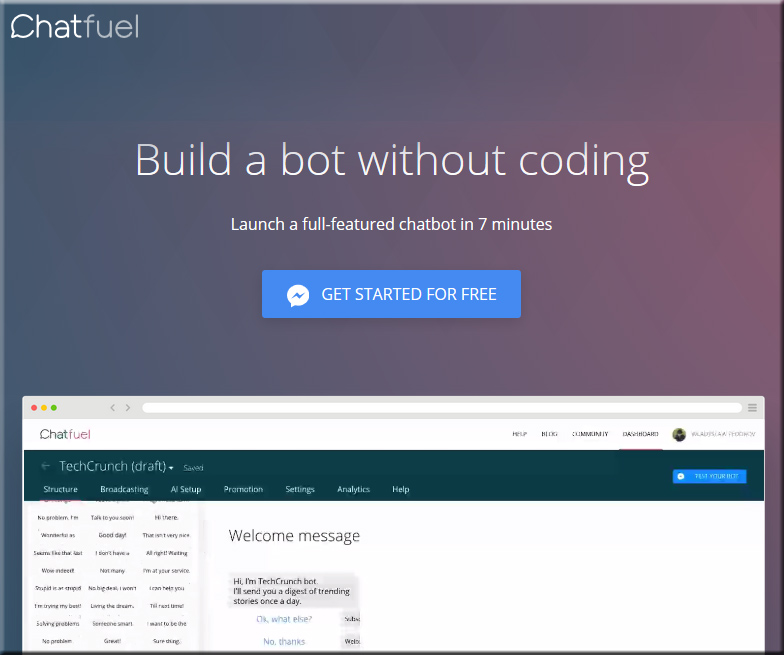
Chatbots, or conversational bots, are the “other” trending topic in the field of artificial intelligence. At the juncture of consumer and business, they provide the ability for an AI-based system to interact with users through a headless interface. It does not matter whether a messaging app is used, or a speech-to-text system, or even another app — the chatbot is front-end agnostic.
Since the user does not have the ability to provide context around the discussion, he just asks questions in natural language to an AI-driven backend that is tasked with figuring this context and looking for the right answer.
For many months IBM has gone to recruiting-industry conferences to say that the famous Watson will be at some point used for talent-acquisition, but that it hasn’t happened quite yet.
It’s here.
IBM is first using Watson for its RPO customers, and then rolling it out as a product for the larger community, perhaps next spring. One of my IBM contacts, Recruitment Innovation Global Leader Yates Baker, tells me that the current version is a work in progress like the first iPhone (or perhaps like that Siri-for-recruiting tool).
There are three parts: recruiting, marketing, and sourcing.
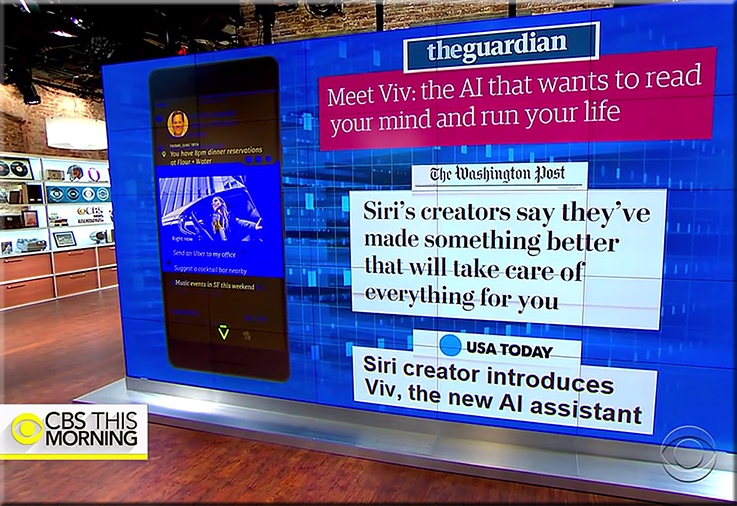
With the new iOS 10, Siri can control third-party apps, like Uber and WhatsApp. With the release of MacOS Sierra on Tuesday, Siri finally lands on the desktop, where it can take care of basic operating system tasks, send emails and more. With WatchOS 3 and the new Apple Watch, Siri is finally faster on the wrist. And with Apple’s Q-tip-looking AirPods arriving in October, Siri can whisper sweet nothings in your inner ear with unprecedented wireless freedom. Think Joaquin Phoenix’s earpiece in the movie “Her.”
The groundwork is laid for an AI assistant to stake a major claim in your life, and finally save you time by doing menial tasks. But the smarter Siri becomes in some places, the dumber it seems in others—specifically compared with Google’s and Amazon’s voice assistants. If I hear “I’m sorry, Joanna, I’m afraid I can’t answer that” one more time…
YORKTOWN HEIGHTS, N.Y., Sept. 20, 2016 /PRNewswire/ — IBM Research (NYSE: IBM) today announced a multi-year collaboration with the Department of Brain & Cognitive Sciences at MIT to advance the scientific field of machine vision, a core aspect of artificial intelligence. The new IBM-MIT Laboratory for Brain-inspired Multimedia Machine Comprehension’s (BM3C) goal will be to develop cognitive computing systems that emulate the human ability to understand and integrate inputs from multiple sources of audio and visual information into a detailed computer representation of the world that can be used in a variety of computer applications in industries such as healthcare, education, and entertainment.
The BM3C will address technical challenges around both pattern recognition and prediction methods in the field of machine vision that are currently impossible for machines alone to accomplish. For instance, humans watching a short video of a real-world event can easily recognize and produce a verbal description of what happened in the clip as well as assess and predict the likelihood of a variety of subsequent events, but for a machine, this ability is currently impossible.
Satya Nadella on Microsoft’s new age of intelligence — from fastcompany.com by Harry McCracken How the software giant aims to tie everything from Cortana to Office to HoloLens to Azure servers into one AI experience.
Excerpt:
“Microsoft was born to do a certain set of things. We’re about empowering people in organizations all over the world to achieve more. In today’s world, we want to use AI to achieve that.”
That’s Microsoft CEO Satya Nadella, crisply explaining the company’s artificial-intelligence vision to me this afternoon shortly after he hosted a keynote at Microsoft’s Ignite conference for IT pros in Atlanta. But even if Microsoft only pursues AI opportunities that it considers to be core to its mission, it has a remarkably broad tapestry to work with. And the examples that were part of the keynote made that clear.
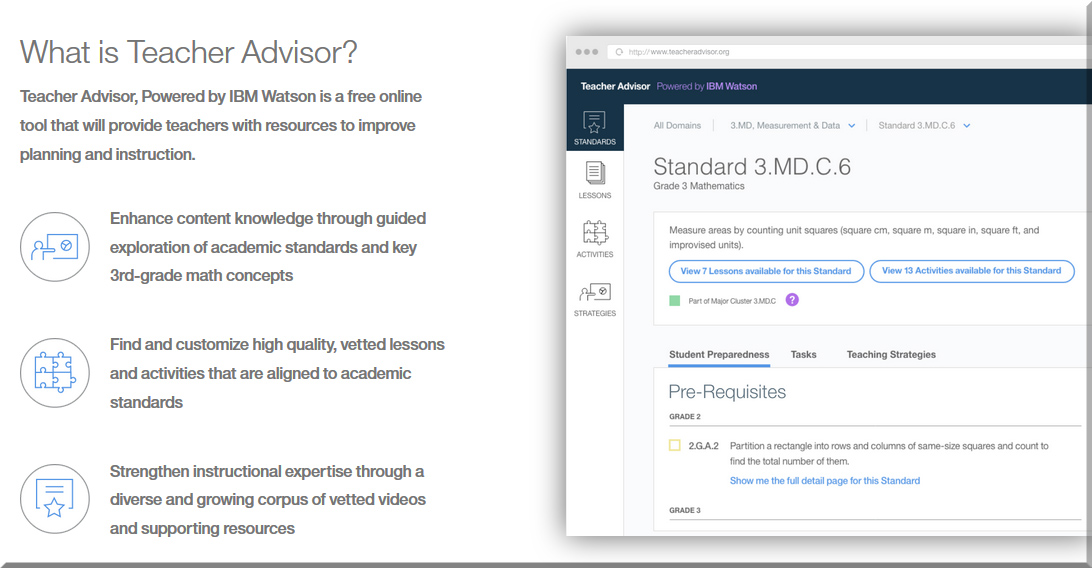
ARMONK, N.Y., Sept. 28, 2016 /PRNewswire/ — Teachers will have access to a new, first-of-its-kind, free tool using IBM’s innovative Watson cognitive technology that has been trained by teachers and designed to strengthen teachers’ instruction and improve student achievement, the IBM Foundation and the American Federation of Teachers announced today.
Hundreds of elementary school teachers across the United States are piloting Teacher Advisor with Watson – an innovative tool by the IBM Foundation that provides teachers with a complete, personalized online resource. Teacher Advisor enables teachers to deepen their knowledge of key math concepts, access high-quality vetted math lessons and acclaimed teaching strategies and gives teachers the unique ability to tailor those lessons to meet their individual classroom needs.
…
Litow said there are plans to make Teacher Advisor available to all elementary school teachers across the U.S. before the end of the year.
In this first phase, Teacher Advisor offers hundreds of high-quality vetted lesson plans, instructional resources, and teaching techniques, which are customized to meet the needs of individual teachers and the particular needs of their students.
Also see:
Educators can also access high-quality videos on teaching techniques to master key skills and bring a lesson or teaching strategy to life into their classroom.
From DSC: Today’s announcement involved personalization and giving customized directions, and it caused my mind to go in a slightly different direction. (IBM, Google, Microsoft, Apple, Amazon, and others like Smart Sparrow are likely also thinking about this type of direction as well. Perhaps they’re already there…I’m not sure.)
But given the advancements in machine learning/cognitive computing (where example applications include optical character recognition (OCR) and computer vision), how much longer will it be before software is able to remotely or locally “see” what a third grader wrote down for a given math problem (via character and symbol recognition) and “see” what the student’s answer was while checking over the student’s work…if the answer was incorrect, the algorithms will likely know where the student went wrong. The software will be able to ascertain what the student did wrong and then show them how the problem should be solved (either via hints or by showing the entire problem to the student — per the teacher’s instructions/admin settings). Perhaps, via natural language processing, this process could be verbalized as well.
Further questions/thoughts/reflections then came to my mind:
Will we have bots that teachers can use to teach different subjects? (“Watson may even ask the teacher additional questions to refine its response, honing in on what the teacher needs to address certain challenges.)
Will we have bots that students can use to get the basics of a given subject/topic/equation?
Will instructional designers — and/or trainers in the corporate world — need to modify their skillsets to develop these types of bots?
Will teachers — as well as schools of education in universities and colleges — need to modify their toolboxes and their knowledgebases to take advantage of these sorts of developments?
How might the corporate world take advantage of these trends and technologies?
Will MOOCs begin to incorporate these sorts of technologies to aid in personalized learning?
What sorts of delivery mechanisms could be involved? Will we be tapping into learning-related bots from our living rooms or via our smartphones?
IBM Watson will help educators improve teaching skills — from zdnet.com by Natalie Gagliordi The IBM Foundation has teamed with teachers and the American Federation of Teachers union to create an AI-based lesson plan tool called Teacher Advisor.
Burger, a computer chip researcher who had joined the company four years earlier, was pitching a new idea to the execs. He called it Project Catapult.
The tech world, Burger explained, was moving into a new orbit. In the future, a few giant Internet companies would operate a few giant Internet services so complex and so different from what came before that these companies would have to build a whole new architecture to run them. They would create not just the software driving these services, but the hardware, including servers and networking gear. Project Catapult would equip all of Microsoft’s servers—millions of them—with specialized chips that the company could reprogram for particular tasks.
…
Today, the programmable chips that Burger and Lu believed would transform the world—called field programmable gate arrays—are here. FPGAs already underpin Bing, and in the coming weeks, they will drive new search algorithms based on deep neural networks—artificial intelligence modeled on the structure of the human brain—executing this AI several orders of magnitude faster than ordinary chips could. As in, 23 milliseconds instead of four seconds of nothing on your screen. FPGAs also drive Azure, the company’s cloud computing service. And in the coming years, almost every new Microsoft server will include an FPGA. That’s millions of machines across the globe. “This gives us massive capacity and enormous flexibility, and the economics work,” Burger says. “This is now Microsoft’s standard, worldwide architecture.”
…
It’s a typical tangle of tech acronyms. CPUs. GPUs. TPUs. FPGAs. But it’s the subtext that matters. With cloud computing, companies like Microsoft and Google and Amazon are driving so much of the world’s technology that those alternative chips will drive the wider universe of apps and online services. Lee says that Project Catapult will allow Microsoft to continue expanding the powers of its global supercomputer until the year 2030. After that, he says, the company can move toward quantum computing.
From DSC:
The articles listed inthis PDF documentdemonstrate the exponential pace of technological change that many nations across the globe are currently experiencing and will likely be experiencing for the foreseeable future. As we are no longer on a linear trajectory, we need to consider what this new trajectory means for how we:
Educate and prepare our youth in K-12
Educate and prepare our young men and women studying within higher education
One thought that comes to mind…when we’re moving this fast, we need to be looking upwards and outwards into the horizons — constantly pulse-checking the landscapes. We can’t be looking down or be so buried in our current positions/tasks that we aren’t noticing the changes that are happening around us.
From DSC: The pace of technological development is moving extremely fast; the ethical, legal, and moral questions are trailing behind it (as is normally the case). But this exponential pace continues to bring some questions, concerns, and thoughts to my mind. For example:
What kind of future do we want?
Just because we can, should we?
Who is going to be able to weigh in on the future direction of some of these developments?
If we follow the trajectories of some of these pathways, where will these trajectories take us? For example, if many people are out of work, how are they going to purchase the products and services that the robots are building?
These and other questions arise when you look at the articles below.
This is the 8th part of a series of postings regarding this matter.
The other postings are in the Ethics section.
What would your ideal robot be like? One that can change nappies and tell bedtime stories to your child? Perhaps you’d prefer a butler that can polish silver and mix the perfect cocktail? Or maybe you’d prefer a companion that just happened to be a robot? Certainly, some see robots as a hypothetical future replacement for human carers. But a question roboticists are asking is: how human should these future robot companions be?
A companion robot is one that is capable of providing useful assistance in a socially acceptable manner. This means that a robot companion’s first goal is to assist humans. Robot companions are mainly developed to help people with special needs such as older people, autistic children or the disabled. They usually aim to help in a specific environment: a house, a care home or a hospital.
The next president will have a range of issues on their plate, from how to deal with growing tensions with China and Russia, to an ongoing war against ISIS. But perhaps the most important decision they will make for overall human history is what to do about autonomous weapons systems (AWS), aka “killer robots.” The new president will literally have no choice. It is not just that the technology is rapidly advancing, but because of a ticking time bomb buried in US policy on the issue.
It sounds like a line from a science fiction novel, but many of us are already managed by algorithms, at least for part of our days. In the future, most of us will be managed by algorithms and the vast majority of us will collaborate daily with intelligent technologies including robots, autonomous machines and algorithms.
Algorithms for task management
Many workers at UPS are already managed by algorithms. It is an algorithm that tells the humans the optimal way to pack the back of the delivery truck with packages. The algorithm essentially plays a game of “temporal Tetris” with the parcels and packs them to optimize for space and for the planned delivery route–packages that are delivered first are towards the front, packages for the end of the route are placed at the back.
The Enterprisers Project (TEP): Machines are genderless, have no race, and are in and of themselves free of bias. How does bias creep in?
Sharp: To understand how bias creeps in you first need to understand the difference between programming in the traditional sense and machine learning. With programming in the traditional sense, a programmer analyses a problem and comes up with an algorithm to solve it (basically an explicit sequence of rules and steps). The algorithm is then coded up, and the computer executes the programmer’s defined rules accordingly.
With machine learning, it’s a bit different. Programmers don’t solve a problem directly by analyzing it and coming up with their rules. Instead, they just give the computer access to an extensive real-world dataset related to the problem they want to solve. The computer then figures out how best to solve the problem by itself.
In his latest book ‘Technology vs. Humanity’, futurist Gerd Leonhard once again breaks new ground by bringing together mankind’s urge to upgrade and automate everything (including human biology itself) with our timeless quest for freedom and happiness.
Before it’s too late, we must stop and ask the big questions:How do we embrace technology without becoming it? When it happens—gradually, then suddenly—the machine era will create the greatest watershed in human life on Earth.
Digital transformation has migrated from the mainframe to the desktop to the laptop to the smartphone, wearables and brain-computer interfaces. Before it moves to the implant and the ingestible insert, Gerd Leonhard makes a last-minute clarion call for an honest debate and a more philosophical exchange.
Technological innovation in fields from genetic engineering to cyberwarfare is accelerating at a breakneck pace, but ethical deliberation over its implications has lagged behind. Thus argues Sheila Jasanoff — who works at the nexus of science, law and policy — in The Ethics of Invention, her fresh investigation. Not only are our deliberative institutions inadequate to the task of oversight, she contends, but we fail to recognize the full ethical dimensions of technology policy. She prescribes a fundamental reboot.
Ethics in innovation has been given short shrift, Jasanoff says, owing in part to technological determinism, a semi-conscious belief that innovation is intrinsically good and that the frontiers of technology should be pushed as far as possible. This view has been bolstered by the fact that many technological advances have yielded financial profit in the short term, even if, like the ozone-depleting chlorofluorocarbons once used as refrigerants, they have proved problematic or ruinous in the longer term.
Machine learning Of prediction and policy — from economist.com Governments have much to gain from applying algorithms to public policy, but controversies loom
Excerpt:
FOR frazzled teachers struggling to decide what to watch on an evening off (DC insert: a rare event indeed), help is at hand. An online streaming service’s software predicts what they might enjoy, based on the past choices of similar people. When those same teachers try to work out which children are most at risk of dropping out of school, they get no such aid. But, as Sendhil Mullainathan of Harvard University notes, these types of problem are alike. They require predictions based, implicitly or explicitly, on lots of data. Many areas of policy, he suggests, could do with a dose of machine learning.
Machine-learning systems excel at prediction. A common approach is to train a system by showing it a vast quantity of data on, say, students and their achievements. The software chews through the examples and learns which characteristics are most helpful in predicting whether a student will drop out. Once trained, it can study a different group and accurately pick those at risk. By helping to allocate scarce public funds more accurately, machine learning could save governments significant sums. According to Stephen Goldsmith, a professor at Harvard and a former mayor of Indianapolis, it could also transform almost every sector of public policy.
…
But the case for code is not always clear-cut. Many American judges are given “risk assessments”, generated by software, which predict the likelihood of a person committing another crime. These are used in bail, parole and (most controversially) sentencing decisions. But this year ProPublica, an investigative-journalism group, concluded that in Broward County, Florida, an algorithm wrongly labelled black people as future criminals nearly twice as often as whites. (Northpointe, the algorithm provider, disputes the finding.)
Who will own the robots?— from technologyreview.com by David Rotman We’re in the midst of a jobs crisis, and rapid advances in AI and other technologies may be one culprit. How can we get better at sharing the wealth that technology creates
IdioT InTo IoT — from a2apple.com by Michael Moe, Luben Pampoulov, Li Jiang, Nick Franco, Suzee Han, Michael Bartimer
Excerpt (emphasis DSC):
But an interesting twist to Negroponte’s paradigm is emerging. As we embed chips in physical devices to make them “smart,” bits and atoms are co-mingling in compelling ways. Collectively called the Internet of Things (IoT), connected devices are appearing in our homes, on the highway, in manufacturing plants, and on our wrists. Estimates vary widely but IDC has predicted that the IoT market will surpass $1.7 trillion by 2020.
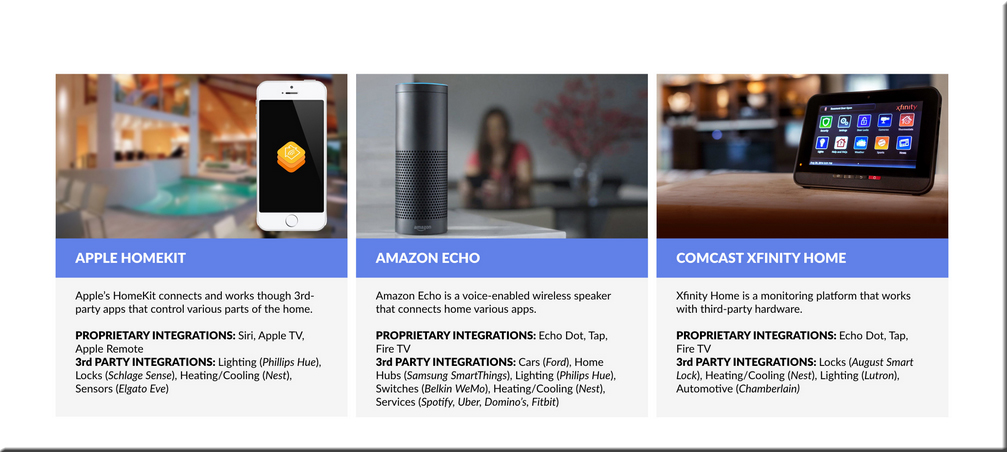
Here again, Amazon’s arc is instructive. Its “Echo” smart speaker, powered by a digital assistant, “Alexa”, has sold over three million units in a little over a year. Echo enables users to play music with voice commands, as well as manage other integrated home systems, including lights, fans, door locks, and thermostats.
The first truly awesome chatbot is a talking T. Rex — from fastcodesign.com by John Brownlee National Geographic uses a virtual Tyrannosaur to teach kids about dinosaurs—and succeeds where other chatbots fail.
Excerpt:
As some have declared chatbots to be the “next webpage,” brands have scrambled to develop their own talkative bots, letting you do everything from order a pizza to rewrite your resume. The truth is, though, that a lot of these chatbots are actually quite stupid, and tend to have a hard time understanding natural human language. Sooner or later, users get frustrated bashing their heads up against the wall of a dim-witted bot’s AI.
So how do you design around a chatbot’s walnut-sized brain? If you’re National Geographic Kids UK, you set your chatbot to the task of pretending to be a Tyrannosaurus rex, a Cretaceous-era apex predator that really had a walnut-sized brain (at least comparatively speaking).
She’s called Tina the T. rex, and by making it fun to learn about dinosaurs, she suggests that education — rather than advertising or shopping — might be the real calling of chatbots.
Dropping a child off at college is a stressful experience. I should know — I dropped off one last week and another today. It’s confusing because everything is so new, your child (who is actually a young adult, how did that happen?) is anxious, and you usually have to settle up on your finances.
This situation happens to be ideal for a chatbot, because the administrative staff is way too busy to handle questions in person or by phone. There might be someone directing you in the parking lot, but not everyone standing around in the student center knows how to submit FAFSA data.
…
One of the main reasons for thinking of this is that I would have used one myself today. It’s a situation where you want immediate, quick information without having to explain all of the background information. You just need the campus map or the schedule for the day — that’s it. You don’t want any extra frills.
From DSC: My question is:
Will Instructional Designers, Technical Communicators, e-Learning Designers, Trainers, (and other positions as as well) going to have to know how to build chatbots in the future? Our job descriptions could be changing soon. Or will this kind of thing require more programming-related skills? Perhaps more firms like the one below could impact that situation…
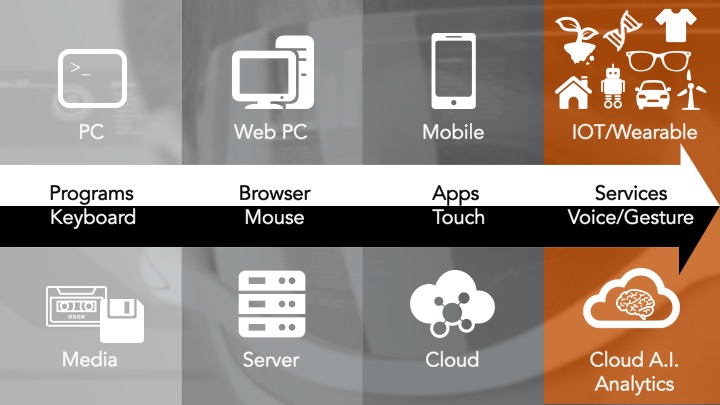
I believe we are moving into the fourth era of personal computing. The first era was characterized by the emergence of the PC. The second by the web and the browser, and the third by mobile and apps.
The fourth personal computing platform will be a combination of IOT, wearable and AR-based clients using speech and gesture, connected over 4G/5G networks to PA, CaaS and social networking platforms that draw upon a new class of cloud-based AI to deliver highly personalized access to information and services.
So what does the fourth era of personal computing look like? It’s a world of smart objects, smart spaces, voice control, augmented reality, and artificial intelligence.
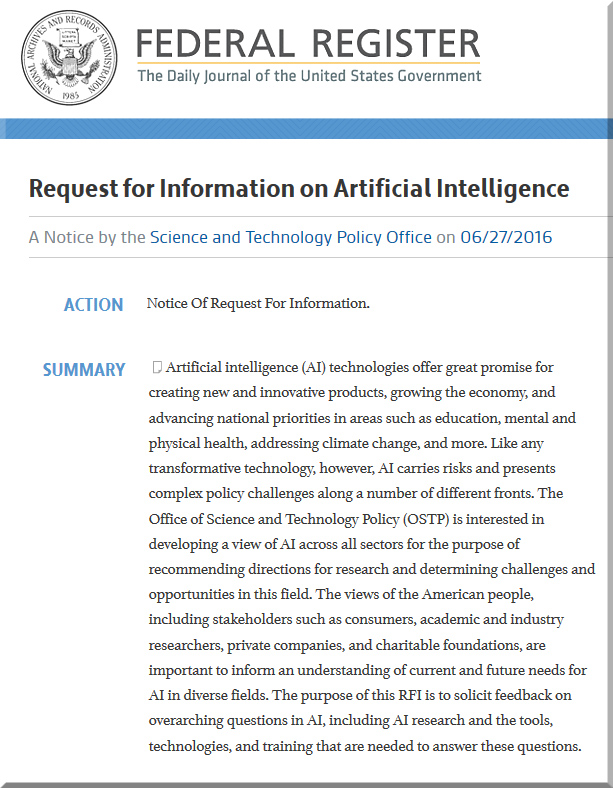
With the current AI revolution, comes a flock of skeptics. Alarmed of what AI could be in the near future, the White House released a Notice of Request For Information (RFI) on it. In response, IBM has created what seems to be an AI 101, giving a good sense of the current state, future, and risks of AI.
Attribution and retribution in the fight against cybercrime: Imagine being enthroned at the end of the long table in the C-suite. You’ve got riches beyond imagination at your disposal; tens of thousands of vassals are toiling day and night for you. Your knights surround you, awaiting your command. And, at this very moment, some evil-minded jester with a computer and an Internet connection is breaching the castle walls.
But wait, is that a war horn you hear in the distance? Yes, it’s the lawyers from Steptoe & Johnson riding to your rescue. Enough, says partner Stewart Baker and trusty clerk Victoria Muth in an article for Brink. “It’s pretty clear that building higher walls around our networks is a dead end. So is tighter scrutiny and control over what happens on the network,” they write. “Government is failing us…, too.” The solution? Fight back.
Attribution and retribution are the weapons in this counterattack. “It might mean building ‘beacons’ into documents so that when they are opened by attackers, they phone home to alert defenders that their information was compromised,” suggest Baker and Muth. “It might mean using information provided by beacons to compromise the attackers’ network and gather evidence as to the attackers’ identities. It might mean stopping a DDOS attack by taking over the botnet, or by patching the vulnerability by which the botnet conscripted third-party machines.”
It feels like the barbarians are continually at the gate. We can’t seem to go more than a week before a new data breach is in the news, impacting potentially millions of individuals. The targets range from companies like Omni Hotels, which had been breached affecting up to 50,000 customers whose personal and credit card information was exposed, to North Carolina State University, where over 38,000 students’ personal information, including their SSNs, were at risk. As I mentioned in a recent blog ‘Internet of Things and Big Data – who owns your data?‘, we have been storing our personal and credit card information in a variety of systems, credit card companies, banks, online retailers, hotels – and that’s just naming a few. The information in those systems is more valuable than gold to the hackers. The hacker attacks are constant, creative, and changing frequently.
Watson, IBM’s computer brain, has a lot of talents. It mastered “Jeopardy!,” it cooks, and even tries to cure cancer. But now, it’s training for a new challenge: Hunting hackers.
On [May10th, 2016], IBM Security announced a new cloud-based version of the cognitive technology, dubbed “Watson for Cybersecurity.” In the fall, IBM will be partnering with eight universities to help get Watson up to speed by flooding it with security reports and data.
From DSC: I try never to judge anyone, as I don’t want to be judged (Matthew 7:1). I try to extend grace, as I, myself, have nothing to stand on.
That said, I struggle with how to deal with and view hackers. Daily, they wreak havoc on institutions and individuals throughout the globe — causing billions of dollars of damage.
I’m amazed at the lack of punishment dealt out to hackers. Our governments don’t step in, likely because they are all trying to hack each others’ systems as well.
But the individual and group-based hackers out there have created an underground economy…where one wakes up and goes to the office and hacks away, all for making some coin — just like a normal job evidently. These hackers have smarts, know-how, and intelligence — but they have chosen to put it towards destructive purposes. And there doesn’t seem to be any fear involved in doing so.
Well, that needs to stop! There needs to be major punishment for those who hack.
That’s why the articles above caught my eye. We need to fight back against the hackers. We need to release serious damage to their systems, networks, hardware and software — just as they do to ours.
I don’t like to take this stance. I don’t like to even use the words “fight back.” But there is warfare going on — and fear needs to enter the equation for those who would resort to hacking.
BTW, I’m even nervous about posting this item…as some hacker could come after my site. If so, I hope to be back up and running again soon. But if not…yet another one bites the dust.
The classroom of tomorrow will undoubtedly employ more and more smart devices, and coupled with the Internet of Things (IoT) phenomenon, the way in which students learn could be very different in the not-so-distant future.
A new survey conducted by Extreme Networks reveals that while smart classrooms and schools only represent a small fraction of campuses today, the promise is there for the technology to redefine the academic experience going forward. There are K-12 schools and universities across the country that are already using the IoT to connect smart devices that can “talk” to one another for the purpose of enhancing the learning experience.
From DSC: I look forward to the time when machine-to-machine communications and sensors will give faculty members the settings that they want setup/initiated as soon as they walk into a room (some of this is most likely already occurring somewhere else…just not on our campus yet!):
The front lights lower down 50% (as the professor had requested previously)
The front 80′ LCD — a smart/Internet connected device — display is turned on and brings up that specific course on the screen (having already signed into the cloud-based CMS/LMS upon that professor entering the room; the system has already queried the appropriate back end system to ascertain what that professor teaches at that particular time and place)
The window treatments are lowered all the way down for better viewing
The speakers play a previously scheduled song, or a spoken poem, or an announcement, or what the students should be doing for the first 5-10 minutes of class
Etc.
Also:
Attendance is automatic (this clearly is already here today and has been for a while).
Students could receive any handouts that the professor wanted to wait to deliver until that particular date and time — again, automatically
Students could upload content that they created — automatically to an electronic parking lot, for the professor or other students to review and comment on
Also see the infographic, a portion of which is seen below:
But the classroom of tomorrow will look very different. The latest advancements in technology and innovation are paving the way for an educational space that’s interactive, engaging and fun.
The conventions of learning are changing. It’s becoming normal for youngsters to use games like Minecraft to develop skills such as team working and problem solving, and for teachers to turn to artificial intelligence to get a better understanding of how their pupils are progressing in lessons.
Virtual reality is also introducing new possibilities in the classroom. Gone are the days of imagining what an Ancient Egyptian tomb might look like – now you can just strap on a headset and transport yourself there in a heartbeat.
The potential for using VR to teach history, geography and other subjects is incredible when you really think about it – and it’s not the only tech that’s going to shake things up.
…
Artificial intelligence is already doing groundbreaking things in areas like robotics, computer science, neuroscience and linguistics, but now they’re now entering the world of education too.
London-based edtech firm Digital Assess has been working on an AI app that has the potential to revolutionise the way youngsters learn.
With the backing of the UK Government, the company has been trialing its web-based application Formative Assess in schools in England.
Using semantic indexing and natural language processing in a similar way to social networking sites, an on-screen avatar – which can be a rubber duck or robot – quizzes students on their knowledge and provides them with individual feedback on their work.
Description:
A new wave of compute technology -fueled by; big data analytics, the internet of things, augmented reality and so on- will change the way we live and work to be more immersive and natural with technology in the role as partner.
We haven’t even scratched the surface of the things technology can do to further human progress. Education is the next major frontier. We already have PC- and smartphone-enabled students, as well as tech-enabled classrooms, but the real breakthrough will be in personalized learning.
Every educator divides his or her time between teaching and interacting. In lectures they have to choose between teaching to the smartest kid in the class or the weakest. Efficiency (and reality) dictates that they must teach to the theoretical median, meaning some students will be bored and some will still struggle. What if a digital assistant could step in to personalize the learning experience for each student, accelerating the curriculum for the advanced students and providing greater extra support for those that need more help? The digital assistant could “sense” and “learn” that Student #1 has already mastered a particular subject and “assign” more advanced materials. And it could provide additional work to Student #2 to ensure that he or she was ready for the next subject. Self-paced learning to supplant and support classroom learning…that’s the next big advancement.


![The Living [Class] Room -- by Daniel Christian -- July 2012 -- a second device used in conjunction with a Smart/Connected TV](http://danielschristian.com/learning-ecosystems/wp-content/uploads/2012/07/The-Living-Class-Room-Daniel-S-Christian-July-2012.jpg)