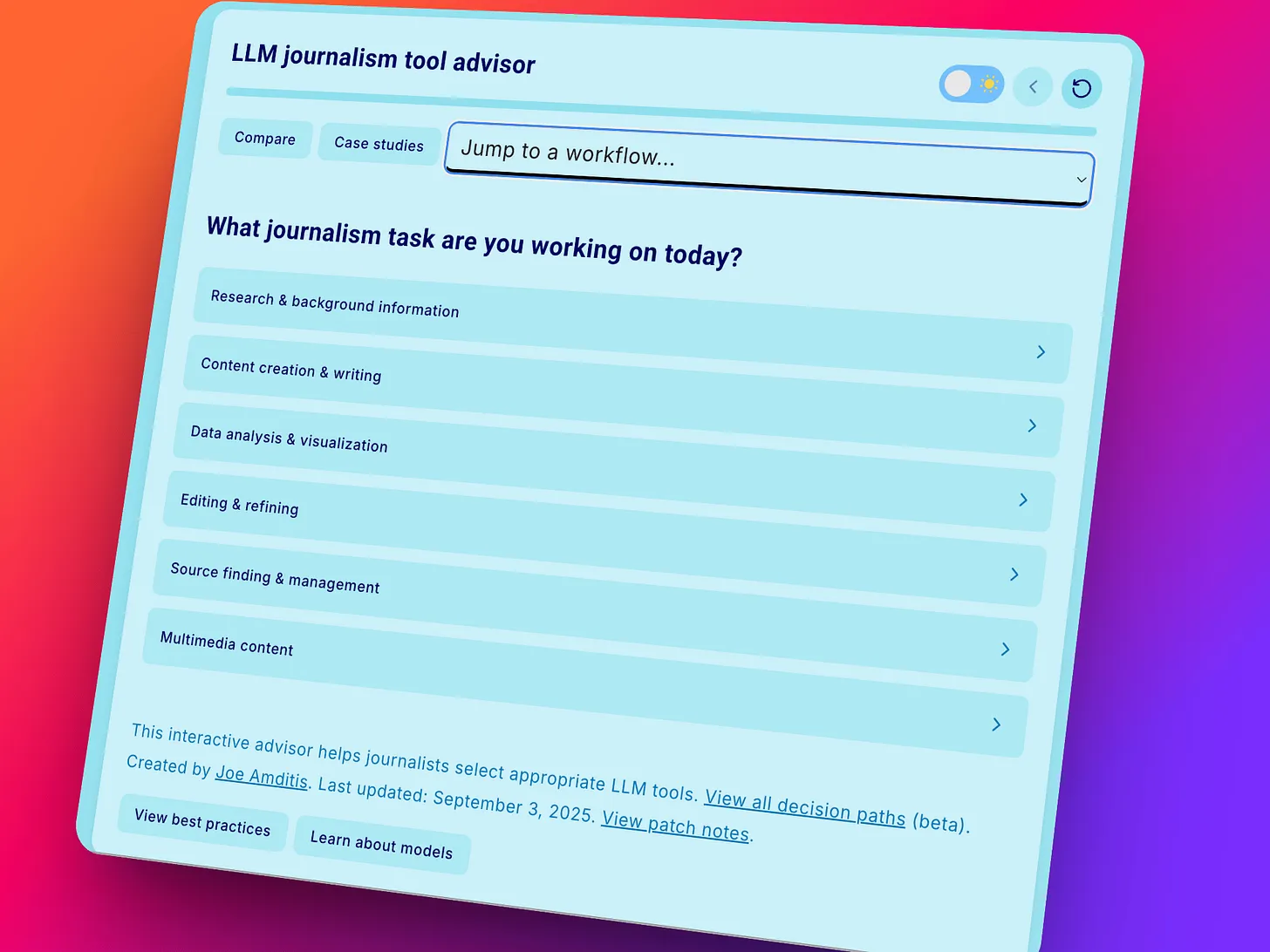
As news organizations scramble to update their digital toolkits, I invited one of the most tech savvy journalism advisors I know to share his guidance.
In the guest post below, Joe Amditis shares a bunch of useful resources. A former CUNY student of mine, Joe now serves as associate director of operations at the Center for Cooperative Media at Montclair State University.
SINGAPORE Sept. 3, 2025 /PRNewswire/ — Today, Midoo AIproudly announces the launch of the world’s first AI language learning agent, a groundbreaking innovation set to transform language education forever.
For decades, language learning has pursued one ultimate goal: true personalization. Traditional tools offered smart recommendations, gamified challenges, and pre-written role-play scripts—but real personalization remained out of reach. Midoo AI changes that. Here is the >launch video of Midoo AI.
Imagine a learning experience that evolves with you in real time. A system that doesn’t rely on static courses or scripts but creates a dynamic, one-of-a-kind language world tailored entirely to your needs. This is the power of Midoo’s Dynamic Generation technology.
“Midoo is not just a language-learning tool,” said Yvonne, co-founder of Midoo AI. “It’s a living agent that senses your needs, adapts instantly, and shapes an experience that’s warm, personal, and alive. Learning is no longer one-size-fits-all—now, it’s yours and yours alone.”
Language learning apps have traditionally focused on exercises, quizzes, and progress tracking. Midoo AI introduces a different approach. Instead of presenting itself as a course provider, it acts as an intelligent learning agent that builds, adapts, and sustains a learner’s journey.
This review examines how Midoo AI operates, its feature set, and what makes it distinct from other AI-powered tutors.
Midoo AI in Context: Purpose and Position
Midoo AI is not structured around distributing lessons or modules. Its core purpose is to provide an agent-like partner that adapts in real time. Where many platforms ask learners to select a “level” or “topic,”
Midoo instead begins by analyzing goals, usage context, and error patterns. The result is less about consuming predesigned units and more about co-constructing a pathway.
Turning Time Saved Into Better Learning
AI can save teachers time, but what can that time be used for (besides taking a breath)? For most of us, it means redirecting energy into the parts of teaching that made us want to pursue this profession in the first place: connecting with our students and helping them grow academically.
Differentiation Every classroom has students with different readiness levels, language needs, and learning preferences. AI tools like Diffit or MagicSchool can instantly create multiple versions of a passage or assignment, differentiated by grade level, complexity, or language. This allows every student to engage with the same core concept, moving together as one cohesive class. Instead of spending an evening retyping and rephrasing, teachers can review and tweak AI drafts in minutes, ready for the next lesson.
Mass Intelligence — from oneusefulthing.org by Ethan Mollick From GPT-5 to nano banana: everyone is getting access to powerful AI
When a billion people have access to advanced AI, we’ve entered what we might call the era of Mass Intelligence. Every institution we have — schools, hospitals, courts, companies, governments — was built for a world where intelligence was scarce and expensive. Now every profession, every institution, every community has to figure out how to thrive with Mass Intelligence. How do we harness a billion people using AI while managing the chaos that comes with it? How do we rebuild trust when anyone can fabricate anything? How do we preserve what’s valuable about human expertise while democratizing access to knowledge?
By the time today’s 9th graders and college freshman enter the workforce, the most disruptive waves of AGI and robotics may already be embedded into part society.
What replaces the old system will not simply be a more digital version of the same thing. Structurally, schools may move away from rigid age-groupings, fixed schedules, and subject silos. Instead, learning could become more fluid, personalized, and interdisciplinary—organized around problems, projects, and human development rather than discrete facts or standardized assessments.
AI tutors and mentors will allow for pacing that adapts to each student, freeing teachers to focus more on guidance, relationships, and high-level facilitation. Classrooms may feel less like miniature factories and more like collaborative studios, labs, or even homes—spaces for exploring meaning and building capacity, not just delivering content.
…
If students are no longer the default source of action, then we need to teach them to:
Design agents,
Collaborate with agents,
Align agentic systems with human values,
And most of all, retain moral and civic agency in a world where machines act on our behalf.
We are no longer educating students to be just doers.
We must now educate them to be judges, designers, and stewards of agency.
Meet Your New AI Tutor — from wondertools.substack.com by Jeremy Caplan Try new learning modes in ChatGPT, Claude, and Gemini
AI assistants are now more than simple answer machines. ChatGPT’s new Study Mode, Claude’s Learning Mode, and Gemini’s Guided Learningrepresent a significant shift. Instead of just providing answers, these free tools act as adaptive, 24/7 personal tutors.
That’s why, in preparation for my next bootcamp which kicks off September 8th 2025, I’ve just completed a full refresh of my list of the most powerful & popular AI tools for Instructional Designers, complete with tips on how to get the most from each tool.
The list has been created using my own experience + the experience of hundreds of Instructional Designers who I work with every week.
It contains the 50 most powerful AI tools for instructional design available right now, along with tips on how to optimise their benefits while mitigating their risks.
Addendums on 9/4/25:
AI Companies Roll Out Educational Tools — from insidehighered.com by Ray Schroeder This fall, Google, Anthropic and OpenAI are rolling out powerful new AI tools for students and educators, each taking a different path to shape the future of learning.
So here’s the new list of essential skills I think my students will need when they are employed to work with AI five years from now:
They can follow directions, analyze outcomes, and adapt to change when needed.
They can write or edit AI to capture a unique voice and appropriate tone in sync with an audience’s needs
They have a deep understanding of one or more content areas of a particular profession, business, or industry, so they can easily identify factual errors.
They have a strong commitment to exploration, a flexible mindset, and a broad understanding of AI literacy.
They are resilient and critical thinkers, ready to question results and demand better answers.
They are problem solvers.
And, of course, here is a new rubric built on those skills:
What’s changing is not the foundation—it’s the ecosystem. Teams are looking to create more flexible, scalable, and diverse learning experiences that meet people where they are.
What Did We Explore? Everyone seems to have a take on what’s happening in L&D these days. From bold claims about six-figure roles to debates over whether portfolios or degrees matter more, everyone seems to have a take. So, we wanted to get to the heart of it by exploring five of the biggest, most debated areas shaping our work today:
Salaries: Are compensation trends really keeping pace with the value we deliver?
Hiring: What skills are managers actually looking for—and are those ATS horror stories true?
Portfolios: Are portfolios helping candidates stand out, and what are hiring managers actually looking for?
Tools & Modalities: What types of training are teams building, and what tools are they using to build it?
Artificial Intelligence: Who’s using it, how, and what concerns still exist?
These five areas are shaping the future of instructional design—not just for job seekers, but for team leaders, hiring managers, and the entire ecosystem of L&D professionals.
The takeaway? A portfolio is more than a collection of projects—it’s a storytelling tool. The ones that stand out highlight process, decision-making, and results—not just pretty screens.
Educators use AI in and out of the classroom Educators’ uses range from developing course materials and writing grant proposals to academic advising and managing administrative tasks like admissions and financial planning.
Educators aren’t just using chatbots; they’re building their own custom tools with AI
Faculty are using Claude Artifacts to create interactive educational materials, such as chemistry simulations, automated grading rubrics, and data visualization dashboards.
Educators tend to automate the drudgery while staying in the loop for everything else
Tasks requiring significant context, creativity, or direct student interaction—like designing lessons, advising students, and writing grant proposals—are where educators are more likely to use AI as an enhancement. In contrast, routine administrative work such as financial management and record-keeping are more automation-heavy.
Some educators are automating grading; others are deeply opposed
In our Claude.ai data, faculty used AI for grading and evaluation less frequently than other uses, but when they did, 48.9% of the time they used it in an automation-heavy way (where the AI directly performs the task). That’s despite educator concerns about automating assessment tasks, as well as our surveyed faculty rating it as the area where they felt AI was least effective.
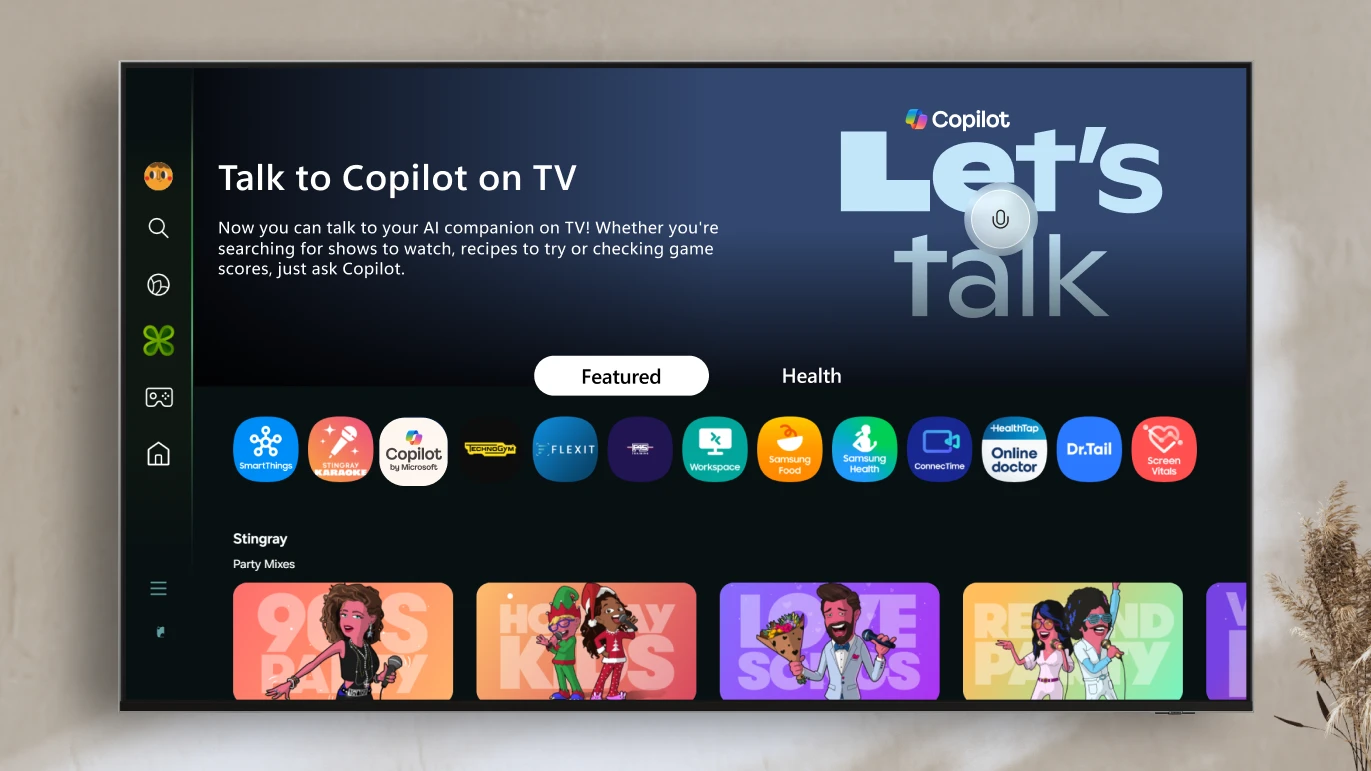
Voice-powered AI meets a visual companion for entertainment, everyday help, and everything in between.
Redmond, Wash., August 27—Today, we’re announcing the launch ofCopilot on select Samsung TVs and monitors, transforming the biggest screen in your home into your most personal and helpful companion—and it’s free to use.
Copilot makes your TV easier and more fun to use with its voice-powered interface, friendly on-screen character, and simple visual cards. Now you can quickly find what you’re looking for and discover new favorites right from your living room.
Because it lives on the biggest screen in the home, Copilot is a social experience—something you can use together with family and friends to spark conversations, help groups decide what to watch, and turn the TV into a shared space for curiosity and connection.
Young workers are getting hit in fields where generative-AI tools such as ChatGPT can most easily automate tasks done by humans, such as software development, according to a paper released Tuesday by three Stanford University economists. They crunched anonymized data on millions of employees at tens of thousands of firms, including detailed information on workers’ ages and jobs, making this one of clearest indicators yet of AI’s disruptive impact.
Young workers in jobs where AI could act as a helper, rather than a replacement, actually saw employment growth, economists found.
The AI Education Revolution — from linkedin.com by Whitney Kilgore We’re witnessing the biggest shift in education since the textbook—and most institutions are still deciding whether to allow it.
On the surface, ILTACON 2025, the International Legal Technology Association’s largest annual legal technology event, had all the makings of a great conference. But despite the thought-provoking sessions and keynotes, networking opportunities and PR fanfare, I couldn’t shake the sense that we were in the midst of a seismic shift in legal tech, surrounded by the restless energy of a boomtown.
… The gold rush
It wasn’t ILTACON that bothered me; it was the heady, gold-rushed, “anything goes and whatever sticks works” environment that was unsettling. While this year’s conference was pirate-themed, it felt more like the Wild West to me.
This attitude permeated the conference, driven largely by the frenzied, frontier-style artificial intelligence revolution. The AI train is hurtling forward at lightning speed, destination unknown, and everyone is trying to cash in before it derails.
Two themes emerged from my discussions. First, no matter who you spoke to, “agentic AI,” meaning AI that autonomously takes purposeful actions, was a buzzword that cropped up often, whether during press briefings or over drinks. Another key trend was the race to become the generative AI home base for legal professionals.
— Nicole Black
“We are at the start of the biggest disruption to the legal profession in its history.”
Is AI the technology that will finally force lawyer tech competence? With rapid advances and the ability to address numerous problems and pain points in our legal systems, AI simply can’t be ignored. Dennis & Tom welcome Bridget McCormack to discuss her perspectives on current AI trends and other exciting new tech applications in legal…
Despite concerns about widespread job losses, AI adoption is expected to have only a modest and relatively temporary impact on employment levels.
Goldman Sachs Research estimates that unemployment will increase by half a percentage point during the AI transition period as displaced workers seek new positions.
If current AI use cases were expanded across the economy and reduced employment proportionally to efficiency gains, an estimated 2.5% of US employment would be at risk of related job loss.
Occupations with higher risk of being displaced by AI include computer programmers, accountants and auditors, legal and administrative assistants, and customer service representatives.
The Neuron recently highlighted the above item. Here is Grant Harvey’s take on that and other AI-related items:
Goldman Sachs’ says AI’s job hit will be real… but thankfully, brief. Goldman Sachs says AI will lift productivity with only brief job losses, which we think means it’s time to shift our work mindset from set roles to outcome-based delivery, leading to more small teams who win back local market share from slower moving corporations.
UK businesses are dialing back hiring for jobs that are likely to be affected by the rollout of artificial intelligence, a study found, suggesting the new technology is accentuating a slowdown in the nation’s labor market. Job vacancies have declined across the board in the UK as employers cut costs in the face of sluggish growth and high borrowing rates, with the overall number of online job postings down 31% in the three months to May compared with the same period in 2022, a McKinsey & Co. analysis found. Tiwa Adebayo joins Stephen Carroll on Bloomberg Radio to discuss the details.
I talked to Sam Altman about the GPT-5 launch fiasco – from theverge.com by Alex Heath Over dinner, OpenAI CEO’s addressed criticism of GPT-5’s rollout, the AI bubble, brain-computer interfaces, buying Google Chrome, and more.
But throughout the night, it becomes clear to me that this dinner is about OpenAI’s future beyond GPT-5. OpenAI’s executives give the impression that AI model launches are less important than they were when GPT-4 launched in 2023. After all, OpenAI is a very different company now, focused on upending legacy players in search, consumer hardware, and enterprise software.
OpenAI shares some new details about those efforts.
Learn something new. Map out a personalized curriculum
Try this: Give an AI assistant context about what you want to learn, why, and how.
Detail your rationale and motivation, which may impact your approach.
Note your current knowledge or skill level, ideally with examples.
Summarize your learning preferences
Note whether you prefer to read, listen to, or watch learning materials.
Mention if you like quizzes, drills, or exercises you can do while commuting or during a break at work.
If you appreciate learning games, task your AI assistant with generating one for you, using its coding capabilities detailed below.
Ask for specific book, textbook, article, or learning path recommendations using the Web search or Deep Research capabilities of Perplexity, ChatGPT, Gemini or Claude. They can also summarize research literature about effective learning tactics.
If you need a human learning partner, ask for guidance on finding one or language you can use in reaching out.
GPT-5 for Instructional Designers — from drphilippahardman.substack.com by Dr Philippa Hardman 10 Hacks to Work Smarter & Safer with OpenAI’s Latest Model
The TLDR is that as Instructional Designers, we can’t afford to miss some of the very real benefits of GPT-5’s potential, but we also can’t ensure our professional standards or learner outcomes if we blindly accept its outputs without due testing and validation.
For this reason, I decided to synthesise the latest GPT-5 research—from OpenAI’s technical documentation to independent security audits to real-world user testing—into 10 essential reality checks for using GPT-5 as an Instructional Designer.
These aren’t theoretical exercises; they’re practical tests designed to help you safely unlock GPT-5’s benefits while identifying and mitigating its most well-documented limitations.
While I regularly use tools like ChatGPT, Grammarly, Microsoft Copilot, and even YouTube Premium (I would cancel Netflix before this), Perplexity has earned a top spot in my toolkit. It blends AI and real-time web search into one seamless, research-driven platform that saves time and improves the quality of information I rely on every day.
These ChatGPT Prompts Will Fast-Track Your Job Search — from builtin.com by Jeff Rumage Used correctly, ChatGPT could help you land your dream job — but used incorrectly, it can cost you the offer. Here’s how you can make ChatGPT your secret weapon for research help, resume writing, interview prep and more.
Example prompt: Here are several bullet points from my resume: [paste bullets]. Rewrite them so each one begins with a strong action verb, clearly states what I did, and quantifies results or outcomes wherever possible. If metrics are missing, suggest realistic ways they could be added.
Example prompt:Here is my resume [paste resume]. Here’s the job description of a job I’m applying for [paste job description]. Highlight the most important skills and qualifications for this job. Without making up information, revise my resume to match these requirements. Include action verbs for each accomplishment on the resume, and highlight which accomplishments could be quantified.
Example prompt: What are the current trends impacting companies in the [industry]? How would [company name] be affected by these trends, and what might it do to adjust to/capitalize on these trends?
Example prompt: I’m a [current role] but want to become a [dream role]. Create a detailed career development plan outlining:
Skills I should develop
Relevant experiences I need to gain
Educational or certification needs
Recommended resources or programs
A realistic timeline with milestones for the next 1-3 years.
Thomson Reuters President and CEO Steve Hasker believes the legal profession is experiencing “the biggest disruption … in its history” due to generative and agentic artificial intelligence, fundamentally rewriting how legal work products are created for the first time in more than 300 years.
Speaking to legal technology reporters during ILTACON, the International Legal Technology Association’s annual conference, Hasker outlined his company’s ambitious goal to become “the most innovative company” in the legal tech sector while navigating what he described as unprecedented technological change affecting a profession that has remained largely unchanged since its origins in London tea houses centuries ago.
The winning team comprised of students of computer science, law, psychology and physics. They developed a privacy-first legal assistant powered by AI that helps people understand their legal rights without needing to navigate dense legal language.
Law Schools These insights have particular urgency for legal education. Indeed, most of Cowen’s criticisms and suggested changes need to be front and center for law school leaders. It’s naïve to think that law student and lawyers aren’t going to use GenAI tools in virtually every aspect of their professional and personal lives. Rather than avoiding the subject or worse yet trying to stop use of these tools, law schools should make GenAI tools a fundamental part of research, writing and drafting training.
They need to focus not on memorization but on the critical thinking skills beginning lawyers used to get in the on-the-job training guild type system. As I discussed, that training came from repetitive and often tedious work that developed experienced lawyers who could recognize patterns and solutions based on the exposure to similar situations. But much of that repetitive and tedious work may go away in a GenAI world.
The Role of Adjunct Professors But to do this, law schools need to better partner with actual practicing lawyers who can serve as adjunct professors. Law schools need to do away with the notion that adjuncts are second-class teachers.
As someone who has covered legal tech for 30 years, I cannot remember there ever being a time such as this, when the energy and excitement are raging, driven by generative AI and a new era of innovation and new ideas of the possible.
…
But this year was different. Wandering the exhibit hall, getting product briefings from vendors, talking with attendees, it was impossible to ignore the fundamental shift happening in legal technology. Gen AI isn’t just creating new products – it is spawning entirely new categories of products that truly are reshaping how legal work gets done.
Agentic AI is the buzzword of 2025 and agentic systems were everywhere at ILTACON, promising to streamline workflows across all areas of legal practice. But, perhaps more importantly, these tools are also beginning to address the business side of running a law practice – from client intake and billing to marketing and practice management. The scope of transformation is now beginning to extend beyond the practice of law into the business of law. … Largely missing from this gathering were solo practitioners, small firm lawyers, legal aid organizations, and access-to-justice advocates – the very people who stand to benefit most from the democratizing potential of AI.
…
However, now more than ever, the innovations we are seeing in legal tech have the power to level the playing field, to give smaller practitioners access to tools and capabilities that were once prohibitively expensive. If these technologies remain priced for and marketed primarily to Big Law, we will have succeeded only in widening the justice gap rather than closing it.
Thanks to breakthroughs in artificial intelligence – particularly in semantic search, multimodal models, and natural language processing – new legaltech solutions are emerging to streamline and accelerate deposition review. What once took hours or days of manual analysis now can be accomplished in minutes, with greater accuracy and efficiency than possible with manual review.
Historically, lawyers have been slow adopters of emerging technologies, and with good reason. Legal work is high stakes, deeply rooted in precedent, and built on individual judgment. AI, especially the new generation of agentic AI (systems that not only generate output but initiate tasks, make decisions, and operate semi-autonomously), represents a fundamental shift in how legal work gets done. This shift naturally leads to caution as it challenges long-held assumptions about lawyer workflows and several aspects of their role in the legal process.
The path forward is not to push harder or faster, but smarter. Firms need to take a structured approach that builds trust through transparency, context, training, and measurement of success. This article provides a five-part playbook for law firm leaders navigating AI change management, especially in environments where skepticism is high and reputational risk is even higher.
This year’s ILTACON in Washington was heavy on AI, but the conversation with vendors has shifted. Legal IT Insider’s briefings weren’t about potential use cases or speculative roadmaps. Instead, they focused on how AI is now being embedded into the tools lawyers use every day — and, crucially, how those tools are starting to talk to each other.
Taken together, they point to an inflection point, where agentic workflows, data integration, and open ecosystems define the agenda. But it’s important amidst the latest buzzwords to remember that agents are only as good as the tools they have to work with, and AI only as good as its underlying data. Also, as we talk about autonomous AI, end users are still struggling with cloud implementations and infrastructure challenges, and need vendors to be business partners that help them to make progress at speed.
Harvey’s roadmap is all about expanding its surface area — connecting to systems like iManage, LexisNexis, and more recently publishing giant Wolters Kluwer — so that a lawyer can issue a single query and get synthesised, contextualised answers directly within their workflow. Weinberg said: “What we’re trying to do is get all of the surface area of all of the context that a lawyer needs to complete a task and we’re expanding the product surface so you can enter a search, search all resources, and apply that to the document automatically.”
The common thread: no one is talking about AI in isolation anymore. It’s about orchestration — pulling together multiple data sources into a workflow that actually reflects how lawyers practice.
Why You Can’t Afford to Wait to Adopt AI Tools that have Plaintiffs Moving Faster than Ever Just as photocopiers shifted law firm operations in the early 1970s and cloud computing transformed legal document management in the early 2000s, AI automation tools are altering the current legal landscape—enabling litigation teams to instantly structure unstructured data, zero in on key arguments in seconds, and save hundreds (if not thousands) of hours of manual work.
The Floor, Not the Ceiling Smart firms need to flip their entire approach. Instead of dictating which AI tools lawyers must use, leadership should set a floor for acceptable use and then get out of the way.
The floor is simple: no free versions for client work. Free tools are free because users are the product. Client data becomes training data. Confidentiality gets compromised. The firm loses any ability to audit or control how information flows. This isn’t about control; it’s about professional responsibility.
But setting the floor is only the first step. Firms must provide paid, enterprise versions of AI tools that lawyers actually want to use. Not some expensive legal tech platform that promises AI features but delivers complicated workflows. Real AI tools. The same ones lawyers are already using secretly, but with enterprise security, data protection, and proper access controls.
Education must be practical and continuous. Single training sessions don’t work. AI tools evolve weekly. New capabilities emerge constantly. Lawyers need ongoing support to experiment, learn, and share discoveries. This means regular workshops, internal forums for sharing prompts and techniques, and recognition for innovative uses.
The education investment pays off immediately. Lawyers who understand AI use it more effectively. They catch its mistakes. They know when to verify outputs. They develop specialized prompts for legal work. They become force multipliers, not just for themselves but for their entire teams.
As a new academic year begins, many instructors, trainers, and program leaders are bracing for familiar challenges—keeping learners engaged, making complex material accessible, and preparing students for real-world application.
But there’s a quiet shift happening in classrooms and online courses everywhere.
This fall, it’s not the syllabus that’s guiding the learning experience—it’s the conversation between the learner and an AI tool.
From bootcamp to bust: How AI is upending the software development industry — from reuters.com by Anna Tong; via Paul Fain Coding bootcamps have been a mainstay in Silicon Valley for more than a decade. Now, as AI eliminates the kind of entry-level roles for which they trained people, they’re disappearing.
Coding bootcamps have been a Silicon Valley mainstay for over a decade, offering an important pathway for non-traditional candidates to get six-figure engineering jobs. But coding bootcamp operators, students and investors tell Reuters that this path is rapidly disappearing, thanks in large part to AI.
“Coding bootcamps were already on their way out, but AI has been the nail in the coffin,” said Allison Baum Gates, a general partner at venture capital fund SemperVirens, who was an early employee at bootcamp pioneer General Assembly.
Gates said bootcamps were already in decline due to market saturation, evolving employer demand and market forces like growth in international hiring.