Is Generative AI and ChatGPT healthy for Students? — from ai-supremacy.com by Michael Spencer and Nick Potkalitsky
Beyond Text Generation: How AI Ignites Student Discovery and Deep Thinking, according to firsthand experiences of Teachers and AI researchers like Nick Potkalitsky.

After two years of intensive experimentation with AI in education, I am witnessing something amazing unfolding before my eyes. While much of the world fixates on AI’s generative capabilities—its ability to create essays, stories, and code—my students have discovered something far more powerful: exploratory AI, a dynamic partner in investigation and critique that’s transforming how they think.
…
They’ve moved beyond the initial fascination with AI-generated content to something far more sophisticated: using AI as an exploratory tool for investigation, interrogation, and intellectual discovery.
…
Instead of the much-feared “shutdown” of critical thinking, we’re witnessing something extraordinary: the emergence of what I call “generative thinking”—a dynamic process where students learn to expand, reshape, and evolve their ideas through meaningful exploration with AI tools. Here I consciously reposition the term “generative” as a process of human origination, although one ultimately spurred on by machine input.


A Road Map for Leveraging AI at a Smaller Institution — from er.educause.edu by Dave Weil and Jill Forrester
Smaller institutions and others may not have the staffing and resources needed to explore and take advantage of developments in artificial intelligence (AI) on their campuses. This article provides a roadmap to help institutions with more limited resources advance AI use on their campuses.

The following activities can help smaller institutions better understand AI and lay a solid foundation that will allow them to benefit from it.

  1. Understand the impact…
  2. Understand the different types of AI tools…
  3. Focus on institutional data and knowledge repositories…

Smaller institutions do not need to fear being left behind in the wake of rapid advancements in AI technologies and tools. By thinking intentionally about how AI will impact the institution, becoming familiar with the different types of AI tools, and establishing a strong data and analytics infrastructure, institutions can establish the groundwork for AI success. The five fundamental activities of coordinating, learning, planning and governing, implementing, and reviewing and refining can help smaller institutions make progress on their journey to use AI tools to gain efficiencies and improve students’ experiences and outcomes while keeping true to their institutional missions and values.

Also from Educause, see:


AI school opens – learners are not good or bad but fast and slow — from donaldclarkplanb.blogspot.com by Donald Clark

That is what they are doing here. Lesson plans focus on learners rather than the traditional teacher-centric model. Assessing prior strengths and weaknesses, personalising to focus more on weaknesses and less on things known or mastered. It’s adaptive, personalised learning. The idea that everyone should learn at the exactly same pace, within the same timescale is slightly ridiculous, ruled by the need for timetabling a one to many, classroom model.

For the first time in the history of our species we have technology that performs some of the tasks of teaching. We have reached a pivot point where this can be tried and tested. My feeling is that we’ll see a lot more of this, as parents and general teachers can delegate a lot of the exposition and teaching of the subject to the technology. We may just see a breakthrough that transforms education.


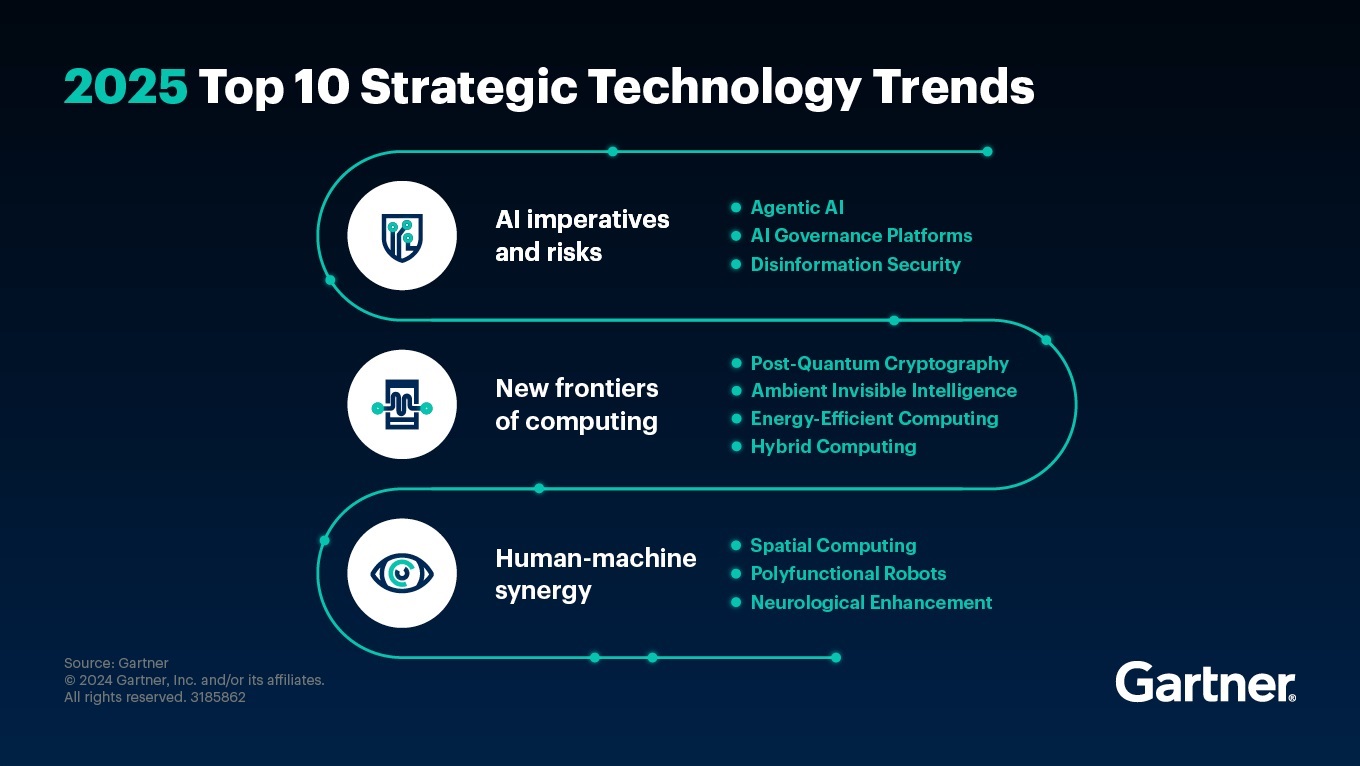
Agentic AI Named Top Tech Trend for 2025 — from campustechnology.com by David Ramel

Agentic AI will be the top tech trend for 2025, according to research firm Gartner. The term describes autonomous machine “agents” that move beyond query-and-response generative chatbots to do enterprise-related tasks without human guidance.
…
More realistic challenges that the firm has listed elsewhere include:

    • Agentic AI proliferating without governance or tracking;
    • Agentic AI making decisions that are not trustworthy;
    • Agentic AI relying on low-quality data;
    • Employee resistance; and
    • Agentic-AI-driven cyberattacks enabling “smart malware.”
Also from campustechnology.com, see:


Three items from edcircuit.com:


All or nothing at Educause24 — from onedtech.philhillaa.com by Kevin Kelly
Looking for specific solutions at the conference exhibit hall, with an educator focus

Here are some notable trends:

  • Alignment with campus policies: …
  • Choose your own AI adventure: …
  • Integrate AI throughout a workflow: …
  • Moving from prompt engineering to bot building: …
  • More complex problem-solving: …

…
Not all AI news is good news. In particular, AI has exacerbated the problem of fraudulent enrollment–i.e., rogue actors who use fake or stolen identities with the intent of stealing financial aid funding with no intention of completing coursework.
…
The consequences are very real, including financial aid funding going to criminal enterprises, enrollment estimates getting dramatically skewed, and legitimate students being blocked from registering for classes that appear “full” due to large numbers of fraudulent enrollments.



How Legal Education Must Evolve In The Age Of AI: Insights From An In-House Legal Innovator — from by abovethelaw.com Olga Mack
Traditional legal education has remained largely unchanged for decades, focusing heavily on theoretical knowledge and case law analysis.

As we stand on the brink of a new era defined by artificial intelligence (AI) and data-driven decision-making, the question arises: How should legal education adapt to prepare the next generation of lawyers for the challenges ahead?

Here are three unconventional, actionable insights from our conversation that highlight the need for a radical rethinking of legal education.

  1. Integrate AI Education Into Every Aspect Of Legal Training…
  2. Adopt A ‘Technology-Agnostic’ Approach To AI Training…
  3. Redefine Success In Legal Education To Include Technological Proficiency…


Google’s worst nightmare just became reality — from aidisruptor.ai by Alex McFarland
OpenAI just launched an all-out assault on traditional search engines.

Google’s worst nightmare just became reality. OpenAI didn’t just add search to ChatGPT – they’ve launched an all-out assault on traditional search engines.

It’s the beginning of the end for search as we know it.

Let’s be clear about what’s happening: OpenAI is fundamentally changing how we’ll interact with information online. While Google has spent 25 years optimizing for ad revenue and delivering pages of blue links, OpenAI is building what users actually need – instant, synthesized answers from current sources.

The rollout is calculated and aggressive: ChatGPT Plus and Team subscribers get immediate access, followed by Enterprise and Education users in weeks, and free users in the coming months. This staged approach is about systematically dismantling Google’s search dominance.


Open for AI: India Tech Leaders Build AI Factories for Economic Transformation — from blogs.nvidia.com
Yotta Data Services, Tata Communications, E2E Networks and Netweb are among the providers building and offering NVIDIA-accelerated infrastructure and software, with deployments expected to double by year’s end.


AI Tutors Double Rates of Learning in Less Learning Time — by drphilippahardman.substack.com Dr. Philippa Hardman
Inside Harvard’s new groundbreaking study

Conclusion
This Harvard study provides robust evidence that AI tutoring, when thoughtfully designed, can significantly enhance learning outcomes. The combination of doubled learning gains, increased engagement, and reduced time to competency suggests we’re seeing just the beginning of AI’s potential in education and that its potential is significant.

If this data is anything to go by, and if we – as humans – are open and willing to acting on it, it’s possible AI will have a significant and for some deeply positive impact on how we design and deliver learning experiences.

That said, as we look forward, the question shouldn’t just be, “how AI can enhance current educational methods?”, but also “how it might AI transform the very nature of learning itself?”. With continued research and careful implementation, we could be moving toward an era of education that’s more effective but also more accessible than ever before.


Three Quick Examples of Teaching with and about Generative AI — from derekbruff.org Derek Bruff

  • Text-to-Podcast.
  • Assigning Students to Groups.
  • AI Acceptable Use Scale.

Also from Derek’s blog, see:


From Mike Sharples on LinkedIn: 


ChatGPT’s free voice wizard — from wondertools.substack.com by Jeremy Caplan
How and why to try the new Advanced Voice Mode

7 surprisingly practical ways to use voice AI
Opening up ChatGPT’s Advanced Voice Mode (AVM) is like conjuring a tutor eager to help with whatever simple — or crazy — query you throw at it. Talking is more fluid and engaging than typing, especially if you’re out and about. It’s not a substitute for human expertise, but AVM provides valuable machine intelligence.

  • Get a virtual museum tour. …
  • Chat with historical figures….
  • Practice languages. …
  • Explore books. …
  • Others…


Though not AI-related, this is along the lines of edtech:


…which links to:


Half of Higher Ed Institutions Now Use AI for Outcomes Tracking, But Most Lag in Implementing Comprehensive Learner Records — from prnewswire.com; via GSV

SALT LAKE CITY, Oct. 22, 2024 /PRNewswire/ — Instructure, the leading learning ecosystem and UPCEA, the online and professional education association, announced the results of a survey on whether institutions are leveraging AI to improve learner outcomes and manage records, along with the specific ways these tools are being utilized. Overall, the study revealed interest in the potential of these technologies is far outpacing adoption. Most respondents are heavily involved in developing learner experiences and tracking outcomes, though nearly half report their institutions have yet to adopt AI-driven tools for these purposes. The research also found that only three percent of institutions have implemented Comprehensive Learner Records (CLRs), which provide a complete overview of an individual’s lifelong learning experiences.


New Survey Says U.S. Teachers Colleges Lag on AI Training. Here are 4 Takeaways — from the74million.org by ; via GSV
Most preservice teachers’ programs lack policies on using AI, CRPE finds, and are likely unready to teach future educators about the field.

In the nearly two years since generative artificial intelligence burst into public consciousness, U.S. schools of education have not kept pace with the rapid changes in the field, a new report suggests.

Only a handful of teacher training programs are moving quickly enough to equip new K-12 teachers with a grasp of AI fundamentals — and fewer still are helping future teachers grapple with larger issues of ethics and what students need to know to thrive in an economy dominated by the technology.

The report, from the Center on Reinventing Public Education, a think tank at Arizona State University, tapped leaders at more than 500 U.S. education schools, asking how their faculty and preservice teachers are learning about AI. Through surveys and interviews, researchers found that just one in four institutions now incorporates training on innovative teaching methods that use AI. Most lack policies on using AI tools, suggesting that they probably won’t be ready to teach future educators about the intricacies of the field anytime soon.


The 5 Secret Hats Teachers are Wearing Right Now (Thanks to AI!) — from aliciabankhofer.substack.com by Alicia Bankhofer
New, unanticipated roles for educators sitting in the same boat

As beta testers, we’re shaping the tools of tomorrow. As researchers, we’re pioneering new pedagogical approaches. As ethical guardians, we’re ensuring that AI enhances rather than compromises the educational experience. As curators, we’re guiding students through the wealth of information AI provides. And as learners ourselves, we’re staying at the forefront of educational innovation.


Articulate AI & the “Buttonification” of Instructional Design — from drphilippahardman.substack.com by Dr. Philippa Hardman
A new trend in AI-UX, and its implications for Instructional Design

1. Using AI to Scale Exceptional Instructional Design Practice
Imagine a bonification system that doesn’t just automate tasks, but scales best practices in instructional design:

  • Evidence-Based Design Button…
  • Learner-Centered Objectives Generator…
    Engagement Optimiser…

2. Surfacing AI’s Instructional Design Thinking
Instead of hiding AI’s decision-making process, what if we built an AI system which invites instructional designers to probe, question, and learn from an expert trained AI?

  • Explain This Design…
  • Show Me Alternatives…
  • Challenge My Assumptions…
  • Learning Science Insights…

By reimagining the role of AI in this way, we would…


Recapping OpenAI’s Education Forum — from marcwatkins.substack.com by Marc Watkins

OpenAI’s Education Forum was eye-opening for a number of reasons, but the one that stood out the most was Leah Belsky acknowledging what many of us in education had known for nearly two years—the majority of the active weekly users of ChatGPT are students. OpenAI has internal analytics that track upticks in usage during the fall and then drops off in the spring. Later that evening, OpenAI’s new CFO, Sarah Friar, further drove the point home with an anecdote about usage in the Philippines jumping nearly 90% at the start of the school year.

I had hoped to gain greater insight into OpenAI’s business model and how it related to education, but the Forum left me with more questions than answers. What app has the majority of users active 8 to 9 months out of the year and dormant for the holidays and summer breaks? What business model gives away free access and only converts 1 out of every 20-25 users to paid users? These were the initial thoughts that I hoped the Forum would address. But those questions, along with some deeper and arguably more critical ones, were skimmed over to drive home the main message of the Forum—Universities have to rapidly adopt AI and become AI-enabled institutions.


Off-Loading in the Age of Generative AI — from insidehighered.com by James DeVaney

As we embrace these technologies, we must also consider the experiences we need to discover and maintain our connections—and our humanity. In a world increasingly shaped by AI, I find myself asking: What are the experiences that define us, and how do they influence the relationships we build, both professionally and personally?

This concept of “off-loading” has become central to my thinking. In simple terms, off-loading is the act of delegating tasks to AI that we would otherwise do ourselves. As AI systems advance, we’re increasingly confronted with a question: Which tasks should we off-load to AI?


The Tutoring Revolution — from educationnext.org by Holly Korbey
More families are seeking one-on-one help for their kids. What does that tell us about 21st-century education?

Recent research suggests that the number of students seeking help with academics is growing, and that over the last couple of decades, more families have been turning to tutoring for that help.
…

What the Future Holds
Digital tech has made private tutoring more accessible, more efficient, and more affordable. Students whose families can’t afford to pay $75 an hour at an in-person center can now log on from home to access a variety of online tutors, including Outschool, Wyzant, and Anchorbridge, and often find someone who can cater to their specific skills and needs—someone who can offer help in French to a student with ADHD, for example. Online tutoring is less expensive than in-person programs. Khan Academy’s Khanmigo chatbot can be a student’s virtual AI tutor, no Zoom meeting required, for $4 a month, and nonprofits like Learn to Be work with homeless shelters and community centers to give virtual reading and math tutoring free to kids who can’t afford it and often might need it the most.


According to Notebook LM on this Future U podcast — Searching for Fit: The Impacts of AI in Higher Ed — here are some excerpts from the generated table of contents:

Part 1: Setting the Stage

I. Introduction (0:00 – 6:16): …
II. Historical Contextualization (6:16 – 11:30): …
III. The Role of Product Fit in AI’s Impact (11:30 – 17:10): …
IV. AI and the Future of Knowledge Work (17:10 – 24:03): …
V. Teaching About AI in Higher Ed: A Measured Approach (24:03 – 34:20): …
VI. AI & the Evolving Skills Landscape (34:20 – 44:35): …
VII. Ethical & Pedagogical Considerations in an AI-Driven World (44:35 – 54:03):…
VIII. AI Beyond the Classroom: Administrative Applications & the Need for Intuition (54:03 – 1:04:30): …
IX. Reflections & Future Directions (1:04:30 – 1:11:15): ….

Part 2: Administrative Impacts & Looking Ahead

X. Bridging the Conversation: From Classroom to Administration (1:11:15 – 1:16:45): …
XI. The Administrative Potential of AI: A Looming Transformation (1:16:45 – 1:24:42): …
XII. The Need for Intuitiveness & the Importance of Real-World Applications (1:24:42 – 1:29:45): …
XIII. Looking Ahead: From Hype to Impactful Integration (1:29:45 – 1:34:25): …
XIV. Conclusion and Call to Action (1:34:25 – 1:36:03): …


The future of language learning — from medium.com by Sami Tatar

Most language learners do not have access to affordable 1:1 tutoring, which is also proven to be the most effective way to learn (short of moving to a specific country for complete immersion). Meanwhile, language learning is a huge market, and with an estimated 60% of this still dominated by “offline” solutions, meaning it is prime for disruption and never more so than with the opportunities unlocked through AI powered language learning. Therefore — we believe this presents huge opportunities for new startups creating AI native products to create the next language learning unicorns.


“The Broken Mirror: Rethinking Education, AI, and Equity in America’s Classrooms” — from nickpotkalitsky.substack.com by JC Price

It’s not that AI is inherently biased, but in its current state, it favors those who can afford it. The wealthy districts continue to pull ahead, leaving schools without resources further behind. Students in these underserved areas aren’t just being deprived of technology—they’re being deprived of the future.

But imagine a different world—one where AI doesn’t deepen the divide, but helps to bridge it. Technology doesn’t have to be the luxury of the wealthy. It can be a tool for every student, designed to meet them where they are. Adaptive AI systems, integrated into schools regardless of their budget, can provide personalized learning experiences that help students catch up and push forward, all while respecting the limits of their current infrastructure. This is where AI’s true potential lies—not in widening the gap, but in leveling the field.

But imagine if, instead of replacing teachers, AI helped to support them. Picture a world where teachers are freed from the administrative burdens that weigh them down. Where AI systems handle the logistics, so teachers can focus on what they do best—teaching, mentoring, and inspiring the next generation. Professional development could be personalized, helping teachers integrate AI into their classrooms in ways that enhance their teaching, without adding to their workload. This is the future we should be striving toward—one where technology serves to lift up educators, not push them out.


Employers Say Students Need AI Skills. What If Students Don’t Want Them? — from insidehighered.com by Ashley Mowreader
Colleges and universities are considering new ways to incorporate generative AI into teaching and learning, but not every student is on board with the tech yet. Experts weigh in on the necessity of AI in career preparation and higher education’s role in preparing students for jobs of the future.

Among the 5,025-plus survey respondents, around 2 percent (n=93), provided free responses to the question on AI policy and use in the classroom. Over half (55) of those responses were flat-out refusal to engage with AI. A few said they don’t know how to use AI or are not familiar with the tool, which impacts their ability to apply appropriate use to coursework.

But as generative AI becomes more ingrained into the workplace and higher education, a growing number of professors and industry experts believe this will be something all students need, in their classes and in their lives beyond academia.

From DSC:
I used to teach a Foundations of Information Technology class. Some of the students didn’t want to be there as they began the class, as it was a required class for non-CS majors. But after seeing what various applications and technologies could do for them, a good portion of those same folks changed their minds. But not all. Some students (2% sounds about right) asserted that they would never use technologies in their futures. Good luck with that I thought to myself. There’s hardly a job out there that doesn’t use some sort of technology.

And I still think that today — if not more so. If students want good jobs, they will need to learn how to use AI-based tools and technologies. I’m not sure there’s much of a choice. And I don’t think there’s much of a choice for the rest of us either — whether we’re still working or not. 

So in looking at the title of the article — “Employers Say Students Need AI Skills. What If Students Don’t Want Them?” — those of us who have spent any time working within the world of business already know the answer.

#Reinvent #Skills #StayingRelevant #Surviving #Workplace + several other categories/tags apply.


For those folks who have tried AI:

Skills: However, genAI may also be helpful in building skills to retain a job or secure a new one. People who had used genAI tools were more than twice as likely to think that these tools could help them learn new skills that may be useful at work or in locating a new job. Specifically, among those who had not used genAI tools, 23 percent believed that these tools might help them learn new skills, whereas 50 percent of those who had used the tools thought they might be helpful in acquiring useful skills (a highly statistically significant difference, after controlling for demographic traits).

Source: Federal Reserve Bank of New York


Duolingo Introduces AI-Powered Innovations at Duocon 2024 — from investors.duolingo.com; via Claire Zau

Duolingo’s new Video Call feature represents a leap forward in language practice for learners. This AI-powered tool allows Duolingo Max subscribers to engage in spontaneous, realistic conversations with Lily, one of Duolingo’s most popular characters. The technology behind Video Call is designed to simulate natural dialogue and provides a personalized, interactive practice environment. Even beginner learners can converse in a low-pressure environment because Video Call is designed to adapt to their skill level. By offering learners the opportunity to converse in real-time, Video Call builds the confidence needed to communicate effectively in real-world situations. Video Call is available for Duolingo Max subscribers learning English, Spanish, and French.


And here’s another AI-based learning item:

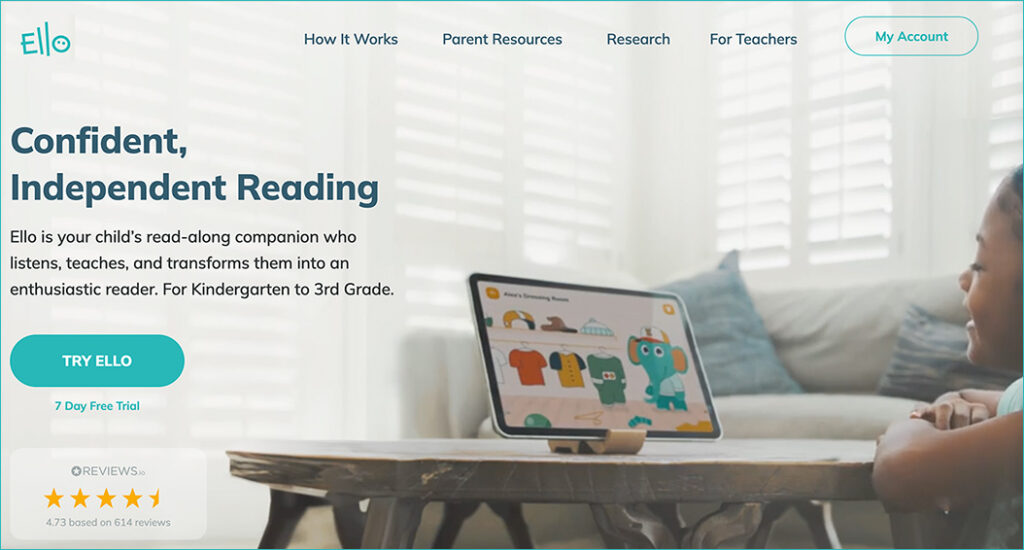
AI reading coach startup Ello now lets kids create their own stories — from techcrunch.com by Lauren Forristal; via Claire Zau

Ello, the AI reading companion that aims to support kids struggling to read, launched a new product on Monday that allows kids to participate in the story-creation process.

Called “Storytime,” the new AI-powered feature helps kids generate personalized stories by picking from a selection of settings, characters, and plots. For instance, a story about a hamster named Greg who performed in a talent show in outer space.


Workera’s CEO was mentored by Andrew Ng. Now he wants an AI agent to mentor you. — from techcrunch.com by Maxwell Zeff; via Claire Zau

On Tuesday, Workera announced Sage, an AI agent you can talk with that’s designed to assess an employee’s skill level, goals, and needs. After taking some short tests, Workera claims Sage will accurately gauge how proficient someone is at a certain skill. Then, Sage can recommend the appropriate online courses through Coursera, Workday, or other learning platform partners. Through chatting with Sage, Workera is designed to meet employees where they are, testing their skills in writing, machine learning, or math, and giving them a path to improve.

From DSC:
This is very much akin to what I’ve been trying to get at with my Learning from the Living [AI-Based Class] Room vision. And as learning agents come onto the scene, this type of vision should take off!


Voice and Trust in Autonomous Learning Experiences — from learningguild.com by Bill Brandon

This article seeks to apply some lessons from brand management to learning design at a high level. Throughout the rest of this article, it is essential to remember that the context is an autonomous, interactive learning experience. The experience is created adaptively by Gen AI or (soon enough) by agents, not by rigid scripts. It may be that an AI will choose to present prewritten texts or prerecorded videos from a content library according to the human users’ responses or questions. Still, the overall experience will be different for each user. It will be more like a conversation than a book.
…
In summary, while AI chatbots have the potential to enhance learning experiences, their acceptance and effectiveness depend on several factors, including perceived usefulness, ease of use, trust, relational factors, perceived risk, and enjoyment. 

Personalization and building trust are essential for maintaining user engagement and achieving positive learning outcomes. The right “voice” for autonomous AI or a chatbot can enhance trust by making interactions more personal, consistent, and empathetic.


FlexOS’ Stay Ahead Edition #43 — from flexos.work

People started discussing what they could do with Notebook LM after Google launched the audio overview, where you can listen to 2 hosts talking in-depth about the documents you upload. Here are what it can do:

  • Summarization: Automatically generate summaries of uploaded documents, highlighting key topics and suggesting relevant questions.
  • Question Answering: Users can ask NotebookLM questions about their uploaded documents, and answers will be provided based on the information contained within them.
  • Idea Generation: NotebookLM can assist with brainstorming and developing new ideas.
  • Source Grounding: A big plus against AI chatbot hallucination, NotebookLM allows users to ground the responses in specific documents they choose.
  • …plus several other items

The posting also lists several ideas to try with NotebookLM such as:

Idea 2: Study Companion

  • Upload all your course materials and ask NotebookLM to turn them into Question-and-Answer format, a glossary, or a study guide.
  • Get a breakdown of the course materials to understand them better.

Google’s NotebookLM: A Game-Changer for Education and Beyond — from ai-supremacy.com by Michael Spencer and Nick Potkalitsky
AI Tools: Breaking down Google’s latest AI tool and its implications for education.

“Google’s AI note-taking app NotebookLM can now explain complex topics to you out loud”

With more immersive text-to-video and audio products soon available and the rise of apps like Suno AI, how we “experience” Generative AI is also changing from a chatbot of 2 years ago, to a more multi-modal educational journey. The AI tools on the research and curation side are also starting to reflect these advancements.


Meet Google NotebookLM: 10 things to know for educators — from ditchthattextbook.com by Matt Miller

1. Upload a variety of sources for NotebookLM to use. 
You can use …

  • websites
  • PDF files
  • links to websites
  • any text you’ve copied
  • Google Docs and Slides
  • even Markdown

You can’t link it to YouTube videos, but you can copy/paste the transcript (and maybe type a little context about the YouTube video before pasting the transcript).

2. Ask it to create resources.
3. Create an audio summary.
4. Chat with your sources.
5. Save (almost) everything. 


NotebookLM summarizes my dissertation — from darcynorman.net by D’Arcy Norman, PhD

I finally tried out Google’s newly-announced NotebookLM generative AI application. It provides a set of LLM-powered tools to summarize documents. I fed it my dissertation, and am surprised at how useful the output would be.

The most impressive tool creates a podcast episode, complete with dual hosts in conversation about the document. First – these are AI-generated hosts. Synthetic voices, speaking for synthetic hosts. And holy moly is it effective. Second – although I’d initially thought the conversational summary would be a dumb gimmick, it is surprisingly powerful.


4 Tips for Designing AI-Resistant Assessments — from techlearning.com by Steve Baule and Erin Carter
As AI continues to evolve, instructors must modify their approach by designing meaningful, rigorous assessments.

As instructors work through revising assessments to be resistant to generation by AI tools with little student input, they should consider the following principles:

  • Incorporate personal experiences and local content into assignments
  • Ask students for multi-modal deliverables
  • Assess the developmental benchmarks for assignments and transition assignments further up Bloom’s Taxonomy
  • Consider real-time and oral assignments

Google CEO Sundar Pichai announces $120M fund for global AI education — from techcrunch.com by Anthony Ha

He added that he wants to avoid a global “AI divide” and that Google is creating a $120 million Global AI Opportunity Fund through which it will “make AI education and training available in communities around the world” in partnership with local nonprofits and NGOs.


Educators discuss the state of creativity in an AI world — from gettingsmart.com by Joe & Kristin Merrill, LaKeshia Brooks, Dominique’ Harbour, Erika Sandstrom

Key Points

  • AI allows for a more personalized learning experience, enabling students to explore creative ideas without traditional classroom limitations.
  • The focus of technology integration should be on how the tool is used within lessons, not just the tool itself

Addendum on 9/27/24:

Google’s NotebookLM enhances AI note-taking with YouTube, audio file sources, sharable audio discussions — from techcrunch.com by Jagmeet Singh

Google on Thursday announced new updates to its AI note-taking and research assistant, NotebookLM, allowing users to get summaries of YouTube videos and audio files and even create sharable AI-generated audio discussions…

NotebookLM adds audio and YouTube support, plus easier sharing of Audio Overviews — from blog.google


10 Ways I Use LLMs like ChatGPT as a Professor — from automatedteach.com by Graham Clay
ChatGPT-4o, Gemini 1.5 Pro, Claude 3.5 Sonnet, custom GPTs – you name it, I use it. Here’s how…

Excerpt:

  1. To plan lessons (especially activities)
  2. To create course content (especially quizzes)
  3. To tutor my students
  4. To grade faster and give better feedback
  5. To draft grant applications
  6. Plus 5 other items

From Caution to Calcification to Creativity: Reanimating Education with AI’s Frankenstein Potential — from nickpotkalitsky.substack.com by Nick Potkalitsky
A Critical Analysis of AI-Assisted Lesson Planning: Evaluating Efficacy and Pedagogical Implications

Excerpt (emphasis DSC):

As we navigate the rapidly evolving landscape of artificial intelligence in education, a troubling trend has emerged. What began as cautious skepticism has calcified into rigid opposition. The discourse surrounding AI in classrooms has shifted from empirical critique to categorical rejection, creating a chasm between the potential of AI and its practical implementation in education.

This hardening of attitudes comes at a significant cost. While educators and policymakers debate, students find themselves caught in the crossfire. They lack safe, guided access to AI tools that are increasingly ubiquitous in the world beyond school walls. In the absence of formal instruction, many are teaching themselves to use these tools, often in less than productive ways. Others live in a state of constant anxiety, fearing accusations of AI reliance in their work. These are just a few symptoms of an overarching educational culture that has become resistant to change, even as the world around it transforms at an unprecedented pace.

Yet, as this calcification sets in, I find myself in a curious position: the more I thoughtfully integrate AI into my teaching practice, the more I witness its potential to enhance and transform education


NotebookLM and Google’s Multimodal Vision for AI-Powered Learning Tools — from marcwatkins.substack.com by Marc Watkins

A Variety of Use Cases

  • Create an Interactive Syllabus
  • Presentation Deep Dive: Upload Your Slides
  • Note Taking: Turn Your Chalkboard into a Digital Canvas
  • Explore a Reading or Series of Readings
  • Help Navigating Feedback
  • Portfolio Building Blocks

Must-Have Competencies and Skills in Our New AI World: A Synthesis for Educational Reform — from er.educause.edu by Fawzi BenMessaoud
The transformative impact of artificial intelligence on educational systems calls for a comprehensive reform to prepare future generations for an AI-integrated world.

The urgency to integrate AI competencies into education is about preparing students not just to adapt to inevitable changes but to lead the charge in shaping an AI-augmented world. It’s about equipping them to ask the right questions, innovate responsibly, and navigate the ethical quandaries that come with such power.

AI in education should augment and complement their aptitude and expertise, to personalize and optimize the learning experience, and to support lifelong learning and development. AI in education should be a national priority and a collaborative effort among all stakeholders, to ensure that AI is designed and deployed in an ethical, equitable, and inclusive way that respects the diversity and dignity of all learners and educators and that promotes the common good and social justice. AI in education should be about the production of AI, not just the consumption of AI, meaning that learners and educators should have the opportunity to learn about AI, to participate in its creation and evaluation, and to shape its impact and direction.


Legal budgets will get an AI-inspired makeover in 2025: survey — from legaldive.com by Justin Bachman
Nearly every general counsel is budgeting to add generative AI tools to their departments – and they’re all expecting to realize efficiencies by doing so.

Dive Brief:

  • Nearly all general counsel say their budgets are up slightly after wrestling with widespread cuts last year. And most of them, 61%, say they expect slightly larger budgets next year as well, an average of 5% more, according to the 2025 In-House Legal Budgeting Report from Axiom and Wakefield Research. Technology was ranked as the top in-house investment priority for both 2024 and 2025 for larger companies.
  • Legal managers predict their companies will boost investment on technology and real estate/facilities in 2025, while reducing outlays for human resources and mergers and acquisition activity, according to the survey. This mix of changing priorities might disrupt legal budgets.
  • Among the planned legal tech spending, the top three areas for investment are virtual legal assistants/AI-powered chatbots (35%); e-billing and spend-management software (31%); and contract management platforms (30%).
 
© 2025 | Daniel Christian