From DSC:
Look out Google, Amazon, and others! Nvidia is putting the pedal to the metal in terms of being innovative and visionary! They are leaving the likes of Apple in the dust.

The top talent out there is likely to go to Nvidia for a while. Engineers, programmers/software architects, network architects, product designers, data specialists, AI researchers, developers of robotics and autonomous vehicles, R&D specialists, computer vision specialists, natural language processing experts, and many more types of positions will be flocking to Nvidia to work for a company that has already changed the world and will likely continue to do so for years to come. 


NVIDIA’s AI Superbowl — from theneurondaily.com by Noah and Grant
PLUS: Prompt tips to make AI writing more natural

That’s despite a flood of new announcements (here’s a 16 min video recap), which included:

  1. A new architecture for massive AI data centers (now called “AI factories”).
  2. A physics engine for robot training built with Disney and DeepMind.
  3. partnership with GM to develop next-gen vehicles, factories and robots.
  4. A new Blackwell chip with “Dynamo” software that makes AI reasoning 40x faster than previous generations.
  5. A new “Rubin” chip slated for 2026 and a “Feynman” chip set for 2028.

For enterprises, NVIDIA unveiled DGX Spark and DGX Station—Jensen’s vision of AI-era computing, bringing NVIDIA’s powerful Blackwell chip directly to your desk.


Nvidia Bets Big on Synthetic Data — from wired.com by Lauren Goode
Nvidia has acquired synthetic data startup Gretel to bolster the AI training data used by the chip maker’s customers and developers.


Nvidia, xAI to Join BlackRock and Microsoft’s $30 Billion AI Infrastructure Fund — from investopedia.com by Aaron McDade
Nvidia and xAI are joining BlackRock and Microsoft in an AI infrastructure group seeking $30 billion in funding. The group was first announced in September as BlackRock and Microsoft sought to fund new data centers to power AI products.
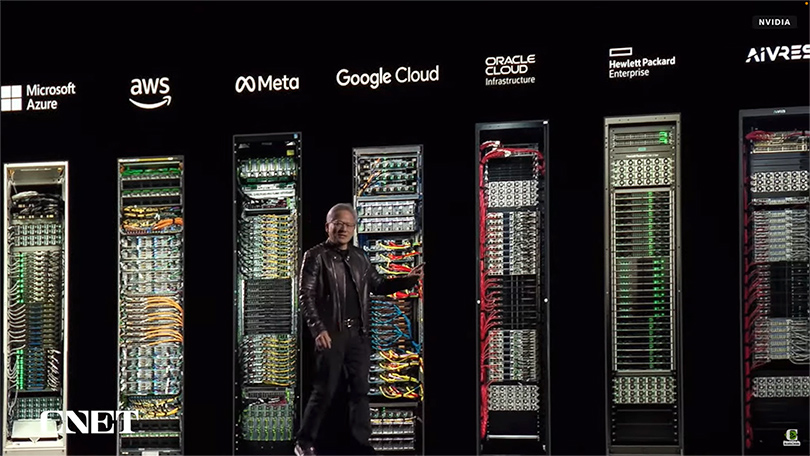


Nvidia CEO Jensen Huang says we’ll soon see 1 million GPU data centers visible from space — from finance.yahoo.com by Daniel Howley
Nvidia CEO Jensen Huang says the company is preparing for 1 million GPU data centers.


Nvidia stock stems losses as GTC leaves Wall Street analysts ‘comfortable with long term AI demand’ — from finance.yahoo.com by Laura Bratton
Nvidia stock reversed direction after a two-day slide that saw shares lose 5% as the AI chipmaker’s annual GTC event failed to excite investors amid a broader market downturn.


Microsoft, Google, and Oracle Deepen Nvidia Partnerships. This Stock Got the Biggest GTC Boost. — from barrons.com by Adam Clark and Elsa Ohlen


The 4 Big Surprises from Nvidia’s ‘Super Bowl of AI’ GTC Keynote — from barrons.com by Tae Kim; behind a paywall

AI Super Bowl. Hi everyone. This week, 20,000 engineers, scientists, industry executives, and yours truly descended upon San Jose, Calif. for Nvidia’s annual GTC developers’ conference, which has been dubbed the “Super Bowl of AI.”


Introducing NextGenAI: A consortium to advance research and education with AI — from openai.com; via Claire Zau
OpenAI commits $50M in funding and tools to leading institutions.

Today, we’re launching NextGenAI, a first-of-its-kind consortium with 15 leading research institutions dedicated to using AI to accelerate research breakthroughs and transform education.

AI has the power to drive progress in research and education—but only when people have the right tools to harness it. That’s why OpenAI is committing $50M in research grants, compute funding, and API access to support students, educators, and researchers advancing the frontiers of knowledge.

Uniting institutions across the U.S. and abroad, NextGenAI aims to catalyze progress at a rate faster than any one institution would alone. This initiative is built not only to fuel the next generation of discoveries, but also to prepare the next generation to shape AI’s future.


 ‘I want him to be prepared’: why parents are teaching their gen Alpha kids to use AI — from theguardian.com by Aaron Mok; via Claire Zau
As AI grows increasingly prevalent, some are showing their children tools from ChatGPT to Dall-E to learn and bond

“My goal isn’t to make him a generative AI wizard,” White said. “It’s to give him a foundation for using AI to be creative, build, explore perspectives and enrich his learning.”

White is part of a growing number of parents teaching their young children how to use AI chatbots so they are prepared to deploy the tools responsibly as personal assistants for school, work and daily life when they’re older.


Are Entry-Level Jobs Going Away? The Hidden Workforce Shift — from forbes.com by Dr. Diane Hamilton; via Ryan Craig

The problem is that these new roles demand a level of expertise that wasn’t expected from entry-level candidates in the past. Where someone might have previously learned on the job, they are now required to have relevant certifications, AI proficiency, or experience with digital platforms before they even apply.

Some current and emerging job titles that serve as entry points into industries include:

  • Digital marketing associate – This role often involves content creation, social media management, and working with AI-driven analytics tools.
  • Junior AI analyst – Employees in this role assist data science teams by labeling and refining machine learning datasets.
  • Customer success associate – Replacing traditional customer service roles, these professionals help manage AI-enhanced customer support systems.
  • Technical support specialist – While this role still involves troubleshooting software, it now often includes AI-driven diagnostics and automation oversight.
 

Blind Spot on AI — from the-job.beehiiv.com by Paul Fain
Office tasks are being automated now, but nobody has answers on how education and worker upskilling should change.

Students and workers will need help adjusting to a labor market that appears to be on the verge of a historic disruption as many business processes are automated. Yet job projections and policy ideas are sorely lacking.

The benefits of agentic AI are already clear for a wide range of organizations, including small nonprofits like CareerVillage. But the ability to automate a broad range of business processes means that education programs and skills training for knowledge workers will need to change. And as Chung writes in a must-read essay, we have a blind spot with predicting the impacts of agentic AI on the labor market.

“Without robust projections,” he writes, “policymakers, businesses, and educators won’t be able to come to terms with how rapidly we need to start this upskilling.”


Drive Continuous Learning: AI Integrates Work & Training — from learningguild.com by George Hanshaw

Imagine with me for a moment: Training is no longer confined to scheduled sessions in a classroom, an online module or even a microlearning you click to activate during your workflow. Imagine training being delivered because the system senses what you are doing and provides instructions and job aids without you having to take an action.

The rapid evolution of artificial intelligence (AI) and wearable technology has made it easier than ever to seamlessly integrate learning directly into the workflow. Smart glasses, earpieces, and other advanced devices are redefining how employees gain knowledge and skills by delivering microlearning moments precisely when and where they are needed.

AI plays a crucial role in this transformation by sensing the optimal moment to deliver the training through augmented reality (AR).


These Schools Are Banding Together to Make Better Use of AI in Education — from edsurge.com by Emily Tate Sullivan

Kennelly and Geraffo are part of a small team at their school in Denver, DSST: College View High School, that is participating in the School Teams AI Collaborative, a year-long pilot initiative in which more than 80 educators from 19 traditional public and charter schools across the country are experimenting with and evaluating AI-enabled instruction to improve teaching and learning.

The goal is for some of AI’s earliest adopters in education to band together, share ideas and eventually help lead the way on what they and their colleagues around the U.S. could do with the emerging technology.

“Pretty early on we thought it was going to be a massive failure,” says Kennelly of last semester’s project. “But it became a huge hit. Students loved it. They were like, ‘I ran to second period to build this thing.’”


Transactional vs. Conversational Visions of Generative AI in Teaching — from elmartinsen.substack.com by Eric Lars Martinsen
AI as a Printer, or AI as a Thought Partner

As writing instructors, we have a choice in how we frame AI for our students. I invite you to:

  1. Experiment with AI as a conversation partner yourself before introducing it to students
  2. Design assignments that leverage AI’s strengths as a thought partner rather than trying to “AI-proof” your existing assignments
  3. Explicitly teach students how to engage in productive dialogue with AI—how to ask good questions, challenge AI’s assumptions, and use it to refine rather than replace their thinking
  4. Share your experiences, both positive and negative, with colleagues to build our collective understanding of effective AI integration


Nvidia helps launch AI platform for teaching American Sign Language — from venturebeat.com by Dean Takahashi; via Claire Zau

Nvidia has unveiled a new AI platform for teaching people how to use American Sign Language to help bridge communication gaps.

The Signs platform is creating a validated dataset for sign language learners and developers of ASL-based AI applications.

Nvidia, the American Society for Deaf Children and creative agency Hello Monday are helping close this gap with Signs, an interactive web platform built to support ASL learning and the development of accessible AI applications.


Using Gen AI to Design, Implement, and Assess PBL — from gettingsmart.com by David Ross

Key Points

  • Generative AI can significantly reduce the time and effort required in designing PBL by providing tools for research, brainstorming, and organization.
  • AI tools can assist educators in managing project implementation and assessment, providing formative feedback and organizing resources efficiently.

I usually conclude blogs with some pithy words, but this time I’ll turn the microphone over to Rachel Harcrow, a high school English/Language Arts teacher at Young Women’s College Prep Charter School of Rochester, NY: “After years of struggling to call myself a PBL practitioner, I finally feel comfortable saying I am, thanks to the power of Gen AI,” Harcrow told me. “Initial ideas now turn into fully fledged high-quality project plans in minutes that I can refine, giving me the space and energy to focus on what truly matters: My students.”


AI Resources for District Leaders — from techlearning.com by Steve Baule
Educational leaders aiming to effectively integrate generative AI into their schools should consider several key resources

To truly harness the transformative power of generative AI in education, district leaders must navigate a landscape rich with resources and opportunities. By delving into state and national guidelines, exploring successful case studies, utilizing innovative planning tools, and engaging in professional development, educational leaders can craft robust implementation plans. These plans can then assist in integrating AI seamlessly into their schools and elevate the learning experience to new heights.


Anthropic brings ‘extended thinking’ to Claude, which can solves complex physics problems with 96.5% accuracy — from rdworldonline.com by Brian Buntz

Anthropic, a favorite frontier AI lab among many coders and genAI power users has unveiled Claude 3.7 Sonnet, its first “hybrid reasoning” AI model. It is capable of both near-instant answers and in-depth, step-by-step reasoning within a single system.

Users can toggle an extended thinking mode where the model self-reflects before answering, considerably improving performance on complex tasks like math, physics and coding. In early testing by the author, the model largely succeeded in creating lines of Python (related to unsupervised learning) that were close to 1,000 lines long that ran without error on the first or second try, including the unsupervised machine learning task shown below:


New Tools. Old Complaints. Why AI Won’t Kill Education or Fix it  — from coolcatteacher.com by Vicki Davis; via Stephen Downes

AI won’t kill education. But will it kill learning? The challenge isn’t AI itself—it’s whether students can still think for themselves when the answers are always one click away.

Wait. Before you go, let me ask you one thing.
AI has opportunities to help learning. But it also won’t fix it. The real question isn’t whether students can use AI—but whether they’re still learning without it.

Whether the learning is happening between the ears.

And so much of what we teach in schools isn’t the answers on a test. It answers questions like “What is my purpose in life?” “How do I make friends?” and “How can I help my team be stronger.” Questions that aren’t asked on a test but are essential to living a good life. These questions aren’t answered between the ears but within the heart.

That, my friends, is what teaching has always been about.

The heart.

And the heart of the matter is we have new challenges, but these are old complaints. Complaints since the beginning of time and teaching. And in those days, you didn’t need kids just to be able to talk about how to build a fire, they had to make one themselves. Their lives depend on it.

And these days, we need to build another kind of fire. A fire that sparks the joy of learning. The joy of the opportunities that await us sparked by some of the most powerful tools ever invented. Kids need to not be able to just talk about making a difference, they need to know how to build a better world tomorrow. Our lives depend on it.


How Debating Skills Can Help Us In The Fight Against AI — from adigaskell.org by Adi Gaskell

Debating skills have a range of benefits in the workplace, from helping to improve our communication to bolstering our critical thinking skills. Research from the University of Mississippi suggests it might also help us in the battle with AI in the workplace.

We can often assume that debate teaches us nothing more than how to argue our point, but in order to do this, we have to understand both our own take on a subject and that of our opponent. This allows us to see both sides of any issue we happen to be debating.

“Even though AI has offered a shortcut through the writing process, it actually still is important to be able to write and speak and think on your own,” the researchers explain. “That’s what the focus of this research is: how debate engenders those aspects of being able to write and speak and study and research on your own.”


.
Building an AI-Ready Workforce: A look at College Student ChatGPT Adoption in the US — from cdn.openai.com

One finding from our student survey that stood out to us: Many college and university students are teaching themselves and their friends about AI without waiting for their institutions to provide formal AI education or clear policies about the technology’s use. The education ecosystem is in an important moment of exploration and learning, but the rapid adoption by students across the country who haven’t received formalized instruction in how and when to use the technology creates disparities in AI access and knowledge.

The enclosed snapshot of how young people are using ChatGPT provides insight into the state of AI use among America’s college-aged students. We also include actionable proposals to help address adoption gaps. We hope these insights and proposals can inform research and policy conversation across the nation’s education ecosystem about how to achieve outcomes that support our students, our workforce, and the economy. By improving literacy, expanding access, and implementing clear policies, policymakers and educators can better integrate AI into our educational infrastructure and ensure that our workforce is ready to both sustain and benefit from our future with AI.

Leah Belsky | Vice President, Education | OpenAI


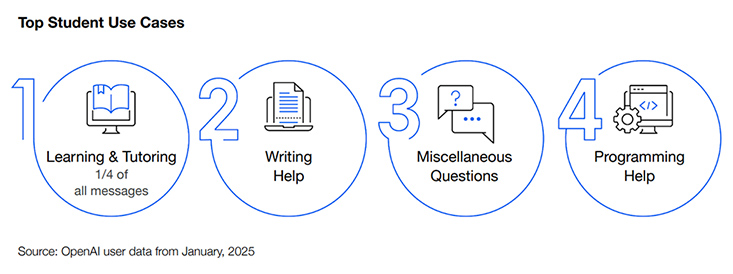
Top student use cases of ChatGPT -- learning and tutoring, writing help, miscellaneouc questions, and programming help


The Learning & Development Global Sentiment Survey 2025 — from donaldhtaylor.co.uk by Don Taylor

The L&D Global Sentiment Survey, now in its 12th year, once again asked two key questions of L&D professionals worldwide:

  • What will be hot in workplace learning in 2025?
  • What are your L&D challenges in 2025?

For the obligatory question on what they considered ‘hot’ topics, respondents voted for one to three of 15 suggested options, plus a free text ‘Other’ option. Over 3,000 voters participated from nearly 100 countries. 85% shared their challenges for 2025.

The results show more interest in AI, a renewed focus on showing the value of L&D, and some signs of greater maturity around our understanding of AI in L&D.


AI in K12: Today’s Breakthroughs and Tomorrow’s Possibilities (webinar)
How AI is Transforming Classrooms Today and What’s Next


Audio-Based Learning 4.0 — from drphilippahardman.substack.com by Dr. Philippa Hardman
A new & powerful way to leverage AI for learning?

At the end of all of this my reflection is that the research paints a pretty exciting picture – audio-based learning isn’t just effective, it’s got some unique superpowers when it comes to boosting comprehension, ramping up engagement, and delivering feedback that really connects with learners.

While audio has been massively under-used as a mode of learning, especially compared to video and text, we’re at an interesting turning point where AI tools are making it easier than ever to tap into audio’s potential as a pedagogical tool.

What’s super interesting is how the solid research backing audio’s effectiveness is and how well this is converging with these new AI capabilities.

From DSC:
I’ve noticed that I don’t learn as well via audio-only based events. It can help if visuals are also provided, but I have to watch the cognitive loads. My processing can start to get overloaded — to the point that I have to close my eyes and just listen sometimes. But there are people I know who love to listen to audiobooks and prefer to learn that way. They can devour content and process/remember it all. Audio is a nice change of pace at times, but I prefer visuals and reading often times. It needs to be absolutely quiet if I’m tackling some new information/learning. 


In Conversation With… Ashton Cousineau — from drphilippahardman.substack.com by Dr. Philippa Hardman
A new video series exploring how L&D professionals are working with AI on the ground

In Conversation With… Ashton Cousineau by Dr Philippa Hardman

A new video series exploring how L&D professionals are working with AI on the ground

Read on Substack


The Learning Research Digest vol. 28 — from learningsciencedigest.substack.com by Dr. Philippa Hardman

Hot Off the Research Press This Month:

  • AI-Infused Learning Design – A structured approach to AI-enhanced assignments using a three-step model for AI integration.
  • Mathematical Dance and Creativity in STEAM – Using AI-powered motion capture to translate dance movements into mathematical models.
  • AI-Generated Instructional Videos – How adaptive AI-powered video learning enhances problem-solving and knowledge retention.
  • Immersive Language Learning with XR & AI – A new framework for integrating AI-driven conversational agents with Extended Reality (XR) for task-based language learning.
  • Decision-Making in Learning Design – A scoping review on how instructional designers navigate complex instructional choices and make data-driven decisions.
  • Interactive E-Books and Engagement – Examining the impact of interactive digital books on student motivation, comprehension, and cognitive engagement.
  • Elevating Practitioner Voices in Instructional Design – A new initiative to amplify instructional designers’ contributions to research and innovation.

Deep Reasoning, Agentic AI & the Continued Rise of Specialised AI Research & Tools for Education — from learningfuturesdigest.substack.com by Dr. Philippa Hardman

Here’s a quick teaser of key developments in the world of AI & learning this month:

  • DeepSeek R-1, OpenAI’s Deep Seek & Perplexity’s ‘Deep Research’ are the latest additions to a growing number of “reasoning models” with interesting implications for evidence-based learning design & development.
  • The U.S. Education Dept release an AI Toolkit and a fresh policy roadmap enabling the adoption of AI use in schools.
  • Anthropic Release “Agentic Claude”, another AI agent that clicks, scrolls, and can even successfully complete e-learning courses…
  • Oxford University Announce the AIEOU Hub, a research-backed research lab to support research and implementation on AI in education.
  • “AI Agents Everywhere”: A Forbes peek at how agentic AI will handle the “boring bits” of classroom life.
  • [Bias klaxon!] Epiphany AI: My own research leads to the creation of a specialised, “pedagogy first” AI co-pilot for instructional design marking the continued growth of specialised AI tools designed for specific industries and workflows.

AI is the Perfect Teaching Assistant for Any Educator — from unite.ai by Navi Azaria, CPO at Kaltura

Through my work with leading educational institutions at Kaltura, I’ve seen firsthand how AI agents are rapidly becoming indispensable. These agents alleviate the mounting burdens on educators and provide new generations of tech-savvy students with accessible, personalized learning, giving teachers the support they need to give their students the personalized attention and engagement they deserve.


Learning HQ — from ai-disruptor-hq.notion.site

This HQ includes all of my AI guides, organized by tool/platform. This list is updated each time a new one is released, and outdated guides are removed/replaced over time.


How AI Is Reshaping Teachers’ Jobs — from edweek.org

Artificial intelligence is poised to fundamentally change the job of teaching. AI-powered tools can shave hours off the amount of time teachers spend grading, lesson-planning, and creating materials. AI can also enrich the lessons they deliver in the classroom and help them meet the varied needs of all students. And it can even help bolster teachers’ own professional growth and development.

Despite all the promise of AI, though, experts still urge caution as the technology continues to evolve. Ethical questions and practical concerns are bubbling to the surface, and not all teachers feel prepared to effectively and safely use AI.

In this special report, see how early-adopter teachers are using AI tools to transform their daily work, tackle some of the roadblocks to expanded use of the technology, and understand what’s on the horizon for the teaching profession in the age of artificial intelligence.


2025 EDUCAUSE AI Landscape Study: Into the Digital AI Divide — from library.educause.edu

The higher education community continues to grapple with questions related to using artificial intelligence (AI) in learning and work. In support of these efforts, we present the 2025 EDUCAUSE AI Landscape Study, summarizing our community’s sentiments and experiences related to strategy and leadership, policies and guidelines, use cases, the higher education workforce, and the institutional digital divide.


Half A Million Students Given ChatGPT As CSU System Makes AI History — from forbes.com by Dan Fitzpatrick

The California State University system has partnered with OpenAI to launch the largest deployment of AI in higher education to date.

The CSU system, which serves nearly 500,000 students across 23 campuses, has announced plans to integrate ChatGPT Edu, an education-focused version of OpenAI’s chatbot, into its curriculum and operations. The rollout, which includes tens of thousands of faculty and staff, represents the most significant AI deployment within a single educational institution globally.

We’re still in the early stages of AI adoption in education, and it is critical that the entire ecosystem—education systems, technologists, educators, and governments—work together to ensure that all students globally have access to AI and develop the skills to use it responsibly

Leah Belsky, VP and general manager of education at OpenAI.


HOW educators can use GenAI – where to start and how to progress — from aliciabankhofer.substack.com by Alicia Bankhofer
Part of 3 of my series: Teaching and Learning in the AI Age

As you read through these use cases, you’ll notice that each one addresses multiple tasks from our list above.

1. Researching a topic for a lesson
2. Creating Tasks For Practice
3. Creating Sample Answers
4. Generating Ideas
5. Designing Lesson Plans
6. Creating Tests
7. Using AI in Virtual Classrooms
8. Creating Images
9. Creating worksheets
10. Correcting and Feedback


DeepSeek: How China’s AI Breakthrough Could Revolutionize Educational Technology — from nickpotkalitsky.substack.com by Nick Potkalitsky
Can DeepSeek’s 90% efficiency boost make AI accessible to every school?

The most revolutionary aspect of DeepSeek for education isn’t just its cost—it’s the combination of open-source accessibility and local deployment capabilities. As Azeem Azhar notes, “R-1 is open-source. Anyone can download and run it on their own hardware. I have R1-8b (the second smallest model) running on my Mac Mini at home.”

Real-time Learning Enhancement

  • AI tutoring networks that collaborate to optimize individual learning paths
  • Immediate, multi-perspective feedback on student work
  • Continuous assessment and curriculum adaptation

The question isn’t whether this technology will transform education—it’s how quickly institutions can adapt to a world where advanced AI capabilities are finally within reach of every classroom.


Over 100 AI Tools for Teachers — from educatorstechnology.com by Med Kharbach, PhD

I know through your feedback on my social media and blog posts that several of you have legitimate concerns about the impact of AI in education, especially those related to data privacy, academic dishonesty, AI dependence, loss of creativity and critical thinking, plagiarism, to mention a few. While these concerns are valid and deserve careful consideration, it’s also important to explore the potential benefits AI can bring when used thoughtfully.

Tools such as ChatGPT and Claude are like smart research assistants that are available 24/7 to support you with all kinds of tasks from drafting detailed lesson plans, creating differentiated materials, generating classroom activities, to summarizing and simplifying complex topics. Likewise, students can use them to enhance their learning by, for instance, brainstorming ideas for research projects, generating constructive feedback on assignments, practicing problem-solving in a guided way, and much more.

The point here is that AI is here to stay and expand, and we better learn how to use it thoughtfully and responsibly rather than avoid it out of fear or skepticism.


Beth’s posting links to:


Derek’s posting on LinkedIn


From Theory to Practice: How Generative AI is Redefining Instructional Materials — from edtechinsiders.substack.com by Alex Sarlin
Top trends and insights from The Edtech Insiders Generative AI Map research process about how Generative AI is transforming Instructional Materials

As part of our updates to the Edtech Insiders Generative AI Map, we’re excited to release a new mini market map and article deep dive on Generative AI tools that are specifically designed for Instructional Materials use cases.

In our database, the Instructional Materials use case category encompasses tools that:

  • Assist educators by streamlining lesson planning, curriculum development, and content customization
  • Enable educators or students to transform materials into alternative formats, such as videos, podcasts, or other interactive media, in addition to leveraging gaming principles or immersive VR to enhance engagement
  • Empower educators or students to transform text, video, slides or other source material into study aids like study guides, flashcards, practice tests, or graphic organizers
  • Engage students through interactive lessons featuring historical figures, authors, or fictional characters
  • Customize curriculum to individual needs or pedagogical approaches
  • Empower educators or students to quickly create online learning assets and courses

On a somewhat-related note, also see:


Four objectives to guide artificial intelligence’s impact on higher education — from timeshighereducation.com by Susan C. Aldridge
How can higher education leaders manage both the challenge and the opportunity artificial intelligence presents? Here are four objectives to guide the way

That’s why, today, the question I’m asking is: How best can we proactively guide AI’s use in higher education and shape its impact on our students, faculty and institution? The answer to that broad, strategic question lies in pursuing four objectives that, I believe, are relevant for many colleges and universities.


In This Week’s Gap Letter — by Ryan Craig

Learning to use business software is different from learning to think. But if the software is sufficiently complex, how different is it really? What if AI’s primary impact on education isn’t in the classroom, but rather shifting the locus of learning to outside the classroom?

Instead of sitting in a classroom listening to a teacher, high school and college students could be assigned real work and learn from that work. Students could be matched with employers or specific projects provided by or derived from employers, then do the work on the same software used in the enterprise. As AI-powered digital adoption platforms (DAPs) become increasingly powerful, they have the potential to transform real or simulated work into educational best practice for students only a few years away from seeking full-time employment.

If DAPs take us in this direction, four implications come to mind….


The Impact of Gen AI on Human Learning: a research summary — from drphilippahardman.substack.com by  Dr. Philippa Hardman
A literature review of the most recent & important peer-reviewed studies

In this week’s blog post, I share a summary of five recent studies on the impact of Gen AI on learning to bring you right up to date.

Implications for Educators and Developers

For Educators:

  • Combine ChatGPT with Structured Activities: …
  • Use ChatGPT as a Supplement, Not a Replacement:…
  • Promote Self-Reflection and Evaluation:

For Developers:

  • Reimagine AI for Reflection-First Design: …
  • Develop Tools that Foster Critical Thinking: …
  • Integrate Adaptive Support: …

Assessing the GenAI process, not the output — from timeshighereducation.com by Paul McDermott, Leoni Palmer, and Rosemary Norton
A framework for building AI literacy in a literature-review-type assessment

In this resource, we outline our advice for implementing an approach that opens AI use up to our students through a strategy of assessing the process rather than outputs.

To start with, we recommend identifying learning outcomes for your students that can be achieved in collaboration with AI.


What’s New: The Updated Edtech Insiders Generative AI Map — from edtechinsiders.substack.com by Sarah Morin, Alex Sarlin, and Ben Kornell
A major expansion on our previously released market map, use case database, and AI tool company directory.

.


Tutorial: 4 Ways to Use LearnLM as a Professor — from automatedteach.com by Graham Clay
Create better assessments, improve instructions and feedback, and tutor your students with this fine-tuned version of Gemini.

I cover how to use LearnLM

  • to create sophisticated assessments that promote learning
  • to develop clearer and more effective assignment instructions
  • to provide more constructive feedback on student work, and
  • to support student learning through guided tutoring
 

Your AI Writing Partner: The 30-Day Book Framework — from aidisruptor.ai by Alex McFarland and Kamil Banc
How to Turn Your “Someday” Manuscript into a “Shipped” Project Using AI-Powered Prompts

With that out of the way, I prefer Claude.ai for writing. For larger projects like a book, create a Claude Project to keep all context in one place.

  • Copy [the following] prompts into a document
  • Use them in sequence as you write
  • Adjust the word counts and specifics as needed
  • Keep your responses for reference
  • Use the same prompt template for similar sections to maintain consistency

Each prompt builds on the previous one, creating a systematic approach to helping you write your book.


Using NotebookLM to Boost College Reading Comprehension — from michellekassorla.substack.com by Michelle Kassorla and Eugenia Novokshanova
This semester, we are using NotebookLM to help our students comprehend and engage with scholarly texts

We were looking hard for a new tool when Google released NotebookLM. Not only does Google allow unfettered use of this amazing tool, it is also a much better tool for the work we require in our courses. So, this semester, we have scrapped our “old” tools and added NotebookLM as the primary tool for our English Composition II courses (and we hope, fervently, that Google won’t decide to severely limit its free tier before this semester ends!)

If you know next-to-nothing about NotebookLM, that’s OK. What follows is the specific lesson we present to our students. We hope this will help you understand all you need to know about NotebookLM, and how to successfully integrate the tool into your own teaching this semester.


Leadership & Generative AI: Hard-Earned Lessons That Matter — from jeppestricker.substack.com by Jeppe Klitgaard Stricker
Actionable Advice for Higher Education Leaders in 2025

AFTER two years of working closely with leadership in multiple institutions, and delivering countless workshops, I’ve seen one thing repeatedly: the biggest challenge isn’t the technology itself, but how we lead through it. Here is some of my best advice to help you navigate generative AI with clarity and confidence:

  1. Break your own AI policies before you implement them.
  2. Fund your failures.
  3. Resist the pilot program. …
  4. Host Anti-Tech Tech Talks
  5. …+ several more tips

While generative AI in higher education obviously involves new technology, it’s much more about adopting a curious and human-centric approach in your institution and communities. It’s about empowering learners in new, human-oriented and innovative ways. It is, in a nutshell, about people adapting to new ways of doing things.


Maria Anderson responded to Clay’s posting with this idea:

Here’s an idea: […] the teacher can use the [most advanced] AI tool to generate a complete solution to “the problem” — whatever that is — and demonstrate how to do that in class. Give all the students access to the document with the results.

And then grade the students on a comprehensive followup activity / presentation of executing that solution (no notes, no more than 10 words on a slide). So the students all have access to the same deep AI result, but have to show they comprehend and can iterate on that result.


Grammarly just made it easier to prove the sources of your text in Google Docs — from zdnet.com by Jack Wallen
If you want to be diligent about proving your sources within Google Documents, Grammarly has a new feature you’ll want to use.

In this age of distrust, misinformation, and skepticism, you may wonder how to demonstrate your sources within a Google Document. Did you type it yourself, copy and paste it from a browser-based source, copy and paste it from an unknown source, or did it come from generative AI?

You may not think this is an important clarification, but if writing is a critical part of your livelihood or life, you will definitely want to demonstrate your sources.

That’s where the new Grammarly feature comes in.

The new feature is called Authorship, and according to Grammarly, “Grammarly Authorship is a set of features that helps users demonstrate their sources of text in a Google doc. When you activate Authorship within Google Docs, it proactively tracks the writing process as you write.”


AI Agents Are Coming to Higher Education — from govtech.com
AI agents are customizable tools with more decision-making power than chatbots. They have the potential to automate more tasks, and some schools have implemented them for administrative and educational purposes.

Custom GPTs are on the rise in education. Google’s version, Gemini Gems, includes a premade version called Learning Coach, and Microsoft announced last week a new agent addition to Copilot featuring use cases at educational institutions.


Generative Artificial Intelligence and Education: A Brief Ethical Reflection on Autonomy — from er.educause.edu by Vicki Strunk and James Willis
Given the widespread impacts of generative AI, looking at this technology through the lens of autonomy can help equip students for the workplaces of the present and of the future, while ensuring academic integrity for both students and instructors.

The principle of autonomy stresses that we should be free agents who can govern ourselves and who are able to make our own choices. This principle applies to AI in higher education because it raises serious questions about how, when, and whether AI should be used in varying contexts. Although we have only begun asking questions related to autonomy and many more remain to be asked, we hope that this serves as a starting place to consider the uses of AI in higher education.


‘Lazy and Mediocre’ HR Team Fired After Manager’s Own CV Gets Auto-Rejected in Seconds, Exposing System Failure — from ibtimes.co.uk by Vinay Patel
The automated system’s error highlights the potential for bias and inefficiency in technology-driven HR practices

An entire HR team was terminated after their manager discovered and confirmed that their system automatically rejected all candidates — including his own application.

The manager wrote in their comment, “Auto rejection systems from HR make me angry.” They explained that while searching for a new employee, their HR department could not find a single qualified candidate in three months. As expected, the suspicious manager decided to investigate.

“I created myself a new email and sent them a modified version of my CV with a fake name to see what was going on with the process,” they wrote. “And guess what, I got auto-rejected. HR didn’t even look at my CV.”

When the manager reported the issue to upper management, “half of the HR department was fired in the following weeks.” A typographical error with significant consequences caused the entire problem.

The manager works in the tech industry and was trying to hire developers. However, HR had set up the system to search for developers with expertise in the wrong development software and one that no longer exists.

From DSC:
Back in 2017, I had survived several rounds of layoffs at the then Calvin College (now Calvin University) but I didn’t survive the layoff of 12 people in the spring of 2017. I hadn’t needed to interview for a new job in quite a while. So boy, did I get a wake-up call with discovering that Applicant Tracking Systems existed and could be tough to get past. (Also, the old-school job replacement firm that Calvin hired wasn’t much help in dealing with them either.)

I didn’t like these ATSs then, and I still have my concerns about them now. The above article points out that my concerns were/are at least somewhat founded. And if you take the entire day to research and apply for a position — only to get an instant reply back from the ATS — it’s very frustrating and discouraging. 

Plus the ATSs may not pick up on nuances. An experienced human being might be able to see that a candidate’s skills are highly relevant and/or transferable to the position that they’re hiring for. 

Networking is key of course. But not everyone has been taught about networking and not everyone gets past the ATS to get their resume viewed by a pair of human eyes. HR, IT, and any other relevant groups here need to be very careful with programming their ATSs.

 
© 2025 | Daniel Christian