I Was a University AI Czar. I’m Not Equipped to Teach in the Age of AI. — from jgellers.substack.com by Josh Gellers, PhD

The reason that I claim I am not well-suited to thrive as an instructor in the age of AI is because both AI Enthusiasts and AI Resisters put a lot of thought and energy into completely redesigning their classes in response to AI. This is the one takeaway that I don’t think the Exhausted Majority has fully accepted yet—to excel as a teacher in this AI era, you need to totally revise how you teach and how you assess what students learn in your classes.

I can say this much—whatever solution our industry comes up with, it’s likely to emerge from teaching and learning centers. Contrary to what Paul Schofield  wrote in the Chronicle of Higher Education, pedagogy experts are the best hope we have to equip today’s faculty with the tools required to succeed in this uncertain educational environment. As I always tell my students, “I was trained for 7 years to become a researcher and 2 days to become a teacher.” The idea that only disciplinary experts know how to teach and have nothing to learn from so-called “nonscholars” is so laughable that one has to wonder whether an AI agent jokingly wrote that sad opinion piece to troll the whole academe.

Also from Dr. Gellers, see:

The Worst AI Policy in Higher Ed
How Berkeley Law Boalt-ed From Expertise in Favor of Abstinence

Last week, one of the top law schools in the United States, the University of California, Berkeley School of Law, released its final policy on artificial intelligence, effective summer 2026. In the span of a breezy 1.5 pages, the school outlined the challenge AI poses to legal education and how it plans to address this problem. Despite these intentions, this AI policy is, in my estimation, the worst AI policy in higher education I have seen.


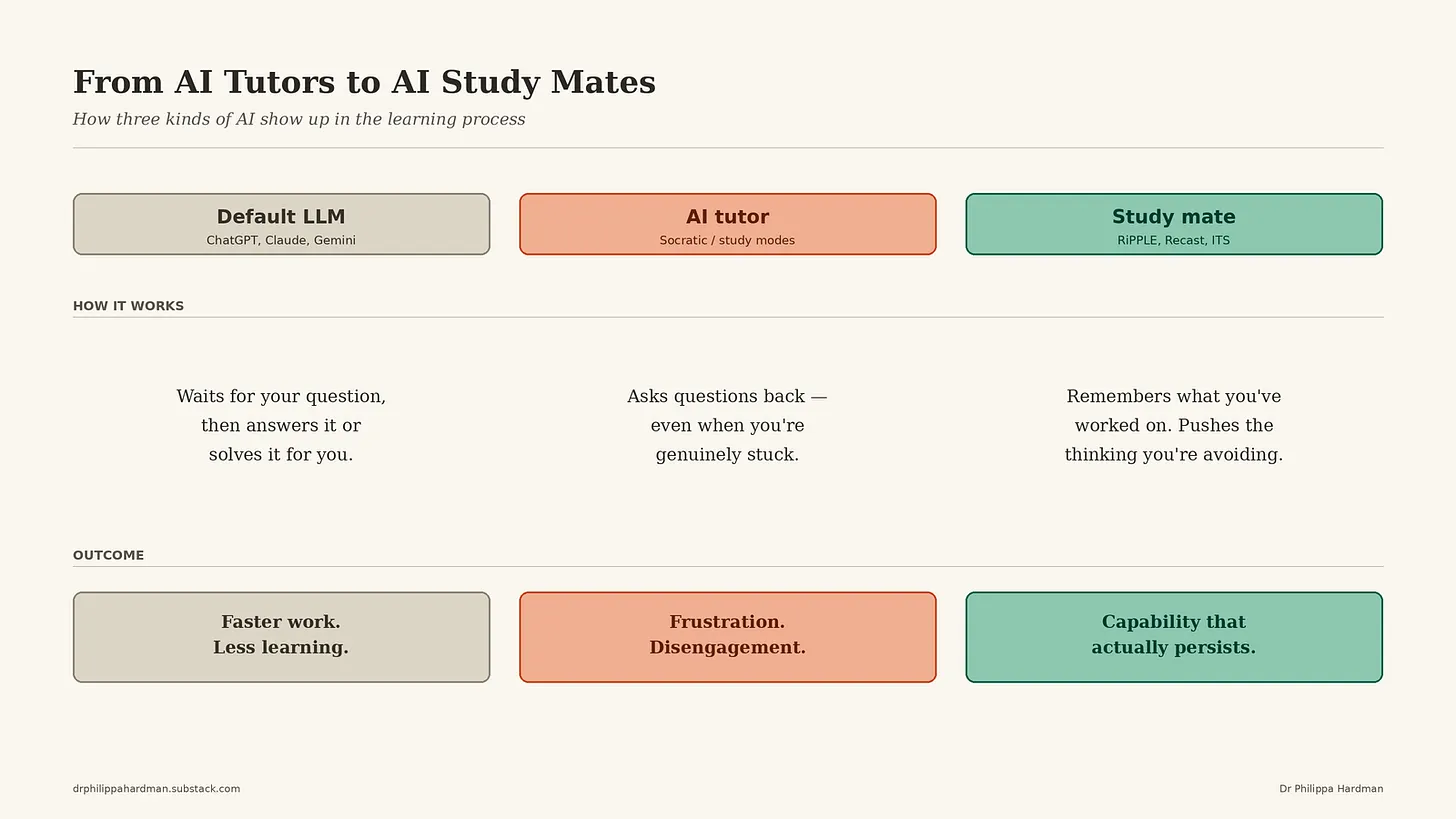
From AI Tutors to AI Study Mates— from drphilippahardman.substack.com by Dr Philippa Hardman
New research reveals how AI can enable real learning — not just productivity gains


.

The point isn’t that AI is inherently bad for learning — it’s that the meta-analyses showing that LLMs improve assignment and performance scores are measuring the wrong thing. They’re measuring performance with the AI present, not learning that persists once it’s gone.

.
From DSC:
Notice that when an AI-based learning system can remember what you’ve worked on and how you are doing — where you are struggling or doing well — it can have a positive impact on your longer-term learning. That, to me, is where long-term based learner profiles come in.

Later in the article, Dr. Hardman points out that “if we want to deliver AI tooling which supports substantive learning, we need to intentionally create a new category of AI tool for ‘learning at work’ which prioritises learning and development over productivity.” While I agree with that, I do wonder if businesses will care, so long as the work gets done and gets done well. But this calls into mind the word “experience” — something that traditionally has been hard fought to get in the corporate world. But the corporate realm often doesn’t like to pay for experience (beyond key AI-based jobs) when they perceive it’s getting too expensive. Ask all those 50 and over who had or have a target on their backs.

.


“The sad fact is that we don’t teach learners how to be good at learning. Whether K12, higher ed, or organizations, it’s just not there.”


from Clark Quinn’s posting entitled, Thoughts on meta-coaching!


From DSC:
I agree. We could do a much better job at this.


Putting college on the fast track — from hechingerreport.org by Jon Marcus
As students grow impatient, colleges try three-year bachelor’s degrees

Some colleges and the accreditors and states that oversee them are adding and approving three-year bachelor’s degrees that require fewer credits than the traditional four-year kind.

Institutions facing enrollment declines hope the new three-year degrees will attract students unwilling to spend the usual amount of time and money that it takes to graduate. States need those graduates to fill jobs.

Nearly 60 universities and colleges are planning, considering or have already launched reduced-credit, three-year bachelor’s degrees in some disciplines. They’re calling them “applied” or “career-focused” bachelor’s degrees.

While earning bachelor’s degrees with fewer credits may appeal to some students, the idea is so new that there’s a key unanswered question: whether employers, graduate schools and licensing agencies will accept them. 

From DSC:
Given the often high price of obtaining a degree these days…whether it’s a 4-year program or a 3-year program, the key is whether a student can get a good job coming out of that program.  I think the required time doesn’t help as much as making the necessary changes to offer more responsive curricula, relevant programs, and real-world learning experiences (including apprenticeships and internships).  I appreciate the experiment to lower the overall costs, but like so many other “innovations,” it’s playing at the fringes. It’s really the same old, same old — just on a shorter time frame.

At current prices, families are FORCED to consider employment prospects. They are demanding a ROI, because they have to.

I was at a meeting earlier this year with other parents and family members who were interested in a particular program at a Michigan-based university. One set of parents really wanted to know if their student would be getting a good job coming out of the program. They didn’t want to take a second mortgage out if the investment wasn’t going to pay off.


Also see:

Here is the link to Chris Mayer’s posting on LinkedIn.


Want Students to Build a Healthier Relationship With Technology? Start With The Arts — from techlearning.com by Adrianna Marshall
Arts classrooms demonstrate what technology integration at its best can look like

But at a moment defined by rapid AI adoption and ongoing debates about screen time, the argument for protecting and investing in arts education needs to take on a new tone. The arts continue to be one of the most effective places in school for students to build healthier, more intentional relationships with technology.

In short, in the age of AI, we need the arts more than ever.

Digital composition software, notation tools, and recording platforms allow students to experiment, revise, and refine their ideas in ways that would have been far more time-consuming a decade ago. Students can layer tracks, hear immediate playback, annotate their own scores, and collaborate across devices. The same is true in other contexts besides music; in visual arts, for instance, a variety of digital drawing and painting platforms enable students to practice with new mediums, styles, and techniques without having to worry about supplies or messes. But in either case, the core intellectual work of looking and listening critically, understanding structure, and making aesthetic choices remains entirely human and part of the learning.


From DSC:
I agree. At one of my previous positions, I spent 10 years supervising a digital studio — helping professors and students use a variety of applications to create things. The applications were from Adobe, Apple, and a variety of smaller vendors. The deliverables could be graphics, edited soundtracks, music, videos, flyers, posters, collages, edited photographs, presentations, websites, and more. I longed for people to discover the power of multimedia to communicate their messages, tell stories, stir emotion, powerfully engage themselves (and others), and unleash their creativity.

There were several obstacles to our digital studio being more impactful at that institution. It was under the IT department, not the academic side of the house. It was in the basement of the library, where few students and faculty traveled. During those years, it was highly uncommon for faculty members to require multimedia-based assignments — so many students had to WANT to develop these skills on their own time. The majority of students didn’t see the value in developing the types of digital skills that we were trying to build…or they didn’t have the time.


Also relevant/see:


This $10K AI School Promises to Future-Proof Your Career — from builtin.com by Matthew Urwin
Khan Academy, TED and ETS are starting a new program to equip students and professionals with the skills to thrive in an increasingly AI-driven economy. Here’s what you need to know.

Summary: The Khan TED Institute is a higher-education program that will teach students and workers how to use AI through interactive learning. The program’s AI-centric curriculum is an unproven approach, though, casting doubt on whether it will actually improve learning outcomes and career prospects.

Higher education might be on the verge of a radical overhaul to bring it up to speed in the age of artificial intelligence. At the TED2026 conference, Khan Academy, TED and ETS announced that they’re partnering to establish the Khan TED Institute — a new program that reorients the college curriculum around AI. By joining forces, the education technology trio aims to develop an alternative to traditional universities that better tracks student progress, teaches more relevant skills and provides a more personalized learning experience.

Accessibility is another major tenet of the Khan TED Institute. Its virtual nature allows anyone with an internet connection to participate in the program and makes it easier for students to move at their preferred pace. And because its curriculum prioritizes competency over course credits, advanced learners can complete the program in a shorter period. Time isn’t the only thing students can save on, either: The Institute promises a bachelor’s degree for less than $10,000, offering a much more affordable alternative to the typical four-year degree. 


From DSC:
Faculty senates don’t do well with this pace of change. But to their credit, few organizations can begin to deal with this pace of change.


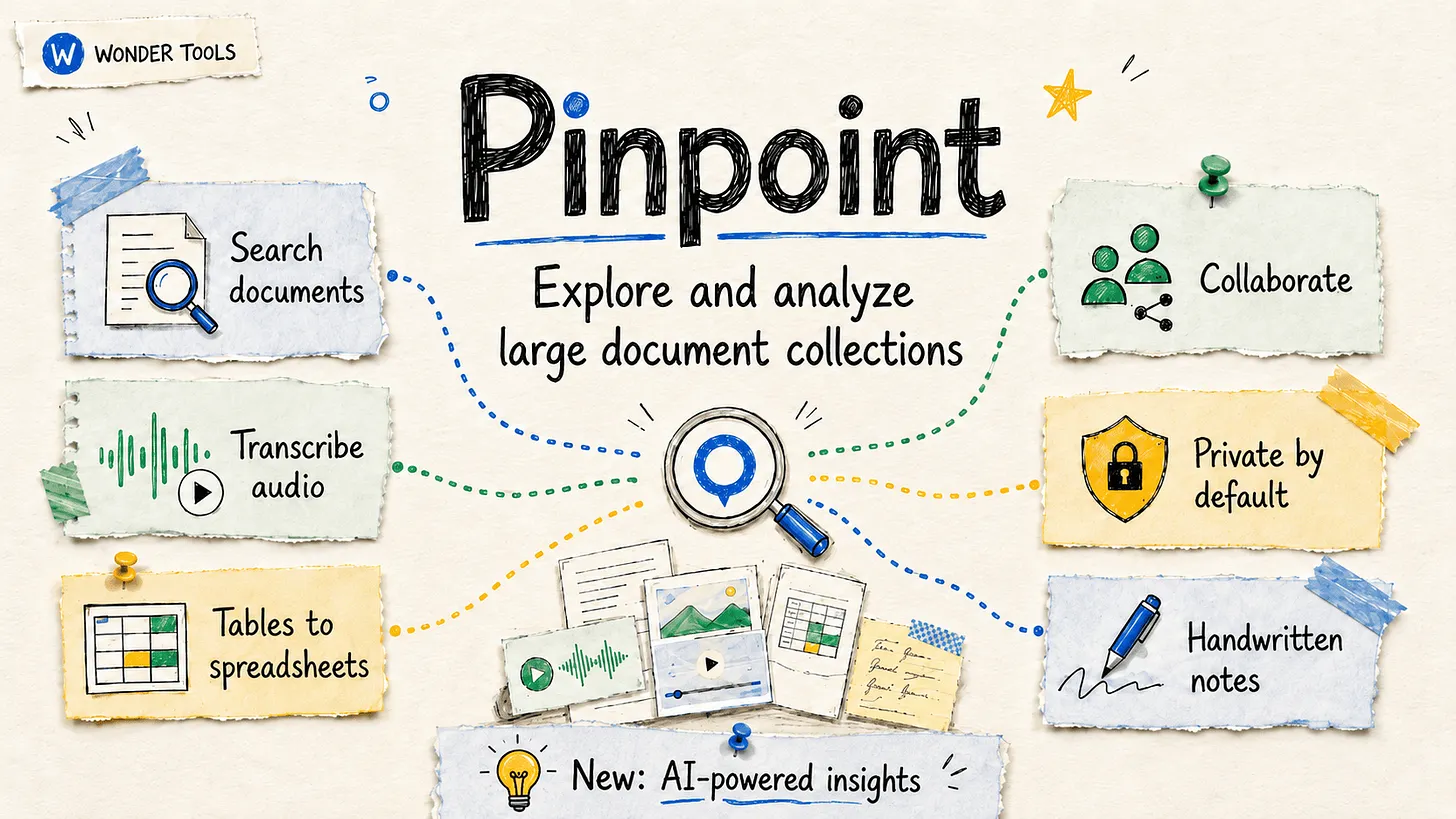
Let AI Interview You — from wondertools.substack.com by Jeremy Caplan & Jay Dixit
A smarter way to get past the blank page

There’s nothing wrong with using AI to get answers to your questions. But there’s another mode of interacting with AI that many people never consider — one I find much more useful for my creative process.

Here’s what I do instead: I flip the script and let the AI ask the questions. Instead of prompting AI, I get the AI to prompt me.


6 Reasons Universities Are Building Media Labs Now — from edtechmagazine.com by Brad Grimes
Digital production centers help institutions close the gap between academic training and professional practice.

Higher education is undergoing a significant transformation in how it prepares the next generation of media professionals. Across the country, universities are investing in state-of-the-art media labs — facilities built not around traditional classroom instruction, but around the tools, workflows and collaborative environments that define today’s professional production landscape. These spaces represent a fundamental rethinking of what it means to train students for careers in film, animation, gaming and digital storytelling.


“Learning ecosystems begin with people.” — Getting Smart


ASU/GSV Summit

There’s something about walking into a space like the ASU+GSV Summit that feels a little like stepping into a living, breathing idea. You hear fragments of possibility in passing conversations, see it in the way people lean in a little closer during sessions, feel it in the quiet moments when something lands and you know it’s going to stay with you. This year, what lingered wasn’t just the talk of innovation; it was a deeper pull toward something more human. A reminder that before we build better systems, we have to create better conditions for dreaming. And there’s a kind of quiet joy that emerges when educators find each other in that work, when ideas connect, and you can feel the bridges across networks and ecosystems getting stronger in real time.

And dreaming is not a given. It requires space, safety, and adults who understand the weight of what they’re holding. The most powerful moments weren’t about what we can do for learners, but how we show up with them. Adults who are still learning, still stretching, still willing to have their thinking reshaped are the ones who make room for young people to imagine beyond what they’ve seen. That kind of space doesn’t happen by accident. It’s protected. It’s intentional. It’s built by people who know their non-negotiables, who draw clear lines around dignity and belonging so learners can take risks without fear of losing themselves in the process.

Across conversations on pathways, experience, and AI, there was a steady undercurrent. Knowledge alone isn’t carrying the day anymore. Young people need chances to test, to try, to wrestle with ideas in real contexts. That’s where wisdom starts to take shape. AI showed up as a partner in that work, not the main character, but a tool that can expand thinking when used well. Still, the heartbeat of it all is human. It’s the relationships, the networks, the shared belief that we don’t have to do this alone. When adults come together to learn, to challenge each other, and to build something bigger than their own corner, they create the kind of ecosystems where young people don’t just prepare for the future, they begin to shape it.


Also from Getting Smart:


From DSC:
It’s great to see this type of good news for a change!


Tiny Traverse City restaurant sells more than 3,000 burgers in one day – all to help a competitor — this is a gifted article (which lasts for 7 days) out at mlive.com, by Tanda Gmiter

TRAVERSE CITY, MI – The long line out the door and down the street of the little Oakwood Proper Burgers shop was a head-turner Saturday as the restaurant invited people to its 1,000 Burger Challenge event.

But the swift sales being rung up inside weren’t benefitting their own business. Instead, they were a heartfelt helping hand to a competitor across town.

The team behind Oakwood Proper – as well as several other restaurant friends from the area – joined together to raise money for “Chef Tim” Bergstrom, the man behind his namesake Bergstrom’s Burgers. He’s been undergoing cancer treatment for some time now, and medical bills are mounting.
.


What the Future of Learning Looks Like in the Era of AI — from the Center for Academic Innovation at the University of Michigan, by Sean Corp

AI & the Future of Learning Summit brings industry, education leaders together to discuss higher education’s opportunity to lead, what students need, and what partnerships are possible

As artificial intelligence rapidly reshapes the nature of work and learning, speakers at the University of Michigan’s AI & the Future of Learning Summit delivered a clear message: higher education must take a leading role in defining what comes next.

One CEO of a leading educational technology company put it like this: “The only bad thing would be universities standing still.”

Universities must embrace their roles as providers of continuous, lifelong learning that evolves alongside technological change. 


This shift is already affecting early-career pathways. Employers are placing greater emphasis on experience, while traditional entry-level roles are becoming less accessible. There is often a gap between what a credential represents and the expectations of employers.

That gap is particularly evident in access to internships. Chris Parrish, co-founder and president of Podium, noted that millions of students compete for a limited number of internships each year, making it increasingly difficult to gain the experience employers demand.

“If you miss out on an internship, you’re twice as likely to be unemployed,” Parrish said. 


You Can’t Future-Proof Your Career From AI, But You Can Do This — from builtin.com by Liz Tran
Agility has become the most important skill to cultivate in today’s job market. Here’s how to get started.

Summary: Job seekers facing future panic should prioritize agility over information consumption. Build it by focusing on 30-day action experiments, reframing resumes around durable skills like problem-solving and embracing uncertainty through stretch applications and real-world feedback.

The antidote is what I call AQ — the agility quotient — which is your capacity to face change, disappointment and uncertainty without losing your footing. Unlike IQ, which measures what you know, AQ measures how fast you adapt when the rules change. Right now, it’s the most important career asset you have. Here’s how to build it.

What Is Agility Quotient (AQ)?
AQ is a measure of an individual’s capacity to adapt quickly when rules, industries or circumstances change. Unlike IQ, which focuses on existing knowledge, AQ emphasizes the ability to face uncertainty and disappointment without losing one’s footing, prioritizing action and iteration over exhaustive planning.

 
© 2025 | Daniel Christian