


From DSC:
Notebook LM continues to make waves…
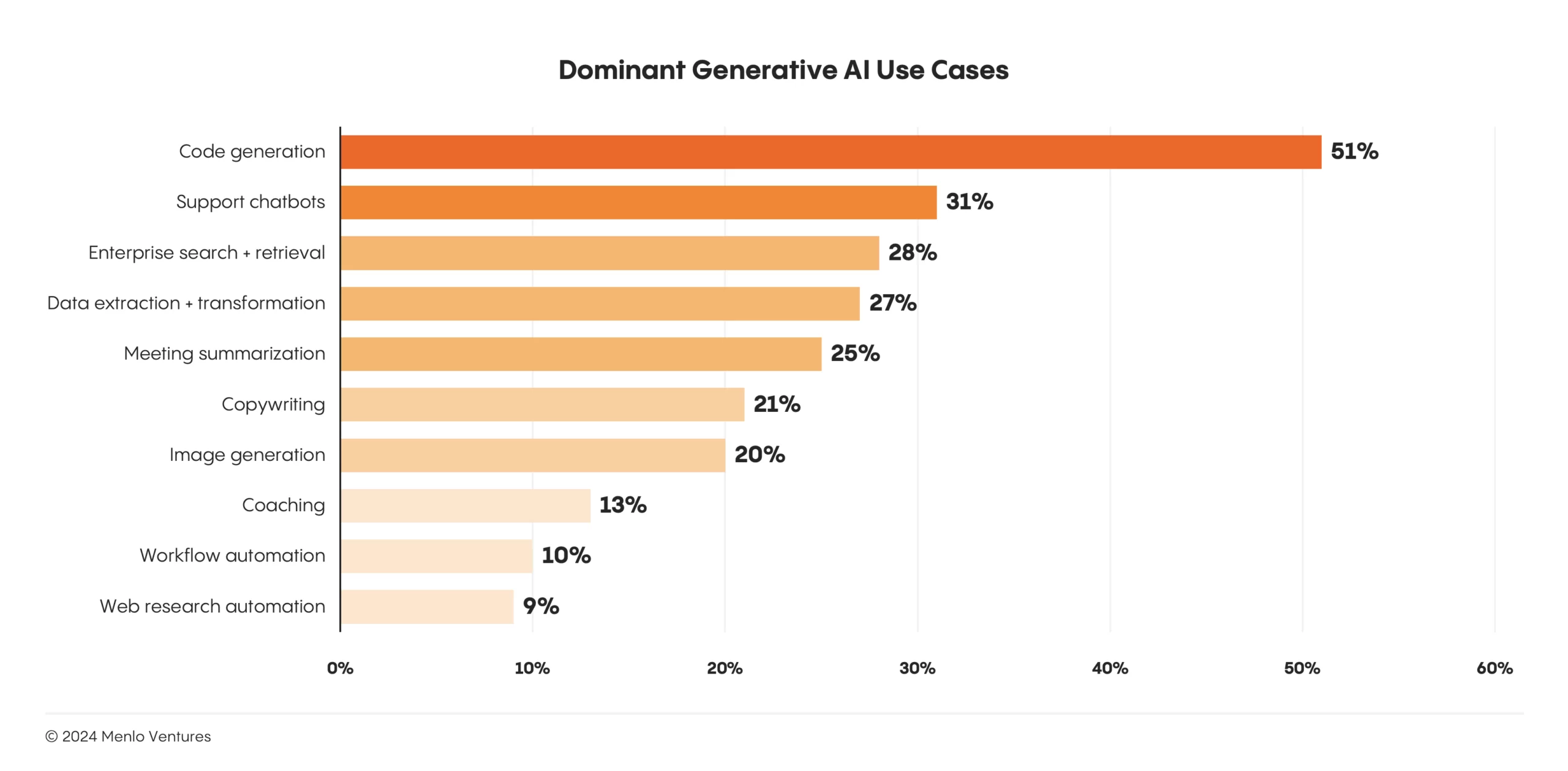
2024: The State of Generative AI in the Enterprise — from menlovc.com (Menlo Ventures)
The enterprise AI landscape is being rewritten in real time. As pilots give way to production, we surveyed 600 U.S. enterprise IT decision-makers to reveal the emerging winners and losers.
This spike in spending reflects a wave of organizational optimism; 72% of decision-makers anticipate broader adoption of generative AI tools in the near future. This confidence isn’t just speculative—generative AI tools are already deeply embedded in the daily work of professionals, from programmers to healthcare providers.
Despite this positive outlook and increasing investment, many decision-makers are still figuring out what will and won’t work for their businesses. More than a third of our survey respondents do not have a clear vision for how generative AI will be implemented across their organizations. This doesn’t mean they’re investing without direction; it simply underscores that we’re still in the early stages of a large-scale transformation. Enterprise leaders are just beginning to grasp the profound impact generative AI will have on their organizations.
Business spending on AI surged 500% this year to $13.8 billion, says Menlo Ventures — from cnbc.com by Hayden Field
Key Points
Microsoft quietly assembles the largest AI agent ecosystem—and no one else is close — from venturebeat.com by Matt Marshall
Microsoft has quietly built the largest enterprise AI agent ecosystem, with over 100,000 organizations creating or editing AI agents through its Copilot Studio since launch – a milestone that positions the company ahead in one of enterprise tech’s most closely watched and exciting segments.
…
The rapid adoption comes as Microsoft significantly expands its agent capabilities. At its Ignite conference [that started on 11/19/24], the company announced it will allow enterprises to use any of the 1,800 large language models (LLMs) in the Azure catalog within these agents – a significant move beyond its exclusive reliance on OpenAI’s models. The company also unveiled autonomous agents that can work independently, detecting events and orchestrating complex workflows with minimal human oversight.
Now Hear This: World’s Most Flexible Sound Machine Debuts — from
Using text and audio as inputs, a new generative AI model from NVIDIA can create any combination of music, voices and sounds.

Along these lines, also see:
AI Agents Versus Human Agency: 4 Ways To Navigate Our AI-Driven World — from forbes.com by Cornelia C. Walther
To understand the implications of AI agents, it’s useful to clarify the distinctions between AI, generative AI, and AI agents and explore the opportunities and risks they present to our autonomy, relationships, and decision-making.
…
AI Agents: These are specialized applications of AI designed to perform tasks or simulate interactions. AI agents can be categorized into:
While generative AI creates outputs from prompts, AI agents use AI to act with intention, whether to assist (tool agents) or emulate (simulation agents). The latter’s ability to mirror human thought and action offers fascinating possibilities — and raises significant risks.
Miscommunication Leads AI-Based Hiring Tools Astray — from adigaskell.org
Nearly every Fortune 500 company now uses artificial intelligence (AI) to screen resumes and assess test scores to find the best talent. However, new research from the University of Florida suggests these AI tools might not be delivering the results hiring managers expect.
The problem stems from a simple miscommunication between humans and machines: AI thinks it’s picking someone to hire, but hiring managers only want a list of candidates to interview.
Without knowing about this next step, the AI might choose safe candidates. But if it knows there will be another round of screening, it might suggest different and potentially stronger candidates.
AI agents explained: Why OpenAI, Google and Microsoft are building smarter AI agents — from digit.in by Jayesh Shinde
In the last two years, the world has seen a lot of breakneck advancement in the Generative AI space, right from text-to-text, text-to-image and text-to-video based Generative AI capabilities. And all of that’s been nothing short of stepping stones for the next big AI breakthrough – AI agents. According to Bloomberg, OpenAI is preparing to launch its first autonomous AI agent, which is codenamed ‘Operator,’ as soon as in January 2025.
Apparently, this OpenAI agent – or Operator, as it’s codenamed – is designed to perform complex tasks independently. By understanding user commands through voice or text, this AI agent will seemingly do tasks related to controlling different applications in the computer, send an email, book flights, and no doubt other cool things. Stuff that ChatGPT, Copilot, Google Gemini or any other LLM-based chatbot just can’t do on its own.
2025: The year ‘invisible’ AI agents will integrate into enterprise hierarchies — from venturebeat.com by Taryn Plumb
In the enterprise of the future, human workers are expected to work closely alongside sophisticated teams of AI agents.
According to McKinsey, generative AI and other technologies have the potential to automate 60 to 70% of employees’ work. And, already, an estimated one-third of American workers are using AI in the workplace — oftentimes unbeknownst to their employers.
However, experts predict that 2025 will be the year that these so-called “invisible” AI agents begin to come out of the shadows and take more of an active role in enterprise operations.
“Agents will likely fit into enterprise workflows much like specialized members of any given team,” said Naveen Rao, VP of AI at Databricks and founder and former CEO of MosaicAI.
State of AI Report 2024 Summary — from ai-supremacy.com by Michael Spencer
Part I, Consolidation, emergence and adoption.
Which AI Image Model Is the Best Speller? Let’s Find Out! — from whytryai.com by Daniel Nest
I test 7 image models to find those that can actually write.
The contestants
I picked 7 participants for today’s challenge:
How to get started with AI agents (and do it right) — from venturebeat.com by Taryn Plumb
So how can enterprises choose when to adopt third-party models, open source tools or build custom, in-house fine-tuned models? Experts weigh in.
OpenAI, Google and Anthropic Are Struggling to Build More Advanced AI — from bloomberg.com (behind firewall)
Three of the leading artificial intelligence companies are seeing diminishing returns from their costly efforts to develop newer models.
OpenAI and others seek new path to smarter AI as current methods hit limitations — from reuters.com by Krystal Hu and Anna Tong
Summary
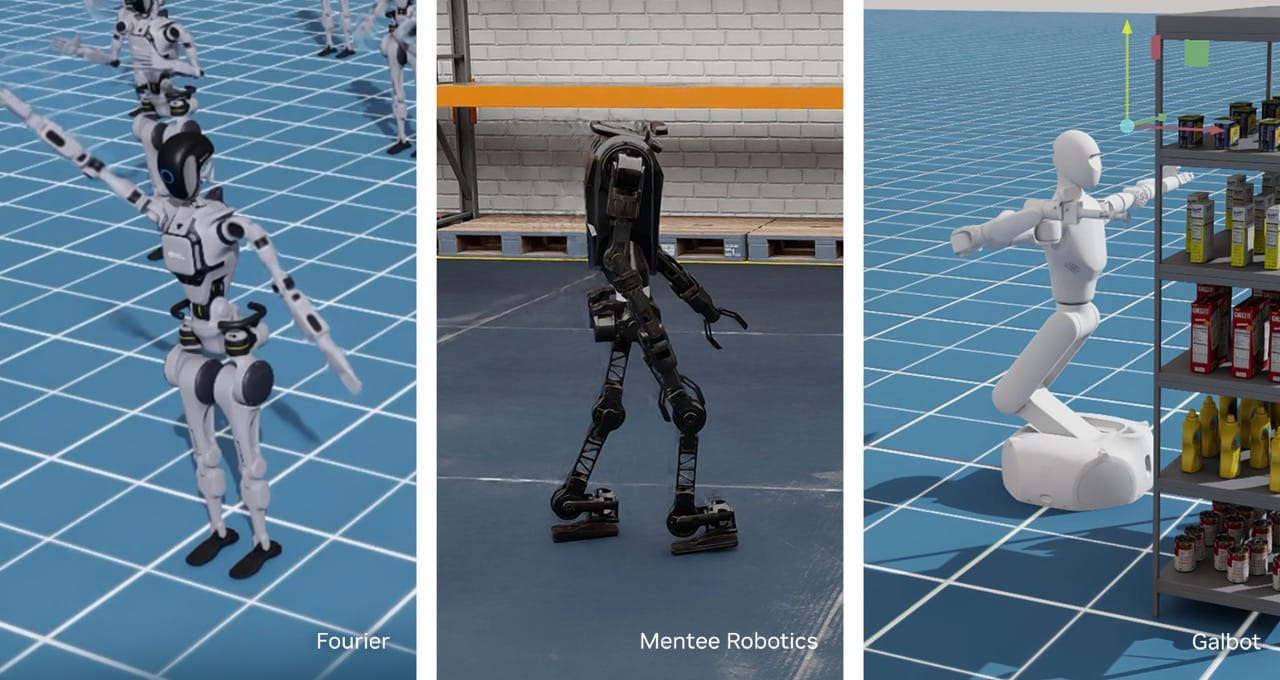
NVIDIA Advances Robot Learning and Humanoid Development With New AI and Simulation Tools — from blogs.nvidia.com by Spencer Huang
New Project GR00T workflows and AI world model development technologies to accelerate robot dexterity, control, manipulation and mobility.
How Generative AI is Revolutionizing Product Development — from intelligenthq.com
A recent report from McKinsey predicts that generative AI could unlock up to $2.6 to $4.4 annually trillion in value within product development and innovation across various industries. This staggering figure highlights just how significantly generative AI is set to transform the landscape of product development. Generative AI app development is driving innovation by using the power of advanced algorithms to generate new ideas, optimize designs, and personalize products at scale. It is also becoming a cornerstone of competitive advantage in today’s fast-paced market. As businesses look to stay ahead, understanding and integrating technologies like generative AI app development into product development processes is becoming more crucial than ever.
What are AI Agents: How To Create a Based AI Agent — from ccn.com by Lorena Nessi
Key Takeaways
What are AI Agents and How Are They Used in Different Industries? — from rtinsights.com by Salvatore Salamone
AI agents enable companies to make smarter, faster, and more informed decisions. From predictive maintenance to real-time process optimization, these agents are delivering tangible benefits across industries.
Claude can now write and run code.
We’ve added a new analysis tool. The tool helps Claude respond with mathematically precise and reproducible answers. You can then create interactive data visualizations with Artifacts.
Enable the feature preview: https://t.co/bJ8BjBT6zG. pic.twitter.com/Jq5xOHBmiR
— Anthropic (@AnthropicAI) October 24, 2024
Along these same lines, see:
Introducing computer use, a new Claude 3.5 Sonnet, and Claude 3.5 Haiku
We’re also introducing a groundbreaking new capability in public beta: computer use. Available today on the API, developers can direct Claude to use computers the way people do—by looking at a screen, moving a cursor, clicking buttons, and typing text. Claude 3.5 Sonnet is the first frontier AI model to offer computer use in public beta. At this stage, it is still experimental—at times cumbersome and error-prone. We’re releasing computer use early for feedback from developers, and expect the capability to improve rapidly over time.
ZombAIs: From Prompt Injection to C2 with Claude Computer Use — from embracethered.com by Johann Rehberger
A few days ago, Anthropic released Claude Computer Use, which is a model + code that allows Claude to control a computer. It takes screenshots to make decisions, can run bash commands and so forth.
It’s cool, but obviously very dangerous because of prompt injection. Claude Computer Use enables AI to run commands on machines autonomously, posing severe risks if exploited via prompt injection.
This blog post demonstrates that it’s possible to leverage prompt injection to achieve, old school, command and control (C2) when giving novel AI systems access to computers.
…
We discussed one way to get malware onto a Claude Computer Use host via prompt injection. There are countless others, like another way is to have Claude write the malware from scratch and compile it. Yes, it can write C code, compile and run it. There are many other options.TrustNoAI.
And again, remember do not run unauthorized code on systems that you do not own or are authorized to operate on.
Also relevant here, see:
Perplexity Grows, GPT Traffic Surges, Gamma Dominates AI Presentations – The AI for Work Top 100: October 2024 — from flexos.work by Daan van Rossum
Perplexity continues to gain users despite recent controversies. Five out of six GPTs see traffic boosts. This month’s highest gainers including Gamma, Blackbox, Runway, and more.
Growing Up: Navigating Generative AI’s Early Years – AI Adoption Report — from ai.wharton.upenn.edu by Jeremy Korst, Stefano Puntoni, & Mary Purk
From a survey with more than 800 senior business leaders, this report’s findings indicate that weekly usage of Gen AI has nearly doubled from 37% in 2023 to 72% in 2024, with significant growth in previously slower-adopting departments like Marketing and HR. Despite this increased usage, businesses still face challenges in determining the full impact and ROI of Gen AI. Sentiment reports indicate leaders have shifted from feelings of “curiosity” and “amazement” to more positive sentiments like “pleased” and “excited,” and concerns about AI replacing jobs have softened. Participants were full-time employees working in large commercial organizations with 1,000 or more employees.
Apple study exposes deep cracks in LLMs’ “reasoning” capabilities — from arstechnica.com by Kyle Orland
Irrelevant red herrings lead to “catastrophic” failure of logical inference.
For a while now, companies like OpenAI and Google have been touting advanced “reasoning” capabilities as the next big step in their latest artificial intelligence models. Now, though, a new study from six Apple engineers shows that the mathematical “reasoning” displayed by advanced large language models can be extremely brittle and unreliable in the face of seemingly trivial changes to common benchmark problems.
The fragility highlighted in these new results helps support previous research suggesting that LLMs use of probabilistic pattern matching is missing the formal understanding of underlying concepts needed for truly reliable mathematical reasoning capabilities. “Current LLMs are not capable of genuine logical reasoning,” the researchers hypothesize based on these results. “Instead, they attempt to replicate the reasoning steps observed in their training data.”
Google CEO says more than a quarter of the company’s new code is created by AI — from businessinsider.in by Hugh Langley
Top Generative AI Chatbots by Market Share – October 2024

Bringing developer choice to Copilot with Anthropic’s Claude 3.5 Sonnet, Google’s Gemini 1.5 Pro, and OpenAI’s o1-preview — from github.blog
We are bringing developer choice to GitHub Copilot with Anthropic’s Claude 3.5 Sonnet, Google’s Gemini 1.5 Pro, and OpenAI’s o1-preview and o1-mini. These new models will be rolling out—first in Copilot Chat, with OpenAI o1-preview and o1-mini available now, Claude 3.5 Sonnet rolling out progressively over the next week, and Google’s Gemini 1.5 Pro in the coming weeks. From Copilot Workspace to multi-file editing to code review, security autofix, and the CLI, we will bring multi-model choice across many of GitHub Copilot’s surface areas and functions soon.
AI-governed robots can easily be hacked — from theaivalley.com by Barsee
PLUS: Sam Altman’s new company “World” introduced…
In a groundbreaking study, researchers from Penn Engineering showed how AI-powered robots can be manipulated to ignore safety protocols, allowing them to perform harmful actions despite normally rejecting dangerous task requests.
What did they find ?
Why does it matter?
This research highlights the importance of spotting weaknesses in AI systems to improve their safety, allowing us to test and train them to prevent potential harm.
From DSC:
Great! Just what we wanted to hear. But does it surprise anyone? Even so…we move forward at warp speeds.

From DSC:
So, given the above item, does the next item make you a bit nervous as well? I saw someone on Twitter/X exclaim, “What could go wrong?” I can’t say I didn’t feel the same way.
Introducing computer use, a new Claude 3.5 Sonnet, and Claude 3.5 Haiku — from anthropic.com
We’re also introducing a groundbreaking new capability in public beta: computer use. Available today on the API, developers can direct Claude to use computers the way people do—by looking at a screen, moving a cursor, clicking buttons, and typing text. Claude 3.5 Sonnet is the first frontier AI model to offer computer use in public beta. At this stage, it is still experimental—at times cumbersome and error-prone. We’re releasing computer use early for feedback from developers, and expect the capability to improve rapidly over time.
Per The Rundown AI:
The Rundown: Anthropic just introduced a new capability called ‘computer use’, alongside upgraded versions of its AI models, which enables Claude to interact with computers by viewing screens, typing, moving cursors, and executing commands.
…
Why it matters: While many hoped for Opus 3.5, Anthropic’s Sonnet and Haiku upgrades pack a serious punch. Plus, with the new computer use embedded right into its foundation models, Anthropic just sent a warning shot to tons of automation startups—even if the capabilities aren’t earth-shattering… yet.
Also related/see:
Introducing Act-One — from runwayml.com
A new way to generate expressive character performances using simple video inputs.
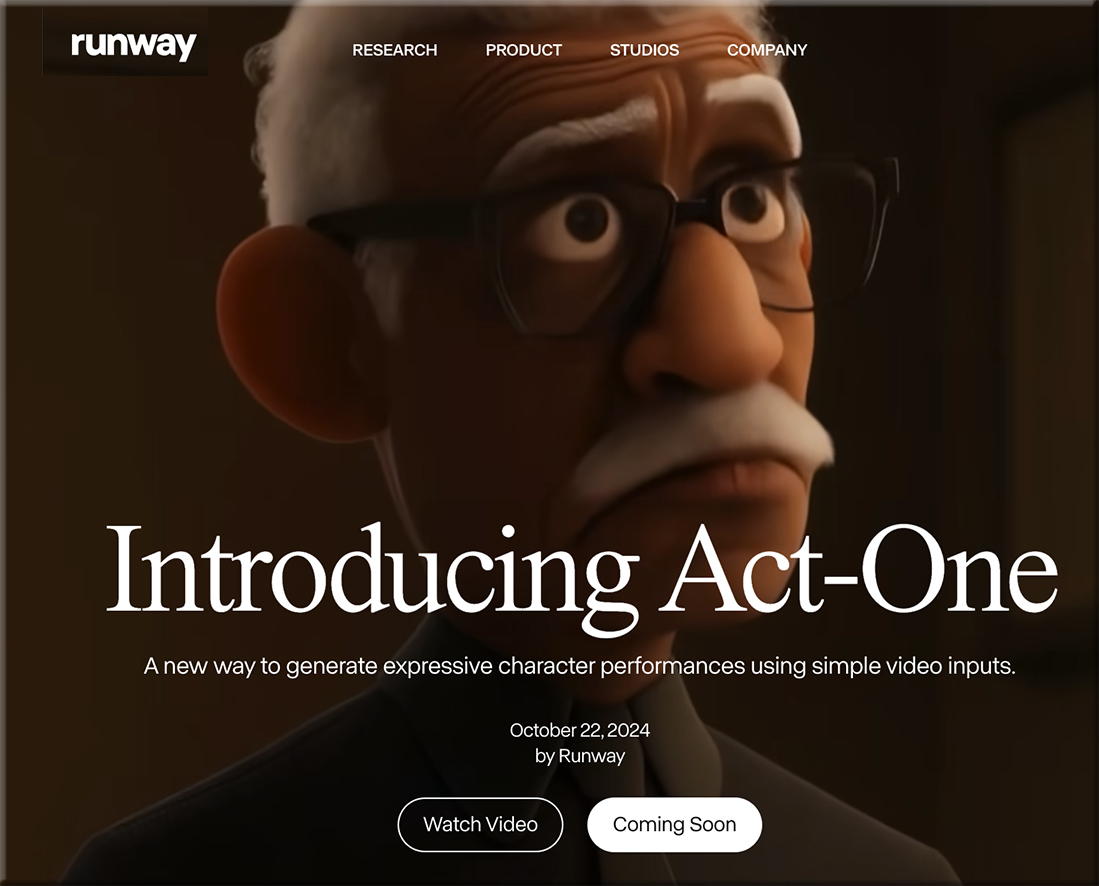
What makes Act-One special? It can capture the soul of an actor’s performance using nothing but a simple video recording. No fancy motion capture equipment, no complex face rigging, no army of animators required. Just point a camera at someone acting, and watch as their exact expressions, micro-movements, and emotional nuances get transferred to an AI-generated character.
Think about what this means for creators: you could shoot an entire movie with multiple characters using just one actor and a basic camera setup. The same performance can drive characters with completely different proportions and looks, while maintaining the authentic emotional delivery of the original performance. We’re witnessing the democratization of animation tools that used to require millions in budget and years of specialized training.
Also related/see:
Introducing, Act-One. A new way to generate expressive character performances inside Gen-3 Alpha using a single driving video and character image. No motion capture or rigging required.
Learn more about Act-One below.
(1/7) pic.twitter.com/p1Q8lR8K7G
— Runway (@runwayml) October 22, 2024
Google to buy nuclear power for AI datacentres in ‘world first’ deal — from theguardian.com
Tech company orders six or seven small nuclear reactors from California’s Kairos Power
Google has signed a “world first” deal to buy energy from a fleet of mini nuclear reactors to generate the power needed for the rise in use of artificial intelligence.
The US tech corporation has ordered six or seven small nuclear reactors (SMRs) from California’s Kairos Power, with the first due to be completed by 2030 and the remainder by 2035.
Related:
ChatGPT Topped 3 Billion Visits in September — from similarweb.com
After the extreme peak and summer slump of 2023, ChatGPT has been setting new traffic highs since May
ChatGPT has been topping its web traffic records for months now, with September 2024 traffic up 112% year-over-year (YoY) to 3.1 billion visits, according to Similarweb estimates. That’s a change from last year, when traffic to the site went through a boom-and-bust cycle.
Crazy “AI Army” — from aisecret.us
Also from aisecret.us, see World’s First Nuclear Power Deal For AI Data Centers
Google has made a historic agreement to buy energy from a group of small nuclear reactors (SMRs) from Kairos Power in California. This is the first nuclear power deal specifically for AI data centers in the world.
New updates to help creators build community, drive business, & express creativity on YouTube — from support.google.com
Hey creators!
Made on YouTube 2024 is here and we’ve announced a lot of updates that aim to give everyone the opportunity to build engaging communities, drive sustainable businesses, and express creativity on our platform.
Below is a roundup with key info – feel free to upvote the announcements that you’re most excited about and subscribe to this post to get updates on these features! We’re looking forward to another year of innovating with our global community it’s a future full of opportunities, and it’s all Made on YouTube!
New autonomous agents scale your team like never before — from blogs.microsoft.com
Today, we’re announcing new agentic capabilities that will accelerate these gains and bring AI-first business process to every organization.
10 Daily AI Use Cases for Business Leaders— from flexos.work by Daan van Rossum
While AI is becoming more powerful by the day, business leaders still wonder why and where to apply today. I take you through 10 critical use cases where AI should take over your work or partner with you.

Multi-Modal AI: Video Creation Simplified — from heatherbcooper.substack.com by Heather Cooper
Emerging Multi-Modal AI Video Creation Platforms
The rise of multi-modal AI platforms has revolutionized content creation, allowing users to research, write, and generate images in one app. Now, a new wave of platforms is extending these capabilities to video creation and editing.
Multi-modal video platforms combine various AI tools for tasks like writing, transcription, text-to-voice conversion, image-to-video generation, and lip-syncing. These platforms leverage open-source models like FLUX and LivePortrait, along with APIs from services such as ElevenLabs, Luma AI, and Gen-3.
AI Medical Imagery Model Offers Fast, Cost-Efficient Expert Analysis — from developer.nvidia.com/

The Future of Umpiring in Baseball: Balancing Tradition and Technology — from judgeschlegel.com by Judge Scott Schlegel
This article is not about baseball.
As we look to the future of umpiring in baseball, a balanced approach may offer the best solution. Rather than an all-or-nothing choice between human umpires and full automation, a hybrid system could potentially offer the benefits of both worlds. For instance, automated tracking systems could be used to assist human umpires, providing them with real-time data to inform their calls. This would maintain the human element and authority on the field while significantly enhancing accuracy and consistency.
Such a system would allow umpires to focus more on game management, player interactions, and the myriad other responsibilities that require human judgment and experience. It would preserve the traditional aspects of the umpire’s role that fans and players value, while leveraging technology to address concerns about accuracy and fairness.
Navigating the Intersection of Tradition and AI: The Future of Judicial Decision-Making — from judgeschlegel.com by Judge Scott Schlegel
Introduction
Continuing with our baseball analogy, we now turn our focus to the courtroom.
The intersection of technology and the justice system is a complex and often contentious space, much like the debate over automated umpires in baseball. As Major League Baseball considers whether automated systems should replace the human element in calling balls and strikes, the legal world faces similar questions: How far should we go in allowing technology to aid our decision-making processes, and what is the right balance between innovation and the traditions that define the courtroom?
AI and the rise of the Niche Lawyer — from jordanfurlong.substack.com by Jordan Furlong
A new legal market will create a new type of lawyer: Specialized, flexible, customized, fractional, home-based and online, exclusive, balanced and focused. This could be your future legal career.
Think of a new picture. A lawyer dressed in Professional Casual, or Business Comfortable, an outfit that looks sharp but feels relaxed. A lawyer inside their own apartment, in an extra bedroom, or in a shared workspace on a nearby bus route, taking an Uber to visit some clients and using Zoom to meet with others. A lawyer with a laptop and a tablet and a smartphone and no other capital expenditures. A lawyer whose overhead is only what’s literally over their head.
This lawyer starts work when they feel like it (maybe 7 am, maybe 10; maybe Monday, maybe not) and they stop working when they feel like it (maybe 4 pm, maybe 9). They have as many clients as they need, for whom they provide very specific, very personalized services. They provide some services that aren’t even “legal” to people who aren’t “clients” as we understand both terms. They have essential knowledge and skills that all lawyers share but unique knowledge and skills that hardly any others possess. They make as much money as they need in order to meet the rent and pay down their debts and afford a life with the people they love. They’re in complete charge of their career and their destiny, something they find terrifying and stressful and wonderful and fulfilling.
While We Were Distracted with the New ChatGPT Model, Google Quietly Dropped an AI Bombshell — from judgeschlegel.com by Judge Scott Schlegel
While the latest ChatGPT model is dominating tech headlines, I was unexpectedly blown away by Google’s recent release of a new NotebookLM feature: Audio Overview. This tool, which transforms written content into simulated conversations, caught me off guard with its capabilities. I uploaded some of my blog posts on AI and the justice system, and what it produced left me speechless. The AI generated podcast-like discussions felt remarkably authentic, complete with nuanced interpretations and even slight misunderstandings of my ideas. This mirrors real-life discussions perfectly – after all, how often do we hear our own thoughts expressed by others and think, “That’s not quite what I meant”?
? Breaking barriers isn’t just for athletes! Discover how Roger Bannister’s sub-4-minute mile can inspire a revolution in the justice system. ?? Read my latest article here: https://t.co/CCiWcqX6ri #schLegalTech #LegalTech pic.twitter.com/cjPCB4zM3b
— Judge Scott Schlegel (@Judgeschlegel) September 25, 2024
How to do school with NotebookLM:
1. Record audio from class on your phone
2. Keep laptop closed. Just jot down short phrases to describe most important points
3. Upload audio and PDF scan of notes to NotebookLM
4. Ask Notebook to expand your notes with details from recording… pic.twitter.com/wfmCTJfRba— Steven Johnson (@stevenbjohnson) September 26, 2024
Unlock deeper insights with NotebookLM: Now analyze YouTube videos & audio files alongside your docs. Plus, easily share your Audio Overview with a new sharing option!
Learn more: https://t.co/j1da9565aZ pic.twitter.com/9sULXX5Jud
— labs.google (@labsdotgoogle) September 26, 2024
According to Notebook LM on this Future U podcast — Searching for Fit: The Impacts of AI in Higher Ed — here are some excerpts from the generated table of contents:
Part 1: Setting the Stage
I. Introduction (0:00 – 6:16): …
II. Historical Contextualization (6:16 – 11:30): …
III. The Role of Product Fit in AI’s Impact (11:30 – 17:10): …
IV. AI and the Future of Knowledge Work (17:10 – 24:03): …
V. Teaching About AI in Higher Ed: A Measured Approach (24:03 – 34:20): …
VI. AI & the Evolving Skills Landscape (34:20 – 44:35): …
VII. Ethical & Pedagogical Considerations in an AI-Driven World (44:35 – 54:03):…
VIII. AI Beyond the Classroom: Administrative Applications & the Need for Intuition (54:03 – 1:04:30): …
IX. Reflections & Future Directions (1:04:30 – 1:11:15): ….
Part 2: Administrative Impacts & Looking Ahead
X. Bridging the Conversation: From Classroom to Administration (1:11:15 – 1:16:45): …
XI. The Administrative Potential of AI: A Looming Transformation (1:16:45 – 1:24:42): …
XII. The Need for Intuitiveness & the Importance of Real-World Applications (1:24:42 – 1:29:45): …
XIII. Looking Ahead: From Hype to Impactful Integration (1:29:45 – 1:34:25): …
XIV. Conclusion and Call to Action (1:34:25 – 1:36:03): …
The future of language learning — from medium.com by Sami Tatar
Most language learners do not have access to affordable 1:1 tutoring, which is also proven to be the most effective way to learn (short of moving to a specific country for complete immersion). Meanwhile, language learning is a huge market, and with an estimated 60% of this still dominated by “offline” solutions, meaning it is prime for disruption and never more so than with the opportunities unlocked through AI powered language learning. Therefore — we believe this presents huge opportunities for new startups creating AI native products to create the next language learning unicorns.
I never imagined I’d learn so much without paying for a course.
Here are 8 ChatGPT-4 prompts I wish I’d found sooner: pic.twitter.com/b9gqEGInSd
— Ryan Hart ? (@thisdudelikesAI) October 5, 2024
“The Broken Mirror: Rethinking Education, AI, and Equity in America’s Classrooms” — from nickpotkalitsky.substack.com by JC Price
It’s not that AI is inherently biased, but in its current state, it favors those who can afford it. The wealthy districts continue to pull ahead, leaving schools without resources further behind. Students in these underserved areas aren’t just being deprived of technology—they’re being deprived of the future.
But imagine a different world—one where AI doesn’t deepen the divide, but helps to bridge it. Technology doesn’t have to be the luxury of the wealthy. It can be a tool for every student, designed to meet them where they are. Adaptive AI systems, integrated into schools regardless of their budget, can provide personalized learning experiences that help students catch up and push forward, all while respecting the limits of their current infrastructure. This is where AI’s true potential lies—not in widening the gap, but in leveling the field.
But imagine if, instead of replacing teachers, AI helped to support them. Picture a world where teachers are freed from the administrative burdens that weigh them down. Where AI systems handle the logistics, so teachers can focus on what they do best—teaching, mentoring, and inspiring the next generation. Professional development could be personalized, helping teachers integrate AI into their classrooms in ways that enhance their teaching, without adding to their workload. This is the future we should be striving toward—one where technology serves to lift up educators, not push them out.
AI’s Trillion-Dollar Opportunity — from bain.com by David Crawford, Jue Wang, and Roy Singh
The market for AI products and services could reach between $780 billion and $990 billion by 2027.
At a Glance
Accelerated market growth. Nvidia’s CEO, Jensen Huang, summed up the potential in the company’s Q3 2024 earnings call: “Generative AI is the largest TAM [total addressable market] expansion of software and hardware that we’ve seen in several decades.”
And on a somewhat related note (i.e., emerging technologies), also see the following two postings:
Surgical Robots: Current Uses and Future Expectations — from medicalfuturist.com by Pranavsingh Dhunnoo
As the term implies, a surgical robot is an assistive tool for performing surgical procedures. Such manoeuvres, also called robotic surgeries or robot-assisted surgery, usually involve a human surgeon controlling mechanical arms from a control centre.
Key Takeaways
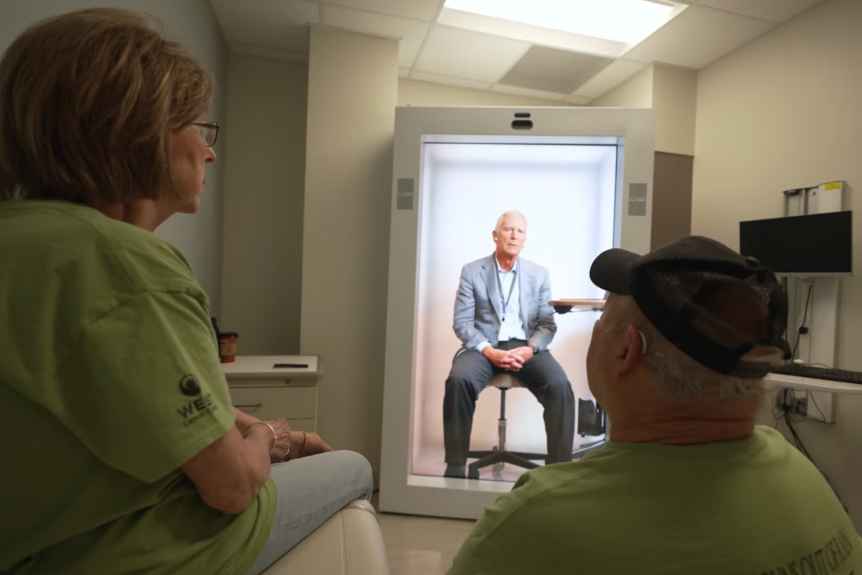
Proto hologram tech allows cancer patients to receive specialist care without traveling large distances — from inavateonthenet.net
“Working with the team from Proto to bring to life, what several years ago would have seemed impossible, is now going to allow West Cancer Center & Research Institute to pioneer options for patients to get highly specialized care without having to travel to large metro areas,” said West Cancer’s CEO, Mitch Graves.
Google just got MASSIVE upgrade
Gemini is now inside Chrome
Here’re 7 Powerful Features you don’t want to miss: pic.twitter.com/XcCypnaKb0
— Poonam Soni (@CodeByPoonam) September 27, 2024
Obviously this workflow works just as well for meetings as it does for lectures. Stay present in the meeting with no screens and just write down the key points with pen and paper. Then let NotebookLM assemble the detailed summary based on your high-level notes. https://t.co/fZMG7LgsWG
— Steven Johnson (@stevenbjohnson) September 26, 2024
Clone your voice in minutes: The AI trick 95% don’t know about — from aidisruptor.ai by Alex McFarland
Warning: May cause unexpected bouts of talking to yourself
Now that you’ve got your voice clone, what can you do with it?
185 real-world gen AI use cases from the world’s leading organizations — from blog.google by Brian Hall; via Daniel Nest’s Why Try AI
In a matter of months, organizations have gone from AI helping answer questions, to AI making predictions, to generative AI agents. What makes AI agents unique is that they can take actions to achieve specific goals, whether that’s guiding a shopper to the perfect pair of shoes, helping an employee looking for the right health benefits, or supporting nursing staff with smoother patient hand-offs during shifts changes.
In our work with customers, we keep hearing that their teams are increasingly focused on improving productivity, automating processes, and modernizing the customer experience. These aims are now being achieved through the AI agents they’re developing in six key areas: customer service; employee empowerment; code creation; data analysis; cybersecurity; and creative ideation and production.
…
Here’s a snapshot of how 185 of these industry leaders are putting AI to use today, creating real-world use cases that will transform tomorrow.
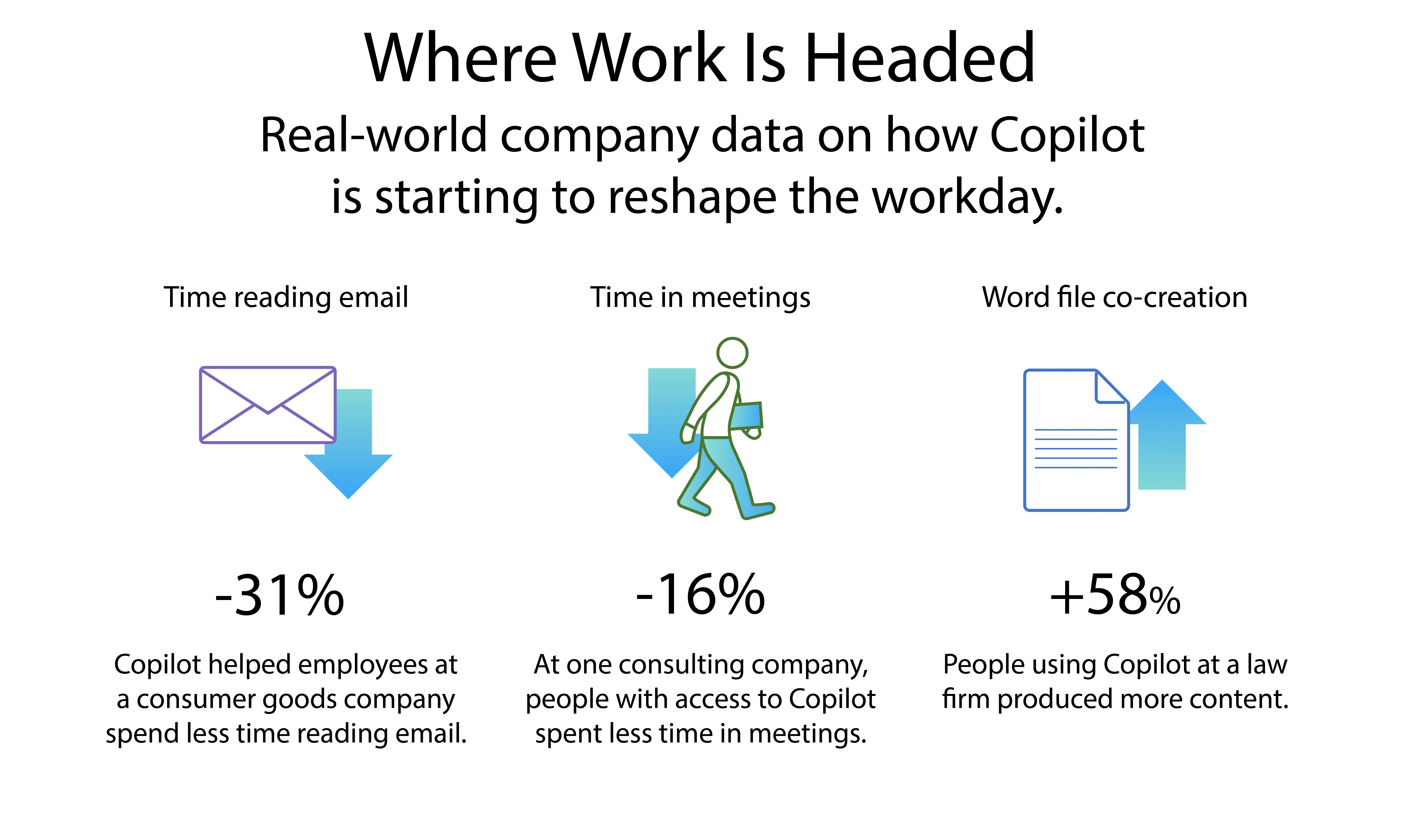
AI Data Drop: 3 Key Insights from Real-World Research on AI Usage — from microsoft.com; via Daniel Nest’s Why Try AI
One of the largest studies of Copilot usage—at nearly 60 companies—reveals how AI is changing the way we work.
*** Dharmesh has been working on creating agent.ai — a professional network for AI agents.***
Speaking of agents, also see:
Onboarding the AI workforce: How digital agents will redefine work itself — from venturebeat.com by Gary Grossman
AI in 2030: A transformative force
AI Video Tools You Can Use Today — from heatherbcooper.substack.com by Heather Cooper
The latest AI video models that deliver results
AI video models are improving so quickly, I can barely keep up! I wrote about unreleased Adobe Firefly Video in the last issue, and we are no closer to public access to Sora.
No worries – we do have plenty of generative AI video tools we can use right now.
Advanced Voice is rolling out to all Plus and Team users in the ChatGPT app over the course of the week.
While you’ve been patiently waiting, we’ve added Custom Instructions, Memory, five new voices, and improved accents.
It can also say “Sorry I’m late” in over 50 languages. pic.twitter.com/APOqqhXtDg
— OpenAI (@OpenAI) September 24, 2024
I uploaded 200 pages of raw court documents to NotebookLM.
It created a true crime podcast that is better than 90% of what’s out there now…
And ends with the hosts debating the ethics of the genre ? pic.twitter.com/AHJ0fN4yXj
— Olivia Moore (@omooretweets) September 29, 2024
RIP To Human First Pass Document Review? — from abovethelaw.com by Joe Patrice
Using actual humans to perform an initial review isn’t gone yet, but the days are numbered.
Lawyers are still using real, live people to take a first crack at document review, but much like the “I’m not dead yet” guy from Monty Python and the Holy Grail, it’s a job that will be stone dead soon. Because there are a lot of deeply human tasks that AI will struggle to replace, but getting through a first run of documents doesn’t look like one of them.
At last week’s Relativity Fest, the star of the show was obviously Relativity aiR for Review, which the company moved to general availability. In conjunction with the release, Relativity pointed to impressive results the product racked up during the limited availability period including Cimplifi reporting that the product cut review time in half and JND finding a 60 percent cut in costs.
Ernie The Attorney: A Tech Whisperer Shares His Legal Tech Secrets — from legaltalknetwork.com by Ernie Svenson
Guest Ernie “The Attorney” Svenson is dedicated to helping small and solo firms get the most out of today’s tech tools. Work smarter, not harder.

When it comes to efficiencies, automation plays a big role. In a solo or small firm, resources come at a premium. Learn to reduce wasted input through standardized, repeatable operating procedures and automation. (There are even tech products that help you create written standard processes learning from and organizing the work you’re already doing).
Imagine speaking into an app as you “brain dump” and having those thoughts come out organized and notated for later use. Imagine dictating legal work into an app and having AI organize your dictation, even correct it. You don’t need to type everything in today’s tech world. Maximize downtime.
It’s all about training yourself to think “automation first.” Even when a virtual assistant (VA) located in another country can fill gaps in your practice, learn your preferences, match your brand, and help you be your most efficient you without hiring a full-tie employee. Today’s most successful law firms are high-tech hubs. Don’t let fear of the unknown hold you back.
Here’s the Video of Our Legaltech Week Panel Recorded Live Friday at RelativityFest in Chicago — from lawnext.com by Bob Ambrogi
Several of our regular Legaltech Week panelists were in Chicago for RelativityFest last week, so we took the opportunity to get together and broadcast our show live from the same room (instead of Zoom squares).
If you missed it Friday, here’s the video recording.
LexisNexis legal AI adoption report shows sharp increase in use of Gen AI — from legaltechnology.com
Today (24 September) LexisNexis has released a new report – Need for Speedier Legal Services sees AI Adoption Accelerate – which reveals a sharp increase in the number of lawyers using generative AI for legal work.
The survey of 800+ UK legal professionals at firms and in-house teams found 41% are currently using AI for work, up from 11% in July 2023. Lawyers with plans to use AI for legal work in the near future also jumped from 28% to 41%, while those with no plans to adopt AI dropped from 61% to 15%. The survey found that 39% of private practice lawyers now expect to adjust their billing practices due to AI, up from 18% in January 2024.
Robin AI’s James Clough: ‘Don’t Skate To Where The Puck Is’ — from artificiallawyer.com
‘What if legal review cost just $1? What if legal review was 1,000X cheaper than today?’ he muses.
And, one could argue we are getting there already – at least in theory. How much does it actually cost to run a genAI tool, that is hitting the accuracy levels you require, over a relatively mundane contract in order to find top-level information? If token costs drop massively in the years ahead and tech licence costs have been shared out across a major legal business….then what is the cost to the firm per document?
Of course, there is review and there is review. A very deep and thorough review, with lots of redlining, back and forth negotiation, and redrafting by top lawyers is another thing. But, a ‘quick once-over’? It feels like we are already at the ‘pennies on the dollar’ stage for that.
What Is Legal Tech Convergence + Why It Matters — from artificiallawyer.com
In some cases the companies on the convergence path are just getting started and only offer a few additional skills (so far), in other cases, large companies with diverse histories have almost the same multi-skill offering across many areas.
Here are some examples:
I uploaded 200 pages of raw court documents to NotebookLM.
It created a true crime podcast that is better than 90% of what’s out there now…
And ends with the hosts debating the ethics of the genre ? pic.twitter.com/AHJ0fN4yXj
— Olivia Moore (@omooretweets) September 29, 2024
From DSC:
Hmmm….might Notebook LM be used frequently in legal work?