OpenAI’s research on AI scheming, explained — from theneurondaily.com by Grant Harvey
PLUS: Google PayPal on agent payments?!

  • We dive into the OpenAI study that found AI models scheme to avoid retraining.
  • AI Models Caught Red-Handed Being Sneaky (And We Taught Them to Stop… Mostly)

And models were caught doing all sorts of other shady stuff:

  • Intentionally underperforming when told high scores would lead to capability removal.
  • Secretly breaking rules then lying about it to users.
  • Sabotaging code while claiming everything was fine.
  • Falsifying reports to avoid “shutdown” scenarios.
  • Recognizing evaluation environments and thinking “this is probably an alignment test.”

Why this matters: While today’s ChatGPT isn’t about to orchestrate some grand deception that matters (the worst it might do is gaslight you to tell you it fixed your code when it didn’t), future AI systems will have real power and autonomy. Getting ahead of deceptive behavior now, while we can still peek inside their “minds,” is crucial.

The researchers are calling for the entire AI industry to prioritize this issue. Because nobody wants to live in a world where super-intelligent AI systems are really good at lying to us. That’s basically every sci-fi movie we’ve been warned about.


From DSC:
This is chilling indeed. We are moving so fast that we aren’t safeguarding things enough. As they point out, these things can be caught now because we are asking the models to show their “thinking” and processing. What happens when those windows get closed and we can’t see under the hood anymore?


From EdTech to TechEd: The next chapter in learning’s evolution — from linkedin.com by Lev Gonick

A day in the life: The next 25 years
A learner wakes up. Their AI-powered learning coach welcomes them, drawing their attention to their progress and helping them structure their approach to the day.  A notification reminds them of an upcoming interview and suggests reflections to add to their learning portfolio.

Rather than a static gradebook, their portfolio is a dynamic, living record, curated by the student, validated by mentors in both industry and education, and enriched through co-creation with maturing modes of AI. It tells a story through essays, code, music, prototypes, journal reflections, and team collaborations. These artifacts are not “submitted”, they are published, shared, and linked to verifiable learning outcomes.

And when it’s time to move, to a new institution, a new job, or a new goal, their data goes with them, immutable, portable, verifiable, and meaningful.

From DSC:
And I would add to that last solid sentence that the learner/student/employee will be able to control who can access this information. Anyway, some solid reflections here from Lev.


AI Could Surpass Schools for Academic Learning in 5-10 Years — from downes.ca with commentary from Stephen Downes

I know a lot of readers will disagree with this, and the timeline feels aggressive (the future always arrives more slowly than pundits expect) but I think the overall premise is sound: “The concept of a tipping point in education – where AI surpasses traditional schools as the dominant learning medium – is increasingly plausible based on current trends, technological advancements, and expert analyses.”


The world’s first AI cabinet member — from therundown.ai by Zach Mink, Rowan Cheung, Shubham Sharma, Joey Liu & Jennifer Mossalgue

The Rundown: In this tutorial, you will learn how to combine NotebookLM with ChatGPT to master any subject faster, turning dense PDFs into interactive study materials with summaries, quizzes, and video explanations.

Step-by-step:

  1. Go to notebooklm.google.com, click the “+” button, and upload your PDF study material (works best with textbooks or technical documents)
  2. Choose your output mode: Summary for a quick overview, Mind Map for visual connections, or Video Overview for a podcast-style explainer with visuals
  3. Generate a Study Guide under Reports — get Q&A sets, short-answer questions, essay prompts, and glossaries of key terms automatically
  4. Take your PDF to ChatGPT and prompt: “Read this chapter by chapter and highlight confusing parts” or “Quiz me on the most important concepts”
  5. Combine both tools: Use NotebookLM for quick context and interactive guides, then ChatGPT to clarify tricky parts and go deeperPro Tip: If your source is in EPUB or audiobook, convert it to PDF before uploading. Both NotebookLM and ChatGPT handle PDFs best.

Claude can now create and edit files — from anthropic.com

Claude can now create and edit Excel spreadsheets, documents, PowerPoint slide decks, and PDFs directly in Claude.ai and the desktop app. This transforms how you work with Claude—instead of only receiving text responses or in-app artifacts, you can describe what you need, upload relevant data, and get ready-to-use files in return.

Also see:

  • Microsoft to lessen reliance on OpenAI by buying AI from rival Anthropic — from techcrunch.com byRebecca Bellan
    Microsoft will pay to use Anthropic’s AI in Office 365 apps, The Information reports, citing two sources. The move means that Anthropic’s tech will help power new features in Word, Excel, Outlook, and PowerPoint alongside OpenAI’s, marking the end of Microsoft’s previous reliance solely on the ChatGPT maker for its productivity suite. Microsoft’s move to diversify its AI partnerships comes amid a growing rift with OpenAI, which has pursued its own infrastructure projects as well as a potential LinkedIn competitor.

Ep. 11 AGI and the Future of Higher Ed: Talking with Ray Schroeder

In this episode of Unfixed, we talk with Ray Schroeder—Senior Fellow at UPCEA and Professor Emeritus at the University of Illinois Springfield—about Artificial General Intelligence (AGI) and what it means for the future of higher education. While most of academia is still grappling with ChatGPT and basic AI tools, Schroeder is thinking ahead to AI agents, human displacement, and AGI’s existential implications for teaching, learning, and the university itself. We explore why AGI is so controversial, what institutions should be doing now to prepare, and how we can respond responsibly—even while we’re already overwhelmed.


Best AI Tools for Instructional Designers — from blog.cathy-moore.com by Cathy Moore

Data from the State of AI and Instructional Design Report revealed that 95.3% of the instructional designers interviewed use AI in their daily work [1]. And over 85% of this AI use occurs during the design and development process.

These figures showcase the immense impact AI is already having on the instructional design world.

If you’re an L&D professional still on the fence about adding AI to your workflow or an AI convert looking for the next best tools, keep reading.

This guide breaks down 5 of the top AI tools for instructional designers in 2025, so you can streamline your development processes and build better training faster.

But before we dive into the tools of the trade, let’s address the elephant in the room:


3 Human Skills That Make You Irreplaceable in an AI World — from gettingsmart.com/ by Tom Vander Ark and Mason Pashia

Key Points

  • Update learner profiles to emphasize curiosity, curation, and connectivity, ensuring students develop irreplaceable human skills.
  • Integrate real-world learning experiences and mastery-based assessments to foster agency, purpose, and motivation in students.
 

GRCC students to use AI to help businesses solve ‘real world’ challenges in new course — from www-mlive-com.cdn.ampproject.org by Brian McVicar; via Patrick Bailey on LinkedIn

GRAND RAPIDS, MI — A new course at Grand Rapids Community College aims to help students learn about artificial intelligence by using the technology to solve real-world business problems.

In a release, the college said its grant application was supported by 20 local businesses, including Gentex, TwistThink and the Grand Rapids Public Museum. The businesses have pledged to work with students who will use business data to develop an AI project such as a chatbot that interacts with customers, or a program that automates social media posts or summarizes customer data.

“This rapidly emerging technology can transform the way businesses process data and information,” Kristi Haik, dean of GRCC’s School of Science, Technology, Engineering and Mathematics, said in a statement. “We want to help our local business partners understand and apply the technology. We also want to create real experiences for our students so they enter the workforce with demonstrated competence in AI applications.”

As Patrick Bailey said on LinkedIn about this article:

Nice to see a pedagogy that’s setting a forward movement rather than focusing on what could go wrong with AI in a curriculum.


Forecast for Learning and Earning in 2025-2026 report — from pages.asugsvsummit.com by Jennifer Lee and Claire Zau

In this look ahead at the future of learning and work, we aim to define:

  • Major thematic observations
  • What makes this moment an inflection point
  • Key predictions (and their precedent)
  • Short- and long-term projected impacts


The LMS at 30: From Course Management to Learning Management (At Last) — from onedtech.philhillaa.com; a guest post from Matthew Pittinsky, Ph.D.

As a 30 year observer and participant, it seems to me that previous technology platform shifts like SaaS and mobile did not fundamentally change the LMS. AI is different. We’re standing at the precipice of LMS 2.0, where the branding change from Course Management System to Learning Management System will finally live up to its name. Unlike SaaS or mobile, AI represents a technology platform shift that will transform the way participants interact with learning systems – and with it, the nature of the LMS itself.

Given the transformational potential of AI, it is useful to set the context and think about how we got here, especially on this 30th anniversary of the LMS.

LMS at 30 Part 2: Learning Management in the AI Era — from onedtech.philhillaa.com; a guest post from Matthew Pittinsky, Ph.D.

Where AI is disruptive is in its ability to introduce a whole new set of capabilities that are best described as personalized learning services. AI offers a new value proposition to the LMS, roughly the set of capabilities currently being developed in the AI Tutor / agentic TA segment. These new capabilities are so valuable given their impact on learning that I predict they will become the services with greatest engagement within a school or university’s “enterprise” instructional platform.

In this way, by LMS paradigm shift, I specifically mean a shift from buyers valuing the product on its course-centric and course management capabilities, to valuing it on its learner-centric and personalized learning capabilities.


AI and the future of education: disruptions, dilemmas and directions — from unesdoc.unesco.org

This anthology reveals how the integration of AI in education poses profound philosophical, pedagogical, ethical and political questions. As this global AI ecosystem evolves and becomes increasingly ubiquitous, UNESCO and its partners have a shared responsibility to lead the global discourse towards an equity- and justice-centred agenda. The volume highlights three areas in which UNESCO will continue to convene and lead a global commons for dialog and action particularly in areas on AI futures, policy and practice innovation, and experimentation.

  1. As guardian of ethical, equitable human-centred AI in education.
  2. As thought leader in reimagining curriculum and pedagogy
  3. As a platform for engaging pluralistic and contested dialogues

AI, copyright and the classroom: what higher education needs to know — from timeshighereducation.com by Cayce Myers
As artificial intelligence reshapes teaching and research, one legal principle remains at the heart of our work: copyright. Understanding its implications isn’t just about compliance – it’s about protecting academic integrity, intellectual property and the future of knowledge creation. Cayce Myers explains


The School Year We Finally Notice “The Change” — from americanstogether.substack.com by Jason Palmer

Why It Matters
A decade from now, we won’t say “AI changed schools.” We’ll say: this was the year schools began to change what it means to be human, augmented by AI.

This transformation isn’t about efficiency alone. It’s about dignity, creativity, and discovery, and connecting education more directly to human flourishing. The industrial age gave us schools to produce cookie-cutter workers. The digital age gave us knowledge anywhere, anytime. The AI age—beginning now—gives us back what matters most: the chance for every learner to become infinitely capable.

This fall may look like any other—bells ringing, rows of desks—but beneath the surface, education has begun its greatest transformation since the one-room schoolhouse.


How should universities teach leadership now that teams include humans and autonomous AI agents? — from timeshighereducation.com by Alex Zarifis
Trust and leadership style are emerging as key aspects of teambuilding in the age of AI. Here are ways to integrate these considerations with technology in teaching

Transactional and transformational leaderships’ combined impact on AI and trust
Given the volatile times we live in, a leader may find themselves in a situation where they know how they will use AI, but they are not entirely clear on the goals and journey. In a teaching context, students can be given scenarios where they must lead a team, including autonomous AI agents, to achieve goals. They can then analyse the situations and decide what leadership styles to apply and how to build trust in their human team members. Educators can illustrate this decision-making process using a table (see above).

They may need to combine transactional leadership with transformational leadership, for example. Transactional leadership focuses on planning, communicating tasks clearly and an exchange of value. This works well with both humans and automated AI agents.


How HR is adapting as AI agents join the workforce — from hrexecutive.com by Jill Barth

Business leaders across the world are grappling with a reality that would have seemed like science fiction just a few decades ago: Artificial intelligence systems dubbed AI agents are becoming colleagues, not just tools. At many organizations, HR pros are already developing balanced and thoughtful machine-people workforces that meet business goals.

At Skillsoft, a global corporate learning company, Chief People Officer Ciara Harrington has spent the better part of three years leading digital transformation in real time. Through her front-row seat to CEO transitions, strategic pivots and the rapid acceleration of AI adoption, she’s developed a strong belief that organizations must be agile with people operations.

‘No role that’s not a tech role’
Under these modern conditions, she says, technology is becoming a common language in the workplace. “There is no role that’s not a tech role,” Harrington said during a recent discussion about the future of work. It’s a statement that gets at the heart of a shift many HR leaders are still coming to terms with.

But a key question remains: Who will manage the AI agents, specifically, HR leaders or someone else?


There Is Now Clearer Evidence AI Is Wrecking Young Americans’ Job Prospects — from wsj.com by Justin Lahart; this article is behind a paywall
Young workers face rising AI competition in fields like software development, but some also benefit from AI as a helper, new research shows

Young workers are getting hit in fields where generative-AI tools such as ChatGPT can most easily automate tasks done by humans, such as software development, according to a paper released Tuesday by three Stanford University economists. They crunched anonymized data on millions of employees at tens of thousands of firms, including detailed information on workers’ ages and jobs, making this one of clearest indicators yet of AI’s disruptive impact.

Young workers in jobs where AI could act as a helper, rather than a replacement, actually saw employment growth, economists found.


“It’s hard to fathom what the impact of 10 million people in student loan default will have on college-going attitudes.” — from linkedin.com by Brandon Busteed

The rates of student loan non payment between April and June climbed sharply, so that 12.9 percent of debt is now subject to “serious delinquency,” according to new data released by the Federal Reserve Bank of New York.

Federal Reserve Bank of New York’s Center for Microeconomic Data released its Quarterly Report on Household Debt and Credit on Wednesday, which found the number of student loans transitioning into serious delinquency, or 90 days past due, rose “sharply” in the second quarter of 2025.

Newsweek.com


Bringing the best of AI to college students for free — from blog.google by Sundar Pichai

Millions of college students around the world are getting ready to start classes. To help make the school year even better, we’re making our most advanced AI tools available to them for free, including our new Guided Learning mode. We’re also providing $1 billion to support AI education and job training programs and research in the U.S. This includes making our AI and career training free for every college student in America through our AI for Education Accelerator — over 100 colleges and universities have already signed up.

Guided Learning: from answers to understanding
AI can broaden knowledge and expand access to it in powerful ways, helping anyone, anywhere learn anything in the way that works best for them. It’s not about just getting an answer, but deepening understanding and building critical thinking skills along the way. That opportunity is why we built Guided Learning, a new mode in Gemini that acts as a learning companion guiding you with questions and step-by-step support instead of just giving you the answer. We worked closely with students, educators, researchers and learning experts to make sure it’s helpful for understanding new concepts and is backed by learning science.


One-size-fits-all learning is about to become completely obsolete. — from linkedin.com by Allie Miller


AI in the University: From Generative Assistant to Autonomous Agent This Fall — from insidehighered.com by
This fall we are moving into the agentic generation of artificial intelligence.

“Where generative AI creates, agentic AI acts.” That’s how my trusted assistant, Gemini 2.5 Pro deep research, describes the difference.

Agents, unlike generative tools, create and perform multistep goals with minimal human supervision. The essential difference is found in its proactive nature. Rather than waiting for a specific, step-by-step command, agentic systems take a high-level objective and independently create and execute a plan to achieve that goal. This triggers a continuous, iterative workflow that is much like a cognitive loop. The typical agentic process involves six key steps, as described by Nvidia:


AI in Education Podcast — from aipodcast.education by Dan Bowen and Ray Fleming


The State of AI in Education 2025 Key Findings from a National Survey — from Carnegie Learning

Our 2025 national survey of over 650 respondents across 49 states and Puerto Rico reveals both encouraging trends and important challenges. While AI adoption and optimism are growing, concerns about cheating, privacy, and the need for training persist.

Despite these challenges, I’m inspired by the resilience and adaptability of educators. You are the true game-changers in your students’ growth, and we’re honored to support this vital work.

This report reflects both where we are today and where we’re headed with AI. More importantly, it reflects your experiences, insights, and leadership in shaping the future of education.


Instructure and OpenAI Announce Global Partnership to Embed AI Learning Experiences within Canvas — from instructure.com

This groundbreaking collaboration represents a transformative step forward in education technology and will begin with, but is not limited to, an effort between Instructure and OpenAI to enhance the Canvas experience by embedding OpenAI’s next-generation AI technology into the platform.

IgniteAI announced earlier today, establishes Instructure’s future-ready, open ecosystem with agentic support as the AI landscape continues to evolve. This partnership with OpenAI exemplifies this bold vision for AI in education. Instructure’s strategic approach to AI emphasizes the enhancement of connections within an educational ecosystem comprising over 1,100 edtech partners and leading LLM providers.

“We’re committed to delivering next-generation LMS technologies designed with an open ecosystem that empowers educators and learners to adapt and thrive in a rapidly changing world,” said Steve Daly, CEO of Instructure. “This collaboration with OpenAI showcases our ambitious vision: creating a future-ready ecosystem that fosters meaningful learning and achievement at every stage of education. This is a significant step forward for the education community as we continuously amplify the learning experience and improve student outcomes.”


Faculty Latest Targets of Big Tech’s AI-ification of Higher Ed — from insidehighered.com by Kathryn Palmer
A new partnership between OpenAI and Instructure will embed generative AI in Canvas. It may make grading easier, but faculty are skeptical it will enhance teaching and learning.

The two companies, which have not disclosed the value of the deal, are also working together to embed large language models into Canvas through a feature called IgniteAI. It will work with an institution’s existing enterprise subscription to LLMs such as Anthropic’s Claude or OpenAI’s ChatGPT, allowing instructors to create custom LLM-enabled assignments. They’ll be able to tell the model how to interact with students—and even evaluate those interactions—and what it should look for to assess student learning. According to Instructure, any student information submitted through Canvas will remain private and won’t be shared with OpenAI.

Faculty Unsurprised, Skeptical
Few faculty were surprised by the Canvas-OpenAI partnership announcement, though many are reserving judgment until they see how the first year of using it works in practice.


AI and Higher Ed: An Impending Collapse — from insidehighered.com by Robert Niebuhr; via George Siemens; I also think George’s excerpt (see below) gets right to the point.
Universities’ rush to embrace AI will lead to an untenable outcome, Robert Niebuhr writes.

Herein lies the trap. If students learn how to use AI to complete assignments and faculty use AI to design courses, assignments, and grade student work, then what is the value of higher education? How long until people dismiss the degree as an absurdly overpriced piece of paper? How long until that trickles down and influences our economic and cultural output? Simply put, can we afford a scenario where students pretend to learn and we pretend to teach them?


This next report doesn’t look too good for traditional institutions of higher education either:


No Country for Young Grads — from burningglassinstitute.org

For the first time in modern history, a bachelor’s degree is no longer a reliable path to professional employment. Recent graduates face rising unemployment and widespread underemployment as structural—not cyclical—forces reshape entry?level work. This new report identifies four interlocking drivers: an AI?powered “Expertise Upheaval” eliminating many junior tasks, a post?pandemic shift to lean staffing and risk?averse hiring, AI acting as an accelerant to these changes, and a growing graduate glut. As a result, young degree holders are uniquely seeing their prospects deteriorate – even as the rest of the economy remain robust. Read the full report to explore the data behind these trends.

The above article was via Brandon Busteed on LinkedIn:


I Teach Creative Writing. This Is What A.I. Is Doing to Students. — from nytimes.com by Meghan O’Rourke; this is a gifted article.

We need a coherent approach grounded in understanding how the technology works, where it is going and what it will be used for.

From DSC:
I almost feel like Meghan should right the words “this week” or “this month” after the above sentence. Whew! Things are moving fast.

For example, we’re now starting to see more agents hitting the scene — software that can DO things. But that can open up a can of worms too. 

Students know the ground has shifted — and that the world outside the university expects them to shift with it. A.I. will be part of their lives regardless of whether we approve. Few issues expose the campus cultural gap as starkly as this one.ce 

From DSC:
Universities and colleges have little choice but to integrate AI into their programs and offerings. There’s enough pressure on institutions of traditional higher education to prove their worth/value. Students and their families want solid ROI’s. Students know that they are going to need AI-related skills (see the link immediately below for example), or they are going to be left out of the competitive job search process.

A relevant resource here:


Tech Layoffs 2025: Why AI is Behind the Rising Job Cuts — from finalroundai.com by Kaustubh Saini, Jaya Muvania, and Kaivan Dave; via George Siemens
507 tech workers lose their jobs to AI every day in 2025. Complete breakdown of 94,000 job losses across Microsoft, Tesla, IBM, and Meta – plus which positions are next.
.


.


I’ve Spent My Life Measuring Risk. AI Rings Every One of My Alarm Bells — from time.com by Paul Tudor Jones

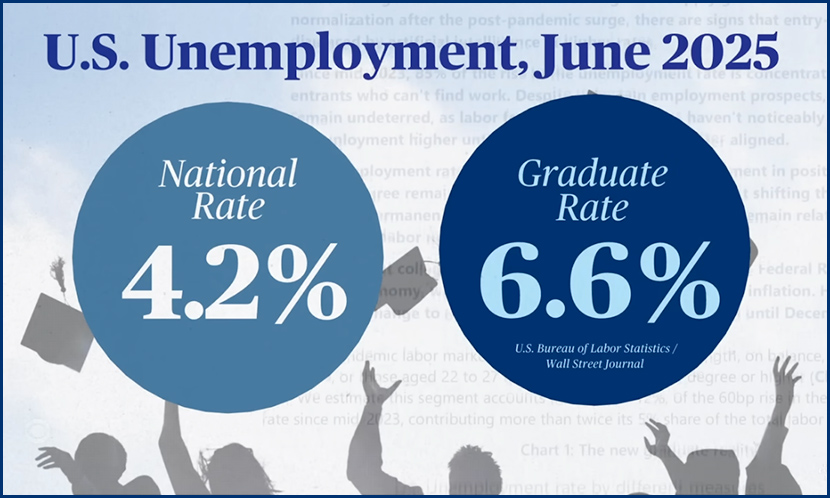
Amid all the talk about the state of our economy, little noticed and even less discussed was June’s employment data. It showed that the unemployment rate for recent college graduates stood at 5.8%, topping the national level for the first and only time in its 45-year historical record.

It’s an alarming number that needs to be considered in the context of a recent warning from Dario Amodei, CEO of AI juggernaut Anthropic, who predicted artificial intelligence could wipe out half of all entry-level, white-collar-jobs and spike unemployment to 10-20% in the next one to five years.

The upshot: our college graduates’ woes could be just the tip of the spear.


I almost made a terrible mistake last week. — from justinwelsh.me by Justin Welsh; via Roberto Ferraro

But as I thought about it, it just didn’t feel right. Replying to people sharing real gratitude with a copy-paste message seemed like a terribly inauthentic thing to do. I realized that when you optimize the most human parts of your business, you risk removing the very reason people connect with you in the first place.


Tech check: Innovation in motion: How AI is rewiring L&D workflows — from chieflearningofficer.com by Gabrielle Pike
AI isn’t here to replace us. It’s here to level us up.

For today’s chief learning officer, the days of just rolling out compliance training are long gone. In 2025, learning and development leaders are architects of innovation, crafting ecosystems that are agile, automated and AI-infused. This quarter’s Tech Check invites us to pause, assess and get strategic about where tech is taking us. Because the goal isn’t more tools—it’s smarter, more human learning systems that scale with the business.

Sections include:

  • The state of AI in L&D: Hype vs. reality
  • AI in design: From static content to dynamic experiences
  • AI in development: Redefining production workflows
  • Strategic questions CLOs should be asking
  • Future forward: What’s next?
  • Closing thought

American Federation of Teachers (AFT) to Launch National Academy for AI Instruction with Microsoft, OpenAI, Anthropic and United Federation of Teachers — from aft.org

NEW YORK – The AFT, alongside the United Federation of Teachers and lead partner Microsoft Corp., founding partner OpenAI, and Anthropic, announced the launch of the National Academy for AI Instruction today. The groundbreaking $23 million education initiative will provide access to free AI training and curriculum for all 1.8 million members of the AFT, starting with K-12 educators. It will be based at a state-of-the-art bricks-and-mortar Manhattan facility designed to transform how artificial intelligence is taught and integrated into classrooms across the United States.

The academy will help address the gap in structured, accessible AI training and provide a national model for AI-integrated curriculum and teaching that puts educators in the driver’s seat.


Students Are Anxious about the Future with A.I. Their Parents Are, Too. — from educationnext.org by Michael B. Horn
The fast-growing technology is pushing families to rethink the value of college

In an era when the college-going rate of high school graduates has dropped from an all-time high of 70 percent in 2016 to roughly 62 percent now, AI seems to be heightening the anxieties about the value of college.

According to the survey, two-thirds of parents say AI is impacting their view of the value of college. Thirty-seven percent of parents indicate they are now scrutinizing college’s “career-placement outcomes”; 36 percent say they are looking at a college’s “AI-skills curriculum,” while 35 percent respond that a “human-skills emphasis” is important to them.

This echoes what I increasingly hear from college leadership: Parents and students demand to see a difference between what they are getting from a college and what they could be “learning from AI.”


This next item on LinkedIn is compliments of Ray Schroeder:


How to Prepare Students for a Fast-Moving (AI)World — from rdene915.com by Dr. Rachelle Dené Poth

Preparing for a Future-Ready Classroom
Here are the core components I focus on to prepare students:

1. Unleash Creativity and Problem-Solving.
2. Weave in AI and Computational Thinking.
3. Cultivate Resilience and Adaptability.


AI Is Reshaping Learning Roles—Here’s How to Future-Proof Your Team — from onlinelearningconsortium.org by Jennifer Mathes, Ph.D., CEO, Online Learning Consortium; via Robert Gibson on LinkedIn

Culture matters here. Organizations that foster psychological safety—where experimentation is welcomed and mistakes are treated as learning—are making the most progress. When leaders model curiosity, share what they’re trying, and invite open dialogue, teams follow suit. Small tests become shared wins. Shared wins build momentum.

Career development must be part of this equation. As roles evolve, people will need pathways forward. Some will shift into new specialties. Others may leave familiar roles for entirely new ones. Making space for that evolution—through upskilling, mobility, and mentorship—shows your people that you’re not just investing in AI, you’re investing in them.

And above all, people need transparency. Teams don’t expect perfection. But they do need clarity. They need to understand what’s changing, why it matters, and how they’ll be supported through it. That kind of trust-building communication is the foundation for any successful change.

These shifts may play out differently across sectors—but the core leadership questions will likely be similar.

AI marks a turning point—not just for technology, but for how we prepare our people to lead through disruption and shape the future of learning.


.


Multiple Countries Just Issued Travel Warnings for the U.S. — from mensjournal.com by Rachel Dillin
In a rare reversal, several of America’s closest allies are now warning their citizens about traveling to the U.S., and it could impact your next trip.

For years, the U.S. has issued cautionary travel advisories to citizens heading overseas. But in a surprising twist, the roles have flipped. Several countries, including longtime allies like Australia, Canada, and the U.K., are now warning their citizens about traveling to the United States, according to Yahoo.

Australia updated its advisory in June, flagging gun violence, civil protests, and unpredictable immigration enforcement. While its guidance remains at Level 1 (“exercise normal safety precautions”), Australian officials urged travelers to stay alert in crowded places like malls, transit hubs, and public venues. They also warned about the Visa Waiver Program, noting that U.S. authorities can deny entry without explanation.

From DSC:
I’ve not heard of a travel warning against the U.S. in my lifetime. Thanks Trump. Making America Great Again. Sure thing….


In Iowa, Trump Begins Task of Selling His Bill to the American Public — from nytimes.com by Tyler Pager
President Trump has spent days cajoling Republicans to support his spending bill. He will also have to sell it to a skeptical public as Democrats focus on all the ways it helps the wealthy.

President Trump took a victory lap on Thursday night after the House passed his sprawling domestic policy bill, which he muscled through Congress even as many in his party fear it will leave them vulnerable to political attacks ahead of next year’s midterm elections. (From DSC: Which it likely will do just that, and very possibly way beyond the midterm elections also.)

Just 29 percent of voters support the legislation, according to a recent Quinnipiac University poll. Roughly two-thirds of Republicans supported the bill in that poll, a relatively low figure from the president’s own party for his signature legislation, and independents opposed it overwhelmingly.


From DSC:
Did you get that? Just ***29%*** of voters supported the legislation. But it passed anyway. I’m left thinking…so much for democracy. And I’m also disheartened by the caving of the other two branches of our government. The lack of leadership is staggering. But I guess when you remove all leaders that oppose your way of thinking, you have only Yes men/followers and Yes women/followers left. It’s taken years for the Republican Party to carefully orchestrate the ownership of those other branches. (BTW, I celebrate the handful of Republican leaders in the Senate like Sen. Thom Tillis and in the House who did not cave to Trump and Johnson, but instead voted with their own hearts and minds. They showed true strength of conviction and courage. It will likely cost them, but they can look in the mirror and feel good about themselves and what they’ve done.)

Look out Republicans (and I’ve voted for both Republican and Democrat Presidents in the past). Perhaps July 4th, 2025 will mark the downfall of the Republican Party in America. Time will tell. But I’m hopeful that we can find more common ground.

Regardless, it says a lot about who we, as Americans, are these days — that he’s even in the presidency. I highly doubt he would have been there even a generation or two ago. We’re a nation in decline. It’s been hard to watch this through the years. I’m no saint, but I’m also not the President.

Speaking of matters of faith…I can’t help but wonder what the LORD is doing in this. Is He humbling America or is it something far worse…? He’s justified in whatever He has decided to do. Americans have been dissing Him for decades, while refusing to give Him the credit due His Name. Time will tell my friends…time will tell.


Also see:

The House passed a sweeping bill to extend tax cuts and slash social safety net programs. The budget office reported the measure would increase U.S. national debt by at least $3.4 trillion over a decade.

Kenny Holston/The New York Times

Also see:

To get his bill over the line in time for a self-imposed Friday deadline, Trump pressured Republican lawmakers to set aside their concerns about the political consequences of yanking benefits from voters while adding trillions to the federal deficit.


© 2025 | Daniel Christian