Five Legal Tech Insights From New York — from artificiallawyer.com by Richard Tromans
A week spent in Manhattan gave Artificial Lawyer plenty to think about. Here are five insights inspired by a series of ‘New York moments’, often about legal AI.

On the way back from Paddington the cab driver was also questioned on the topic. He replied with wisdom: ‘When they made Heathrow Express a lot of us feared it would take away work. The funny thing is, it pushes more people to Paddington and generates a steady flow of fares. Before, you might spend ages getting to Heathrow with one passenger and sometimes have to drive all the way back with no fare.’

The end result: the effort to increase speed and efficiency ended up making the taxi drivers of London much happier and their lives more flexible. Whereas the taxi drivers of New York remain stuck doing huge, one-off journeys, while the general public suffers high costs and slow – and unpredictable – travel times.

Now, one wonders where there could be a connection to how the legal world works…..?


ABA TECHSHOW 2025 to spotlight future of legal technology — from americanbar.org
Artificial intelligence, cloud-based practice management, data privacy and e-discovery will be among the hot topics featured at the American Bar Association TECHSHOW 2025, which spotlights the most useful and practical technologies available in the legal industry, April 2-5 in Chicago.


Legaltech leaders roundtable: The challenges and emerging best practices of GenAI adoption — from legaltechnology.com

One of the key themes to emerge was the need to encourage creativity and open mindedness  around use cases. Conan Hines, Fried Frank’s director of practice innovation, said: “I felt a lot of ‘imaginative play’ vibes. This is where we give lawyers secure AI tools and support to explore the possibilities. The support is even more interesting as innovative teams are complementing their current staff with behavioural science and anthropological approaches to unlock this potential.”


Inhouse World Is Embracing Legal AI – Survey — from artificiallawyer.com


It’s the end of work as we knew it
and I feel…

powerless to fight the technology that we pioneered
nostalgic for a world that moved on without us
after decades of paying our dues
for a payday that never came
…so yeah
not exactly fine.


The Gen X Career Meltdown — from nytimes.com by Steeven Kurutz (DSC: This is a gifted article for you)
Just when they should be at their peak, experienced workers in creative fields find that their skills are all but obsolete.

If you entered media or image-making in the ’90s — magazine publishing, newspaper journalism, photography, graphic design, advertising, music, film, TV — there’s a good chance that you are now doing something else for work. That’s because those industries have shrunk or transformed themselves radically, shutting out those whose skills were once in high demand.

“I am having conversations every day with people whose careers are sort of over,” said Chris Wilcha, a 53-year-old film and TV director in Los Angeles.

Talk with people in their late 40s and 50s who once imagined they would be able to achieve great heights — or at least a solid career while flexing their creative muscles — and you are likely to hear about the photographer whose work dried up, the designer who can’t get hired or the magazine journalist who isn’t doing much of anything.

In the wake of the influencers comes another threat, artificial intelligence, which seems likely to replace many of the remaining Gen X copywriters, photographers and designers. By 2030, ad agencies in the United States will lose 32,000 jobs, or 7.5 percent of the industry’s work force, to the technology, according to the research firm Forrester.


From DSC:
This article reminds me of how tough it is to navigate change in our lives. For me, it was often due to the fact that I was working with technologies. Being a technologist can be difficult, especially as one gets older and faces age discrimination in a variety of industries. You need to pick the right technologies and the directions that will last (for me it was email, videoconferencing, the Internet, online-based education/training, discovering/implementing instructional technologies, and becoming a futurist).

For you younger folks out there — especially students within K-16 — aim to develop a perspective and a skillset that is all about adapting to change. You will likely need to reinvent yourself and/or pick up new skills over your working years. You are most assuredly required to be a lifelong learner now. That’s why I have been pushing for school systems to be more concerned with providing more choice and control to students — so that students actually like school and enjoy learning about new things.


AI in Education Survey: What UK and US Educators Think in 2025 — from twinkl.com
As artificial intelligence (AI) continues to shape the world around us, Twinkl conducted a large-scale survey between January 15th and January 22nd to explore its impact on the education sector, as well as the work lives of teachers across the UK and the USA.

Teachers’ use of AI for work continues to rise
Twinkl’s survey asked teachers whether they were currently using AI for work purposes. Comparing these findings to similar surveys over recent years shows the use of AI tools by teachers has seen a significant increase across both the UK and USA.

  • According to two UK surveys by the National Literacy Trust – 30% of teachers used generative AI in 2023 and nearly half (47.7%) in 2024. Twinkl’s survey indicates that AI adoption continues to rise rapidly, with 60% of UK educators currently integrating it into their work lives in 2025.
  • Similarly, with 62% of US teachers currently using AI for work, uptake appears to have risen greatly in the past 12 months, with just 25% saying they were leveraging the new technology in the 2023-24 school year according to a RAND report.
  • Teachers are using AI more for work than in their personal lives: In the UK, personal usage drops to 43% (from 60% at school).  In the US, 52% are using AI for non-work purposes (versus 62% in education settings).

    60% of UK teachers and 62% of US teachers use AI in their work life in 2025.


Students and folks looking for work may want to check out:

Also relevant/see:


The Third Horizon of Learning Shifting beyond the Industrial Model — from gettingsmart.com by Sujata Bhatt & Mason Pashia

Over 24 blog posts, we have sketched a bold vision of what this next horizon of education looks like in action and highlighted the many innovators working to bring it to life. These pioneers are building new models that prioritize human development, relationships, and real-world relevance as most valuable. They are forging partnerships, designing and adopting transformative technologies, developing new assessment methods, and more. These shifts transform the lived experiences of young people and serve the needs of families and communities. In short, they are delivering authentic learning experiences that better address the demands of today’s economy, society, and learners.

We’ve aggregated our findings from this blog series and turned it into an H3 Publication. Inside, you’ll find our key transformation takeaways for school designers and system leaders, as well as a full list of the contributing authors. Thank you to all of the contributors, including LearnerStudio for sponsoring the series and Sujata Bhatt at Incubate Learning for authorship, editing and curation support throughout the entirety of the series and publication.
.


8 Weeks Left to Prepare Students for the AI-Enhanced Workplace — from insidehighered.com by Ray Schroeder
We are down to the final weeks left to fully prepare students for entry into the AI-enhanced workplace. Are your students ready?

The urgent task facing those of us who teach and advise students, whether they be degree program or certificate seeking, is to ensure that they are prepared to enter (or re-enter) the workplace with skills and knowledge that are relevant to 2025 and beyond. One of the first skills to cultivate is an understanding of what kinds of services this emerging technology can provide to enhance the worker’s productivity and value to the institution or corporation.

Given that short period of time, coupled with the need to cover the scheduled information in the syllabus, I recommend that we consider merging AI use into authentic assignments and assessments, supplementary modules, and other resources to prepare for AI.


Learning Design in the Era of Agentic AI — from drphilippahardman.substack.com by Dr Philippa Hardman
Aka, how to design online async learning experiences that learners can’t afford to delegate to AI agents

The point I put forward was that the problem is not AI’s ability to complete online async courses, but that online async courses courses deliver so little value to our learners that they delegate their completion to AI.

The harsh reality is that this is not an AI problem — it is a learning design problem.

However, this realisation presents us with an opportunity which we overall seem keen to embrace. Rather than seeking out ways to block AI agents, we seem largely to agree that we should use this as a moment to reimagine online async learning itself.


8 Schools Innovating With Google AI — Here’s What They’re Doing — from forbes.com by Dan Fitzpatrick

While fears of AI replacing educators swirl in the public consciousness, a cohort of pioneering institutions is demonstrating a far more nuanced reality. These eight universities and schools aren’t just experimenting with AI, they’re fundamentally reshaping their educational ecosystems. From personalized learning in K-12 to advanced research in higher education, these institutions are leveraging Google’s AI to empower students, enhance teaching, and streamline operations.


Essential AI tools for better work — from wondertools.substack.com by Jeremy Caplan
My favorite tactics for making the most of AI — a podcast conversation

AI tools I consistently rely on (areas covered mentioned below)

  • Research and analysis
  • Communication efficiency
  • Multimedia creation

AI tactics that work surprisingly well 

1. Reverse interviews
Instead of just querying AI, have it interview you. Get the AI to interview you, rather than interviewing it. Give it a little context and what you’re focusing on and what you’re interested in, and then you ask it to interview you to elicit your own insights.”

This approach helps extract knowledge from yourself, not just from the AI. Sometimes we need that guide to pull ideas out of ourselves.


How can businesses stay ahead of trends and technologies that are rapidly changing their industries? — from linkedin.com by Tanja Schindler; via her Dancing with Uncertainty newsletter

Companies need to develop a sense of curiosity about both the observable trends in the present and the unobserved factors that could significantly influence their futures. While current trends can drive us in certain directions, we also need to imagine possible futures that could either disrupt our industry or offer tremendous opportunities for growth.

To stay ahead of the game, companies should focus on recognising weak signals in the present – subtle hints of emerging trends – and deciding whether to encourage or discourage these signals to avoid undesirable futures and encourage desirable ones. This process is a constant dance between the push of the present (existing trends) and the pull of the future (visions of the future we want to create).


From DSC:
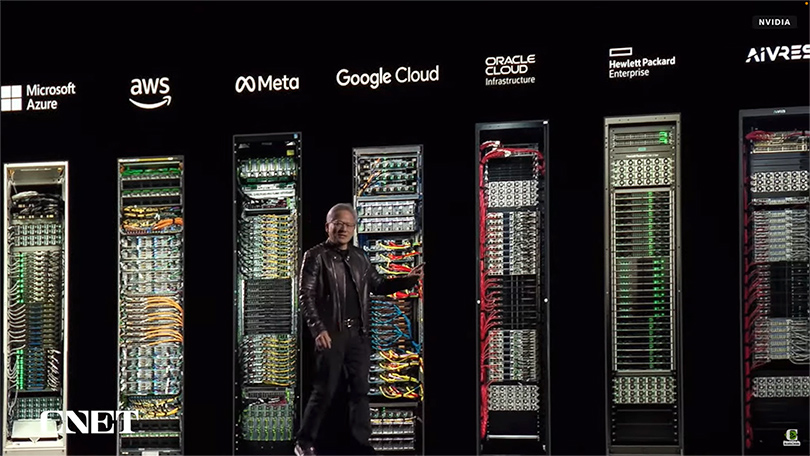
Look out Google, Amazon, and others! Nvidia is putting the pedal to the metal in terms of being innovative and visionary! They are leaving the likes of Apple in the dust.

The top talent out there is likely to go to Nvidia for a while. Engineers, programmers/software architects, network architects, product designers, data specialists, AI researchers, developers of robotics and autonomous vehicles, R&D specialists, computer vision specialists, natural language processing experts, and many more types of positions will be flocking to Nvidia to work for a company that has already changed the world and will likely continue to do so for years to come. 


NVIDIA’s AI Superbowl — from theneurondaily.com by Noah and Grant
PLUS: Prompt tips to make AI writing more natural

That’s despite a flood of new announcements (here’s a 16 min video recap), which included:

  1. A new architecture for massive AI data centers (now called “AI factories”).
  2. A physics engine for robot training built with Disney and DeepMind.
  3. partnership with GM to develop next-gen vehicles, factories and robots.
  4. A new Blackwell chip with “Dynamo” software that makes AI reasoning 40x faster than previous generations.
  5. A new “Rubin” chip slated for 2026 and a “Feynman” chip set for 2028.

For enterprises, NVIDIA unveiled DGX Spark and DGX Station—Jensen’s vision of AI-era computing, bringing NVIDIA’s powerful Blackwell chip directly to your desk.


Nvidia Bets Big on Synthetic Data — from wired.com by Lauren Goode
Nvidia has acquired synthetic data startup Gretel to bolster the AI training data used by the chip maker’s customers and developers.


Nvidia, xAI to Join BlackRock and Microsoft’s $30 Billion AI Infrastructure Fund — from investopedia.com by Aaron McDade
Nvidia and xAI are joining BlackRock and Microsoft in an AI infrastructure group seeking $30 billion in funding. The group was first announced in September as BlackRock and Microsoft sought to fund new data centers to power AI products.


Nvidia CEO Jensen Huang says we’ll soon see 1 million GPU data centers visible from space — from finance.yahoo.com by Daniel Howley
Nvidia CEO Jensen Huang says the company is preparing for 1 million GPU data centers.


Nvidia stock stems losses as GTC leaves Wall Street analysts ‘comfortable with long term AI demand’ — from finance.yahoo.com by Laura Bratton
Nvidia stock reversed direction after a two-day slide that saw shares lose 5% as the AI chipmaker’s annual GTC event failed to excite investors amid a broader market downturn.


Microsoft, Google, and Oracle Deepen Nvidia Partnerships. This Stock Got the Biggest GTC Boost. — from barrons.com by Adam Clark and Elsa Ohlen


The 4 Big Surprises from Nvidia’s ‘Super Bowl of AI’ GTC Keynote — from barrons.com by Tae Kim; behind a paywall

AI Super Bowl. Hi everyone. This week, 20,000 engineers, scientists, industry executives, and yours truly descended upon San Jose, Calif. for Nvidia’s annual GTC developers’ conference, which has been dubbed the “Super Bowl of AI.”


Who does need college anymore? About that book title … — from Education Design Lab

As you may know, Lab founder Kathleen deLaski just published a book with a provocative title: Who Needs College Anymore? Imagining a Future Where Degrees Won’t Matter.

Kathleen is asked about the title in every media interview, before and since the Feb. 25 book release. “It has generated a lot of questions,” she said in our recent book chat. “I tell people to focus on the word, ‘who.’ Who needs college anymore? That’s in keeping with the design thinking frame, where you look at the needs of individuals and what needs are not being met.”

In the same conversation, Kathleen reminded us that only 38% of American adults have a four-year degree. “We never talk about the path to the American dream for the rest of folks,” she said. “We currently are not supporting the other really interesting pathways to financial sustainability — apprenticeships, short-term credentials. And that’s really why I wrote the book, to push the conversation around the 62% of who we call New Majority Learners at the Lab, the people for whom college was not designed.” Watch the full clip

She distills the point into one sentence in this SmartBrief essay:  “The new paradigm is a ‘yes and’ paradigm that embraces college and/or other pathways instead of college or bust.”

What can colleges do moving forward?
In this excellent Q&A with Inside Higher Ed, Kathleen shares her No. 1 suggestion: “College needs to be designed as a stepladder approach, where people can come in and out of it as they need, and at the very least, they can build earnings power along the way to help afford a degree program.”

In her Hechinger Report essay, Kathleen lists four more steps colleges can take to meet the demand for more choices, including “affordability must rule.”

From white-collar apprenticeships and micro-credential programs at local community colleges to online bootcamps, self-instruction using YouTube, and more—students are forging alternative paths to GREAT high-paying jobs. (source)


Introducing NextGenAI: A consortium to advance research and education with AI — from openai.com; via Claire Zau
OpenAI commits $50M in funding and tools to leading institutions.

Today, we’re launching NextGenAI, a first-of-its-kind consortium with 15 leading research institutions dedicated to using AI to accelerate research breakthroughs and transform education.

AI has the power to drive progress in research and education—but only when people have the right tools to harness it. That’s why OpenAI is committing $50M in research grants, compute funding, and API access to support students, educators, and researchers advancing the frontiers of knowledge.

Uniting institutions across the U.S. and abroad, NextGenAI aims to catalyze progress at a rate faster than any one institution would alone. This initiative is built not only to fuel the next generation of discoveries, but also to prepare the next generation to shape AI’s future.


 ‘I want him to be prepared’: why parents are teaching their gen Alpha kids to use AI — from theguardian.com by Aaron Mok; via Claire Zau
As AI grows increasingly prevalent, some are showing their children tools from ChatGPT to Dall-E to learn and bond

“My goal isn’t to make him a generative AI wizard,” White said. “It’s to give him a foundation for using AI to be creative, build, explore perspectives and enrich his learning.”

White is part of a growing number of parents teaching their young children how to use AI chatbots so they are prepared to deploy the tools responsibly as personal assistants for school, work and daily life when they’re older.


Are Entry-Level Jobs Going Away? The Hidden Workforce Shift — from forbes.com by Dr. Diane Hamilton; via Ryan Craig

The problem is that these new roles demand a level of expertise that wasn’t expected from entry-level candidates in the past. Where someone might have previously learned on the job, they are now required to have relevant certifications, AI proficiency, or experience with digital platforms before they even apply.

Some current and emerging job titles that serve as entry points into industries include:

  • Digital marketing associate – This role often involves content creation, social media management, and working with AI-driven analytics tools.
  • Junior AI analyst – Employees in this role assist data science teams by labeling and refining machine learning datasets.
  • Customer success associate – Replacing traditional customer service roles, these professionals help manage AI-enhanced customer support systems.
  • Technical support specialist – While this role still involves troubleshooting software, it now often includes AI-driven diagnostics and automation oversight.
 

6 Characteristics of an Education that Students Want — from gettingsmart.com by IDEA (School of Industrial Design, Engineering and Arts) Students in Tacoma Washington

As current high school students, we want:

  1. Education for the Real World
  2. Personalized and Flexible Education
  3. Cultivating Agency
  4. Creativity and Divergent Thinking
  5. Joyful Learning and Community Building
  6. Empathy and Emotional Growth

Also from gettingsmart.com

Diving into the Evidence: Virtual and Hybrid Models as High-Quality School Choice Options

Key Points

  • The Learning Accelerator is building an evidence base of what high-quality virtual and hybrid learning looks like and how it can be a catalyst for expanding access to powerful learning opportunities.
  • An analysis of 64 high-quality models revealed that virtual and hybrid learning occurs in various contexts, from state-based, fully-virtual programs to individual, hybrid schools and meets the needs of different student populations, including those underserved or disengaged by traditional education systems as well as looking for increased flexibility and course access.
 

5 Legal Tech Trends Set to Impact Law Firms in 2025 — from programminginsider.com by Marc Berman

The legal industry is experiencing swift changes, with technology becoming an ever more crucial factor in its evolution. As law firms respond to shifting client demands and regulatory changes, the pace of change is accelerating. Embracing legal tech is no longer just an advantage; it’s a necessity.

According to a Forbes report, 66% of legal leaders acknowledge this trend and intend to boost their investments in legal tech moving forward. From artificial intelligence streamlining workflows to cloud computing enabling globalized legal services, the legal landscape is undergoing a digital revolution.

In this article, we’ll explore five key legal tech trends that will define how law firms operate in 2025.


GenAI, Legal Ops, and The Future of Law Firms: A Wake-Up Call? — from echlawcrossroads.com by Stephen Embry

A new study from the Blickstein Group reveals some distributing trends for law firms that represent businesses, particularly large ones. The Study is entitled  Legal Service Delivery in the Age of AI. The Study was done jointly by FTI Technologies, a consulting group, and Blickstein. It looks at law department legal operations.

The Findings

GenAI Use by Legal Ops Personnel

The responses reflect a bullish view of what GenAI can do in the legal marketplace but also demonstrate GenAi has a ways to go:

  • Almost 80% of the respondents think that GenAI will become an “essential part of the legal profession.
  • 81% believe GenAi will drive improved efficiencies
  • Despite this belief, only some 30% have plans to purchase GenAI tools. For 81%, the primary reason for obtaining and using GenAI tools is the efficiencies these tools bring.
  • 52% say their GenAI strategy is not as sophisticated as they would like or nonexistent.

The biggest barrier to the use of GenAI among the legal ops professions is cost and security concerns and the lack of skilled personnel available to them.


Voting Is Closed, Results Are In: Here are the 15 Legal Tech Startups Selected for the 2025 Startup Alley at ABA TECHSHOW — from lawnext.com by Bob Ambrogi

Voting has now closed and your votes have been tallied to pick the 15 legal tech startups that will get to participate as finalists in the ninth-annual Startup Alley at ABA TECHSHOW 2025, taking place April 2-5 in Chicago.

These 15 finalists will face off in an opening-night pitch competition that is the opening event of TECHSHOW, with the conference’s attendees voting at the conclusion of the pitches to pick the top winners.


Balancing innovation and ethics: Applying generative AI in legal work — from legal.thomsonreuters.com

Generative artificial intelligence (GenAI) has brought a new wave of opportunities to the legal profession, opening doors to greater efficiency and innovation. Its rapid development has also raised questions about its integration within the legal industry. As legal professionals are presented with more options for adopting new technologies, they now face the important task of understanding how GenAI can be seamlessly — and ethically — incorporated into their daily operations.


Emerging Trends in Court Reporting for 2025: Legal Technology and Advantages for Law Firms — from jdsupra.com

The court reporting industry is evolving rapidly, propelled by technological advancements and the increasing demand for efficiency in the legal sector. For 2025, trends such as artificial intelligence (AI), real-time transcription technologies, and data-driven tools are reshaping how legal professionals work. Here’s an overview of these emerging trends and five reasons law firms should embrace these advancements.


Market scan: What’s possible in the current skills validation ecosystem? — from eddesignlab.org
Education Design Lab provides an overview of emerging practices + tools in this 2025 Skills Validation Market Scan.

Employers and opportunity seekers are excited about the possibilities of a skills-based ecosystem, but this new process for codifying a person’s experiences and abilities into skills requires one significant, and missing, piece: Trust. Employers need to trust that the credentials they receive from opportunity seekers are valid representations of their skills. Jobseekers need to trust that their digital credentials are safe, accurate, and will lead to employment and advancement.

Our hypothesis
We posit that the trust needed for the validation of skills to be brought into a meaningful reality is established through a network of skills validation methods and opportunities. We also recognize that the routes through which an individual can demonstrate skills are as varied as the individuals themselves. Therefore, in order to equitably create a skills-based employment ecosystem, the routes by which skills are validated must be held together with common standards and language, but flexible enough to accommodate a multitude of validation practices.


Half A Million Students Given ChatGPT As CSU System Makes AI History — from forbes.com by Dan Fitzpatrick

The California State University system has partnered with OpenAI to launch the largest deployment of AI in higher education to date.

The CSU system, which serves nearly 500,000 students across 23 campuses, has announced plans to integrate ChatGPT Edu, an education-focused version of OpenAI’s chatbot, into its curriculum and operations. The rollout, which includes tens of thousands of faculty and staff, represents the most significant AI deployment within a single educational institution globally.

We’re still in the early stages of AI adoption in education, and it is critical that the entire ecosystem—education systems, technologists, educators, and governments—work together to ensure that all students globally have access to AI and develop the skills to use it responsibly

Leah Belsky, VP and general manager of education at OpenAI.


HOW educators can use GenAI – where to start and how to progress — from aliciabankhofer.substack.com by Alicia Bankhofer
Part of 3 of my series: Teaching and Learning in the AI Age

As you read through these use cases, you’ll notice that each one addresses multiple tasks from our list above.

1. Researching a topic for a lesson
2. Creating Tasks For Practice
3. Creating Sample Answers
4. Generating Ideas
5. Designing Lesson Plans
6. Creating Tests
7. Using AI in Virtual Classrooms
8. Creating Images
9. Creating worksheets
10. Correcting and Feedback


© 2025 | Daniel Christian