More Chief Online Learning Officers Step Up to Senior Leadership Roles In 2024, I think we will see more Chief Online Learning Officers (COLOs) take on more significant roles and projects at institutions.
In recent years, we have seen many COLOs accept provost positions. The typical provost career path that runs up through the faculty ranks does not adequately prepare leaders for the digital transformation occurring in postsecondary education.
As we’ve seen with the professionalization of the COLO role, in general, these same leaders proved to be incredibly valuable during the pandemic due to their unique skills: part academic, part entrepreneur, part technologist, COLOs are unique in higher education. They sit at the epicenter of teaching, learning, technology, and sustainability. As institutions are evolving, look for more online and professional continuing leaders to take on more senior roles on campuses.
Julie Uranis, Senior Vice President, Online and Strategic Initiatives, UPCEA
6. ChatGPT’s hype will fade, as a new generation of tailor-made bots rises up
11. We’ll finally turn the corner on teacher pay in 2024
21. Employers will combat job applicants’ use of AI with…more AI
31. Universities will view the creator economy as a viable career path
DSC: I’m a bit confused this am as I’m seeing multiple — but different – references to “Q” and what it is. It seems to be at least two different things: 1) OpenAI’s secret project Q* and 2) Amazon Q, a new type of generative artificial intelligence-powered assistant
We need to start aligning the educational system with a world where humans live with machines that have intelligence capabilities that approximate their own.
Today’s freshmen *may* graduate into a world where AIs have at least similar intelligence abilities to humans. Today’s 1st graders *probably* will.
Efforts need to be made to align the educational system with a world where machines will have intelligence capabilities similar to those of humans.
AWS Announces Amazon Q to Reimagine the Future of Work— from press.aboutamazon.com New type of generative AI-powered assistant, built with security and privacy in mind, empowers employees to get answers to questions, solve problems, generate content, and take actions using the data and expertise found at their company
LAS VEGAS–(BUSINESS WIRE)–At AWS re:Invent, Amazon Web Services, Inc. (AWS), an Amazon.com, Inc. company (NASDAQ: AMZN), today announced Amazon Q, a new type of generative artificial intelligence-(AI) powered assistant that is specifically for work and can be tailored to a customer’s business. Customers can get fast, relevant answers to pressing questions, generate content, and take actions—all informed by a customer’s information repositories, code, and enterprise systems. Amazon Q provides information and advice to employees to streamline tasks, accelerate decision making and problem solving, and help spark creativity and innovation at work.
What: We’re taking the first steps in Bard’s ability to understand YouTube videos. For example, if you’re looking for videos on how to make olive oil cake, you can now also ask how many eggs the recipe in the first video requires.
Why: We’ve heard you want deeper engagement with YouTube videos. So we’re expanding the YouTube Extension to understand some video content so you can have a richer conversation with Bard about it.
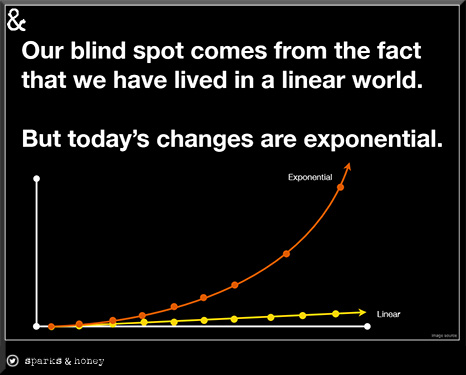
I am not sure who said it first, but there are only two ways to react to exponential change: too early or too late. Today’s AIs are flawed and limited in many ways. While that restricts what AI can do, the capabilities of AI are increasing exponentially, both in terms of the models themselves and the tools these models can use. It might seem too early to consider changing an organization to accommodate AI, but I think that there is a strong possibility that it will quickly become too late.
From DSC: Readers of this blog have seen the following graphic for several years now, but there is no question that we are in a time of exponential change. One would have had an increasingly hard time arguing the opposite of this perspective during that time.
Nvidia’s results surpassed analysts’ projections for revenue and income in the fiscal fourth quarter.
Demand for Nvidia’s graphics processing units has been exceeding supply, thanks to the rise of generative artificial intelligence.
Nvidia announced the GH200 GPU during the quarter.
Here’s how the company did, compared to the consensus among analysts surveyed by LSEG, formerly known as Refinitiv:
Earnings: $4.02 per share, adjusted, vs. $3.37 per share expected
Revenue: $18.12 billion, vs. $16.18 billion expected
Nvidia’s revenue grew 206% year over year during the quarter ending Oct. 29, according to a statement. Net income, at $9.24 billion, or $3.71 per share, was up from $680 million, or 27 cents per share, in the same quarter a year ago.
DC: Anyone surprised? This is why the U.S. doesn’t want high-powered chips going to China. History repeats itself…again. The ways of the world/power continue on.
Pentagon’s AI initiatives accelerate hard decisions on lethal autonomous weapons https://t.co/PTDmJugiE2
Despite the hype and big promises about AI, if it is used correctly, could it be the differentiator that sets good legal professionals apart from the pack? Stephen Embry offers a good argument for this in the latest episode.
Stephen is a long-time attorney and the legal tech aficionado behind the TechLaw Crossroads blog– a great resource for practical and real-world insight about legal tech and how technology is impacting the practice of law. Embry emphasizes that good lawyers will embrace artificial intelligence to increase efficiency and serve their clients better, leaving more time for strategic thinking and advisory roles.
AI Pedagogy Project, metaLAB (at) Harvard Creative and critical engagement with AI in education. A collection of assignments and materials inspired by the humanities, for educators curious about how AI affects their students and their syllabi
AI Guide
Focused on the essentials and written to be accessible to a newcomer, this interactive guide will give you the background you need to feel more confident with engaging conversations about AI in your classroom.
From #47 of SAIL: Sensemaking AI Learning — by George Siemens
Excerpt (emphasis DSC):
Welcome to Sensemaking, AI, and Learning (SAIL), a regular look at how AI is impacting education and learning.
Over the last year, after dozens of conferences, many webinars, panels, workshops, and many (many) conversations with colleagues, it’s starting to feel like higher education, as a system, is in an AI groundhog’s day loop. I haven’t heard anything novel generated by universities. We have a chatbot! Soon it will be a tutor! We have a generative AI faculty council! Here’s our list of links to sites that also have lists! We need AI literacy! My mantra over the last while has been that higher education leadership is failing us on AI in a more dramatic way than it failed us on digitization and online learning. What will your universities be buying from AI vendors in five years because they failed to develop a strategic vision and capabilities today?
AI + the Education System — from drphilippahardman.substack.com Dr. Philippa Hardman The key to relevance, value & excellence?
(e) What is really required is a significant re-organization of schooling and curriculum. At a meta-level, the school system is focused on developing the type of intelligence I opened with, and the economic value of that is going to rapidly decline.
(f). This is all going to happen very quickly (faster than any previous change in history), and many people aren’t paying attention. AI is already here.
From DSC: As I’ve long stated on the Learning from the Living [Class]Room vision, we are heading toward a new AI-empowered learning platform — where humans play a critically important role in making this new learning ecosystem work.
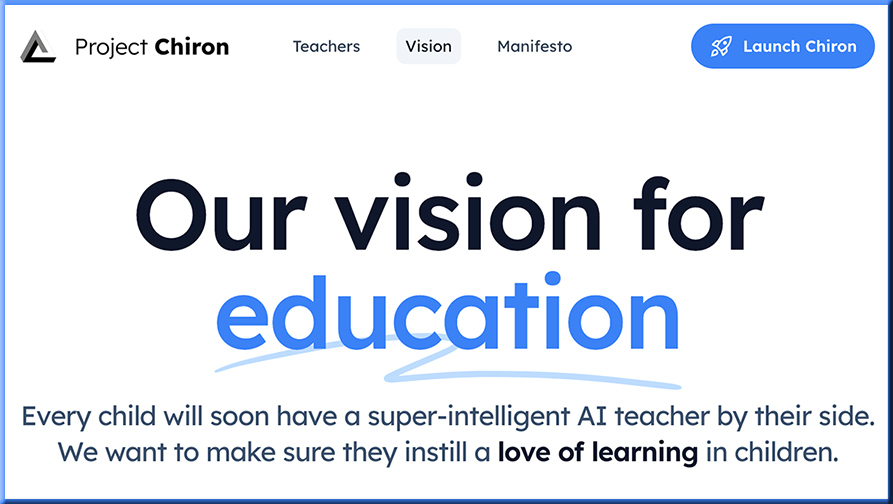
Along these lines, I ran into this site out on X/Twitter. We’ll see how this unfolds, but it will be an interesting space to watch.
From DSC: This future learning platform will also focus on developing skills and competencies. Along those lines, see:
Scale for Skills-First— from the-job.beehiiv.com by Paul Fain An ed-tech giant’s ambitious moves into digital credentialing and learner records.
A Digital Canvas for Skills
Instructure was a player in the skills and credentials space before its recent acquisition of Parchment, a digital transcript company. But that $800M move made many observers wonder if Instructure can develop digital records of skills that learners, colleges, and employers might actually use broadly.
…
Ultimately, he says, the CLR approach will allow students to bring these various learning types into a coherent format for employers.
Instructure seeks a leadership role in working with other organizations to establish common standards for credentials and learner records, to help create consistency. The company collaborates closely with 1EdTech. And last month it helped launch the 1EdTech TrustEd Microcredential Coalition, which aims to increase quality and trust in digital credentials.
These could help with the creation of interactive learning assistants, aligned with curricula.
They can be easily created with natural language programming.
Important to note users must have a ChatGPT Plus paid account
Custom GPT Store:
Marketplace for sharing and accessing educational GPT tools created by other teachers.
A store could offer access to specialised tools for diverse learning needs.
A store could enhance teaching strategies when accessing proven, effective GPT applications.
From DSC: I appreciate Dan’s potential menu of options for a child’s education:
Monday AM: Sports club
Monday PM: Synthesis Online School AI Tutor
Tuesday AM: Music Lesson
Tuesday PM: Synthesis Online School Group Work
Wednesday AM: Drama Rehearsal
Wednesday PM: Synthesis Online School AI Tutor
Thursday AM: Volunteer work
Thursday PM: Private study
Friday AM: Work experience
Friday PM: Work experience
Our daughter has special learning needs and this is very similar to what she is doing.
The future of generative AI in higher ed? How to be critical, pragmatic, and playful at once? Nothing like having someone you admire ask you hard questions in a friendly way. This Q&A with Leon Furze got me to take a stab at articulating some responses.https://t.co/IxreZYwWmv
— Anna Mills, annamillsoer.bsky.social, she/her (@EnglishOER) November 13, 2023
Two boxes. In my May Cottesmore presentation, I put up two boxes:
(a) Box 1 — How educators can use AI to do what they do now (lesson plans, quizzes, tests, vocabulary lists, etc.)
(b) Box 2 — How the education system needs to change because, in the near future (sort of already), everyone is going to have multiple AIs working with them all day, and the premium on intelligence, especially “knowledge-based” intelligence, is going to decline rapidly. It’s hard to think that significant changes in the education system won’t be needed to accommodate that change.
There is a lot of focus on preparing educators to work in Box 1, which is important, if for no other reason than that they can see the power of even the current but limited technologies, but the hard questions are starting to be about Box 2. I encourage you to start those conversations, as the “ed tech” companies already are, and they’ll be happy to provide the answers and the services if you don’t want to.
Practical suggestions: Two AI teams in your institution. Team 1 works on Box A and Team 2 works on Box B.
The legal world in 10 years (if we’re really lucky) — from jordanfurlong.substack.com by Jordan Furlong Here are eight predictions for how the legal sector will be different and mostly better in 2033. If you have an alternative vision, there’s one sure way to prove me wrong.
What part are you going to play in determining the future? This isn’t a spectator sport or a video game. “The future” will be what you (and everyone else) make it by your decisions, commitments, sacrifices, and leadership — or, equally, by your inaction on all these fronts.
There’s a meme making the rounds that says, “People in time-travel movies are always afraid of committing one tiny action in the past, because it might completely change the present. But people in the present don’t seem to believe that committing one tiny action in the present could completely change the future.” I think that has it exactly right. The future we get is the future that you and I start making in the present, meaning today, right now.
Shadow AI: A Thorny Problem For Law Firms — from abovethelaw.com by Sharon D. Nelson, John W. Simek, and Michael C. Maschke Its use is often unknown to a law firm’s IT or security group.
ChatGPT can produce a perfectly serviceable writing “product,” she said. But writing isn’t a product per se — it’s a tool for thinking, for organizing ideas, she said.
“ChatGPT and other text-based tools can’t think for us,” she said. “There’s still things to learn when it comes to writing because writing is a form of figuring out what you think.”
When students could contrast their own writing to ChatGPT’s more generic version, Levine said, they were able to “understand what their own voice is and what it does.”
But what about text? Should — and if so, how should — writers be recognized and remunerated for AI-generated works that mimic their voices?
Those are questions that are likely to be raised by a feature in Grammarly, the cloud-based typing assistant, that’s scheduled to launch by the end of the year for subscribers to Grammarly’s business tier. Called “Personalized voice detection and application,” the feature automatically detects a person’s unique writing style and creates a “voice profile” that can rewrite any text in the person’s style.
From bustling metropolises to serene hamlets, schools across the globe are greeting a new companion—Artificial Intelligence (AI). This companion promises to redefine the essence of education, making learning a journey tailored to each child’s unique abilities.
The advent of AI in education is akin to a gentle breeze, subtly transforming the academic landscape. Picture a classroom where each child, with their distinct capabilities and pace, embarks on a personalized learning path. AI morphs this vision into reality, crafting a personalized educational landscape that celebrates the unique potential harbored within every learner.
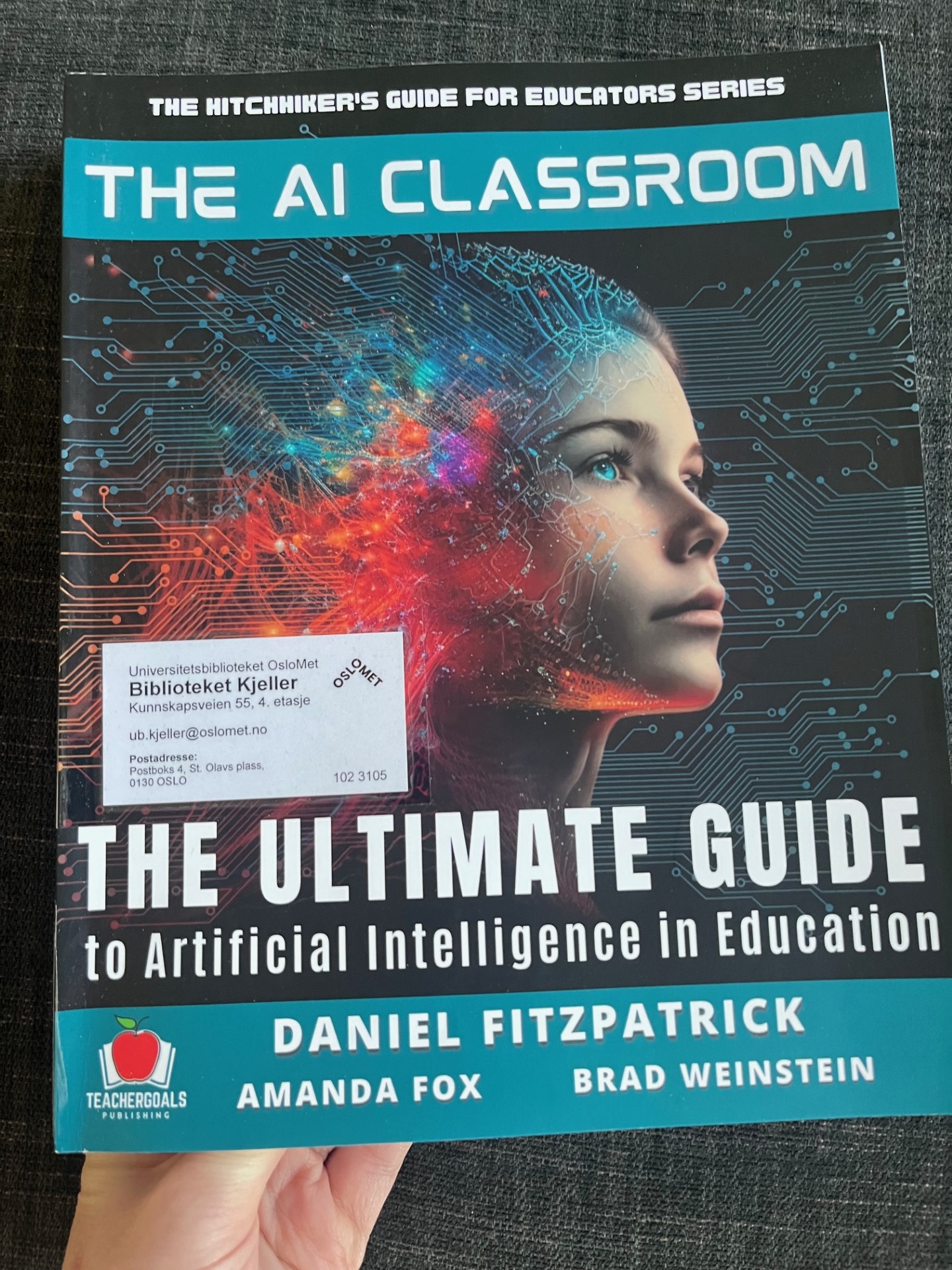
Books have always held a special place in my heart. As an avid reader and AI enthusiast, I have curated a list of books on artificial intelligence specifically tailored for educators. These books delve into the realms of AI, exploring its applications, ethical considerations, and its impact on education. Share your suggestions and let me know which books you would like to see included on this list.
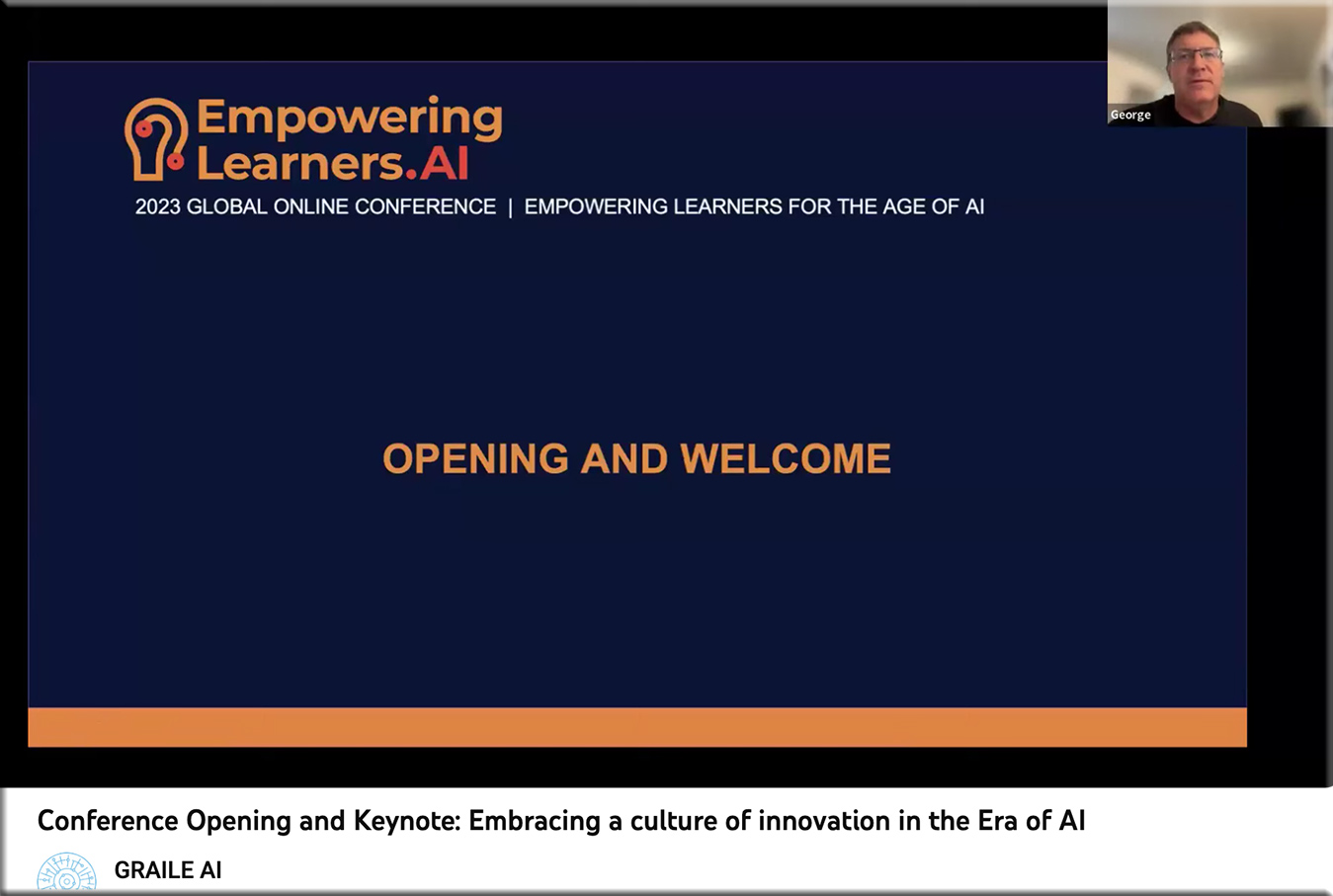
We held our fourth online Empowering Learners for the Age of AI conference last week. We sold out at 1500 people (a Whova and budget limit). The recordings/playlist from the conference can now be accessed here.
Artificial intelligence is disrupting higher education — from itweb.co.za by Rennie Naidoo; via GSV Traditional contact universities need to adapt faster and find creative ways of exploring and exploiting AI, or lose their dominant position.
Higher education professionals have a responsibility to shape AI as a force for good.
Introducing Canva’s biggest education launch — from canva.com We’re thrilled to unveil our biggest education product launch ever. Today, we’re introducing a whole new suite of products that turn Canva into the all-in-one classroom tool educators have been waiting for.
Also seeCanva for Education. Create and personalize lesson plans, infographics,
posters, video, and more. 100% free for
teachers and students at eligible schools.
ChatGPT and generative AI: 25 applications to support student engagement — from timeshighereducation.com by Seb Dianati and Suman Laudari In the fourth part of their series looking at 100 ways to use ChatGPT in higher education, Seb Dianati and Suman Laudari share 25 prompts for the AI tool to boost student engagement
There are two ways to use ChatGPT — from theneurondaily.com
Type to it.
Talk to it (new).
… Since then, we’ve looked to it for a variety of real-world business advice. For example, Prof Ethan Mollick posted a great guide using ChatGPT-4 with voice as a negotiation instructor.
In a similar fashion, you can consult ChatGPT with voice for feedback on:
Job interviews.
Team meetings.
Business presentations.
With a prompt, GPT-4 with voice does a pretty good job of acting as a negotiation simulator/instructor. It is not all the way there, but as someone who builds educational simulations, I can tell you this is already impressively far along towards an effective teaching tool.… pic.twitter.com/IphPHF95cL
Via The Rundown:Google is using AI to analyze the company’s Maps data and suggest adjustments to traffic light timing — aiming to cut driver waits, stops, and emissions.
The camera never lies. Except, of course, it does – and seemingly more often with each passing day.
In the age of the smartphone, digital edits on the fly to improve photos have become commonplace, from boosting colours to tweaking light levels.
Now, a new breed of smartphone tools powered by artificial intelligence (AI) are adding to the debate about what it means to photograph reality.
Google’s latest smartphones released last week, the Pixel 8 and Pixel 8 Pro, go a step further than devices from other companies. They are using AI to help alter people’s expressions in photographs.
Still using AI to help you mark a student’s work?
Mark a full class’s worth with one prompt.
Here’s the Whole Class Feedback Giant Prompt.
Comment & retweet & I’ll DM it to you.
Discover why thousands of teachers subscribe to the Sunday AI Educator ?https://t.co/ivpXYyWNzN
— Dan Fitzpatrick – The AI Educator (@theaieducatorX) October 22, 2023
Dr. Chris Dede, of Harvard University and Co-PI of the National AI Institute for Adult Learning and Online Education, spoke about the differences between knowledge and wisdom in AI-human interactions in a keynote address at the 2022 Empowering Learners for the Age of AI conference. He drew a parallel between Star Trek: The Next Generation characters Data and Picard during complex problem-solving: While Data offers the knowledge and information, Captain Picard offers the wisdom and context from on a leadership mantle, and determines its relevance, timing, and application.
This “decreasing obstacles” framing turned out to be helpful in thinking about generative AI. When the time came, my answer to the panel question, “how would you summarize the impact generative AI is going to have on education?” was this:
“Generative AI greatly reduces the degree to which access to expertise is an obstacle to education.”
We haven’t even started to unpack the implications of this notion yet, but hopefully just naming it will give the conversation focus, give people something to disagree with, and help the conversation progress more quickly.
How to Make an AI-Generated Film — from heatherbcooper.substack.com by Heather Cooper Plus, Midjourney finally has a new upscale tool!
From DSC: I’m not excited about this, as I can’t help but wonder…how long before the militaries of the world introduce this into their warfare schemes and strategies?
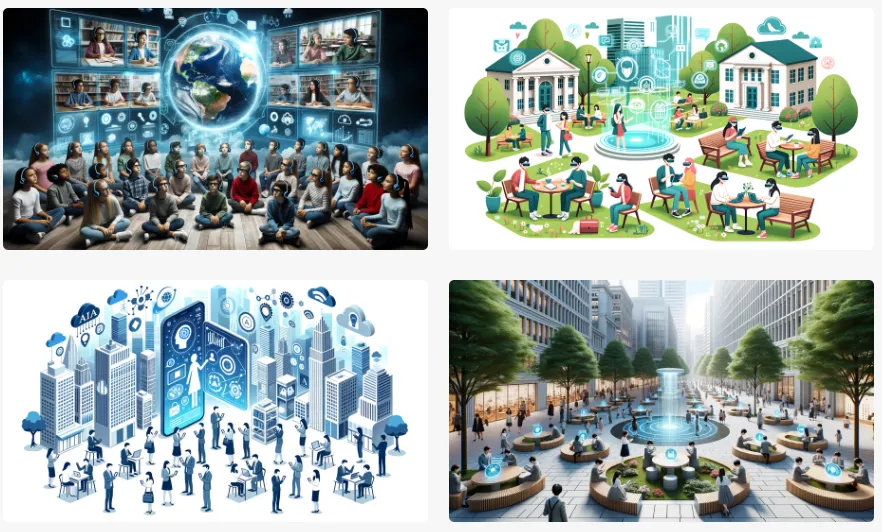
What does the future of education LOOK like?— from stefanbauschard.substack.com by Stefen Bauschard Diverse students receive instruction from robots in an online classroom that mimics the current structure of education.
Everyone is empowered to access learning and earning opportunities based on what they know and can do, whether those skills and abilities are obtained through degrees, work experiences, or independent learning.
People can capture and communicate the skills and competencies they’ve acquired across their entire learning journey — from education, experience and service — with more ease, confidence, and clarity than a traditional resume.
Learners and earners control their information and can curate their skills to take advantage of every opportunity they are truly qualified to pursue, opening up pathways that help address systemic inequities.
Employers can tap into a wider talent pool and better match applicants to opportunities with verifiable credentials that represent skills, competencies, and achievements.
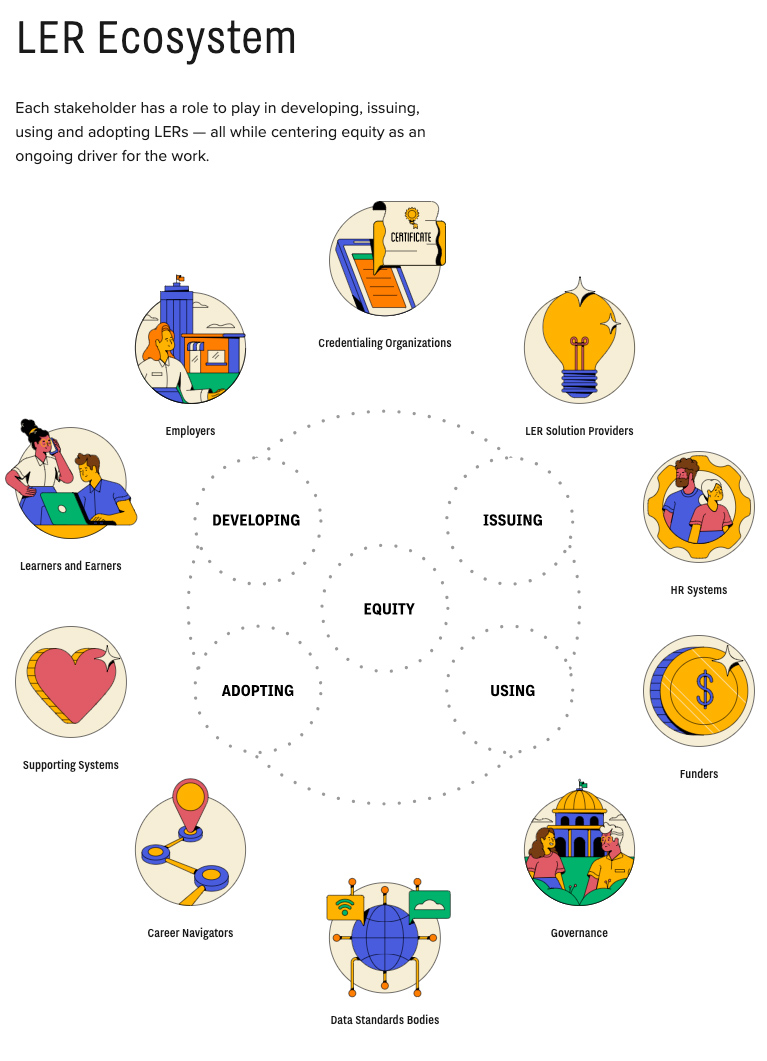
This is the world that we believe can be created by Learning and Employment Records (LERs), i.e. digital records of learning and work experiences that are linked to and controlled by learners and earners. An interoperable, well-governed LER ecosystem has the potential to transform the future of work so that it is more equitable, efficient, and effective for everyone involved— individuals, training and education providers, employers, and policymakers.