The 2025 AI Index Report — from Stanford University’s Human-Centered Artificial Intelligence Lab (hai.stanford.edu); item via The Neuron

Top Takeaways

  1. AI performance on demanding benchmarks continues to improve.
  2. AI is increasingly embedded in everyday life.
  3. Business is all in on AI, fueling record investment and usage, as research continues to show strong productivity impacts.
  4. The U.S. still leads in producing top AI models—but China is closing the performance gap.
  5. The responsible AI ecosystem evolves—unevenly.
  6. Global AI optimism is rising—but deep regional divides remain.
  7. …and several more

Also see:

The Neuron’s take on this:

So, what should you do? You really need to start trying out these AI tools. They’re getting cheaper and better, and they can genuinely help save time or make work easier—ignoring them is like ignoring smartphones ten years ago.

Just keep two big things in mind:

  1. Making the next super-smart AI costs a crazy amount of money and uses tons of power (seriously, they’re buying nuclear plants and pushing coal again!).
  2. Companies are still figuring out how to make AI perfectly safe and fair—cause it still makes mistakes.

So, use the tools, find what helps you, but don’t trust them completely.

We’re building this plane mid-flight, and Stanford’s report card is just another confirmation that we desperately need better safety checks before we hit major turbulence.


Addendum on 4/16:


Uplimit raises stakes in corporate learning with suite of AI agents that can train thousands of employees simultaneously — from venturebeat.com by Michael Nuñez|

Uplimit unveiled a suite of AI-powered learning agents today designed to help companies rapidly upskill employees while dramatically reducing administrative burdens traditionally associated with corporate training.

The San Francisco-based company announced three sets of purpose-built AI agents that promise to change how enterprises approach learning and development: skill-building agents, program management agents, and teaching assistant agents. The technology aims to address the growing skills gap as AI advances faster than most workforces can adapt.

“There is an unprecedented need for continuous learning—at a scale and speed traditional systems were never built to handle,” said Julia Stiglitz, CEO and co-founder of Uplimit, in an interview with VentureBeat. “The companies best positioned to thrive aren’t choosing between AI and their people—they’re investing in both.”


Introducing Claude for Education — from anthropic.com

Today we’re launching Claude for Education, a specialized version of Claude tailored for higher education institutions. This initiative equips universities to develop and implement AI-enabled approaches across teaching, learning, and administration—ensuring educators and students play a key role in actively shaping AI’s role in society.

As part of announcing Claude for Education, we’re introducing:

  1. Learning mode: A new Claude experience that guides students’ reasoning process rather than providing answers, helping develop critical thinking skills
  2. University-wide Claude availability: Full campus access agreements with Northeastern University, London School of Economics and Political Science (LSE), and Champlain College, making Claude available to all students
  3. Academic partnerships: Joining Internet2 and working with Instructure to embed AI into teaching & learning with Canvas LMS
  4. Student programs: A new Claude Campus Ambassadors program along with an initiative offering API credits for student projects

A comment on this from The Rundown AI:

Why it matters: Education continues to grapple with AI, but Anthropic is flipping the script by making the tech a partner in developing critical thinking rather than an answer engine. While the controversy over its use likely isn’t going away, this generation of students will have access to the most personalized, high-quality learning tools ever.


Should College Graduates Be AI Literate? — from chronicle.com by Beth McMurtrie (behind a paywall)
More institutions are saying yes. Persuading professors is only the first barrier they face.

Last fall one of Jacqueline Fajardo’s students came to her office, eager to tell her about an AI tool that was helping him learn general chemistry. Had she heard of Google NotebookLM? He had been using it for half a semester in her honors course. He confidently showed her how he could type in the learning outcomes she posted for each class and the tool would produce explanations and study guides. It even created a podcast based on an academic paper he had uploaded. He did not feel it was important to take detailed notes in class because the AI tool was able to summarize the key points of her lectures.


Showing Up for the Future: Why Educators Can’t Sit Out the AI Conversation — from marcwatkins.substack.com with a guest post from Lew Ludwig

The Risk of Disengagement
Let’s be honest: most of us aren’t jumping headfirst into AI. At many of our institutions, it’s not a gold rush—it’s a quiet standoff. But the group I worry most about isn’t the early adopters. It’s the faculty who’ve decided to opt out altogether.

That choice often comes from a place of care. Concerns about data privacy, climate impact, exploitative labor, and the ethics of using large language models are real—and important. But choosing not to engage at all, even on ethical grounds, doesn’t remove us from the system. It just removes our voices from the conversation.

And without those voices, we risk letting others—those with very different priorities—make the decisions that shape what AI looks like in our classrooms, on our campuses, and in our broader culture of learning.


Turbocharge Your Professional Development with AI — from learningguild.com by Dr. RK Prasad

You’ve just mastered a few new eLearning authoring tools, and now AI is knocking on the door, offering to do your job faster, smarter, and without needing coffee breaks. Should you be worried? Or excited?

If you’re a Learning and Development (L&D) professional today, AI is more than just a buzzword—it’s transforming the way we design, deliver, and measure corporate training. But here’s the good news: AI isn’t here to replace you. It’s here to make you better at what you do.

The challenge is to harness its potential to build digital-ready talent, not just within your organization but within yourself.

Let’s explore how AI is reshaping L&D strategies and how you can leverage it for professional development.


5 Recent AI Notables — from automatedteach.com by Graham Clay

1. OpenAI’s New Image Generator
What Happened: OpenAI integrated a much more powerful image generator directly into GPT-4o, making it the default image creator in ChatGPT. Unlike previous image models, this one excels at accurately rendering text in images, precise visualization of diagrams/charts, and multi-turn image refinement through conversation.

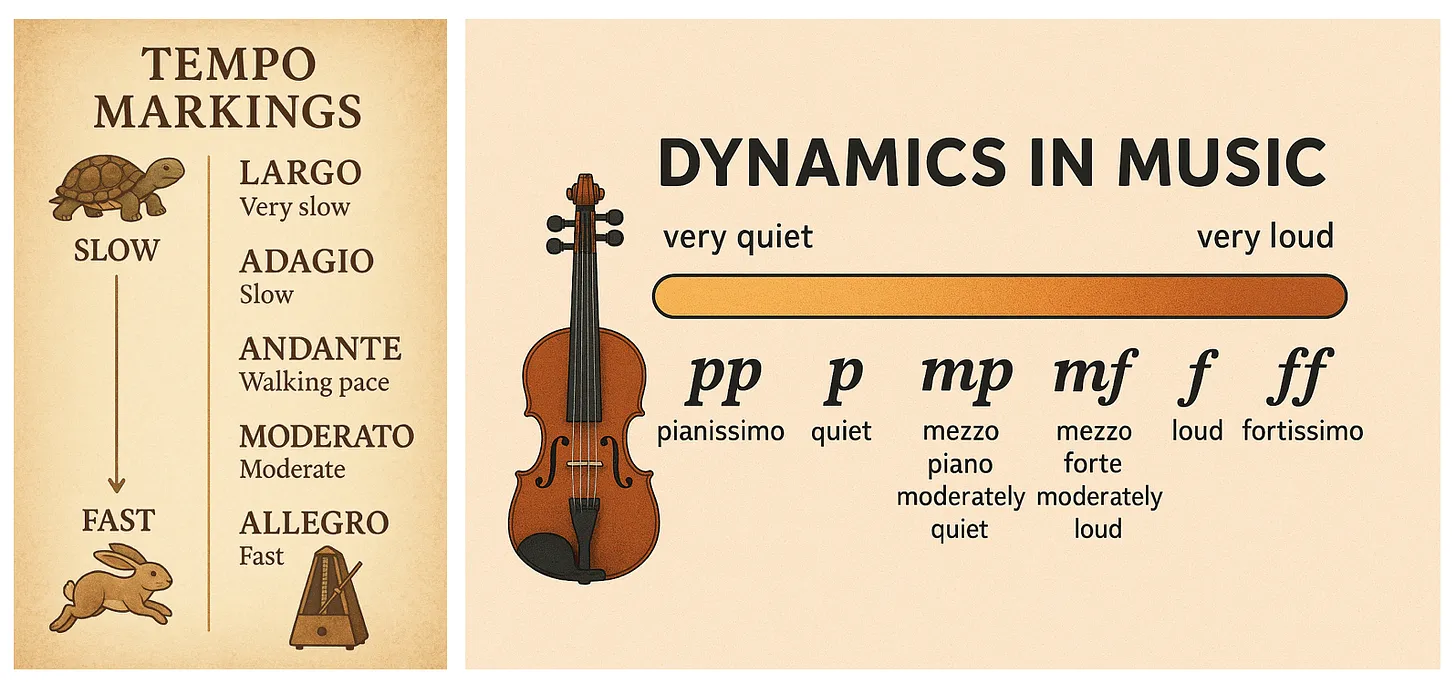
Why It’s Big: For educators, this represents a significant advancement in creating educational visuals, infographics, diagrams, and other instructional materials with unprecedented accuracy and control. It’s not perfect, but you can now quickly generate custom illustrations that accurately display mathematical equations, chemical formulas, or process workflows — previously a significant hurdle in digital content creation — without requiring graphic design expertise or expensive software. This capability dramatically reduces the time between conceptualizing a visual aid and implementing it in course materials.
.


The 4 AI modes that will supercharge your workflow — from aiwithallie.beehiiv.com by Allie K. Miller
The framework most people and companies won’t discover until 2026


Outsourcing Thought: The Hidden Cost of Letting AI Think for You — from linkedin.com by Robert Atkinson

I’ve watched it unfold in real time. A student submits a flawless coding assignment or a beautifully written essay—clean syntax, sharp logic, polished prose. But when I ask them to explain their thinking, they hesitate. They can’t trace their reasoning or walk me through the process. The output is strong, but the understanding is shallow. As a professor, I’ve seen this pattern grow more common: AI-assisted work that looks impressive on the surface but reveals a troubling absence of cognitive depth underneath.

This article is written with my students in mind—but it’s meant for anyone navigating learning, teaching, or thinking in the age of artificial intelligence. Whether you’re a student, educator, or professional, the question is the same: What happens to the brain when we stop doing our own thinking?

We are standing at a pivotal moment. With just a few prompts, generative AI can produce essays, solve complex coding problems, and summarize ideas in seconds. It feels efficient. It feels like progress. But from a cognitive neuroscience perspective, that convenience comes at a hidden cost: the gradual erosion of the neural processes that support reasoning, creativity, and long-term learning.


7 ways to use ChatGPT’s new image AI — from wondertools.substack.com by Jeremy Caplan
Transform your ideas into strong visuals

7 ways to use ChatGPT’s new image AI

  • Cartoons
  • Infographics
  • Posters
  • …plus several more


AI in Education Survey: What UK and US Educators Think in 2025 — from twinkl.com
As artificial intelligence (AI) continues to shape the world around us, Twinkl conducted a large-scale survey between January 15th and January 22nd to explore its impact on the education sector, as well as the work lives of teachers across the UK and the USA.

Teachers’ use of AI for work continues to rise
Twinkl’s survey asked teachers whether they were currently using AI for work purposes. Comparing these findings to similar surveys over recent years shows the use of AI tools by teachers has seen a significant increase across both the UK and USA.

  • According to two UK surveys by the National Literacy Trust – 30% of teachers used generative AI in 2023 and nearly half (47.7%) in 2024. Twinkl’s survey indicates that AI adoption continues to rise rapidly, with 60% of UK educators currently integrating it into their work lives in 2025.
  • Similarly, with 62% of US teachers currently using AI for work, uptake appears to have risen greatly in the past 12 months, with just 25% saying they were leveraging the new technology in the 2023-24 school year according to a RAND report.
  • Teachers are using AI more for work than in their personal lives: In the UK, personal usage drops to 43% (from 60% at school).  In the US, 52% are using AI for non-work purposes (versus 62% in education settings).

    60% of UK teachers and 62% of US teachers use AI in their work life in 2025.


Students and folks looking for work may want to check out:

Also relevant/see:


8 Weeks Left to Prepare Students for the AI-Enhanced Workplace — from insidehighered.com by Ray Schroeder
We are down to the final weeks left to fully prepare students for entry into the AI-enhanced workplace. Are your students ready?

The urgent task facing those of us who teach and advise students, whether they be degree program or certificate seeking, is to ensure that they are prepared to enter (or re-enter) the workplace with skills and knowledge that are relevant to 2025 and beyond. One of the first skills to cultivate is an understanding of what kinds of services this emerging technology can provide to enhance the worker’s productivity and value to the institution or corporation.

Given that short period of time, coupled with the need to cover the scheduled information in the syllabus, I recommend that we consider merging AI use into authentic assignments and assessments, supplementary modules, and other resources to prepare for AI.


Learning Design in the Era of Agentic AI — from drphilippahardman.substack.com by Dr Philippa Hardman
Aka, how to design online async learning experiences that learners can’t afford to delegate to AI agents

The point I put forward was that the problem is not AI’s ability to complete online async courses, but that online async courses courses deliver so little value to our learners that they delegate their completion to AI.

The harsh reality is that this is not an AI problem — it is a learning design problem.

However, this realisation presents us with an opportunity which we overall seem keen to embrace. Rather than seeking out ways to block AI agents, we seem largely to agree that we should use this as a moment to reimagine online async learning itself.


8 Schools Innovating With Google AI — Here’s What They’re Doing — from forbes.com by Dan Fitzpatrick

While fears of AI replacing educators swirl in the public consciousness, a cohort of pioneering institutions is demonstrating a far more nuanced reality. These eight universities and schools aren’t just experimenting with AI, they’re fundamentally reshaping their educational ecosystems. From personalized learning in K-12 to advanced research in higher education, these institutions are leveraging Google’s AI to empower students, enhance teaching, and streamline operations.


Essential AI tools for better work — from wondertools.substack.com by Jeremy Caplan
My favorite tactics for making the most of AI — a podcast conversation

AI tools I consistently rely on (areas covered mentioned below)

  • Research and analysis
  • Communication efficiency
  • Multimedia creation

AI tactics that work surprisingly well 

1. Reverse interviews
Instead of just querying AI, have it interview you. Get the AI to interview you, rather than interviewing it. Give it a little context and what you’re focusing on and what you’re interested in, and then you ask it to interview you to elicit your own insights.”

This approach helps extract knowledge from yourself, not just from the AI. Sometimes we need that guide to pull ideas out of ourselves.


.
Building an AI-Ready Workforce: A look at College Student ChatGPT Adoption in the US — from cdn.openai.com

One finding from our student survey that stood out to us: Many college and university students are teaching themselves and their friends about AI without waiting for their institutions to provide formal AI education or clear policies about the technology’s use. The education ecosystem is in an important moment of exploration and learning, but the rapid adoption by students across the country who haven’t received formalized instruction in how and when to use the technology creates disparities in AI access and knowledge.

The enclosed snapshot of how young people are using ChatGPT provides insight into the state of AI use among America’s college-aged students. We also include actionable proposals to help address adoption gaps. We hope these insights and proposals can inform research and policy conversation across the nation’s education ecosystem about how to achieve outcomes that support our students, our workforce, and the economy. By improving literacy, expanding access, and implementing clear policies, policymakers and educators can better integrate AI into our educational infrastructure and ensure that our workforce is ready to both sustain and benefit from our future with AI.

Leah Belsky | Vice President, Education | OpenAI


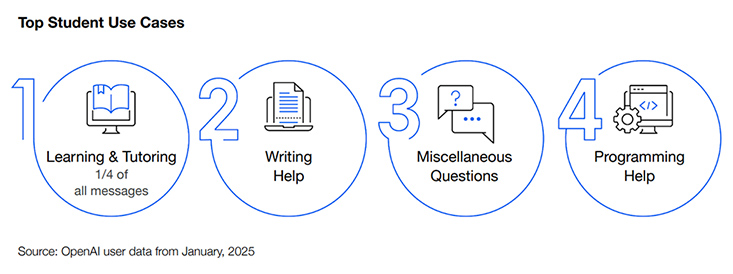
Top student use cases of ChatGPT -- learning and tutoring, writing help, miscellaneouc questions, and programming help


Market scan: What’s possible in the current skills validation ecosystem? — from eddesignlab.org
Education Design Lab provides an overview of emerging practices + tools in this 2025 Skills Validation Market Scan.

Employers and opportunity seekers are excited about the possibilities of a skills-based ecosystem, but this new process for codifying a person’s experiences and abilities into skills requires one significant, and missing, piece: Trust. Employers need to trust that the credentials they receive from opportunity seekers are valid representations of their skills. Jobseekers need to trust that their digital credentials are safe, accurate, and will lead to employment and advancement.

Our hypothesis
We posit that the trust needed for the validation of skills to be brought into a meaningful reality is established through a network of skills validation methods and opportunities. We also recognize that the routes through which an individual can demonstrate skills are as varied as the individuals themselves. Therefore, in order to equitably create a skills-based employment ecosystem, the routes by which skills are validated must be held together with common standards and language, but flexible enough to accommodate a multitude of validation practices.


The Learning & Development Global Sentiment Survey 2025 — from donaldhtaylor.co.uk by Don Taylor

The L&D Global Sentiment Survey, now in its 12th year, once again asked two key questions of L&D professionals worldwide:

  • What will be hot in workplace learning in 2025?
  • What are your L&D challenges in 2025?

For the obligatory question on what they considered ‘hot’ topics, respondents voted for one to three of 15 suggested options, plus a free text ‘Other’ option. Over 3,000 voters participated from nearly 100 countries. 85% shared their challenges for 2025.

The results show more interest in AI, a renewed focus on showing the value of L&D, and some signs of greater maturity around our understanding of AI in L&D.


AI in K12: Today’s Breakthroughs and Tomorrow’s Possibilities (webinar)
How AI is Transforming Classrooms Today and What’s Next


Audio-Based Learning 4.0 — from drphilippahardman.substack.com by Dr. Philippa Hardman
A new & powerful way to leverage AI for learning?

At the end of all of this my reflection is that the research paints a pretty exciting picture – audio-based learning isn’t just effective, it’s got some unique superpowers when it comes to boosting comprehension, ramping up engagement, and delivering feedback that really connects with learners.

While audio has been massively under-used as a mode of learning, especially compared to video and text, we’re at an interesting turning point where AI tools are making it easier than ever to tap into audio’s potential as a pedagogical tool.

What’s super interesting is how the solid research backing audio’s effectiveness is and how well this is converging with these new AI capabilities.

From DSC:
I’ve noticed that I don’t learn as well via audio-only based events. It can help if visuals are also provided, but I have to watch the cognitive loads. My processing can start to get overloaded — to the point that I have to close my eyes and just listen sometimes. But there are people I know who love to listen to audiobooks and prefer to learn that way. They can devour content and process/remember it all. Audio is a nice change of pace at times, but I prefer visuals and reading often times. It needs to be absolutely quiet if I’m tackling some new information/learning. 


In Conversation With… Ashton Cousineau — from drphilippahardman.substack.com by Dr. Philippa Hardman
A new video series exploring how L&D professionals are working with AI on the ground

In Conversation With… Ashton Cousineau by Dr Philippa Hardman

A new video series exploring how L&D professionals are working with AI on the ground

Read on Substack


The Learning Research Digest vol. 28 — from learningsciencedigest.substack.com by Dr. Philippa Hardman

Hot Off the Research Press This Month:

  • AI-Infused Learning Design – A structured approach to AI-enhanced assignments using a three-step model for AI integration.
  • Mathematical Dance and Creativity in STEAM – Using AI-powered motion capture to translate dance movements into mathematical models.
  • AI-Generated Instructional Videos – How adaptive AI-powered video learning enhances problem-solving and knowledge retention.
  • Immersive Language Learning with XR & AI – A new framework for integrating AI-driven conversational agents with Extended Reality (XR) for task-based language learning.
  • Decision-Making in Learning Design – A scoping review on how instructional designers navigate complex instructional choices and make data-driven decisions.
  • Interactive E-Books and Engagement – Examining the impact of interactive digital books on student motivation, comprehension, and cognitive engagement.
  • Elevating Practitioner Voices in Instructional Design – A new initiative to amplify instructional designers’ contributions to research and innovation.

Deep Reasoning, Agentic AI & the Continued Rise of Specialised AI Research & Tools for Education — from learningfuturesdigest.substack.com by Dr. Philippa Hardman

Here’s a quick teaser of key developments in the world of AI & learning this month:

  • DeepSeek R-1, OpenAI’s Deep Seek & Perplexity’s ‘Deep Research’ are the latest additions to a growing number of “reasoning models” with interesting implications for evidence-based learning design & development.
  • The U.S. Education Dept release an AI Toolkit and a fresh policy roadmap enabling the adoption of AI use in schools.
  • Anthropic Release “Agentic Claude”, another AI agent that clicks, scrolls, and can even successfully complete e-learning courses…
  • Oxford University Announce the AIEOU Hub, a research-backed research lab to support research and implementation on AI in education.
  • “AI Agents Everywhere”: A Forbes peek at how agentic AI will handle the “boring bits” of classroom life.
  • [Bias klaxon!] Epiphany AI: My own research leads to the creation of a specialised, “pedagogy first” AI co-pilot for instructional design marking the continued growth of specialised AI tools designed for specific industries and workflows.

AI is the Perfect Teaching Assistant for Any Educator — from unite.ai by Navi Azaria, CPO at Kaltura

Through my work with leading educational institutions at Kaltura, I’ve seen firsthand how AI agents are rapidly becoming indispensable. These agents alleviate the mounting burdens on educators and provide new generations of tech-savvy students with accessible, personalized learning, giving teachers the support they need to give their students the personalized attention and engagement they deserve.


Learning HQ — from ai-disruptor-hq.notion.site

This HQ includes all of my AI guides, organized by tool/platform. This list is updated each time a new one is released, and outdated guides are removed/replaced over time.


How AI Is Reshaping Teachers’ Jobs — from edweek.org

Artificial intelligence is poised to fundamentally change the job of teaching. AI-powered tools can shave hours off the amount of time teachers spend grading, lesson-planning, and creating materials. AI can also enrich the lessons they deliver in the classroom and help them meet the varied needs of all students. And it can even help bolster teachers’ own professional growth and development.

Despite all the promise of AI, though, experts still urge caution as the technology continues to evolve. Ethical questions and practical concerns are bubbling to the surface, and not all teachers feel prepared to effectively and safely use AI.

In this special report, see how early-adopter teachers are using AI tools to transform their daily work, tackle some of the roadblocks to expanded use of the technology, and understand what’s on the horizon for the teaching profession in the age of artificial intelligence.


2025 EDUCAUSE AI Landscape Study: Into the Digital AI Divide — from library.educause.edu

The higher education community continues to grapple with questions related to using artificial intelligence (AI) in learning and work. In support of these efforts, we present the 2025 EDUCAUSE AI Landscape Study, summarizing our community’s sentiments and experiences related to strategy and leadership, policies and guidelines, use cases, the higher education workforce, and the institutional digital divide.


Half A Million Students Given ChatGPT As CSU System Makes AI History — from forbes.com by Dan Fitzpatrick

The California State University system has partnered with OpenAI to launch the largest deployment of AI in higher education to date.

The CSU system, which serves nearly 500,000 students across 23 campuses, has announced plans to integrate ChatGPT Edu, an education-focused version of OpenAI’s chatbot, into its curriculum and operations. The rollout, which includes tens of thousands of faculty and staff, represents the most significant AI deployment within a single educational institution globally.

We’re still in the early stages of AI adoption in education, and it is critical that the entire ecosystem—education systems, technologists, educators, and governments—work together to ensure that all students globally have access to AI and develop the skills to use it responsibly

Leah Belsky, VP and general manager of education at OpenAI.


HOW educators can use GenAI – where to start and how to progress — from aliciabankhofer.substack.com by Alicia Bankhofer
Part of 3 of my series: Teaching and Learning in the AI Age

As you read through these use cases, you’ll notice that each one addresses multiple tasks from our list above.

1. Researching a topic for a lesson
2. Creating Tasks For Practice
3. Creating Sample Answers
4. Generating Ideas
5. Designing Lesson Plans
6. Creating Tests
7. Using AI in Virtual Classrooms
8. Creating Images
9. Creating worksheets
10. Correcting and Feedback


How to Make Learning as Addictive as Social Media | Duolingo’s Luis Von Ahn | TED — from youtube.com; via Kamil Banc at AI Adopter

When technologist Luis von Ahn was building the popular language-learning platform Duolingo, he faced a big problem: Could an app designed to teach you something ever compete with addictive platforms like Instagram and TikTok? He explains how Duolingo harnesses the psychological techniques of social media and mobile games to get you excited to learn — all while spreading access to education across the world.
.


10 Extreme Challenges Facing Schools — from stefanbauschard.substack.com by Stefan Bauschard

TL;DR
Schools face 10 extreme challenges

– assessment
– funding
– deportations
– opposition to trans students
– mental health
– AI/AGI world
– a struggle to engage students
– too many hats
– war risks
– resource redistribution and civil conflict


Hundreds of thousands of students are entitled to training and help finding jobs. They don’t get it — from hechingerreport.org by Meredith Kolodner
The best program to help students with disabilities get jobs is so hidden, ‘It’s like a secret society’

There’s a half-billion-dollar federal program that is supposed to help students with disabilities get into the workforce when they leave high school, but most parents — and even some school officials — don’t know it exists. As a result, hundreds of thousands of students who could be getting help go without it. New Jersey had the nation’s lowest proportion — roughly 2 percent — of eligible students receiving these services in 2023.

More than a decade ago, Congress recognized the need to help young people with disabilities get jobs, and earmarked funding for pre-employment transition services to help students explore and train for careers and send them on a pathway to independence after high school. Yet, today, fewer than 40 percent of people with disabilities ages 16 to 64 are employed, even though experts say most are capable of working.

The article links to:

Pre-Employment Transition Services

Both vocational rehabilitation agencies and schools are required by law to provide certain transition services and supports to improve post-school outcomes of students with disabilities.

The Workforce Innovation and Opportunity Act (WIOA) amends the Rehabilitation Act of 1973 and requires vocational rehabilitation (VR) agencies to set aside at least 15% of their federal funds to provide pre-employment transition services (Pre-ETS) to students with disabilities who are eligible or potentially eligible for VR services.  The intent of pre-employment transition services is to:

improve the transition of students with disabilities from school to postsecondary education or to an employment outcome, increase opportunities for students with disabilities to practice and improve workplace readiness skills, through work-based learning experiences in a competitive, integrated work setting and increase opportunities for students with disabilities to explore post-secondary training options, leading to more industry recognized credentials, and meaningful post-secondary employment.


Repurposing Furniture to Support Learning in the Early Grades — from edutopia.org by Kendall Stallings
A kindergarten teacher gives five practical examples of repurposing classroom furniture to serve multiple uses.

I’m a supporter of evolving classroom spaces—of redesigning the layout of the room as the needs and interests of students develop. The easiest way to accommodate students, I’ve found, is to use the furniture itself to set up a functional, spacious, and logical classroom. There are several benefits to this approach. It provides children with safe, low-stakes environmental changes; fosters flexibility; and creates opportunities for spatial adaptation and problem-solving. Additionally, rearranging the room throughout the school year enables teachers to address potential catalysts for challenging behaviors and social conflicts that may arise, while sparking curiosity in an otherwise-familiar space.


How Teacher-Generated Videos Support Students in Science — from edutopia.org by Shawn Sutton
A five-minute video can help students get a refresher on important science concepts at their own pace.

While instructional videos were prepared out of necessity in the past, I’ve rediscovered their utility as a quick, flexible, and personal way to enhance classroom teaching. Instructional videos can be created through free screencasting software such as ScreencastifyScreenRecLoom, or OBS Studio. Screencasting would be ideal for the direct presentation of information, like a slide deck of notes. Phone cameras make practical recording devices for live content beyond the computer screen, like a science demo. A teacher could invest in a phone stand and ring light at a nominal cost to assist in this type of recording.

However, not all teacher videos are created equal, and I’ve discovered four benefits and strategies that help make these teaching tools more effective.


© 2025 | Daniel Christian