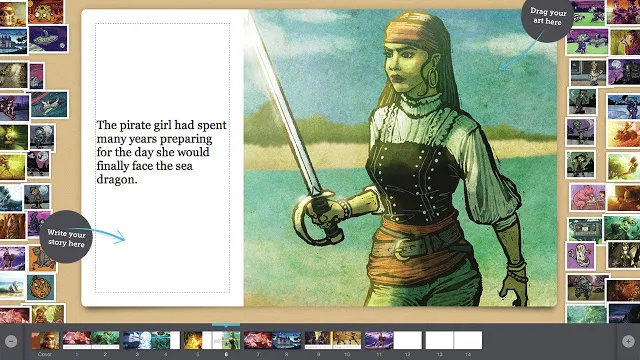
5 of the Best Tools To Teach Storytelling — from techlearning.com by Luke Edwards Use these best tools to teach storytelling to help students progress towards mastery
The best tools to teach storytelling can also be some of the most ideal ways to engage students, both creatively and more generally with education. From sparking their imaginations to helping structure a creative toolset, these digital assistants can be powerful in the classroom and beyond.
Giving a student the ability to structure and tell a compelling story can help to empower them in terms of literacy, empathy, and critical thinking.
Students can be given the opportunity to explore historical perspectives, dive into personal narratives, build fictional worlds, and present research in a story form. All of which helps strengthen communication skills while learning at the same time. .
I need to be honest with you. I’ve been running experiments this week with Claude Code and Opus 4.6, and we have reached the precipice in the collapse of time required to produce high-quality text-based ID outputs.
This includes performance consulting reports, learning needs analyses, action mapping, scripts, storyboards, facilitator guides, rubrics, and technical specs.
I just mapped the entire performance consulting process into a multimodal AI integration architecture (diagram image). Every phase. Entry and contracting. Performance analysis. Cause analysis. Solution design. Implementation. Evaluation. Thirty files. System specifications for each. The next step is to vet out each “skill” with an expert performance consultant.
Then I attempted a learning output: an 8-module course built with a cognitive scaffold that moves beyond content delivery to facilitate deliberate practice, meaning-making, and guided reflection within the learner’s own context.
AI adaptive learning can adapt learning in real-time. These tools have the potential to provide a more personalized learning experience, but only if used properly.
The California State University system uses ChatGPT Edu (OpenAI, 2025). Students use it for AI-assisted tutoring, study aids, and writing support. These resources provide 24/7 availability of subject-matter expertise tailored to students’ learning needs. It is not a replacement for professors. Rather, it extends the reach of mentorship by reducing access barriers.
However, we must proceed with intellectual humility and ethical responsibility. Even though AI can customize messages, it cannot replace the encouragement of a teacher or professor, or the social and emotional aspects of learning. It’s at the intersection of humanistic values and knowledge development that education must find its balance.
In the rush to expand work-based learning (WBL), it is easy to focus on the “placement”—the logistics of getting a student into a workplace. But a placement alone isn’t a strategy. If an experience doesn’t help a student build the internal capacity to navigate their own future, we are simply checking a box.
At GPS Ed, we believe WBL is most powerful when viewed as a sequenced journey of career literacy. It starts with early awareness and exploration, giving students the chance to “try on” different roles, and scales up to intensive, hands-on experiences. By centering this journey on the 4 As—authenticity, aspiration, ability, agency—we ensure that the time invested by students, schools, and employers yields a lifelong return.
Something Big Is Happening— from shumer.dev by Matt Shumer; see below from the BIG Questions Institute, where I got this article from
I’ve spent six years building an AI startup and investing in the space. I live in this world. And I’m writing this for the people in my life who don’t… my family, my friends, the people I care about who keep asking me “so what’s the deal with AI?” and getting an answer that doesn’t do justice to what’s actually happening. I keep giving them the polite version. The cocktail-party version. Because the honest version sounds like I’ve lost my mind. And for a while, I told myself that was a good enough reason to keep what’s truly happening to myself. But the gap between what I’ve been saying and what is actually happening has gotten far too big. The people I care about deserve to hear what is coming, even if it sounds crazy.
…
They’ve now done it. And they’re moving on to everything else.
The experience that tech workers have had over the past year, of watching AI go from “helpful tool” to “does my job better than I do”, is the experience everyone else is about to have. Law, finance, medicine, accounting, consulting, writing, design, analysis, customer service.Not in ten years. The people building these systems say one to five years. Some say less. And given what I’ve seen in just the last couple of months, I think “less” is more likely.
…
The models available today are unrecognizable from what existed even six months ago. The debate about whether AI is “really getting better” or “hitting a wall” — which has been going on for over a year — is over. It’s done. Anyone still making that argument either hasn’t used the current models, has an incentive to downplay what’s happening, or is evaluating based on an experience from 2024 that is no longer relevant. I don’t say that to be dismissive. I say it because the gap between public perception and current reality is now enormous, and that gap is dangerous… because it’s preventing people from preparing.
What “Something Big Is Happening” Means for Schools — from/by the BIG Questions Institute
Matt Shumer’s newsletter post Something Big is Happening has been read over 80 million times within the week when it was published, on February 9.
…
Still, it’s worth reading Shumer’s post. Given the claims and warnings in Something Big Is Happening (and countless other articles), how would you truly, honestly respond to these questions:
What will the purpose of school be in 5 years?
What are we doing now that we must leave behind right away?
What can we leave behind gradually?
What does rigor look like in this AI-powered world?
Does our strategy look like making adjustments at the margins or are we preparing our students for a fundamental shift?
What is our definition of success? How do the the implications of AI and jobs (and other important forces, from geopolitical shifts and climate change, to mental health needs and shifting generational values) impact the outcomes we prioritize? What is the story of success we want to pass on to our students and wider community?
Character consistency, native audio, 15-second generations & first results
Image & Video Prompts
Imagine Art 1.5 Pro, Genspark AI Workspace 2.0 & PixVerse Real-Time Video Workflows
Kling 3.0: Everyone a Director
Kling just dropped version 3.0, and it’s a legitimate leap forward for AI video production (Kling is the GOAT). After spending early access time testing the new capabilities, I can confirm this is the most significant update to video generation tools I’ve seen in months.
Jim VandeHei’s note to his kids: Blunt AI talk — from axios.com by CEO Jim VandeHei Axios CEO Jim VandeHei wrote this note to his wife, Autumn, and their three kids. She suggested sharing it more broadly since so many families are wrestling with how to think and talk about AI. So here it is …
Dear Family: I want to put to words what I’m hearing, seeing, thinking and writing about AI.
Simply put, I’m now certain it will upend your work and life in ways more profound than the internet or possibly electricity. This will hit in months, not years.
The changes will be fast, wide, radical, disorienting and scary. No one will avoid its reach.
I’m not trying to frighten you. And I know your opinions range from wonderment to worry. That’s natural and OK. Our species isn’t wired for change of this speed or scale.
My conversations with the CEOs and builders of these LLMs, as well as my own deep experimentation with AI, have shaken and stirred me in ways I never imagined.
All of you must figure out how to master AI for any specific job or internship you hold or take. You’d be jeopardizing your future careers by not figuring out how to use AI to amplify and improve your work. You’d be wise to replace social media scrolling with LLM testing.
What if the biggest change in education isn’t a new app… but the end of the university monopoly on credibility?
Jensen Huang has framed AI as a platform shift—an industrial revolution that turns intelligence into infrastructure. And when intelligence becomes cheap, personal, and always available, education stops being a place you go… and becomes a system that follows you. The question isn’t whether universities will disappear. The question is whether the old model—high cost, slow updates, one-size-fits-all—can survive a world where every student can have a private tutor, a lab partner, and a curriculum designer on demand.
This video explores what AI has in store for education—and why traditional universities may need to reinvent themselves fast.
In this video you’ll discover:
How AI tutors could deliver personalized learning at scale
Why credentials may shift from “degrees” to proof-of-skill portfolios
What happens when the “middle” of studying becomes automated
How universities could evolve: research hubs, networks, and high-trust credentialing
The risks: cheating, dependency, bias, and widening inequality
The 3 skills that become priceless when information is everywhere: judgment, curiosity, and responsibility
From DSC:
There appears to be another, similar video, but with a different date and length of the video. So I’m including this other recording as well here:
What if universities don’t “disappear”… but lose their monopoly on learning, credentials, and opportunity?
AI is turning education into something radically different: personal, instant, adaptive, and always available. When every student can have a 24/7 tutor, a writing coach, a coding partner, and a study plan designed specifically for them, the old model—one professor, one curriculum, one pace for everyone—starts to look outdated. And the biggest disruption isn’t the classroom. It’s the credential. Because in an AI world, proof of skill can become more valuable than a piece of paper.
This video explores the end of universities as we know them: what AI is bringing, what will break, what will survive, and what replaces the traditional path.
In this video you’ll discover:
Why AI tutoring could outperform one-size-fits-all lectures
How “degrees” may shift into skill proof: portfolios, projects, and verified competency
What happens when the “middle” of studying becomes automated
How universities may evolve: research hubs, networks, high-trust credentialing
The dark side: cheating, dependency, inequality, and biased evaluation
The new advantage: judgment, creativity, and responsibility in a world of instant answers
Most students here and in the United States wouldn’t get access to expensive equipment like this until graduate school. Goshawk — a 21-year-old undergraduate student and one of 149 “degree apprentices” employed by AstraZeneca across the U.K. — started using them his second week in.
“It shows the trust we’ve been given,” said Goshawk, who is working nearly full time while studying toward a degree in chemical science at Manchester Metropolitan University that his employer is paying for. By the time he graduates next spring, he will have earned roughly 100,000 pounds (approximately $130,000) in wages, on top of the tuition-free education.
Degree apprenticeships like Goshawk’s have exploded across England since their introduction a decade ago. More than 60,000 apprentices began programs leading to the U.K. equivalent of bachelor’s and master’s degrees in the 2024-25 academic year, in fields as varied as engineering, digital technology, health care, law and business.
The real story isn’t what AI can produce — it’s how it changes the decisions we make at every stage of instructional design.
After working with thousands of instructional designers on my bootcamp, I’ve learned something counterintuitive: the best teams aren’t the ones with the fanciest AI tools — they’re the ones who know when to use which mode—and when to use none at all.
Once you recognise that, you start to see instructional design differently — not as a linear process, but as a series of decision loops where AI plays distinct roles.
In this post, I show you the 3 modes of AI that actually matter in instructional design — and map them across every phase of ADDIE so you know exactly when to let AI run, and when to slow down and think.
In higher education, developing strong multiple-choice questions can be a time-intensive part of the course design process. Developing such items requires subject-matter expertise and assessment literacy, and for faculty and designers who are creating and producing online courses, it can be difficult to find the capacity to craft quality multiple-choice questions.
At the University of Michigan Center for Academic Innovation, learning experience designers are using generative artificial intelligence to streamline the multiple-choice question development process and help ameliorate this issue. In this article, I summarize one of our projects that explored effective prompting strategies to develop multiple-choice questions with ChatGPT for our open course portfolio. We examined how structured prompting can improve the quality of AI-generated assessments, producing relevant comprehension and recall items and options that include plausible distractors.
Achieving this goal enables us to develop several ungraded practice opportunities, preparing learners for their graded assessments while also freeing up more time for course instructors and designers.
Happy new year! One of the biggest L&D stories of 2025 was the rise to fame among L&D teams of AI video generator tools. As we head into 2026, platforms like Colossyan, Synthesia, HeyGen, and NotebookLM’s video creation feature are firmly embedded in most L&D tech stacks. These tools promise rapid production and multi-language output at significantly reduced costs —and they deliver on a lot of that.
But something has been playing on my mind: we rarely evaluate these tools on what matters most for learning design—whether they enable us to build instructional content that actually enables learning.
So, I spent some time over the holiday digging into this question: do the AI video tools we use most in L&D create content that supports substantive learning?
To answer it, I took two decades of learning science research and translated it into a scoring rubric. Then I scored the four most popular AI video generation platforms among L&D professionals against the rubric. .
For an AI-based tool or two — as they regard higher ed — see:
YouTube to NotebookLM: Import a Whole Playlist or Channel in One Click YouTube to NotebookLM is a remarkably useful new Chrome extension that lets you bulk-add any YouTube playlists, channels, or search results into NotebookLM. for AI-powered analysis.
… What to try
Find or create YouTube playlists on topics of interest. Then use this extension to ingest those playlists into NotebookLM. The videos are automatically indexed, and within minutes you can create reports, slides, and infographics to enhance your learning.
Summarize a playlist or channel with an audio or video overview. Or create quizzes, flash cards, data tables, or mind maps to explore a batch of YouTube videos. Or have a chat in NotebookLM with your favorite video channel. Check my recent post for some YouTube channels to try.