Enrollment Growth Continues, Bolstered by Short-Term Credentials — from insidehighered.com by Johanna Alonso
Enrollment is up across the board this fall, except for graduate student enrollment, which remained stagnant. The biggest increase was among those pursuing short-term credentials, followed by those earning associate degrees.

College enrollment continued to grow this fall, increasing by 2 percent compared to fall 2024, according to preliminary fall data released by the National Student Clearinghouse Research Center.

The biggest gains came from students studying for short-term credentials, whose ranks increased 6.6 percent, while the number of students enrolled in associate and bachelor’s degree programs rose 3.1 percent and 1.2 percent, respectively. Enrollment also grew faster at community colleges, which experienced a 4 percent increase, than at public (1.9 percent) and private (0.9 percent) four-year institutions.

Total graduate enrollment was stagnant, however, and the number of master’s students actually decreased by 0.6 percent.


Speaking of higher education, also see:

OPINION: Too many college graduates are stranded before their careers can even begin. We can’t let that happen — from hechingerreport.org by Bruno V. Manno

This fall, some 19 million undergraduates returned to U.S. campuses with a long-held expectation: Graduate, land an entry-level job, climb the career ladder. That formula is breaking down.

Once reliable gateway jobs for college graduates in industries like finance, consulting and journalism have tightened requirements. Many entry-level job postings that previously provided initial working experience for college graduates now require two to three years of prior experience, while AI, a recent analysis concluded, “snaps up good entry-level tasks,” especially routine work like drafting memos, preparing spreadsheets and summarizing research.

Without these proving grounds, new hires lose chances to build skills by doing. And the demand for work experience that potential workers don’t have creates an experience gap for new job seekers. Once stepping-stones, entry-level positions increasingly resemble mid-career jobs.


The Most Innovative Law Schools (2025) — from abovethelaw.com by Staci Zaretsky
Forget dusty casebooks — today’s leaders in legal education are using AI, design thinking, and real-world labs to reinvent how law is taught.

“[F]rom AI labs and interdisciplinary centers to data-driven reform and bold new approaches to design and client service,” according to National Jurist’s preLaw Magazine, these are the law schools that “exemplify innovation in action.”

  1. North Carolina Central University School of Law
  2. Suffolk University Law School
  3. UC Berkeley School of Law
  4. Nova Southeastern University Shepard Broad College of Law
  5. Northeastern University School of Law
  6. Maurice A. Deane School of Law at Hofstra University
  7. Seattle University School of Law
  8. Case Western Reserve University School of Law
  9. University of Miami School of Law
  10. Benjamin N. Cardozo School of Law at Yeshiva University
  11. Vanderbilt University Law School
  12. Southwestern Law School

Click here to read short summaries of why each school made this year’s list of top innovators.


Clio’s Metamorphosis: From Practice Management To A Comprehensive AI And Law Practice Provider — from abovethelaw.com by Stephen Embry
Clio is no longer a practice management company. It’s much more of a comprehensive provider of all needs of its customers big and small.

Newton delivered what may have been the most consequential keynote in the company’s history and one that signals a shift by Clio from a traditional practice management provider to a comprehensive platform that essentially does everything for the business and practice of law.

Clio also earlier this year acquired vLex, the heavy-duty AI legal research player. The acquisition is pending regulatory approval. It is the vLex acquisition that is powering the Clio transformation that Newton described in his keynote.

vLex has a huge amount of legal data in its wheelhouse to power sophisticated legal AI research. On top of this data, vLex developed Vincent, a powerful AI tool to work with this data and enable all sorts of actions and work.

This means a couple of things. First, by acquiring vLex, Clio can now offer its customers AI legal research tools. Clio customers will no longer have to go one place for its practice management needs and a second place for its substantive legal work, like research. It makes what Clio can provide much more comprehensive and all inclusive.


‘Adventures In Legal Tech’: How AI Is Changing Law Firms — from abovethelaw.com
Ernie the Attorney shares his legal tech takes.

Artificial intelligence will give solos and small firms “a huge advantage,” according to one legal tech consultant.

In this episode of “Adventures in Legal Tech,” host Jared Correia speaks with Ernie Svenson — aka “Ernie the Attorney” — about the psychology behind resistance to change, how law firms are positioning their AI use, the power of technology for business development, and more.


Legal software: how to look for and compare AI in legal technology — from legal.thomsonreuters.com by Chris O’Leary

Highlights

  • Legal ops experts can categorize legal AI platforms and software by the ability to streamline key tasks such as legal research, document processing or analysis, and drafting.
  • The trustworthiness and accuracy of AI hinge on the quality of its underlying data; solutions like CoCounsel Legal are grounded in authoritative, expert-verified content from Westlaw and Practical Law, unlike providers that may rely on siloed or less reliable databases.
  • When evaluating legal software, firms should use a framework that assesses critical factors such as integration with existing tech stacks, security, scalability, user adoption, and vendor reputation.

ASU Law appoints a director of AI and Legal Tech Studio, advancing its initiative to reimagine legal education — from law.asu.edu

The Sandra Day O’Connor College of Law at Arizona State University appointed Sean Harrington as director of the newly established AI and Legal Tech Studio, a key milestone in ASU Law’s bold initiative to reimagine legal education for the artificial intelligence era. ASU, ranked No. 1 in innovation for the 11th consecutive year, drives AI solutions that enhance teaching, enrich student training and facilitate digital transformation.


The American Legal Technology Awards Name 2025 Winners — from natlawreview.com by Tom Martin

The sixth annual American Legal Technology Awards were presented on Wednesday, October 15th, at Suffolk University Law School (Boston), recognizing winners across ten categories. There were 211 nominees who were evaluated by 27 judges.

The honorees on the night included:


Why Co-Teaching Will Be A Hot New Trend In Higher Education — from forbes.com by Brandon Busteed

When it comes to innovation in higher education, most bets are being placed on technology platforms and AI. But the innovation students, faculty and industry need most can be found in a much more human dimension: co-teaching. And specifically, a certain kind of co-teaching – between industry experts and educators.

While higher education has largely embraced the value of interdisciplinary teaching across different majors or fields of study, it has yet to embrace the value of co-teaching between industry and academia. Examples of co-teaching through industry-education collaborations are rare and underutilized across today’s higher ed landscape. But they may be the most valuable and relevant way to prepare students for success. And leveraging these collaborations can help institutions struggling to satisfy unfulfilled student demand for immersive work experiences such as internships.


From DSC:
It’s along these lines that I think that ADJUNCT faculty members should be highly sought after and paid much better — as the up-to-date knowledge and experience they bring into the classroom is very valuable. They should have equal say in terms of curriculum/programs and in the way a college or university is run.


I Teach Creative Writing. This Is What A.I. Is Doing to Students. — from nytimes.com by Meghan O’Rourke; this is a gifted article.

We need a coherent approach grounded in understanding how the technology works, where it is going and what it will be used for.

From DSC:
I almost feel like Meghan should right the words “this week” or “this month” after the above sentence. Whew! Things are moving fast.

For example, we’re now starting to see more agents hitting the scene — software that can DO things. But that can open up a can of worms too. 

Students know the ground has shifted — and that the world outside the university expects them to shift with it. A.I. will be part of their lives regardless of whether we approve. Few issues expose the campus cultural gap as starkly as this one.ce 

From DSC:
Universities and colleges have little choice but to integrate AI into their programs and offerings. There’s enough pressure on institutions of traditional higher education to prove their worth/value. Students and their families want solid ROI’s. Students know that they are going to need AI-related skills (see the link immediately below for example), or they are going to be left out of the competitive job search process.

A relevant resource here:


The 2025 Global Skills Report— from coursera.org
Discover in-demand skills and credentials trends across 100+ countries and six regions to deliver impactful industry-aligned learning programs.

GenAI adoption fuels global skill demands
In 2023, early adopters flocked to GenAI, with approximately one person per minute enrolling in a GenAI course on Coursera —a rate that rose to eight per minute in 2024.  Since then, GenAI has continued to see exceptional growth, with global enrollment in GenAI courses surging 195% year-over-year—maintaining its position as one of the most rapidly growing skill domains on our platform. To date, Coursera has recorded over 8 million GenAI enrollments, with 12 learners per minute signing up for GenAI content in 2025 across our catalog of nearly 700 GenAI courses.

Driving this surge, 94% of employers say they’re likely to hire candidates with GenAI credentials, while 75% prefer hiring less-experienced candidates with GenAI skills over more experienced ones without these capabilities.8 Demand for roles such as AI and Machine Learning Specialists is projected to grow by up to 40% in the next four years.9 Mastering AI fundamentals—from prompt engineering to large language model (LLM) applications—is essential to remaining competitive in today’s rapidly evolving economy.

Countries leading our new AI Maturity Index— which highlights regions best equipped to harness AI innovation and translate skills into real-world applications—include global frontrunners such as Singapore, Switzerland, and the United States.

Insights in action

Businesses
Integrate role-specific GenAI modules into employee development programs, enabling teams to leverage AI for efficiency and innovation.

Governments
Scale GenAI literacy initiatives—especially in emerging economies—to address talent shortages and foster human-machine capabilities needed to future-proof digital jobs.

Higher education
Embed credit-eligible GenAI learning into curricula, ensuring graduates enter the workforce job-ready.

Learners
Focus on GenAI courses offering real-world projects (e.g., prompt engineering) that help build skills for in-demand roles.


Also relevant/see:


Report: 93% of Students Believe Gen AI Training Belongs in Degree Programs — from campustechnology.com by Rhea Kelly

The vast majority of today’s college students — 93% — believe generative AI training should be included in degree programs, according to a recent Coursera report. What’s more, 86% of students consider gen AI the most crucial technical skill for career preparation, prioritizing it above in-demand skills such as data strategy and software development. And 94% agree that microcredentials help build the essential skills they need to achieve career success.

For its Microcredentials Impact Report 2025, Coursera surveyed more than 1,200 learners and 1,000 employers around the globe to better understand the demand for microcredentials and their impact on workforce readiness and hiring trends.


1 in 4 employers say they’ll eliminate degree requirements by year’s end — from hrdive.com by Carolyn Crist
Companies that recently removed degree requirements reported a surge in applications, a more diverse applicant pool and the ability to offer lower salaries.

A quarter of employers surveyed said they will remove bachelor’s degree requirements for some roles by the end of 2025, according to a May 20 report from Resume Templates.

In addition, 7 in 10 hiring managers said their company looks at relevant experience over a bachelor’s degree while making hiring decisions.

In the survey of 1,000 hiring managers, 84% of companies that recently removed degree requirements said it has been a successful move. Companies without degree requirements also reported a surge in applications, a more diverse applicant pool and the ability to offer lower salaries.


Why AI literacy is now a core competency in education — from weforum.org by Tanya Milberg

  • Education systems must go beyond digital literacy and embrace AI literacy as a core educational priority.
  • A new AI Literacy Framework (AILit) aims to empower learners to navigate an AI-integrated world with confidence and purpose.
  • Here’s what you need to know about the AILit Framework – and how to get involved in making it a success.

Also from Allison Salisbury, see:


“Student Guide to AI”; “AI Isn’t Just Changing How We Work — It’s Changing How We Learn”; + other items re: AI in our LE’s

.Get the 2025 Student Guide to Artificial Intelligence — from studentguidetoai.org
This guide is made available under a Creative Commons license by Elon University and the American Association of Colleges and Universities (AAC&U).
.


AI Isn’t Just Changing How We Work — It’s Changing How We Learn — from entrepreneur.com by Aytekin Tank; edited by Kara McIntyre
AI agents are opening doors to education that just a few years ago would have been unthinkable. Here’s how.

Agentic AI is taking these already huge strides even further. Rather than simply asking a question and receiving an answer, an AI agent can assess your current level of understanding and tailor a reply to help you learn. They can also help you come up with a timetable and personalized lesson plan to make you feel as though you have a one-on-one instructor walking you through the process. If your goal is to learn to speak a new language, for example, an agent might map out a plan starting with basic vocabulary and pronunciation exercises, then progress to simple conversations, grammar rules and finally, real-world listening and speaking practice.

For instance, if you’re an entrepreneur looking to sharpen your leadership skills, an AI agent might suggest a mix of foundational books, insightful TED Talks and case studies on high-performing executives. If you’re aiming to master data analysis, it might point you toward hands-on coding exercises, interactive tutorials and real-world datasets to practice with.

The beauty of AI-driven learning is that it’s adaptive. As you gain proficiency, your AI coach can shift its recommendations, challenge you with new concepts and even simulate real-world scenarios to deepen your understanding.

Ironically, the very technology feared by workers can also be leveraged to help them. Rather than requiring expensive external training programs or lengthy in-person workshops, AI agents can deliver personalized, on-demand learning paths tailored to each employee’s role, skill level, and career aspirations. Given that 68% of employees find today’s workplace training to be overly “one-size-fits-all,” an AI-driven approach will not only cut costs and save time but will be more effective.


What’s the Future for AI-Free Spaces? — from higherai.substack.com by Jason Gulya
Please let me dream…

This is one reason why I don’t see AI-embedded classrooms and AI-free classrooms as opposite poles. The bone of contention, here, is not whether we can cultivate AI-free moments in the classroom, but for how long those moments are actually sustainable.

Can we sustain those AI-free moments for an hour? A class session? Longer?

Here’s what I think will happen. As AI becomes embedded in society at large, the sustainability of imposed AI-free learning spaces will get tested. Hard. I think it’ll become more and more difficult (though maybe not impossible) to impose AI-free learning spaces on students.

However, consensual and hybrid AI-free learning spaces will continue to have a lot of value. I can imagine classes where students opt into an AI-free space. Or they’ll even create and maintain those spaces.


Duolingo’s AI Revolution — from drphilippahardman.substack.com by Dr. Philippa Hardman
What 148 AI-Generated Courses Tell Us About the Future of Instructional Design & Human Learning

Last week, Duolingo announced an unprecedented expansion: 148 new language courses created using generative AI, effectively doubling their content library in just one year. This represents a seismic shift in how learning content is created — a process that previously took the company 12 years for their first 100 courses.

As CEO Luis von Ahn stated in the announcement, “This is a great example of how generative AI can directly benefit our learners… allowing us to scale at unprecedented speed and quality.”

In this week’s blog, I’ll dissect exactly how Duolingo has reimagined instructional design through AI, what this means for the learner experience, and most importantly, what it tells us about the future of our profession.


Are Mixed Reality AI Agents the Future of Medical Education? — from ehealth.eletsonline.com

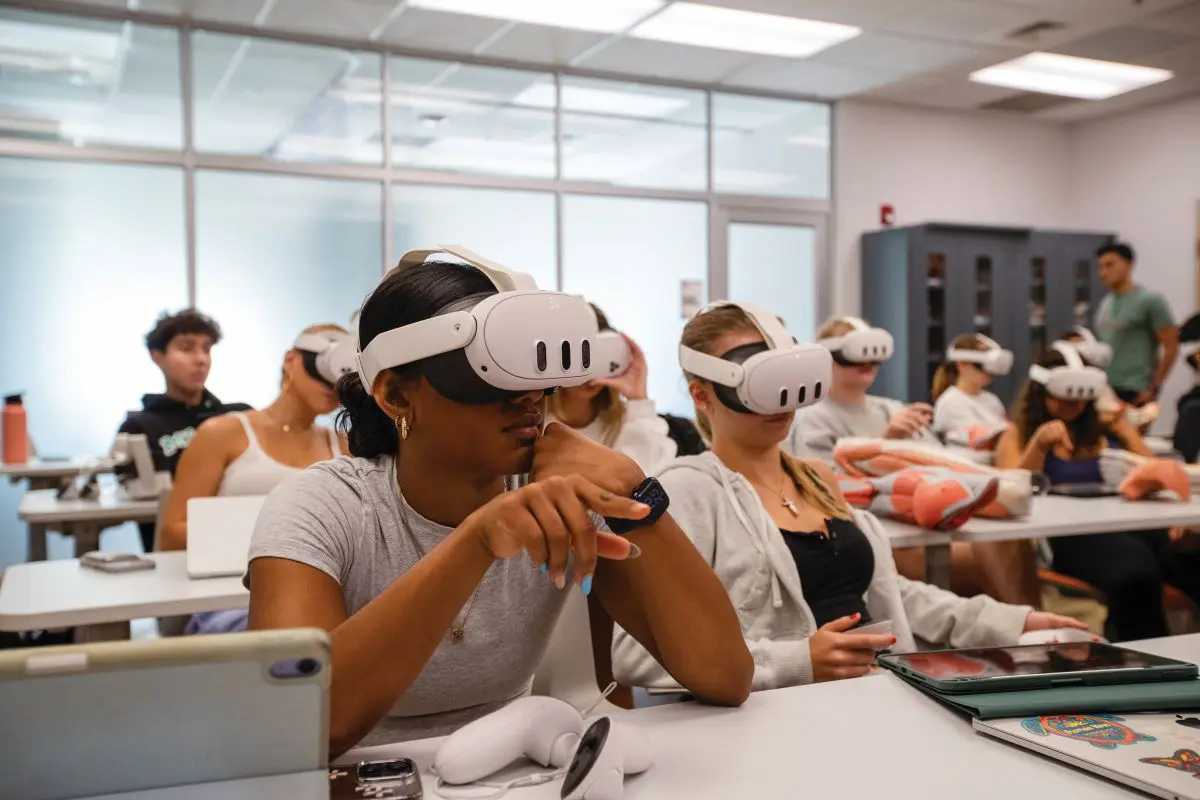
Medical education is experiencing a quiet revolution—one that’s not taking place in lecture theatres or textbooks, but with headsets and holograms. At the heart of this revolution are Mixed Reality (MR) AI Agents, a new generation of devices that combine the immersive depth of mixed reality with the flexibility of artificial intelligence. These technologies are not mere flashy gadgets; they’re revolutionising the way medical students interact with complicated content, rehearse clinical skills, and prepare for real-world situations. By combining digital simulations with the physical world, MR AI Agents are redefining what it means to learn medicine in the 21st century.


4 Reasons To Use Claude AI to Teach — from techlearning.com by Erik Ofgang
Features that make Claude AI appealing to educators include a focus on privacy and conversational style.

After experimenting using Claude AI on various teaching exercises, from generating quizzes to tutoring and offering writing suggestions, I found that it’s not perfect, but I think it behaves favorably compared to other AI tools in general, with an easy-to-use interface and some unique features that make it particularly suited for use in education.


Class of 2025 grads are experiencing disconnect between job expectations and reality, study finds — from hrdive.com by Carolyn Crist
Soon-to-be graduates believe they’ll secure a job sooner than recent graduates have experienced, ZipRecruiter said.

Class of 2025 graduates’ expectations seem to be clashing with reality during their job search, especially when it comes to pay, job preferences and beliefs about the job market, according to an April 23 report from ZipRecruiter.

For instance, some graduates have found that the job search is taking longer than they expected. About 82% of those about to graduate expect to start work within three months of graduation, but only 77% of recent graduates accomplished that, and 5% said they’re still searching for a job.


Nearly half of Gen Z and millennials say college was a waste of money—AI has already made degrees obsolete — from fortune.com by Preston Fore

College is often advertised as the best four years of one’s life, but many Americans now have regrets.

More than a third of all graduates now say their degree was a “waste of money,” according to a new survey by Indeed. This frustration is especially pronounced among Gen Z, with 51% expressing remorse—compared to 41% of millennials and just 20% of baby boomers.

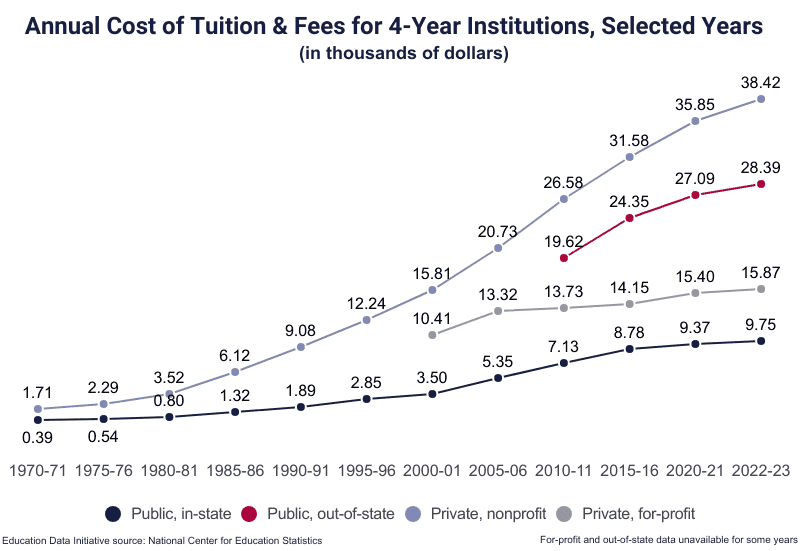
Overall, a growing share of college-educated workers are questioning the return on investment (ROI) of their degree, Kyle M.K., a career trend expert at Indeed, told Fortune. It’s something that’s not all too surprising considering that the average cost of a bachelor’s degree has doubled in the last two decades to over $38,000, and total student loan debt has ballooned to nearly $2 trillion.

“Another 38% feel student loans have limited their career growth more than their diploma has accelerated it,” M.K. said.

“AI won’t invalidate a solid education, but it will reward those who keep upgrading their toolkit.”


Average Cost of College & Tuition — from educationdata.org
Last Updated: March 8, 2025

Report Highlights. The average cost of college* in the United States is $38,270 per student per year, including books, supplies, and daily living expenses.

  • The average cost of college has more than doubled in the 21st century; the compound annual growth rate (CAGR) of tuition is 4.04%.
  • The average in-state student attending a public 4-year institution and living on-campus spends $27,146 for one academic year.
  • The average cost of in-state tuition alone is $9,750; out-of-state tuition averages $28,386.
  • The average private, nonprofit university student spends $58,628 per academic year living on campus, $38,421 of it on tuition and fees.
  • Considering student loan interest and loss of income, investing in a bachelor’s degree can ultimately cost in excess of $500,000.

.


From DSC:
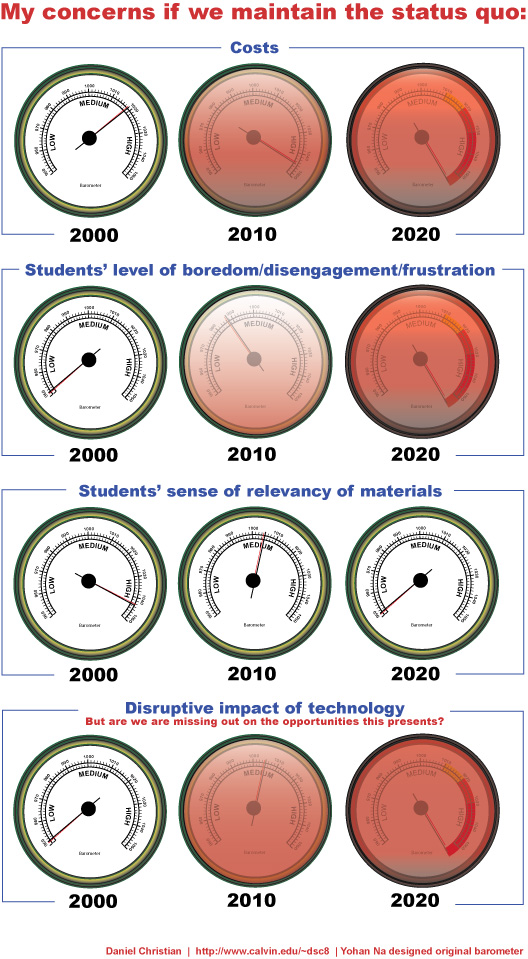
Reminds me of a graphic that Yohan Na and I created back in 2009:
.


Micro-Credentials Impact Report — from coursera.org
Get exclusive insights on how industry-aligned micro- credentials are bridging skill gaps, driving career outcomes, and building a future-ready workforce—with data from 2,000+ students and employers across six regions.

See how micro-credentials are driving student success, meeting industry demand, and transforming higher education institutions. Deliver industry-aligned learning with confidence—whether you’re leading a university or designing workforce development programs.

Our data shows that 90% of employers are willing to offer higher starting salaries to those with micro-credentials. Most offer 10–15% more for credit-bearing vs. non-credit credentials—even higher for GenAI. Help your graduates earn more by integrating micro-credentials into your programs.

Students are 2x as likely to choose programs with micro-credentials—even more if credentials are credit-bearing, the report finds. Higher education leaders echo this trend, with 7 in 10 saying students are more likely to enroll in programs that offer micro-credentials for academic credit.


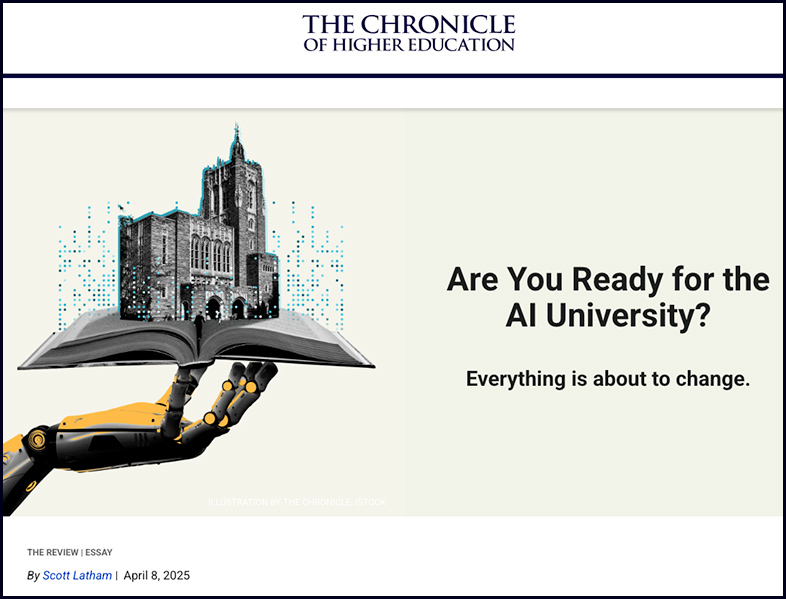
Reflections on “Are You Ready for the AI University? Everything is about to change.” [Latham]

.
Are You Ready for the AI University? Everything is about to change. — from chronicle.com by Scott Latham

Over the course of the next 10 years, AI-powered institutions will rise in the rankings. US News & World Report will factor a college’s AI capabilities into its calculations. Accrediting agencies will assess the degree of AI integration into pedagogy, research, and student life. Corporations will want to partner with universities that have demonstrated AI prowess. In short, we will see the emergence of the AI haves and have-nots.

What’s happening in higher education today has a name: creative destruction. The economist Joseph Schumpeter coined the term in 1942 to describe how innovation can transform industries. That typically happens when an industry has both a dysfunctional cost structure and a declining value proposition. Both are true of higher education.

Out of the gate, professors will work with technologists to get AI up to speed on specific disciplines and pedagogy. For example, AI could be “fed” course material on Greek history or finance and then, guided by human professors as they sort through the material, help AI understand the structure of the discipline, and then develop lectures, videos, supporting documentation, and assessments.

In the near future, if a student misses class, they will be able watch a recording that an AI bot captured. Or the AI bot will find a similar lecture from another professor at another accredited university. If you need tutoring, an AI bot will be ready to help any time, day or night. Similarly, if you are going on a trip and wish to take an exam on the plane, a student will be able to log on and complete the AI-designed and administered exam. Students will no longer be bound by a rigid class schedule. Instead, they will set the schedule that works for them.

Early and mid-career professors who hope to survive will need to adapt and learn how to work with AI. They will need to immerse themselves in research on AI and pedagogy and understand its effect on the classroom. 

From DSC:
I had a very difficult time deciding which excerpts to include. There were so many more excerpts for us to think about with this solid article. While I don’t agree with several things in it, EVERY professor, president, dean, and administrator working within higher education today needs to read this article and seriously consider what Scott Latham is saying.

Change is already here, but according to Scott, we haven’t seen anything yet. I agree with him and, as a futurist, one has to consider the potential scenarios that Scott lays out for AI’s creative destruction of what higher education may look like. Scott asserts that some significant and upcoming impacts will be experienced by faculty members, doctoral students, and graduate/teaching assistants (and Teaching & Learning Centers and IT Departments, I would add). But he doesn’t stop there. He brings in presidents, deans, and other members of the leadership teams out there.

There are a few places where Scott and I differ.

  • The foremost one is the importance of the human element — i.e., the human faculty member and students’ learning preferences. I think many (most?) students and lifelong learners will want to learn from a human being. IBM abandoned their 5-year, $100M ed push last year and one of the key conclusions was that people want to learn from — and with — other people:

To be sure, AI can do sophisticated things such as generating quizzes from a class reading and editing student writing. But the idea that a machine or a chatbot can actually teach as a human can, he said, represents “a profound misunderstanding of what AI is actually capable of.” 

Nitta, who still holds deep respect for the Watson lab, admits, “We missed something important. At the heart of education, at the heart of any learning, is engagement. And that’s kind of the Holy Grail.”

— Satya Nitta, a longtime computer researcher at
IBM’s Watson
Research Center in Yorktown Heights, NY
.

By the way, it isn’t easy for me to write this. As I wanted AI and other related technologies to be able to do just what IBM was hoping that it would be able to do.

  • Also, I would use the term learning preferences where Scott uses the term learning styles.

Scott also mentions:

“In addition, faculty members will need to become technologists as much as scholars. They will need to train AI in how to help them build lectures, assessments, and fine-tune their classroom materials. Further training will be needed when AI first delivers a course.”

It has been my experience from working with faculty members for over 20 years that not all faculty members want to become technologists. They may not have the time, interest, and/or aptitude to become one (and vice versa for technologists who likely won’t become faculty members).

That all said, Scott relays many things that I have reflected upon and relayed for years now via this Learning Ecosystems blog and also via The Learning from the Living [AI-Based Class] Room vision — the use of AI to offer personalized and job-relevant learning, the rising costs of higher education, the development of new learning-related offerings and credentials at far less expensive prices, the need to provide new business models and emerging technologies that are devoted more to lifelong learning, plus several other things.

So this article is definitely worth your time to read, especially if you are working in higher education or are considering a career therein!


Addendum later on 4/10/25:

U-M’s Ross School of Business, Google Public Sector launch virtual teaching assistant pilot program — from news.umich.edu by Jeff Karoub; via Paul Fain

Google Public Sector and the University of Michigan’s Ross School of Business have launched an advanced Virtual Teaching Assistant pilot program aimed at improving personalized learning and enlightening educators on artificial intelligence in the classroom.

The AI technology, aided by Google’s Gemini chatbot, provides students with all-hours access to support and self-directed learning. The Virtual TA represents the next generation of educational chatbots, serving as a sophisticated AI learning assistant that instructors can use to modify their specific lessons and teaching styles.

The Virtual TA facilitates self-paced learning for students, provides on-demand explanations of complex course concepts, guides them through problem-solving, and acts as a practice partner. It’s designed to foster critical thinking by never giving away answers, ensuring students actively work toward solutions.


8 Weeks Left to Prepare Students for the AI-Enhanced Workplace — from insidehighered.com by Ray Schroeder
We are down to the final weeks left to fully prepare students for entry into the AI-enhanced workplace. Are your students ready?

The urgent task facing those of us who teach and advise students, whether they be degree program or certificate seeking, is to ensure that they are prepared to enter (or re-enter) the workplace with skills and knowledge that are relevant to 2025 and beyond. One of the first skills to cultivate is an understanding of what kinds of services this emerging technology can provide to enhance the worker’s productivity and value to the institution or corporation.

Given that short period of time, coupled with the need to cover the scheduled information in the syllabus, I recommend that we consider merging AI use into authentic assignments and assessments, supplementary modules, and other resources to prepare for AI.


Learning Design in the Era of Agentic AI — from drphilippahardman.substack.com by Dr Philippa Hardman
Aka, how to design online async learning experiences that learners can’t afford to delegate to AI agents

The point I put forward was that the problem is not AI’s ability to complete online async courses, but that online async courses courses deliver so little value to our learners that they delegate their completion to AI.

The harsh reality is that this is not an AI problem — it is a learning design problem.

However, this realisation presents us with an opportunity which we overall seem keen to embrace. Rather than seeking out ways to block AI agents, we seem largely to agree that we should use this as a moment to reimagine online async learning itself.


8 Schools Innovating With Google AI — Here’s What They’re Doing — from forbes.com by Dan Fitzpatrick

While fears of AI replacing educators swirl in the public consciousness, a cohort of pioneering institutions is demonstrating a far more nuanced reality. These eight universities and schools aren’t just experimenting with AI, they’re fundamentally reshaping their educational ecosystems. From personalized learning in K-12 to advanced research in higher education, these institutions are leveraging Google’s AI to empower students, enhance teaching, and streamline operations.


Essential AI tools for better work — from wondertools.substack.com by Jeremy Caplan
My favorite tactics for making the most of AI — a podcast conversation

AI tools I consistently rely on (areas covered mentioned below)

  • Research and analysis
  • Communication efficiency
  • Multimedia creation

AI tactics that work surprisingly well 

1. Reverse interviews
Instead of just querying AI, have it interview you. Get the AI to interview you, rather than interviewing it. Give it a little context and what you’re focusing on and what you’re interested in, and then you ask it to interview you to elicit your own insights.”

This approach helps extract knowledge from yourself, not just from the AI. Sometimes we need that guide to pull ideas out of ourselves.


Degree in hand, jobs out of reach: Why recent grads are struggling in a competitive market — from cnn.com by Nayeli Jaramillo-Plata; via Ryan Craig

Bellebuono’s story isn’t unique. A recent study from the Federal Reserve Bank of New York reported the widest unemployment gap between new graduates and experienced degree holders since the 1990s.

The struggle to find work
The unemployment gap is partly due to the increase in competition and changing employer expectations, said David Deming, professor of public policy at the Harvard Kennedy School.

Skill requirements for entry-level roles are higher today than a decade ago, he said. But the change has been gradual from year to year.

 
© 2025 | Daniel Christian