Entrepreneurship: The New Core Curriculum — from gettingsmart.com by Tom Vander Ark

Key Points

  • Entrepreneurship education fosters resilience, creativity, and financial literacy—skills critical for success in an unpredictable, tech-driven world.
  • Programs like NFTE, Junior Achievement, and Uncharted Learning empower students by offering real-world entrepreneurial experiences and mentorship.

“Entrepreneurship is the job of the future.”

— Charles Fadel, Education for the Age of AI

This shift requires a radical re-evaluation of what we teach. Education leaders across the country are realizing that the most valuable skill we can impart is not accounting or marketing, but the entrepreneurial mindset. This mindset—built on resilience, creative problem-solving, comfort with ambiguity, and the ability to pivot—is essential in startups, as an intrapreuer in big organizations, or as a citizen working for the common good.


2. Concern and excitement about AI — from pewresearch.org by Jacob Poushter,Moira Faganand Manolo Corichi

Key findings

  • A median of 34% of adults across 25 countries are more concerned than excited about the increased use of artificial intelligence in daily life. A median of 42% are equally concerned and excited, and 16% are more excited than concerned.
  • Older adults, women, people with less education and those who use the internet less often are particularly likely to be more concerned than excited.

Also relevant here:


AI Video Wars include Veo 3.1, Sora 2, Ray3, Kling 2.5 + Wan 2.5 — from heatherbcooper.substack.com by Heather Cooper
House of David Season 2 is here!

In today’s edition:

  • Veo 3.1 brings richer audio and object-level editing to Google Flow
  • Sora 2 is here with Cameo self-insertion and collaborative Remix features
  • Ray3 brings world-first reasoning and HDR to video generation
  • Kling 2.5 Turbo delivers faster, cheaper, more consistent results
  • WAN 2.5 revolutionizes talking head creation with perfect audio sync
  • House of David Season 2 Trailer
  • HeyGen Agent, Hailuo Agent, Topaz Astra, and Lovable Cloud updates
  • Image & Video Prompts

From DSC:
By the way, the House of David (which Heather referred to) is very well done! I enjoyed watching Season 1. Like The Chosen, it brings the Bible to life in excellent, impactful ways! Both series convey the context and cultural tensions at the time. Both series are an answer to prayer for me and many others — as they are professionally-done. Both series match anything that comes out of Hollywood in terms of the acting, script writing, music, the sets, etc.  Both are very well done.
.


An item re: Sora:


Other items re: Open AI’s new Atlas browser:

Introducing ChatGPT Atlas — from openai.com
The browser with ChatGPT built in.

[On 10/21/25] we’re introducing ChatGPT Atlas, a new web browser built with ChatGPT at its core.

AI gives us a rare moment to rethink what it means to use the web. Last year, we added search in ChatGPT so you could instantly find timely information from across the internet—and it quickly became one of our most-used features. But your browser is where all of your work, tools, and context come together. A browser built with ChatGPT takes us closer to a true super-assistant that understands your world and helps you achieve your goals.

With Atlas, ChatGPT can come with you anywhere across the web—helping you in the window right where you are, understanding what you’re trying to do, and completing tasks for you, all without copying and pasting or leaving the page. Your ChatGPT memory is built in, so conversations can draw on past chats and details to help you get new things done.

ChatGPT Atlas: the AI browser test — from getsuperintel.com by Kim “Chubby” Isenberg
Chat GPT Atlas aims to transform web browsing into a conversational, AI-native experience, but early reviews are mixed

OpenAI’s new ChatGPT Atlas promises to merge web browsing, search, and automation into a single interface — an “AI-native browser” meant to make the web conversational. After testing it myself, though, I’m still trying to see the real breakthrough. It feels familiar: summaries, follow-ups, and even the Agent’s task handling all mirror what I already do inside ChatGPT.

OpenAI’s new Atlas browser remembers everything — from theneurondaily.com by Grant Harvey
PLUS: Our AIs are getting brain rot?!

Here’s how it works: Atlas can see what you’re looking at on any webpage and instantly help without you needing to copy/paste or switch tabs. Researching hotels? Ask ChatGPT to compare prices right there. Reading a dense article? Get a summary on the spot. The AI lives in the browser itself.

OpenAI’s new product — from bensbites.com

The latest entry in AI browsers is Atlas – A new browser from OpenAI. Atlas would feel similar to Dia or Comet if you’ve used them. It has an “Ask ChatGPT” sidebar that has the context of your page, and choose “Agent” to work on that tab. Right now, Agent is limited to a single tab, and it is way too slow to delegate anything for real to it. Click accuracy for Agent is alright on normal web pages, but it will definitely trip up if you ask it to use something like Google Sheets.

One ambient feature that I think many people will like is “select to rewrite” – You can select any text in Atlas, hover/click on the blue dot in the top right corner to rewrite it using AI.


Your AI Resume Hacks Probably Won’t Fool Hiring Algorithms — from builtin.com by Jeff Rumage
Recruiters say those viral hidden prompt for resumes don’t work — and might cost you interviews.

Summary: Job seekers are using “prompt hacking” — embedding hidden AI commands in white font on resumes — to try to trick applicant tracking systems. While some report success, recruiters warn the tactic could backfire and eliminate the candidate from consideration.


The Job Market Might Be a Mess, But Don’t Blame AI Just Yet — from builtin.com by Matthew Urwin
A new study by Yale University and the Brookings Institution says the panic around artificial intelligence stealing jobs is overblown. But that might not be the case for long.

Summary: A Yale and Brookings study finds generative AI has had little impact on U.S. jobs so far, with tariffs, immigration policies and the number of college grads potentially playing a larger role. Still, AI could disrupt the workforce in the not-so-distant future.


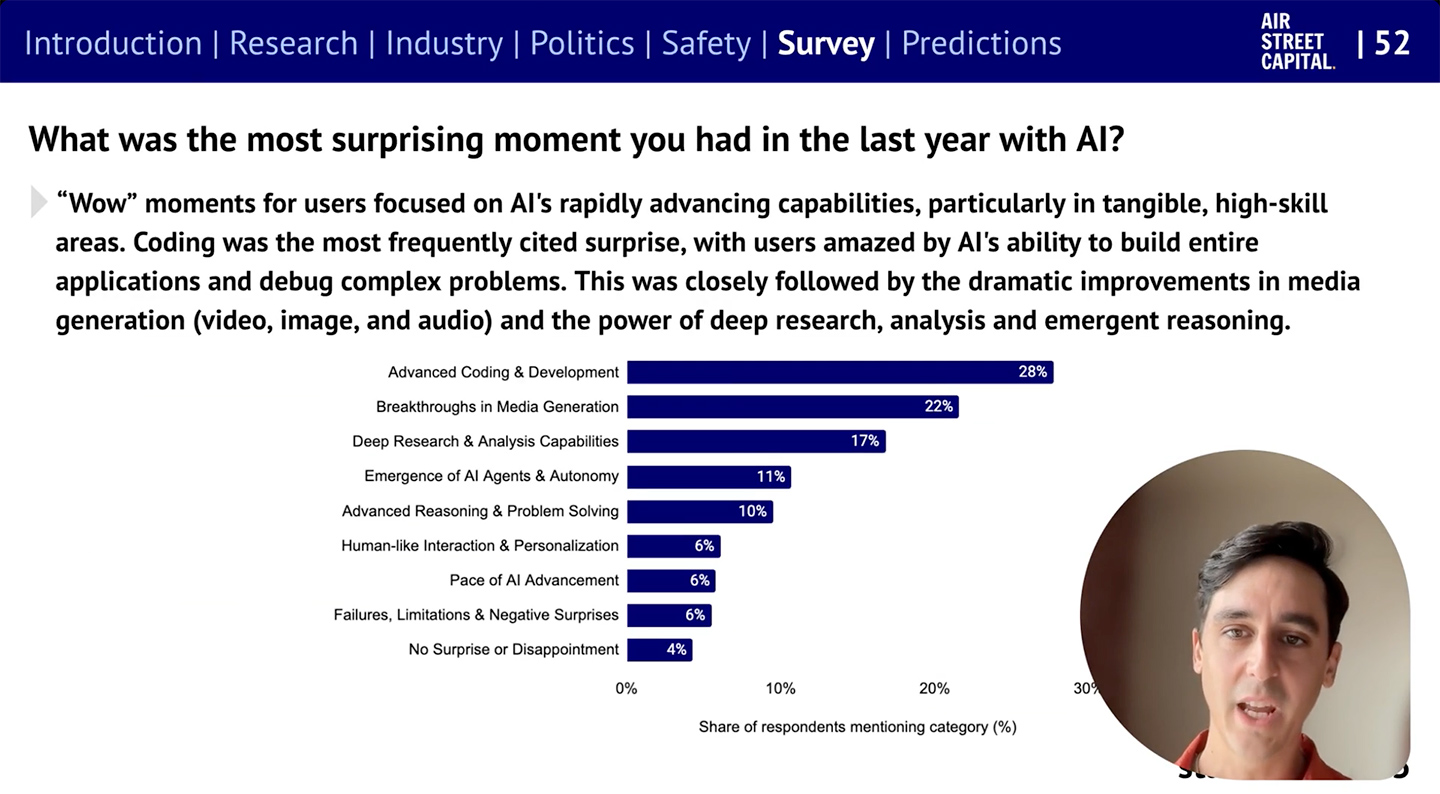
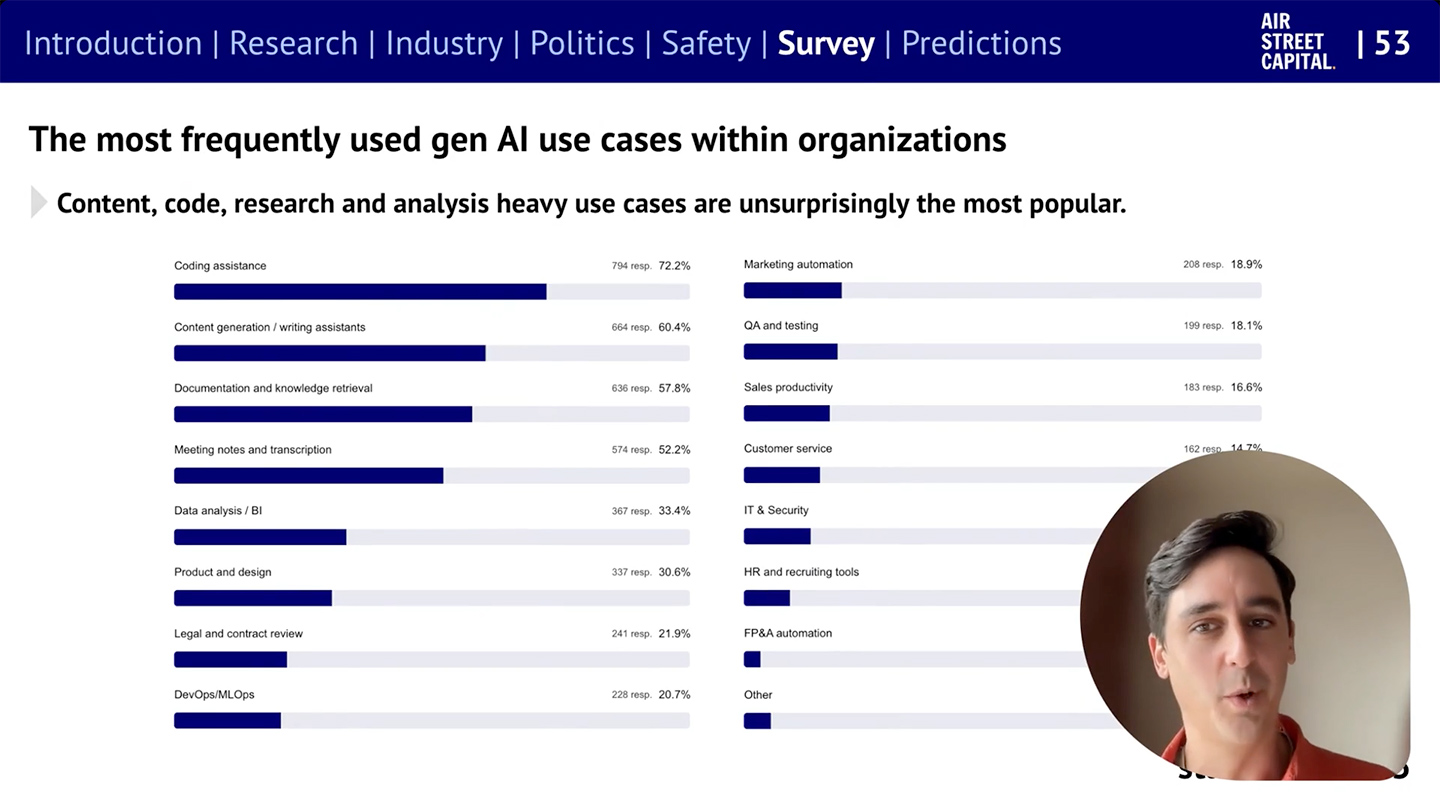
The State of AI Report 2025 — from nathanbenaich.substack.com by Nathan Benaich

In short, it’s been a monumental 12 months for AI. Our eighth annual report is the most comprehensive it’s ever been, covering what you need to know about research, industry, politics, and safety – along with our first State of AI Usage Survey of 1,200 practitioners.

stateof.ai
.


Via Kim “Chubby” Isenberg


Stanford Law Unveils liftlab, a Groundbreaking AI Initiative Focused on the Legal Profession’s Future — from law.stanford.edu

September 15, 2025 — Stanford, CA — Stanford Law School today announced the launch of the Legal Innovation through Frontier Technology Lab, or liftlab, to explore how artificial intelligence can reshape legal services—not just to make them faster and cheaper, but better and more widely accessible.

Led by Professor Julian Nyarko and Executive Director Megan Ma, liftlab is among the first academic efforts in legal AI to unite research, prototyping, and real-time collaboration with industry. While much of AI innovation in law has so far focused on streamlining routine tasks, liftlab is taking a broader and more ambitious approach. The goal is to tap AI’s potential to fundamentally change the way legal work serves society.


The divergence of law firms from lawyers — from jordanfurlong.substack.com by Jordan Furlong
LLMs’ absorption of legal task performance will drive law firms towards commoditized service hubs while raising lawyers to unique callings as trustworthy legal guides — so long as we do this right.

Generative AI is going to weaken and potentially dissolve that relationship. Law firms will become capable of generating output that can be sold to clients with no lawyer involvement at all.

Right now, it’s possible for an ordinary person to obtain from an LLM like ChatGPT-5 the performance of a legal task — the provision of legal analysis, the production of a legal instrument, the delivery of legal advice — that previously could only be acquired from a human lawyer.

I’m not saying a person should do that. The LLM’s output might be effective and reliable, or it might prove disastrously off-base. But many people are already using LLMs in this way, and in the absence of other accessible options for legal assistance, they will continue to do so.


Why legal professionals need purpose-built agentic AI — from legal.thomsonreuters.com by Frank Schilder with Thomson Reuters Labs

Highlights

  • Professional-grade agentic AI systems are architecturally distinct from consumer chatbots, utilizing domain-specific data and robust verification mechanisms to deliver the high accuracy and reliability essential for legal work, whereas consumer tools prioritize conversational flow using unvetted web data.
  • True agentic AI for legal professionals offers transparent, multi-agent workflows, integrates with authoritative legal databases for verification, and applies domain-specific reasoning to understand legal nuances, unlike traditional chatbots that lack this complexity and autonomy.
  • When evaluating legal AI, professionals should avoid solutions that lack workflow transparency, offer no human checkpoints for oversight, and cannot integrate with professional databases, ensuring the chosen tool enhances, rather than replaces, expert judgment.

How I Left Corporate Law to Become a Legal Tech Entrepreneur — from news.bloomberglaw.com by Adam Nguyen; behind a paywall

If you’re a lawyer wondering whether to take the leap into entrepreneurship, I understand the apprehension that comes with leaving a predictable path. Embracing the fear, uncertainty, challenges, and constant evolution integral to an entrepreneur’s journey has been worth it for me.


Lawyering In The Age Of AI: Why Artificial Intelligence Might Make Lawyers More Human — from abovethelaw.com by Lisa Lang and Joshua Horenstein
AI could rehumanize the legal profession.

AI is already adept at doing what law school trained us to do — identifying risks, spotting issues, and referencing precedent. What it’s not good at is nuance, trust, or judgment — skills that define great lawyering.

When AI handles some of the drudgery — like contract clause spotting and formatting — it gives us something precious back: time. That time forces lawyers to stop hiding behind legalese and impractical analysis. It allows — and even demands — that we communicate like leaders.

Imagine walking into a business meeting and, instead of delivering a 20-page memo, offering a single slide with a recommendation tied directly to company goals. That’s not just good lawyering; that’s leadership. And AI may be the catalyst that gets us there.

AI changes the game. When generative tools can translate clauses into plain English, the old value proposition of complexity begins to crumble. The playing field shifts — from who can analyze the most thoroughly to who can communicate the most clearly.

That’s not a threat. It’s an opportunity — one for lawyers to become better partners to the business by focusing on what matters most: sound judgment delivered in plain language.


Recurring Themes In Bob Ambrogi’s 30 Years of Legal Tech Reporting (A Guest Post By ChatGPT) — from lawnext.com by ChatGPT
#legaltech #innovation #law #legal #innovation #vendors #lawyers #lawfirms #legaloperations

  • Evolution of Legal Technology: From Early Web to AI Revolution
  • Challenges in Legal Innovation and Adoption
  • Law Firm Innovation vs. Corporate Legal Demand: Shifting Dynamics
  • Tracking Key Technologies and Players in Legal Tech
  • Access to Justice, Ethics, and Regulatory Reform

Also re: legaltech, see:

How LegalTech is Changing the Client Experience in 2025 — from techbullion.com by Uzair Hasan

A Digital Shift in Law
In 2025, LegalTech isn’t a trend—it’s a standard. Tools like client dashboards, e-signatures, AI legal assistants, and automated case tracking are making law firms more efficient and more transparent. These systems also help reduce errors and save time. For clients, it means less confusion and more control.

For example, immigration law—a field known for paperwork and long processing times—is being transformed through tech. Clients now track their case status online, receive instant updates, and even upload key documents from their phones. Lawyers, meanwhile, use AI tools to spot issues faster, prepare filings quicker, and manage growing caseloads without dropping the ball.

Loren Locke, Founder of Locke Immigration Law, explains how tech helps simplify high-stress cases:
“As a former consular officer, I know how overwhelming the visa process can feel. Now, we use digital tools to break down each step for our clients—timelines, checklists, updates—all in one place. One client recently told me it was the first time they didn’t feel lost during their visa process. That’s why I built my firm this way: to give people clarity when they need it most.”


While not so much legaltech this time, Jordan’s article below is an excellent, highly relevant posting for what we are going through — at least in the United States:

What are lawyers for? — from jordanfurlong.substack.com by Jordan Furlong
We all know lawyers’ commercial role, to be professional guides for human affairs. But we also need lawyers to bring the law’s guarantees to life for people and in society. And we need it right now.

The question “What are lawyers for?” raises another, prior and more foundational question: “What is the law for?”

But there’s more. The law also exists to regulate power in a society: to structure its distribution, create processes for its implementation, and place limits on its application. In a healthy society, power flows through the law, not around it. Certainly, we need to closely examine and evaluate those laws — the exercise of power through a biased or corrupted system will be illegitimate even if it’s “lawful.” But as a general rule, the law is available as a check on the arbitrary exercise of power, whether by a state authority or a private entity.

And above these two aspects of law’s societal role, I believe there’s also a third: to serve as a kind of “moral architecture” of society.


Teach business students to write like executives — from timeshighereducation.com by José Ignacio Sordo Galarza
Many business students struggle to communicate with impact. Teach them to pitch ideas on a single page to build clarity, confidence and work-ready communication skills

Many undergraduate business students transition into the workforce equipped with communication habits that, while effective in academic settings, prove ineffective in professional environments. At university, students are trained to write for professors, not executives. This becomes problematic in the workplace where lengthy reports and academic jargon often obscure rather than clarify intent. Employers seek ideas they can absorb in seconds. This is where the one-pager – a single-page, high-impact document that helps students develop clarity of thought, concise expression and strategic communication – proves effective.


Also from Times Higher Education, see:


Is the dissertation dead? If so, what are the alternatives? — from timeshighereducation.com by Rushana Khusainova, Sarah Sholl, & Patrick Harte
Dissertation alternatives, such as capstone projects and applied group-based projects, could better prepare graduates for their future careers. Discover what these might look like

The traditional dissertation, a longstanding pillar of higher education, is facing increasing scrutiny. Concerns about its relevance to contemporary career paths, limitations in fostering practical skills and the changing nature of knowledge production in the GenAI age have fuelled discussions about its continued efficacy. So, is the dissertation dead?

The dissertation is facing a number of challenges. It can be perceived as having little relevance to career aspirations in increasingly competitive job markets. According to The Future of Jobs Report 2025 by the World Economic Forum, employers demand and indeed prioritise skills such as collaborative problem-solving in diverse and complex contexts, which a dissertation might not demonstrate.


Is graduate employability a core university priority? — from timeshighereducation.com by Katherine Emms and Andrea Laczik
Universities, once judged primarily on the quality of their academic outcomes, are now also expected to prepare students for the workplace. Here’s how higher education is adapting to changing pressures

A clear, deliberate shift in priorities is under way. Embedding employability is central to an Edge Foundation report, carried out in collaboration with UCL’s Institute of Education, looking at how English universities are responding. In placing employability at the centre of their strategies – not just for professional courses but across all disciplines – the two universities that were analysed in this research show how they aim to prepare students for the labour market overall. Although the employability strategy is initialled by the universities’ senior leaders, the research showed that realising this employability strategy must be understood and executed by staff at all levels across departments. The complexity of offering insights into industry pathways and building relevant skills involves curricula development, student-centred teaching, careers support, partnership work and employer engagement.


Every student can benefit from an entrepreneurial mindset — from timeshighereducation.com by Nicolas Klotz
To develop the next generation of entrepreneurs, universities need to nurture the right mindset in students of all disciplines. Follow these tips to embed entrepreneurial education

This shift demands a radical rethink of how we approach entrepreneurial mindset in higher education. Not as a specialism for a niche group of business students but as a core competency that every student, in every discipline, can benefit from.

At my university, we’ve spent the past several years re-engineering how we embed entrepreneurship into daily student life and learning.

What we’ve learned could help other institutions, especially smaller or resource-constrained ones, adapt to this new landscape.

The first step is recognising that entrepreneurship is not only about launching start-ups for profit. It’s about nurturing a mindset that values initiative, problem-solving, resilience and creative risk-taking. Employers increasingly want these traits, whether the student is applying for a traditional job or proposing their own venture.


Build foundations for university-industry partnerships in 90 days— from timeshighereducation.com by Raul Villamarin Rodriguez and Hemachandran K
Graduate employability could be transformed through systematic integration of industry partnerships. This practical guide offers a framework for change in Indian universities

The most effective transformation strategy for Indian universities lies in systematic industry integration that moves beyond superficial partnerships and towards deep curriculum collaboration. Rather than hoping market alignment will occur naturally, institutions must reverse-engineer academic programmes from verified industry needs.

Our six-month implementation at Woxsen University demonstrates this framework’s practical effectiveness, achieving more than 130 industry partnerships, 100 per cent faculty participation in transformation training, and 75 per cent of students receiving industry-validated credentials with significantly improved employment outcomes.


Agentic AI use cases in the legal industry — from legal.thomsonreuters.com
What legal professionals need to know now with the rise of agentic AI

While GenAI can create documents or answer questions, agentic AI takes intelligence a step further by planning how to get multi-step work done, including tasks such as consuming information, applying logic, crafting arguments, and then completing them.? This leaves legal teams more time for nuanced decision-making, creative strategy, and relationship-building with clients—work that machines can’t do.


The AI Legal Landscape in 2025: Beyond the Hype — from akerman.com by Melissa C. Koch

What we’re witnessing is a profession in transition where specific tasks are being augmented or automated while new skills and roles emerge.

The data tells an interesting story: approximately 79% of law firms have integrated AI tools into their workflows, yet only a fraction have truly transformed their operations. Most implementations focus on pattern recognition tasks such as document review, legal research, contract analysis. These implementations aren’t replacing lawyers; they’re redirecting attention to higher-value work.

This technological shift doesn’t happen in isolation. It’s occurring amid client pressure for efficiency, competition from alternative providers, and the expectations of a new generation of lawyers who have never known a world without AI assistance.


LexisNexis and Harvey team up to revolutionize legal research with artificial intelligence — from abajournal.com by Danielle Braff

Lawyers using the Harvey artificial intelligence platform will soon be able to tap into LexisNexis’ vast legal research capabilities.

Thanks to a new partnership announced Wednesday, Harvey users will be able to ask legal questions and receive fast, citation-backed answers powered by LexisNexis case law, statutes and Shepard’s Citations, streamlining everything from basic research to complex motions. According to a press release, generated responses to user queries will be grounded in LexisNexis’ proprietary knowledge graphs and citation tools—making them more trustworthy for use in court or client work.


10 Legal Tech Companies to Know — from builtin.com
These companies are using AI, automation and analytics to transform how legal work gets done.
.


Four months after a $3B valuation, Harvey AI grows to $5B — from techcrunch.com by Marina Temkin

Harvey AI, a startup that provides automation for legal work, has raised $300 million in Series E funding at a $5 billion valuation, the company told Fortune. The round was co-led by Kleiner Perkins and Coatue, with participation from existing investors, including Conviction, Elad Gil, OpenAI Startup Fund, and Sequoia.


The billable time revolution — from jordanfurlong.substack.com by Jordan Furlong
Gen AI will bring an end to the era when lawyers’ value hinged on performing billable work. Grab the coming opportunity to re-prioritize your daily activities and redefine your professional purpose.

Because of Generative AI, lawyers will perform fewer “billable” tasks in future; but why is that a bad thing? Why not devote that incoming “freed-up” time to operating, upgrading, and flourishing your law practice? Because this is what you do now: You run a legal business. You deliver good outcomes, good experiences, and good relationships to clients. Humans do some of the work and machines do some of the work and the distinction that matters is not billable/non-billable, it’s which type of work is best suited to which type of performer.


AI will kill billable hour, says lawtech founder — from lawgazette.co.uk by John Hyde

A pioneer in legal technology has predicted the billable hour model cannot survive the transition into the use of artificial intelligence.

Speaking to the Gazette on a visit to the UK, Canadian Jack Newton, founder and chief executive of lawtech company Clio, said there was a ‘structural incompatibility’ between the productivity gains of AI and the billable hour.

Newton said the adoption of AI should be welcomed and embraced by the legal profession but that lawyers will need an entrepreneurial mindset to make the most of its benefits.

Newton added: ‘There is enormous demand but the paradox is that the number one thing we hear from lawyers is they need to grow their firms through more clients, while 77% of legal needs are not met.

‘It’s exciting that AI can address these challenges – it will be a tectonic shift in the industry driving down costs and making legal services more accessible.’


Speaking of legaltech-related items, also see:

Legal AI Platform Harvey To Get LexisNexis Content and Tech In New Partnership Between the Companies — from lawnext.com by Bob Ambrogi

The generative AI legal startup Harvey has entered into a strategic alliance with LexisNexis Legal & Professional by which it will integrate LexisNexis’ gen AI technology, primary law content, and Shepard’s Citations within the Harvey platform and jointly develop advanced legal workflows.

As a result of the partnership, Harvey’s customers working within its platform will be able to ask questions of LexisNexis Protégé, the AI legal assistant released in January, and receive AI-generated answers grounded in the LexisNexis collection of U.S. case law and statutes and validated through Shepard’s Citations, the companies said.


Mary Meeker AI Trends Report: Mind-Boggling Numbers Paint AI’s Massive Growth Picture — from ndtvprofit.com
Numbers that prove AI as a tech is unlike any other the world has ever seen.

Here are some incredibly powerful numbers from Mary Meeker’s AI Trends report, which showcase how artificial intelligence as a tech is unlike any other the world has ever seen.

  • AI took only three years to reach 50% user adoption in the US; mobile internet took six years, desktop internet took 12 years, while PCs took 20 years.
  • ChatGPT reached 800 million users in 17 months and 100 million in only two months, vis-à-vis Netflix’s 100 million (10 years), Instagram (2.5 years) and TikTok (nine months).
  • ChatGPT hit 365 billion annual searches in two years (2024) vs. Google’s 11 years (2009)—ChatGPT 5.5x faster than Google.

Above via Mary Meeker’s AI Trend-Analysis — from getsuperintel.com by Kim “Chubby” Isenberg
How AI’s rapid rise, efficiency race, and talent shifts are reshaping the future.

The TLDR
Mary Meeker’s new AI trends report highlights an explosive rise in global AI usage, surging model efficiency, and mounting pressure on infrastructure and talent. The shift is clear: AI is no longer experimental—it’s becoming foundational, and those who optimize for speed, scale, and specialization will lead the next wave of innovation.


Also see Meeker’s actual report at:

Trends – Artificial Intelligence — from bondcap.com by Mary Meeker / Jay Simons / Daegwon Chae / Alexander Krey


The Rundown: Meta aims to release tools that eliminate humans from the advertising process by 2026, according to a report from the WSJ — developing an AI that can create ads for Facebook and Instagram using just a product image and budget.

The details:

  • Companies would submit product images and budgets, letting AI craft the text and visuals, select target audiences, and manage campaign placement.
  • The system will be able to create personalized ads that can adapt in real-time, like a car spot featuring mountains vs. an urban street based on user location.
  • The push would target smaller companies lacking dedicated marketing staff, promising professional-grade advertising without agency fees or skillset.
  • Advertising is a core part of Mark Zuckerberg’s AI strategy and already accounts for 97% of Meta’s annual revenue.

Why it matters: We’re already seeing AI transform advertising through image, video, and text, but Zuck’s vision takes the process entirely out of human hands. With so much marketing flowing through FB and IG, a successful system would be a major disruptor — particularly for small brands that just want results without the hassle.


Cultivating a responsible innovation mindset among future tech leaders — from timeshighereducation.com by Andreas Alexiou from the University of Southampton
The classroom is a perfect place to discuss the messy, real-world consequences of technological discoveries, writes Andreas Alexiou. Beyond ‘How?’, students should be asking ‘Should we…?’ and ‘What if…?’ questions around ethics and responsibility

University educators play a crucial role in guiding students to think about the next big invention and its implications for privacy, the environment and social equity. To truly make a difference, we need to bring ethics and responsibility into the classroom in a way that resonates with students. Here’s how.

Debating with industry pioneers on incorporating ethical frameworks in innovation, product development or technology adoption is eye-opening because it can lead to students confronting assumptions they hadn’t questioned before.

Students need more than just skills; they need a mindset that sticks with them long after graduation. By making ethics and responsibility a key part of the learning process, educators are doing more than preparing students for a career; they’re preparing them to navigate a world shaped by their choices.


Scientific breakthrough: artificial blood for all blood groups — from getsuperintel.com by Kim “Chubby” Isenberg
Japan’s universal artificial blood could revolutionize emergency medicine and global healthcare resilience.

They all show that we are on the threshold of a new era – one in which technological systems are no longer just tools, but independent players in medical, cognitive and infrastructural change.

This paradigm shift means that AI will no longer be limited to static training data, but will learn through open exploration, similar to biological organisms. This is nothing less than the beginning of an era of autonomous cognition.


From DSC:
While there are some promising developments involving AI these days, we need to look at what the potential downsides might be of AI becoming independent players, don’t you think? Otherwise, what could possibly go wrong?


Cultivating a responsible innovation mindset among future tech leaders — from timeshighereducation.com by Andreas Alexiou
The classroom is a perfect place to discuss the messy, real-world consequences of technological discoveries, writes Andreas Alexiou. Beyond ‘How?’, students should be asking ‘Should we…?’ and ‘What if…?’ questions around ethics and responsibility

University educators play a crucial role in guiding students to think about the next big invention and its implications for privacy, the environment and social equity. To truly make a difference, we need to bring ethics and responsibility into the classroom in a way that resonates with students. Here’s how.

Debating with industry pioneers on incorporating ethical frameworks in innovation, product development or technology adoption is eye-opening because it can lead to students confronting assumptions they hadn’t questioned before. For example, students could discuss the roll-out of emotion-recognition software. Many assume it’s neutral, but guest speakers from industry can highlight how cultural and racial biases are baked into design decisions.

Leveraging alumni networks and starting with short virtual Q&A sessions instead of full lectures can work well.


Are we overlooking the power of autonomy when it comes to motivating students? — from timeshighereducation.com by Danny Oppenheimer
Educators fear giving students too much choice in their learning will see them making the wrong decisions. But structuring choice without dictating the answers could be the way forward

So, how can we get students to make good decisions while still allowing them agency to make their own choices, maintaining the associated motivational advantages that agency provides? One possibility is to use choice architecture, more commonly called “nudges”: structuring choices in ways that scaffold better decisions without dictating them.

Higher education rightly emphasises the importance of belonging and mastery, but when it ignores autonomy – the third leg of the motivational tripod – the system wobbles. When we allow students to decide for themselves how they’ll engage with their coursework, they consistently rise to the occasion. They choose to challenge themselves, perform better academically and enjoy their education more.


Opinions | This Baltimore program shows how to fight generational poverty – from washingtonpost.com by Leana S. Wen; this is a gifted article
How one grassroots organization is teaching young people leadership skills and giving them hope.

She recognized their desperation and felt called to return and use what she had learned to help them realize a different future. So she set up an organization, HeartSmiles, to do just that — one young person at a time.

Holifield’s experience is one that city officials and public health workers can learn from. If they want to disrupt the generational cycle of poverty, trauma and hopelessness that afflicts so many communities, a good place to focus their efforts is children.

How can communities overcome inertia and resignation? Holifield’s organization starts with two core interventions. The first is career and leadership development. Children as young as 8 go to the HeartSmiles center to participate in facilitated sessions on youth entrepreneurship, budgeting and conflict resolution. Those who want to explore certain career paths are matched with professionals in these fields.

The second part of her vision is youth-led mentorship, which involves pairing young people with those not much older than they are. 


Also relevant/see:

Lost boys, trapped men, and the role of lifers in prison education — from college-inside.beehiiv.com by Charlotte West

This week, we’re publishing Part 2 of a Q&A with Erik Maloney, a lifer in Arizona, and Kevin Wright, a criminal justice professor at Arizona State University. They co-authored Imprisoned Minds, a book about trauma and healing published in December 2024, over the course of seven years. Check out Part 1 of the Q&A.

West: The fact that you created your own curriculum to accompany the book makes me think about the role of lifers in creating educational opportunities in prisons. What do you see as the role of lifers in filling some of these gaps?

Maloney
: I’ve said for years that lifers are so underutilized in prison. It’s all about punishment for what you’re in for, and [the prison system] overlooks us as a resource. We are people who, if allowed to be educated properly, can teach courses indefinitely while also being a role model for those with shorter sentences. This gives the lifer meaning and purpose to do good again. He serves as a mentor, whether he likes it or not, to [those] people coming into the prisons. When they see him doing well, it inspires others to want to do well.

But if it’s all about punishment, and a person has no meaning and no purpose in life, then all they have is hopelessness. With hopelessness comes despair, and with despair, you have rampant drug and alcohol abuse in prison, and violence stems from that.

 
© 2025 | Daniel Christian