The Role of Faculty in the University of the Future — from er.educause.edu by Tanya Gamby, David Kil, Rachel Koblic, Paul LeBlanc, Mihnea Moldoveanu, and George Siemens
In the age of AI, the true future of higher education lies not in replacing faculty but in freeing them to do what only humans can—build meaningful relationships, cultivate wisdom, and guide students through the ethical and intellectual challenges machines cannot navigate.

Today, the work of knowledge transfer is often done better, faster, with more precision, and more patiently by AI. These systems can provide nonjudgmental, individualized learning opportunities twenty-four hours a day, seven days a week. Think of AI as a “genius teaching assistant” who assumes much of the work of basic knowledge transfer, unlocking learning when students get stuck and providing real-time assessment. Such a genius TA would offer faculty dashboards that update student progress, flag those who are struggling, and recommend targeted interventions. These tasks free faculty to focus on building genuine relationships with students, using the classroom to foster human skills, and curating community. This may be the great gift of AI to education. But it requires a profound reimagining of faculty roles—perhaps the single biggest hurdle to reimagining higher education, and equally its greatest opportunity.

A concerned faculty member might hear all this and conclude they are becoming obsolete. The opposite is true. The evolution of faculty roles demands more—not less—of what makes a great teacher.

This means intervening in high-impact moments when the genius TA has not unlocked learning; curating class time to lift students from knowing material to applying it in contexts that require critical thinking, judgment, and discernment; and cultivating the human skills that will be most prized in the age of AI: effective communication, constructive dialogue, empathy, creativity, and professional disposition. Most importantly, it means building genuine relationships with students—that make them feel like they matter—the kind that fuels transformation.


From DSC:
A quick comment on one of the sentences in the article, which asserts:

Centers for teaching and learning, which have long supported faculty development at many institutions, will be among the busiest places on campus in the years ahead.

I would change the word will be to should:

Centers for teaching and learning, which have long supported faculty development at many institutions, should be among the busiest places on campus in the years ahead.

For that statement to be true, centers for teaching and learning need to be well-versed in the tools and pedagogies involved, plus in learning science. Those centers need to have credibility for faculty members to value their services. And that’s just it, isn’t it? The faculty members need to see those centers for teaching and learning as having something that they lack…that they need assistance with. Otherwise, if such centers are just viewed as superfluous, nothing much will change.

Also, my experience has been that if those centers for teaching and learning are in an IT group/department, they should be moved to the academic side of the house instead. Many faculty members don’t value people from IT enough to make changes in how they teach — no matter how qualified those people are. They view those people as “IT” only.


You might also be interested in the other articles in that series:


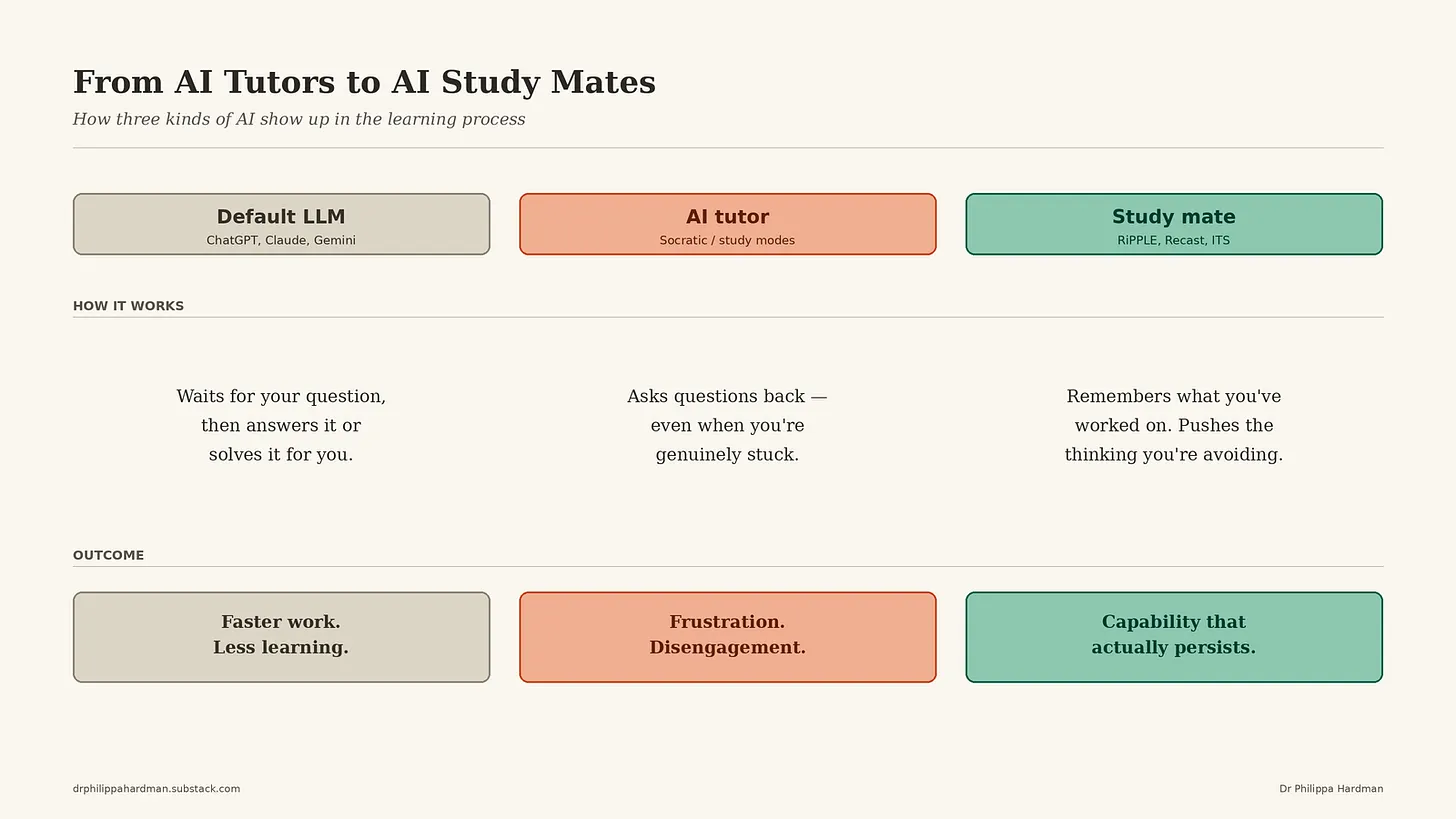
The “Cognitive Offloading” Paradox — from drphilippahardman.substack.com by Dr. Philippa Hardman
New research shows that offloading learning tasks to AI can improve – rather than erode – human thinking and learning

The Rise of the “Offloading Paradox”
In March 2026, the International Journal of Educational Technology in Higher Education published a study that went beyond the question “does offloading hurt?” and asked a harder one: when students form genuine partnerships with AI — treating it as an intellectual collaborator rather than a passive tool — what actually happens to the way they think and learn? Specifically, do two cognitive responses — critical evaluation of AI outputs (what the researchers call cognitive vigilance) and strategic delegation to AI (cognitive offloading) — compete with each other, or can they coexist?

Based on previous research, Wang and Zhang hypothesised that cognitive offloading would hurt transformative learning. They expected the familiar story: delegation reduces cognitive struggle, struggle is where learning happens, therefore delegation undermines learning.

The study — 912 students across China, Europe, and the United States, using a three-wave time-lagged survey design that measured partnership orientation first, cognitive strategies two weeks later, and learning outcomes two weeks after that — found something more interesting than a simple reversal.


This Is a Hard Time to Start a Career. These Two Words Can Help. — a gifted article from nytimes.com by Jodi Kantor
Advice on building a rewarding work life, even amid employment gloom.

If you’re sweating about what field to enter, here are a few things you can do now. Buy a cheap, thin notebook. Keep it on you. Every week, make a practice of writing down which actions you enjoy and which ones you hate, whom you like being around and whom you can’t stand. Keep running lists of what you’re good at and what ideas move you. Notice yourself.

Look to your friends instead. Think about what roles you take on with them: math tutor, party planner, psychologist, workout coach. These answers often reveal truths that our résumés do not. In social relationships, we aren’t bound by suffocating expectations about our future. Our friends have needs, and by noticing how we respond to them, we can learn who we are.

There is a wiser way to seize the future, which is to think about need. What is your own assessment of what society will need most during your working years, the next four or five decades? What kind of care; what kind of products; what kind of information?

The people I see thriving at work are the ones who chased some bigger need — not imposed by hollow conventional wisdom, but articulated through independent observation. Craft gives their work authority. Need gives it propulsion.


What the Future of Learning Looks Like in the Era of AI — from the Center for Academic Innovation at the University of Michigan, by Sean Corp

AI & the Future of Learning Summit brings industry, education leaders together to discuss higher education’s opportunity to lead, what students need, and what partnerships are possible

As artificial intelligence rapidly reshapes the nature of work and learning, speakers at the University of Michigan’s AI & the Future of Learning Summit delivered a clear message: higher education must take a leading role in defining what comes next.

One CEO of a leading educational technology company put it like this: “The only bad thing would be universities standing still.”

Universities must embrace their roles as providers of continuous, lifelong learning that evolves alongside technological change. 


This shift is already affecting early-career pathways. Employers are placing greater emphasis on experience, while traditional entry-level roles are becoming less accessible. There is often a gap between what a credential represents and the expectations of employers.

That gap is particularly evident in access to internships. Chris Parrish, co-founder and president of Podium, noted that millions of students compete for a limited number of internships each year, making it increasingly difficult to gain the experience employers demand.

“If you miss out on an internship, you’re twice as likely to be unemployed,” Parrish said. 


The Course Is Dying as the Unit of Learning — from drphilippahardman.substack.com by Dr Philippa Hardman
Here’s why, and what’s replacing It

What the Bleeding Edge Looks like in Practice
So what does “the new stack” actually look like when organisations lean into this? Here are four real patterns already in play.

Engineering: from engine courses to in-workflow AI coaching.
Product development: from courses to craft-specific agents.
Compliance: from annual course to nudge systems.|
Enablement systems, not catalogues.


The quest to build a better AI tutor — from hechingerreport.org by Jill Barshay
Researchers make progress with an older ed tech idea: personalized practice

One promising idea has less to do with how an AI tutor explains concepts and more with what it asks students to practice next.

A team at the University of Pennsylvania, which included some AI skeptics, recently tested this approach in a study of close to 800 Taiwanese high school students learning Python programming. All the students used the same AI tutor, which was designed not to give away answers.

But there was one key difference. Half the students were randomly assigned to a fixed sequence of practice problems, progressing from easy to hard. The other half received a personalized sequence with the AI tutor continuously adjusting the difficulty of each problem based on how the student was performing and interacting with the chatbot.

The idea is based on what educators call the “zone of proximal development.” When problems are too easy, students get bored. When they’re too hard, students get frustrated. The goal is to keep students in a sweet spot: challenged, but not overwhelmed.

The researchers found that students in the personalized group did better on a final exam than students in the fixed problem group. The difference was characterized as the equivalent of 6 to 9 months of additional schooling, an eye-catching claim for an after-school online course that lasted only five months.

To address this, Chung’s team combined a large language model with a separate machine-learning algorithm that analyzes how students interact with the online course platform — how they answer the practice questions, how many times they revise or edit their coding, and the quality of their conversations with the chatbot — and uses that information to decide which problem to serve up next.


AI and the Law: What Educators Need to Know About Responsible Use in a Rapidly Changing Landscape — from rdene915.com by Dr. Rachelle Dené Poth, JD

As both an attorney and educator who has spent more than eight years researching, teaching, presenting, and writing about AI, I have worked with schools across K–12 and higher education that are navigating these exact questions. The legal implications of AI are not barriers to innovation, but I consider them to serve as guardrails that assist schools with adopting technology responsibly. The key is protecting students, educators, and institutions and staying informed. Understanding the legal landscape and any potential legal implications as a result of the use of AI in classrooms helps schools move forward with confidence rather than hesitation.

Sections of Rachelle’s posting include:

  • Why AI and the Law Matter in Education
  • Key Laws That Shape AI Use in Schools
  • Data Privacy and Vendor Responsibility
  • Transparency Builds Trust With Students and Families
  • Accessibility, Equity, and Emerging Legal Considerations
  • Teaching Digital Citizenship With AI Literacy
  • Supporting Schools and Organizations Through AI and Legal Guidance
  • Moving Forward With Confidence
 

Legal AI Access at 83%, But Trust Issues Remain — from artificiallawyer.com

A new survey of over 200 inhouse and law firm leaders provides solid evidence that while AI tools are now ‘standard’ across our sector, that trust in AI outputs fundamentally drives usage, along with ROI – and vice versa.

The data, from ALSP Factor, shows that 83% had ‘broad AI access’, which is up from 61% in 2025, and in itself is a very positive development that tells us legal AI is now becoming ubiquitous for commercial lawyers, with around 54% using such tools ‘often’.


From DSC:
I have been proposing that the AI-based learning platform of the future will be constantly doing this — every single day. It will know what the in-demand skills are — at any given moment in time. It will then be able to direct you to resources that will help you gain those skills. Though in my vision, the system is querying actual/open job descriptions, not analyzing learning data from enterprise learners. Perhaps I should add that to the vision.


Coursera’s Job Skills Report 2026: Top skills for your students — from coursera.org

The Job Skills Report 2026 analyzes learning data from more than 6 million enterprise learners to identify the future job skills organizations need most. It’s designed for HR and L&D leaders; data, IT, and software & product development leaders; higher education administrators; and government agencies seeking actionable insights on workforce skills trends and AI-driven transformation.

Drawing on data from 6 million enterprise learners across nearly 7,000 organizations, the Job Skills Report 2026 guides you through the skills reshaping the global economy. This year’s analysis spans Data, IT, and Software & Product Development—and the Generative AI skills becoming essential for every role.


From DSC:
The types of postings/articles (such as the one below) make me ask, are we not shooting ourselves in the foot with AI and recent college graduates? If the bottom rungs continue to disappear, internships and apprenticeships can only go so far. There aren’t enough of them — especially valuable ones. So as this article points out, there will be threats to the long-term health of our talent pipelines unless we can take steps to thwart those impacts — and to do so fairly soon.

To me…vocational training and jobs are looking better all the time — i.e., plumbers, carpenters, electricians, mechanics, and more.


Can New Graduates Compete With AI? — from builtin.combyRichard Johnson
The increasing adoption of AI automation is compressing early-career jobs. How should new graduates get a foothold in the economy now?

Summary: AI is hollowing out entry-level roles by automating routine tasks, eliminating a rung on the career ladder. New graduates face intense competition and a rising skill floor. While firms gain short-term productivity, they risk a long-term talent shortage by eliminating junior training grounds.

Conversations about AI have covered all grounds: hype, fear and slop. But while some roll their eyes at yet another automation headline, soon?to?be graduates are watching the labor market with a very different level of urgency. They’re entering a world where the old paradox of needing experience to get experience is colliding with a new reality: AI is absorbing the standardized, routine tasks that once defined entry?level work. The result isn’t just a shift in job descriptions or skill-requirements, but rather a structural reshaping of the career pipeline.

Entry-level workers face an outsized disruption to their long-term career trajectories. They have the least buffer to adapt given their lack of relevant job market experience and heightened financial pressure to secure a job quickly with the student-debt repayment periods for recent graduates looming.

Momentum early in one’s career matters, and the first job on a resume shapes future compensation bands and opportunities. It also serves as a signal for perceived specialization or, at minimum, interest. Losing that foothold has compounding effects to one’s career ladder.


Also relevant/see:

New Anthropic Institute to Study Risks and Economic Effects of Advanced AI — from campustechnology.com by John K. Waters

Key Takeaways

  • Anthropic has launched the Anthropic Institute, a new research effort focused on the biggest societal challenges posed by more powerful AI systems.
  • The institute will study how advanced AI could affect the economy, the legal system, public safety, and broader social outcomes.
  • Anthropic co-founder Jack Clark will lead the institute in a new role as the company’s head of public benefit.
  • The new unit brings together Anthropic’s existing red-teaming, societal impacts, and economic research work, while adding new hires and new research areas.


Law Firm AI Adoption: So Many Choices — from abovethelaw.com by Stephen Embry
Firms need to recognize reality, define what their legal professionals need, and then determine how to adopt and govern the use of AI tools.

It’s tough to be a law firm managing partner in the age of AI. So many choices, so little time. It’s like the proverbial kid in the candy store who has so many choices that they either can’t pick out anything or reach for too much. We see evidence of the first option in 8am’s recent outstanding Legal Industry Report, authored by Niki Black.

8am’s Legal Industry Report
One thing that stood out in the report was the discrepancy between use of AI by individual legal professionals and what firms are doing when it comes to AI adoption and guidance.  Almost 75% of those who responded said they were using general purpose AI tools like ChatGPT and Claude for work purposes. That’s pretty significant.


Legalweek: It’s time to re-engineer how legal work is delivered — from legaltechnology.com by Caroline Hill

AI for good
While focusing on the risks of AI going wrong, it is only fair to mention the conversations I had around using AI for good.  Two in particular stand out.

The first is the news from Everlaw that its Everlaw for Good Program has, over the past year, supported more than 675 active cases across 235 organisations, and expanded its support to a growing network of non-profit organisations.

The program extends Everlaw’s technology to organisations working to advance access to justice. In a recent survey by Everlaw, 88% of legal aid professionals said they are optimistic about AI’s potential to help narrow the justice gap.

“Mission-driven organizations are increasingly handling complex investigations and litigation with limited resources,” said Joanne Sprague, head of Everlaw for Good. “Expanding access to powerful, easy-to-use technology helps level the playing field so these teams can uncover critical evidence, take on more complex matters, and yield stronger results for the communities they serve.”


LawNext on Location: Visiting Everlaw’s Headquarters For A Conversation with AJ Shankar, Founder and CEO — from lawnext.com by Bob Ambrogi

The bulk of our conversation focuses on generative AI, and how Everlaw has approached it differently than much of the market. Rather than bolting on a chatbot, AJ says, Everlaw embedded AI deliberately throughout the platform — document summarization, coding suggestions, deposition analysis, fact extraction — always grounding responses in the actual documents at hand and citing sources so users can verify the work. The December launch of Deep Dive, which lets litigators pose a question and get a synthesized, cited answer drawn from an entire document corpus in about a minute, is the feature AJ calls a “new era” for discovery — one he genuinely believes represents a categorical shift.


The Future of College in an AI World — from linkedin.com by Jeff Selingo
In today’s issue: The tension over AI in higher ed; application inflation continues and testing is back; what’s the future of the original classroom technology, the learning management system. 


Hundreds of higher ed and industry leaders gathered Tuesday for a summit
on AI and the future of learning at the University of Michigan.
.

Conversations like the one we had at Michigan this week are necessary, but the action rarely matches the ambition.

  • We say the humanities are the operating system of an AI world, yet students and parents don’t believe it. They’re voting with their feet toward STEM, business, and narrowly tailored majors they believe will lead to a job.
  • Meanwhile, colleges are quietly eliminating the very humanities degrees the panelists were championing, employers are cutting the entry rungs off the career ladder for new graduates, and as Podium Education co-founder Christopher Parrish reminded us yesterday, there’s a yawning gap between demand for experience and the internships that actually exist.


AI Music Generators: Teaching With These Catchy AI Tools — from techlearning.com by Erik Ofgang
AI music generators are getting better and better, and there are more applications in the classroom as a result.

Are All AI Music Generators More Or Less The Same?
No. After experimenting with a few various free ones, I found a wide range of quality with the same prompts.

Gemini is the only one I’d currently recommend. It’s user-friendly but limited and only creates 30-second clips. Other music generators could potentially outperform Gemini with prompt adjustments. The ones I tried did better with the instrumentals but struggled more with the lyrics, and that kind of defeated the purpose of the tool for me.


ChatDOC: Teaching With The AI Summarizing Tool — from techlearning.com by Erik Ofgang
ChatDOC lets users turn any PDF into an AI chatbot that can summarize the text, answer questions, and generate quizzes.

What Is ChatDOC?
ChatDOC is an AI designed to help users interact with PDFs of various types, be it research papers, short stories, or chapters from larger works. Users upload a PDF and then have the opportunity to “chat” with that document, that is speak with a chatbot that bases its answers off of the uploaded text.

ChatDOC can perform tasks such as provide a short summary, search for specific terms, explain the overall theme if it’s a work of literature, or unpack the science in a research paper.

Other similar tools are out there, but ChatDOC is definitely one of the better PDF readers I’ve used. Its free version is quick and easy-to-use, and delivers on its promise of providing an AI that can discuss a given document with users and even quiz them on it.


From AI access to workforce readiness — from chieflearningofficer.com by Johnny Hamilton, Amy Stratbucker, & Brad Bigelow
Is your workforce using the right tool with an outdated mindset and playbook? Why old playbooks fall short — and what learning leaders must do next.

The leadership opportunity
Organizations do not need to predict every future AI capability. They need systems that allow people to explore with curiosity, practice safely, reflect deeply and adapt continuously — starting with what they already have and extending as capabilities evolve.

For CLOs, this is a moment to lead from the center of change — designing workforce readiness that keeps pace with accelerating technology while making work more rewarding for employees and more valuable for the organization. That is how AI moves from the promise of transformation to demonstrated readiness and, ultimately, from promise to performance.


Addendums on 3/19/26:
How to Build Practice-Based Learning Activities with AI — from drphilippahardman.substack.com by Dr Philippa Hardman
Four evidence-based methods for designing, building & deploying active learning activities with your favourite LLM

Most L&D teams are using AI to make content faster. The real opportunity is using it as a practice engine.

The Synthesia 2026 AI in L&D Report f2026 AI in L&D Report found that the fastest-growing areas of planned AI adoption aren’t in content creation — they’re in assessments and simulations (36%), adaptive pathways (33%), and AI tutors (29%). In other words: L&D teams are starting to realise that the most powerful use of AI isn’t producing learning materials. It’s creating environments where learners actually practise.

And you can build these right now — no dev team, no custom platform, no code. Each method below includes a prompt you can paste into your preferred AI tool to generate a working interactive prototype: a self-contained practice activity with a briefing screen, a live AI interaction, and a debrief — all running in the browser, ready to share with stakeholders or deploy to learners.

OpenAI Adds Interactive Math and Science Learning Tools to ChatGPT — from campustechnology.com by Rhea Kelly

Key Takeaways

  • ChatGPT adds interactive learning tools: OpenAI introduced interactive math and science visualizations that allow users to explore formulas, variables, and relationships in real time.
  • The tool currently covers over 70 core math and science topics and is aimed initially at high school and college-level learners.
  • Users can adjust variables, manipulate formulas, and immediately see how changes affect graphs and outcomes.
 

U.S. Department of Labor Defines 5 Key Areas of AI Literacy — from campustechnology.com by Rhea Kelly

Key Takeaways

  • Department of Labor releases AI Literacy Framework: The framework defines AI literacy as competencies for using and evaluating AI responsibly, with a primary focus on generative AI in the workplace.
  • Framework outlines five core AI literacy areas: These include understanding AI principles, exploring real-world uses, directing AI effectively, evaluating AI outputs, and using AI responsibly.
  • Guidance for workforce and education systems: The framework also provides training principles and recommendations for workers, employers, education providers, and government agencies to expand AI education and training.
 
© 2025 | Daniel Christian