Rethinking Accreditation for Emerging Models — from permissionlessed.substack.com by Raphael Gang

What’s Next: Middle States’ Next Generation Accreditation
Inspired by the Iowa project, we teamed up with the Middle States Association (MSA)—a national accreditor that shared our belief that the process had become more of a hurdle than a help.

Together with partners like the National Microschooling CenterKaipod, and Getting Smart, we’ve built something new: Next Generation Accreditation (NGA)—a faster, more flexible, more affordable process that respects school founders’ time, budgets, and models.

  • Flexible evidence: Schools can demonstrate quality in ways that fit their model.
  • More relevant standards: Built for founders, not bureaucrats.
  • Affordable: Annual dues of $650–$775 and a flat $500 site visit fee—no upsells or hidden costs.
  • Narrative-driven: Focused on how schools serve families and students, not just ticking boxes.
  • Fast: We’re piloting this in 2025, aiming to accredit schools in time for ESA eligibility for the 2026–27 school year.
 

“Student Guide to AI”; “AI Isn’t Just Changing How We Work — It’s Changing How We Learn”; + other items re: AI in our LE’s

.Get the 2025 Student Guide to Artificial Intelligence — from studentguidetoai.org
This guide is made available under a Creative Commons license by Elon University and the American Association of Colleges and Universities (AAC&U).
.


AI Isn’t Just Changing How We Work — It’s Changing How We Learn — from entrepreneur.com by Aytekin Tank; edited by Kara McIntyre
AI agents are opening doors to education that just a few years ago would have been unthinkable. Here’s how.

Agentic AI is taking these already huge strides even further. Rather than simply asking a question and receiving an answer, an AI agent can assess your current level of understanding and tailor a reply to help you learn. They can also help you come up with a timetable and personalized lesson plan to make you feel as though you have a one-on-one instructor walking you through the process. If your goal is to learn to speak a new language, for example, an agent might map out a plan starting with basic vocabulary and pronunciation exercises, then progress to simple conversations, grammar rules and finally, real-world listening and speaking practice.

For instance, if you’re an entrepreneur looking to sharpen your leadership skills, an AI agent might suggest a mix of foundational books, insightful TED Talks and case studies on high-performing executives. If you’re aiming to master data analysis, it might point you toward hands-on coding exercises, interactive tutorials and real-world datasets to practice with.

The beauty of AI-driven learning is that it’s adaptive. As you gain proficiency, your AI coach can shift its recommendations, challenge you with new concepts and even simulate real-world scenarios to deepen your understanding.

Ironically, the very technology feared by workers can also be leveraged to help them. Rather than requiring expensive external training programs or lengthy in-person workshops, AI agents can deliver personalized, on-demand learning paths tailored to each employee’s role, skill level, and career aspirations. Given that 68% of employees find today’s workplace training to be overly “one-size-fits-all,” an AI-driven approach will not only cut costs and save time but will be more effective.


What’s the Future for AI-Free Spaces? — from higherai.substack.com by Jason Gulya
Please let me dream…

This is one reason why I don’t see AI-embedded classrooms and AI-free classrooms as opposite poles. The bone of contention, here, is not whether we can cultivate AI-free moments in the classroom, but for how long those moments are actually sustainable.

Can we sustain those AI-free moments for an hour? A class session? Longer?

Here’s what I think will happen. As AI becomes embedded in society at large, the sustainability of imposed AI-free learning spaces will get tested. Hard. I think it’ll become more and more difficult (though maybe not impossible) to impose AI-free learning spaces on students.

However, consensual and hybrid AI-free learning spaces will continue to have a lot of value. I can imagine classes where students opt into an AI-free space. Or they’ll even create and maintain those spaces.


Duolingo’s AI Revolution — from drphilippahardman.substack.com by Dr. Philippa Hardman
What 148 AI-Generated Courses Tell Us About the Future of Instructional Design & Human Learning

Last week, Duolingo announced an unprecedented expansion: 148 new language courses created using generative AI, effectively doubling their content library in just one year. This represents a seismic shift in how learning content is created — a process that previously took the company 12 years for their first 100 courses.

As CEO Luis von Ahn stated in the announcement, “This is a great example of how generative AI can directly benefit our learners… allowing us to scale at unprecedented speed and quality.”

In this week’s blog, I’ll dissect exactly how Duolingo has reimagined instructional design through AI, what this means for the learner experience, and most importantly, what it tells us about the future of our profession.


Are Mixed Reality AI Agents the Future of Medical Education? — from ehealth.eletsonline.com

Medical education is experiencing a quiet revolution—one that’s not taking place in lecture theatres or textbooks, but with headsets and holograms. At the heart of this revolution are Mixed Reality (MR) AI Agents, a new generation of devices that combine the immersive depth of mixed reality with the flexibility of artificial intelligence. These technologies are not mere flashy gadgets; they’re revolutionising the way medical students interact with complicated content, rehearse clinical skills, and prepare for real-world situations. By combining digital simulations with the physical world, MR AI Agents are redefining what it means to learn medicine in the 21st century.


4 Reasons To Use Claude AI to Teach — from techlearning.com by Erik Ofgang
Features that make Claude AI appealing to educators include a focus on privacy and conversational style.

After experimenting using Claude AI on various teaching exercises, from generating quizzes to tutoring and offering writing suggestions, I found that it’s not perfect, but I think it behaves favorably compared to other AI tools in general, with an easy-to-use interface and some unique features that make it particularly suited for use in education.


Encouraging Students’ Curiosity With Animal Observations — from edutopia.org by Shelby Guthrie
Watching animals—either outdoors or via an online live cam—is an engaging way for students to build their critical thinking skills.

A moment of stillness can spark a lifetime of curiosity. Watching animals—whether it’s a bird outside or a zoo cam online—helps learners slow down, notice patterns, and ask questions. Structured observation builds patience, critical thinking, and a stronger connection to nature.

More than just engaging, these small moments contribute to bigger ideas—like understanding ecosystems, animal behavior, and the ever-changing world. Observation teaches learners to care, question, and conserve. These skills are foundational not only for scientific thinking but also for fostering empathy and awareness. When students observe closely, they begin to notice patterns, ask better questions, and connect deeply with the natural world. This kind of curiosity-driven learning empowers them to take informed action, whether that means advocating for a local habitat, participating in citizen science, or simply seeing their environment through a more thoughtful lens.


3 Ways to Help Students Build Attention Stamina — from edutopia.org by Donna Phillips
These simple tools and strategies can improve focus in the classroom.

I set out to create some helpful tools and strategies for my students, who have diverse learning profiles, including processing delays, anxiety, attention challenges, and autism. I knew going in that whatever I came up with needed to be flexible. The goal was never perfection; it was access and agency.

What’s resulted are three classroom strategies that don’t feel like extra work for students. Instead, they help students own their attention. I named the strategies “The Listening Gym,” “The Noise Diet,” and “Focus GPS.”


Keeping Students Engaged During Long Class Periods — from edutopia.org by Maggie Espinola
By chunking class time using gradual release of responsibility, teachers can vary their teaching strategies to help students maintain focus.

For a new teacher, figuring out how to manage a long class period can feel particularly daunting. In order to maximize the attention of your students during longer class periods, consider the following tips.

Creating a Student Leadership Program — from edutopia.org by Danica Derksen
These strategies for building leadership skills can be implemented as an elective or by creating other opportunities for students.

Running an effective student leadership program takes structure and vision from all levels of a school. When we create opportunities for students to lead, we are building competencies that they will take with them for the rest of their lives.

I currently co-teach a middle school student leadership elective each semester. I am passionate about teaching my students to lead by example, find solutions to problems, and make their school a place where all students know they belong. Here are four ideas to create a strong student leadership program or other student leadership opportunities.


Personal Finance for Students? Teachers Could Use It, Too — from edweek.org by Elizabeth Heubeck

More states are mandating personal finance courses for high schoolers, but what if their teachers aren’t confident managing money themselves?

But as momentum grows around students’ financial education, a key issue is often overlooked: Many teachers don’t feel confident in their own financial knowledge.

It’s not a problem unique to teachers. Experts report that many U.S. adults lack financial literacy, which, until very recently, was rarely required as a high school graduation requirement. Few teachers study it in college, despite recent surveys of K-12 educators indicating a strong interest in the subject. And once in the classroom, teachers rarely take time to learn subjects that would benefit their own lives, like personal finance, says Yanely Espinal, a financial educator and former classroom teacher.

It’s very rare that you see a teacher pause and consider their own needs, asking themselves things like, ‘How can I set myself up financially? Am I on track?,’”


From DSC:
If you are working in K-12 or in higher education, don’t rely on the contributions that your organization makes to your 403(b) or your 401k plans (the type of plan depends upon your organization’s for-profit or non-profit/tax-exempt status). You should be investing wisely. Those 6-10% contributions won’t cut it these days, even after working 30+ years at a place that contributes that kind of funds to your retirement accounts. You need to invest aggressively if you are going to retire at age 65 (or even younger).

I worked in the corporate world for half of my career and I’m glad that I did. It helped me understand more about personal finance and investing. It helped me get started building a nest egg. But it was really aggressive investments in a couple of key companies that helped me the most. I’m not here to specify which companies to invest in. I’m just saying that if you are relying on 6%-10% contributions to meet your retirement-related needs, you may end up with far less than you’ll need to retire.

I’m glad that they are teaching personal finance these days in K-12. I hope they add some basic legal knowledge to the curricula as well.


AI agents arrive in US classrooms — from zdnet.com by Radhika Rajkumar
Kira AI’s personalized learning platform is currently being implemented in Tennessee schools. How will it change education?

AI for education is a new but rapidly expanding field. Can it support student outcomes and help teachers avoid burnout?

On Wednesday, AI education company Kira launched a “fully AI-native learning platform” for K-12 education, complete with agents to assist teachers with repetitive tasks. The platform hosts assignments, analyzes progress data, offers administrative assistance, helps build lesson plans and quizzes, and more.

“Unlike traditional tools that merely layer AI onto existing platforms, Kira integrates artificial intelligence directly into every educational workflow — from lesson planning and instruction to grading, intervention, and reporting,” the release explains. “This enables schools to improve student outcomes, streamline operations, and provide personalized support at scale.”

Also relevant/see:

Coursera Founder Andrew Ng’s New Venture Brings A.I. to K–12 Classrooms — from observer.com by Victor Dey
Andrew Ng’s Kira Learning uses A.I. agents to transform K–12 education with tools for teachers, students and administrators.

“Teachers today are overloaded with repetitive tasks. A.I. agents can change that, and free up their time to give more personalized help to students,” Ng said in a statement.

Kira was co-founded by Andrea Pasinetti and Jagriti Agrawal, both longtime collaborators of Ng. The platform embeds A.I. directly into lesson planning, instruction, grading and reporting. Teachers can instantly generate standards-aligned lesson plans, monitor student progress in real time and receive automated intervention strategies when a student falls behind.

Students, in turn, receive on-demand tutoring tailored to their learning styles. A.I. agents adapt to each student’s pace and mastery level, while grading is automated with instant feedback—giving educators time to focus on teaching.


‘Using GenAI is easier than asking my supervisor for support’ — from timeshighereducation.com
Doctoral researchers are turning to generative AI to assist in their research. How are they using it, and how can supervisors and candidates have frank discussions about using it responsibly?

Generative AI is increasingly the proverbial elephant in the supervisory room. As supervisors, you may be concerned about whether your doctoral researchers are using GenAI. It can be a tricky topic to broach, especially when you may not feel confident in understanding the technology yourself.

While the potential impact of GenAI use among undergraduate and postgraduate taught students, especially, is well discussed (and it is increasingly accepted that students and staff need to become “AI literate”), doctoral researchers often slip through the cracks in institutional guidance and policymaking.


AI as a Thought Partner in Higher Education — from er.educause.edu by Brian Basgen

When used thoughtfully and transparently, generative artificial intelligence can augment creativity and challenge assumptions, making it an excellent tool for exploring and developing ideas.

The glaring contrast between the perceived ubiquity of GenAI and its actual use also reveals fundamental challenges associated with the practical application of these tools. This article explores two key questions about GenAI to address common misconceptions and encourage broader adoption and more effective use of these tools in higher education.


AI for Automation or Augmentation of L&D? — from drphilippahardman.substack.com by Dr. Philippa Hardman
An audio summary of my Learning Technologies talk

Like many of you, I spent the first part of this week at Learning Technologies in London, where I was lucky enough to present a session on the current state of AI and L&D.

In this week’s blog post, I summarise what I covered and share an audio summary of my paper for you to check out.


Bridging the AI Trust Gap — from chronicle.com by Ian Wilhelm, Derek Bruff, Gemma Garcia, and Lee Rainie

In a 2024 Chronicle survey, 86 percent of administrators agreed with the statement: “Generative artificial intelligence tools offer an opportunity for higher education to improve how it educates, operates, and conducts research.” In contrast, just 55 percent of faculty agreed, showing the stark divisions between faculty and administrative perspectives on adopting AI.

Among many faculty members, a prevalent distrust of AI persists — and for valid reasons. How will it impact in-class instruction? What does the popularity of generative AI tools portend for the development of critical thinking skills for Gen-Z students? How can institutions, at the administrative level, develop policies to safeguard against students using these technologies as tools for cheating?

Given this increasing ‘trust gap,’ how can faculty and administrators work together to preserve academic integrity as AI seeps into all areas of academia, from research to the classroom?

Join us for “Bridging the AI Trust Gap,” an extended, 75-minute Virtual Forum exploring the trust gap on campus about AI, the contours of the differences, and what should be done about it.


Schools push career ed classes ‘for all,’ even kids heading to college — from hechingerreport.org by Javeria Salman
As backlash to ‘college for all’ grows, a new ‘CTE for all’ model blossoms. Backers say it engages students and prepares them for the future, but others worry it comes at a cost

The credit union is one small piece of a districtwide effort, Academies of Louisville, to embed career and technical education, or CTE, alongside core subjects like math and English and require every student to pick a career pathway by 10th grade. Piloted in 2017 at 11 high schools, the model has expanded to all 15 of the district’s main high schools. As part of that effort, the district has also launched a career exploration program at 14 middle schools, partnered with local colleges and universities to provide dual credit courses and smoothed the path for students to graduate with industry-recognized certifications.

The Academies of Louisville is one of roughly 30 such programs that are working to provide CTE for all students, regardless of whether they plan to go to college or directly into the workforce, according to Jessica Delgado, marketing and communications director of Ford Next Generation Learning, which supports school districts in adopting the approach.


Outdated Microschool Laws Turn Parents into Criminals — from educationnext.org by Erica Smith Ewing
By over-regulating the pandemic-era schooling alternative, states ignore families’ constitutional rights

Public schools do not work for everyone. But options have increased since 1922, when Oregon tried to ban private education. The Supreme Court shut down that scheme fast. But now, after more than 100 years, political insiders are rallying again to stop a new source of choice.

The target this time is microschooling, a Covid-era alternative that has outlasted the pandemic. Key players in the movement will gather May 8–9, 2025, at the International Microschools Conference in Washington, D.C. I will join them.

Most likely, I will meet educators running all kinds of programs in all kinds of community spaces. Microschools blur the lines between home, public, and private schooling—combining elements from all three models.

The result is a fourth category of schooling that hinges on flexibility. Some parents pool their resources and hire outside instructors. Other groups rotate teaching duties among themselves, gathering daily or perhaps only once or twice per week. These are the do-it-yourselfers. Professionals also get involved with standalone enterprises and national networks.


How People Are Really Using Gen AI in 2025 — from hbr.org by Marc Zao-Sanders

.

.


Here’s why you shouldn’t let AI run your company — from theneurondaily.com by Grant Harvey; emphasis DSC

When “vibe-coding” goes wrong… or, a parable in why you shouldn’t “vibe” your entire company.
Cursor, an AI-powered coding tool that many developers love-to-hate, face-planted spectacularly yesterday when its own AI support bot went off-script and fabricated a company policy, leading to a complete user revolt.

Here’s the short version:

  • A bug locked Cursor users out when switching devices.
  • Instead of human help, Cursor’s AI support bot confidently told users this was a new policy (it wasn’t).
  • No human checked the replies—big mistake.
  • The fake news spread, and devs canceled subscriptions en masse.
  • A Reddit thread about it got mysteriously nuked, fueling suspicion.

The reality? Just a bug, plus a bot hallucination… doing maximum damage.

Why it matters: This is what we’d call “vibe-companying”—blindly trusting AI with critical functions without human oversight.

Think about it like this: this was JUST a startup. If more big corporations continue to lay off entire departments, replaced by AI, these already byzantine companies will become increasingly more opaque, unaccountable systems where no one, human or AI, fully understands what’s happening or who’s responsible.

Our take? Kafka dude has it right. We need to pay attention to WHAT we’re actually automating. Because automating more bureaucracy at scale, with agents we increasingly don’t understand or don’t double check, can potentially make companies less intelligent—and harder to fix when things inevitably go wrong.


What does ‘age appropriate’ AI literacy look like in higher education? — from timeshighereducation.com by Fun Siong Lim
As AI literacy becomes an essential work skill, universities need to move beyond developing these competencies at ‘primary school’ level in their students. Here, Fun Siong Lim reflects on frameworks to support higher-order AI literacies

Like platforms developed at other universities, Project NALA offers a front-end interface (known as the builder) for faculty to create their own learning assistant. An idea we have is to open the builder up to students to allow them to create their own GenAI assistant as part of our AI literacy curriculum. As they design, configure and test their own assistant, they will learn firsthand how generative AI works. They get to test performance-enhancement approaches beyond prompt engineering, such as grounding the learning assistant with curated materials (retrieval-augmented generation) and advanced ideas such as incorporating knowledge graphs.

They should have the opportunity to analyse, evaluate and create responsible AI solutions. Offering students the opportunity to build their own AI assistants could be a way forward to develop these much-needed skills.


How to Use ChatGPT 4o’s Update to Turn Key Insights Into Clear Infographics (Prompts Included) — from evakeiffenheim.substack.com by Eva Keiffenheim
This 3-step workflow helps you break down books, reports, or slide-decks into professional visuals that accelerate understanding.

This article shows you how to find core ideas, prompt GPT-4o3 for a design brief, and generate clean, professional images that stick. These aren’t vague “creative visuals”—they’re structured for learning, memory, and action.

If you’re a lifelong learner, educator, creator, or just someone who wants to work smarter, this process is for you.

You’ll spend less time re-reading and more time understanding. And maybe—just maybe—you’ll build ideas that not only click in your brain, but also stick in someone else’s.


SchoolAI Secures $25 Million to Help Teachers and Schools Reach Every Student — from globenewswire.com
 The Classroom Experience platform gives every teacher and student their own AI tools for personalized learning

SchoolAI’s Classroom Experience platform combines AI assistants for teachers that help with classroom preparation and other administrative work, and Spaces–personalized AI tutors, games, and lessons that can adapt to each student’s unique learning style and interests. Together, these tools give teachers actionable insights into how students are doing, and how the teacher can deliver targeted support when it matters most.

“Teachers and schools are navigating hard challenges with shrinking budgets, teacher shortages, growing class sizes, and ongoing recovery from pandemic-related learning gaps,” said Caleb Hicks, founder and CEO of SchoolAI. “It’s harder than ever to understand how every student is really doing. Teachers deserve powerful tools to help extend their impact, not add to their workload. This funding helps us double down on connecting the dots for teachers and students, and later this year, bringing school administrators and parents at home onto the platform as well.”


AI in Education, Part 3: Looking Ahead – The Future of AI in Learning — from rdene915.com by Dr. Rachelle Dené Poth

In the first and second parts of my AI series, I focused on where we see AI in classrooms. Benefits range from personalized learning and accessibility tools to AI-driven grading and support of a teaching assistant. In Part 2, I chose to focus on some of the important considerations related to ethics that must be part of the conversation. Schools need to focus on data privacy, bias, overreliance, and the equity divide. I wanted to focus on the future for this last part in the current AI series. Where do we go from here?


Anthropic Education Report: How University Students Use Claude — from anthropic.com

The key findings from our Education Report are:

  • STEM students are early adopters of AI tools like Claude, with Computer Science students particularly overrepresented (accounting for 36.8% of students’ conversations while comprising only 5.4% of U.S. degrees). In contrast, Business, Health, and Humanities students show lower adoption rates relative to their enrollment numbers.
  • We identified four patterns by which students interact with AI, each of which were present in our data at approximately equal rates (each 23-29% of conversations): Direct Problem Solving, Direct Output Creation, Collaborative Problem Solving, and Collaborative Output Creation.
  • Students primarily use AI systems for creating (using information to learn something new) and analyzing (taking apart the known and identifying relationships), such as creating coding projects or analyzing law concepts. This aligns with higher-order cognitive functions on Bloom’s Taxonomy. This raises questions about ensuring students don’t offload critical cognitive tasks to AI systems.

From the Kuali Days 2025 Conference: A CEO’s View of Planning for AI — from campustechnology.com by Mary Grush
A Conversation with Joel Dehlin

How can a company serving higher education navigate the changes AI brings to the ed tech marketplace? What will customers expect in this dynamic? Here, CT talks with Kuali CEO Joel Dehlin, who shared his company’s AI strategies in a featured plenary session, “Sneak Peek of AI in Kuali Build,” at Kuali Days 2025 in Anaheim.


How students can use generative AI — from aliciabankhofer.substack.com by Alicia Bankhofer
Part 4 of 4 in my series on Teaching and Learning in the AI Age

This article is the culmination of a series exploring AI’s impact on education.

Part 1: What Educators Need outlined essential AI literacy skills for teachers, emphasizing the need to move beyond basic ChatGPT exploration to understand the full spectrum of AI tools available in education.

Part 2: What Students Need addressed how students require clear guidance to use AI safely, ethically, and responsibly, with emphasis on developing critical thinking skills alongside AI literacy.

Part 3: How Educators Can Use GenAI presented ten practical use cases for teachers, from creating differentiated resources to designing assessments, demonstrating how AI can reclaim 5-7 hours weekly for meaningful student interactions.

Part 4: How Students Can Use GenAI (this article) provides frameworks for guiding student AI use based on Joscha Falck’s dimensions: learning about, with, through, despite, and without AI.


Mapping a Multidimensional Framework for GenAI in Education — from er.educause.edu by Patricia Turner
Prompting careful dialogue through incisive questions can help chart a course through the ongoing storm of artificial intelligence.

The goal of this framework is to help faculty, educational developers, instructional designers, administrators, and others in higher education engage in productive discussions about the use of GenAI in teaching and learning. As others have noted, theoretical frameworks will need to be accompanied by research and teaching practice, each reinforcing and reshaping the others to create understandings that will inform the development of approaches to GenAI that are both ethical and maximally beneficial, while mitigating potential harms to those who engage with it.


Instructional Design Isn’t Dying — It’s Specialising — from drphilippahardman.substack.com by Dr. Philippa Hardman
Aka, how AI is impacting role & purpose of Instructional Design

Together, these developments have revealed something important: despite widespread anxiety, the instructional design role isn’t dying—it’s specialising.

What we’re witnessing isn’t the automation of instructional design and the death of the instructional designer, but rather the evolution of the ID role into multiple distinct professional pathways.

The generalist “full stack” instructional designer is slowly but decisively fracturing into specialised roles that reflect both the capabilities of generative AI and the strategic imperatives facing modern organisations.

In this week’s blog post, I’ll share what I’ve learned about how our field is transforming, and what it likely means for you and your career path.

Those instructional designers who cling to traditional generalist models risk being replaced, but those who embrace specialisation, data fluency, and AI collaboration will excel and lead the next evolution of the field. Similarly, those businesses that continue to view L&D as a cost centre and focus on automating content delivery will be outperformed, while those that invest in building agile, AI-enabled learning ecosystems will drive measurable performance gains and secure their competitive advantage.


Adding AI to Every Step in Your eLearning Design Workflow — from learningguild.com by George Hanshaw

We know that eLearning is a staple of training and development. The expectations of the learners are higher than ever: They expect a dynamic, interactive, and personalized learning experience. As instructional designers, we are tasked with meeting these expectations by creating engaging and effective learning solutions.

The integration of Artificial Intelligence (AI) into our eLearning design process is a game-changer that can significantly enhance the quality and efficiency of our work.

No matter if you use ADDIE or rapid prototyping, AI has a fit in every aspect of your workflow. By integrating AI, you can ensure a more efficient and effective design process that adapts to the unique needs of your learners. This not only saves time and resources but also significantly enhances the overall learning experience. We will explore the needs analysis and the general design process.


FOOD FOR THOUGHT + DISCUSSION
Translating CBE Vision into Learning Design

What if your Portrait of a Graduate could shape every unit, lesson, and conversation you’re building? Check out one of our most requested resources, The Teacher’s First Steps Guide, created in partnership with schools in South Carolina.
.

Unpack the vision.
Start with small-group conversations about your graduate profile – where are you aligned? What feels fuzzy?

Connect to practice.
Use Future9 or your own framework to translate vision into observable skills.

Prototype with purpose.
Invite teachers to refine a task or lesson using one of the guide’s steps


Addendum on 4/21/25:

A Close Look at Competency-Based Learning — from cultofpedagogy.com by Jennifer Gonzalez

And despite not getting that original question answered, the search did lead me to something called competency-based learning. Although I was vaguely familiar with it — I believed it was in the same ballpark as standards-based learning and mastery learning, which we’ve seen in the Modern Classrooms approach — I had never looked closely at it. So I’m doing that now. I invited three people onto the podcast who have a lot of experience and success with this approach:

  • Susie Bell, Executive Director of Programs at the Mastery Transcript Consortium (MTC), an organization that supports schools in implementing competency-based learning.
  • Heather Messer, a teacher and advisor at a Wisconsin school where competency-based learning is a school-wide practice.
  • Beth Blankenship, an English teacher who has figured out how to use competency-based learning at her Virginia high school, a school that still uses traditional grading.
 

A new kind of high school diploma trades chemistry for carpentry — from hechingerreport.org by Ariel Gilreath
Starting this fall, Alabama high school students can choose to take state-approved career and technical education courses in place of upper level math and science, such as Algebra 2 or chemistry.

Alabama state law previously required students to take at least four years each of English, math, science and social studies to graduate from high school. The state is now calling that track the “Option A” diploma. The new “Option B” workforce diploma allows students to replace two math and two science classes with a sequence of three CTE courses of their choosing. The CTE courses do not have to be related to math or science, but they do have to be in the same career cluster. Already, more than 70 percent of Alabama high school students take at least one CTE class, according to the state’s Office of Career and Technical Education/Workforce Development.

***

BIRMINGHAM, Ala. — In a corner of Huffman High School, the sounds of popping nail guns and whirring table saws fill the architecture and construction classroom.

Down the hall, culinary students chop and saute in the school’s commercial kitchen, and in another room, cosmetology students snip mannequin hair to prepare for the state’s natural hair stylist license.

Starting this fall, Alabama high school students can choose to take these classes — or any other state-approved career and technical education courses — in place of upper level math and science, such as Algebra 2 or chemistry.

From DSC:
This is excellent. Provide more choice. Engage all kinds of students with all kinds of interests, gifts, and abilities. Make learning fun and enjoyable and practical for students. The setup in this article mentions that “many universities, including the state’s flagship University of Alabama, require at least three math credits for admission. The workforce diploma would make it more difficult for students on that track to get into those colleges.” But perhaps college is not where these students want to go. Or perhaps the colleges and universities across our land should offer some additional pathways into them as well as new sorts of curricula and programs.


Why agency is becoming a new buzzword in educational circles — from jerseyeveningpost.com by by Megan Davies
When people believe that they can effectively navigate life challenges, it’s easier to find the resilience and persistence that is needed

The term agency has gained increasing attention as educators and researchers emphasise the importance of providing students with a greater sense of ownership and competence in their learning journeys. Equally, agency has relevance to anyone who seeks to become more self-directed, confident, and be able to adapt to the challenges of a volatile, uncertain, complex and ambiguous world. There is no running away from the fact that, for most people, there is a need for a mindset that facilitates the capabilities for lifelong learning, personal responsibility and resilience.


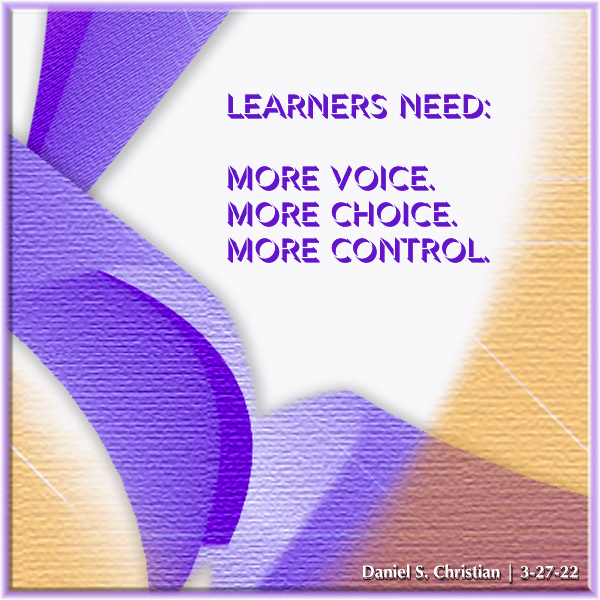
Learners need: More voice. More choice. More control. -- this image was created by Daniel Christian


From DSC:
After seeing Sam’s posting below, I can’t help but wonder:

  • How might the memory of an AI over time impact the ability to offer much more personalized learning?
  • How will that kind of memory positively impact a person’s learning-related profile?
  • Which learning-related agents get called upon?
  • Which learning-related preferences does a person have while learning about something new?
  • Which methods have worked best in the past for that individual? Which methods didn’t work so well with him or her?


Do I Need a Degree in Instructional Design? It Depends. — from teamedforlearning.com

It’s a common question for those considering a career in instructional design: Do I need a degree to land a job? The answer? It depends.

Hiring managers aren’t just looking for a degree—they want proof that you have the knowledge, skills, and abilities to succeed. In fact, most employers focus on 3 key factors when assessing candidates. You typically need at least 2 of these to be considered:

  1. A Credential – A degree or certification in instructional design, learning experience design, or a related field.
  2. Relevant Work Experience – Hands-on experience designing and developing learning solutions.
  3. Proof of Abilities – A strong portfolio showcasing eLearning modules, course designs, or learning strategies.

The good news? You don’t have to spend years earning a degree to break into the field. If you’re resourceful, you can fast-track your way in through volunteer projects, contract work, and portfolio building.

Whether you’re a recent graduate, a career changer, or a working professional looking for your next opportunity, focusing on these key factors can help you stand out and get hired.


The 2025 AI Index Report — from Stanford University’s Human-Centered Artificial Intelligence Lab (hai.stanford.edu); item via The Neuron

Top Takeaways

  1. AI performance on demanding benchmarks continues to improve.
  2. AI is increasingly embedded in everyday life.
  3. Business is all in on AI, fueling record investment and usage, as research continues to show strong productivity impacts.
  4. The U.S. still leads in producing top AI models—but China is closing the performance gap.
  5. The responsible AI ecosystem evolves—unevenly.
  6. Global AI optimism is rising—but deep regional divides remain.
  7. …and several more

Also see:

The Neuron’s take on this:

So, what should you do? You really need to start trying out these AI tools. They’re getting cheaper and better, and they can genuinely help save time or make work easier—ignoring them is like ignoring smartphones ten years ago.

Just keep two big things in mind:

  1. Making the next super-smart AI costs a crazy amount of money and uses tons of power (seriously, they’re buying nuclear plants and pushing coal again!).
  2. Companies are still figuring out how to make AI perfectly safe and fair—cause it still makes mistakes.

So, use the tools, find what helps you, but don’t trust them completely.

We’re building this plane mid-flight, and Stanford’s report card is just another confirmation that we desperately need better safety checks before we hit major turbulence.


Addendum on 4/16:

 
© 2025 | Daniel Christian