New Study: Business As Usual Could Doom Dozens Of New England Colleges — from forbes.com by Michael B. Horn

The cause of the challenges isn’t one single factor, but a series of pressures from demographic changes, shifts in the public’s perception of higher education’s value, rising operating costs, emerging alternatives to traditional colleges, and, of late, changes in federal policies and programs. The net effect is that many institutions are much closer to the brink of closure than ever before.

What’s daunting is that flat enrollment is almost certainly an overly optimistic scenario.

If enrollment at the 44 schools falls by 15 percent over the next four years and business proceeds as usual, then 28 of the schools will have less than 10 years of cash and unrestricted quasi-endowments before they would become insolvent—assuming no major cuts, additional philanthropy, new debt, or asset sales. Fourteen would have less than five years before insolvency.

Also see:

From DSC:
The cultures at many institutions of traditional higher education will make some of the necessary changes and strategies (that Michael and Steven discuss) very hard to make. For example, to merge with another institution or institutions. Such a strategy could be very challenging to implement, even as alternatives continue to emerge.


Six Transformative Technology Trends Impacting the Legal Profession — from americanbar.org

Summary

  • Law firm leaders should evaluate their legal technology and decide if they are truly helping legal work or causing a disconnect between human and AI contributions.
  • 75% of firms now rely on cloud platforms for everything from document storage to client collaboration.
  • The rise of virtual law firms and remote work is reshaping the profession’s culture. Hybrid and remote-first models, supported by cloud and collaboration tools, are growing.

Are we truly innovating, or just rearranging the furniture? That’s the question every law firm leader should be asking as the legal technology landscape shifts beneath our feet. There are many different thoughts and opinions on how the legal technology landscape will evolve in the coming years, particularly regarding the pace of generative AI-driven changes and the magnitude of these changes.

To try to answer the question posed above, we looked at six recently published technology trends reports from influential entities in the legal technology arena: the American Bar Association, Clio, Wolters Kluwer, Lexis Nexis, Thomson Reuters, and NetDocuments.

When we compared these reports, we found them to be remarkably consistent. While the level of detail on some topics varied across the reports, they identified six trends that are reshaping the very core of legal practice. These trends are summarized in the following paragraphs.

  1. Generative AI and AI-Assisted Drafting …
  2. Cloud-Based Practice Management…
  3. Cybersecurity and Data Privacy…
  4. Flat Fee and Alternative Billing Models…
  5. Legal Analytics and Data-Driven Decision Making…
  6. Virtual Law Firms and Remote Work…
 

Proverbs 10:12

Hatred stirs up conflict, but love covers over all wrongs.

Proverbs 9:10

The fear of the Lord is the beginning of wisdom, and knowledge of the Holy One is understanding.

Hebrews 4:12

For the word of God is alive and active. Sharper than any double-edged sword, it penetrates even to dividing soul and spirit, joints and marrow; it judges the thoughts and attitudes of the heart.

Proverbs 11:1

The LORD detests dishonest scales, but accurate weights find favor with him.


From DSC:
As a relevant aside, the following article made me think about some of the reasons why the LORD used parables/stories to speak to the people:

The 2-Minute Story That Saved My Career: How Storytelling Can Be The Most Effective Form of Feedback — from techlearning.com by Michael Gaskell
By harnessing the power of story, school leaders can create a culture in which feedback is embraced as an essential ingredient for growth

The Storytelling Approach
Sharing stories is effective because it seems to get around our defensiveness. When information is presented in a story form, people reason about it differently than if it were presented as a list of facts or a direct critique.

Here’s more of why and then how to implement it with success in your school leadership work.

1. Transportation and Distancing: Listening to a story pulls us out of a defensive mode (the “do I agree or do I disagree?” mindset) and into a thoughtful, observant framework. Being transported allows the individual to identify with others in a way that is different from experiencing the situation for themselves. It’s a third-person, objective mindset, a safe zone for people to evaluate a situation from.

2. Shifting Perspective: When individuals consider challenges from the perspective of someone who is not them, it dramatically alters their thinking. They gain the latitude and freedom to consider the available options without feeling personally attacked. That wise sage did this when he shared his story of struggling. Making it safe and helping me to see him as having an objective, difficult experience is why when I was able to take the perspective of a distanced other. It became easier to think about the situation in a wiser way and come up with a better solution.

3. Engaging Different Brain Systems: Fundamentally different pathways are triggered when processing stories compared to facts. Storytelling engages social relevance brain systems–those that help us understand what other people think and feel, such as empathy, another higher order processing mechanism.


The 2025 Changing Landscape of Online Education (CHLOE) 10 Report — from qualitymatters.org; emphasis below from DSC

Notable findings from the 73-page report include: 

  • Online Interest Surges Across Student Populations: 
  • Institutional Preparedness Falters Amid Rising Demand: Despite accelerating demand, institutional readiness has stagnated—or regressed—in key areas.
  • The Online Education Marketplace Is Increasingly Competitive: …
  • Alternative Credentials Take Center Stage: …
  • AI Integration Lacks Strategic Coordination: …

Just 28% of faculty are considered fully prepared for online course design, and 45% for teaching. Alarmingly, only 28% of institutions report having fully developed academic continuity plans for future emergency pivots to online.


Also relevant, see:


Great Expectations, Fragile Foundations — from onedtech.philhillaa.com by Glenda Morgan
Lessons about growth from the CHLOE & BOnES reports

Cultural resistance remains strong. Many [Chief Online Learning Officers] COLOs say faculty and deans still believe in-person learning is “just better,” creating headwinds even for modest online growth. As one respondent at a four-year institution with a large online presence put it:

Supportive departments [that] see the value in online may have very different levels of responsiveness compared to academic departments [that] are begrudgingly online. There is definitely a growing belief that students “should” be on-ground and are only choosing online because it’s easy/ convenient. Never mind the very real and growing population of nontraditional learners who can only take online classes, and the very real and growing population of traditional-aged learners who prefer online classes; many faculty/deans take a paternalistic, “we know what’s best” approach.


Ultimately, what we need is not just more ambition but better ambition. Ambition rooted in a realistic understanding of institutional capacity, a shared strategic vision, investments in policy and infrastructure, and a culture that supports online learning as a core part of the academic mission, not an auxiliary one. It’s time we talked about what it really takes to grow online learning , and where ambition needs to be matched by structure.

From DSC:
Yup. Culture is at the breakfast table again…boy, those strategies taste good.

I’d like to take some of this report — like the graphic below — and share it with former faculty members and members of a couple of my past job families’ leadership. They strongly didn’t agree with us when we tried to advocate for the development of online-based learning/programs at our organizations…but we were right. We were right all along. And we were LEADING all along. No doubt about it — even if the leadership at the time said that we weren’t leading.

The cultures of those organizations hurt us at the time. But our cultivating work eventually led to the development of online programs — unfortunately, after our groups were disbanded, they had to outsource those programs to OPMs.


Arizona State University — with its dramatic growth in online-based enrollments.


1 in 2 graduates believe their college major didn’t prepare them for today’s market — from hrdive.com by Carolyn Crist
Respondents said they felt unprepared in numerous ways, especially finding a job after graduation and navigating student debt and personal finances.

As today’s college graduates struggle to start a steady career, 1 in 2 Americans say their college major didn’t prepare them for the job market, according to a June 18 report from Preply.

Beyond that, 1 in 6 Americans who went to college said they regret it. When thinking about their college experience, college graduates said their top regrets included taking out student loans, not networking more and not doing internships.

College graduates said they felt unprepared in numerous ways, especially finding a job after graduation and navigating student debt and personal finances. 

From DSC:
The Career Placement Office at Northwestern University did not help build my skills to get a job, at all. I had no clue what I was doing. I had no idea what networking was even about, nor the power of it, and why it would be useful throughout my career. They provided conference rooms for interviews to occur…and that was about it, at least in my experience. In terms of my education, I didn’t get any real-world experience (such as apprenticeships, internships, capstone courses, etc.), nor did I pick up many practical or technical skills. 


Driving Culture Change in Higher Education — from jeffselingo.com by Jeff Selingo

The call for transformation in higher education has never been louder, yet the path forward remains unclear for many institutions. Leaders often struggle with the “how” of meaningful change. This five-part playbook by higher education author and strategist Jeff Selingo as well as other experts draws on proven methodologies to provide clear, actionable guidance from mapping current institutional culture to sustaining long-term momentum.


Employers’ emphasis on skilled trades lost on Gen Z: Harris poll — from facilitiesdive.com
Young workers don’t realize going into the trades can offer good pay more quickly than pursuing a college-based career, the report says.

A mismatch exists between the importance employers are putting on skilled trades and how the generation that’s newly joining the workforce views those jobs, a Harris poll finds.

Gen Z, the oldest members of which are 28, is the age cohort least focused on skilled trades, in part because they’re misinformed about the jobs, says the report based on 2,200 respondents to survey questions posted online in June.

“Only 38% of Gen Z says skilled trades offer the best job opportunities today” and “only 36% strongly agree skilled trades offer a faster and more affordable path to a good career,” the report says.


From DSC:
Forgive us world for our current President, who stoops to a new low almost every day. Below is yet another example of that. He’s an embarrassment to me and to many others in our nation. He twists truths into lies, and lies into “truths” (such as he does on “Truth” Social). Lies are his native tongue. (To those who know scripture, this is an enlightening and descriptive statement.)

And speaking of matters of faith, I think God is watching us closely, as numerous moral/ethical tests are presented to our society and to our culture. How will we and our leadership respond to these tests?

For examples:

  • Are we joining the mockery of justice in our country, or are we fighting against these developments?
  • Do we support it when Trump makes a fake video of a former President, or do we find it reprehensible? Especially when we realize it’s yet another attempt at deflecting our attention away from where Trump does NOT want our attention to be –> i.e., away from Trump’s place within the Epstein files.

Trump Posts Fake Video Showing Obama Arrest — from nytimes.com by Matthew Mpoke Bigg; this is a gifted article
President Trump shared what appeared to be an A.I.-generated video of former President Barack Obama being detained in the Oval Office.

President Trump reposted a fake video showing former President Barack Obama being arrested in the Oval Office, as Trump administration officials continue to accuse Mr. Obama of trying to harm Mr. Trump’s campaign during the 2016 election, and the president seeks to redirect conversation from the Epstein files.

The short video, which appears to have been generated by artificial intelligence and posted on TikTok before being reposted on Mr. Trump’s Truth Social account on Sunday…

The fake video purports to show F.B.I. agents bursting into the meeting, pushing Mr. Obama into a kneeling position and putting him in handcuffs as Mr. Trump looks on smiling, while the song “Y.M.C.A.” by the Village People plays. Later, the fake video shows Mr. Obama in an orange jumpsuit pacing in a cell. 

Also relevant/see:

Trump Talks About Anything but Epstein on His Social Media Account — from nytimes.com by Luke Broadwater; this is a gifted article
On Truth Social, the president railed against Democrats and shared a wacky video.

Dogged for weeks over his administration’s refusal to release the Epstein files, President Trump spent the weekend posting on social media about, well, anything else.

On Sunday, the president railed against Senator Adam Schiff, Democrat of California, long a prime target. He attacked Samantha Power, the former administrator of U.S.A.I.D. He posted a fake video of former President Barack Obama being arrested and a fake photo of Mr. Obama and members of his administration in prison garb. He threatened to derail a deal for a new football stadium for the Washington Commanders if the team did not take back its old name, the Redskins.


Multiple Countries Just Issued Travel Warnings for the U.S. — from mensjournal.com by Rachel Dillin
In a rare reversal, several of America’s closest allies are now warning their citizens about traveling to the U.S., and it could impact your next trip.

For years, the U.S. has issued cautionary travel advisories to citizens heading overseas. But in a surprising twist, the roles have flipped. Several countries, including longtime allies like Australia, Canada, and the U.K., are now warning their citizens about traveling to the United States, according to Yahoo.

Australia updated its advisory in June, flagging gun violence, civil protests, and unpredictable immigration enforcement. While its guidance remains at Level 1 (“exercise normal safety precautions”), Australian officials urged travelers to stay alert in crowded places like malls, transit hubs, and public venues. They also warned about the Visa Waiver Program, noting that U.S. authorities can deny entry without explanation.

From DSC:
I’ve not heard of a travel warning against the U.S. in my lifetime. Thanks Trump. Making America Great Again. Sure thing….


In Iowa, Trump Begins Task of Selling His Bill to the American Public — from nytimes.com by Tyler Pager
President Trump has spent days cajoling Republicans to support his spending bill. He will also have to sell it to a skeptical public as Democrats focus on all the ways it helps the wealthy.

President Trump took a victory lap on Thursday night after the House passed his sprawling domestic policy bill, which he muscled through Congress even as many in his party fear it will leave them vulnerable to political attacks ahead of next year’s midterm elections. (From DSC: Which it likely will do just that, and very possibly way beyond the midterm elections also.)

Just 29 percent of voters support the legislation, according to a recent Quinnipiac University poll. Roughly two-thirds of Republicans supported the bill in that poll, a relatively low figure from the president’s own party for his signature legislation, and independents opposed it overwhelmingly.


From DSC:
Did you get that? Just ***29%*** of voters supported the legislation. But it passed anyway. I’m left thinking…so much for democracy. And I’m also disheartened by the caving of the other two branches of our government. The lack of leadership is staggering. But I guess when you remove all leaders that oppose your way of thinking, you have only Yes men/followers and Yes women/followers left. It’s taken years for the Republican Party to carefully orchestrate the ownership of those other branches. (BTW, I celebrate the handful of Republican leaders in the Senate like Sen. Thom Tillis and in the House who did not cave to Trump and Johnson, but instead voted with their own hearts and minds. They showed true strength of conviction and courage. It will likely cost them, but they can look in the mirror and feel good about themselves and what they’ve done.)

Look out Republicans (and I’ve voted for both Republican and Democrat Presidents in the past). Perhaps July 4th, 2025 will mark the downfall of the Republican Party in America. Time will tell. But I’m hopeful that we can find more common ground.

Regardless, it says a lot about who we, as Americans, are these days — that he’s even in the presidency. I highly doubt he would have been there even a generation or two ago. We’re a nation in decline. It’s been hard to watch this through the years. I’m no saint, but I’m also not the President.

Speaking of matters of faith…I can’t help but wonder what the LORD is doing in this. Is He humbling America or is it something far worse…? He’s justified in whatever He has decided to do. Americans have been dissing Him for decades, while refusing to give Him the credit due His Name. Time will tell my friends…time will tell.


Also see:

The House passed a sweeping bill to extend tax cuts and slash social safety net programs. The budget office reported the measure would increase U.S. national debt by at least $3.4 trillion over a decade.

Kenny Holston/The New York Times

Also see:

To get his bill over the line in time for a self-imposed Friday deadline, Trump pressured Republican lawmakers to set aside their concerns about the political consequences of yanking benefits from voters while adding trillions to the federal deficit.


From DSC:
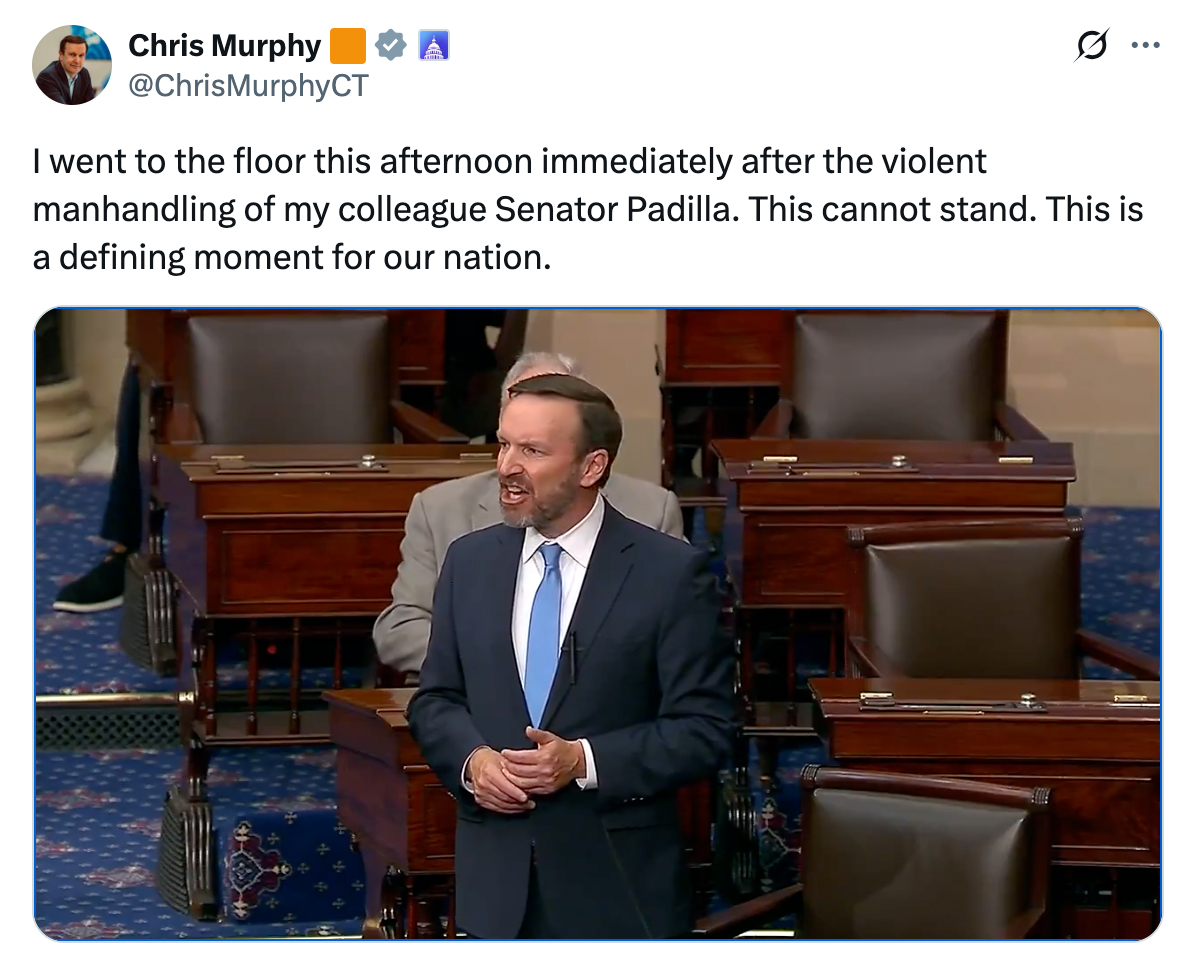
As you can see and hear below, Senator Alex Padilla had been trying to get answers for several weeks now from Homeland Security, but wasn’t hearing much back. So he heard that the Secretary of Homeland Security, Kristi Noem, was holding a press conference down the hallway and he attended it to see if he could get some answers to his questions. And while I don’t have all the details on how this situation unfolded, there is NO WAY that a U.S. Senator should be pushed out of a conference room and then pushed to the ground and handcuffed for trying to get answers for his constituents! No way!

As others in the videos below assert, a line has been crossed in our country!

Let’s move to impeach Donald Trump and also rid his administration of these incompetent individuals who are destroying our democracy! If they don’t like the Constitution and how our country has been governed for over 200 years, then perhaps they should consider leaving this country. 

The actions they are taking are NOT making America great again. They are making America the stench of the world.

And it’s not just Donald Trump and members of his administration that should be held accountable. Let’s also start holding Donald’s instruments of power — such as his ICE Agents and others who behave like them — accountable. To any ICE agents out there, take those damn masks off. You shouldn’t be hiding behind masks.

By the way, the silence from the Republicans is deafening.
.


Calif. Senator Forcibly Removed and Handcuffed After Interrupting Noem — from nytimes.com by Shawn Hubler, Jennifer Medina, and Jill Cowan (this is a gifted article)
Alex Padilla, Democrat of California, was shoved out of a room and handcuffed after he tried to question Kristi Noem, the homeland security secretary, during a news conference.

In the tense hyperpartisanship of the moment, the episode quickly swelled into a cause célèbre for both parties. Democratic senators, House members and governors rushed to denounce the treatment of a sitting senator, framing it as the latest escalation in authoritarian actions by the Trump administration. It followed the indictment on Tuesday of Representative LaMonica McIver of New Jersey and the arrest of Mayor Ras Baraka of Newark, after the officials, both Democrats, tried to visit a new immigration detention facility in the city.

Republicans just as eagerly tried to frame Mr. Padilla’s behavior as in line with what they have called the lawlessness of the political left as President Trump tries to combat illegal immigration.


Cultivating a responsible innovation mindset among future tech leaders — from timeshighereducation.com by Andreas Alexiou
The classroom is a perfect place to discuss the messy, real-world consequences of technological discoveries, writes Andreas Alexiou. Beyond ‘How?’, students should be asking ‘Should we…?’ and ‘What if…?’ questions around ethics and responsibility

University educators play a crucial role in guiding students to think about the next big invention and its implications for privacy, the environment and social equity. To truly make a difference, we need to bring ethics and responsibility into the classroom in a way that resonates with students. Here’s how.

Debating with industry pioneers on incorporating ethical frameworks in innovation, product development or technology adoption is eye-opening because it can lead to students confronting assumptions they hadn’t questioned before. For example, students could discuss the roll-out of emotion-recognition software. Many assume it’s neutral, but guest speakers from industry can highlight how cultural and racial biases are baked into design decisions.

Leveraging alumni networks and starting with short virtual Q&A sessions instead of full lectures can work well.


Are we overlooking the power of autonomy when it comes to motivating students? — from timeshighereducation.com by Danny Oppenheimer
Educators fear giving students too much choice in their learning will see them making the wrong decisions. But structuring choice without dictating the answers could be the way forward

So, how can we get students to make good decisions while still allowing them agency to make their own choices, maintaining the associated motivational advantages that agency provides? One possibility is to use choice architecture, more commonly called “nudges”: structuring choices in ways that scaffold better decisions without dictating them.

Higher education rightly emphasises the importance of belonging and mastery, but when it ignores autonomy – the third leg of the motivational tripod – the system wobbles. When we allow students to decide for themselves how they’ll engage with their coursework, they consistently rise to the occasion. They choose to challenge themselves, perform better academically and enjoy their education more.


Opinions | This Baltimore program shows how to fight generational poverty – from washingtonpost.com by Leana S. Wen; this is a gifted article
How one grassroots organization is teaching young people leadership skills and giving them hope.

She recognized their desperation and felt called to return and use what she had learned to help them realize a different future. So she set up an organization, HeartSmiles, to do just that — one young person at a time.

Holifield’s experience is one that city officials and public health workers can learn from. If they want to disrupt the generational cycle of poverty, trauma and hopelessness that afflicts so many communities, a good place to focus their efforts is children.

How can communities overcome inertia and resignation? Holifield’s organization starts with two core interventions. The first is career and leadership development. Children as young as 8 go to the HeartSmiles center to participate in facilitated sessions on youth entrepreneurship, budgeting and conflict resolution. Those who want to explore certain career paths are matched with professionals in these fields.

The second part of her vision is youth-led mentorship, which involves pairing young people with those not much older than they are. 


Also relevant/see:

Lost boys, trapped men, and the role of lifers in prison education — from college-inside.beehiiv.com by Charlotte West

This week, we’re publishing Part 2 of a Q&A with Erik Maloney, a lifer in Arizona, and Kevin Wright, a criminal justice professor at Arizona State University. They co-authored Imprisoned Minds, a book about trauma and healing published in December 2024, over the course of seven years. Check out Part 1 of the Q&A.

West: The fact that you created your own curriculum to accompany the book makes me think about the role of lifers in creating educational opportunities in prisons. What do you see as the role of lifers in filling some of these gaps?

Maloney
: I’ve said for years that lifers are so underutilized in prison. It’s all about punishment for what you’re in for, and [the prison system] overlooks us as a resource. We are people who, if allowed to be educated properly, can teach courses indefinitely while also being a role model for those with shorter sentences. This gives the lifer meaning and purpose to do good again. He serves as a mentor, whether he likes it or not, to [those] people coming into the prisons. When they see him doing well, it inspires others to want to do well.

But if it’s all about punishment, and a person has no meaning and no purpose in life, then all they have is hopelessness. With hopelessness comes despair, and with despair, you have rampant drug and alcohol abuse in prison, and violence stems from that.


Summers Says Harvard Student Ban ‘The Stuff of Tyranny’ — from bloomberg.com

Former US Treasury Secretary Lawrence Summers blasted the Trump administration’s decision to block Harvard University from enrolling international students, calling on the institution to fight back. “This is vicious, it is illegal, it is unwise, and it is very damaging,” Summers, who is president emeritus of Harvard University, told Bloomberg TV. “Why does it make any sense at all to stop 6,000 enormously talented young people who want to come to the United States to study from having that opportunity?” “Harvard must start by resisting,” he said. “This is the stuff of tyranny.” Summers spoke to Bloomberg’s David Ingles on “The China Show.” (Source: Bloomberg)


GIFTED ARTICLE

Trump Administration Says It Is Halting Harvard’s Ability to Enroll International Students
The move was a major escalation in the administration’s efforts to pressure the college to fall in line with President Trump’s demands.

The Trump administration on Thursday said it would halt Harvard University’s ability to enroll international students, taking aim at a crucial funding source for the nation’s oldest and wealthiest college in a major escalation of the administration’s efforts to pressure the elite school to fall in line with the president’s agenda.

The administration notified Harvard about the decision — which could affect about a quarter of the school’s student body — after a back-and-forth in recent weeks over the legality of a sprawling records request as part of the Department of Homeland Security’s investigation, according to three people with knowledge of the negotiations. The people spoke on the condition of anonymity because they were not authorized to discuss the matter publicly.


From DSC:
We had better not lose the rule of law in the United States! Donald Trump is an enormous threat to our constitutional democracy! He has NO respect for the rule of law, the judicial branch of our government, our constitution, telling the truth, or having virtues and strong character. He is a threat to the entire world. People are already feeling that in their wallets, purses, and 401(k)s. Supply chains throughout the globe have been negatively impacted. Many have lost their jobs, and more people will likely lose their jobs as a recession is becoming increasingly likely as each day passes.

At minimum, the USA has lost the respect and goodwill of many nations. And I understand why


From Bloomberg on 4/11/25:

The Trump administration, which admitted to wrongly sending a man to a notorious prison in El Salvador (violating a court order in the process) and declined to try and get him back, on Friday went a step further. Lawyers for Trump, despite an order by the US Supreme Court, refused to tell a federal judge where the man was or what it’s doing to get him back. A federal judge, following the Supreme Court’s direction, set a deadline today for Trump’s lawyers to explain how the government planned to follow the high court’s ruling. Trump’s lawyers rejected the court’s order, saying it didn’t have enough time, and questioned her authority.

The Supreme Court ruling against Trump was one of his first defeats tied to the administration’s attempt to broadly expand executive powers. It followed a series of recent procedural rulings that saw the Republican-appointee controlled court rule in his favor. But this latest refusal by Justice Department lawyers to fully comply with court orders, unlike previous cases tied to Trump policies, directly implicates a ruling from the highest court in the land, intensifying an ongoing and unprecedented constitutional crisis between the two branches of government.


Link to this item on LinkedIn


Addendum on 4/17 from DSC:
And speaking of the rule of law…what in the world does a President of the U.S. have to do with which cases law firms can and can’t take up? That’s not his job. Yet he threatens people, law firms, universities, and others to do his will or face the consequences (normally, that has to do with withdrawing funding or getting fired). One billion dollars worth of legal services donated to causes that Trump supports?!?!?! WHAT? 

Trump announces deals with more law firms for a combined $600 million — from washingtonpost.com by Mark Berman
Firms seeking to avoid sanctions from President Donald Trump have agreed to provide nearly ***$1 billion*** in legal services to causes he supports.

President Donald Trump on Friday announced that he had reached agreements with five more law firms pledging to provide a combined $600 million in legal services for causes he supports, the latest deals firms have struck with him in apparent bids to avoid punishment.

Since February, Trump has issued several executive orders sanctioning prominent law firms with ties to his political adversaries or that had opposed his policies, seeking to strip them of government contracts and block them from federal buildings. Three firms targeted by Trump have sued to fight back, while several others made deals with Trump that some framed as necessary to keep their businesses afloat. A fourth firm filed a lawsuit Friday evening challenging Trump’s actions.


Addendum from Above the Law on 4/17/25:

Biglaw Is Under Attack. Here’s What The Firms Are Doing About It.
Introducing the Biglaw Spine Index.

The President of the United States is using the might and power of the office to attack Biglaw firms and the rule of law. It’s pretty chilling stuff that is clearly designed to break major law firms and have them bend a knee to Trump or extract a tremendous financial penalty. This is an assault not just on the firms in the crosshairs, but on the very rule of law that is the backbone of our nation, without which there’s little to check abuses of power.

But in the face of financial harm, too many firms are willing to proactively seek out Trump’s seal of approval and provide pro bono payola, that is, free legal services on behalf of conservative clients or causes in order to avoid Trumpian retribution. So we here at Above the Law have decided to track what exact Biglaw firms are doing in response to the bombardment on Biglaw and the legal system. Some have struck a deal with Trump, some are fighting in court, some have signed an amicus brief in the Perkins Coie case, but the overwhelming majority have stayed silent.


Addendum from Bloomberg on 4/16/25:

The Trump administration’s resistance to and in some cases rejection of the federal judiciary’s constitutional powers has earned it its first finding of contempt, a grave escalation in the deepening crisis at the heart of American government. A federal judge who had been repeatedly attacked by Trump and his aides found there is “probable cause” to hold administration officials in criminal contempt of court for sending scores of men and boys to an El Salvador prison despite his order to halt the deportations. The administration has claimed without providing evidence that the deportees are gang members. A Bloomberg investigation revealed the vast majority had never been charged in the US with anything other than immigration or traffic violations. A Maryland US senator meanwhile was turned away from meeting with a man imprisoned in El Salvador who the Trump administration illegally deported and now refuses to bring back—despite a US Supreme Court order that it facilitate his return.


The following resource was from Roberto Ferraro:

Micromanagement — from psychsafety.com by Jade Garratt

Psychological Safety and Micromanagement
Those who have followed our work at Psych Safety for a while will know that we believe exploring not just what to do – the behaviours and practices that support psychological safety – but also what to avoid can be hugely valuable. Understanding the behaviours that damage psychological safety, what not to do, and even what not to say can help us build better workplaces.

There are many behaviours that damage psychological safety, and one that almost always comes up in our workshops when discussing cultures of fear is micromanagement. So we thought it was time we explored micromanagement in more detail, considering how and why it damages psychological safety and what we can do instead.

Micromanagement is a particular approach to leadership where a manager exhibits overly controlling behaviours or an excessive and inappropriate focus on minor details. They might scrutinise their team’s work closely, insist on checking work, refrain from delegating, and limit the autonomy people need to do their jobs well. It can also manifest as an authoritarian leadership style, where decision-making is centralised (back to themselves) and employees have little say in their work.


From DSC:
I was fortunate to not have a manager who was a micromanager until my very last boss/supervisor of my career. But it was that particular manager who made me call it quits and leave the track. She demeaned me in front of others, and was extremely directive and controlling. She wanted constant check-ins and progress reports. And I could go on and on here. 

But suffice it to say that after having worked for several decades, that kind of manager was not what I was looking for. And you wouldn’t be either. By the way…my previous boss — at the same place — and I achieved a great deal in a very short time. She taught me a lot and was a great administrator, designer, professor, mentor, and friend. But that boss was moved to a different role as upper management/leadership changed. Then the micromanagement began after I reported to a different supervisor.

Anyway, don’t be a micromanager. If you are a recent graduate or are coming up on your graduation from college, learn that lesson now. No one likes to work for a micromanager. No one. It can make your employees’ lives miserable and do damage to their mental health, their enjoyment (or lack thereof) of work, and several other things that this article mentions. Instead, respect your employees. Trust your employees. Let them do their thing. See what they might need, then help meet those needs. Then get out of their way.


© 2025 | Daniel Christian