45 Next Generation Learning Tools That Kids Will Love — from ireviews.com with thanks to Alex Ward for this resource

Excerpts:

There’s a wide range of tools designed to support curriculum and help teachers and students achieve their goals. These are our top picks for school students of every age, due to their impressive functionality and simple integration into the classroom.


From DSC:
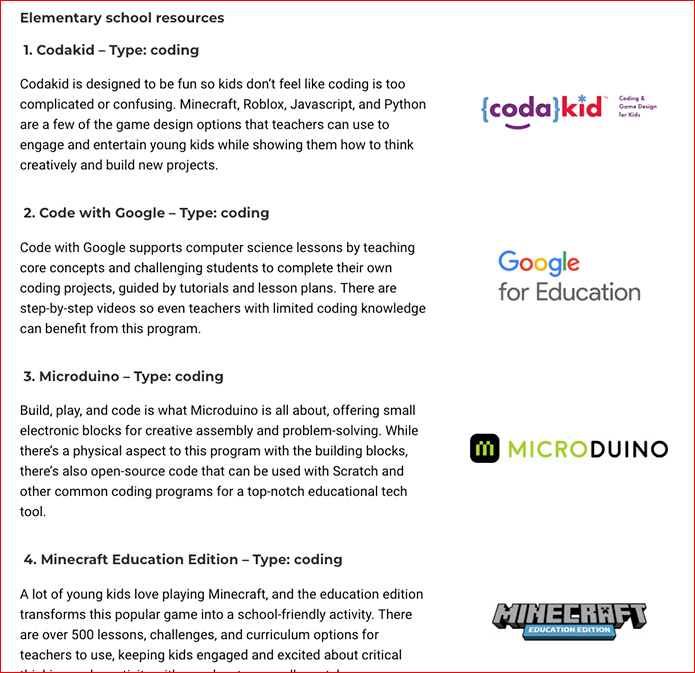
Below is a sample screenshot from the Elementary school resources section. They also have resources for middle schoolers and high schoolers.


45 Next Generation Learning Tools That Kids Will Love


Technology Trends for 2022 — from oreilly.com
What O’Reilly Learning Platform Usage Tells Us About Where the Industry Is Headed

Excerpt:

It’s been a year since our last report on the O’Reilly learning platform. Last year we cautioned against a “horse race” view of technology. That caution is worth remembering: focus on the horse race and the flashy news and you’ll miss the real stories. While new technologies may appear on the scene suddenly, the long, slow process of making things that work rarely attracts as much attention. We start with an explosion of fantastic achievements that seem like science fiction—imagine, GPT-3 can write stories!—but that burst of activity is followed by the process of putting that science fiction into production, of turning it into real products that work reliably, consistently, and fairly. AI is making that transition now; we can see it in our data. But what other transitions are in progress? What developments represent new ways of thinking, and what do those ways of thinking mean? What are the bigger changes shaping the future of software development and software architecture? This report is about those transitions.

O’Reilly Answers
We’re very excited about O’Reilly Answers, the newest product on the platform. Answers is an intelligent search that takes users directly to relevant content, whether that’s a paragraph from a book, a snippet of a video, or a block of code that answers a question. Rather than searching for an appropriate book or video and skimming through it, you can ask a specific question like “How do you flatten a list of lists in Python?” (a question I’ve asked several times). 


Also see:


Over Half of Students Surveyed See Coding Skills as Vital But Over a Third Lack Learning Access — from thejournal.com by Kristal Kuykendall

Excerpt:

A new survey by KX shows that over half of U.S. students ages 16–23 believe coding skills are as important as foreign language skills for future career prospects, yet more than a third say they lack educational access to coding programs


Announcing the 2022 AI Index Report — from hai.stanford.edu by Stanford University

Excerpt/description:

Welcome to the Fifth Edition of the AI Index

The AI Index is an independent initiative at the Stanford Institute for Human-Centered Artificial Intelligence (HAI), led by the AI Index Steering Committee, an interdisciplinary group of experts from across academia and industry. The annual report trackscollatesdistills, and visualizes data relating to artificial intelligence, enabling decision-makers to take meaningful action to advance AI responsibly and ethically with humans in mind.

The 2022 AI Index report measures and evaluates the rapid rate of AI advancement from research and development to technical performance and ethics, the economy and education, AI policy and governance, and more. The latest edition includes data from a broad set of academic, private, and non-profit organizations as well as more self-collected data and original analysis than any previous editions.

Also relevant/see:

  • Andrew Ng predicts the next 10 years in AI — from venturebeat.com by George Anadiotis
  • Nvidia’s latest AI wizardry turns 2D photos into 3D scenes in milliseconds — from thenextweb.com by Thomas Macaulay
    The Polaroid of the future?
    Nvidia events are renowned for mixing technical bravado with splashes of showmanship — and this year’s GTC conference was no exception. The company ended a week that introduced a new enterprise GPU and an Arm-based “superchip” with a trademark flashy demo. Some 75 years after the world’s first instant photo captured the 3D world in a 2D picture…

Nvidia believes Instant NeRF could generate virtual worlds, capture video conferences in 3D, and reconstruct scenes for 3D maps.


From DSC:
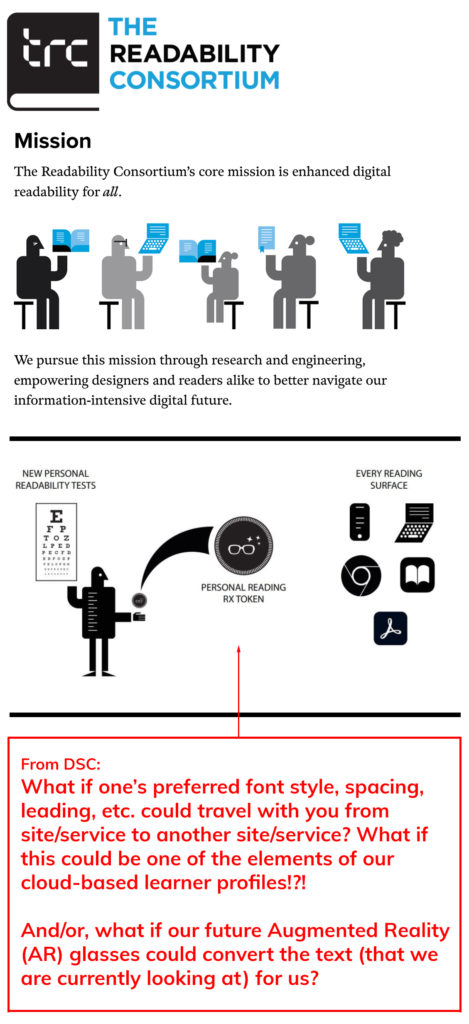
After checking out the following two links, I created the graphic below:

  1. Readability initiative > Better reading for all. — from Adobe.com
    We’re working with educators, nonprofits, and technologists to help people of all ages and abilities read better by personalizing the reading experience on digital devices.
  2. The Readability Consortium > About page


What if one's preferred font style, spacing, leading, etc. could travel with you from site to site? Or perhaps future AR glasses will be able to convert the text that we are looking at for us


Also related/see:


Accelerated Digital Skills and the ‘Bootcamp Boom’. — from holoniq.com
The market for accelerated digital skills is stepping up to a whole new level. Bootcamps, among others, are evolving rapidly to meet the opportunity.

Excerpt:

Tech Bootcamps re-skilled and up-skilled over 100,000 professionals globally in 2021, up from less than 20,000 in 2015. We expect this number to reach over 380,000 by 2025 representing over $3B of expenditure with significant upside as tech up-skilling models and modes overlap and converge. Governments, employers, universities and colleges everywhere are embracing rapid, high ROI training to build capacity in software, marketing, cyber and tech sales to drive their economies and growth.

Also from holoniq.com, see:

Also relevant/see:


Google wants 20,000 Americans to have higher-paying jobs — from protocol.com by Amber Burton
Google’s Career Certificate Fund is aimed at creating a sustainable model of support for American job seekers.

Excerpt:

The program is designed for students to pay zero upfront costs for the three to six-month courses, but Google certificate students are expected to repay program costs if they land a job that pays at least $40,000 annually. While the exact amount of the monthly payments was not shared in the announcement, Google said it will be low no-interest payments for Social Finance to reinvest in the program for additional participants.

Our new $100 million Google Career Certificates Fund — from blog.google by Sundar Pichai

It’s another promising example of how the entire ecosystem — from private companies to nonprofits — can work together to help more Americans access economic opportunities.

Addendum on 3/2/22:


AI Foundation Models for the Rest of Us — from future.a16z.com by Elliot Turner

Excerpt:

While 2012’s state-of-the-art systems could be trained on a $700 video game card, today’s state-of-the-art systems – often referred to as foundation models – likely require tens of millions of dollars in computation to train.

The emergence of these massive-scale, high-cost foundation models brings opportunities, risks, and limitations for startups and others that want to innovate in artificial intelligence and machine learning.


22 Augmented Reality Trends to Keep an Eye on for 2022 — from linkedin.com by Tom Emrich

Excerpts:

#1 Metaverse remains at peak hype as the next iteration of the Internet feels so close but is actually much further away

#2 The smartphone continues to become an even more powerful augmented reality machine with advancements in chips, displays and connectivity

#3 Early consumer smartglasses reinforce the need for smartphones rather than attempt to replace them

The metaverse is defined differently by different people but for me, the metaverse is an aha moment. It is a realization by industry that the next wave of computing is comprised of a stack of emerging technologies (including blockchain, AI, IoT, AR and VR) that will all work together to create a fundamental shift in our relationship with technology. 


Also see:


Skillsoft to acquire CodeAcademy, a leading platform for learning high-demand technical skills, creating a worldwide community of more than 85 million learners — from skillsoft.com with thanks to Ray Schroeder for this resource out on LinkedIn

Excerpts (emphasis DSC):

Boston – December 22, 2021 – Skillsoft (NYSE: SKIL), a global leader in corporate digital learning, today announced it has entered into a definitive agreement to acquire Codecademy, a leading online learning platform for technical skills, for approximately $525 million in cash and stock.

With the addition of Codecademy’s innovative capabilities, we will create an even more immersive online learning experience. When we combine Skillsoft’s enterprise customer base of more than 12,000 corporate customers and over 46 million learners with Codecademy’s 40 million learners, sophisticated digital marketing capability and influential brand, we expect to unlock significant revenue synergies.”

Expands Immersive Platform with New Ways of Learning. Skillsoft has already assembled an expansive set of learning options, including virtual instructor-led training, coaching, micro videos, audio, books, bootcamps, live events, assessments and badges. Together with Codecademy’s interactive, self-paced courses and hands-on learning, Skillsoft will be able to deliver even more immersive experiences through its AI-driven platform, Percipio.


A Move for ‘Algorithmic Reparation’ Calls for Racial Justice in AI — from wired.com by Khari Johnson
Researchers are encouraging those who work in AI to explicitly consider racism, gender, and other structural inequalities.

Excerpt:

FORMS OF AUTOMATION such as artificial intelligence increasingly inform decisions about who gets hired, is arrested, or receives health care. Examples from around the world articulate that the technology can be used to exclude, control, or oppress people and reinforce historic systems of inequality that predate AI.

“Algorithms are animated by data, data comes from people, people make up society, and society is unequal,” the paper reads. “Algorithms thus arc towards existing patterns of power and privilege, marginalization, and disadvantage.


Amazon Gift Signals Confidence in Community Colleges — from insidehighered.com by Suzanne Smalley
The company is giving $3 million to kick-start a computer science bachelor’s degree program at community and technical colleges throughout Washington State.

Excerpt:

Amazon is funding a pilot that will support the launch of new computer science bachelor’s degree programs at community and technical colleges in Seattle and across Washington State, an investment meant to address a workforce shortage plaguing the e-commerce giant and other employers who can’t find qualified candidates for unfilled computer science positions.


© 2025 | Daniel Christian