5 Legal Tech Trends Set to Impact Law Firms in 2025 — from programminginsider.com by Marc Berman

The legal industry is experiencing swift changes, with technology becoming an ever more crucial factor in its evolution. As law firms respond to shifting client demands and regulatory changes, the pace of change is accelerating. Embracing legal tech is no longer just an advantage; it’s a necessity.

According to a Forbes report, 66% of legal leaders acknowledge this trend and intend to boost their investments in legal tech moving forward. From artificial intelligence streamlining workflows to cloud computing enabling globalized legal services, the legal landscape is undergoing a digital revolution.

In this article, we’ll explore five key legal tech trends that will define how law firms operate in 2025.


GenAI, Legal Ops, and The Future of Law Firms: A Wake-Up Call? — from echlawcrossroads.com by Stephen Embry

A new study from the Blickstein Group reveals some distributing trends for law firms that represent businesses, particularly large ones. The Study is entitled  Legal Service Delivery in the Age of AI. The Study was done jointly by FTI Technologies, a consulting group, and Blickstein. It looks at law department legal operations.

The Findings

GenAI Use by Legal Ops Personnel

The responses reflect a bullish view of what GenAI can do in the legal marketplace but also demonstrate GenAi has a ways to go:

  • Almost 80% of the respondents think that GenAI will become an “essential part of the legal profession.
  • 81% believe GenAi will drive improved efficiencies
  • Despite this belief, only some 30% have plans to purchase GenAI tools. For 81%, the primary reason for obtaining and using GenAI tools is the efficiencies these tools bring.
  • 52% say their GenAI strategy is not as sophisticated as they would like or nonexistent.

The biggest barrier to the use of GenAI among the legal ops professions is cost and security concerns and the lack of skilled personnel available to them.


Voting Is Closed, Results Are In: Here are the 15 Legal Tech Startups Selected for the 2025 Startup Alley at ABA TECHSHOW — from lawnext.com by Bob Ambrogi

Voting has now closed and your votes have been tallied to pick the 15 legal tech startups that will get to participate as finalists in the ninth-annual Startup Alley at ABA TECHSHOW 2025, taking place April 2-5 in Chicago.

These 15 finalists will face off in an opening-night pitch competition that is the opening event of TECHSHOW, with the conference’s attendees voting at the conclusion of the pitches to pick the top winners.


Balancing innovation and ethics: Applying generative AI in legal work — from legal.thomsonreuters.com

Generative artificial intelligence (GenAI) has brought a new wave of opportunities to the legal profession, opening doors to greater efficiency and innovation. Its rapid development has also raised questions about its integration within the legal industry. As legal professionals are presented with more options for adopting new technologies, they now face the important task of understanding how GenAI can be seamlessly — and ethically — incorporated into their daily operations.


Emerging Trends in Court Reporting for 2025: Legal Technology and Advantages for Law Firms — from jdsupra.com

The court reporting industry is evolving rapidly, propelled by technological advancements and the increasing demand for efficiency in the legal sector. For 2025, trends such as artificial intelligence (AI), real-time transcription technologies, and data-driven tools are reshaping how legal professionals work. Here’s an overview of these emerging trends and five reasons law firms should embrace these advancements.

 

Market scan: What’s possible in the current skills validation ecosystem? — from eddesignlab.org
Education Design Lab provides an overview of emerging practices + tools in this 2025 Skills Validation Market Scan.

Employers and opportunity seekers are excited about the possibilities of a skills-based ecosystem, but this new process for codifying a person’s experiences and abilities into skills requires one significant, and missing, piece: Trust. Employers need to trust that the credentials they receive from opportunity seekers are valid representations of their skills. Jobseekers need to trust that their digital credentials are safe, accurate, and will lead to employment and advancement.

Our hypothesis
We posit that the trust needed for the validation of skills to be brought into a meaningful reality is established through a network of skills validation methods and opportunities. We also recognize that the routes through which an individual can demonstrate skills are as varied as the individuals themselves. Therefore, in order to equitably create a skills-based employment ecosystem, the routes by which skills are validated must be held together with common standards and language, but flexible enough to accommodate a multitude of validation practices.


The Learning & Development Global Sentiment Survey 2025 — from donaldhtaylor.co.uk by Don Taylor

The L&D Global Sentiment Survey, now in its 12th year, once again asked two key questions of L&D professionals worldwide:

  • What will be hot in workplace learning in 2025?
  • What are your L&D challenges in 2025?

For the obligatory question on what they considered ‘hot’ topics, respondents voted for one to three of 15 suggested options, plus a free text ‘Other’ option. Over 3,000 voters participated from nearly 100 countries. 85% shared their challenges for 2025.

The results show more interest in AI, a renewed focus on showing the value of L&D, and some signs of greater maturity around our understanding of AI in L&D.


Like it or not, AI is learning how to influence you — from venturebeat.com by Louis Rosenberg

Unfortunately, without regulatory protections, we humans will likely become the objective that AI agents are tasked with optimizing.

I am most concerned about the conversational agents that will engage us in friendly dialog throughout our daily lives. They will speak to us through photorealistic avatars on our PCs and phones and soon, through AI-powered glasses that will guide us through our days. Unless there are clear restrictions, these agents will be designed to conversationally probe us for information so they can characterize our temperaments, tendencies, personalities and desires, and use those traits to maximize their persuasive impact when working to sell us products, pitch us services or convince us to believe misinformation.
.


The Anthropic Economic Index — from anthropic.com; via George Siemens

In the coming years, AI systems will have a major impact on the ways people work. For that reason, we’re launching the Anthropic Economic Index, an initiative aimed at understanding AI’s effects on labor markets and the economy over time.

The Index’s initial report provides first-of-its-kind data and analysis based on millions of anonymized conversations on Claude.ai, revealing the clearest picture yet of how AI is being incorporated into real-world tasks across the modern economy.

We’re also open sourcing the dataset used for this analysis, so researchers can build on and extend our findings.


Half A Million Students Given ChatGPT As CSU System Makes AI History — from forbes.com by Dan Fitzpatrick

The California State University system has partnered with OpenAI to launch the largest deployment of AI in higher education to date.

The CSU system, which serves nearly 500,000 students across 23 campuses, has announced plans to integrate ChatGPT Edu, an education-focused version of OpenAI’s chatbot, into its curriculum and operations. The rollout, which includes tens of thousands of faculty and staff, represents the most significant AI deployment within a single educational institution globally.

We’re still in the early stages of AI adoption in education, and it is critical that the entire ecosystem—education systems, technologists, educators, and governments—work together to ensure that all students globally have access to AI and develop the skills to use it responsibly

Leah Belsky, VP and general manager of education at OpenAI.


HOW educators can use GenAI – where to start and how to progress — from aliciabankhofer.substack.com by Alicia Bankhofer
Part of 3 of my series: Teaching and Learning in the AI Age

As you read through these use cases, you’ll notice that each one addresses multiple tasks from our list above.

1. Researching a topic for a lesson
2. Creating Tasks For Practice
3. Creating Sample Answers
4. Generating Ideas
5. Designing Lesson Plans
6. Creating Tests
7. Using AI in Virtual Classrooms
8. Creating Images
9. Creating worksheets
10. Correcting and Feedback


What if students had the power to design their own learning journeys?

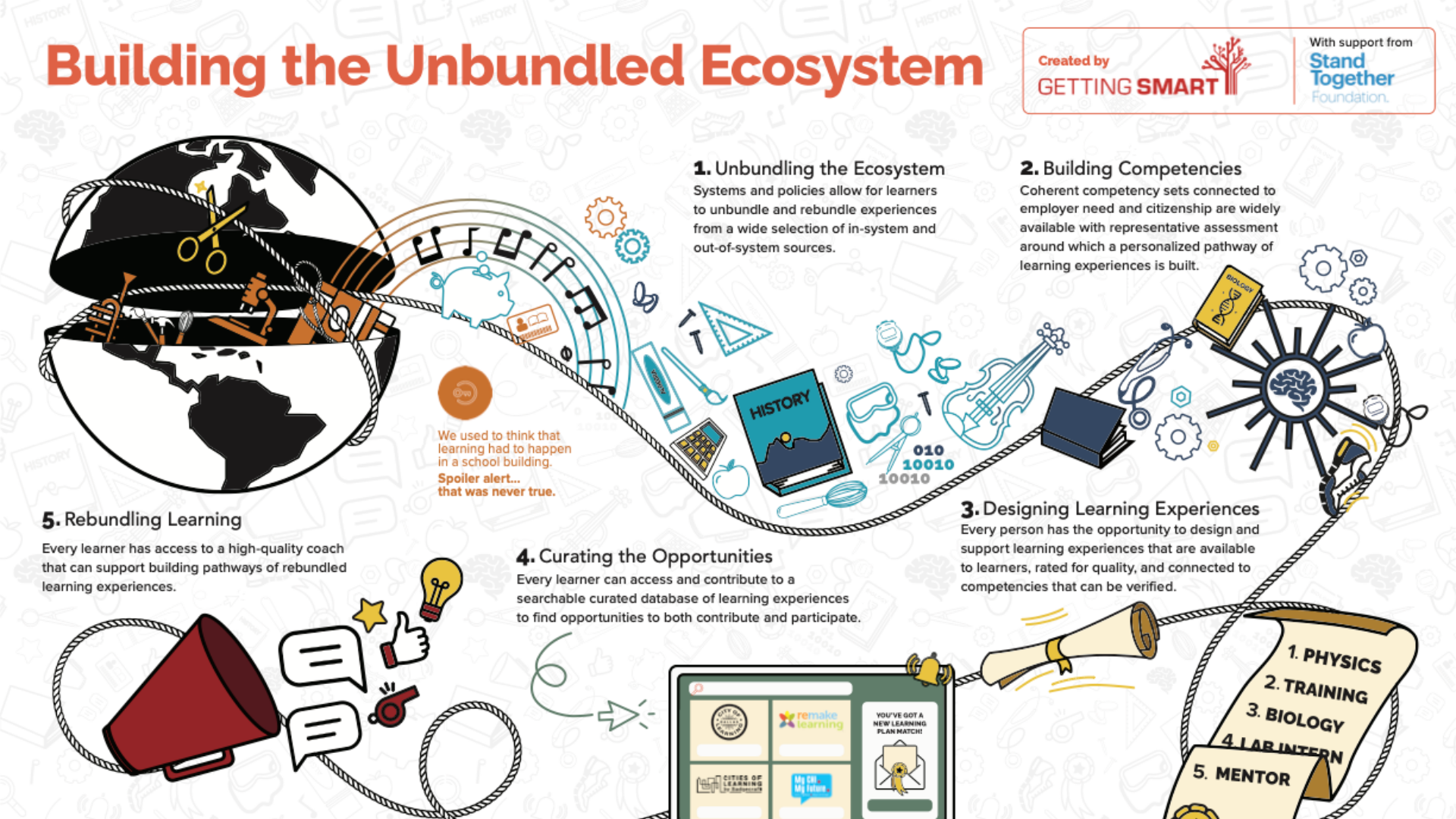
Across the U.S., states are moving beyond one-size-fits-all education and embracing unbundled learning, creating personalized pathways that equip students with the skills they need for the future. Getting Smart’s Unbundled Learning Podcast Series explores how Colorado, Arizona, and New Hampshire are leading the way—expanding real-world learning, shifting to competency-based models, empowering learner agency, and aligning education with workforce needs.

For policymakers, the newly released Policymaker’s Guide offers a roadmap for fostering unbundled systems. It highlights key priorities such as competency-driven accountability, flexible credentialing, and funding models that prioritize equity, helping state leaders create policies that expand opportunities for all learners.

Explore how unbundled learning is shaping the future of education and how states can build more personalized, future-ready systems.

New Pathways > Unbundled Learning — from gettingsmart.com
We used to think that learning had to happen in a school building. Spoiler alert…that was never true.

How might we create an ecosystem where learning doesn’t just happen at school? With Unbundled Learning, learners don’t need permission to have equitable experiences. Unbundled Learning removes all the barriers and allows learning to happen at school, after school, with industry partners and anywhere a learner can imagine. Unbundled Learning is the foundation for which new learning models are built, learners are supported and systems are scaled.

If we used to think that school was the only answer, now we know we have options.
.


Eight Legal Tech Trends Set To Impact Law Firms In 2025 — from forbes.com by Daniel Farrar

Trends To Watch This Year

1. A Focus On Client Experience And Technology-Driven Client Services
2. Evolution Of Pricing Models In Legal Services
3. Cloud Computing, Remote Work, Globalization And Cross-Border Legal Services
4. Legal Analytics And Data-Driven Decision Making
5. Automation Of Routine Legal Tasks
6. Integration Of Artificial Intelligence
7. AI In Mergers And Acquisitions
8. Cybersecurity And Data Privacy


The Future of Legal Tech Jobs: Trends, Opportunities, and Skills for 2025 and Beyond — from jdjournal.com by Maria Lenin Laus

This guide explores the top legal tech jobs in demand, key skills for success, hiring trends, and future predictionsfor the legal industry. Whether you’re a lawyer, law student, IT professional, or business leader, this article will help you navigate the shifting terrain of legal tech careers.

Top Legal Tech Hiring Trends for 2025

1. Law Firms Are Prioritizing Tech Skills
Over 65% of law firms are hiring legal tech experts over traditional attorneys.
AI implementation, automation, and analytics skills are now must-haves.
2. In-House Legal Teams Are Expanding Legal Tech Roles
77% of corporate legal teams say tech expertise is now mandatory.
More companies are investing in contract automation and legal AI tools.
3. Law Schools Are Adding Legal Tech Courses
Institutions like Harvard and Stanford now offer AI and legal tech curriculums.
Graduates with legal tech skills gain a competitive advantage.


Legal tech predictions for 2025: What’s next in legal innovation? — from jdsupra.com

  1. Collaboration tools reshape communication and documentation
  2. From chatbots to ‘AI agents’: The next evolution
  3. Governance AI frameworks take center stage
  4. Local governments drive AI accountability
  5. Continuous growing legal fees and ROI become a primary focus

Meet Ivo, The Legal AI That Will Review Your Contracts — from forbes.com by David Prosser

Contract reviews and negotiations are the bread-and-butter work of many corporate lawyers, but artificial intelligence (AI) promises to transform every aspect of the legal profession. Legaltech start-up Ivo, which is today announcing a $16 million Series A funding round, wants to make manual contract work a thing of the past.

“We help in-house legal teams to red-line and negotiate contract agreements more quickly and easily,” explains Min-Kyu Jung, CEO and co-founder of Ivo. “It’s a challenge that couldn’t be solved well by AI until relatively recently, but the evolution of generative AI has made it possible.”


A&O Shearman, Cooley Leading Legal Tech Investment at Law Firms — from news.bloomberglaw.com by Evan Ochsner

  • Leading firms are investing their own resources in legal tech
  • Firms seek to tailor tech development to specific functions
 

Law School Trends 2025: AI, Bar Exam Changes & Career Shifts — from jdjournal.com by Maria Lenin Laus
This comprehensive guide explores these significant trends, their implications, and what to expect in the coming years.

AI’s Growing Role in Legal Education
AI-powered platforms are being utilized for legal research, document automation, and predictive analytics. Tools like AI-driven case analysis systems are helping students develop advanced research and drafting capabilities.

3.2. Integration of AI into Law School Curricula

  • AI-Powered Research Labs: Schools are incorporating AI-driven tools to assist students in case law research and document drafting.
  • Ethics and AI Courses: New courses explore the ethical implications and legal ramifications of AI in law practice.
  • AI-Assisted Exam Prep: Intelligent tutoring systems and adaptive learning platforms are enhancing bar exam preparation.

3.3. Future Outlook
By 2030, AI proficiency will be a standard expectation for law graduates. Students who fail to familiarize themselves with AI tools risk falling behind in a technology-driven legal market.

4. The Bar Exam Is Changing: The NextGen Bar Exam
The introduction of the NextGen Bar Exam in 2026 marks a significant shift in how aspiring lawyers are tested. Unlike the traditional exam, this new format emphasizes practical legal skills over rote memorization.

4.1. Key Differences Between the Traditional and NextGen Bar Exam
The NextGen Bar Exam replaces multiple-choice and essay-based testing with performance-based tasks that assess practical legal skills. It aims to better prepare graduates for real-world practice by focusing on essential competencies rather than memorization.

4.2. Future Outlook
By 2028, at least half of U.S. states are expected to adopt the NextGen Bar Exam. Law schools will need to adjust their curricula accordingly to prepare students for a more skills-focused licensing process.


Also see:


Your AI Writing Partner: The 30-Day Book Framework — from aidisruptor.ai by Alex McFarland and Kamil Banc
How to Turn Your “Someday” Manuscript into a “Shipped” Project Using AI-Powered Prompts

With that out of the way, I prefer Claude.ai for writing. For larger projects like a book, create a Claude Project to keep all context in one place.

  • Copy [the following] prompts into a document
  • Use them in sequence as you write
  • Adjust the word counts and specifics as needed
  • Keep your responses for reference
  • Use the same prompt template for similar sections to maintain consistency

Each prompt builds on the previous one, creating a systematic approach to helping you write your book.


Using NotebookLM to Boost College Reading Comprehension — from michellekassorla.substack.com by Michelle Kassorla and Eugenia Novokshanova
This semester, we are using NotebookLM to help our students comprehend and engage with scholarly texts

We were looking hard for a new tool when Google released NotebookLM. Not only does Google allow unfettered use of this amazing tool, it is also a much better tool for the work we require in our courses. So, this semester, we have scrapped our “old” tools and added NotebookLM as the primary tool for our English Composition II courses (and we hope, fervently, that Google won’t decide to severely limit its free tier before this semester ends!)

If you know next-to-nothing about NotebookLM, that’s OK. What follows is the specific lesson we present to our students. We hope this will help you understand all you need to know about NotebookLM, and how to successfully integrate the tool into your own teaching this semester.


Leadership & Generative AI: Hard-Earned Lessons That Matter — from jeppestricker.substack.com by Jeppe Klitgaard Stricker
Actionable Advice for Higher Education Leaders in 2025

AFTER two years of working closely with leadership in multiple institutions, and delivering countless workshops, I’ve seen one thing repeatedly: the biggest challenge isn’t the technology itself, but how we lead through it. Here is some of my best advice to help you navigate generative AI with clarity and confidence:

  1. Break your own AI policies before you implement them.
  2. Fund your failures.
  3. Resist the pilot program. …
  4. Host Anti-Tech Tech Talks
  5. …+ several more tips

While generative AI in higher education obviously involves new technology, it’s much more about adopting a curious and human-centric approach in your institution and communities. It’s about empowering learners in new, human-oriented and innovative ways. It is, in a nutshell, about people adapting to new ways of doing things.


Maria Anderson responded to Clay’s posting with this idea:

Here’s an idea: […] the teacher can use the [most advanced] AI tool to generate a complete solution to “the problem” — whatever that is — and demonstrate how to do that in class. Give all the students access to the document with the results.

And then grade the students on a comprehensive followup activity / presentation of executing that solution (no notes, no more than 10 words on a slide). So the students all have access to the same deep AI result, but have to show they comprehend and can iterate on that result.


Grammarly just made it easier to prove the sources of your text in Google Docs — from zdnet.com by Jack Wallen
If you want to be diligent about proving your sources within Google Documents, Grammarly has a new feature you’ll want to use.

In this age of distrust, misinformation, and skepticism, you may wonder how to demonstrate your sources within a Google Document. Did you type it yourself, copy and paste it from a browser-based source, copy and paste it from an unknown source, or did it come from generative AI?

You may not think this is an important clarification, but if writing is a critical part of your livelihood or life, you will definitely want to demonstrate your sources.

That’s where the new Grammarly feature comes in.

The new feature is called Authorship, and according to Grammarly, “Grammarly Authorship is a set of features that helps users demonstrate their sources of text in a Google doc. When you activate Authorship within Google Docs, it proactively tracks the writing process as you write.”


AI Agents Are Coming to Higher Education — from govtech.com
AI agents are customizable tools with more decision-making power than chatbots. They have the potential to automate more tasks, and some schools have implemented them for administrative and educational purposes.

Custom GPTs are on the rise in education. Google’s version, Gemini Gems, includes a premade version called Learning Coach, and Microsoft announced last week a new agent addition to Copilot featuring use cases at educational institutions.


Generative Artificial Intelligence and Education: A Brief Ethical Reflection on Autonomy — from er.educause.edu by Vicki Strunk and James Willis
Given the widespread impacts of generative AI, looking at this technology through the lens of autonomy can help equip students for the workplaces of the present and of the future, while ensuring academic integrity for both students and instructors.

The principle of autonomy stresses that we should be free agents who can govern ourselves and who are able to make our own choices. This principle applies to AI in higher education because it raises serious questions about how, when, and whether AI should be used in varying contexts. Although we have only begun asking questions related to autonomy and many more remain to be asked, we hope that this serves as a starting place to consider the uses of AI in higher education.


The Rise of the Heretical Leader — from ditchthattextbook.com; a guest post by Dan Fitzpatrick

Now is the time for visionary leadership in education. The era of artificial intelligence is reshaping the demands on education systems. Rigid policies, outdated curricula, and reliance on obsolete metrics are failing students. A recent survey from Resume Genius found that graduates lack skills in communication, collaboration, and critical thinking. Consequently, there is a growing trend in companies hiring candidates based on skills instead of traditional education or work experience. This underscores the urgent need for educational leaders to prioritize adaptability and innovation in their systems. Educational leaders must embrace a transformative approach to keep pace.

[Heretical leaders] bring courage, empathy, and strategic thinking to reimagine education’s potential. Here are their defining characteristics:

  • Visionary Thinking: They identify bold, innovative paths to progress.
  • Courage to Act: These leaders take calculated risks to overcome resistance and inertia.
  • Relentless Curiosity: They challenge assumptions and seek better alternatives.
  • Empathy for Stakeholders: Understanding the personal impact of change allows them to lead with compassion.
  • Strategic Disruption: Their deliberate actions ensure systemic improvements.
    These qualities enable Heretical leaders to reframe challenges as opportunities and drive meaningful change.

From DSC:
Readers of this blog will recognize that I believe visionary leadership is extremely important — in all areas of our society, but especially within our learning ecosystems. Vision trumps data, at least in my mind. There are times when data can be used to support a vision, but having a powerful vision is more lasting and impactful than relying on data to drive the organization.

So while I’d vote for a different term other than “heretical leaders,” I get what Dan is saying and I agree with him. Such leaders are going against the grain. They are swimming upstream. They are espousing perspectives that others often don’t buy into (at least initially or for some time). 

Such were the leaders who introduced online learning into the K-16 educational systems back in the late ’90s and into the next two+ decades. The growth of online-based learning continues and has helped educate millions of people. Those leaders and the people who worked for such endeavors were going against the grain.

We haven’t seen the end point of online-based learning. I think it will become even more powerful and impactful when AI is used to determine which jobs are opening up, and which skills are needed for those jobs, and then provide a listing of sources of where one can obtain that knowledge and develop those skills. People will be key in this vision. But so will AI and personalized learning. It will be a collaborative effort.

By the way, I am NOT advocating for using AI to outsource our thinking. Also, having basic facts and background knowledge in a domain is critically important, especially to use AI effectively. But we should be teaching students about AI (as we learn more about it ourselves). We should be working collaboratively with our students to understand how best to use AI. It’s their futures at stake.


The number of 18-year-olds is about to drop sharply, packing a wallop for colleges — and the economy — from hechingerreport.org by Jon Marcus
America is about to go over the ‘demographic cliff’

That’s because the current class of high school seniors is the last before a long decline begins in the number of 18-year-olds — the traditional age of students when they enter college.

This so-called demographic cliff has been predicted ever since Americans started having fewer babies at the advent of the Great Recession around the end of 2007 — a falling birth rate that has not recovered since, except for a slight blip after the Covid-19 pandemic, according to the Centers for Disease Control.

Demographers say it will finally arrive in the fall of this year. That’s when recruiting offices will begin to confront the long-anticipated drop-off in the number of applicants from among the next class of high school seniors.

“A few hundred thousand per year might not sound like a lot,” Strohl said. “But multiply that by a decade and it has a big impact.”

From DSC:
I remember seeing graphics about this demographic cliff over a decade ago…so institutions of traditional higher education have seen this coming for many years now (and the article references this as well). But it’s still important and the ramifications of this could be significant for many colleges and universities out there (for students, faculty, staff, and administrations).

  • Will there be new business models?
  • More lifelong learning models?
  • Additions to the curricula?

I sure hope so.


Higher Ed’s Governance Problem — from chronicle.com by Brian Rosenberg; via Ryan Craig
Boards are bloated and ineffectual.

According to the Association of Governing Boards of Universities and Colleges, the average size of a private nonprofit college or university board is 28 (larger than a major-league baseball roster), though boards of elite colleges tend to skew even larger: closer to 40, according to a study done by McKinsey.

By way of comparison, the average size of the board of directors of a publicly traded company in the United States is nine. If that seems too “corporate,” consider that the average size of the board of a nonprofit health-care institution is 13…

Still, anyone who studies organizational effectiveness would tell you that college and university boards are much too large, as would almost any college or university president when speaking off the record. Getting 12 people to spend significant time studying serious challenges and then reaching consensus about how to tackle those challenges is a heavy lift. Doing this with 25 or 35 or 45 people is close to impossible.


From Google ads to NFL sponsorships: Colleges throw billions at marketing themselves to attract students — from hechingerreport.org by Jon Marcus
Marketing and branding are getting big budgets and advertising is setting new records

In fact, the sum is small compared to what other colleges and universities are investing in advertising, marketing and promotion, which has been steadily rising and is on track this year to be nearly double what it was last year.

Among the reasons are a steep ongoing decline in enrollment, made worse by the pandemic, and increasing competition from online providers and others.

“Private schools in particular are acutely conscious of the demographics in this country. They’re competing for students, and marketing is how you have to do that.”

John Garvey, president, Catholic University


From DSC:
And for you students out there, check this sound advice out!


© 2025 | Daniel Christian