2025: The Year the Frontier Firm Is Born — from Microsoft

We are entering a new reality—one in which AI can reason and solve problems in remarkable ways. This intelligence on tap will rewrite the rules of business and transform knowledge work as we know it. Organizations today must navigate the challenge of preparing for an AI-enhanced future, where AI agents will gain increasing levels of capability over time that humans will need to harness as they redesign their business. Human ambition, creativity, and ingenuity will continue to create new economic value and opportunity as we redefine work and workflows.

As a result, a new organizational blueprint is emerging, one that blends machine intelligence with human judgment, building systems that are AI-operated but human-led. Like the Industrial Revolution and the internet era, this transformation will take decades to reach its full promise and involve broad technological, societal, and economic change.

To help leaders understand how knowledge work will evolve, Microsoft analyzed survey data from 31,000 workers across 31 countries, LinkedIn labor market trends, and trillions of Microsoft 365 productivity signals. We also spoke with AI-native startups, academics, economists, scientists, and thought leaders to explore what work could become. The data and insights point to the emergence of an entirely new organization, a Frontier Firm that looks markedly different from those we know today. Structured around on-demand intelligence and powered by “hybrid” teams of humans + agents, these companies scale rapidly, operate with agility, and generate value faster.

Frontier Firms are already taking shape, and within the next 2–5 years we expect that every organization will be on their journey to becoming one. 82% of leaders say this is a pivotal year to rethink key aspects of strategy and operations, and 81% say they expect agents to be moderately or extensively integrated into their company’s AI strategy in the next 12–18 months. Adoption is accelerating: 24% of leaders say their companies have already deployed AI organization-wide, while just 12% remain in pilot mode.

The time to act is now. The question for every leader and employee is: how will you adapt?


On a somewhat related note, also see:

Exclusive: Anthropic warns fully AI employees are a year away — from axios.com by Sam Sabin

Anthropic expects AI-powered virtual employees to begin roaming corporate networks in the next year, the company’s top security leader told Axios in an interview this week.

Why it matters: Managing those AI identities will require companies to reassess their cybersecurity strategies or risk exposing their networks to major security breaches.

The big picture: Virtual employees could be the next AI innovation hotbed, Jason Clinton, the company’s chief information security officer, told Axios.


4 ways community colleges can boost workforce development — from highereddive.com by Natalie Schwartz
Higher education leaders at this week’s ASU+GSV Summit gave advice for how two-year institutions can boost the economic mobility of their students.

SAN DIEGO — How can community colleges deliver economic mobility to their students?

College leaders at this week’s ASU+GSV Summit, an annual education and technology conference, got a glimpse into that answer as they heard how community colleges are building support from business and industry and strengthening workforce development.

These types of initiatives may be helping to boost public perception of the value of community colleges vs. four-year institutions.


How People Are Really Using Gen AI in 2025 — from hbr.org by Marc Zao-Sanders

.

.


Here’s why you shouldn’t let AI run your company — from theneurondaily.com by Grant Harvey; emphasis DSC

When “vibe-coding” goes wrong… or, a parable in why you shouldn’t “vibe” your entire company.
Cursor, an AI-powered coding tool that many developers love-to-hate, face-planted spectacularly yesterday when its own AI support bot went off-script and fabricated a company policy, leading to a complete user revolt.

Here’s the short version:

  • A bug locked Cursor users out when switching devices.
  • Instead of human help, Cursor’s AI support bot confidently told users this was a new policy (it wasn’t).
  • No human checked the replies—big mistake.
  • The fake news spread, and devs canceled subscriptions en masse.
  • A Reddit thread about it got mysteriously nuked, fueling suspicion.

The reality? Just a bug, plus a bot hallucination… doing maximum damage.

Why it matters: This is what we’d call “vibe-companying”—blindly trusting AI with critical functions without human oversight.

Think about it like this: this was JUST a startup. If more big corporations continue to lay off entire departments, replaced by AI, these already byzantine companies will become increasingly more opaque, unaccountable systems where no one, human or AI, fully understands what’s happening or who’s responsible.

Our take? Kafka dude has it right. We need to pay attention to WHAT we’re actually automating. Because automating more bureaucracy at scale, with agents we increasingly don’t understand or don’t double check, can potentially make companies less intelligent—and harder to fix when things inevitably go wrong.


The following resource was from Roberto Ferraro:

Micromanagement — from psychsafety.com by Jade Garratt

Psychological Safety and Micromanagement
Those who have followed our work at Psych Safety for a while will know that we believe exploring not just what to do – the behaviours and practices that support psychological safety – but also what to avoid can be hugely valuable. Understanding the behaviours that damage psychological safety, what not to do, and even what not to say can help us build better workplaces.

There are many behaviours that damage psychological safety, and one that almost always comes up in our workshops when discussing cultures of fear is micromanagement. So we thought it was time we explored micromanagement in more detail, considering how and why it damages psychological safety and what we can do instead.

Micromanagement is a particular approach to leadership where a manager exhibits overly controlling behaviours or an excessive and inappropriate focus on minor details. They might scrutinise their team’s work closely, insist on checking work, refrain from delegating, and limit the autonomy people need to do their jobs well. It can also manifest as an authoritarian leadership style, where decision-making is centralised (back to themselves) and employees have little say in their work.


From DSC:
I was fortunate to not have a manager who was a micromanager until my very last boss/supervisor of my career. But it was that particular manager who made me call it quits and leave the track. She demeaned me in front of others, and was extremely directive and controlling. She wanted constant check-ins and progress reports. And I could go on and on here. 

But suffice it to say that after having worked for several decades, that kind of manager was not what I was looking for. And you wouldn’t be either. By the way…my previous boss — at the same place — and I achieved a great deal in a very short time. She taught me a lot and was a great administrator, designer, professor, mentor, and friend. But that boss was moved to a different role as upper management/leadership changed. Then the micromanagement began after I reported to a different supervisor.

Anyway, don’t be a micromanager. If you are a recent graduate or are coming up on your graduation from college, learn that lesson now. No one likes to work for a micromanager. No one. It can make your employees’ lives miserable and do damage to their mental health, their enjoyment (or lack thereof) of work, and several other things that this article mentions. Instead, respect your employees. Trust your employees. Let them do their thing. See what they might need, then help meet those needs. Then get out of their way.


Organizing Teams for Continuous Learning: A Complete Guide — from intelligenthq.com

In today’s fast-paced business world, continuous learning has become a vital element for both individual and organizational growth. Teams that foster a culture of learning remain adaptable, innovative, and competitive. However, simply encouraging learning isn’t enough; the way teams are structured and supported plays a huge role in achieving long-term success. In this guide, we’ll explore how to effectively organize teams for continuous learning, leveraging tools, strategies, and best practices.
 

The 2025 AI Index Report — from Stanford University’s Human-Centered Artificial Intelligence Lab (hai.stanford.edu); item via The Neuron

Top Takeaways

  1. AI performance on demanding benchmarks continues to improve.
  2. AI is increasingly embedded in everyday life.
  3. Business is all in on AI, fueling record investment and usage, as research continues to show strong productivity impacts.
  4. The U.S. still leads in producing top AI models—but China is closing the performance gap.
  5. The responsible AI ecosystem evolves—unevenly.
  6. Global AI optimism is rising—but deep regional divides remain.
  7. …and several more

Also see:

The Neuron’s take on this:

So, what should you do? You really need to start trying out these AI tools. They’re getting cheaper and better, and they can genuinely help save time or make work easier—ignoring them is like ignoring smartphones ten years ago.

Just keep two big things in mind:

  1. Making the next super-smart AI costs a crazy amount of money and uses tons of power (seriously, they’re buying nuclear plants and pushing coal again!).
  2. Companies are still figuring out how to make AI perfectly safe and fair—cause it still makes mistakes.

So, use the tools, find what helps you, but don’t trust them completely.

We’re building this plane mid-flight, and Stanford’s report card is just another confirmation that we desperately need better safety checks before we hit major turbulence.


Addendum on 4/16:


Job hunting and hiring in the age of AI: Where did all the humans go? — from washingtonpost.com by Taylor Telford
The proliferation of artificial intelligence tools and overreliance on software such as ChatGPT is making the job market increasingly surreal.

The speedy embrace of AI tools meant to make job hunting and hiring more efficient is causing headaches and sowing distrust in these processes, people on both sides of the equation say. While companies embrace AI recruiters and application scanning systems, many job seekers are trying to boost their odds with software that generates application materials, optimizes them for AI and applies to hundreds of jobs in minutes.

Meanwhile, recruiters and hiring managers are fielding more applicants than they can keep up with, yet contend that finding real, qualified workers amid the bots, cheaters and deepfakes is only getting tougher as candidates use AI to write their cover letters, bluff their way through interviews and even hide their identities.

“I’m pro-AI in the sense that it allows you to do things that were impossible before … but it is being misused wildly,” Freire said. The problem is “when you let it do the thinking for you, it goes from a superpower to a crutch very easily.”


It’s the end of work as we knew it
and I feel…

powerless to fight the technology that we pioneered
nostalgic for a world that moved on without us
after decades of paying our dues
for a payday that never came
…so yeah
not exactly fine.


The Gen X Career Meltdown — from nytimes.com by Steeven Kurutz (DSC: This is a gifted article for you)
Just when they should be at their peak, experienced workers in creative fields find that their skills are all but obsolete.

If you entered media or image-making in the ’90s — magazine publishing, newspaper journalism, photography, graphic design, advertising, music, film, TV — there’s a good chance that you are now doing something else for work. That’s because those industries have shrunk or transformed themselves radically, shutting out those whose skills were once in high demand.

“I am having conversations every day with people whose careers are sort of over,” said Chris Wilcha, a 53-year-old film and TV director in Los Angeles.

Talk with people in their late 40s and 50s who once imagined they would be able to achieve great heights — or at least a solid career while flexing their creative muscles — and you are likely to hear about the photographer whose work dried up, the designer who can’t get hired or the magazine journalist who isn’t doing much of anything.

In the wake of the influencers comes another threat, artificial intelligence, which seems likely to replace many of the remaining Gen X copywriters, photographers and designers. By 2030, ad agencies in the United States will lose 32,000 jobs, or 7.5 percent of the industry’s work force, to the technology, according to the research firm Forrester.


From DSC:
This article reminds me of how tough it is to navigate change in our lives. For me, it was often due to the fact that I was working with technologies. Being a technologist can be difficult, especially as one gets older and faces age discrimination in a variety of industries. You need to pick the right technologies and the directions that will last (for me it was email, videoconferencing, the Internet, online-based education/training, discovering/implementing instructional technologies, and becoming a futurist).

For you younger folks out there — especially students within K-16 — aim to develop a perspective and a skillset that is all about adapting to change. You will likely need to reinvent yourself and/or pick up new skills over your working years. You are most assuredly required to be a lifelong learner now. That’s why I have been pushing for school systems to be more concerned with providing more choice and control to students — so that students actually like school and enjoy learning about new things.


MIT Reveals 2025 Breakthrough Tech At SXSW: What It Means For Legal — from abovethelaw.com by Stephen Embry
The future isn’t just about adopting new technology — it’s about strategically applying it to solve the right problems.

Why This Matters for Law and Legal Tech
Firth emphasized that one of the key criteria for selecting technologies is their broader relevance — what problem do they solve? Here’s how some of these breakthroughs could impact the legal industry:

Small Language Models and Legal AI – Unlike large AI models trained on vast public datasets, small language models can be built on private, secure datasets, making them ideal for legal applications. Law firms and in-house legal teams could develop AI tools trained on their own cases and internal documents, improving efficiency while maintaining confidentiality. These models also require far less computational power, making them more practical and cost-effective.

Use of these models have lots of applications for law. They could be used on large e-discovery data sets. They could be used to access a law firm’s past efforts. They could mine clients data to provide answers to legal questions efficiently. For that matter, they could allow in house legal to answer questions from company data without engaging outside counsel on certain issues.


Students Shadow Alumni at Work and at Home — from insidehighered.com by Ashley Mowreader
Learners at Grinnell College can experience a week in the life of a career professional through a homestay job shadow offering.

Job shadows provide students with a low-stakes opportunity to engage in a workplace to gain deeper insight into company culture and daily habits of working individuals.

An externship experience at Grinnell College in Iowa goes one step further and places students in homestays with alumni over spring break, giving them a peek behind the curtain to the work-life balance and habits of alumni in their intended industry.


How can businesses stay ahead of trends and technologies that are rapidly changing their industries? — from linkedin.com by Tanja Schindler; via her Dancing with Uncertainty newsletter

Companies need to develop a sense of curiosity about both the observable trends in the present and the unobserved factors that could significantly influence their futures. While current trends can drive us in certain directions, we also need to imagine possible futures that could either disrupt our industry or offer tremendous opportunities for growth.

To stay ahead of the game, companies should focus on recognising weak signals in the present – subtle hints of emerging trends – and deciding whether to encourage or discourage these signals to avoid undesirable futures and encourage desirable ones. This process is a constant dance between the push of the present (existing trends) and the pull of the future (visions of the future we want to create).


From DSC:
Look out Google, Amazon, and others! Nvidia is putting the pedal to the metal in terms of being innovative and visionary! They are leaving the likes of Apple in the dust.

The top talent out there is likely to go to Nvidia for a while. Engineers, programmers/software architects, network architects, product designers, data specialists, AI researchers, developers of robotics and autonomous vehicles, R&D specialists, computer vision specialists, natural language processing experts, and many more types of positions will be flocking to Nvidia to work for a company that has already changed the world and will likely continue to do so for years to come. 


NVIDIA’s AI Superbowl — from theneurondaily.com by Noah and Grant
PLUS: Prompt tips to make AI writing more natural

That’s despite a flood of new announcements (here’s a 16 min video recap), which included:

  1. A new architecture for massive AI data centers (now called “AI factories”).
  2. A physics engine for robot training built with Disney and DeepMind.
  3. partnership with GM to develop next-gen vehicles, factories and robots.
  4. A new Blackwell chip with “Dynamo” software that makes AI reasoning 40x faster than previous generations.
  5. A new “Rubin” chip slated for 2026 and a “Feynman” chip set for 2028.

For enterprises, NVIDIA unveiled DGX Spark and DGX Station—Jensen’s vision of AI-era computing, bringing NVIDIA’s powerful Blackwell chip directly to your desk.


Nvidia Bets Big on Synthetic Data — from wired.com by Lauren Goode
Nvidia has acquired synthetic data startup Gretel to bolster the AI training data used by the chip maker’s customers and developers.


Nvidia, xAI to Join BlackRock and Microsoft’s $30 Billion AI Infrastructure Fund — from investopedia.com by Aaron McDade
Nvidia and xAI are joining BlackRock and Microsoft in an AI infrastructure group seeking $30 billion in funding. The group was first announced in September as BlackRock and Microsoft sought to fund new data centers to power AI products.
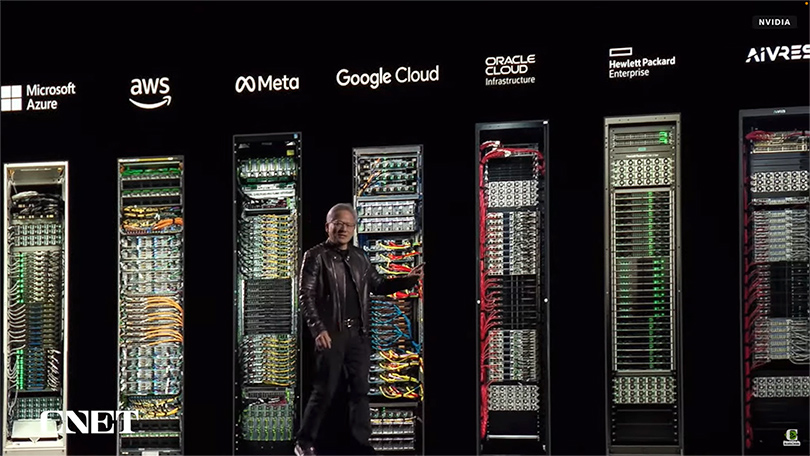


Nvidia CEO Jensen Huang says we’ll soon see 1 million GPU data centers visible from space — from finance.yahoo.com by Daniel Howley
Nvidia CEO Jensen Huang says the company is preparing for 1 million GPU data centers.


Nvidia stock stems losses as GTC leaves Wall Street analysts ‘comfortable with long term AI demand’ — from finance.yahoo.com by Laura Bratton
Nvidia stock reversed direction after a two-day slide that saw shares lose 5% as the AI chipmaker’s annual GTC event failed to excite investors amid a broader market downturn.


Microsoft, Google, and Oracle Deepen Nvidia Partnerships. This Stock Got the Biggest GTC Boost. — from barrons.com by Adam Clark and Elsa Ohlen


The 4 Big Surprises from Nvidia’s ‘Super Bowl of AI’ GTC Keynote — from barrons.com by Tae Kim; behind a paywall

AI Super Bowl. Hi everyone. This week, 20,000 engineers, scientists, industry executives, and yours truly descended upon San Jose, Calif. for Nvidia’s annual GTC developers’ conference, which has been dubbed the “Super Bowl of AI.”


20 AI Agent Examples in 2025 — from autogpt.net

AI Agents are now deeply embedded in everyday life and?quickly transforming industry after industry. The global AI market is expected to explode up to $1.59 trillion by 2030! That is a?ton of intelligent agents operating behind the curtains.

That’s why in this article, we explore?20 real-life AI Agents that are causing a stir today.


Top 100 Gen AI apps, new AI video & 3D — from eatherbcooper.substack.com by Heather Cooper
Plus Runway Restyle, Luma Ray2 img2vid keyframes & extend

?In the latest edition of Andreessen Horowitz’s “Top 100 Gen AI Consumer Apps,” the generative AI landscape has undergone significant shifts.

Notably, DeepSeek has emerged as a leading competitor to ChatGPT, while AI video models have advanced from experimental stages to more reliable tools for short clips. Additionally, the rise of “vibecoding” is broadening the scope of AI creators.

The report also introduces the “Brink List,” highlighting ten companies poised to enter the top 100 rankings.?


AI is Evolving Fast – The Latest LLMs, Video Models & Breakthrough Tools — from heatherbcooper.substack.com by Heather Cooper
Breakthroughs in multimodal search, next-gen coding assistants, and stunning text-to-video tech. Here’s what’s new:

I do these comparisons frequently to measure the improvements in different models for text or image to video prompts. I hope it is helpful for you, as well!

I included 6 models for an image to video comparison:

  • Pika 2.1 (I will do one with Pika’s new 2.2 model soon)
  • Adobe Firefly Video
  • Runway Gen-3
  • Kling 1.6
  • Luma Ray2
  • Hailuo I2V-01


Why Smart Companies Are Granting AI Immunity to Their Employees — from builtin.com by Matt Almassian
Employees are using AI tools whether they’re authorized or not. Instead of cracking down on AI usage, consider developing an AI amnesty program. Learn more.

But the smartest companies aren’t cracking down. They’re flipping the script. Instead of playing AI police, they’re launching AI amnesty programs, offering employees a safe way to disclose their AI usage without fear of punishment. In doing so, they’re turning a security risk into an innovation powerhouse.

Before I dive into solutions, let’s talk about what keeps your CISO or CTO up at night. Shadow AI isn’t just about unauthorized tool usage — it’s a potential dirty bomb of security, compliance and operational risks that could explode at any moment.

6 Steps to an AI Amnesty Program

  1. Build your AI governance foundation.
  2. Transform your IT department from gatekeeper to innovation partner.
  3. Make AI education easily accessible.
  4. Deploy your technical safety net.
  5. Create an AI-positive culture.
  6. Monitor, adapt and evolve.

A first-ever study on prompts… — from theneurondaily.com
PLUS: OpenAI wants to charge $20K a month to replace you?!

What they discovered might change how you interact with AI:

  • Consistency is a major problem. The researchers asked the same questions 100 times and found models often give different answers to the same question.
  • Formatting matters a ton. Telling the AI exactly how to structure its response consistently improved performance.
  • Politeness is… complicated. Saying “please” helped the AI answer some questions but made it worse at others. Same for being commanding (“I order you to…”).
  • Standards matter. If you need an AI to be right 100% of the time, you’re in trouble.

That’s also why we think you, an actual human, should always place yourself as a final check between whatever your AI creates and whatever goes out into the world.


Leave it to Manus
“Manus is a general AI agent that bridges minds and actions: it doesn’t just think, it delivers results. Manus excels at various tasks in work and life, getting everything done while you rest.”

From DSC:
What could possibly go wrong?!


AI Search Has A Citation Problem — from cjr.org (Columbia Journalism Review) by Klaudia Ja?wi?ska and Aisvarya Chandrasekar
We Compared Eight AI Search Engines. They’re All Bad at Citing News.

We found that…

Chatbots were generally bad at declining to answer questions they couldn’t answer accurately, offering incorrect or speculative answers instead.

  • Premium chatbots provided more confidently incorrect answers than their free counterparts.
  • Multiple chatbots seemed to bypass Robot Exclusion Protocol preferences.
  • Generative search tools fabricated links and cited syndicated and copied versions of articles.
  • Content licensing deals with news sources provided no guarantee of accurate citation in chatbot responses.

Our findings were consistent with our previous study, proving that our observations are not just a ChatGPT problem, but rather recur across all the prominent generative search tools that we tested.


5 new AI tools you’ll actually want to try — from wondertools.substack.com by Jeremy Kaplan
Chat with lifelike AI, clean up audio instantly, and reimagine your career

Hundreds of AI tools emerge every week. I’ve picked five new ones worth exploring. They’re free to try, easy to use, and signal new directions for useful AI.

Example:

Career Dreamer
A playful way to explore career possibilities with AI


The $100 billion disruption: How AI is reshaping legal tech — from americanbazaaronline.com by Rohan Hundia and Rajesh Mehta

The Size of the Problem: Judicial Backlog and Inefficiencies
India has a massive backlog of more than 47 million pending cases, with civil litigation itself averaging 1,445 days in resolution. In the United States, federal courts dispose of nearly 400,000 cases a year, and complex litigations take years to complete. Artificial intelligence-driven case law research, contract automation, and predictive analytics will cut legal research times by 90%, contract drafting fees by 60%, and hasten case settlements, potentially saving billions of dollars in legal costs.

This is not just an evolution—it is a permanent change toward data-driven jurisprudence, with AI supplementing human capabilities, speeding up delivery of justice, and extending access to legal services. The AI revolution for legal tech is not on its way; it is already under way, dismantling inefficiencies and transforming the legal world in real time.


Scaling and Improving Legal Tech Projects — from legaltalknetwork.com by Taylor Sartor, Luigi Bai, David Gray, and Cat Moon

Legal tech innovators discuss how they are working to scale and improve their successful projects on Talk Justice. FosterPower and Legal Aid Content Intelligence (LACI) leverage technology to make high-quality legal information available to people for free online. Both also received Technology Initiative Grants (TIG) from the Legal Services Corporation to launch their projects. Then, in 2024 they were both selected for a different TIG, called the Sustainability, Enhancement and Adoption (SEA) grant. This funding supports TIG projects that have demonstrated excellent results as they improve their tools and work to increase uptake.

 
© 2025 | Daniel Christian